







 Chat with AI

Deck 6: Production and Costs
Full screen (f)

Question
Figure 7-H 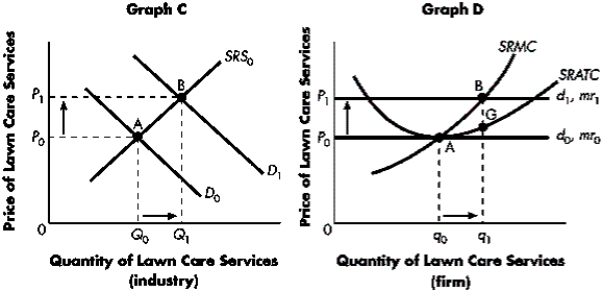
In the long run, all costs are variable.
In the long run, all costs are variable.

Question
Figure 7-H
Economists define the long run as any production time period lasting over one year.
Economists define the long run as any production time period lasting over one year.
Question
Figure 7-H
Ray Tucker has run his company, Tucker's Towing and Wrecking, for two years and has made an accounting profit of $34,000 each year.As long as Tucker's Towing continues to make accounting profits, it is rational to remain in the towing business.
Ray Tucker has run his company, Tucker's Towing and Wrecking, for two years and has made an accounting profit of $34,000 each year.As long as Tucker's Towing continues to make accounting profits, it is rational to remain in the towing business.
Question
Figure 7-H
If the marginal cost is less than average total cost, average total cost will decrease.
If the marginal cost is less than average total cost, average total cost will decrease.
Question
Figure 7-H
An economic profit of zero indicates a satisfactory situation for the firm.
An economic profit of zero indicates a satisfactory situation for the firm.
Question
Figure 7-H
The law of diminishing marginal product provides an explanation for why average total cost eventually increases as output is expanded in the short run.
The law of diminishing marginal product provides an explanation for why average total cost eventually increases as output is expanded in the short run.
Question
Figure 7-H
Total cost equals total variable cost plus marginal cost.
Total cost equals total variable cost plus marginal cost.
Question
Figure 7-H
If a firm experiences economies of scale, the average total cost of production increases as output expands.
If a firm experiences economies of scale, the average total cost of production increases as output expands.
Question
Figure 7-H
The total fixed cost of operating a lumberyard equals $12,000 this year.The average fixed cost of the lumberyard will not be affected by the quantity of lumber that is sold.
The total fixed cost of operating a lumberyard equals $12,000 this year.The average fixed cost of the lumberyard will not be affected by the quantity of lumber that is sold.
Question
Figure 7-H
When marginal cost exceeds the average variable cost, average variable cost must be increasing.
When marginal cost exceeds the average variable cost, average variable cost must be increasing.
Question
Figure 7-H
A Texas oil woman would like to increase the oil produced from her oil fields.Since it takes over a year to drill new wells, she opts instead for increasing labor and other variable inputs to produce more oil from existing wells.She is making a short-run production decision.
A Texas oil woman would like to increase the oil produced from her oil fields.Since it takes over a year to drill new wells, she opts instead for increasing labor and other variable inputs to produce more oil from existing wells.She is making a short-run production decision.
Question
Figure 7-H
In the short run, some costs are fixed.
In the short run, some costs are fixed.
Question
Figure 7-H
When marginal cost is increasing, average total cost must be increasing.
When marginal cost is increasing, average total cost must be increasing.
Question
Figure 7-H
In the long run, firms can vary all inputs in the production process.
In the long run, firms can vary all inputs in the production process.
Question
Figure 7-H
One would expect to observe a diminishing marginal product of labor when crowded office space reduces the productivity of new workers.
One would expect to observe a diminishing marginal product of labor when crowded office space reduces the productivity of new workers.
Question
Question
Question
Figure 7-H
Economic profit always exceeds accounting profit.
Economic profit always exceeds accounting profit.
Question
Figure 7-H
In the short run, all costs are variable.
In the short run, all costs are variable.
Question
Figure 7-H
The period of time that is too short for the firm to change the quantity of certain resources used in production, known as fixed inputs, is called the short run.
The period of time that is too short for the firm to change the quantity of certain resources used in production, known as fixed inputs, is called the short run.
Question
Question
Question
Question
Question
Question
Question
Question
Question
Question
Question
Question
Question
Question
Question
Question
Question
Question
Question
Question
Question
Question
Question
Question
Question
Question
Question
Question
Question
Question
Question
Question
Question
Question
Question
Question
Question
Question
Question
Question
Question
Question
Question
Question
Question
Question
Question
Question
Question
Question
Question
Question
Question
Question
Question
Question
Question
Question
Question
Question

Unlock Deck
Sign up to unlock the cards in this deck!
Unlock Deck
Unlock Deck
1/177

Play

Full screen (f)
Deck 6: Production and Costs
1
Figure 7-H
In the long run, all costs are variable.
In the long run, all costs are variable.
True
2
Figure 7-H
Economists define the long run as any production time period lasting over one year.
Economists define the long run as any production time period lasting over one year.
False
3
Figure 7-H
Ray Tucker has run his company, Tucker's Towing and Wrecking, for two years and has made an accounting profit of $34,000 each year.As long as Tucker's Towing continues to make accounting profits, it is rational to remain in the towing business.
Ray Tucker has run his company, Tucker's Towing and Wrecking, for two years and has made an accounting profit of $34,000 each year.As long as Tucker's Towing continues to make accounting profits, it is rational to remain in the towing business.
False
4
Figure 7-H
If the marginal cost is less than average total cost, average total cost will decrease.
If the marginal cost is less than average total cost, average total cost will decrease.
Unlock Deck
Unlock for access to all 177 flashcards in this deck.
Unlock Deck
k this deck
5
Figure 7-H
An economic profit of zero indicates a satisfactory situation for the firm.
An economic profit of zero indicates a satisfactory situation for the firm.
Unlock Deck
Unlock for access to all 177 flashcards in this deck.
Unlock Deck
k this deck
6
Figure 7-H
The law of diminishing marginal product provides an explanation for why average total cost eventually increases as output is expanded in the short run.
The law of diminishing marginal product provides an explanation for why average total cost eventually increases as output is expanded in the short run.
Unlock Deck
Unlock for access to all 177 flashcards in this deck.
Unlock Deck
k this deck
7
Figure 7-H
Total cost equals total variable cost plus marginal cost.
Total cost equals total variable cost plus marginal cost.
Unlock Deck
Unlock for access to all 177 flashcards in this deck.
Unlock Deck
k this deck
8
Figure 7-H
If a firm experiences economies of scale, the average total cost of production increases as output expands.
If a firm experiences economies of scale, the average total cost of production increases as output expands.
Unlock Deck
Unlock for access to all 177 flashcards in this deck.
Unlock Deck
k this deck
9
Figure 7-H
The total fixed cost of operating a lumberyard equals $12,000 this year.The average fixed cost of the lumberyard will not be affected by the quantity of lumber that is sold.
The total fixed cost of operating a lumberyard equals $12,000 this year.The average fixed cost of the lumberyard will not be affected by the quantity of lumber that is sold.
Unlock Deck
Unlock for access to all 177 flashcards in this deck.
Unlock Deck
k this deck
10
Figure 7-H
When marginal cost exceeds the average variable cost, average variable cost must be increasing.
When marginal cost exceeds the average variable cost, average variable cost must be increasing.
Unlock Deck
Unlock for access to all 177 flashcards in this deck.
Unlock Deck
k this deck
11
Figure 7-H
A Texas oil woman would like to increase the oil produced from her oil fields.Since it takes over a year to drill new wells, she opts instead for increasing labor and other variable inputs to produce more oil from existing wells.She is making a short-run production decision.
A Texas oil woman would like to increase the oil produced from her oil fields.Since it takes over a year to drill new wells, she opts instead for increasing labor and other variable inputs to produce more oil from existing wells.She is making a short-run production decision.
Unlock Deck
Unlock for access to all 177 flashcards in this deck.
Unlock Deck
k this deck
12
Figure 7-H
In the short run, some costs are fixed.
In the short run, some costs are fixed.
Unlock Deck
Unlock for access to all 177 flashcards in this deck.
Unlock Deck
k this deck
13
Figure 7-H
When marginal cost is increasing, average total cost must be increasing.
When marginal cost is increasing, average total cost must be increasing.
Unlock Deck
Unlock for access to all 177 flashcards in this deck.
Unlock Deck
k this deck
14
Figure 7-H
In the long run, firms can vary all inputs in the production process.
In the long run, firms can vary all inputs in the production process.
Unlock Deck
Unlock for access to all 177 flashcards in this deck.
Unlock Deck
k this deck
15
Figure 7-H
One would expect to observe a diminishing marginal product of labor when crowded office space reduces the productivity of new workers.
One would expect to observe a diminishing marginal product of labor when crowded office space reduces the productivity of new workers.
Unlock Deck
Unlock for access to all 177 flashcards in this deck.
Unlock Deck
k this deck
16
The long-run average total cost curve is less u-shaped than the short-run average total cost curve.
Unlock Deck
Unlock for access to all 177 flashcards in this deck.
Unlock Deck
k this deck
17
In the long-run the firm gets to choose which short-run curve it wants to use.
Unlock Deck
Unlock for access to all 177 flashcards in this deck.
Unlock Deck
k this deck
18
Figure 7-H
Economic profit always exceeds accounting profit.
Economic profit always exceeds accounting profit.
Unlock Deck
Unlock for access to all 177 flashcards in this deck.
Unlock Deck
k this deck
19
Figure 7-H
In the short run, all costs are variable.
In the short run, all costs are variable.
Unlock Deck
Unlock for access to all 177 flashcards in this deck.
Unlock Deck
k this deck
20
Figure 7-H
The period of time that is too short for the firm to change the quantity of certain resources used in production, known as fixed inputs, is called the short run.
The period of time that is too short for the firm to change the quantity of certain resources used in production, known as fixed inputs, is called the short run.
Unlock Deck
Unlock for access to all 177 flashcards in this deck.
Unlock Deck
k this deck
21
If opportunity costs are ignored:
A)all firms will show accounting profits.
B)all firms will appear to incur economic losses.
C)firms will still make profit-maximizing production decisions.
D)firms experiencing economic losses may appear to be profitable.
A)all firms will show accounting profits.
B)all firms will appear to incur economic losses.
C)firms will still make profit-maximizing production decisions.
D)firms experiencing economic losses may appear to be profitable.
Unlock Deck
Unlock for access to all 177 flashcards in this deck.
Unlock Deck
k this deck
22
Diseconomies of scale are present when the long run average total cost of production declines as output expands.
Unlock Deck
Unlock for access to all 177 flashcards in this deck.
Unlock Deck
k this deck
23
Which of the following is an implicit cost to Mondo Manufacturing, Inc.?
A)Payments of wages to its office workers.
B)Property taxes.
C)Depreciation charges on company owned automobiles and trucks.
D)Rent paid for the use of equipment.
E)None of the above.
A)Payments of wages to its office workers.
B)Property taxes.
C)Depreciation charges on company owned automobiles and trucks.
D)Rent paid for the use of equipment.
E)None of the above.
Unlock Deck
Unlock for access to all 177 flashcards in this deck.
Unlock Deck
k this deck
24
An example of an implicit cost of production is:
A)the cost of raw materials used to produce bread in a bakery.
B)the cost of labor in a factory that assembles DVD players.
C)the income an entrepreneur could have earned working for someone else.
D)all of the above.
A)the cost of raw materials used to produce bread in a bakery.
B)the cost of labor in a factory that assembles DVD players.
C)the income an entrepreneur could have earned working for someone else.
D)all of the above.
Unlock Deck
Unlock for access to all 177 flashcards in this deck.
Unlock Deck
k this deck
25
What do foregone interest on money invested in a firm, wages paid to production workers, interest paid on bank loans, and the purchase of parts for assembly have in common?
A)All are explicit costs.
B)All are implicit costs.
C)All are opportunity costs.
D)None are opportunity costs.
A)All are explicit costs.
B)All are implicit costs.
C)All are opportunity costs.
D)None are opportunity costs.
Unlock Deck
Unlock for access to all 177 flashcards in this deck.
Unlock Deck
k this deck
26
In the long-run, the firm can only expand output by adding more variable inputs (workers and raw materials).
Unlock Deck
Unlock for access to all 177 flashcards in this deck.
Unlock Deck
k this deck
27
An important and often ignored opportunity cost is the:
A)cost of accounting services.
B)cost of missed market opportunities when funds are invested in a firm.
C)cost of interest paid to bondholders by the firm.
D)cost of utilities used by the firm.
A)cost of accounting services.
B)cost of missed market opportunities when funds are invested in a firm.
C)cost of interest paid to bondholders by the firm.
D)cost of utilities used by the firm.
Unlock Deck
Unlock for access to all 177 flashcards in this deck.
Unlock Deck
k this deck
28
Economists normally assume that the goal of a firm is to:
A)sell as many units of output as possible.
B)maximize profits.
C)sell products at the highest prices possible.
D)maximize sales revenue.
A)sell as many units of output as possible.
B)maximize profits.
C)sell products at the highest prices possible.
D)maximize sales revenue.
Unlock Deck
Unlock for access to all 177 flashcards in this deck.
Unlock Deck
k this deck
29
Which of the following is not an explicit cost for the owner of a local pizza parlor?
A)flour
B)cleaning products
C)other uses for the land that the parlor sits on
D)pizza ovens
E)food preparers
A)flour
B)cleaning products
C)other uses for the land that the parlor sits on
D)pizza ovens
E)food preparers
Unlock Deck
Unlock for access to all 177 flashcards in this deck.
Unlock Deck
k this deck
30
Accounting profits are calculated based upon:
A)explicit cash receipts and implicit expenditures of cash.
B)actual cash receipts and actual expenditures of cash.
C)implicit cash receipts and actual expenditures of cash.
D)opportunity costs plus explicit costs.
A)explicit cash receipts and implicit expenditures of cash.
B)actual cash receipts and actual expenditures of cash.
C)implicit cash receipts and actual expenditures of cash.
D)opportunity costs plus explicit costs.
Unlock Deck
Unlock for access to all 177 flashcards in this deck.
Unlock Deck
k this deck
31
An example of an explicit cost of production is:
A)the cost of foregone labor earnings for an entrepreneur.
B)the cost of flour for a baker.
C)the foregone rent that could have been earned if land owned by a firm was not used as its parking lot.
D)provided by none of the above.
A)the cost of foregone labor earnings for an entrepreneur.
B)the cost of flour for a baker.
C)the foregone rent that could have been earned if land owned by a firm was not used as its parking lot.
D)provided by none of the above.
Unlock Deck
Unlock for access to all 177 flashcards in this deck.
Unlock Deck
k this deck
32
There are two types of costs associated with production: ____ costs that require monetary payments, and ____ costs that do not.
A)implicit; accounting
B)accounting; explicit
C)implicit; explicit
D)explicit; implicit
E)accounting; economic
A)implicit; accounting
B)accounting; explicit
C)implicit; explicit
D)explicit; implicit
E)accounting; economic
Unlock Deck
Unlock for access to all 177 flashcards in this deck.
Unlock Deck
k this deck
33
Assume Brad worked as a contractor for a year and had revenues of $120,000 and explicit cost of $70,000.If he could have been paid $80,000 working for a computer company, his accounting profit as a contractor was ____ and his economic profit was ____.
A)$50,000; -$10,000
B)$10,000; $50,000
C)$40,000; $50,000
D)$50,000; $40,000
A)$50,000; -$10,000
B)$10,000; $50,000
C)$40,000; $50,000
D)$50,000; $40,000
Unlock Deck
Unlock for access to all 177 flashcards in this deck.
Unlock Deck
k this deck
34
Cassie produces and sells 400 jars of homemade jelly each month for $3 each.Each month, she pays $200 for jars, $150 for ingredients, and uses her own time, with an opportunity cost of $300.Her economic profits each month are:
A)$550.
B)$700.
C)$850.
D)$900.
E)minus $1200.
A)$550.
B)$700.
C)$850.
D)$900.
E)minus $1200.
Unlock Deck
Unlock for access to all 177 flashcards in this deck.
Unlock Deck
k this deck
35
A firm has $300 million in revenues and explicit costs of $100 million.If its owners have invested $150 million in the company at an opportunity cost of 10 percent a year, the firm's accounting profit is:
A)$50 million.
B)$150 million.
C)$185 million.
D)$200 million.
E)$215 million.
A)$50 million.
B)$150 million.
C)$185 million.
D)$200 million.
E)$215 million.
Unlock Deck
Unlock for access to all 177 flashcards in this deck.
Unlock Deck
k this deck
36
Diseconomies of scale are most likely at very low levels of output.
Unlock Deck
Unlock for access to all 177 flashcards in this deck.
Unlock Deck
k this deck
37
An understanding of opportunity costs is important to understanding:
A)how to calculate the total revenue generated by a firm.
B)how to assess the economic profitability of a firm.
C)the tax liability of a firm.
D)how accountants calculate accounting profits.
A)how to calculate the total revenue generated by a firm.
B)how to assess the economic profitability of a firm.
C)the tax liability of a firm.
D)how accountants calculate accounting profits.
Unlock Deck
Unlock for access to all 177 flashcards in this deck.
Unlock Deck
k this deck
38
A firm which owns its own equipment and is earning positive economic profits
A)is likely earning positive accounting profits.
B)is likely earning zero accounting profits.
C)is likely earning negative accounting profits.
D)could be earning positive or negative accounting profits.
A)is likely earning positive accounting profits.
B)is likely earning zero accounting profits.
C)is likely earning negative accounting profits.
D)could be earning positive or negative accounting profits.
Unlock Deck
Unlock for access to all 177 flashcards in this deck.
Unlock Deck
k this deck
39
Assume Brad worked as a contractor for a year and had revenues of $120,000 and explicit cost of $70,000.If he could have been paid $80,000 working for a computer company, his:
A)accounting profit equaled $10,000 and he would be rational to stop working as a contractor.
B)accounting profit equaled $50,000 and he would be rational to continue working as a contractor.
C)economic profit equaled $50,000 and he would be rational to continue working as a contractor.
D)economic profit equaled -$10,000 and he would be rational to stop working as a contractor.
A)accounting profit equaled $10,000 and he would be rational to stop working as a contractor.
B)accounting profit equaled $50,000 and he would be rational to continue working as a contractor.
C)economic profit equaled $50,000 and he would be rational to continue working as a contractor.
D)economic profit equaled -$10,000 and he would be rational to stop working as a contractor.
Unlock Deck
Unlock for access to all 177 flashcards in this deck.
Unlock Deck
k this deck
40
An example of an implicit cost of production is:
A)the cost of leather used in manufacturing furniture.
B)the opportunity cost of space in your home that is used for a home office.
C)the wages paid to high school students that work in a fast-food restaurant.
D)none of the above.
A)the cost of leather used in manufacturing furniture.
B)the opportunity cost of space in your home that is used for a home office.
C)the wages paid to high school students that work in a fast-food restaurant.
D)none of the above.
Unlock Deck
Unlock for access to all 177 flashcards in this deck.
Unlock Deck
k this deck
41
The short run is not the same length of time for all firms and industries because:
A)entrepreneurs have different tastes and preferences.
B)the average product of labor varies across industries.
C)the life span of capital and the extent of capital specialization will vary across firms and industries.
D)The marginal product of capital begins to diminish at different levels of capital utilization across firms.
A)entrepreneurs have different tastes and preferences.
B)the average product of labor varies across industries.
C)the life span of capital and the extent of capital specialization will vary across firms and industries.
D)The marginal product of capital begins to diminish at different levels of capital utilization across firms.
Unlock Deck
Unlock for access to all 177 flashcards in this deck.
Unlock Deck
k this deck
42
Which of the following observations is true?
A)Sunk costs are irrelevant for any future action.
B)Sunk costs should not be ignored when making decisions.
C)Sunk costs are often hidden.
D)Sunk costs can be recovered using corrective measures.
A)Sunk costs are irrelevant for any future action.
B)Sunk costs should not be ignored when making decisions.
C)Sunk costs are often hidden.
D)Sunk costs can be recovered using corrective measures.
Unlock Deck
Unlock for access to all 177 flashcards in this deck.
Unlock Deck
k this deck
43
The long-run production period:
A)is a time when all inputs are variable.
B)varies in length according to how capital goods are specialized.
C)is likely longer for a steel manufacturer than for a retailer who sells watches off a cart at the local mall.
D)is characterized by all of the above.
A)is a time when all inputs are variable.
B)varies in length according to how capital goods are specialized.
C)is likely longer for a steel manufacturer than for a retailer who sells watches off a cart at the local mall.
D)is characterized by all of the above.
Unlock Deck
Unlock for access to all 177 flashcards in this deck.
Unlock Deck
k this deck
44
An economic profit of zero implies:
A)normal profit.
B)the firm is covering both explicit and implicit costs.
C)the firm's revenues are sufficient to compensate the money and time that the owners put into the business.
D)all of the above
E)none of the above
A)normal profit.
B)the firm is covering both explicit and implicit costs.
C)the firm's revenues are sufficient to compensate the money and time that the owners put into the business.
D)all of the above
E)none of the above
Unlock Deck
Unlock for access to all 177 flashcards in this deck.
Unlock Deck
k this deck
45
When a firm makes zero economic profit, it means that:
A)the firm is covering implicit costs alone.
B)the firm is covering the total opportunity costs of its resources.
C)the firm is covering explicit costs alone.
D)the firm is running at a loss.
E)the firm is also making a zero accounting profit.
A)the firm is covering implicit costs alone.
B)the firm is covering the total opportunity costs of its resources.
C)the firm is covering explicit costs alone.
D)the firm is running at a loss.
E)the firm is also making a zero accounting profit.
Unlock Deck
Unlock for access to all 177 flashcards in this deck.
Unlock Deck
k this deck
46
Economic profits are:
A)less than accounting profits if implicit costs are greater than zero.
B)less than accounting profits even if implicit costs are zero.
C)greater than accounting profits if implicit costs are greater than zero.
D)greater than accounting profits even if implicit costs are zero.
A)less than accounting profits if implicit costs are greater than zero.
B)less than accounting profits even if implicit costs are zero.
C)greater than accounting profits if implicit costs are greater than zero.
D)greater than accounting profits even if implicit costs are zero.
Unlock Deck
Unlock for access to all 177 flashcards in this deck.
Unlock Deck
k this deck
47
The long run:
A)is a period long enough for every input except plant size to be varied.
B)is a period in which there are no fixed costs.
C)is typically a period of two years.
D)is all of the above.
A)is a period long enough for every input except plant size to be varied.
B)is a period in which there are no fixed costs.
C)is typically a period of two years.
D)is all of the above.
Unlock Deck
Unlock for access to all 177 flashcards in this deck.
Unlock Deck
k this deck
48
Economic profits will exist:
A)whenever total revenues exceed accounting costs.
B)whenever a firm is being operated efficiently.
C)whenever a firm is a monopolist.
D)as a result of firms exiting an industry.
E)Economic profits are not sure to exist in any of the above cases.
A)whenever total revenues exceed accounting costs.
B)whenever a firm is being operated efficiently.
C)whenever a firm is a monopolist.
D)as a result of firms exiting an industry.
E)Economic profits are not sure to exist in any of the above cases.
Unlock Deck
Unlock for access to all 177 flashcards in this deck.
Unlock Deck
k this deck
49
The short run is that period in which firms:
A)are free to vary all inputs.
B)are able to vary some, but not all, inputs.
C)can vary inputs, but only by varying all inputs in equal proportion.
D)cannot increase production at all.
A)are free to vary all inputs.
B)are able to vary some, but not all, inputs.
C)can vary inputs, but only by varying all inputs in equal proportion.
D)cannot increase production at all.
Unlock Deck
Unlock for access to all 177 flashcards in this deck.
Unlock Deck
k this deck
50
If Rocco's Rib Joint took in $35,000 in revenue last week and had out-of-pocket expenses of $31,500:
A)it is clear that Rocco made an economic profit of $3,500.
B)Rocco really didn't make any economic profit since he needs to put the difference between revenue and out-of-pocket expenses back into the firm.
C)it is not clear whether Rocco earned any economic profit last week because it depends on the magnitude of the implicit costs.
D)Rocco clearly did not earn an economic profit.
A)it is clear that Rocco made an economic profit of $3,500.
B)Rocco really didn't make any economic profit since he needs to put the difference between revenue and out-of-pocket expenses back into the firm.
C)it is not clear whether Rocco earned any economic profit last week because it depends on the magnitude of the implicit costs.
D)Rocco clearly did not earn an economic profit.
Unlock Deck
Unlock for access to all 177 flashcards in this deck.
Unlock Deck
k this deck
51
The production function describes:
A)the relationship between the quantity of inputs utilized and the quantity of output produced.
B)how inputs are most profitably used in production.
C)the most cost-effective method of combining various inputs in the production process.
D)the relationship between a firm's revenue and its level of production.
A)the relationship between the quantity of inputs utilized and the quantity of output produced.
B)how inputs are most profitably used in production.
C)the most cost-effective method of combining various inputs in the production process.
D)the relationship between a firm's revenue and its level of production.
Unlock Deck
Unlock for access to all 177 flashcards in this deck.
Unlock Deck
k this deck
52
A firm has $350 million in revenues and explicit costs of $150 million.If its owners have invested $150 million in the company at an opportunity cost of 10 percent a year, the firm's economic profit is:
A)$50 million.
B)$150 million.
C)$185 million.
D)$200 million.
E)$215 million.
A)$50 million.
B)$150 million.
C)$185 million.
D)$200 million.
E)$215 million.
Unlock Deck
Unlock for access to all 177 flashcards in this deck.
Unlock Deck
k this deck
53
Scarlett recently began running her husband's lumber mill.Last month she took in $5,000 in sales revenue and paid $3,400 in out-of-pocket costs.Did the lumberyard make an economic profit last month?
A)Definitely not.
B)Yes. After considering non-zero explicit and implicit costs, it is clear that her profit is exactly equal to $1,600.
C)Without knowing the magnitude of implicit costs, it is not possible to state whether the lumberyard earned an economic profit last month.
D)Yes, after factoring implicit costs, it is clear that her profit will exceed $1,600.
A)Definitely not.
B)Yes. After considering non-zero explicit and implicit costs, it is clear that her profit is exactly equal to $1,600.
C)Without knowing the magnitude of implicit costs, it is not possible to state whether the lumberyard earned an economic profit last month.
D)Yes, after factoring implicit costs, it is clear that her profit will exceed $1,600.
Unlock Deck
Unlock for access to all 177 flashcards in this deck.
Unlock Deck
k this deck
54
A production function:
A)shows the relationship between a firm's costs and revenues.
B)shows the relationship between production and profits.
C)shows the relationship between inputs and the maximum output that can be produced from those inputs.
D)shows the relationship between variable inputs and fixed inputs.
E)shows the relationship between a worker's human capital and her average productivity.
A)shows the relationship between a firm's costs and revenues.
B)shows the relationship between production and profits.
C)shows the relationship between inputs and the maximum output that can be produced from those inputs.
D)shows the relationship between variable inputs and fixed inputs.
E)shows the relationship between a worker's human capital and her average productivity.
Unlock Deck
Unlock for access to all 177 flashcards in this deck.
Unlock Deck
k this deck
55
Which of the following factors of production is not variable in the long run?
A)the size of the firm's plant
B)land
C)highly skilled labor
D)All factors are variable in the long run.
A)the size of the firm's plant
B)land
C)highly skilled labor
D)All factors are variable in the long run.
Unlock Deck
Unlock for access to all 177 flashcards in this deck.
Unlock Deck
k this deck
56
During the short-run period of the production process, a firm is:
A)unable to vary any of its factors of production.
B)able to vary only some of its factors of production.
C)able to vary all of its factors of production.
D)able to vary the size of its plant.
E)unlikely to experience diminishing marginal productivity.
A)unable to vary any of its factors of production.
B)able to vary only some of its factors of production.
C)able to vary all of its factors of production.
D)able to vary the size of its plant.
E)unlikely to experience diminishing marginal productivity.
Unlock Deck
Unlock for access to all 177 flashcards in this deck.
Unlock Deck
k this deck
57
An economist's measurement of profit differs from an accountant's in that:
A)accountants calculate total revenue differently than do economists.
B)economists do not always include all of the opportunity costs when calculating total production costs.
C)accountants do not always include all of the opportunity costs when calculating total production costs.
D)economic profit generally exceeds accounting profit.
A)accountants calculate total revenue differently than do economists.
B)economists do not always include all of the opportunity costs when calculating total production costs.
C)accountants do not always include all of the opportunity costs when calculating total production costs.
D)economic profit generally exceeds accounting profit.
Unlock Deck
Unlock for access to all 177 flashcards in this deck.
Unlock Deck
k this deck
58
Which of the following would be considered a variable input in the long run?
A)The size of a firm's plant.
B)The acreage of an apple farmer's orchard.
C)The production capacity of a machine.
D)All of the above.
E)None of the above.
A)The size of a firm's plant.
B)The acreage of an apple farmer's orchard.
C)The production capacity of a machine.
D)All of the above.
E)None of the above.
Unlock Deck
Unlock for access to all 177 flashcards in this deck.
Unlock Deck
k this deck
59
Economic profits will take into account:
A)explicit costs but not implicit costs.
B)implicit costs but not explicit costs.
C)both implicit and explicit costs.
D)neither explicit nor implicit costs.
A)explicit costs but not implicit costs.
B)implicit costs but not explicit costs.
C)both implicit and explicit costs.
D)neither explicit nor implicit costs.
Unlock Deck
Unlock for access to all 177 flashcards in this deck.
Unlock Deck
k this deck
60
Which of the following would be considered a variable input in the short run?
A)The size of a firm's plant.
B)The acreage of an apple farmer's orchard.
C)The production capacity of a machine.
D)All of the above.
E)None of the above.
A)The size of a firm's plant.
B)The acreage of an apple farmer's orchard.
C)The production capacity of a machine.
D)All of the above.
E)None of the above.
Unlock Deck
Unlock for access to all 177 flashcards in this deck.
Unlock Deck
k this deck
61
Diminishing marginal product of labor occurs when:
A)adding another unit of labor increases output, but not by as large a margin as the last unit of labor employed.
B)the average product of labor begins to rise.
C)adding another unit of labor increases output by a larger margin than the last unit of labor employed.
D)all inputs are varied simultaneously in the same proportion.
A)adding another unit of labor increases output, but not by as large a margin as the last unit of labor employed.
B)the average product of labor begins to rise.
C)adding another unit of labor increases output by a larger margin than the last unit of labor employed.
D)all inputs are varied simultaneously in the same proportion.
Unlock Deck
Unlock for access to all 177 flashcards in this deck.
Unlock Deck
k this deck
62
Which of the following is a reason that marginal product will eventually begin to fall?
A)economies of scale
B)effective use of fixed inputs
C)decrease in demand
D)specialization
E)limited amounts of fixed inputs
A)economies of scale
B)effective use of fixed inputs
C)decrease in demand
D)specialization
E)limited amounts of fixed inputs
Unlock Deck
Unlock for access to all 177 flashcards in this deck.
Unlock Deck
k this deck
63
The sum of AVC and AFC equals:
A)total variable cost.
B)economic profit.
C)accounting profit.
D)average total cost.
E)marginal cost.
A)total variable cost.
B)economic profit.
C)accounting profit.
D)average total cost.
E)marginal cost.
Unlock Deck
Unlock for access to all 177 flashcards in this deck.
Unlock Deck
k this deck
64
Which of the following is most likely to be a fixed cost for a business?
A)payment for raw materials used in manufacturing goods
B)interest payments on a loan used to finance the construction of a building
C)shipping charges for the delivery of products
D)wages paid to temporary workers
A)payment for raw materials used in manufacturing goods
B)interest payments on a loan used to finance the construction of a building
C)shipping charges for the delivery of products
D)wages paid to temporary workers
Unlock Deck
Unlock for access to all 177 flashcards in this deck.
Unlock Deck
k this deck
65
In the table below, diminishing marginal product is first evident with the addition of the ____ worker.
A)5
B)6
C)7
D)8
A)5
B)6
C)7
D)8
Unlock Deck
Unlock for access to all 177 flashcards in this deck.
Unlock Deck
k this deck
66
Whenever the marginal product of a firm's only variable input was positive, but falling:
A)its total product is growing at a decreasing rate.
B)it will use more of the variable input until its marginal product is negative.
C)it would reduce its use of the variable input.
D)its total product is beyond its maximum.
E)all of the above would be true.
A)its total product is growing at a decreasing rate.
B)it will use more of the variable input until its marginal product is negative.
C)it would reduce its use of the variable input.
D)its total product is beyond its maximum.
E)all of the above would be true.
Unlock Deck
Unlock for access to all 177 flashcards in this deck.
Unlock Deck
k this deck
67
If AVC is subtracted from the ATC, the result is:
A)economic profit.
B)accounting profit.
C)average fixed cost.
D)marginal cost.
E)none of the above.
A)economic profit.
B)accounting profit.
C)average fixed cost.
D)marginal cost.
E)none of the above.
Unlock Deck
Unlock for access to all 177 flashcards in this deck.
Unlock Deck
k this deck
68
The marginal cost of a good is:
A)the difference between average total cost and average variable cost.
B)the addition to total cost from producing one more unit of output.
C)decreasing whenever average total cost is decreasing.
D)always equal to average variable cost when the firm is maximizing profit.
A)the difference between average total cost and average variable cost.
B)the addition to total cost from producing one more unit of output.
C)decreasing whenever average total cost is decreasing.
D)always equal to average variable cost when the firm is maximizing profit.
Unlock Deck
Unlock for access to all 177 flashcards in this deck.
Unlock Deck
k this deck
69
Which of the following is consistent with diminishing marginal product?
A)The more you study each day, the more you learn from each added hour of study.
B)The more you study each day, the less you know.
C)Beyond some point, each added hour studying each day adds less to what you know than the previous hour's study.
D)None of the above.
A)The more you study each day, the more you learn from each added hour of study.
B)The more you study each day, the less you know.
C)Beyond some point, each added hour studying each day adds less to what you know than the previous hour's study.
D)None of the above.
Unlock Deck
Unlock for access to all 177 flashcards in this deck.
Unlock Deck
k this deck
70
Characteristics of the short run include:
A)at least one fixed input.
B)insufficient time for firms to enter or leave the industry in question.
C)the applicability of the law of diminishing returns.
D)all of the above.
A)at least one fixed input.
B)insufficient time for firms to enter or leave the industry in question.
C)the applicability of the law of diminishing returns.
D)all of the above.
Unlock Deck
Unlock for access to all 177 flashcards in this deck.
Unlock Deck
k this deck
71
Don Keene promotes boxing matches.He makes $6,500 per fight.Which cost is most relevant to a decision as to whether to promote one more fight?
A)the total cost of promoting all boxing matches during the year
B)the marginal cost of promoting one additional boxing match
C)the average fixed cost of promoting a boxing match
D)the average total cost of promoting a boxing match
E)the sunk cost of promoting previous boxing matches
A)the total cost of promoting all boxing matches during the year
B)the marginal cost of promoting one additional boxing match
C)the average fixed cost of promoting a boxing match
D)the average total cost of promoting a boxing match
E)the sunk cost of promoting previous boxing matches
Unlock Deck
Unlock for access to all 177 flashcards in this deck.
Unlock Deck
k this deck
72
Over the range of diminishing marginal product, if the variable input to a firm is increased:
A)output will increase more than in proportion to the increase in the input.
B)output will increase less than in proportion to the increase in the input.
C)output will increase exactly in proportion to the increase in the input.
D)output will increase more than in proportion to the increase in the inputs at first, but it will eventually increase less than in proportion to the increase in the input.
E)According to the principle of diminishing marginal product nothing will happen to output when only the variable input is increased.
A)output will increase more than in proportion to the increase in the input.
B)output will increase less than in proportion to the increase in the input.
C)output will increase exactly in proportion to the increase in the input.
D)output will increase more than in proportion to the increase in the inputs at first, but it will eventually increase less than in proportion to the increase in the input.
E)According to the principle of diminishing marginal product nothing will happen to output when only the variable input is increased.
Unlock Deck
Unlock for access to all 177 flashcards in this deck.
Unlock Deck
k this deck
73
Which of the following is a short run adjustment?
A)A bakery hiring two additional bakers.
B)Two new firms enter the textile industry.
C)Three firms leave the bicycle industry.
D)A computer hardware company builds a new factory.
E)None of the above.
A)A bakery hiring two additional bakers.
B)Two new firms enter the textile industry.
C)Three firms leave the bicycle industry.
D)A computer hardware company builds a new factory.
E)None of the above.
Unlock Deck
Unlock for access to all 177 flashcards in this deck.
Unlock Deck
k this deck
74
The marginal product of labor can be defined as:
A)the change in profit divided by the change in labor, other factors of production held constant.
B)the change in total output divided by the change in labor, other factors of production held constant.
C)the total output divided by the total labor utilized.
D)the change in labor utilized divided by the change in total output, other factors of production held constant.
E)the change in labor divided by the change in the total cost, other factors of production held constant.
A)the change in profit divided by the change in labor, other factors of production held constant.
B)the change in total output divided by the change in labor, other factors of production held constant.
C)the total output divided by the total labor utilized.
D)the change in labor utilized divided by the change in total output, other factors of production held constant.
E)the change in labor divided by the change in the total cost, other factors of production held constant.
Unlock Deck
Unlock for access to all 177 flashcards in this deck.
Unlock Deck
k this deck
75
The range in which there is diminishing marginal productivity starts at the point where:
A)marginal product reaches its maximum.
B)average product reaches its maximum.
C)total product reaches its maximum.
D)marginal product begins to decrease at an increasing rate.
A)marginal product reaches its maximum.
B)average product reaches its maximum.
C)total product reaches its maximum.
D)marginal product begins to decrease at an increasing rate.
Unlock Deck
Unlock for access to all 177 flashcards in this deck.
Unlock Deck
k this deck
76
The marginal product of capital:
A)is equal to the increase in capital necessary to generate a one-unit increase in output.
B)is equal to the increase in output obtained from a one-unit increase in capital, holding other factors constant.
C)is equal to the incremental profit associated with selling one more unit of output.
D)is equal to the incremental cost of employing one more unit of physical or human capital.
E)is always equal to total output divided by the number of units of capital employed.
A)is equal to the increase in capital necessary to generate a one-unit increase in output.
B)is equal to the increase in output obtained from a one-unit increase in capital, holding other factors constant.
C)is equal to the incremental profit associated with selling one more unit of output.
D)is equal to the incremental cost of employing one more unit of physical or human capital.
E)is always equal to total output divided by the number of units of capital employed.
Unlock Deck
Unlock for access to all 177 flashcards in this deck.
Unlock Deck
k this deck
77
The change in total cost resulting from a one-unit increase in production is called:
A)average fixed cost.
B)average variable cost.
C)marginal cost.
D)average opportunity cost.
E)marginal revenue.
A)average fixed cost.
B)average variable cost.
C)marginal cost.
D)average opportunity cost.
E)marginal revenue.
Unlock Deck
Unlock for access to all 177 flashcards in this deck.
Unlock Deck
k this deck
78
According to diminishing marginal product, if all the inputs to a firm are increased in equal proportions,
A)output will increase more than in proportion to the increase in the inputs.
B)output will increase less than in proportion to the increase in the inputs.
C)output will increase exactly in proportion to the increase in the inputs.
D)output will increase more than in proportion to the increase in the inputs at first, but it will eventually increase less than in proportion to the increase in the inputs.
E)The law of diminishing returns says nothing about what will happen to output when all inputs are increased in equal proportions.
A)output will increase more than in proportion to the increase in the inputs.
B)output will increase less than in proportion to the increase in the inputs.
C)output will increase exactly in proportion to the increase in the inputs.
D)output will increase more than in proportion to the increase in the inputs at first, but it will eventually increase less than in proportion to the increase in the inputs.
E)The law of diminishing returns says nothing about what will happen to output when all inputs are increased in equal proportions.
Unlock Deck
Unlock for access to all 177 flashcards in this deck.
Unlock Deck
k this deck
79
Fixed costs are best defined as:
A)costs that do not vary with output.
B)costs that vary with output.
C)the sum of all marginal costs.
D)the change in total cost when one more unit of output is produced.
E)costs that decline as output increases.
A)costs that do not vary with output.
B)costs that vary with output.
C)the sum of all marginal costs.
D)the change in total cost when one more unit of output is produced.
E)costs that decline as output increases.
Unlock Deck
Unlock for access to all 177 flashcards in this deck.
Unlock Deck
k this deck
80
Which of the following is false?
A)The total product schedule shows the total amount of output generated as the level of the fixed input increases.
B)The marginal product of any single input is the change in total product resulting from a small change in the amount of that input used.
C)As the amount of a variable input is increased, the amount of other fixed inputs being held constant, a point ultimately will be reached beyond which marginal product will decline. This is called diminishing marginal product.
D)A firm never knowingly allows itself to reach the point where the marginal product becomes negative.
E)None of the above is false.
A)The total product schedule shows the total amount of output generated as the level of the fixed input increases.
B)The marginal product of any single input is the change in total product resulting from a small change in the amount of that input used.
C)As the amount of a variable input is increased, the amount of other fixed inputs being held constant, a point ultimately will be reached beyond which marginal product will decline. This is called diminishing marginal product.
D)A firm never knowingly allows itself to reach the point where the marginal product becomes negative.
E)None of the above is false.
Unlock Deck
Unlock for access to all 177 flashcards in this deck.
Unlock Deck
k this deck
Unlock Deck
Unlock for access to all 177 flashcards in this deck.






