







 Chat with AI

Deck 25: Departmentalized Profit and Cost Centers
Full screen (f)

Question

Question
Question
Question
Question
Question
Question
Question
Question
Question
Question
Question
Question
Question
Question
Question
Question
Question
Question
Question
Question
Question
Question
Question
Question
Question
Question
Question
Question
Question
Question
Question
Question
Question
Question
Question
Question
Question
Question
Question
Question
Question
Question
Question
Question
Question
Question
Question
Question
Question
Question
Question
Question
Question
Question
Question
Question
Question
Question
Question
Question
Examine the following partial Income Statement for Gemology Products and determine whether or not to close the Jewelry Department. If the Jewelry Department is closed, the Insurance Expense will be reduced by $500 and one office employee part time position will be eliminated. That position pays $6,500 a year. The other expenses will remain. 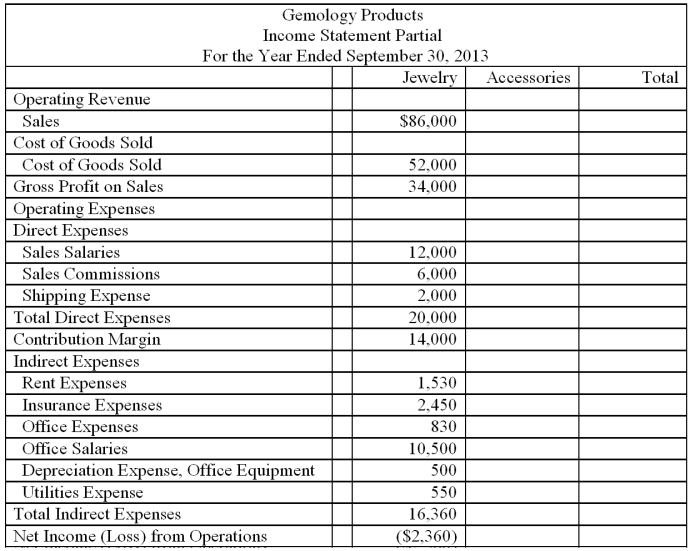
Question
Question
Question
Question
Question
Question
Question
Question
Complete the table of Uncollectible Accounts given below. 
Question
Question
Question
Question
Data related to the income and expenses of Moffet Company for the year ended December 31, 2013, are shown below. Use this information to prepare a departmental income statement showing contribution margin and net income of each department. 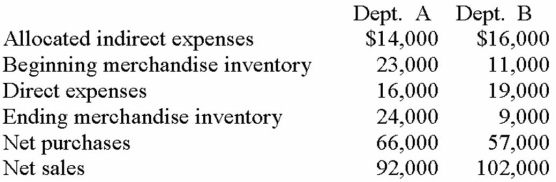
Question
Barista Coffee Shoppe and Store has two departments. The Store sells ground coffees, coffee beans, grinders, coffee makes, cappuccino machines, mugs, aprons, flavored additives, and flavored creamers. The Shoppe sells brewed coffees. Prepare the gross profit section of the Income Statement for Barista Coffee Shoppe and Store as of its yearend on June 30, 2013 using the information given. Include the proper heading. 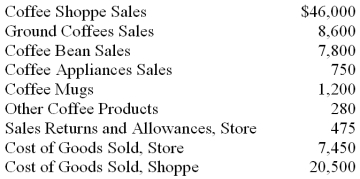
Question
Prepare the Operating Expenses section of the Income Statement for Sanjam Company at yearend, March 31, 2013. The Gross Profit for Sanjam Petit Fours is $36,500 and for Chocolates it is $102,350. (Hint: The first line of your partial Income Statement after the heading should be Operating Expenses, and the final line should be Total Indirect Expenses. Include Contribution Margin in its proper place.) 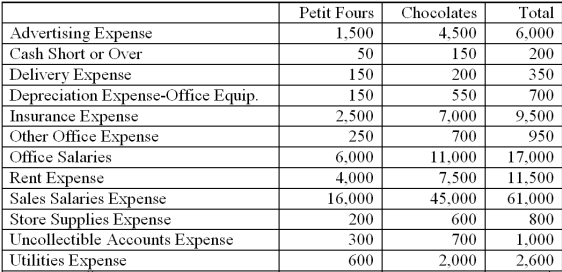
Question
Question
Question
Question
Question

Unlock Deck
Sign up to unlock the cards in this deck!
Unlock Deck
Unlock Deck
1/90

Play

Full screen (f)
Deck 25: Departmentalized Profit and Cost Centers
1
Allocated expenses can be rounded to the nearest whole dollar on departmental income statements.
True
2
The difficulty of fairly allocating direct expenses is one limitation of departmental income statements.
False
3
Nonoperating income, such as interest income, should be allocated on the basis of total sales in each department.
False
4
The purchasing, information systems, and maintenance departments are examples of profit centers of a company.
Unlock Deck
Unlock for access to all 90 flashcards in this deck.
Unlock Deck
k this deck
5
A company may have several cost centers, but it can have only one profit center.
Unlock Deck
Unlock for access to all 90 flashcards in this deck.
Unlock Deck
k this deck
6
Semidirect and indirect expenses are allocated to the sales department at the time the expenses are incurred.
Unlock Deck
Unlock for access to all 90 flashcards in this deck.
Unlock Deck
k this deck
7
Office expenses such as postage and stationery should be allocated on the basis of contribution margin of each department.
Unlock Deck
Unlock for access to all 90 flashcards in this deck.
Unlock Deck
k this deck
8
Contribution margin is another name for gross profit.
Unlock Deck
Unlock for access to all 90 flashcards in this deck.
Unlock Deck
k this deck
9
Traditional financial statements may not contain adequate information for managing a business.
Unlock Deck
Unlock for access to all 90 flashcards in this deck.
Unlock Deck
k this deck
10
A department that has a positive contribution margin is contributing something toward the net income of the business.
Unlock Deck
Unlock for access to all 90 flashcards in this deck.
Unlock Deck
k this deck
11
Cost centers do not directly earn revenue.
Unlock Deck
Unlock for access to all 90 flashcards in this deck.
Unlock Deck
k this deck
12
Management decisions involving the elimination of a department should be based on the contribution margin of the department.
Unlock Deck
Unlock for access to all 90 flashcards in this deck.
Unlock Deck
k this deck
13
When a departmentalized income statement is to be prepared, the sales journal must be departmentalized.
Unlock Deck
Unlock for access to all 90 flashcards in this deck.
Unlock Deck
k this deck
14
The amount of floor space occupied by each department is a common basis for allocating rent expense or utilities expense.
Unlock Deck
Unlock for access to all 90 flashcards in this deck.
Unlock Deck
k this deck
15
Responsibility accounting provides detailed data for each cost center and profit center so that management can determine how efficiently the individual segments are functioning.
Unlock Deck
Unlock for access to all 90 flashcards in this deck.
Unlock Deck
k this deck
16
For accounting purposes, both revenue and cost data are accumulated for a profit center.
Unlock Deck
Unlock for access to all 90 flashcards in this deck.
Unlock Deck
k this deck
17
Some indirect costs may be allocated on the basis of departmental sales in proportion to total sales.
Unlock Deck
Unlock for access to all 90 flashcards in this deck.
Unlock Deck
k this deck
18
Office salaries expense should be allocated on the basis of total sales in each department.
Unlock Deck
Unlock for access to all 90 flashcards in this deck.
Unlock Deck
k this deck
19
When a business is organized into separate departments, it is necessary to provide accounting information about each department.
Unlock Deck
Unlock for access to all 90 flashcards in this deck.
Unlock Deck
k this deck
20
In departmental accounting, any costs and expenses not directly related to a specific department are allocated to all departments.
Unlock Deck
Unlock for access to all 90 flashcards in this deck.
Unlock Deck
k this deck
21
Operating expenses that cannot be easily assigned to particular departments at the time transactions occur and are recorded are called ____________________ expenses.
Unlock Deck
Unlock for access to all 90 flashcards in this deck.
Unlock Deck
k this deck
22
The difference between a department's gross profit on sales and its direct expenses is called ___________________.
Unlock Deck
Unlock for access to all 90 flashcards in this deck.
Unlock Deck
k this deck
23
If an attempt is made to identify and accumulate both revenue and cost data for a specific segment of a company, that segment is called a(n) ____________________ center.
Unlock Deck
Unlock for access to all 90 flashcards in this deck.
Unlock Deck
k this deck
24
Eliminating a department that has a negative contribution margin would result in ____________________ net income for the company than if the department were not eliminated.
Unlock Deck
Unlock for access to all 90 flashcards in this deck.
Unlock Deck
k this deck
25
Department A had total sales of $40,000 and Department B had total sales of $10,000. If office salaries expense is allocated on the basis of total sales, ____________________ percent would be used to determine the allocation for Department
B.
B.
Unlock Deck
Unlock for access to all 90 flashcards in this deck.
Unlock Deck
k this deck
26
Expenses that are closely related to the activities in each department, but cannot be allocated to any specific department are called ____________________ expenses.
Unlock Deck
Unlock for access to all 90 flashcards in this deck.
Unlock Deck
k this deck
27
A department's ____________________ is usually more important than its net income or net loss when management is considering whether to close the department.
Unlock Deck
Unlock for access to all 90 flashcards in this deck.
Unlock Deck
k this deck
28
A systematic and logical way to allocate the rent expense for a building to various sales departments would be on the basis of ___________________.
Unlock Deck
Unlock for access to all 90 flashcards in this deck.
Unlock Deck
k this deck
29
The Copying Department occupied 9,000 square feet of space and the Printing Department occupied 6,000 square feet of space in the same building. If janitorial costs for the building were $12,000, then the amount that the Copying Department would be allocated for janitorial services would be ________________.
Unlock Deck
Unlock for access to all 90 flashcards in this deck.
Unlock Deck
k this deck
30
The area of accounting that provides financial information about individual segments, activities, or products of a business is called ____________________ accounting.
Unlock Deck
Unlock for access to all 90 flashcards in this deck.
Unlock Deck
k this deck
31
Eliminating a department should eliminate all ____________________ expenses of the department.
Unlock Deck
Unlock for access to all 90 flashcards in this deck.
Unlock Deck
k this deck
32
When a company has departmentalized profit and cost centers each of the following is reported separately except for
A) Merchandise inventories.
B) Sales.
C) Purchases.
D) General Office Expense.
A) Merchandise inventories.
B) Sales.
C) Purchases.
D) General Office Expense.
Unlock Deck
Unlock for access to all 90 flashcards in this deck.
Unlock Deck
k this deck
33
Which of the following is NOT a cost center?
A) accounting department
B) purchasing department
C) shoe department
D) research laboratory
A) accounting department
B) purchasing department
C) shoe department
D) research laboratory
Unlock Deck
Unlock for access to all 90 flashcards in this deck.
Unlock Deck
k this deck
34
Departments that provide services to other departments of the firm are often organized as ____________________ centers.
Unlock Deck
Unlock for access to all 90 flashcards in this deck.
Unlock Deck
k this deck
35
In departmental accounting, expenses that can be closely identified with an individual department are referred to as ____________________ expenses.
Unlock Deck
Unlock for access to all 90 flashcards in this deck.
Unlock Deck
k this deck
36
Which of the following enables management to evaluate the performance of each business segment?
A) responsibility accounting
B) transfer pricing
C) profit center costing
D) cost center costing
A) responsibility accounting
B) transfer pricing
C) profit center costing
D) cost center costing
Unlock Deck
Unlock for access to all 90 flashcards in this deck.
Unlock Deck
k this deck
37
Managerial accounting is generally utilized to provide financial information about all of the following except
A) business segments.
B) corporate headquarters.
C) products.
D) activities.
A) business segments.
B) corporate headquarters.
C) products.
D) activities.
Unlock Deck
Unlock for access to all 90 flashcards in this deck.
Unlock Deck
k this deck
38
The basic principle of ____________________ accounting is that management should be able to evaluate the performance of each segment of the business and pinpoint responsibility for its financial results.
Unlock Deck
Unlock for access to all 90 flashcards in this deck.
Unlock Deck
k this deck
39
The price at which goods are moved from one segment of a company to another is the ____________________ price.
Unlock Deck
Unlock for access to all 90 flashcards in this deck.
Unlock Deck
k this deck
40
A logical way to allocate janitorial wages to various departments would be on the basis of ___________________.
Unlock Deck
Unlock for access to all 90 flashcards in this deck.
Unlock Deck
k this deck
41
The telephone expense is allocated on the basis of floor space. Department A occupies 1,875 square feet and Department B occupies 625 square feet. If the telephone expense is $600, the amount allocated to Department A is
A) $150.
B) $300.
C) $450.
D) $288.
A) $150.
B) $300.
C) $450.
D) $288.
Unlock Deck
Unlock for access to all 90 flashcards in this deck.
Unlock Deck
k this deck
42
Department XYZ had sales of $90,000, direct expenses of $60,000 and indirect expenses of $50,000. The indirect expenses allocated to this department would have been incurred whether or not the department existed. If this department had been eliminated, the company's reported net income would have been
A) $20,000 higher.
B) $30,000 higher.
C) $20,000 lower.
D) $30,000 lower.
A) $20,000 higher.
B) $30,000 higher.
C) $20,000 lower.
D) $30,000 lower.
Unlock Deck
Unlock for access to all 90 flashcards in this deck.
Unlock Deck
k this deck
43
Department A had total sales of $84,000 and Department B had total sales of $36,000. Other Office Expenses, totaling $2,500, are allocated on the basis of total sales. The amount allocated to Department B is
A) $750.
B) $1,750.
C) $1,250.
D) $1,071.
A) $750.
B) $1,750.
C) $1,250.
D) $1,071.
Unlock Deck
Unlock for access to all 90 flashcards in this deck.
Unlock Deck
k this deck
44
The procedure for assigning indirect expenses to departments at the end of an accounting period is called
A) valuation.
B) amortization.
C) allocation.
D) distribution.
A) valuation.
B) amortization.
C) allocation.
D) distribution.
Unlock Deck
Unlock for access to all 90 flashcards in this deck.
Unlock Deck
k this deck
45
A department probably would be considered for elimination if it had
A) a positive contribution margin and a net income from operations.
B) a positive contribution margin and a net loss from operations.
C) a negative contribution margin and a net loss from operations.
D) a net loss, regardless of the contribution margin.
A) a positive contribution margin and a net income from operations.
B) a positive contribution margin and a net loss from operations.
C) a negative contribution margin and a net loss from operations.
D) a net loss, regardless of the contribution margin.
Unlock Deck
Unlock for access to all 90 flashcards in this deck.
Unlock Deck
k this deck
46
An example of a direct expense in a department store is
A) interest expense.
B) sales salaries expense.
C) rent expense for the building where the store is located.
D) utilities expense.
A) interest expense.
B) sales salaries expense.
C) rent expense for the building where the store is located.
D) utilities expense.
Unlock Deck
Unlock for access to all 90 flashcards in this deck.
Unlock Deck
k this deck
47
Department A had gross profit on sales of $20,000, contribution margin of $12,000, total direct expenses of $8,000, and total indirect expenses of $7,000. Department A has
A) a net income from operations of $5,000.
B) a net income from operations of $4,000.
C) a net loss from operations of $4,000.
D) a net loss of $7,000.
A) a net income from operations of $5,000.
B) a net income from operations of $4,000.
C) a net loss from operations of $4,000.
D) a net loss of $7,000.
Unlock Deck
Unlock for access to all 90 flashcards in this deck.
Unlock Deck
k this deck
48
The contribution margin of a department is the difference between
A) its net sales and the total expenses.
B) its net sales and its cost of goods sold.
C) its gross profit on sales and its indirect expenses.
D) its gross profit on sales and its direct expenses.
A) its net sales and the total expenses.
B) its net sales and its cost of goods sold.
C) its gross profit on sales and its indirect expenses.
D) its gross profit on sales and its direct expenses.
Unlock Deck
Unlock for access to all 90 flashcards in this deck.
Unlock Deck
k this deck
49
In a store with several sales departments, departmentalized accounts would be used for
A) sales only.
B) sales, purchases, and merchandise inventory.
C) sales and other income items only.
D) all expense accounts.
A) sales only.
B) sales, purchases, and merchandise inventory.
C) sales and other income items only.
D) all expense accounts.
Unlock Deck
Unlock for access to all 90 flashcards in this deck.
Unlock Deck
k this deck
50
Department A had total sales of $84,000 and Department B had total sales of $36,000. Other Office Expenses, totaling $2,500, are allocated on the basis of total sales. The amount allocated to Department A is
A) $750.
B) $1,750.
C) $1,250.
D) $1,071.
A) $750.
B) $1,750.
C) $1,250.
D) $1,071.
Unlock Deck
Unlock for access to all 90 flashcards in this deck.
Unlock Deck
k this deck
51
A transfer price is
A) the price for which a company sells its products to customers.
B) the price at which goods are moved from one department of a company to another department of the company.
C) the basis on which indirect expenses are allocated.
D) the price at which a company purchases its products from a supplier.
A) the price for which a company sells its products to customers.
B) the price at which goods are moved from one department of a company to another department of the company.
C) the basis on which indirect expenses are allocated.
D) the price at which a company purchases its products from a supplier.
Unlock Deck
Unlock for access to all 90 flashcards in this deck.
Unlock Deck
k this deck
52
Expenses that are closely related to a particular department and can easily be assigned to it during an accounting period are called
A) operating expenses.
B) indirect expenses.
C) allocated expenses.
D) direct expenses.
A) operating expenses.
B) indirect expenses.
C) allocated expenses.
D) direct expenses.
Unlock Deck
Unlock for access to all 90 flashcards in this deck.
Unlock Deck
k this deck
53
If a segment of business is considered a profit center
A) it must sell products or services to customers outside the business.
B) both revenue and cost data must be accumulated for the segment.
C) no indirect expenses can be allocated to the segment.
D) only revenue is accumulated for the segment.
A) it must sell products or services to customers outside the business.
B) both revenue and cost data must be accumulated for the segment.
C) no indirect expenses can be allocated to the segment.
D) only revenue is accumulated for the segment.
Unlock Deck
Unlock for access to all 90 flashcards in this deck.
Unlock Deck
k this deck
54
Floor space would be a reasonable basis for the allocation of
A) rent expense for a building.
B) sales revenue.
C) payroll taxes expense.
D) advertising expense.
A) rent expense for a building.
B) sales revenue.
C) payroll taxes expense.
D) advertising expense.
Unlock Deck
Unlock for access to all 90 flashcards in this deck.
Unlock Deck
k this deck
55
How much of the computer system's cost will be allocated to the Tax Division?
A) $96,000.
B) $60,000.
C) $84,000.
D) $80,000.
A) $96,000.
B) $60,000.
C) $84,000.
D) $80,000.
Unlock Deck
Unlock for access to all 90 flashcards in this deck.
Unlock Deck
k this deck
56
Costs that cannot be directly assigned to a department, but are closely related to departmental activities are categorized as
A) semidirect expenses.
B) direct expenses.
C) indirect expenses.
D) general expenses.
A) semidirect expenses.
B) direct expenses.
C) indirect expenses.
D) general expenses.
Unlock Deck
Unlock for access to all 90 flashcards in this deck.
Unlock Deck
k this deck
57
Department B had net sales of $70,000, gross profit on sales of $35,000, total direct expenses of $9,000, and total indirect expenses of $6,000. Department B's contribution margin is
A) $20,000.
B) $29,000.
C) $26,000.
D) $35,000.
A) $20,000.
B) $29,000.
C) $26,000.
D) $35,000.
Unlock Deck
Unlock for access to all 90 flashcards in this deck.
Unlock Deck
k this deck
58
How much of the computer system's cost will be allocated to the Business Consulting Division?
A) $96,000.
B) $60,000.
C) $84,000.
D) $80,000.
A) $96,000.
B) $60,000.
C) $84,000.
D) $80,000.
Unlock Deck
Unlock for access to all 90 flashcards in this deck.
Unlock Deck
k this deck
59
Department B had net sales of $70,000, gross profit on sales of $35,000, total direct expenses of $9,000, and total indirect expenses of $6,000. Department B's net income is
A) $20,000.
B) $29,000.
C) $26,000.
D) $35,000.
A) $20,000.
B) $29,000.
C) $26,000.
D) $35,000.
Unlock Deck
Unlock for access to all 90 flashcards in this deck.
Unlock Deck
k this deck
60
One department in a company had a contribution margin of $15,000 and a net loss from operations of $2,000. The indirect expenses allocated to this department would have been incurred whether or not the department existed. If this department had been eliminated, the company's reported net income would have been
A) $2,000 higher.
B) $15,000 lower.
C) $13,000 lower.
D) the same with or without the department.
A) $2,000 higher.
B) $15,000 lower.
C) $13,000 lower.
D) the same with or without the department.
Unlock Deck
Unlock for access to all 90 flashcards in this deck.
Unlock Deck
k this deck
61
Examine the following partial Income Statement for Gemology Products and determine whether or not to close the Jewelry Department. If the Jewelry Department is closed, the Insurance Expense will be reduced by $500 and one office employee part time position will be eliminated. That position pays $6,500 a year. The other expenses will remain.
Unlock Deck
Unlock for access to all 90 flashcards in this deck.
Unlock Deck
k this deck
62
City Shoe's insurance expense for the year totaled $6,300 and is to be allocated on the basis of the book value of inventory and equipment in each department. Using the financial data given below, compute the amount allocated to each department.
Book value of inventory and equipment:
(1) Women's Shoes, $79,800
(2) Men's Shoes, $69,300
(3) Children's Shoes, $60,900
Book value of inventory and equipment:
(1) Women's Shoes, $79,800
(2) Men's Shoes, $69,300
(3) Children's Shoes, $60,900
Unlock Deck
Unlock for access to all 90 flashcards in this deck.
Unlock Deck
k this deck
63
The Whippleton Department had gross profit on sales of $120,000, contribution margin of $60,000, total direct expenses of $18,000, and total indirect expenses of $52,000. The Whippleton Department has
A) a net income from operations of $42,000.
B) a net income from operations of $8,000.
C) a net income from operations of $50,000.
D) a net loss from operations of $10,000.
A) a net income from operations of $42,000.
B) a net income from operations of $8,000.
C) a net income from operations of $50,000.
D) a net loss from operations of $10,000.
Unlock Deck
Unlock for access to all 90 flashcards in this deck.
Unlock Deck
k this deck
64
Semidirect and indirect expenses are treated the same for accounting purposes. At the end of the accounting period they are
A) recorded by the department they relate to.
B) allocated.
C) charged to headquarters (corporate) general expenses.
D) treated as direct expenses.
A) recorded by the department they relate to.
B) allocated.
C) charged to headquarters (corporate) general expenses.
D) treated as direct expenses.
Unlock Deck
Unlock for access to all 90 flashcards in this deck.
Unlock Deck
k this deck
65
Unit Manufacturing Company has a Northeast Division, a Central Division and a Southwest Division and a travel department which supports the employees in all three divisions. The $144,000 in travel department expenses is allocated to the divisions based on the number of reservations required by each of the divisions. If the Northeast Division requires 1,700 reservations and the Central Division requires 2,800 reservations, and the Southwest Division requires 3,500 reservations, calculate the amount of travel department costs that will be allocated to each of the divisions.
Unlock Deck
Unlock for access to all 90 flashcards in this deck.
Unlock Deck
k this deck
66
Prestige Corporation has Sales of $98,500, Indirect Expenses of $26,000, Direct Expenses of $62,400, and Cost of Goods Sold of $49,600. What is Prestige Corporation's Contribution Margin?
A) $36,100
B) ($13,500)
C) ($39,500)
D) $48,900
A) $36,100
B) ($13,500)
C) ($39,500)
D) $48,900
Unlock Deck
Unlock for access to all 90 flashcards in this deck.
Unlock Deck
k this deck
67
Departmental income statements provide management with information necessary for decision-making. Which of the following is NOT a decision made possible by these statements?
A) where improvements in the profitable departments are needed
B) which departments to expand
C) whether or not to eliminate a department
D) what base to use to allocate costs
A) where improvements in the profitable departments are needed
B) which departments to expand
C) whether or not to eliminate a department
D) what base to use to allocate costs
Unlock Deck
Unlock for access to all 90 flashcards in this deck.
Unlock Deck
k this deck
68
City Shoe's loss from uncollectible accounts is estimated to be one-half of 1 percent of net credit sales. Using the financial data given below, compute the amount allocated to each department.
Credit sales:
(1) Women's Shoes, $278,200
(2) Men's Shoes, $185,800
(3) Children's Shoes, $116,000
Sales returns and allowances (credit sales):
(1) Women's Shoes, $2,200
(2) Men's Shoes, $1,800
(3) Children's Shoes, $1,000
Credit sales:
(1) Women's Shoes, $278,200
(2) Men's Shoes, $185,800
(3) Children's Shoes, $116,000
Sales returns and allowances (credit sales):
(1) Women's Shoes, $2,200
(2) Men's Shoes, $1,800
(3) Children's Shoes, $1,000
Unlock Deck
Unlock for access to all 90 flashcards in this deck.
Unlock Deck
k this deck
69
Complete the table of Uncollectible Accounts given below.
Unlock Deck
Unlock for access to all 90 flashcards in this deck.
Unlock Deck
k this deck
70
Which of the following is NOT a limitation to using departmental operating income?
A) It is difficult to determine each department's fair share of semidirect and indirect expenses.
B) If one department is eliminated, many of the expenses allocated to it would continue.
C) Managers rely more on contribution per department than on income from operations.
D) It highlights the individual department's financial information.
A) It is difficult to determine each department's fair share of semidirect and indirect expenses.
B) If one department is eliminated, many of the expenses allocated to it would continue.
C) Managers rely more on contribution per department than on income from operations.
D) It highlights the individual department's financial information.
Unlock Deck
Unlock for access to all 90 flashcards in this deck.
Unlock Deck
k this deck
71
Which of the following is usually not departmentalized?
A) depreciation expense
B) interest expense
C) payroll taxes expense
D) rent expense
A) depreciation expense
B) interest expense
C) payroll taxes expense
D) rent expense
Unlock Deck
Unlock for access to all 90 flashcards in this deck.
Unlock Deck
k this deck
72
Cody Reese, manager of Cobra Sports, Ink, decided to eliminate its Division
A) Division A had a contribution margin of $14,000 and a loss from operations of $2,500. What other information does Cody need to make the correct decision?
A) which direct expenses will still be incurred
B) the amount of Cost of Goods Sold
C) the Gross Profit on Sales
D) which of the indirect expenses will still be incurred
A) Division A had a contribution margin of $14,000 and a loss from operations of $2,500. What other information does Cody need to make the correct decision?
A) which direct expenses will still be incurred
B) the amount of Cost of Goods Sold
C) the Gross Profit on Sales
D) which of the indirect expenses will still be incurred
Unlock Deck
Unlock for access to all 90 flashcards in this deck.
Unlock Deck
k this deck
73
Data related to the income and expenses of Moffet Company for the year ended December 31, 2013, are shown below. Use this information to prepare a departmental income statement showing contribution margin and net income of each department.
Unlock Deck
Unlock for access to all 90 flashcards in this deck.
Unlock Deck
k this deck
74
Barista Coffee Shoppe and Store has two departments. The Store sells ground coffees, coffee beans, grinders, coffee makes, cappuccino machines, mugs, aprons, flavored additives, and flavored creamers. The Shoppe sells brewed coffees. Prepare the gross profit section of the Income Statement for Barista Coffee Shoppe and Store as of its yearend on June 30, 2013 using the information given. Include the proper heading.
Unlock Deck
Unlock for access to all 90 flashcards in this deck.
Unlock Deck
k this deck
75
Prepare the Operating Expenses section of the Income Statement for Sanjam Company at yearend, March 31, 2013. The Gross Profit for Sanjam Petit Fours is $36,500 and for Chocolates it is $102,350. (Hint: The first line of your partial Income Statement after the heading should be Operating Expenses, and the final line should be Total Indirect Expenses. Include Contribution Margin in its proper place.)
Unlock Deck
Unlock for access to all 90 flashcards in this deck.
Unlock Deck
k this deck
76
City Shoe's office expenses for the year totaled $63,000 and are to be allocated on the basis of the total sales of each department. Using the financial data given below compute the amount allocated to each department.
Total sales:
(1) Women's Shoes, $322,500
(2) Men's Shoes, $270,000
(3) Children's Shoes, $157,500
Total sales:
(1) Women's Shoes, $322,500
(2) Men's Shoes, $270,000
(3) Children's Shoes, $157,500
Unlock Deck
Unlock for access to all 90 flashcards in this deck.
Unlock Deck
k this deck
77
McKay Corporation has Sales of $147,500, Cost of Goods Sold of $70,200, Direct Expenses of $35,300, and Indirect Expenses of $30,000. What is McKay Corporation's Contribution Margin?
A) $77,300
B) $47,300
C) $42,000
D) $12,000
A) $77,300
B) $47,300
C) $42,000
D) $12,000
Unlock Deck
Unlock for access to all 90 flashcards in this deck.
Unlock Deck
k this deck
78
City Shoe's custodial expense for the year totaled $7,000 and is to be allocated on the basis of the floor space occupied by each department. Using the financial data given below, compute the amount allocated to each department.
Floor space occupied:
(1) Women's Shoes, 6,615 sq. ft.
(2) Men's Shoes, 5,145 sq. ft.
(3) Children's Shoes, 2,940 sq. ft.
Floor space occupied:
(1) Women's Shoes, 6,615 sq. ft.
(2) Men's Shoes, 5,145 sq. ft.
(3) Children's Shoes, 2,940 sq. ft.
Unlock Deck
Unlock for access to all 90 flashcards in this deck.
Unlock Deck
k this deck
79
The departments of Cacophony Music Company are listed below. For each, determine whether it is a cost center or a profit center.
________ 1. Instrument Rental Department
________ 2. Instrument Repair Department
________ 3. Accounting Department
________ 4. Recording Studio
________ 5. Maintenance Department
________ 6. Sheet Music Department
________ 7. Storeroom
________ 8. Customer Service
________ 9. CDs and Tapes Department
________ 10. Purchasing & Receiving
________ 1. Instrument Rental Department
________ 2. Instrument Repair Department
________ 3. Accounting Department
________ 4. Recording Studio
________ 5. Maintenance Department
________ 6. Sheet Music Department
________ 7. Storeroom
________ 8. Customer Service
________ 9. CDs and Tapes Department
________ 10. Purchasing & Receiving
Unlock Deck
Unlock for access to all 90 flashcards in this deck.
Unlock Deck
k this deck
80
Shigley and Lothian, CPAs, allocate the expenses of the duplicating center to the Audit Department and the Tax Department, based on the number of copies that each department requests. During 2014, the Audit Department requested 80,000 copies and the Tax Department requested 120,000 copies. Total expenses of the duplicating center were $640,000 in 2014. How much of the duplicating center's expenses will be allocated to the Audit Department and the Tax Department?
Unlock Deck
Unlock for access to all 90 flashcards in this deck.
Unlock Deck
k this deck
Unlock Deck
Unlock for access to all 90 flashcards in this deck.






