Deck 6: Inventory and Cost of Goods Sold

Full screen (f)
exit full mode
Question
Inventory records for Dunbar Incorporated revealed the following:  Date  Transaction  Number  Unit  of Units  Cost  Apr. 1  Beginning inventory 500$2.40 Apr. 20  Purchase 4002.50\begin{array} { l l c r } \text { Date } &{ \text { Transaction } } & \text { Number } & \text { Unit } \\&&\text { of Units } & \text { Cost } \\\text { Apr. 1 } & \text { Beginning inventory } & 500 & \$ 2.40 \\\text { Apr. 20 } & \text { Purchase } & 400 & 2.50\end{array} Dunbar sold 700 units of inventory during the month. Ending inventory assuming LIFO would be:

A) $500.
B) $490.
C) $470.
D) $480.
Use Space or
up arrow
down arrow
to flip the card.
Question
Inventory does not include:

A) Materials used in the production of goods to be sold.
B) Assets intended to be sold in the normal course of business.
C) Equipment used in the manufacturing of assets for sale.
D) Assets currently in production for normal sales.
Question
Inventory records for Dunbar Incorporated revealed the following:  Date  Transaction  Number  Unit  Apr. Units  Cost  Apr 1  Beginning inventory 500$2.40 Apr. 20  Purchase 4002.50\begin{array} { l l c r } \text { Date } & { \text { Transaction } } & \text { Number } & \text { Unit } \\&&\text { Apr. Units } & \text { Cost } \\\text { Apr 1 } & \text { Beginning inventory } & 500 & \$ 2.40 \\\text { Apr. 20 } & \text { Purchase } & 400 & 2.50\end{array} Dunbar sold 700 units of inventory during the month. Cost of goods sold assuming LIFO would be:

A) $1,730.
B) $1,700.
C) $1,720.
D) $1,710.
Question
The following information pertains to Julia & Company: March 1 Beginning inventory =30= 30 units @$5@ \$ 5
March 3 Purchased15 units @ \$4
March 9 Sold 25 units @$8@ \$ 8 What is the cost of goods sold for Julia & Company assuming it uses LIFO?

A) $125.
B) $100.
C) $110.
D) $85.
Question
Inventory records for Marvin Company revealed the following:  Date  Transaction  Number  of Units  Unit  Cost  Mar. 1  Beginning inventory 1,000$7.20 Mar. 10  Purchase 6007.25 Mar. 16  Purchase 8007.30 Mar. 23  Purchase 6007.35\begin{array} { c l c r } \text { Date } & { \text { Transaction } } & \begin{array} { c } \text { Number } \\\text { of Units }\end{array} & \begin{array} { r } \text { Unit } \\\text { Cost }\end{array} \\\text { Mar. 1 } & \text { Beginning inventory } & 1,000 & \$ 7.20 \\\text { Mar. 10 } & \text { Purchase } & 600 & 7.25 \\\text { Mar. 16 } & \text { Purchase } & 800 & 7.30 \\\text { Mar. 23 } & \text { Purchase } & 600 & 7.35\end{array} Marvin sold 2,300 units of inventory during the month. Ending inventory assuming weighted-average cost would be (round weighted-average unit cost to four decimals if necessary):

A) $5,087.
B) $5,107.
C) $5,077.
D) $5,005.
Question
Inventory records for Dunbar Incorporated revealed the following:  Date  Transaction  Number  Unit Cost Apr. 1  Beginning inventory 500 $2.40  Apr. 20  Purchase 4002.50\begin{array} { l l c r } \text { Date } &{ \text { Transaction } } & \text { Number } & \text { Unit Cost} \\\text { Apr. 1 } & \text { Beginning inventory } & 500 & \text { \$2.40 } \\\text { Apr. 20 } & \text { Purchase } & 400 & 2.50\end{array} Dunbar sold 700 units of inventory during the month. Ending inventory assuming FIFO would be:

A) $500.
B) $490.
C) $470.
D) $480.
Question
Baker Fine Foods has beginning inventory for the year of $12,000. During the year, Baker purchases inventory for $150,000 and ends the year with $20,000 of inventory. Baker will report cost of goods sold equal to:

A) $150,000.
B) $158,000.
C) $142,000.
D) $170,000.
Question
The largest expense on a retailer's income statement is typically:

A) Salaries.
B) Cost of goods sold.
C) Income tax expense.
D) Depreciation expense.
Question
Inventory records for Dunbar Incorporated revealed the following:  Date  Transaction  Number  Unit Cost Apr. 1  Beginning inventory 500 $2.40  Apr. 20  Purchase 4002.50\begin{array} { l l c r } \text { Date } &{ \text { Transaction } } & \text { Number } & \text { Unit Cost} \\\text { Apr. 1 } & \text { Beginning inventory } & 500 & \text { \$2.40 } \\\text { Apr. 20 } & \text { Purchase } & 400 & 2.50\end{array} Dunbar sold 700 units of inventory during the month. Cost of goods sold assuming weighted-average cost would be (round weighted-average unit cost to four decimals if necessary):

A) $1,711.
B) $1,700.
C) $1,720.
D) $1,708.
Question
Inventory records for Dunbar Incorporated revealed the following:  Date  Transaction  Number  Unit Cost Apr. 1  Beginning inventory 500 $2.40  Apr. 20  Purchase 4002.50\begin{array} { l l c r } \text { Date } &{ \text { Transaction } } & \text { Number } & \text { Unit Cost} \\\text { Apr. 1 } & \text { Beginning inventory } & 500 & \text { \$2.40 } \\\text { Apr. 20 } & \text { Purchase } & 400 & 2.50\end{array} Dunbar sold 700 units of inventory during the month. Cost of goods sold assuming FIFO would be:

A) $1,730.
B) $1,700.
C) $1,720.
D) $1,710.
Question
Cost of goods sold equals:

A) Beginning inventory - net purchases + ending inventory.
B) Beginning inventory + accounts payable - net purchases.
C) Net purchases + ending inventory - beginning inventory.
D) Beginning inventory + net purchases - ending inventory.
Question
The following information pertains to Julia & Company: March 1 Beginning inventory =30= 30 units @$5@ \$ 5
March3 Purchased15 units@\$4
March 9 Sold 25 units @$8@ \$ 8 What's the ending balance of inventory for Julia & Company assuming that it uses FIFO?

A) $125
B) $100
C) $110
D) $85
Question
Inventory records for Marvin Company revealed the following:  Date  Transaction  Number  of Units  Unit  Cost  Mar. 1  Beginning inventory 1,000$7.20 Mar. 10  Purchase 6007.25 Mar. 16  Purchase 8007.30 Mar. 23  Purchase 6007.35\begin{array} { c l c r } \text { Date } & { \text { Transaction } } & \begin{array} { c } \text { Number } \\\text { of Units }\end{array} & \begin{array} { r } \text { Unit } \\\text { Cost }\end{array} \\\text { Mar. 1 } & \text { Beginning inventory } & 1,000 & \$ 7.20 \\\text { Mar. 10 } & \text { Purchase } & 600 & 7.25 \\\text { Mar. 16 } & \text { Purchase } & 800 & 7.30 \\\text { Mar. 23 } & \text { Purchase } & 600 & 7.35\end{array} Marvin sold 2,300 units of inventory during the month. Cost of goods sold assuming LIFO would be:

A) $16,800.
B) $16,760.
C) $16,540.
D) $16,660.
Question
Inventory records for Marvin Company revealed the following:  Date  Transaction  Number  of Units  Unit  Cost  Mar. 1  Beginning inventory 1,000$7.20 Mar. 10  Purchase 6007.25 Mar. 16  Purchase 8007.30 Mar. 23  Purchase 6007.35\begin{array} { c l c r } \text { Date } & { \text { Transaction } } & \begin{array} { c } \text { Number } \\\text { of Units }\end{array} & \begin{array} { r } \text { Unit } \\\text { Cost }\end{array} \\\text { Mar. 1 } & \text { Beginning inventory } & 1,000 & \$ 7.20 \\\text { Mar. 10 } & \text { Purchase } & 600 & 7.25 \\\text { Mar. 16 } & \text { Purchase } & 800 & 7.30 \\\text { Mar. 23 } & \text { Purchase } & 600 & 7.35\end{array} Marvin sold 2,300 units of inventory during the month. Cost of goods sold assuming FIFO would be:

A) $16,800.
B) $16,760.
C) $16,540.
D) $16,660.
Question
Inventory records for Marvin Company revealed the following:  Date  Transaction  Number  of Units  Unit  Cost  Mar. 1  Beginning inventory 1,000$7.20 Mar. 10  Purchase 6007.25 Mar. 16  Purchase 8007.30 Mar. 23  Purchase 6007.35\begin{array} { c l c r } \text { Date } & { \text { Transaction } } & \begin{array} { c } \text { Number } \\\text { of Units }\end{array} & \begin{array} { r } \text { Unit } \\\text { Cost }\end{array} \\\text { Mar. 1 } & \text { Beginning inventory } & 1,000 & \$ 7.20 \\\text { Mar. 10 } & \text { Purchase } & 600 & 7.25 \\\text { Mar. 16 } & \text { Purchase } & 800 & 7.30 \\\text { Mar. 23 } & \text { Purchase } & 600 & 7.35\end{array} Marvin sold 2,300 units of inventory during the month. Ending inventory assuming FIFO would be:

A) $5,140.
B) $5,080.
C) $5,060.
D) $5,050.
Question
Tyler Toys has beginning inventory for the year of $18,000. During the year, Tyler purchases inventory for $230,000 and has cost of goods sold equal to $233,000. Tyler's ending inventory equals:

A) $15,000.
B) $18,000.
C) $21,000.
D) $19,000.
Question
Inventory records for Dunbar Incorporated revealed the following:  Date  Transaction  Number  Unit Cost Apr. 1  Beginning inventory 500 $2.40  Apr. 20  Purchase 4002.50\begin{array} { l l c r } \text { Date } &{ \text { Transaction } } & \text { Number } & \text { Unit Cost} \\\text { Apr. 1 } & \text { Beginning inventory } & 500 & \text { \$2.40 } \\\text { Apr. 20 } & \text { Purchase } & 400 & 2.50\end{array} Dunbar sold 700 units of inventory during the month. Ending inventory assuming weighted-average cost would be (round weighted-average unit cost to four decimals if necessary):

A) $502.
B) $490.
C) $489.
D) $480.
Question
Inventory records for Marvin Company revealed the following:  Date  Transaction  Number  of Units  Unit  Cost  Mar. 1  Beginning inventory 1,000$7.20 Mar. 10  Purchase 6007.25 Mar. 16  Purchase 8007.30 Mar. 23  Purchase 6007.35\begin{array} { c l c r } \text { Date } & { \text { Transaction } } & \begin{array} { c } \text { Number } \\\text { of Units }\end{array} & \begin{array} { r } \text { Unit } \\\text { Cost }\end{array} \\\text { Mar. 1 } & \text { Beginning inventory } & 1,000 & \$ 7.20 \\\text { Mar. 10 } & \text { Purchase } & 600 & 7.25 \\\text { Mar. 16 } & \text { Purchase } & 800 & 7.30 \\\text { Mar. 23 } & \text { Purchase } & 600 & 7.35\end{array} Marvin sold 2,300 units of inventory during the month. Ending inventory assuming LIFO would be:

A) $5,040.
B) $5,055.
C) $5,075.
D) $5,135.
Question
Cost of Goods Sold is:

A) An asset account.
B) A revenue account.
C) An expense account.
D) A permanent equity account.
Question
Inventory records for Marvin Company revealed the following:  Date  Transaction  Number  of Units  Unit  Cost  Mar. 1  Beginning inventory 1,000$7.20 Mar. 10  Purchase 6007.25 Mar. 16  Purchase 8007.30 Mar. 23  Purchase 6007.35\begin{array} { c l c r } \text { Date } & { \text { Transaction } } & \begin{array} { c } \text { Number } \\\text { of Units }\end{array} & \begin{array} { r } \text { Unit } \\\text { Cost }\end{array} \\\text { Mar. 1 } & \text { Beginning inventory } & 1,000 & \$ 7.20 \\\text { Mar. 10 } & \text { Purchase } & 600 & 7.25 \\\text { Mar. 16 } & \text { Purchase } & 800 & 7.30 \\\text { Mar. 23 } & \text { Purchase } & 600 & 7.35\end{array} Marvin sold 2,300 units of inventory during the month. Cost of goods sold assuming weighted-average cost would be (round weighted-average unit cost to four decimals if necessary):

A) $16,733.
B) $17,408.
C) $16,713.
D) $16,089.
Question
Which of the following is true regarding LIFO and FIFO?

A) In a period of decreasing costs, LIFO results in lower total assets than FIFO.
B) In a period of decreasing costs, LIFO results in lower net income than FIFO.
C) In a period of rising costs, LIFO results in lower net income than FIFO.
D) The amount reported for COGS is based on market value of inventory if LIFO is used.
Question
In a period when inventory costs are falling, the lowest taxable income is most likely reported by using the inventory method of:

A) Weighted average.
B) LIFO.
C) Moving average.
D) FIFO.
Question
The following information relates to inventory for Shoeless Joe Inc.  Date  Quantity  Price  March 1  Beginning Inventory 20$2 March 7  Purchase 153 March 11  Sale 257 March 12  Purchase 204\begin{array} { l l c c } \text { Date } & & \text { Quantity } & \text { Price } \\\hline \text { March 1 } & \text { Beginning Inventory } & 20 & \$ 2 \\\text { March 7 } & \text { Purchase } & 15 & 3 \\\text { March 11 } & \text { Sale } & 25 & 7 \\\text { March 12 } & \text { Purchase } & 20 & 4\end{array} At what amount would Shoeless report ending inventory using FIFO cost flow assumptions?

A) $55.
B) $170.
C) $110.
D) $70.
Question
In a period when inventory costs are rising, the inventory method that most likely results in the highest ending inventory is:

A) Lower-of-cost-or-market method.
B) Weighted-average cost.
C) FIFO.
D) LIFO.
Question
The following information relates to inventory for Shoeless Joe Inc.  Date  Quantity  Price  March 1  Beginning Inventory 20$2 March 7  Purchase 153 March 11  Sale 307 March 12  Purchase 156\begin{array} { l l c c } \text { Date } & & \text { Quantity } & \text { Price } \\\text { March 1 } & \text { Beginning Inventory } & 20 & \$ 2 \\\text { March 7 } & \text { Purchase } & 15 & 3 \\\text { March 11 } & \text { Sale } & 30 & 7 \\\text { March 12 } & \text { Purchase } & 15 & 6\end{array} At what amount would Shoeless report cost of goods sold using the weighted-average cost flow assumption? (Round your answer to the nearest dollar)

A) $110.
B) $73.
C) $70.
D) $105.
Question
In a period of rising prices, which inventory valuation method would a company likely choose if they want to have the highest possible balance of inventory on the balance sheet?

A) Average cost.
B) FIFO.
C) LIFO.
D) Periodic.
Question
The following information relates to inventory for Shoeless Joe Inc.  Date  Quantity  Price  March 1  Beginning Inventory 20$2 March 7  Purchase 153 March 11  Sale 257 March 12  Purchase 204\begin{array} { l l c c } \text { Date } & & \underline { \text { Quantity } } & \underline { \text { Price } } \\\text { March 1 } & \text { Beginning Inventory } & 20 & \$ 2 \\\text { March 7 } & \text { Purchase } & 15 & 3 \\\text { March 11 } & \text { Sale } & 25 & 7 \\\text { March 12 } & \text { Purchase } & 20 & 4\end{array} At what amount would Shoeless report gross profit using LIFO cost flow assumptions?

A) $105.
B) $80.
C) $175.
D) $120.
Question
Consider the following inventory transactions for September: Beginning inventory 15\quad 15 units @ $3.00
Purchase on September 122012 \quad 20 units @ $3.50
Purchased on September 231023 \quad 10 units @$4.00@ \$ 4.00 For the month of September, the company sold 35 units. What is the cost of good sold under the weighted-average cost method (round the weighted-average unit cost to four decimals if necessary)?

A) $121.
B) $116.
C) $124.
D) $131.
Question
Good, Inc. sold inventory for $1,200 that was purchased for $700. Good records which of the following when it sells inventory using a perpetual inventory system?

A) No entry is required for cost of goods sold and inventory.
B) Debit Cost of Goods Sold $700; credit Inventory $700.
C) Debit Cost of Goods Sold $1,200; credit Inventory $1,200.
D) Debit Inventory $700; credit Cost of Goods Sold $700.
Question
Davis Hardware Company uses a perpetual inventory system. How should Davis record the sale of inventory costing $620 for $960 on account?

A) Inventory 620\quad 620
Cost of Goods Sold 620\quad 620
Sales Revenue 960\quad 960
Accounts Receivable 960\quad 960
B) Accounts Receivable 960\quad 960
Sales Revenue 960\quad 960
Cost of Goods Sold 620\quad 620
Inventory 620\quad 620
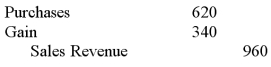
C)  Inventory 620 Gain 340Sales Revenue960\begin{array} { l l } \text { Inventory } & 620 \\ \text { Gain } & 340\\ \text {Sales Revenue}&960 \end{array}

D) Accounts Receivable 960\quad 960
Sales Revenues 620\quad 620
Gain 340\quad 340
Question
During periods when inventory costs are rising, cost of goods sold will most likely be:

A) Higher under FIFO than LIFO.
B) Higher under FIFO than average cost.
C) Lower under average cost than LIFO.
D) Lower under LIFO than FIFO.
Question
In a perpetual inventory system, at the time of a sale the cost of inventory sold is:

A) Debited to Accounts Receivable.
B) Credited to Cost of Goods Sold.
C) Debited to Cost of Goods Sold.
D) Not recorded at the time.
Question
During periods when inventory costs are rising, ending inventory will most likely be:

A) Greater under LIFO than FIFO.
B) Less under average cost than LIFO.
C) Greater under average cost than FIFO.
D) Greater under FIFO than LIFO.
Question
Which of the following is true concerning inventory cost flow assumptions?

A) LIFO produces higher net income than FIFO in a period of rising prices.
B) FIFO is an income statement focus.
C) LIFO is a balance sheet focus.
D) None of the above are true.
Question
Which inventory method is better described as having a balance sheet focus and why is it considered as such?

A) FIFO; better approximates the value of ending inventory.
B) LIFO; better approximates the value of ending inventory.
C) LIFO; better approximates inventory cost necessary to generate revenue.
D) FIFO; better approximates inventory cost necessary to generate revenue.
Question
Which inventory method is better described as having an income statement focus and why is it considered as such?

A) FIFO; better approximates the value of ending inventory.
B) LIFO; better approximates the value of ending inventory.
C) LIFO; better approximates inventory cost necessary to generate revenue.
D) FIFO; better approximates inventory cost necessary to generate revenue.
Question
In a perpetual inventory system, the purchase of inventory is debited to:

A) Purchases.
B) Cost of Goods Sold.
C) Inventory.
D) Accounts Payable.
Question
The primary reason for the popularity of LIFO is that it gives:

A) Better matching of physical flow and cost flow.
B) A lower income tax obligation.
C) Simplified recordkeeping.
D) A simpler method to apply.
Question
The LIFO conformity rule states that if LIFO is used for:

A) One class of inventory, it must be used for all classes of inventory.
B) Tax purposes, it must be used for financial reporting.
C) One company in an affiliated group, it must be used by all companies in an affiliated group.
D) Domestic companies, it must be used by foreign partners.
Question
Which inventory cost flow assumption generally results in the highest reported amount for cost of goods sold when inventory costs are falling?

A) FIFO.
B) LIFO.
C) Weighted-average cost.
D) Straight-line.
Question
What effect would an adjustment to record inventory at the lower-of-cost-or-market have on the company's financial statements?

A) An increase to assets.
B) An increase to stockholders' equity.
C) A decrease to revenue.
D) An increase to expense.
Question
Given the information below, what is the gross profit? Sales revenue $320,000\quad \$ 320,000
Accounts receivable 50,000\quad 50,000
Ending inventory 100,000\quad 100,000
Cost of goods sold 250,000\quad 250,000
Sales Returns 20,000\quad 20,000

A) $250,000
B) $70,000
C) $220,000
D) $50,000
Question
Wildwood, an outdoors clothing store, reports the following information for June:  Sales revenue $104,000 Income tax expense $11,000 Operating expenses 22,000 Cost of goods sold 65,000 Unearned revenues $15,000 Nonoperating revenues 12,000\begin{array} { l r l r } \text { Sales revenue } & \$ 104,000 & \text { Income tax expense } & \$ 11,000 \\\text { Operating expenses } & 22,000 & \text { Cost of goods sold } & 65,000 \\\text { Unearned revenues } & \$ 15,000 & \text { Nonoperating revenues } & 12,000\end{array} What is Wildwood's gross profit for June?

A) $18,000.
B) $39,000.
C) $104,00.
D) $17,000.
Question
On May 1, Ace Bonding Company purchased inventory costing $2,000 on account with terms 2/10, n/30. On May 8, Ace pays for this inventory and records which of the following using a perpetual inventory system?

A) Accounts Payable 2,000\quad 2,000
Cash 2,000\quad 2,000
B)  Accounts Payable 1,960 Inventory 40 Cash 2,000\begin{array} { l r r } \text { Accounts Payable } & 1,960 & \\\text { Inventory } & 40 & \\\quad \text { Cash } & & 2,000\end{array}
C) Accounts Payable 2,000\quad 2,000
Inventory 40\quad 40
Cash 1,960\quad 1,960

D) Cash 2,000\quad 2,000
Accounts Payable 2,000\quad 2,000
Question
LeGrand Corporation reported the following amounts in its income statement:  Sales revenue $440,000 Advertising expense 60,000 Interest expense 10,000 Salaries expense 55,000 Utilities expense 25,000 Income tax expense 45,000 Cost of goods sold 180,000\begin{array} { l r } \text { Sales revenue } & \$ 440,000 \\\text { Advertising expense } & 60,000 \\\text { Interest expense } & 10,000 \\\text { Salaries expense } & 55,000 \\\text { Utilities expense } & 25,000 \\\text { Income tax expense } & 45,000 \\\text { Cost of goods sold } & 180,000\end{array} What was LeGrand's operating income?

A) $120,000.
B) $260,000.
C) $110,000.
D) $65,000.
Question
Ending inventory is equal to the cost of items on hand plus:

A) Items in transit sold FOB shipping point.
B) Sales discounts.
C) Items in transit sold FOB destination.
D) Advertising expense.
Question
Given the information in the table below, what is the company's gross profit?  Sales revenue $350,000 Accounts receivable $280,000 Ending inventory $230,000 Cost of goods sold $180,000 Sales returns $50,000 Sales discount $20,000\begin{array} { | l | r | } \hline \text { Sales revenue } & \$ 350,000 \\\hline \text { Accounts receivable } & \$ 280,000 \\\hline \text { Ending inventory } & \$ 230,000 \\\hline \text { Cost of goods sold } & \$ 180,000 \\\hline \text { Sales returns } & \$ 50,000 \\\hline \text { Sales discount } & \$ 20,000 \\\hline\end{array}

A) $280,000.
B) $170,000.
C) $50,000.
D) $100,000.
Question
Merchandise sold FOB destination indicates that:

A) The seller holds title until the merchandise is received at the buyer's location.
B) The merchandise has not yet been shipped.
C) The merchandise will not be shipped until payment has been received.
D) The seller transfers title to the buyer once the merchandise is shipped.
Question
If A sells to B, and B obtains title while goods are in transit, the goods were shipped. If C sells to D, and C maintains title until the goods arrive at D's door then the goods were shipped.

A) FOB shipping point, FOB destination.
B) FOB destination, FOB shipping point.
C) FOB destination, FOB destination.
D) FOB shipping point, FOB shipping point.
Question
LeGrand Corporation reported the following amounts in its income statement:  Sales revenue $440,000 Advertising expense 60,000 Interest expense 10,000 Salaries expense 55,000 Utilities expense 25,000 Income tax expense 45,000 Cost of goods sold 180,000\begin{array} { l r } \text { Sales revenue } & \$ 440,000 \\\text { Advertising expense } & 60,000 \\\text { Interest expense } & 10,000 \\\text { Salaries expense } & 55,000 \\\text { Utilities expense } & 25,000 \\\text { Income tax expense } & 45,000 \\\text { Cost of goods sold } & 180,000\end{array} What was LeGrand's gross profit?

A) $260,000.
B) $180,000.
C) $220,000.
D) $120,000.
Question
Davis Hardware Company uses a perpetual inventory system. How should Davis record the return of inventory previously purchased on account for $200?

A)  Inventory 200 Accounts Payable 200\begin{array} { l c } \text { Inventory } & 200 \\\text { Accounts Payable } & 200\end{array}
B)  Accounts Payable 200\begin{array} { l l } \text { Accounts Payable } & 200 \end{array}
Inventory
200
C)  Purchase Returns 200\begin{array} { l l } \text { Purchase Returns } & 200 \end{array}
Accounts Payable 200\quad 200
D) Accounts Payable 200\quad 200
Purchase Returns 200\quad 200
Question
On May 1, Ace Bonding Company purchased inventory costing $2,000 on account with terms 2/10, n/30. On May 18, Ace pays for this inventory and records which of the following using a perpetual inventory system?

A) Accounts Payable 2,000\quad 2,000
Cash 2,000\quad 2,000
B)  Accounts Payable 1,960\begin{array} { l l } \text { Accounts Payable } & 1,960 \end{array}
Inventory 40\quad 40
Cash 2,000\quad 2,000
C) Accounts Payable 2,000\quad 2,000
Inventory 40\quad 40
Cash 1,960\quad 1,960
D) Cash 2,000\quad 2,000
Accounts Payable 2,000\quad 2,000
Question
LeGrand Corporation reported the following amounts in its income statement:  Sales revenue \text { Sales revenue } What was LeGrand's net income?

A) $120,000.
B) $60,000.
C) $110,000.
D) $65,000.
Question
Consider the following information pertaining to OldWest's inventory:  Product  Quantity  Cost  Market  Value  Revolvers 16$120$150 Spurs 232722 Hats 125640\begin{array} { l c r c } \text { Product } & \text { Quantity } & \text { Cost } & \begin{array} { c } \text { Market } \\\text { Value }\end{array} \\\text { Revolvers } & 16 & \$ 120 & \$ 150 \\\text { Spurs } & 23 & 27 & 22 \\\text { Hats } & 12 & 56 & 40\end{array} At what amount should OldWest report its inventory?

A) $3,213.
B) $3,386.
C) $2,996.
D) $2,906.
Question
Ace Bonding Company purchased inventory on account. The inventory costs $2,000 and is expected to sell for $3,000. How should Ace record the purchase using a perpetual inventory system?

A) Inventory 2,000\quad 2,000
Accounts Payable 2,000\quad 2,000

B)  Cost of Goods Sold 2,000\begin{array} { l l } \text { Cost of Goods Sold } & 2,000 \end{array}
Unearned Revenue 1,000\quad 1,000
Sales Revenue 3,000\quad 3,000
C) Cost of Goods Sold 2,000\quad 2,000
Accounts Payable 2,000\quad 2,000
D) Cost of Goods Sold 2,000\quad 2,000
Gain 1,000\quad 1,000
Accounts Payable 3,000\quad 3,000
Question
Consider the following year-end information for Spitzer Corporation:  Cost of goods sold $420,000 Sales revenue 800,000 Nonoperating expenses 10,000 Operating expenses 170,000 Income tax expense 80,000\begin{array} { l r } \text { Cost of goods sold } & \$ 420,000 \\\text { Sales revenue } & 800,000 \\\text { Nonoperating expenses } & 10,000 \\\text { Operating expenses } & 170,000 \\\text { Income tax expense } & 80,000\end{array} What amount will Spitzer report for operating income?

A) $200,000
B) $210,000
C) $380,000
D) $120,000
Question
Suppose Company A places an order with Company B on May 12. On May 14, Company B ships the ordered goods to Company A with terms FOB destination. The goods arrive at Company A on May 17. Company A begins selling the goods to customers on May 19 and pays Company B on May 20. When would Company B record the sale of goods to Company A?

A) May 12
B) May 14
C) May 19
D) May 17
Question
The distinction between operating and nonoperating income relates to:

A) Continuity of income.
B) Principal activities of the reporting entity.
C) Consistency of income stream.
D) Reliability of measurements.
Question
Under the principle of lower-of-cost-or-market, when a company has 10 units of inventory A with market value of $50 and a cost of $60, what is the adjustment?

A) Debit Inventory $100; credit Cost of Goods Sold $100.
B) Debit Inventory $500; credit Cost of Goods Sold $500.
C) Debit Cost of Goods Sold $100; credit Inventory $100.
D) Debit Cost of Goods Sold $500; credit Inventory $500.
Question
Merchandise sold FOB shipping point indicates that:

A) The seller holds title until the merchandise is received at the buyer's location.
B) The merchandise has not yet been shipped.
C) The merchandise will not be shipped until payment has been received.
D) The seller transfers title to the buyer once the merchandise is shipped.
Question
Nu Company reported the following data for its first year of operations:  Net sales $2,800 Cost of goods sold 1,680 Operating expenses 880 Ending inventories 820\begin{array} { l r } \text { Net sales } & \$ 2,800 \\\text { Cost of goods sold } & 1,680 \\\text { Operating expenses } & 880 \\\text { Ending inventories } & 820\end{array} What is Nu's gross profit ratio?

A) 80%.
B) 49%.
C) 40%.
D) 5%.
Question
After applying the lower-of-cost-or-market method, the accountant prepares a year-end adjustment. That adjustment would:

A) Decrease the company's cost of goods sold.
B) Reduce the company's stockholders' equity.
C) Increase the company's inventory.
D) Increase the company's total assets.
Question
Anthony Corporation reported the following amounts for the year:  Net sales $296,000 Cost of goods sold 138,000 Average inventory 50,000\begin{array} { l r } \text { Net sales } & \$ 296,000 \\\text { Cost of goods sold } & 138,000 \\\text { Average inventory } & 50,000\end{array} Anthony's gross profit ratio is:

A) 53.4%.
B) 51.9%.
C) 50.3%.
D) 46.6%.
Question
Davis Hardware Company uses a periodic inventory system. How should Davis record the sale of inventory costing $620 for $960 on account?

A)  Cost of Goods Sold 620 Purchases 620 Accounts Receivable 960 Sales Revenue 960\begin{array} { c c c } \text { Cost of Goods Sold } & 620 & \\\text { Purchases } & & 620 \\\text { Accounts Receivable } & 960 & \\\text { Sales Revenue } & & 960\end{array}
B) Accounts Receivable 960\quad 960
Sales Revenue 960\quad 960
C)  <strong>Davis Hardware Company uses a periodic inventory system. How should Davis record the sale of inventory costing $620 for $960 on account?</strong> A)  \begin{array} { c c c } \text { Cost of Goods Sold } & 620 & \\ \text { Purchases } & & 620 \\ \text { Accounts Receivable } & 960 & \\ \text { Sales Revenue } & & 960 \end{array}  B) Accounts Receivable  \quad 960  Sales Revenue \quad 960  C)   D)  \begin{array} { c c r } \text { Accounts Receivable } & 960 & \\ \text { Sales Revenues } & 620 \\ \text { Gain } & 340 \end{array}  <div style=padding-top: 35px>
D)  Accounts Receivable 960 Sales Revenues 620 Gain 340\begin{array} { c c r } \text { Accounts Receivable } & 960 & \\\text { Sales Revenues } & 620 \\\text { Gain } & 340\end{array}
Question
Consider the following inventory data:  Beginning inventory $150,000 Ending inventory 100,000 Purchases 310,000\begin{array} { l r } \text { Beginning inventory } & \$ 150,000 \\\text { Ending inventory } & 100,000 \\\text { Purchases } & 310,000\end{array} What is the average days in inventory for the year?

A) 126.7 days.
B) 101.4 days.
C) 152.0 days.
D) 111.7 days.
Question
Northern Town Equipment has four types of products in its inventory. Northern applies the rules under lower-of-cost or market (LCM) to its inventory at the end of each year as shown below:  Product  Quantity  Cost  Market  A 15$7$8 B 101514 C 2086 D 151110\begin{array} { l c c c c } \text { Product } & \text { Quantity } & \text { Cost } & \text { Market } \\\hline \text { A } & 15 & \$ 7 & \$ 8 \\\text { B } & 10 & 15 & 14 \\\text { C } & 20 & 8 & 6 \\\text { D } & 15 & 11 & 10\end{array} The year-end adjustment based upon the information above would include a:

A) Debit to Cost of Goods Sold $65.
B) Credit to Inventory $50.
C) Debit to Inventory $65.
D) Debit to Cost of Goods Sold $50.
Question
In a periodic inventory system, the purchase of inventory is debited to:

A) Purchases.
B) Cost of goods sold.
C) Inventory.
D) Accounts payable.
Question
At the end of a reporting period, Gamble Corporation determines that its ending inventory has a cost of $300,000 and a market value of $230,000. What would be the effect(s) of the adjustment to write down inventory to market value?

A) Decrease total assets.
B) Decrease net income.
C) Increase retained earnings.
D) a and b.
Question
The practice of using the lower-of-cost-or-market to evaluate inventory reflects which of the following accounting principles?

A) Matching principle.
B) Revenue recognition.
C) Conservatism.
D) Materiality.
Question
Anthony Corporation reported the following amounts for the year:  Net sales $296,000 Cost of goods sold 138,000 Average inventory 50,000\begin{array} { l r } \text { Net sales } & \$ 296,000 \\\text { Cost of goods sold } & 138,000 \\\text { Average inventory } & 50,000\end{array} Anthony's average days in inventory is:

A) 170 days.
B) 114 days.
C) 132 days.
D) 151 days.
Question
Company A is identical to Company B in every regard except that Company A uses FIFO and Company B uses LIFO. In an extended period of rising inventory costs, Company A's gross profit and inventory turnover, compared to Company B's, would be: <strong>Company A is identical to Company B in every regard except that Company A uses FIFO and Company B uses LIFO. In an extended period of rising inventory costs, Company A's gross profit and inventory turnover, compared to Company B's, would be:  </strong> A) Option a B) Option b C) Option c D) Option d <div style=padding-top: 35px>
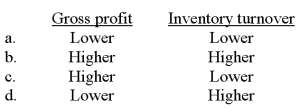
A) Option a
B) Option b
C) Option c
D) Option d
Question
The inventory method that will always produce the same amount for cost of goods sold in a periodic inventory system as in a perpetual inventory system would be:

A) FIFO.
B) LIFO.
C) Weighted average.
D) Each method always produces a different amount.
Question
Consider the following inventory data for two companies: Nichols, Inc. Winters, Inc.Beginning inventory$120,000$150,000Ending inventory80,000100,000Purchases240,000310,000\begin{array} { r r r } &\text {Nichols, Inc.}&\text { Winters, Inc.}\\\text {Beginning inventory}&\$ 120,000 & \$ 150,000 \\ \text{Ending inventory}&80,000 & 100,000 \\ \text {Purchases}&240,000 & 310,000 \end{array} Which of these companies had the higher inventory turnover ratio?

A) Nichols.
B) Winters.
C) The ratios are the same for both companies.
D) Cannot determine with the information given.
Question
Good, Inc. sold inventory for $1,200 that was purchased for $700. Good records which of the following when it sells inventory using a periodic inventory system?

A) No entry is required for cost of goods sold and inventory.
B) Debit Cost of Goods Sold $700; credit Inventory $700.
C) Debit Cost of Goods Sold $1,200; credit Inventory $1,200.
D) Debit Inventory $700; credit Cost of Goods Sold $700.
Question
Anthony Corporation reported the following amounts for the year:  Net sales $296,000 Cost of goods sold 138,000 Average inventory 50,000\begin{array} { l r } \text { Net sales } & \$ 296,000 \\\text { Cost of goods sold } & 138,000 \\\text { Average inventory } & 50,000\end{array} Anthony's inventory turnover ratio is:

A) 2.42.
B) 2.76.
C) 3.21.
D) 2.14.
Question
In a periodic inventory system, at the time of a sale the cost of inventory sold is:

A) Debited to Accounts Receivable.
B) Credited to Cost of Goods Sold.
C) Debited to Cost of Goods Sold.
D) Not recorded at this time.
Question
The primary difference between the periodic and perpetual inventory systems is:

A) The reported amount of ending inventory is higher under the periodic system.
B) The perpetual system maintains a continual record of inventory transactions, whereas the periodic system records these transactions only at the end of the period.
C) The reported amount of sales revenue is higher under the periodic inventory system.
D) The reported amount of cost of goods sold is higher under the perpetual inventory system.
Question
Using the information below, determine the ending inventory value applying the lower-of-cost-or-market method. <strong>Using the information below, determine the ending inventory value applying the lower-of-cost-or-market method.  </strong> A) $13,300. B) $12,000. C) $11,600. D) $13,700. <div style=padding-top: 35px>
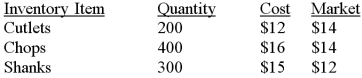
A) $13,300.
B) $12,000.
C) $11,600.
D) $13,700.
Question
Northwest Fur Co. started the year with $94,000 of merchandise inventory on hand. During the year, $400,000 in merchandise was purchased on account with credit terms of 1/15, n/45. All discounts were taken. Northwest paid freight-in charges of $7,500. Merchandise with an invoice amount of $5,000 was returned for credit. Cost of goods sold for the year was $380,000. What is ending inventory?

A) $112,490.
B) $112,550.
C) $116,500.
D) $120,300.
Question
Davis Hardware Company uses a periodic inventory system. How should Davis record the return of inventory previously purchased on account for $200?

A)  Inventory 200 Accounts Payable 200\begin{array} { l c } \text { Inventory } & 200 \\\text { Accounts Payable } & 200\end{array}
B)  Accounts Payable 200Inventory200\begin{array} { l l } \text { Accounts Payable } & 200 \\\text{Inventory}&200\end{array}
C) Purchase Returns 200\quad 200
Accounts payable 200\quad 200
D) Accounts Payable 200\quad 200
Purchase Returns 200\quad 200
Unlock Deck
Sign up to unlock the cards in this deck!
Unlock Deck
Unlock Deck
1/189
auto play flashcards
Play
simple tutorial
Full screen (f)
exit full mode
Deck 6: Inventory and Cost of Goods Sold
1
Inventory records for Dunbar Incorporated revealed the following:  Date  Transaction  Number  Unit  of Units  Cost  Apr. 1  Beginning inventory 500$2.40 Apr. 20  Purchase 4002.50\begin{array} { l l c r } \text { Date } &{ \text { Transaction } } & \text { Number } & \text { Unit } \\&&\text { of Units } & \text { Cost } \\\text { Apr. 1 } & \text { Beginning inventory } & 500 & \$ 2.40 \\\text { Apr. 20 } & \text { Purchase } & 400 & 2.50\end{array} Dunbar sold 700 units of inventory during the month. Ending inventory assuming LIFO would be:

A) $500.
B) $490.
C) $470.
D) $480.
$480.
2
Inventory does not include:

A) Materials used in the production of goods to be sold.
B) Assets intended to be sold in the normal course of business.
C) Equipment used in the manufacturing of assets for sale.
D) Assets currently in production for normal sales.
C
3
Inventory records for Dunbar Incorporated revealed the following:  Date  Transaction  Number  Unit  Apr. Units  Cost  Apr 1  Beginning inventory 500$2.40 Apr. 20  Purchase 4002.50\begin{array} { l l c r } \text { Date } & { \text { Transaction } } & \text { Number } & \text { Unit } \\&&\text { Apr. Units } & \text { Cost } \\\text { Apr 1 } & \text { Beginning inventory } & 500 & \$ 2.40 \\\text { Apr. 20 } & \text { Purchase } & 400 & 2.50\end{array} Dunbar sold 700 units of inventory during the month. Cost of goods sold assuming LIFO would be:

A) $1,730.
B) $1,700.
C) $1,720.
D) $1,710.
$1,720.
4
The following information pertains to Julia & Company: March 1 Beginning inventory =30= 30 units @$5@ \$ 5
March 3 Purchased15 units @ \$4
March 9 Sold 25 units @$8@ \$ 8 What is the cost of goods sold for Julia & Company assuming it uses LIFO?

A) $125.
B) $100.
C) $110.
D) $85.
Unlock Deck
Unlock for access to all 189 flashcards in this deck.
Unlock Deck
k this deck
5
Inventory records for Marvin Company revealed the following:  Date  Transaction  Number  of Units  Unit  Cost  Mar. 1  Beginning inventory 1,000$7.20 Mar. 10  Purchase 6007.25 Mar. 16  Purchase 8007.30 Mar. 23  Purchase 6007.35\begin{array} { c l c r } \text { Date } & { \text { Transaction } } & \begin{array} { c } \text { Number } \\\text { of Units }\end{array} & \begin{array} { r } \text { Unit } \\\text { Cost }\end{array} \\\text { Mar. 1 } & \text { Beginning inventory } & 1,000 & \$ 7.20 \\\text { Mar. 10 } & \text { Purchase } & 600 & 7.25 \\\text { Mar. 16 } & \text { Purchase } & 800 & 7.30 \\\text { Mar. 23 } & \text { Purchase } & 600 & 7.35\end{array} Marvin sold 2,300 units of inventory during the month. Ending inventory assuming weighted-average cost would be (round weighted-average unit cost to four decimals if necessary):

A) $5,087.
B) $5,107.
C) $5,077.
D) $5,005.
Unlock Deck
Unlock for access to all 189 flashcards in this deck.
Unlock Deck
k this deck
6
Inventory records for Dunbar Incorporated revealed the following:  Date  Transaction  Number  Unit Cost Apr. 1  Beginning inventory 500 $2.40  Apr. 20  Purchase 4002.50\begin{array} { l l c r } \text { Date } &{ \text { Transaction } } & \text { Number } & \text { Unit Cost} \\\text { Apr. 1 } & \text { Beginning inventory } & 500 & \text { \$2.40 } \\\text { Apr. 20 } & \text { Purchase } & 400 & 2.50\end{array} Dunbar sold 700 units of inventory during the month. Ending inventory assuming FIFO would be:

A) $500.
B) $490.
C) $470.
D) $480.
Unlock Deck
Unlock for access to all 189 flashcards in this deck.
Unlock Deck
k this deck
7
Baker Fine Foods has beginning inventory for the year of $12,000. During the year, Baker purchases inventory for $150,000 and ends the year with $20,000 of inventory. Baker will report cost of goods sold equal to:

A) $150,000.
B) $158,000.
C) $142,000.
D) $170,000.
Unlock Deck
Unlock for access to all 189 flashcards in this deck.

Unlock Deck
k this deck
8
The largest expense on a retailer's income statement is typically:

A) Salaries.
B) Cost of goods sold.
C) Income tax expense.
D) Depreciation expense.
Unlock Deck
Unlock for access to all 189 flashcards in this deck.

Unlock Deck
k this deck
9
Inventory records for Dunbar Incorporated revealed the following:  Date  Transaction  Number  Unit Cost Apr. 1  Beginning inventory 500 $2.40  Apr. 20  Purchase 4002.50\begin{array} { l l c r } \text { Date } &{ \text { Transaction } } & \text { Number } & \text { Unit Cost} \\\text { Apr. 1 } & \text { Beginning inventory } & 500 & \text { \$2.40 } \\\text { Apr. 20 } & \text { Purchase } & 400 & 2.50\end{array} Dunbar sold 700 units of inventory during the month. Cost of goods sold assuming weighted-average cost would be (round weighted-average unit cost to four decimals if necessary):

A) $1,711.
B) $1,700.
C) $1,720.
D) $1,708.
Unlock Deck
Unlock for access to all 189 flashcards in this deck.
Unlock Deck
k this deck
10
Inventory records for Dunbar Incorporated revealed the following:  Date  Transaction  Number  Unit Cost Apr. 1  Beginning inventory 500 $2.40  Apr. 20  Purchase 4002.50\begin{array} { l l c r } \text { Date } &{ \text { Transaction } } & \text { Number } & \text { Unit Cost} \\\text { Apr. 1 } & \text { Beginning inventory } & 500 & \text { \$2.40 } \\\text { Apr. 20 } & \text { Purchase } & 400 & 2.50\end{array} Dunbar sold 700 units of inventory during the month. Cost of goods sold assuming FIFO would be:

A) $1,730.
B) $1,700.
C) $1,720.
D) $1,710.
Unlock Deck
Unlock for access to all 189 flashcards in this deck.
Unlock Deck
k this deck
11
Cost of goods sold equals:

A) Beginning inventory - net purchases + ending inventory.
B) Beginning inventory + accounts payable - net purchases.
C) Net purchases + ending inventory - beginning inventory.
D) Beginning inventory + net purchases - ending inventory.
Unlock Deck
Unlock for access to all 189 flashcards in this deck.
Unlock Deck
k this deck
12
The following information pertains to Julia & Company: March 1 Beginning inventory =30= 30 units @$5@ \$ 5
March3 Purchased15 units@\$4
March 9 Sold 25 units @$8@ \$ 8 What's the ending balance of inventory for Julia & Company assuming that it uses FIFO?

A) $125
B) $100
C) $110
D) $85
Unlock Deck
Unlock for access to all 189 flashcards in this deck.
Unlock Deck
k this deck
13
Inventory records for Marvin Company revealed the following:  Date  Transaction  Number  of Units  Unit  Cost  Mar. 1  Beginning inventory 1,000$7.20 Mar. 10  Purchase 6007.25 Mar. 16  Purchase 8007.30 Mar. 23  Purchase 6007.35\begin{array} { c l c r } \text { Date } & { \text { Transaction } } & \begin{array} { c } \text { Number } \\\text { of Units }\end{array} & \begin{array} { r } \text { Unit } \\\text { Cost }\end{array} \\\text { Mar. 1 } & \text { Beginning inventory } & 1,000 & \$ 7.20 \\\text { Mar. 10 } & \text { Purchase } & 600 & 7.25 \\\text { Mar. 16 } & \text { Purchase } & 800 & 7.30 \\\text { Mar. 23 } & \text { Purchase } & 600 & 7.35\end{array} Marvin sold 2,300 units of inventory during the month. Cost of goods sold assuming LIFO would be:

A) $16,800.
B) $16,760.
C) $16,540.
D) $16,660.
Unlock Deck
Unlock for access to all 189 flashcards in this deck.
Unlock Deck
k this deck
14
Inventory records for Marvin Company revealed the following:  Date  Transaction  Number  of Units  Unit  Cost  Mar. 1  Beginning inventory 1,000$7.20 Mar. 10  Purchase 6007.25 Mar. 16  Purchase 8007.30 Mar. 23  Purchase 6007.35\begin{array} { c l c r } \text { Date } & { \text { Transaction } } & \begin{array} { c } \text { Number } \\\text { of Units }\end{array} & \begin{array} { r } \text { Unit } \\\text { Cost }\end{array} \\\text { Mar. 1 } & \text { Beginning inventory } & 1,000 & \$ 7.20 \\\text { Mar. 10 } & \text { Purchase } & 600 & 7.25 \\\text { Mar. 16 } & \text { Purchase } & 800 & 7.30 \\\text { Mar. 23 } & \text { Purchase } & 600 & 7.35\end{array} Marvin sold 2,300 units of inventory during the month. Cost of goods sold assuming FIFO would be:

A) $16,800.
B) $16,760.
C) $16,540.
D) $16,660.
Unlock Deck
Unlock for access to all 189 flashcards in this deck.
Unlock Deck
k this deck
15
Inventory records for Marvin Company revealed the following:  Date  Transaction  Number  of Units  Unit  Cost  Mar. 1  Beginning inventory 1,000$7.20 Mar. 10  Purchase 6007.25 Mar. 16  Purchase 8007.30 Mar. 23  Purchase 6007.35\begin{array} { c l c r } \text { Date } & { \text { Transaction } } & \begin{array} { c } \text { Number } \\\text { of Units }\end{array} & \begin{array} { r } \text { Unit } \\\text { Cost }\end{array} \\\text { Mar. 1 } & \text { Beginning inventory } & 1,000 & \$ 7.20 \\\text { Mar. 10 } & \text { Purchase } & 600 & 7.25 \\\text { Mar. 16 } & \text { Purchase } & 800 & 7.30 \\\text { Mar. 23 } & \text { Purchase } & 600 & 7.35\end{array} Marvin sold 2,300 units of inventory during the month. Ending inventory assuming FIFO would be:

A) $5,140.
B) $5,080.
C) $5,060.
D) $5,050.
Unlock Deck
Unlock for access to all 189 flashcards in this deck.
Unlock Deck
k this deck
16
Tyler Toys has beginning inventory for the year of $18,000. During the year, Tyler purchases inventory for $230,000 and has cost of goods sold equal to $233,000. Tyler's ending inventory equals:

A) $15,000.
B) $18,000.
C) $21,000.
D) $19,000.
Unlock Deck
Unlock for access to all 189 flashcards in this deck.
Unlock Deck
k this deck
17
Inventory records for Dunbar Incorporated revealed the following:  Date  Transaction  Number  Unit Cost Apr. 1  Beginning inventory 500 $2.40  Apr. 20  Purchase 4002.50\begin{array} { l l c r } \text { Date } &{ \text { Transaction } } & \text { Number } & \text { Unit Cost} \\\text { Apr. 1 } & \text { Beginning inventory } & 500 & \text { \$2.40 } \\\text { Apr. 20 } & \text { Purchase } & 400 & 2.50\end{array} Dunbar sold 700 units of inventory during the month. Ending inventory assuming weighted-average cost would be (round weighted-average unit cost to four decimals if necessary):

A) $502.
B) $490.
C) $489.
D) $480.
Unlock Deck
Unlock for access to all 189 flashcards in this deck.
Unlock Deck
k this deck
18
Inventory records for Marvin Company revealed the following:  Date  Transaction  Number  of Units  Unit  Cost  Mar. 1  Beginning inventory 1,000$7.20 Mar. 10  Purchase 6007.25 Mar. 16  Purchase 8007.30 Mar. 23  Purchase 6007.35\begin{array} { c l c r } \text { Date } & { \text { Transaction } } & \begin{array} { c } \text { Number } \\\text { of Units }\end{array} & \begin{array} { r } \text { Unit } \\\text { Cost }\end{array} \\\text { Mar. 1 } & \text { Beginning inventory } & 1,000 & \$ 7.20 \\\text { Mar. 10 } & \text { Purchase } & 600 & 7.25 \\\text { Mar. 16 } & \text { Purchase } & 800 & 7.30 \\\text { Mar. 23 } & \text { Purchase } & 600 & 7.35\end{array} Marvin sold 2,300 units of inventory during the month. Ending inventory assuming LIFO would be:

A) $5,040.
B) $5,055.
C) $5,075.
D) $5,135.
Unlock Deck
Unlock for access to all 189 flashcards in this deck.
Unlock Deck
k this deck
19
Cost of Goods Sold is:

A) An asset account.
B) A revenue account.
C) An expense account.
D) A permanent equity account.
Unlock Deck
Unlock for access to all 189 flashcards in this deck.
Unlock Deck
k this deck
20
Inventory records for Marvin Company revealed the following:  Date  Transaction  Number  of Units  Unit  Cost  Mar. 1  Beginning inventory 1,000$7.20 Mar. 10  Purchase 6007.25 Mar. 16  Purchase 8007.30 Mar. 23  Purchase 6007.35\begin{array} { c l c r } \text { Date } & { \text { Transaction } } & \begin{array} { c } \text { Number } \\\text { of Units }\end{array} & \begin{array} { r } \text { Unit } \\\text { Cost }\end{array} \\\text { Mar. 1 } & \text { Beginning inventory } & 1,000 & \$ 7.20 \\\text { Mar. 10 } & \text { Purchase } & 600 & 7.25 \\\text { Mar. 16 } & \text { Purchase } & 800 & 7.30 \\\text { Mar. 23 } & \text { Purchase } & 600 & 7.35\end{array} Marvin sold 2,300 units of inventory during the month. Cost of goods sold assuming weighted-average cost would be (round weighted-average unit cost to four decimals if necessary):

A) $16,733.
B) $17,408.
C) $16,713.
D) $16,089.
Unlock Deck
Unlock for access to all 189 flashcards in this deck.
Unlock Deck
k this deck
21
Which of the following is true regarding LIFO and FIFO?

A) In a period of decreasing costs, LIFO results in lower total assets than FIFO.
B) In a period of decreasing costs, LIFO results in lower net income than FIFO.
C) In a period of rising costs, LIFO results in lower net income than FIFO.
D) The amount reported for COGS is based on market value of inventory if LIFO is used.
Unlock Deck
Unlock for access to all 189 flashcards in this deck.
Unlock Deck
k this deck
22
In a period when inventory costs are falling, the lowest taxable income is most likely reported by using the inventory method of:

A) Weighted average.
B) LIFO.
C) Moving average.
D) FIFO.
Unlock Deck
Unlock for access to all 189 flashcards in this deck.
Unlock Deck
k this deck
23
The following information relates to inventory for Shoeless Joe Inc.  Date  Quantity  Price  March 1  Beginning Inventory 20$2 March 7  Purchase 153 March 11  Sale 257 March 12  Purchase 204\begin{array} { l l c c } \text { Date } & & \text { Quantity } & \text { Price } \\\hline \text { March 1 } & \text { Beginning Inventory } & 20 & \$ 2 \\\text { March 7 } & \text { Purchase } & 15 & 3 \\\text { March 11 } & \text { Sale } & 25 & 7 \\\text { March 12 } & \text { Purchase } & 20 & 4\end{array} At what amount would Shoeless report ending inventory using FIFO cost flow assumptions?

A) $55.
B) $170.
C) $110.
D) $70.
Unlock Deck
Unlock for access to all 189 flashcards in this deck.
Unlock Deck
k this deck
24
In a period when inventory costs are rising, the inventory method that most likely results in the highest ending inventory is:

A) Lower-of-cost-or-market method.
B) Weighted-average cost.
C) FIFO.
D) LIFO.
Unlock Deck
Unlock for access to all 189 flashcards in this deck.
Unlock Deck
k this deck
25
The following information relates to inventory for Shoeless Joe Inc.  Date  Quantity  Price  March 1  Beginning Inventory 20$2 March 7  Purchase 153 March 11  Sale 307 March 12  Purchase 156\begin{array} { l l c c } \text { Date } & & \text { Quantity } & \text { Price } \\\text { March 1 } & \text { Beginning Inventory } & 20 & \$ 2 \\\text { March 7 } & \text { Purchase } & 15 & 3 \\\text { March 11 } & \text { Sale } & 30 & 7 \\\text { March 12 } & \text { Purchase } & 15 & 6\end{array} At what amount would Shoeless report cost of goods sold using the weighted-average cost flow assumption? (Round your answer to the nearest dollar)

A) $110.
B) $73.
C) $70.
D) $105.
Unlock Deck
Unlock for access to all 189 flashcards in this deck.
Unlock Deck
k this deck
26
In a period of rising prices, which inventory valuation method would a company likely choose if they want to have the highest possible balance of inventory on the balance sheet?

A) Average cost.
B) FIFO.
C) LIFO.
D) Periodic.
Unlock Deck
Unlock for access to all 189 flashcards in this deck.
Unlock Deck
k this deck
27
The following information relates to inventory for Shoeless Joe Inc.  Date  Quantity  Price  March 1  Beginning Inventory 20$2 March 7  Purchase 153 March 11  Sale 257 March 12  Purchase 204\begin{array} { l l c c } \text { Date } & & \underline { \text { Quantity } } & \underline { \text { Price } } \\\text { March 1 } & \text { Beginning Inventory } & 20 & \$ 2 \\\text { March 7 } & \text { Purchase } & 15 & 3 \\\text { March 11 } & \text { Sale } & 25 & 7 \\\text { March 12 } & \text { Purchase } & 20 & 4\end{array} At what amount would Shoeless report gross profit using LIFO cost flow assumptions?

A) $105.
B) $80.
C) $175.
D) $120.
Unlock Deck
Unlock for access to all 189 flashcards in this deck.
Unlock Deck
k this deck
28
Consider the following inventory transactions for September: Beginning inventory 15\quad 15 units @ $3.00
Purchase on September 122012 \quad 20 units @ $3.50
Purchased on September 231023 \quad 10 units @$4.00@ \$ 4.00 For the month of September, the company sold 35 units. What is the cost of good sold under the weighted-average cost method (round the weighted-average unit cost to four decimals if necessary)?

A) $121.
B) $116.
C) $124.
D) $131.
Unlock Deck
Unlock for access to all 189 flashcards in this deck.
Unlock Deck
k this deck
29
Good, Inc. sold inventory for $1,200 that was purchased for $700. Good records which of the following when it sells inventory using a perpetual inventory system?

A) No entry is required for cost of goods sold and inventory.
B) Debit Cost of Goods Sold $700; credit Inventory $700.
C) Debit Cost of Goods Sold $1,200; credit Inventory $1,200.
D) Debit Inventory $700; credit Cost of Goods Sold $700.
Unlock Deck
Unlock for access to all 189 flashcards in this deck.
Unlock Deck
k this deck
30
Davis Hardware Company uses a perpetual inventory system. How should Davis record the sale of inventory costing $620 for $960 on account?

A) Inventory 620\quad 620
Cost of Goods Sold 620\quad 620
Sales Revenue 960\quad 960
Accounts Receivable 960\quad 960
B) Accounts Receivable 960\quad 960
Sales Revenue 960\quad 960
Cost of Goods Sold 620\quad 620
Inventory 620\quad 620
C)  Inventory 620 Gain 340Sales Revenue960\begin{array} { l l } \text { Inventory } & 620 \\ \text { Gain } & 340\\ \text {Sales Revenue}&960 \end{array}

D) Accounts Receivable 960\quad 960
Sales Revenues 620\quad 620
Gain 340\quad 340
Unlock Deck
Unlock for access to all 189 flashcards in this deck.
Unlock Deck
k this deck
31
During periods when inventory costs are rising, cost of goods sold will most likely be:

A) Higher under FIFO than LIFO.
B) Higher under FIFO than average cost.
C) Lower under average cost than LIFO.
D) Lower under LIFO than FIFO.
Unlock Deck
Unlock for access to all 189 flashcards in this deck.
Unlock Deck
k this deck
32
In a perpetual inventory system, at the time of a sale the cost of inventory sold is:

A) Debited to Accounts Receivable.
B) Credited to Cost of Goods Sold.
C) Debited to Cost of Goods Sold.
D) Not recorded at the time.
Unlock Deck
Unlock for access to all 189 flashcards in this deck.
Unlock Deck
k this deck
33
During periods when inventory costs are rising, ending inventory will most likely be:

A) Greater under LIFO than FIFO.
B) Less under average cost than LIFO.
C) Greater under average cost than FIFO.
D) Greater under FIFO than LIFO.
Unlock Deck
Unlock for access to all 189 flashcards in this deck.
Unlock Deck
k this deck
34
Which of the following is true concerning inventory cost flow assumptions?

A) LIFO produces higher net income than FIFO in a period of rising prices.
B) FIFO is an income statement focus.
C) LIFO is a balance sheet focus.
D) None of the above are true.
Unlock Deck
Unlock for access to all 189 flashcards in this deck.
Unlock Deck
k this deck
35
Which inventory method is better described as having a balance sheet focus and why is it considered as such?

A) FIFO; better approximates the value of ending inventory.
B) LIFO; better approximates the value of ending inventory.
C) LIFO; better approximates inventory cost necessary to generate revenue.
D) FIFO; better approximates inventory cost necessary to generate revenue.
Unlock Deck
Unlock for access to all 189 flashcards in this deck.
Unlock Deck
k this deck
36
Which inventory method is better described as having an income statement focus and why is it considered as such?

A) FIFO; better approximates the value of ending inventory.
B) LIFO; better approximates the value of ending inventory.
C) LIFO; better approximates inventory cost necessary to generate revenue.
D) FIFO; better approximates inventory cost necessary to generate revenue.
Unlock Deck
Unlock for access to all 189 flashcards in this deck.
Unlock Deck
k this deck
37
In a perpetual inventory system, the purchase of inventory is debited to:

A) Purchases.
B) Cost of Goods Sold.
C) Inventory.
D) Accounts Payable.
Unlock Deck
Unlock for access to all 189 flashcards in this deck.
Unlock Deck
k this deck
38
The primary reason for the popularity of LIFO is that it gives:

A) Better matching of physical flow and cost flow.
B) A lower income tax obligation.
C) Simplified recordkeeping.
D) A simpler method to apply.
Unlock Deck
Unlock for access to all 189 flashcards in this deck.
Unlock Deck
k this deck
39
The LIFO conformity rule states that if LIFO is used for:

A) One class of inventory, it must be used for all classes of inventory.
B) Tax purposes, it must be used for financial reporting.
C) One company in an affiliated group, it must be used by all companies in an affiliated group.
D) Domestic companies, it must be used by foreign partners.
Unlock Deck
Unlock for access to all 189 flashcards in this deck.
Unlock Deck
k this deck
40
Which inventory cost flow assumption generally results in the highest reported amount for cost of goods sold when inventory costs are falling?

A) FIFO.
B) LIFO.
C) Weighted-average cost.
D) Straight-line.
Unlock Deck
Unlock for access to all 189 flashcards in this deck.
Unlock Deck
k this deck
41
What effect would an adjustment to record inventory at the lower-of-cost-or-market have on the company's financial statements?

A) An increase to assets.
B) An increase to stockholders' equity.
C) A decrease to revenue.
D) An increase to expense.
Unlock Deck
Unlock for access to all 189 flashcards in this deck.
Unlock Deck
k this deck
42
Given the information below, what is the gross profit? Sales revenue $320,000\quad \$ 320,000
Accounts receivable 50,000\quad 50,000
Ending inventory 100,000\quad 100,000
Cost of goods sold 250,000\quad 250,000
Sales Returns 20,000\quad 20,000

A) $250,000
B) $70,000
C) $220,000
D) $50,000
Unlock Deck
Unlock for access to all 189 flashcards in this deck.
Unlock Deck
k this deck
43
Wildwood, an outdoors clothing store, reports the following information for June:  Sales revenue $104,000 Income tax expense $11,000 Operating expenses 22,000 Cost of goods sold 65,000 Unearned revenues $15,000 Nonoperating revenues 12,000\begin{array} { l r l r } \text { Sales revenue } & \$ 104,000 & \text { Income tax expense } & \$ 11,000 \\\text { Operating expenses } & 22,000 & \text { Cost of goods sold } & 65,000 \\\text { Unearned revenues } & \$ 15,000 & \text { Nonoperating revenues } & 12,000\end{array} What is Wildwood's gross profit for June?

A) $18,000.
B) $39,000.
C) $104,00.
D) $17,000.
Unlock Deck
Unlock for access to all 189 flashcards in this deck.
Unlock Deck
k this deck
44
On May 1, Ace Bonding Company purchased inventory costing $2,000 on account with terms 2/10, n/30. On May 8, Ace pays for this inventory and records which of the following using a perpetual inventory system?

A) Accounts Payable 2,000\quad 2,000
Cash 2,000\quad 2,000
B)  Accounts Payable 1,960 Inventory 40 Cash 2,000\begin{array} { l r r } \text { Accounts Payable } & 1,960 & \\\text { Inventory } & 40 & \\\quad \text { Cash } & & 2,000\end{array}
C) Accounts Payable 2,000\quad 2,000
Inventory 40\quad 40
Cash 1,960\quad 1,960

D) Cash 2,000\quad 2,000
Accounts Payable 2,000\quad 2,000
Unlock Deck
Unlock for access to all 189 flashcards in this deck.
Unlock Deck
k this deck
45
LeGrand Corporation reported the following amounts in its income statement:  Sales revenue $440,000 Advertising expense 60,000 Interest expense 10,000 Salaries expense 55,000 Utilities expense 25,000 Income tax expense 45,000 Cost of goods sold 180,000\begin{array} { l r } \text { Sales revenue } & \$ 440,000 \\\text { Advertising expense } & 60,000 \\\text { Interest expense } & 10,000 \\\text { Salaries expense } & 55,000 \\\text { Utilities expense } & 25,000 \\\text { Income tax expense } & 45,000 \\\text { Cost of goods sold } & 180,000\end{array} What was LeGrand's operating income?

A) $120,000.
B) $260,000.
C) $110,000.
D) $65,000.
Unlock Deck
Unlock for access to all 189 flashcards in this deck.
Unlock Deck
k this deck
46
Ending inventory is equal to the cost of items on hand plus:

A) Items in transit sold FOB shipping point.
B) Sales discounts.
C) Items in transit sold FOB destination.
D) Advertising expense.
Unlock Deck
Unlock for access to all 189 flashcards in this deck.
Unlock Deck
k this deck
47
Given the information in the table below, what is the company's gross profit?  Sales revenue $350,000 Accounts receivable $280,000 Ending inventory $230,000 Cost of goods sold $180,000 Sales returns $50,000 Sales discount $20,000\begin{array} { | l | r | } \hline \text { Sales revenue } & \$ 350,000 \\\hline \text { Accounts receivable } & \$ 280,000 \\\hline \text { Ending inventory } & \$ 230,000 \\\hline \text { Cost of goods sold } & \$ 180,000 \\\hline \text { Sales returns } & \$ 50,000 \\\hline \text { Sales discount } & \$ 20,000 \\\hline\end{array}

A) $280,000.
B) $170,000.
C) $50,000.
D) $100,000.
Unlock Deck
Unlock for access to all 189 flashcards in this deck.
Unlock Deck
k this deck
48
Merchandise sold FOB destination indicates that:

A) The seller holds title until the merchandise is received at the buyer's location.
B) The merchandise has not yet been shipped.
C) The merchandise will not be shipped until payment has been received.
D) The seller transfers title to the buyer once the merchandise is shipped.
Unlock Deck
Unlock for access to all 189 flashcards in this deck.
Unlock Deck
k this deck
49
If A sells to B, and B obtains title while goods are in transit, the goods were shipped. If C sells to D, and C maintains title until the goods arrive at D's door then the goods were shipped.

A) FOB shipping point, FOB destination.
B) FOB destination, FOB shipping point.
C) FOB destination, FOB destination.
D) FOB shipping point, FOB shipping point.
Unlock Deck
Unlock for access to all 189 flashcards in this deck.
Unlock Deck
k this deck
50
LeGrand Corporation reported the following amounts in its income statement:  Sales revenue $440,000 Advertising expense 60,000 Interest expense 10,000 Salaries expense 55,000 Utilities expense 25,000 Income tax expense 45,000 Cost of goods sold 180,000\begin{array} { l r } \text { Sales revenue } & \$ 440,000 \\\text { Advertising expense } & 60,000 \\\text { Interest expense } & 10,000 \\\text { Salaries expense } & 55,000 \\\text { Utilities expense } & 25,000 \\\text { Income tax expense } & 45,000 \\\text { Cost of goods sold } & 180,000\end{array} What was LeGrand's gross profit?

A) $260,000.
B) $180,000.
C) $220,000.
D) $120,000.
Unlock Deck
Unlock for access to all 189 flashcards in this deck.
Unlock Deck
k this deck
51
Davis Hardware Company uses a perpetual inventory system. How should Davis record the return of inventory previously purchased on account for $200?

A)  Inventory 200 Accounts Payable 200\begin{array} { l c } \text { Inventory } & 200 \\\text { Accounts Payable } & 200\end{array}
B)  Accounts Payable 200\begin{array} { l l } \text { Accounts Payable } & 200 \end{array}
Inventory
200
C)  Purchase Returns 200\begin{array} { l l } \text { Purchase Returns } & 200 \end{array}
Accounts Payable 200\quad 200
D) Accounts Payable 200\quad 200
Purchase Returns 200\quad 200
Unlock Deck
Unlock for access to all 189 flashcards in this deck.
Unlock Deck
k this deck
52
On May 1, Ace Bonding Company purchased inventory costing $2,000 on account with terms 2/10, n/30. On May 18, Ace pays for this inventory and records which of the following using a perpetual inventory system?

A) Accounts Payable 2,000\quad 2,000
Cash 2,000\quad 2,000
B)  Accounts Payable 1,960\begin{array} { l l } \text { Accounts Payable } & 1,960 \end{array}
Inventory 40\quad 40
Cash 2,000\quad 2,000
C) Accounts Payable 2,000\quad 2,000
Inventory 40\quad 40
Cash 1,960\quad 1,960
D) Cash 2,000\quad 2,000
Accounts Payable 2,000\quad 2,000
Unlock Deck
Unlock for access to all 189 flashcards in this deck.
Unlock Deck
k this deck
53
LeGrand Corporation reported the following amounts in its income statement:  Sales revenue \text { Sales revenue } What was LeGrand's net income?

A) $120,000.
B) $60,000.
C) $110,000.
D) $65,000.
Unlock Deck
Unlock for access to all 189 flashcards in this deck.
Unlock Deck
k this deck
54
Consider the following information pertaining to OldWest's inventory:  Product  Quantity  Cost  Market  Value  Revolvers 16$120$150 Spurs 232722 Hats 125640\begin{array} { l c r c } \text { Product } & \text { Quantity } & \text { Cost } & \begin{array} { c } \text { Market } \\\text { Value }\end{array} \\\text { Revolvers } & 16 & \$ 120 & \$ 150 \\\text { Spurs } & 23 & 27 & 22 \\\text { Hats } & 12 & 56 & 40\end{array} At what amount should OldWest report its inventory?

A) $3,213.
B) $3,386.
C) $2,996.
D) $2,906.
Unlock Deck
Unlock for access to all 189 flashcards in this deck.
Unlock Deck
k this deck
55
Ace Bonding Company purchased inventory on account. The inventory costs $2,000 and is expected to sell for $3,000. How should Ace record the purchase using a perpetual inventory system?

A) Inventory 2,000\quad 2,000
Accounts Payable 2,000\quad 2,000

B)  Cost of Goods Sold 2,000\begin{array} { l l } \text { Cost of Goods Sold } & 2,000 \end{array}
Unearned Revenue 1,000\quad 1,000
Sales Revenue 3,000\quad 3,000
C) Cost of Goods Sold 2,000\quad 2,000
Accounts Payable 2,000\quad 2,000
D) Cost of Goods Sold 2,000\quad 2,000
Gain 1,000\quad 1,000
Accounts Payable 3,000\quad 3,000
Unlock Deck
Unlock for access to all 189 flashcards in this deck.
Unlock Deck
k this deck
56
Consider the following year-end information for Spitzer Corporation:  Cost of goods sold $420,000 Sales revenue 800,000 Nonoperating expenses 10,000 Operating expenses 170,000 Income tax expense 80,000\begin{array} { l r } \text { Cost of goods sold } & \$ 420,000 \\\text { Sales revenue } & 800,000 \\\text { Nonoperating expenses } & 10,000 \\\text { Operating expenses } & 170,000 \\\text { Income tax expense } & 80,000\end{array} What amount will Spitzer report for operating income?

A) $200,000
B) $210,000
C) $380,000
D) $120,000
Unlock Deck
Unlock for access to all 189 flashcards in this deck.
Unlock Deck
k this deck
57
Suppose Company A places an order with Company B on May 12. On May 14, Company B ships the ordered goods to Company A with terms FOB destination. The goods arrive at Company A on May 17. Company A begins selling the goods to customers on May 19 and pays Company B on May 20. When would Company B record the sale of goods to Company A?

A) May 12
B) May 14
C) May 19
D) May 17
Unlock Deck
Unlock for access to all 189 flashcards in this deck.
Unlock Deck
k this deck
58
The distinction between operating and nonoperating income relates to:

A) Continuity of income.
B) Principal activities of the reporting entity.
C) Consistency of income stream.
D) Reliability of measurements.
Unlock Deck
Unlock for access to all 189 flashcards in this deck.
Unlock Deck
k this deck
59
Under the principle of lower-of-cost-or-market, when a company has 10 units of inventory A with market value of $50 and a cost of $60, what is the adjustment?

A) Debit Inventory $100; credit Cost of Goods Sold $100.
B) Debit Inventory $500; credit Cost of Goods Sold $500.
C) Debit Cost of Goods Sold $100; credit Inventory $100.
D) Debit Cost of Goods Sold $500; credit Inventory $500.
Unlock Deck
Unlock for access to all 189 flashcards in this deck.
Unlock Deck
k this deck
60
Merchandise sold FOB shipping point indicates that:

A) The seller holds title until the merchandise is received at the buyer's location.
B) The merchandise has not yet been shipped.
C) The merchandise will not be shipped until payment has been received.
D) The seller transfers title to the buyer once the merchandise is shipped.
Unlock Deck
Unlock for access to all 189 flashcards in this deck.
Unlock Deck
k this deck
61
Nu Company reported the following data for its first year of operations:  Net sales $2,800 Cost of goods sold 1,680 Operating expenses 880 Ending inventories 820\begin{array} { l r } \text { Net sales } & \$ 2,800 \\\text { Cost of goods sold } & 1,680 \\\text { Operating expenses } & 880 \\\text { Ending inventories } & 820\end{array} What is Nu's gross profit ratio?

A) 80%.
B) 49%.
C) 40%.
D) 5%.
Unlock Deck
Unlock for access to all 189 flashcards in this deck.
Unlock Deck
k this deck
62
After applying the lower-of-cost-or-market method, the accountant prepares a year-end adjustment. That adjustment would:

A) Decrease the company's cost of goods sold.
B) Reduce the company's stockholders' equity.
C) Increase the company's inventory.
D) Increase the company's total assets.
Unlock Deck
Unlock for access to all 189 flashcards in this deck.
Unlock Deck
k this deck
63
Anthony Corporation reported the following amounts for the year:  Net sales $296,000 Cost of goods sold 138,000 Average inventory 50,000\begin{array} { l r } \text { Net sales } & \$ 296,000 \\\text { Cost of goods sold } & 138,000 \\\text { Average inventory } & 50,000\end{array} Anthony's gross profit ratio is:

A) 53.4%.
B) 51.9%.
C) 50.3%.
D) 46.6%.
Unlock Deck
Unlock for access to all 189 flashcards in this deck.
Unlock Deck
k this deck
64
Davis Hardware Company uses a periodic inventory system. How should Davis record the sale of inventory costing $620 for $960 on account?

A)  Cost of Goods Sold 620 Purchases 620 Accounts Receivable 960 Sales Revenue 960\begin{array} { c c c } \text { Cost of Goods Sold } & 620 & \\\text { Purchases } & & 620 \\\text { Accounts Receivable } & 960 & \\\text { Sales Revenue } & & 960\end{array}
B) Accounts Receivable 960\quad 960
Sales Revenue 960\quad 960
C)  <strong>Davis Hardware Company uses a periodic inventory system. How should Davis record the sale of inventory costing $620 for $960 on account?</strong> A)  \begin{array} { c c c } \text { Cost of Goods Sold } & 620 & \\ \text { Purchases } & & 620 \\ \text { Accounts Receivable } & 960 & \\ \text { Sales Revenue } & & 960 \end{array}  B) Accounts Receivable  \quad 960  Sales Revenue \quad 960  C)   D)  \begin{array} { c c r } \text { Accounts Receivable } & 960 & \\ \text { Sales Revenues } & 620 \\ \text { Gain } & 340 \end{array}
D)  Accounts Receivable 960 Sales Revenues 620 Gain 340\begin{array} { c c r } \text { Accounts Receivable } & 960 & \\\text { Sales Revenues } & 620 \\\text { Gain } & 340\end{array}
Unlock Deck
Unlock for access to all 189 flashcards in this deck.
Unlock Deck
k this deck
65
Consider the following inventory data:  Beginning inventory $150,000 Ending inventory 100,000 Purchases 310,000\begin{array} { l r } \text { Beginning inventory } & \$ 150,000 \\\text { Ending inventory } & 100,000 \\\text { Purchases } & 310,000\end{array} What is the average days in inventory for the year?

A) 126.7 days.
B) 101.4 days.
C) 152.0 days.
D) 111.7 days.
Unlock Deck
Unlock for access to all 189 flashcards in this deck.
Unlock Deck
k this deck
66
Northern Town Equipment has four types of products in its inventory. Northern applies the rules under lower-of-cost or market (LCM) to its inventory at the end of each year as shown below:  Product  Quantity  Cost  Market  A 15$7$8 B 101514 C 2086 D 151110\begin{array} { l c c c c } \text { Product } & \text { Quantity } & \text { Cost } & \text { Market } \\\hline \text { A } & 15 & \$ 7 & \$ 8 \\\text { B } & 10 & 15 & 14 \\\text { C } & 20 & 8 & 6 \\\text { D } & 15 & 11 & 10\end{array} The year-end adjustment based upon the information above would include a:

A) Debit to Cost of Goods Sold $65.
B) Credit to Inventory $50.
C) Debit to Inventory $65.
D) Debit to Cost of Goods Sold $50.
Unlock Deck
Unlock for access to all 189 flashcards in this deck.
Unlock Deck
k this deck
67
In a periodic inventory system, the purchase of inventory is debited to:

A) Purchases.
B) Cost of goods sold.
C) Inventory.
D) Accounts payable.
Unlock Deck
Unlock for access to all 189 flashcards in this deck.
Unlock Deck
k this deck
68
At the end of a reporting period, Gamble Corporation determines that its ending inventory has a cost of $300,000 and a market value of $230,000. What would be the effect(s) of the adjustment to write down inventory to market value?

A) Decrease total assets.
B) Decrease net income.
C) Increase retained earnings.
D) a and b.
Unlock Deck
Unlock for access to all 189 flashcards in this deck.
Unlock Deck
k this deck
69
The practice of using the lower-of-cost-or-market to evaluate inventory reflects which of the following accounting principles?

A) Matching principle.
B) Revenue recognition.
C) Conservatism.
D) Materiality.
Unlock Deck
Unlock for access to all 189 flashcards in this deck.
Unlock Deck
k this deck
70
Anthony Corporation reported the following amounts for the year:  Net sales $296,000 Cost of goods sold 138,000 Average inventory 50,000\begin{array} { l r } \text { Net sales } & \$ 296,000 \\\text { Cost of goods sold } & 138,000 \\\text { Average inventory } & 50,000\end{array} Anthony's average days in inventory is:

A) 170 days.
B) 114 days.
C) 132 days.
D) 151 days.
Unlock Deck
Unlock for access to all 189 flashcards in this deck.
Unlock Deck
k this deck
71
Company A is identical to Company B in every regard except that Company A uses FIFO and Company B uses LIFO. In an extended period of rising inventory costs, Company A's gross profit and inventory turnover, compared to Company B's, would be: <strong>Company A is identical to Company B in every regard except that Company A uses FIFO and Company B uses LIFO. In an extended period of rising inventory costs, Company A's gross profit and inventory turnover, compared to Company B's, would be:  </strong> A) Option a B) Option b C) Option c D) Option d

A) Option a
B) Option b
C) Option c
D) Option d
Unlock Deck
Unlock for access to all 189 flashcards in this deck.
Unlock Deck
k this deck
72
The inventory method that will always produce the same amount for cost of goods sold in a periodic inventory system as in a perpetual inventory system would be:

A) FIFO.
B) LIFO.
C) Weighted average.
D) Each method always produces a different amount.
Unlock Deck
Unlock for access to all 189 flashcards in this deck.
Unlock Deck
k this deck
73
Consider the following inventory data for two companies: Nichols, Inc. Winters, Inc.Beginning inventory$120,000$150,000Ending inventory80,000100,000Purchases240,000310,000\begin{array} { r r r } &\text {Nichols, Inc.}&\text { Winters, Inc.}\\\text {Beginning inventory}&\$ 120,000 & \$ 150,000 \\ \text{Ending inventory}&80,000 & 100,000 \\ \text {Purchases}&240,000 & 310,000 \end{array} Which of these companies had the higher inventory turnover ratio?

A) Nichols.
B) Winters.
C) The ratios are the same for both companies.
D) Cannot determine with the information given.
Unlock Deck
Unlock for access to all 189 flashcards in this deck.
Unlock Deck
k this deck
74
Good, Inc. sold inventory for $1,200 that was purchased for $700. Good records which of the following when it sells inventory using a periodic inventory system?

A) No entry is required for cost of goods sold and inventory.
B) Debit Cost of Goods Sold $700; credit Inventory $700.
C) Debit Cost of Goods Sold $1,200; credit Inventory $1,200.
D) Debit Inventory $700; credit Cost of Goods Sold $700.
Unlock Deck
Unlock for access to all 189 flashcards in this deck.
Unlock Deck
k this deck
75
Anthony Corporation reported the following amounts for the year:  Net sales $296,000 Cost of goods sold 138,000 Average inventory 50,000\begin{array} { l r } \text { Net sales } & \$ 296,000 \\\text { Cost of goods sold } & 138,000 \\\text { Average inventory } & 50,000\end{array} Anthony's inventory turnover ratio is:

A) 2.42.
B) 2.76.
C) 3.21.
D) 2.14.
Unlock Deck
Unlock for access to all 189 flashcards in this deck.
Unlock Deck
k this deck
76
In a periodic inventory system, at the time of a sale the cost of inventory sold is:

A) Debited to Accounts Receivable.
B) Credited to Cost of Goods Sold.
C) Debited to Cost of Goods Sold.
D) Not recorded at this time.
Unlock Deck
Unlock for access to all 189 flashcards in this deck.
Unlock Deck
k this deck
77
The primary difference between the periodic and perpetual inventory systems is:

A) The reported amount of ending inventory is higher under the periodic system.
B) The perpetual system maintains a continual record of inventory transactions, whereas the periodic system records these transactions only at the end of the period.
C) The reported amount of sales revenue is higher under the periodic inventory system.
D) The reported amount of cost of goods sold is higher under the perpetual inventory system.
Unlock Deck
Unlock for access to all 189 flashcards in this deck.
Unlock Deck
k this deck
78
Using the information below, determine the ending inventory value applying the lower-of-cost-or-market method. <strong>Using the information below, determine the ending inventory value applying the lower-of-cost-or-market method.  </strong> A) $13,300. B) $12,000. C) $11,600. D) $13,700.

A) $13,300.
B) $12,000.
C) $11,600.
D) $13,700.
Unlock Deck
Unlock for access to all 189 flashcards in this deck.
Unlock Deck
k this deck
79
Northwest Fur Co. started the year with $94,000 of merchandise inventory on hand. During the year, $400,000 in merchandise was purchased on account with credit terms of 1/15, n/45. All discounts were taken. Northwest paid freight-in charges of $7,500. Merchandise with an invoice amount of $5,000 was returned for credit. Cost of goods sold for the year was $380,000. What is ending inventory?

A) $112,490.
B) $112,550.
C) $116,500.
D) $120,300.
Unlock Deck
Unlock for access to all 189 flashcards in this deck.
Unlock Deck
k this deck
80
Davis Hardware Company uses a periodic inventory system. How should Davis record the return of inventory previously purchased on account for $200?

A)  Inventory 200 Accounts Payable 200\begin{array} { l c } \text { Inventory } & 200 \\\text { Accounts Payable } & 200\end{array}
B)  Accounts Payable 200Inventory200\begin{array} { l l } \text { Accounts Payable } & 200 \\\text{Inventory}&200\end{array}
C) Purchase Returns 200\quad 200
Accounts payable 200\quad 200
D) Accounts Payable 200\quad 200
Purchase Returns 200\quad 200
Unlock Deck
Unlock for access to all 189 flashcards in this deck.
Unlock Deck
k this deck
locked card icon
Unlock Deck
Unlock for access to all 189 flashcards in this deck.