







 Chat with AI

Deck 8: Economic Growth
Full screen (f)

Question

Question
Question
Question
Question
Question
Question
Question
Question
Question
Question
Question
Question
Question
Question
Question
Question
Question
Question
Question
Question
Question
Question
Question
Question
Question
Question
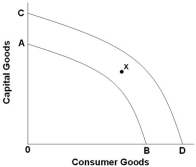 Refer to the above graph. If the production possibilities curve for an economy is at CD but the economy is operating at point X, the reasons are most likely to be because of:
A) Technological progress and industrial change
B) Increases in the quantity and the quality of resources
C) Improvement in labor productivity and the number of work-hours
D) Unemployment and inefficient allocation of resources
Question
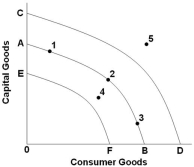 Assume a nation's current production possibilities are represented by the curve AB in the above diagram. Economic growth would best be indicated by a:
A) Shift in the curve from AB to CD
B) Shift in the curve from AB to EF
C) Movement from point 1 to point 2
D) Movement from point 3 to point 4
Question
Question
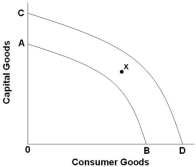 Refer to the above graph. If the production possibilities curve of an economy shifts from AB to CD, it is most likely caused by which of the following factors?
A) A decrease in the price level
B) Allocative efficiency
C) Technological progress
D) Full employment of resources
Question
Question
Question
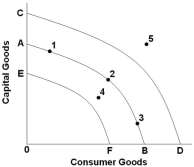 Refer to the above diagram. If the production possibilities curve of an economy shifts from AB to CD, it is most likely the result of what factor affecting economic growth?
A) A supply factor
B) A demand factor
C) An efficiency factor
D) An allocation factor
Question
Question
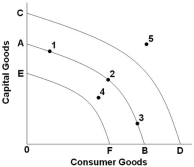 Refer to the above diagram. If the production possibilities of an economy are shown by curve AB but the economy is operating at point 4, the reasons are most likely to be because of:
A) Supply and environmental factors
B) Demand and efficiency factors
C) Labor inputs and labor productivity
D) Technological progress
Question
Question
Question
Question
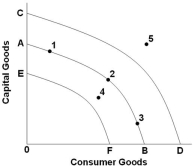 Refer to the above diagram. Which of the following is the most likely cause for a shift in the production possibilities curve from AB to CD?
A) The use of the economy's resources in a more efficient way
B) An increase in the spending of business and consumers
C) An increase in government purchase of the economy's output
D) An increase in the quantity and quality of labor resources
Question
Question
Question
Question
Question
Question
Question
Question
The table below shows the quantity of labor (measured in hours) and the productivity of labor (measured in real GDP per hour) in a hypothetical economy in three different years. 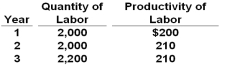 Refer to the above table. In Year 2, the economy's real GDP was:
A) $400,000
B) $420,000
C) $462,000
D) $500,000
Refer to the above table. In Year 2, the economy's real GDP was:A) $400,000
B) $420,000
C) $462,000
D) $500,000
Question
Question
Question
Question
Question
Question
Question
Question
Question
Question
The table below shows the quantity of labor (measured in hours) and the productivity of labor (measured in real GDP per hour) in a hypothetical economy in three different years. 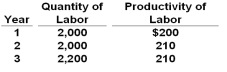 Refer to the above table. Between Year 2 and Year 3, real GDP increased by:
A) 2 percent
B) 5 percent
C) 10 percent
D) 15 percent
Refer to the above table. Between Year 2 and Year 3, real GDP increased by:A) 2 percent
B) 5 percent
C) 10 percent
D) 15 percent
Question
Question
Question
Question
Question
Question
Question
Question
Question
Question
Question
Question
Question
Question
Question
Question
Question
Question
Question
Question
Question
Question
Question

Unlock Deck
Sign up to unlock the cards in this deck!
Unlock Deck
Unlock Deck
1/114

Play

Full screen (f)
Deck 8: Economic Growth
1
Before the Industrial Revolution, living standards in the world:
A) Were relatively stagnant for long periods of time
B) Were already rising significantly for many decades
C) Are not known, for lack of reliable records from that period
D) Were declining because of rapid increases in population
A) Were relatively stagnant for long periods of time
B) Were already rising significantly for many decades
C) Are not known, for lack of reliable records from that period
D) Were declining because of rapid increases in population
Were relatively stagnant for long periods of time
2
The invention of the steam engine ushered in the following developments, except:
A) Mass-production in industrial factories, for the first time
B) Much easier and cheaper transportation of resources and products
C) A sharp reduction in trade as many societies specialized
D) Major population shifts, from farms to towns and cities
A) Mass-production in industrial factories, for the first time
B) Much easier and cheaper transportation of resources and products
C) A sharp reduction in trade as many societies specialized
D) Major population shifts, from farms to towns and cities
A sharp reduction in trade as many societies specialized
3
Economic growth in the U.S. since 1950 has been characterized by:
A) An average growth rate in real GDP that is slower than the growth rate of the population
B) A quadrupling of real GDP from 1950 to 2012
C) An average growth rate in real GDP that is faster than the growth rate of the population
D) An average growth rate in real GDP per capita of about 6% per year
A) An average growth rate in real GDP that is slower than the growth rate of the population
B) A quadrupling of real GDP from 1950 to 2012
C) An average growth rate in real GDP that is faster than the growth rate of the population
D) An average growth rate in real GDP per capita of about 6% per year
An average growth rate in real GDP that is faster than the growth rate of the population
4
Efficient financial institutions foster the flow of:
A) Saving and investment
B) Spending and income
C) Resources and products
D) Inventions and ideas
A) Saving and investment
B) Spending and income
C) Resources and products
D) Inventions and ideas
Unlock Deck
Unlock for access to all 114 flashcards in this deck.
Unlock Deck
k this deck
5
Patents and copyrights foster the flow of:
A) Saving and investment
B) Spending and income
C) Resources and products
D) Inventions and ideas
A) Saving and investment
B) Spending and income
C) Resources and products
D) Inventions and ideas
Unlock Deck
Unlock for access to all 114 flashcards in this deck.
Unlock Deck
k this deck
6
Growth-promoting institutional structures include the following, except:
A) Patents and copyrights
B) Efficient financial institutions
C) Protection of domestic firms from foreign rivals
D) Stable political system
A) Patents and copyrights
B) Efficient financial institutions
C) Protection of domestic firms from foreign rivals
D) Stable political system
Unlock Deck
Unlock for access to all 114 flashcards in this deck.
Unlock Deck
k this deck
7
Which of the following is a measure of economic growth that is most useful for comparing living standards?
A) Growth in nominal GDP
B) Decreases in the rate of unemployment
C) Increases in real GDP per capita
D) Increases in real GDP
A) Growth in nominal GDP
B) Decreases in the rate of unemployment
C) Increases in real GDP per capita
D) Increases in real GDP
Unlock Deck
Unlock for access to all 114 flashcards in this deck.
Unlock Deck
k this deck
8
The following factors tend to make the real GDP growth rate understate the growth of economic well-being, except:
A) Improved product quality
B) Added leisure
C) Debasement of the environment
D) More stress-free lifestyle
A) Improved product quality
B) Added leisure
C) Debasement of the environment
D) More stress-free lifestyle
Unlock Deck
Unlock for access to all 114 flashcards in this deck.
Unlock Deck
k this deck
9
A nation's average annual real GDP growth rate is 2.5%. Based on the "rule of 70", the approximate number of years that it would take for this nation's real GDP to double is:
A) 175 years
B) 40 years
C) 28 years
A) 175 years
B) 40 years
C) 28 years
Unlock Deck
Unlock for access to all 114 flashcards in this deck.
Unlock Deck
k this deck
10
Economic historians identify which invention as a major factor that started the Industrial Revolution in Britain?
A) Steam engine
B) Automobile
C) Telephone
D) Electric motor
A) Steam engine
B) Automobile
C) Telephone
D) Electric motor
Unlock Deck
Unlock for access to all 114 flashcards in this deck.
Unlock Deck
k this deck
11
Modern economic growth often results in the following, except:
A) Less time for ordinary people to enjoy leisure activities because the primary focus is on production and work
B) Vast increases in wealth and living standards for many groups in the economy
C) Spread of universal education and elimination of ancient social norms
D) Movement towards democracy and the abolishment of feudalism
A) Less time for ordinary people to enjoy leisure activities because the primary focus is on production and work
B) Vast increases in wealth and living standards for many groups in the economy
C) Spread of universal education and elimination of ancient social norms
D) Movement towards democracy and the abolishment of feudalism
Unlock Deck
Unlock for access to all 114 flashcards in this deck.
Unlock Deck
k this deck
12
Consider two scenarios for a nation's economic growth. Scenario A has real GDP growing at an average annual rate of 3.5%; scenario B has an average annual growth of 4.5%. The nation's real GDP would double in about:
A) 20 years under scenario A, versus 30 years under scenario B
B) 20 years under scenario A, versus 16 years under scenario B
C) 12 years under scenario A, versus 16 years under scenario B
D) 16 years under scenario A, versus 30 years under scenario B
A) 20 years under scenario A, versus 30 years under scenario B
B) 20 years under scenario A, versus 16 years under scenario B
C) 12 years under scenario A, versus 16 years under scenario B
D) 16 years under scenario A, versus 30 years under scenario B
Unlock Deck
Unlock for access to all 114 flashcards in this deck.
Unlock Deck
k this deck
13
A nation's real GDP was $250 billion in 2013 and $265 billion in 2014. Its population was 120 million in 2013 and 125 million in 2014. What is its real GDP per capita in 2014?
A) $2,120 per person
B) $212 per person
C) $21,200 per person
D) $205 per person
A) $2,120 per person
B) $212 per person
C) $21,200 per person
D) $205 per person
Unlock Deck
Unlock for access to all 114 flashcards in this deck.
Unlock Deck
k this deck
14
Nation A's real GDP was $520 billion in 2013 and $550 billion in 2014. Its population was 150 million in 2013 and 155 million in 2014. On the other hand, Nation B's real GDP was $200 billion in 2013 and $210 billion in 2014; and its population was 53 million in 2013 and 55 million in 2014. Which of the following statements is true?
A) Nation A's GDP per capita increased from 2013 to 2014, while Nation B's decreased
B) Nation B's GDP per capita increased from 2013 to 2014, while Nation A's decreased
C) Nation A's and Nation B's GDP per capita both decreased from 2013 to 2014
D) Nation A's and Nation B's GDP per capita both increased from 2013 to 2014
A) Nation A's GDP per capita increased from 2013 to 2014, while Nation B's decreased
B) Nation B's GDP per capita increased from 2013 to 2014, while Nation A's decreased
C) Nation A's and Nation B's GDP per capita both decreased from 2013 to 2014
D) Nation A's and Nation B's GDP per capita both increased from 2013 to 2014
Unlock Deck
Unlock for access to all 114 flashcards in this deck.
Unlock Deck
k this deck
15
Which of the following is a measure of economic growth that is most useful for measuring geopolitical preeminence or military potential?
A) Growth in nominal GDP
B) Decreases in the rate of unemployment
C) Increases in real GDP per capita
D) Increases in real GDP
A) Growth in nominal GDP
B) Decreases in the rate of unemployment
C) Increases in real GDP per capita
D) Increases in real GDP
Unlock Deck
Unlock for access to all 114 flashcards in this deck.
Unlock Deck
k this deck
16
The "rule of 70" is a formula for determining the approximate number of:
A) Years that it would take for a value (like real GDP) to expand 70 times
B) Years that it would take for a value (like real GDP) to double
C) Times a value (like real GDP) is a multiple of 70
D) Times one could double a certain value (like real GDP) over 70 years
A) Years that it would take for a value (like real GDP) to expand 70 times
B) Years that it would take for a value (like real GDP) to double
C) Times a value (like real GDP) is a multiple of 70
D) Times one could double a certain value (like real GDP) over 70 years
Unlock Deck
Unlock for access to all 114 flashcards in this deck.
Unlock Deck
k this deck
17
In the modern economic growth process, it is typical to find that:
A) Leader countries continue to grow faster than follower countries
B) Follower countries can grow faster than leader countries
C) Large countries cannot grow faster than leader countries
D) The gap between the leader countries and the follower countries stays constant
A) Leader countries continue to grow faster than follower countries
B) Follower countries can grow faster than leader countries
C) Large countries cannot grow faster than leader countries
D) The gap between the leader countries and the follower countries stays constant
Unlock Deck
Unlock for access to all 114 flashcards in this deck.
Unlock Deck
k this deck
18
Nation A's real GDP was $520 billion in 2013 and $550 billion in 2014. Its population was 150 million in 2013 and 155 million in 2014. On the other hand, Nation B's real GDP was $200 billion in 2013 and $210 billion in 2014; and its population was 53 million in 2013 and 55 million in 2014. Which of the following statements is true?
A) Nation A's real GDP growth in 2014 is higher than Nation B's
B) Nation B's real GDP growth in 2014 is higher than Nation A's
C) Nation A's real GDP growth in 2014 is identical to Nation B's
D) Nation A's and Nation B's real GDP growth rates in 2014 are both higher than 10%
A) Nation A's real GDP growth in 2014 is higher than Nation B's
B) Nation B's real GDP growth in 2014 is higher than Nation A's
C) Nation A's real GDP growth in 2014 is identical to Nation B's
D) Nation A's and Nation B's real GDP growth rates in 2014 are both higher than 10%
Unlock Deck
Unlock for access to all 114 flashcards in this deck.
Unlock Deck
k this deck
19
The main cause for the vast differences in per capita GDP levels seen across the globe today is the:
A) Huge differences in the natural-resource endowments of different countries
B) Major differences in the population sizes of various societies
C) Different starting dates of modern economic growth in different parts of the world
D) Differences in religions that different societies around the world believe in
A) Huge differences in the natural-resource endowments of different countries
B) Major differences in the population sizes of various societies
C) Different starting dates of modern economic growth in different parts of the world
D) Differences in religions that different societies around the world believe in
Unlock Deck
Unlock for access to all 114 flashcards in this deck.
Unlock Deck
k this deck
20
Which of the following does not correctly characterize modern economic growth?
A) It spread slowly across the globe, with some societies not having experienced it yet
B) It has occurred only in the last 200 or so years
C) It drastically alters the culture and politics of society
D) It has not affected the average lifespan of human beings
A) It spread slowly across the globe, with some societies not having experienced it yet
B) It has occurred only in the last 200 or so years
C) It drastically alters the culture and politics of society
D) It has not affected the average lifespan of human beings
Unlock Deck
Unlock for access to all 114 flashcards in this deck.
Unlock Deck
k this deck
21
A nation's real GDP will increase by increasing the following, except:
A) Number of workers
B) Labor productivity
C) Technological progress
D) Average price level
A) Number of workers
B) Labor productivity
C) Technological progress
D) Average price level
Unlock Deck
Unlock for access to all 114 flashcards in this deck.
Unlock Deck
k this deck
22
Suppose that an economy is initially operating at a point on its PPC. If it then experiences an expansion in its production capacity, but its total spending does not rise as fast as its capacity, the economy will end up:
A) Still on its PPC
B) Outside its PPC
C) Inside its PPC
D) On one of the axes of its PPC
A) Still on its PPC
B) Outside its PPC
C) Inside its PPC
D) On one of the axes of its PPC
Unlock Deck
Unlock for access to all 114 flashcards in this deck.
Unlock Deck
k this deck
23
Which of the following is the so-called efficiency factor of economic growth?
A) Having an efficient financial system
B) Reaching full production potential
C) Having free trade
D) Enhanced quantity and quality of human resources
A) Having an efficient financial system
B) Reaching full production potential
C) Having free trade
D) Enhanced quantity and quality of human resources
Unlock Deck
Unlock for access to all 114 flashcards in this deck.
Unlock Deck
k this deck
24
Which of the following will NOT increase the average productivity of labor?
A) An increase in the stock of real capital
B) Improvement in the education and health of the population
C) Technological progress
D) An increase in the size of the labor force
A) An increase in the stock of real capital
B) Improvement in the education and health of the population
C) Technological progress
D) An increase in the size of the labor force
Unlock Deck
Unlock for access to all 114 flashcards in this deck.
Unlock Deck
k this deck
25
Which of the following is a demand factor in economic growth?
A) More human and natural resources
B) Technological progress and innovation
C) An increase in the economy's stock of capital goods
D) An increase in total spending in the economy
A) More human and natural resources
B) Technological progress and innovation
C) An increase in the economy's stock of capital goods
D) An increase in total spending in the economy
Unlock Deck
Unlock for access to all 114 flashcards in this deck.
Unlock Deck
k this deck
26
The reasons why per capita GDP in the U.S. is significantly higher than in some other rich countries like, say, France include the following, except:
A) U.S. citizens put in substantially more work hours than do citizens of France
B) Cultural differences between the U.S. and France regarding the right balance between labor and leisure
C) Differences in the tax structure and the resulting incentive effects of taxes
D) Differences is the communication technology due to language differences
A) U.S. citizens put in substantially more work hours than do citizens of France
B) Cultural differences between the U.S. and France regarding the right balance between labor and leisure
C) Differences in the tax structure and the resulting incentive effects of taxes
D) Differences is the communication technology due to language differences
Unlock Deck
Unlock for access to all 114 flashcards in this deck.
Unlock Deck
k this deck
27
Refer to the above graph. If the production possibilities curve for an economy is at CD but the economy is operating at point X, the reasons are most likely to be because of:A) Technological progress and industrial change
B) Increases in the quantity and the quality of resources
C) Improvement in labor productivity and the number of work-hours
D) Unemployment and inefficient allocation of resources
Unlock Deck
Unlock for access to all 114 flashcards in this deck.
Unlock Deck
k this deck
28
Assume a nation's current production possibilities are represented by the curve AB in the above diagram. Economic growth would best be indicated by a:A) Shift in the curve from AB to CD
B) Shift in the curve from AB to EF
C) Movement from point 1 to point 2
D) Movement from point 3 to point 4
Unlock Deck
Unlock for access to all 114 flashcards in this deck.
Unlock Deck
k this deck
29
Which of the following is best considered a demand factor in economic growth?
A) The quantity of human resources
B) The quality of natural resources
C) The stock of capital goods
D) The full employment of resources
A) The quantity of human resources
B) The quality of natural resources
C) The stock of capital goods
D) The full employment of resources
Unlock Deck
Unlock for access to all 114 flashcards in this deck.
Unlock Deck
k this deck
30
Refer to the above graph. If the production possibilities curve of an economy shifts from AB to CD, it is most likely caused by which of the following factors?A) A decrease in the price level
B) Allocative efficiency
C) Technological progress
D) Full employment of resources
Unlock Deck
Unlock for access to all 114 flashcards in this deck.
Unlock Deck
k this deck
31
If 40,000 worker-hours produced a total output of $600,000 in an economy, then the labor productivity is:
A) $10/worker-hour
B) $15/worker-hour
C) $24/worker-hour
D) $240/worker-hour
A) $10/worker-hour
B) $15/worker-hour
C) $24/worker-hour
D) $240/worker-hour
Unlock Deck
Unlock for access to all 114 flashcards in this deck.
Unlock Deck
k this deck
32
Real GDP or total output in any year is equal to:
A) Labor productivity divided by number of worker-hours
B) Labor productivity multiplied by real output
C) Number of worker-hours multiplied by labor productivity
D) Number of worker-hours divided by labor productivity
A) Labor productivity divided by number of worker-hours
B) Labor productivity multiplied by real output
C) Number of worker-hours multiplied by labor productivity
D) Number of worker-hours divided by labor productivity
Unlock Deck
Unlock for access to all 114 flashcards in this deck.
Unlock Deck
k this deck
33
Refer to the above diagram. If the production possibilities curve of an economy shifts from AB to CD, it is most likely the result of what factor affecting economic growth?A) A supply factor
B) A demand factor
C) An efficiency factor
D) An allocation factor
Unlock Deck
Unlock for access to all 114 flashcards in this deck.
Unlock Deck
k this deck
34
The number of worker-hours available in an economy is determined by the following, except:
A) Size of the labor force
B) Length of the average workweek
C) Unemployment rate of the workforce
D) Labor force participation rate
A) Size of the labor force
B) Length of the average workweek
C) Unemployment rate of the workforce
D) Labor force participation rate
Unlock Deck
Unlock for access to all 114 flashcards in this deck.
Unlock Deck
k this deck
35
Refer to the above diagram. If the production possibilities of an economy are shown by curve AB but the economy is operating at point 4, the reasons are most likely to be because of:A) Supply and environmental factors
B) Demand and efficiency factors
C) Labor inputs and labor productivity
D) Technological progress
Unlock Deck
Unlock for access to all 114 flashcards in this deck.
Unlock Deck
k this deck
36
Society can increase its output and income by increasing basically one or both of two factors:
A) Its spending and investment
B) Its private and public sectors of the economy
C) Its resources and the productivity of the resources
D) Its markets and prices
A) Its spending and investment
B) Its private and public sectors of the economy
C) Its resources and the productivity of the resources
D) Its markets and prices
Unlock Deck
Unlock for access to all 114 flashcards in this deck.
Unlock Deck
k this deck
37
Assume that an economy has 1500 workers, each working 2000 hours per year. If the average real output per worker-hour is $20, then total output or real GDP will be:
A) $3 million
B) $30 million
C) $45 million
D) $60 million
A) $3 million
B) $30 million
C) $45 million
D) $60 million
Unlock Deck
Unlock for access to all 114 flashcards in this deck.
Unlock Deck
k this deck
38
Economic growth can best be portrayed as a:
A) Leftward shift of the production possibilities curve
B) Movement from a point inside to a point outside of the production possibilities curve
C) Movement from a point near the vertical axis to a point near the horizontal axis on the production possibilities curve
D) Rightward shift of the production possibilities curve
A) Leftward shift of the production possibilities curve
B) Movement from a point inside to a point outside of the production possibilities curve
C) Movement from a point near the vertical axis to a point near the horizontal axis on the production possibilities curve
D) Rightward shift of the production possibilities curve
Unlock Deck
Unlock for access to all 114 flashcards in this deck.
Unlock Deck
k this deck
39
Refer to the above diagram. Which of the following is the most likely cause for a shift in the production possibilities curve from AB to CD?A) The use of the economy's resources in a more efficient way
B) An increase in the spending of business and consumers
C) An increase in government purchase of the economy's output
D) An increase in the quantity and quality of labor resources
Unlock Deck
Unlock for access to all 114 flashcards in this deck.
Unlock Deck
k this deck
40
Supply factors in economic growth include the following, except:
A) Improvements in technology
B) Expansion of capital stock
C) Increases in purchases of output
D) Better education and training
A) Improvements in technology
B) Expansion of capital stock
C) Increases in purchases of output
D) Better education and training
Unlock Deck
Unlock for access to all 114 flashcards in this deck.
Unlock Deck
k this deck
41
The factor accounting for the largest increase in the productivity of labor in the United States has been:
A) The education and training of workers
B) Improved resource allocation
C) The quantity of capital
D) Technological advance
A) The education and training of workers
B) Improved resource allocation
C) The quantity of capital
D) Technological advance
Unlock Deck
Unlock for access to all 114 flashcards in this deck.
Unlock Deck
k this deck
42
Trends in educational attainment in the U.S. since 1960 indicate that the percentage of adults:
A) Completing high school has been rising, and so has the percentage who do not go to high school nor complete elementary school
B) Completing college has been rising, and so has the percentage completing high school
C) Completing college has been constant, but the percentage completing high school has been rising
D) Who do not go to high school has been falling, but the percentage who do not complete elementary school has been rising
A) Completing high school has been rising, and so has the percentage who do not go to high school nor complete elementary school
B) Completing college has been rising, and so has the percentage completing high school
C) Completing college has been constant, but the percentage completing high school has been rising
D) Who do not go to high school has been falling, but the percentage who do not complete elementary school has been rising
Unlock Deck
Unlock for access to all 114 flashcards in this deck.
Unlock Deck
k this deck
43
In 2011, what percent of adults in the U.S. were college graduates or higher?
A) 10%
B) 30%
C) 50%
D) 70%
A) 10%
B) 30%
C) 50%
D) 70%
Unlock Deck
Unlock for access to all 114 flashcards in this deck.
Unlock Deck
k this deck
44
One concern regarding educational attainment in the U.S. is that:
A) The percentage of adults finishing college is falling
B) There are fewer college graduates in science and engineering
C) Students are graduating later and later
D) Fewer high school graduates are going on to college
A) The percentage of adults finishing college is falling
B) There are fewer college graduates in science and engineering
C) Students are graduating later and later
D) Fewer high school graduates are going on to college
Unlock Deck
Unlock for access to all 114 flashcards in this deck.
Unlock Deck
k this deck
45
The shift of labor out of agriculture to industry in the United States has tended to:
A) Reduce the rate of productivity growth
B) Increase unemployment in the agriculture sector
C) Reduce unemployment in the industrial sector
D) Increase labor productivity
A) Reduce the rate of productivity growth
B) Increase unemployment in the agriculture sector
C) Reduce unemployment in the industrial sector
D) Increase labor productivity
Unlock Deck
Unlock for access to all 114 flashcards in this deck.
Unlock Deck
k this deck
46
The size of the labor force depends on the size of the working-age population and the:
A) Participation rate
B) Employment rate
C) Unemployment rate
D) Inflation rate
A) Participation rate
B) Employment rate
C) Unemployment rate
D) Inflation rate
Unlock Deck
Unlock for access to all 114 flashcards in this deck.
Unlock Deck
k this deck
47
The table below shows the quantity of labor (measured in hours) and the productivity of labor (measured in real GDP per hour) in a hypothetical economy in three different years. Refer to the above table. In Year 2, the economy's real GDP was:
A) $400,000
B) $420,000
C) $462,000
D) $500,000
Refer to the above table. In Year 2, the economy's real GDP was:A) $400,000
B) $420,000
C) $462,000
D) $500,000
Unlock Deck
Unlock for access to all 114 flashcards in this deck.
Unlock Deck
k this deck
48
Which of the following factors has been the dominant source of economic growth in the U.S. (except in 1973-1995)?
A) Increase in population
B) Increase in labor productivity
C) Increase in hours per worker
D) Increase in labor force
A) Increase in population
B) Increase in labor productivity
C) Increase in hours per worker
D) Increase in labor force
Unlock Deck
Unlock for access to all 114 flashcards in this deck.
Unlock Deck
k this deck
49
What economic concept would be most closely associated with a situation where an aluminum plant expands its operations and uses extensive computerization in the production line to reduce per-unit costs of production?
A) Infrastructure
B) Human capital
C) Network effects
D) Economies of scale
A) Infrastructure
B) Human capital
C) Network effects
D) Economies of scale
Unlock Deck
Unlock for access to all 114 flashcards in this deck.
Unlock Deck
k this deck
50
Which of the following factors is projected to be the dominant source of economic growth in the U.S. from now until 2020?
A) Increase in hours per worker
B) Increase in labor force
C) Increase in population
D) Increase in labor productivity
A) Increase in hours per worker
B) Increase in labor force
C) Increase in population
D) Increase in labor productivity
Unlock Deck
Unlock for access to all 114 flashcards in this deck.
Unlock Deck
k this deck
51
In the U.S. economic-growth experience:
A) Most capital substitutes for labor
B) Most capital is complementary to labor
C) The amount of capital available per worker has been relatively constant
D) The amount of capital available per worker has been decreasing
A) Most capital substitutes for labor
B) Most capital is complementary to labor
C) The amount of capital available per worker has been relatively constant
D) The amount of capital available per worker has been decreasing
Unlock Deck
Unlock for access to all 114 flashcards in this deck.
Unlock Deck
k this deck
52
Technological advances that contribute to economic growth include the following, except:
A) Innovative production techniques
B) New managerial methods
C) Innovative digital gadgets for consumers
D) New forms of business organization
A) Innovative production techniques
B) New managerial methods
C) Innovative digital gadgets for consumers
D) New forms of business organization
Unlock Deck
Unlock for access to all 114 flashcards in this deck.
Unlock Deck
k this deck
53
The movement of workers from lower productivity jobs to higher productivity jobs would be an example of a(n):
A) Technological advance
B) Network effects
C) Simultaneous consumption
D) Improved resource allocation
A) Technological advance
B) Network effects
C) Simultaneous consumption
D) Improved resource allocation
Unlock Deck
Unlock for access to all 114 flashcards in this deck.
Unlock Deck
k this deck
54
Technological advance is very tightly intertwined with:
A) Capital formation
B) Household consumption
C) Government spending
D) Population growth
A) Capital formation
B) Household consumption
C) Government spending
D) Population growth
Unlock Deck
Unlock for access to all 114 flashcards in this deck.
Unlock Deck
k this deck
55
In the U.S. in the past six decades or so, we saw the following trends, except:
A) The average length of the workweek remained relatively constant
B) The size of the labor force expanded
C) Rising birthrates kept the native-born population growing at a steady rate
D) Women's labor-force participation rate surged
A) The average length of the workweek remained relatively constant
B) The size of the labor force expanded
C) Rising birthrates kept the native-born population growing at a steady rate
D) Women's labor-force participation rate surged
Unlock Deck
Unlock for access to all 114 flashcards in this deck.
Unlock Deck
k this deck
56
Historically, the total amount of real capital per worker in the United States has:
A) Provided financing for the industrial expansion of business
B) Increased significantly and made labor more productive
C) Been the single most important determinant of economic growth
D) Remained relatively constant, although the quality of capital has improved dramatically
A) Provided financing for the industrial expansion of business
B) Increased significantly and made labor more productive
C) Been the single most important determinant of economic growth
D) Remained relatively constant, although the quality of capital has improved dramatically
Unlock Deck
Unlock for access to all 114 flashcards in this deck.
Unlock Deck
k this deck
57
The table below shows the quantity of labor (measured in hours) and the productivity of labor (measured in real GDP per hour) in a hypothetical economy in three different years. Refer to the above table. Between Year 2 and Year 3, real GDP increased by:
A) 2 percent
B) 5 percent
C) 10 percent
D) 15 percent
Refer to the above table. Between Year 2 and Year 3, real GDP increased by:A) 2 percent
B) 5 percent
C) 10 percent
D) 15 percent
Unlock Deck
Unlock for access to all 114 flashcards in this deck.
Unlock Deck
k this deck
58
Labor productivity can only increase if:
A) Labor increases faster than capital
B) Capital increases faster than labor
C) Labor increases while capital decreases
D) Labor and capital increase at the same rate
A) Labor increases faster than capital
B) Capital increases faster than labor
C) Labor increases while capital decreases
D) Labor and capital increase at the same rate
Unlock Deck
Unlock for access to all 114 flashcards in this deck.
Unlock Deck
k this deck
59
Human capital refers to the:
A) Tools and equipment available to workers
B) Amount of financing available to start-up firms
C) Number of workers available in the economy
D) Education, training, and skills of workers
A) Tools and equipment available to workers
B) Amount of financing available to start-up firms
C) Number of workers available in the economy
D) Education, training, and skills of workers
Unlock Deck
Unlock for access to all 114 flashcards in this deck.
Unlock Deck
k this deck
60
Which of the following is the single most important source of U.S. economic growth?
A) Stability of the socio-cultural-political environment
B) Improvement in the legal and human environment
C) Increases in the quantity of labor
D) Increases in labor productivity
A) Stability of the socio-cultural-political environment
B) Improvement in the legal and human environment
C) Increases in the quantity of labor
D) Increases in labor productivity
Unlock Deck
Unlock for access to all 114 flashcards in this deck.
Unlock Deck
k this deck
61
Sources of increasing returns that help raise productivity growth include the following, except:
A) More specialized inputs
B) Spreading of development costs
C) Network effects
D) Low unemployment
A) More specialized inputs
B) Spreading of development costs
C) Network effects
D) Low unemployment
Unlock Deck
Unlock for access to all 114 flashcards in this deck.
Unlock Deck
k this deck
62
Increasing returns would be a situation where a firm increases its workforce and other inputs by:
A) 8 percent and its output increases by 5 percent
B) 5 percent and its output increase by 8 percent
C) 8 percent and its output increases by 8 percent
D) 12 percent and its output increases by 10 percent
A) 8 percent and its output increases by 5 percent
B) 5 percent and its output increase by 8 percent
C) 8 percent and its output increases by 8 percent
D) 12 percent and its output increases by 10 percent
Unlock Deck
Unlock for access to all 114 flashcards in this deck.
Unlock Deck
k this deck
63
Increasing returns in production implies the following, except:
A) Increasing labor-requirements per unit of output
B) Decreasing per-unit production costs
C) Economies of scale
D) An increase in the productivity of inputs
A) Increasing labor-requirements per unit of output
B) Decreasing per-unit production costs
C) Economies of scale
D) An increase in the productivity of inputs
Unlock Deck
Unlock for access to all 114 flashcards in this deck.
Unlock Deck
k this deck
64
One of the main arguments against further growth for industrialized nations focuses on the problem of:
A) Technological knowledge
B) Environmental quality
C) Feedback mechanisms
D) Infrastructure
A) Technological knowledge
B) Environmental quality
C) Feedback mechanisms
D) Infrastructure
Unlock Deck
Unlock for access to all 114 flashcards in this deck.
Unlock Deck
k this deck
65
Rising real wages for women in the U.S. workforce since the 1960s have:
A) Reduced access to job opportunities for women
B) Increased the opportunity cost of staying at home
C) Led to a rise in the number of lifetime births per woman
D) Reallocated labor resources from urban to rural areas of the nation
A) Reduced access to job opportunities for women
B) Increased the opportunity cost of staying at home
C) Led to a rise in the number of lifetime births per woman
D) Reallocated labor resources from urban to rural areas of the nation
Unlock Deck
Unlock for access to all 114 flashcards in this deck.
Unlock Deck
k this deck
66
One major economic benefit of global competition is:
A) Lower unemployment
B) Increased protection of domestic firms
C) Pressure to innovate
D) More leisure opportunities
A) Lower unemployment
B) Increased protection of domestic firms
C) Pressure to innovate
D) More leisure opportunities
Unlock Deck
Unlock for access to all 114 flashcards in this deck.
Unlock Deck
k this deck
67
Increases in the value of the product to each user, including existing users, as the total number of users rises is called:
A) Network effects
B) Simultaneous consumption
C) Learning by doing
D) The spreading of development costs
A) Network effects
B) Simultaneous consumption
C) Learning by doing
D) The spreading of development costs
Unlock Deck
Unlock for access to all 114 flashcards in this deck.
Unlock Deck
k this deck
68
Which of the following countries ranked highest in the World Economic Forum's Global Competitiveness Ranking in 2012-13?
A) Japan
B) Switzerland
C) Germany
D) The U.S.
A) Japan
B) Switzerland
C) Germany
D) The U.S.
Unlock Deck
Unlock for access to all 114 flashcards in this deck.
Unlock Deck
k this deck
69
The entry of women into the workforce since the 1960s resulted in:
A) A shift outward in the production possibilities curve of the United States
B) A shift inward in the production possibilities curve in the United States
C) A movement along the existing production possibilities curve in the United States
D) A falling real wage for women workers of the United States
A) A shift outward in the production possibilities curve of the United States
B) A shift inward in the production possibilities curve in the United States
C) A movement along the existing production possibilities curve in the United States
D) A falling real wage for women workers of the United States
Unlock Deck
Unlock for access to all 114 flashcards in this deck.
Unlock Deck
k this deck
70
A major effect of the rise in the rate of productivity growth in the United States is a(n):
A) Rise in the rate of inflation
B) Rise in the growth of living standards
C) Increase in the relative prices of U.S. goods in foreign markets
D) Increase in the competitiveness of U.S. goods in foreign markets
A) Rise in the rate of inflation
B) Rise in the growth of living standards
C) Increase in the relative prices of U.S. goods in foreign markets
D) Increase in the competitiveness of U.S. goods in foreign markets
Unlock Deck
Unlock for access to all 114 flashcards in this deck.
Unlock Deck
k this deck
71
Critics of growth policies focus on the following arguments, except:
A) Growth has resulted in resource degradation and pollution
B) Sociological problems like poverty have not been solved by growth
C) Growth may have given us the good life, but we cannot better it anymore
D) Rapid growth is not sustainable in the long term due to resource limitations
A) Growth has resulted in resource degradation and pollution
B) Sociological problems like poverty have not been solved by growth
C) Growth may have given us the good life, but we cannot better it anymore
D) Rapid growth is not sustainable in the long term due to resource limitations
Unlock Deck
Unlock for access to all 114 flashcards in this deck.
Unlock Deck
k this deck
72
The rapid productivity growth experienced in 1995-2012:
A) Is believed by most economists to be a permanent shift in the economy
B) Is still debated among many economists as to whether it represents a permanent shift in the economy
C) Suggests that prospects for lasting increases in productivity growth are rather poor
D) Suggests that productivity growth can occur without raising the nation's standard of living
A) Is believed by most economists to be a permanent shift in the economy
B) Is still debated among many economists as to whether it represents a permanent shift in the economy
C) Suggests that prospects for lasting increases in productivity growth are rather poor
D) Suggests that productivity growth can occur without raising the nation's standard of living
Unlock Deck
Unlock for access to all 114 flashcards in this deck.
Unlock Deck
k this deck
73
If the annual growth in a nation's productivity is 2.8 percent rather than 1.5 percent, then the nation's standard of living will double in about:
A) 20 years instead of 40 years
B) 25 years instead of 47 years
C) 46 years instead of 70 years
D) 55 years instead of 115 years
A) 20 years instead of 40 years
B) 25 years instead of 47 years
C) 46 years instead of 70 years
D) 55 years instead of 115 years
Unlock Deck
Unlock for access to all 114 flashcards in this deck.
Unlock Deck
k this deck
74
One major aspect of the socio-cultural-political environment of the United States which has generally been conducive to economic growth is the:
A) Enforcement of contracts by the market
B) Denial of the rights of property ownership
C) Favorable attitude toward work and risk-taking
D) Strict social regulation of production and progress
A) Enforcement of contracts by the market
B) Denial of the rights of property ownership
C) Favorable attitude toward work and risk-taking
D) Strict social regulation of production and progress
Unlock Deck
Unlock for access to all 114 flashcards in this deck.
Unlock Deck
k this deck
75
From 1960 to today, women's labor-force participation rate in the U.S.:
A) Stayed relatively stable at 50%
B) Increased from about 40% to 60%
C) Fell from 50% to 40%
D) Increased slightly from 60% to 65%
A) Stayed relatively stable at 50%
B) Increased from about 40% to 60%
C) Fell from 50% to 40%
D) Increased slightly from 60% to 65%
Unlock Deck
Unlock for access to all 114 flashcards in this deck.
Unlock Deck
k this deck
76
A piece of software that benefits many users at the same time would be an example of:
A) Network effects
B) Learning by doing
C) Multiple production
D) Simultaneous consumption
A) Network effects
B) Learning by doing
C) Multiple production
D) Simultaneous consumption
Unlock Deck
Unlock for access to all 114 flashcards in this deck.
Unlock Deck
k this deck
77
Factors that have contributed to the increase in women's labor-force participation rate in the U.S. include the following, except:
A) Rising wage earnings brought about by rising productivity
B) Better education and more professional training
C) Access to a wider range of job opportunities
D) Increase in the number of children, requiring mothers to find work along with fathers
A) Rising wage earnings brought about by rising productivity
B) Better education and more professional training
C) Access to a wider range of job opportunities
D) Increase in the number of children, requiring mothers to find work along with fathers
Unlock Deck
Unlock for access to all 114 flashcards in this deck.
Unlock Deck
k this deck
78
Which of the following is a main source of increasing returns in recent years?
A) More learning by doing
B) The concentration of development costs
C) The use of less specialized inputs as firms grow
D) More resources devoted to agricultural production
A) More learning by doing
B) The concentration of development costs
C) The use of less specialized inputs as firms grow
D) More resources devoted to agricultural production
Unlock Deck
Unlock for access to all 114 flashcards in this deck.
Unlock Deck
k this deck
79
Factors that contributed to the higher U.S. labor productivity growth in 1995-2012 relative to the earlier period include the following, except:
A) Microchip and information technologies
B) New start-up firms and increasing returns
C) Global competition
D) Population growth
A) Microchip and information technologies
B) New start-up firms and increasing returns
C) Global competition
D) Population growth
Unlock Deck
Unlock for access to all 114 flashcards in this deck.
Unlock Deck
k this deck
80
Compared with the period from 1973-1995, the annual rate of productivity growth from 1995-2012 was about:
A) The same
B) One-and-a-half times faster
C) Three times faster
D) 10% slower
A) The same
B) One-and-a-half times faster
C) Three times faster
D) 10% slower
Unlock Deck
Unlock for access to all 114 flashcards in this deck.
Unlock Deck
k this deck
Unlock Deck
Unlock for access to all 114 flashcards in this deck.






