







 Chat with AI

Deck 17: The Expansion of Europe 1650-1800
Full screen (f)

Question

Question
Question
Question
Question
Question
Question
Question
Question
Question
Question
Question
Question
Question
Question
Question
Question
Question
Question
Question
Question
Question
Question
Question
Question
Question
Question
Question
Question
Question
Question
Question
Question
Question
Question
Question
Question
Question
Question
Question
Question
Question
Question
Question
Question
Map 17.1: Industry and Population in Eighteenth-Century Europe suggests a relationship between population density and the growth of textile production. This leads to the conclusion that textile production was concentrated in 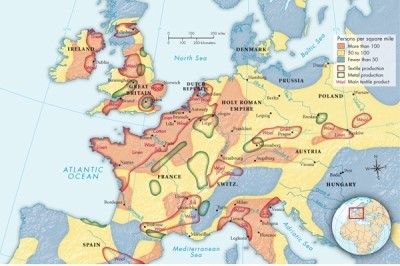
A)large cities.
B)less populated areas where other kinds of work were scarce.
C)France.
D)rural areas with relatively dense populations.
A)large cities.
B)less populated areas where other kinds of work were scarce.
C)France.
D)rural areas with relatively dense populations.
Question
Question
Map 17.2: The Atlantic Economy in 1701 shows trade from Europe, Africa, the Americas, and Asia. What was sent from the Americas to Europe? 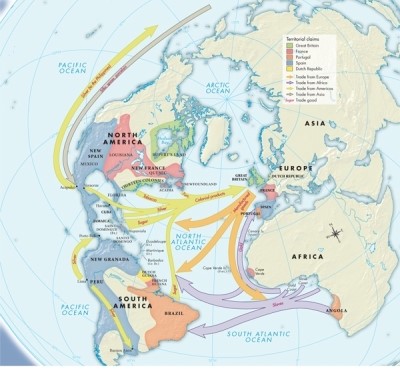
A)Gold and silver
B)Furs, tobacco, and gold
C)Tobacco, silver, spices, and porcelain
D)Tobacco, silver, sugar, and furs
A)Gold and silver
B)Furs, tobacco, and gold
C)Tobacco, silver, spices, and porcelain
D)Tobacco, silver, sugar, and furs
Question
Question
Question
Question
Question
Question
Question
Question
Map 17.2: The Atlantic Economy in 1701 shows trade from Europe, Africa, the Americas, and Asia. What goods were sent from Europe and Africa to the Americas? 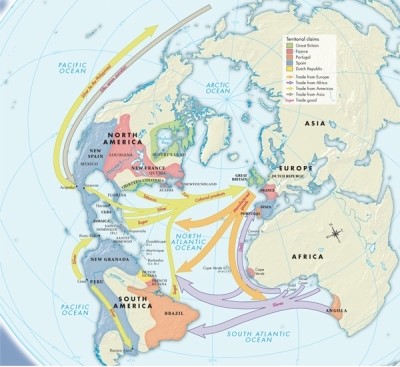
A)Slaves and gold
B)Silks, spices, and porcelain
C)Manufactured goods and gold
D)Manufactured goods and slaves
A)Slaves and gold
B)Silks, spices, and porcelain
C)Manufactured goods and gold
D)Manufactured goods and slaves
Question
Question
Question
Question
Question
Question
Question
Question
Question
Question
Question
Question
Question
Question
Question
Question
Question
Question
Question
Question
Question

Unlock Deck
Sign up to unlock the cards in this deck!
Unlock Deck
Unlock Deck
1/76

Play

Full screen (f)
Deck 17: The Expansion of Europe 1650-1800
1
The English Navigation Acts mandated that all English imports and exports be transported on English ships, and they also
A)restricted English banks from making foreign loans.
B)gave British merchants a virtual monopoly on trade with British colonies.
C)created an alliance with the Dutch against the French.
D)prevented the American colonists from building ships.
A)restricted English banks from making foreign loans.
B)gave British merchants a virtual monopoly on trade with British colonies.
C)created an alliance with the Dutch against the French.
D)prevented the American colonists from building ships.
gave British merchants a virtual monopoly on trade with British colonies.
2
Which of the following characterizes the condition of peasants in western Europe in the eighteenth century?
A)They were bound to a lord's feudal manor and worked the lord's land as part of a long series of feudal obligations.
B)They were technically free but suffered under a system of debt obligation to feudal lords who prevented them from owning their own land.
C)They were free to own small plots of land but never enough to fully support themselves, requiring them to continue to work the land of the local lord, who owned a vast majority of it.
D)They were generally free from serfdom and owned land that they could pass on to their children.
A)They were bound to a lord's feudal manor and worked the lord's land as part of a long series of feudal obligations.
B)They were technically free but suffered under a system of debt obligation to feudal lords who prevented them from owning their own land.
C)They were free to own small plots of land but never enough to fully support themselves, requiring them to continue to work the land of the local lord, who owned a vast majority of it.
D)They were generally free from serfdom and owned land that they could pass on to their children.
They were generally free from serfdom and owned land that they could pass on to their children.
3
Which of the following describes the role of women in guilds in the eighteenth century?
A)Guilds dropped all restrictions that forbade women from serving as masters or laborers.
B)Masters began to hire more female workers, often in defiance of guild rules.
C)Guilds permitted women to serve as workers but forbade any women from becoming masters.
D)Guilds reinforced the regulations forbidding all work by and mastership for women.
A)Guilds dropped all restrictions that forbade women from serving as masters or laborers.
B)Masters began to hire more female workers, often in defiance of guild rules.
C)Guilds permitted women to serve as workers but forbade any women from becoming masters.
D)Guilds reinforced the regulations forbidding all work by and mastership for women.
Masters began to hire more female workers, often in defiance of guild rules.
4
Within the family, the operation of the loom
A)was somewhat dangerous, and children were forbidden from helping with it.
B)generally only occupied one person, leaving other family members to farm or seek outside employment.
C)was reserved for the male head of household.
D)was considered a woman's job, as were most of the sewing crafts.
A)was somewhat dangerous, and children were forbidden from helping with it.
B)generally only occupied one person, leaving other family members to farm or seek outside employment.
C)was reserved for the male head of household.
D)was considered a woman's job, as were most of the sewing crafts.
Unlock Deck
Unlock for access to all 76 flashcards in this deck.
Unlock Deck
k this deck
5
Which of the following correctly characterizes the transformation of the English and Scottish countryside in the enclosure era?
A)Forced to sell their land following enclosures, most of the nobility left the countryside and moved to the cities.
B)The large pools of urban laborers were forced to work in the countryside, because the growing agricultural innovations required more workers for the land.
C)The elimination of common rights and access to land turned small peasant farmers into landless wage earners.
D)While enclosure affected some land usage, most land remained deeply tied to traditional feudal structures.
A)Forced to sell their land following enclosures, most of the nobility left the countryside and moved to the cities.
B)The large pools of urban laborers were forced to work in the countryside, because the growing agricultural innovations required more workers for the land.
C)The elimination of common rights and access to land turned small peasant farmers into landless wage earners.
D)While enclosure affected some land usage, most land remained deeply tied to traditional feudal structures.
Unlock Deck
Unlock for access to all 76 flashcards in this deck.
Unlock Deck
k this deck
6
At the center of Adam Smith's arguments in The Wealth of Nations was the belief that
A)the pursuit of self-interest in competitive markets would improve the living conditions of citizens.
B)capitalism could only flourish if workers' wages were kept low.
C)guilds provided a structural stability to the economy that permitted the free market to function effectively.
D)the government had a responsibility to protect consumers and the general public from price gouging and fraud.
A)the pursuit of self-interest in competitive markets would improve the living conditions of citizens.
B)capitalism could only flourish if workers' wages were kept low.
C)guilds provided a structural stability to the economy that permitted the free market to function effectively.
D)the government had a responsibility to protect consumers and the general public from price gouging and fraud.
Unlock Deck
Unlock for access to all 76 flashcards in this deck.
Unlock Deck
k this deck
7
Population growth in Europe in the eighteenth century occurred
A)only in a few regions that were able to avoid warfare.
B)primarily in regions that saw substantial agricultural innovations.
C)primarily in prosperous regions that were establishing colonial lands in Asia and the Americas.
D)in all regions.
A)only in a few regions that were able to avoid warfare.
B)primarily in regions that saw substantial agricultural innovations.
C)primarily in prosperous regions that were establishing colonial lands in Asia and the Americas.
D)in all regions.
Unlock Deck
Unlock for access to all 76 flashcards in this deck.
Unlock Deck
k this deck
8
According to recent scholarship, during the eighteenth century, the guild system
A)was in the process of collapse as new technologies made guild regulations obsolete.
B)inhibited the development of the economy through its rigid rules and their strict application.
C)provided the foundation for Great Britain's economic growth, since the guilds were strongly supported under British law.
D)remained flexible as masters adopted new technologies and circumvented impractical rules.
A)was in the process of collapse as new technologies made guild regulations obsolete.
B)inhibited the development of the economy through its rigid rules and their strict application.
C)provided the foundation for Great Britain's economic growth, since the guilds were strongly supported under British law.
D)remained flexible as masters adopted new technologies and circumvented impractical rules.
Unlock Deck
Unlock for access to all 76 flashcards in this deck.
Unlock Deck
k this deck
9
In the eighteenth century, European public health measures
A)improved water supply and sewage systems.
B)completely eradicated famine owing to increased supply lines.
C)banned foreign soldiers from entering towns.
D)blocked off roads and canals to prevent the spread of disease.
A)improved water supply and sewage systems.
B)completely eradicated famine owing to increased supply lines.
C)banned foreign soldiers from entering towns.
D)blocked off roads and canals to prevent the spread of disease.
Unlock Deck
Unlock for access to all 76 flashcards in this deck.
Unlock Deck
k this deck
10
In the eighteenth century, advocates for agricultural innovation argued that
A)the rights of the nobility over land needed to be reinforced, since until that time only nobles could force through innovations.
B)landholdings and common lands needed to be consolidated and enclosed in order to farm more efficiently.
C)the key to agricultural innovation was to provide support for the peasants against the lords, as the lords resisted innovation that they feared would diminish their authority.
D)farming should be strictly separated from herding for sheep and cattle, as herds diminished the lands' productivity by trampling and flattening loose soil.
A)the rights of the nobility over land needed to be reinforced, since until that time only nobles could force through innovations.
B)landholdings and common lands needed to be consolidated and enclosed in order to farm more efficiently.
C)the key to agricultural innovation was to provide support for the peasants against the lords, as the lords resisted innovation that they feared would diminish their authority.
D)farming should be strictly separated from herding for sheep and cattle, as herds diminished the lands' productivity by trampling and flattening loose soil.
Unlock Deck
Unlock for access to all 76 flashcards in this deck.
Unlock Deck
k this deck
11
The spinning of thread for the loom
A)required the work of several spinners for each loom, which led merchants to employ the wives and daughters of agricultural workers at terribly low wages.
B)was established as a unique craft in which communities and even regions specialized, especially sheepherding regions.
C)was quickly turned into a mechanized process, which freed more women to take up operation of the loom.
D)marked a new type of industry in which the merchants created unambiguous standards for spun thread that reduced conflicts between merchants and spinners.
A)required the work of several spinners for each loom, which led merchants to employ the wives and daughters of agricultural workers at terribly low wages.
B)was established as a unique craft in which communities and even regions specialized, especially sheepherding regions.
C)was quickly turned into a mechanized process, which freed more women to take up operation of the loom.
D)marked a new type of industry in which the merchants created unambiguous standards for spun thread that reduced conflicts between merchants and spinners.
Unlock Deck
Unlock for access to all 76 flashcards in this deck.
Unlock Deck
k this deck
12
The industrious revolution was a result of
A)the reduction of holidays and festivals by the state in order to create more workdays during the year, combined with laws requiring the closing of taverns two hours past sunset.
B)efforts by Protestant and Catholic churches to combat sin by promoting a gospel of prosperity and industry that would keep workers productively at their labors.
C)merchant capitalists gaining greater authority over workers and forcing them into factories, where their work activity could be more closely monitored and controlled.
D)poor families choosing to reduce leisure time and the production of goods for household consumption in order to earn wages to buy consumer goods.
A)the reduction of holidays and festivals by the state in order to create more workdays during the year, combined with laws requiring the closing of taverns two hours past sunset.
B)efforts by Protestant and Catholic churches to combat sin by promoting a gospel of prosperity and industry that would keep workers productively at their labors.
C)merchant capitalists gaining greater authority over workers and forcing them into factories, where their work activity could be more closely monitored and controlled.
D)poor families choosing to reduce leisure time and the production of goods for household consumption in order to earn wages to buy consumer goods.
Unlock Deck
Unlock for access to all 76 flashcards in this deck.
Unlock Deck
k this deck
13
Merchant capitalists complained bitterly about
A)the high cost of production in the rural countryside.
B)their inability to supervise and direct the work of rural laborers.
C)the constant claims by guilds to authority over rural production.
D)government efforts to protect spinners and weavers from labor abuses.
A)the high cost of production in the rural countryside.
B)their inability to supervise and direct the work of rural laborers.
C)the constant claims by guilds to authority over rural production.
D)government efforts to protect spinners and weavers from labor abuses.
Unlock Deck
Unlock for access to all 76 flashcards in this deck.
Unlock Deck
k this deck
14
Which of the following describes the enclosure movement of the eighteenth century?
A)The land was divided into long, narrow strips that were not enclosed by fences or hedges.
B)The land was not divided but worked communally as villages labored in large fields side by side.
C)The land was divided into plots bounded by fences to farm more effectively.
D)The land was not divided, so the lord of the manor could directly control agricultural techniques and introduce farming innovations.
A)The land was divided into long, narrow strips that were not enclosed by fences or hedges.
B)The land was not divided but worked communally as villages labored in large fields side by side.
C)The land was divided into plots bounded by fences to farm more effectively.
D)The land was not divided, so the lord of the manor could directly control agricultural techniques and introduce farming innovations.
Unlock Deck
Unlock for access to all 76 flashcards in this deck.
Unlock Deck
k this deck
15
Between 1650 and 1790, a crucial component of the global economy was established when European nations developed
A)the African trade
B)the Atlantic economy.
C)the colonial economy.
D)the East Indian trade.
A)the African trade
B)the Atlantic economy.
C)the colonial economy.
D)the East Indian trade.
Unlock Deck
Unlock for access to all 76 flashcards in this deck.
Unlock Deck
k this deck
16
How did the problem of food shortages change in the eighteenth century?
A)Increased road and canal building permitted food to be more easily transported to regions with local crop failure and famine.
B)Advances in agricultural methods produced abundant food supplies and eradicated famine.
C)A return to the open-field system evened out food distribution and helped to prevent food shortages.
D)The European colonies became an alternate source for food that could be used to overcome poor harvests.
A)Increased road and canal building permitted food to be more easily transported to regions with local crop failure and famine.
B)Advances in agricultural methods produced abundant food supplies and eradicated famine.
C)A return to the open-field system evened out food distribution and helped to prevent food shortages.
D)The European colonies became an alternate source for food that could be used to overcome poor harvests.
Unlock Deck
Unlock for access to all 76 flashcards in this deck.
Unlock Deck
k this deck
17
In seventeenth- and eighteenth-century Europe, guild masters
A)permitted easy access to guilds in order to maintain a strong labor force.
B)allowed both men and women entry into all guilds.
C)guarded their guild privileges jealously.
D)denied themselves the right to train their sons or wives in their crafts.
A)permitted easy access to guilds in order to maintain a strong labor force.
B)allowed both men and women entry into all guilds.
C)guarded their guild privileges jealously.
D)denied themselves the right to train their sons or wives in their crafts.
Unlock Deck
Unlock for access to all 76 flashcards in this deck.
Unlock Deck
k this deck
18
What was a competitive advantage of the rural putting-out system?
A)The rural poor worked for low wages.
B)Production in the countryside could be carefully supervised by merchant capitalists.
C)Rural workers were highly skilled in a number of crafts.
D)The workers purchased the raw material themselves, saving the merchant capitalist money.
A)The rural poor worked for low wages.
B)Production in the countryside could be carefully supervised by merchant capitalists.
C)Rural workers were highly skilled in a number of crafts.
D)The workers purchased the raw material themselves, saving the merchant capitalist money.
Unlock Deck
Unlock for access to all 76 flashcards in this deck.
Unlock Deck
k this deck
19
Holland's leadership in farming methodology can be attributed to
A)the absence of marshes and swamps in the Netherlands.
B)the necessity to provide for a densely populated country.
C)the increased migration of peasants from cities to the country.
D)the strong nobility of the Dutch.
A)the absence of marshes and swamps in the Netherlands.
B)the necessity to provide for a densely populated country.
C)the increased migration of peasants from cities to the country.
D)the strong nobility of the Dutch.
Unlock Deck
Unlock for access to all 76 flashcards in this deck.
Unlock Deck
k this deck
20
What was Jethro Tull's contribution to English agriculture in the eighteenth century?
A)He demonstrated that slow oxen that produced more manure were preferred for plowing than swifter-moving horses.
B)He critiqued accepted farming methods and developed better methods through empirical research.
C)He caused a rural rebellion and ultimately the demise of the enclosure movement after burning his fields rather than enclosing them.
D)He paved the way for peasants to own land-after he became the first non-noblemen to be England's largest landowner.
A)He demonstrated that slow oxen that produced more manure were preferred for plowing than swifter-moving horses.
B)He critiqued accepted farming methods and developed better methods through empirical research.
C)He caused a rural rebellion and ultimately the demise of the enclosure movement after burning his fields rather than enclosing them.
D)He paved the way for peasants to own land-after he became the first non-noblemen to be England's largest landowner.
Unlock Deck
Unlock for access to all 76 flashcards in this deck.
Unlock Deck
k this deck
21
In the eighteenth century, the biggest increase in British foreign trade was with
A)France.
B)Britain's own colonies.
C)the European continent.
D)Asia.
A)France.
B)Britain's own colonies.
C)the European continent.
D)Asia.
Unlock Deck
Unlock for access to all 76 flashcards in this deck.
Unlock Deck
k this deck
22
From 1701 to 1763, what was at stake in the wars between Great Britain and France?
A)The position as Europe's leading maritime power, with the ability to claim profits from Europe's overseas expansion
B)The ability of each to establish effective systems to supply expanding militaries
C)The preeminent position in continental Europe with the ability to shape domestic policy in many nations
D)The control over slave trade routes to support colonial development in the Caribbean
A)The position as Europe's leading maritime power, with the ability to claim profits from Europe's overseas expansion
B)The ability of each to establish effective systems to supply expanding militaries
C)The preeminent position in continental Europe with the ability to shape domestic policy in many nations
D)The control over slave trade routes to support colonial development in the Caribbean
Unlock Deck
Unlock for access to all 76 flashcards in this deck.
Unlock Deck
k this deck
23
Christianity in colonial societies in the Americas
A)remained almost exclusively connected to European colonists, for few native people adopted the religion.
B)took on distinctive characteristics through a complex process of cultural exchange that made Christianity more comprehensible to indigenous peoples.
C)remained a foundation of European culture and tradition on which European settlers could depend to defend traditional European practices.
D)so fully embraced native customs and traditions that European Christians came to consider the Christianity practiced in the Americas to be heretical.
A)remained almost exclusively connected to European colonists, for few native people adopted the religion.
B)took on distinctive characteristics through a complex process of cultural exchange that made Christianity more comprehensible to indigenous peoples.
C)remained a foundation of European culture and tradition on which European settlers could depend to defend traditional European practices.
D)so fully embraced native customs and traditions that European Christians came to consider the Christianity practiced in the Americas to be heretical.
Unlock Deck
Unlock for access to all 76 flashcards in this deck.
Unlock Deck
k this deck
24
In the eighteenth century, the West's largest and richest city was
A)Paris.
B)Berlin.
C)London.
D)Vienna.
A)Paris.
B)Berlin.
C)London.
D)Vienna.
Unlock Deck
Unlock for access to all 76 flashcards in this deck.
Unlock Deck
k this deck
25
Which of the following characterizes eighteenth-century colonial trade in Europe?
A)It became insignificant to the French after the loss of their colonies in New France (Canada).
B)The Spanish empire collapsed, for Spain lacked the resources to sustain its military presence in the colonies.
C)Spanish landowners in the colonies instituted slavery among all the Indian populations in order to force them to work on their estates.
D)Britain's mercantilist system achieved remarkable success as trade with its colonies grew substantially.
A)It became insignificant to the French after the loss of their colonies in New France (Canada).
B)The Spanish empire collapsed, for Spain lacked the resources to sustain its military presence in the colonies.
C)Spanish landowners in the colonies instituted slavery among all the Indian populations in order to force them to work on their estates.
D)Britain's mercantilist system achieved remarkable success as trade with its colonies grew substantially.
Unlock Deck
Unlock for access to all 76 flashcards in this deck.
Unlock Deck
k this deck
26
Britain's great rival for influence in India in the eighteenth century was
A)France.
B)Portugal.
C)the Netherlands.
D)Spain.
A)France.
B)Portugal.
C)the Netherlands.
D)Spain.
Unlock Deck
Unlock for access to all 76 flashcards in this deck.
Unlock Deck
k this deck
27
Why did the Dutch fail to maintain their dominance in Asia?
A)The Dutch East India Company failed to diversify its trade to meet changing consumption patterns in Europe.
B)The Dutch government found that sustaining the colonies in Asia cost more than the profits that could be made and withdrew military protection.
C)The Dutch economy was devastated by wars with Great Britain and France and lacked capital for continued colonization.
D)The Dutch missionaries forcefully pressed Christianity onto local leaders, leading to successful rebellions against the colonies.
A)The Dutch East India Company failed to diversify its trade to meet changing consumption patterns in Europe.
B)The Dutch government found that sustaining the colonies in Asia cost more than the profits that could be made and withdrew military protection.
C)The Dutch economy was devastated by wars with Great Britain and France and lacked capital for continued colonization.
D)The Dutch missionaries forcefully pressed Christianity onto local leaders, leading to successful rebellions against the colonies.
Unlock Deck
Unlock for access to all 76 flashcards in this deck.
Unlock Deck
k this deck
28
The proletarianization of peasants in the eighteenth century forced them to
A)move to the cities to seek work.
B)become landless rural wage earners.
C)join the army or navy.
D)emigrate.
A)move to the cities to seek work.
B)become landless rural wage earners.
C)join the army or navy.
D)emigrate.
Unlock Deck
Unlock for access to all 76 flashcards in this deck.
Unlock Deck
k this deck
29
What was the status of Jews in European colonies in the eighteenth century?
A)They were considered heretical people subject to enslavement and lacking all rights.
B)They were welcomed in colonies desperate for European settlers as full citizens equal with Christian settlers.
C)They settled in the colonies but were forbidden from practicing the Jewish faith.
D)They faced political and economic forms of discrimination but were considered to be white Europeans and thus could not be enslaved.
A)They were considered heretical people subject to enslavement and lacking all rights.
B)They were welcomed in colonies desperate for European settlers as full citizens equal with Christian settlers.
C)They settled in the colonies but were forbidden from practicing the Jewish faith.
D)They faced political and economic forms of discrimination but were considered to be white Europeans and thus could not be enslaved.
Unlock Deck
Unlock for access to all 76 flashcards in this deck.
Unlock Deck
k this deck
30
What was the result of the War of the Austrian Succession?
A)A French victory that forced Britain to abandon its last remaining land claims on the North American continent
B)A British victory that forced the French to retreat from North America
C)An Austrian victory that forced Prussia to abandon much of its territory
D)An inconclusive standoff that set the stage for further warfare
A)A French victory that forced Britain to abandon its last remaining land claims on the North American continent
B)A British victory that forced the French to retreat from North America
C)An Austrian victory that forced Prussia to abandon much of its territory
D)An inconclusive standoff that set the stage for further warfare
Unlock Deck
Unlock for access to all 76 flashcards in this deck.
Unlock Deck
k this deck
31
Who provided the labor force for Britain's initial colonization of Australia?
A)Convicted prisoners
B)Indentured servants
C)Slaves
D)Aboriginal people
A)Convicted prisoners
B)Indentured servants
C)Slaves
D)Aboriginal people
Unlock Deck
Unlock for access to all 76 flashcards in this deck.
Unlock Deck
k this deck
32
Why did European slave traders in Africa adopt the "shore method" of trading in the eighteenth century?
A)It secured for Europeans supplies of slaves by establishing fortified trading posts on the coast, thus preventing wasted days at sea looking for slaves to purchase.
B)It gave Europeans more control over the slave trade by sending ashore slave-hunting teams to seize slaves and force them aboard.
C)It relieved Europeans of the moral difficulty of separating families by having all slaves separated into unrelated groups of fifteen before the ships' captains purchased them.
D)It permitted Europeans to move easily along the coast, obtaining slaves at various slave markets and then departing quickly for the Americas.
A)It secured for Europeans supplies of slaves by establishing fortified trading posts on the coast, thus preventing wasted days at sea looking for slaves to purchase.
B)It gave Europeans more control over the slave trade by sending ashore slave-hunting teams to seize slaves and force them aboard.
C)It relieved Europeans of the moral difficulty of separating families by having all slaves separated into unrelated groups of fifteen before the ships' captains purchased them.
D)It permitted Europeans to move easily along the coast, obtaining slaves at various slave markets and then departing quickly for the Americas.
Unlock Deck
Unlock for access to all 76 flashcards in this deck.
Unlock Deck
k this deck
33
The treaty that ended the Seven Years' War in Europe and the colonies in 1763 and ratified British victory on all colonial fronts was the
A)Peace of Utrecht.
B)Treaty of Paris.
C)Peace of Westphalia.
D)Treaty of London.
A)Peace of Utrecht.
B)Treaty of Paris.
C)Peace of Westphalia.
D)Treaty of London.
Unlock Deck
Unlock for access to all 76 flashcards in this deck.
Unlock Deck
k this deck
34
In Africa, the slave trade primarily resulted in
A)greater prosperity and a growing population.
B)more wars and likely fewer people.
C)more consumer goods and greater prosperity.
D)larger empires and more wars.
A)greater prosperity and a growing population.
B)more wars and likely fewer people.
C)more consumer goods and greater prosperity.
D)larger empires and more wars.
Unlock Deck
Unlock for access to all 76 flashcards in this deck.
Unlock Deck
k this deck
35
By the eighteenth century, the elite of Spanish colonial society
A)created an exaggerated sense of their "Spanish-ness" to distinguish themselves from the local peoples.
B)largely abandoned European cultural forms and practices in order to create a new Latin American culture.
C)came to believe that their circumstances gave them different interests and characteristics from those in Spain.
D)had so thoroughly merged with local populations as to be indistinguishable from them.
A)created an exaggerated sense of their "Spanish-ness" to distinguish themselves from the local peoples.
B)largely abandoned European cultural forms and practices in order to create a new Latin American culture.
C)came to believe that their circumstances gave them different interests and characteristics from those in Spain.
D)had so thoroughly merged with local populations as to be indistinguishable from them.
Unlock Deck
Unlock for access to all 76 flashcards in this deck.
Unlock Deck
k this deck
36
Arthur Young, an eighteenth-century agricultural experimentalist, advocated
A)the retention of open-field farming with the addition of crop rotation and other innovations.
B)large-scale enclosure as a necessary means to achieve progress.
C)the development of a primary education system as a means of lessening rural poverty.
D)government intervention as a means of lessening rural poverty.
A)the retention of open-field farming with the addition of crop rotation and other innovations.
B)large-scale enclosure as a necessary means to achieve progress.
C)the development of a primary education system as a means of lessening rural poverty.
D)government intervention as a means of lessening rural poverty.
Unlock Deck
Unlock for access to all 76 flashcards in this deck.
Unlock Deck
k this deck
37
People of Spanish ancestry born in the Americas were referred to as
A)Mestizos.
B)Mulattoes.
C)Creoles.
D)Peninsulares.
A)Mestizos.
B)Mulattoes.
C)Creoles.
D)Peninsulares.
Unlock Deck
Unlock for access to all 76 flashcards in this deck.
Unlock Deck
k this deck
38
Wealthy Spanish landowners kept indigenous workers on their estates through a system of
A)slave labor in which workers had no rights.
B)indentured servitude in which workers had a specified numbers of years to work before gaining their freedom.
C)debt peonage in which landowners advanced food, shelter, and some money, thus keeping the workers in perpetual debt.
D)collusion with government officials to prevent workers from leaving an estate.
A)slave labor in which workers had no rights.
B)indentured servitude in which workers had a specified numbers of years to work before gaining their freedom.
C)debt peonage in which landowners advanced food, shelter, and some money, thus keeping the workers in perpetual debt.
D)collusion with government officials to prevent workers from leaving an estate.
Unlock Deck
Unlock for access to all 76 flashcards in this deck.
Unlock Deck
k this deck
39
Which of the following characterizes the regions to which slaves were carried from Africa to the Americas?
A)About 90 percent of slaves were transported to Brazil or the Caribbean, with only 3 percent brought to North America.
B)Brazil received about one-half of the slaves carried across the Atlantic, while the Caribbean and North America each received about 25 percent.
C)The Spanish colonies of South America received about 35 percent of slaves from Africa, while Brazil received about 15 percent and the Caribbean and North America each received about 25 percent.
D)The Caribbean received about 50 percent of the slaves, while North America and Spanish South America received about 25 percent each.
A)About 90 percent of slaves were transported to Brazil or the Caribbean, with only 3 percent brought to North America.
B)Brazil received about one-half of the slaves carried across the Atlantic, while the Caribbean and North America each received about 25 percent.
C)The Spanish colonies of South America received about 35 percent of slaves from Africa, while Brazil received about 15 percent and the Caribbean and North America each received about 25 percent.
D)The Caribbean received about 50 percent of the slaves, while North America and Spanish South America received about 25 percent each.
Unlock Deck
Unlock for access to all 76 flashcards in this deck.
Unlock Deck
k this deck
40
The British won the American component of the Seven Years' War owing to
A)ineffective French military leadership.
B)France's lack of allies.
C)the size and strength of British naval power.
D)the support of all Native American tribes to the British cause.
A)ineffective French military leadership.
B)France's lack of allies.
C)the size and strength of British naval power.
D)the support of all Native American tribes to the British cause.
Unlock Deck
Unlock for access to all 76 flashcards in this deck.
Unlock Deck
k this deck
41
The following is an excerpt from Olaudah Equiano's autobiography in which he described an alternative to the slave trade (Evaluating the Evidence 17.3): "This I conceive to be a theory founded upon facts, and therefore an infallible one. If the blacks were permitted to remain in their own country, they would double themselves every fifteen years. In proportion to such increase will be the demand for manufactures. Cotton and indigo grow spontaneously in most parts of Africa; a consideration this of no small consequence to the manufacturing towns of Great Britain. It opens a most immense, glorious, and happy prospect-the clothing, & c. of a continent ten thousand miles in circumference, and immensely rich in productions of every denomination in return for manufactures."
In the passage, Equiano stressed the idea that his argument against the slave trade was
A)derived from the Bible.
B)based on facts.
C)simply a reflection of natural law.
D)supported by all known experts.
In the passage, Equiano stressed the idea that his argument against the slave trade was
A)derived from the Bible.
B)based on facts.
C)simply a reflection of natural law.
D)supported by all known experts.
Unlock Deck
Unlock for access to all 76 flashcards in this deck.
Unlock Deck
k this deck
42
What caused the new pattern of population growth in the eighteenth century?
Unlock Deck
Unlock for access to all 76 flashcards in this deck.
Unlock Deck
k this deck
43
What is meant by the idea of the industrious revolution?
Unlock Deck
Unlock for access to all 76 flashcards in this deck.
Unlock Deck
k this deck
44
What criticisms did Adam Smith offer of Europe's traditional economy? What reforms did he advocate?
Unlock Deck
Unlock for access to all 76 flashcards in this deck.
Unlock Deck
k this deck
45
Map 17.1: Industry and Population in Eighteenth-Century Europe suggests a relationship between population density and the growth of textile production. This leads to the conclusion that textile production was concentrated in
A)large cities.
B)less populated areas where other kinds of work were scarce.
C)France.
D)rural areas with relatively dense populations.
A)large cities.
B)less populated areas where other kinds of work were scarce.
C)France.
D)rural areas with relatively dense populations.
Unlock Deck
Unlock for access to all 76 flashcards in this deck.
Unlock Deck
k this deck
46
The following is an excerpt from Olaudah Equiano's autobiography in which he described an alternative to the slave trade (Evaluating the Evidence 17.3): "This I conceive to be a theory founded upon facts, and therefore an infallible one. If the blacks were permitted to remain in their own country, they would double themselves every fifteen years. In proportion to such increase will be the demand for manufactures. Cotton and indigo grow spontaneously in most parts of Africa; a consideration this of no small consequence to the manufacturing towns of Great Britain. It opens a most immense, glorious, and happy prospect-the clothing, & c. of a continent ten thousand miles in circumference, and immensely rich in productions of every denomination in return for manufactures."
In the passage, Equiano stressed the advantages the abolition of slavery would bring to
A)the souls of his readers.
B)Africans.
C)English manufacturers.
D)colonial populations.
In the passage, Equiano stressed the advantages the abolition of slavery would bring to
A)the souls of his readers.
B)Africans.
C)English manufacturers.
D)colonial populations.
Unlock Deck
Unlock for access to all 76 flashcards in this deck.
Unlock Deck
k this deck
47
Map 17.2: The Atlantic Economy in 1701 shows trade from Europe, Africa, the Americas, and Asia. What was sent from the Americas to Europe?
A)Gold and silver
B)Furs, tobacco, and gold
C)Tobacco, silver, spices, and porcelain
D)Tobacco, silver, sugar, and furs
A)Gold and silver
B)Furs, tobacco, and gold
C)Tobacco, silver, spices, and porcelain
D)Tobacco, silver, sugar, and furs
Unlock Deck
Unlock for access to all 76 flashcards in this deck.
Unlock Deck
k this deck
48
How did the putting-out system function, and how did its structures change as industry expanded?
Unlock Deck
Unlock for access to all 76 flashcards in this deck.
Unlock Deck
k this deck
49
What is the difference between the cottage industry and the putting-out system?
Unlock Deck
Unlock for access to all 76 flashcards in this deck.
Unlock Deck
k this deck
50
Why did guilds become controversial in the eighteenth century?
Unlock Deck
Unlock for access to all 76 flashcards in this deck.
Unlock Deck
k this deck
51
The following is an excerpt from Arthur Young's treatise on enclosure (Evaluating the Evidence 17.1): "Respecting open field lands, the quantity of labour in them is not comparable to that of enclosures; for, not to speak of the great numbers of men that in enclosed countries are constantly employed in winter in hedging and ditching, what comparison can there be between the open field system of one half or a third of the lands being in fallow, receiving only three ploughings; and the same portion now tilled four, five, or six times by Midsummer, then sown with turnips, those hand-hoed twice, and then drawn by hand, and carted to stalls for beasts; or else hurdled out in portions for fatting sheep! What a scarcity of employment in one case, what a variety in the other!"
Based on this passage, it is reasonable to conclude that Young believed that
A)the enclosure system was more labor intensive than the traditional open-field system.
B)the enclosure system would result in falling prices.
C)the enclosure system would result in increased migration to urban areas.
D)the enclosure system was less capital intensive than the traditional open-field system.
Based on this passage, it is reasonable to conclude that Young believed that
A)the enclosure system was more labor intensive than the traditional open-field system.
B)the enclosure system would result in falling prices.
C)the enclosure system would result in increased migration to urban areas.
D)the enclosure system was less capital intensive than the traditional open-field system.
Unlock Deck
Unlock for access to all 76 flashcards in this deck.
Unlock Deck
k this deck
52
How did European colonists in the Americas form new views of their place in the world?
Unlock Deck
Unlock for access to all 76 flashcards in this deck.
Unlock Deck
k this deck
53
During the sixteenth century, the Portuguese
A)were minor, but not insignificant, players in the Indian Ocean trade.
B)dominated but did not fundamentally alter the pattern of Indian Ocean trade.
C)vied with Venice for control of the Indian Ocean trade.
D)struggled with the French over control of the Indian Ocean trade.
A)were minor, but not insignificant, players in the Indian Ocean trade.
B)dominated but did not fundamentally alter the pattern of Indian Ocean trade.
C)vied with Venice for control of the Indian Ocean trade.
D)struggled with the French over control of the Indian Ocean trade.
Unlock Deck
Unlock for access to all 76 flashcards in this deck.
Unlock Deck
k this deck
54
How did the enclosure movement alter land-use patterns?
Unlock Deck
Unlock for access to all 76 flashcards in this deck.
Unlock Deck
k this deck
55
Map 17.2: The Atlantic Economy in 1701 shows trade from Europe, Africa, the Americas, and Asia. What goods were sent from Europe and Africa to the Americas?
A)Slaves and gold
B)Silks, spices, and porcelain
C)Manufactured goods and gold
D)Manufactured goods and slaves
A)Slaves and gold
B)Silks, spices, and porcelain
C)Manufactured goods and gold
D)Manufactured goods and slaves
Unlock Deck
Unlock for access to all 76 flashcards in this deck.
Unlock Deck
k this deck
56
What was the connection between the Atlantic slave trade and the rise of plantation agriculture?
Unlock Deck
Unlock for access to all 76 flashcards in this deck.
Unlock Deck
k this deck
57
The following is an excerpt from Adam Smith's description of the pin industry (Evaluating the Evidence 17.2): "I have seen a small manufactory of this kind where ten men only were employed, and where some of them consequently performed two or three distinct operations. But though they were very poor, and therefore but indifferently accommodated with the necessary machinery, they could, when they exerted themselves, make among them about twelve pounds of pins in a day. There are in a pound upward of four thousand pins of a middling size. Those ten persons, therefore, could make among them upward of forty-eight thousand pins in a day."
In this passage, Adam Smith suggested that
A)the division of labor did not yield the production improvements its supporters promised.
B)the division of labor was really a way to divide laborers and prevent the formation of unions.
C)the division of labor facilitated the use of unskilled labor.
D)the division of labor did little for manufacturers and much for workers.
In this passage, Adam Smith suggested that
A)the division of labor did not yield the production improvements its supporters promised.
B)the division of labor was really a way to divide laborers and prevent the formation of unions.
C)the division of labor facilitated the use of unskilled labor.
D)the division of labor did little for manufacturers and much for workers.
Unlock Deck
Unlock for access to all 76 flashcards in this deck.
Unlock Deck
k this deck
58
Between 1700 and 1835, Europe's population
A)tripled.
B)increased by 50 percent.
C)doubled.
D)experienced almost no growth.
A)tripled.
B)increased by 50 percent.
C)doubled.
D)experienced almost no growth.
Unlock Deck
Unlock for access to all 76 flashcards in this deck.
Unlock Deck
k this deck
59
Describe the key features of European mercantilism.
Unlock Deck
Unlock for access to all 76 flashcards in this deck.
Unlock Deck
k this deck
60
The following is an excerpt from Arthur Young's treatise on enclosure (Evaluating the Evidence 17.1): "Thus the land yields a greater neat produce in food for mankind-the landlord doubles his income, which enables him to employ so many more manufacturers and artisans-the farmer increases his income, by means of which he also does the same-the hides and wool are a creation of so much employment for other manufacturers."
Which of the following claims did Young make in this passage?
A)The chief benefit of the enclosure system was its rationality.
B)The enclosure system would increase profits, but at a steep moral cost.
C)The enclosure system would benefit manufacturers at the expense of landowners.
D)The enclosure system would bring benefits to farmers, landowners, artisans, and manufacturers.
Which of the following claims did Young make in this passage?
A)The chief benefit of the enclosure system was its rationality.
B)The enclosure system would increase profits, but at a steep moral cost.
C)The enclosure system would benefit manufacturers at the expense of landowners.
D)The enclosure system would bring benefits to farmers, landowners, artisans, and manufacturers.
Unlock Deck
Unlock for access to all 76 flashcards in this deck.
Unlock Deck
k this deck
61
Answer the following questions:
industrious revolution
A)The movement to fence in fields in order to farm more effectively, at the expense of poor peasants who relied on common fields for farming and pasture.
B)A stage of industrial development in which rural workers used hand tools in their homes to manufacture goods on a large scale for sale in a market.
C)The shift that occurred as families in northwestern Europe focused on earning wages instead of producing goods for household consumption; this reduced their economic self-sufficiency but increased their ability to purchase consumer goods.
D)The forced migration of Africans across the Atlantic for slave labor on plantations and in other industries; the trade reached its peak in the eighteenth century and ultimately involved almost 12 million Africans.
E)The eighteenth-century system of rural industry in which a merchant loaned raw materials to cottage workers, who processed them and returned the finished products to the merchant.
F)A form of serfdom that allowed a planter or rancher to keep his workers or slaves in perpetual debt bondage by periodically advancing food, shelter, and a little money.
G)A belief in free trade and competition based on Adam Smith's argument that "the invisible hand" of free competition would benefit all individuals, rich and poor.
H)A series of English laws that controlled the import of goods to Britain and British colonies.
I)The transformation of large numbers of small peasant farmers into landless rural wage earners.
J)The treaty that ended the Seven Years' War in Europe and the colonies in 1763 and ratified British victory on all colonial fronts.
K)The organization of artisanal production into trade-based associations, or guilds, each of which received a monopoly over its trade and the right to train apprentices and hire workers.
industrious revolution
A)The movement to fence in fields in order to farm more effectively, at the expense of poor peasants who relied on common fields for farming and pasture.
B)A stage of industrial development in which rural workers used hand tools in their homes to manufacture goods on a large scale for sale in a market.
C)The shift that occurred as families in northwestern Europe focused on earning wages instead of producing goods for household consumption; this reduced their economic self-sufficiency but increased their ability to purchase consumer goods.
D)The forced migration of Africans across the Atlantic for slave labor on plantations and in other industries; the trade reached its peak in the eighteenth century and ultimately involved almost 12 million Africans.
E)The eighteenth-century system of rural industry in which a merchant loaned raw materials to cottage workers, who processed them and returned the finished products to the merchant.
F)A form of serfdom that allowed a planter or rancher to keep his workers or slaves in perpetual debt bondage by periodically advancing food, shelter, and a little money.
G)A belief in free trade and competition based on Adam Smith's argument that "the invisible hand" of free competition would benefit all individuals, rich and poor.
H)A series of English laws that controlled the import of goods to Britain and British colonies.
I)The transformation of large numbers of small peasant farmers into landless rural wage earners.
J)The treaty that ended the Seven Years' War in Europe and the colonies in 1763 and ratified British victory on all colonial fronts.
K)The organization of artisanal production into trade-based associations, or guilds, each of which received a monopoly over its trade and the right to train apprentices and hire workers.
Unlock Deck
Unlock for access to all 76 flashcards in this deck.
Unlock Deck
k this deck
62
Answer the following questions:
Treaty of Paris
A)The movement to fence in fields in order to farm more effectively, at the expense of poor peasants who relied on common fields for farming and pasture.
B)A stage of industrial development in which rural workers used hand tools in their homes to manufacture goods on a large scale for sale in a market.
C)The shift that occurred as families in northwestern Europe focused on earning wages instead of producing goods for household consumption; this reduced their economic self-sufficiency but increased their ability to purchase consumer goods.
D)The forced migration of Africans across the Atlantic for slave labor on plantations and in other industries; the trade reached its peak in the eighteenth century and ultimately involved almost 12 million Africans.
E)The eighteenth-century system of rural industry in which a merchant loaned raw materials to cottage workers, who processed them and returned the finished products to the merchant.
F)A form of serfdom that allowed a planter or rancher to keep his workers or slaves in perpetual debt bondage by periodically advancing food, shelter, and a little money.
G)A belief in free trade and competition based on Adam Smith's argument that "the invisible hand" of free competition would benefit all individuals, rich and poor.
H)A series of English laws that controlled the import of goods to Britain and British colonies.
I)The transformation of large numbers of small peasant farmers into landless rural wage earners.
J)The treaty that ended the Seven Years' War in Europe and the colonies in 1763 and ratified British victory on all colonial fronts.
K)The organization of artisanal production into trade-based associations, or guilds, each of which received a monopoly over its trade and the right to train apprentices and hire workers.
Treaty of Paris
A)The movement to fence in fields in order to farm more effectively, at the expense of poor peasants who relied on common fields for farming and pasture.
B)A stage of industrial development in which rural workers used hand tools in their homes to manufacture goods on a large scale for sale in a market.
C)The shift that occurred as families in northwestern Europe focused on earning wages instead of producing goods for household consumption; this reduced their economic self-sufficiency but increased their ability to purchase consumer goods.
D)The forced migration of Africans across the Atlantic for slave labor on plantations and in other industries; the trade reached its peak in the eighteenth century and ultimately involved almost 12 million Africans.
E)The eighteenth-century system of rural industry in which a merchant loaned raw materials to cottage workers, who processed them and returned the finished products to the merchant.
F)A form of serfdom that allowed a planter or rancher to keep his workers or slaves in perpetual debt bondage by periodically advancing food, shelter, and a little money.
G)A belief in free trade and competition based on Adam Smith's argument that "the invisible hand" of free competition would benefit all individuals, rich and poor.
H)A series of English laws that controlled the import of goods to Britain and British colonies.
I)The transformation of large numbers of small peasant farmers into landless rural wage earners.
J)The treaty that ended the Seven Years' War in Europe and the colonies in 1763 and ratified British victory on all colonial fronts.
K)The organization of artisanal production into trade-based associations, or guilds, each of which received a monopoly over its trade and the right to train apprentices and hire workers.
Unlock Deck
Unlock for access to all 76 flashcards in this deck.
Unlock Deck
k this deck
63
How did the industrious revolution manifest itself, and what were its most important effects?
Unlock Deck
Unlock for access to all 76 flashcards in this deck.
Unlock Deck
k this deck
64
Answer the following questions:
Navigation Acts
A)The movement to fence in fields in order to farm more effectively, at the expense of poor peasants who relied on common fields for farming and pasture.
B)A stage of industrial development in which rural workers used hand tools in their homes to manufacture goods on a large scale for sale in a market.
C)The shift that occurred as families in northwestern Europe focused on earning wages instead of producing goods for household consumption; this reduced their economic self-sufficiency but increased their ability to purchase consumer goods.
D)The forced migration of Africans across the Atlantic for slave labor on plantations and in other industries; the trade reached its peak in the eighteenth century and ultimately involved almost 12 million Africans.
E)The eighteenth-century system of rural industry in which a merchant loaned raw materials to cottage workers, who processed them and returned the finished products to the merchant.
F)A form of serfdom that allowed a planter or rancher to keep his workers or slaves in perpetual debt bondage by periodically advancing food, shelter, and a little money.
G)A belief in free trade and competition based on Adam Smith's argument that "the invisible hand" of free competition would benefit all individuals, rich and poor.
H)A series of English laws that controlled the import of goods to Britain and British colonies.
I)The transformation of large numbers of small peasant farmers into landless rural wage earners.
J)The treaty that ended the Seven Years' War in Europe and the colonies in 1763 and ratified British victory on all colonial fronts.
K)The organization of artisanal production into trade-based associations, or guilds, each of which received a monopoly over its trade and the right to train apprentices and hire workers.
Navigation Acts
A)The movement to fence in fields in order to farm more effectively, at the expense of poor peasants who relied on common fields for farming and pasture.
B)A stage of industrial development in which rural workers used hand tools in their homes to manufacture goods on a large scale for sale in a market.
C)The shift that occurred as families in northwestern Europe focused on earning wages instead of producing goods for household consumption; this reduced their economic self-sufficiency but increased their ability to purchase consumer goods.
D)The forced migration of Africans across the Atlantic for slave labor on plantations and in other industries; the trade reached its peak in the eighteenth century and ultimately involved almost 12 million Africans.
E)The eighteenth-century system of rural industry in which a merchant loaned raw materials to cottage workers, who processed them and returned the finished products to the merchant.
F)A form of serfdom that allowed a planter or rancher to keep his workers or slaves in perpetual debt bondage by periodically advancing food, shelter, and a little money.
G)A belief in free trade and competition based on Adam Smith's argument that "the invisible hand" of free competition would benefit all individuals, rich and poor.
H)A series of English laws that controlled the import of goods to Britain and British colonies.
I)The transformation of large numbers of small peasant farmers into landless rural wage earners.
J)The treaty that ended the Seven Years' War in Europe and the colonies in 1763 and ratified British victory on all colonial fronts.
K)The organization of artisanal production into trade-based associations, or guilds, each of which received a monopoly over its trade and the right to train apprentices and hire workers.
Unlock Deck
Unlock for access to all 76 flashcards in this deck.
Unlock Deck
k this deck
65
Answer the following questions:
debt peonage
A)The movement to fence in fields in order to farm more effectively, at the expense of poor peasants who relied on common fields for farming and pasture.
B)A stage of industrial development in which rural workers used hand tools in their homes to manufacture goods on a large scale for sale in a market.
C)The shift that occurred as families in northwestern Europe focused on earning wages instead of producing goods for household consumption; this reduced their economic self-sufficiency but increased their ability to purchase consumer goods.
D)The forced migration of Africans across the Atlantic for slave labor on plantations and in other industries; the trade reached its peak in the eighteenth century and ultimately involved almost 12 million Africans.
E)The eighteenth-century system of rural industry in which a merchant loaned raw materials to cottage workers, who processed them and returned the finished products to the merchant.
F)A form of serfdom that allowed a planter or rancher to keep his workers or slaves in perpetual debt bondage by periodically advancing food, shelter, and a little money.
G)A belief in free trade and competition based on Adam Smith's argument that "the invisible hand" of free competition would benefit all individuals, rich and poor.
H)A series of English laws that controlled the import of goods to Britain and British colonies.
I)The transformation of large numbers of small peasant farmers into landless rural wage earners.
J)The treaty that ended the Seven Years' War in Europe and the colonies in 1763 and ratified British victory on all colonial fronts.
K)The organization of artisanal production into trade-based associations, or guilds, each of which received a monopoly over its trade and the right to train apprentices and hire workers.
debt peonage
A)The movement to fence in fields in order to farm more effectively, at the expense of poor peasants who relied on common fields for farming and pasture.
B)A stage of industrial development in which rural workers used hand tools in their homes to manufacture goods on a large scale for sale in a market.
C)The shift that occurred as families in northwestern Europe focused on earning wages instead of producing goods for household consumption; this reduced their economic self-sufficiency but increased their ability to purchase consumer goods.
D)The forced migration of Africans across the Atlantic for slave labor on plantations and in other industries; the trade reached its peak in the eighteenth century and ultimately involved almost 12 million Africans.
E)The eighteenth-century system of rural industry in which a merchant loaned raw materials to cottage workers, who processed them and returned the finished products to the merchant.
F)A form of serfdom that allowed a planter or rancher to keep his workers or slaves in perpetual debt bondage by periodically advancing food, shelter, and a little money.
G)A belief in free trade and competition based on Adam Smith's argument that "the invisible hand" of free competition would benefit all individuals, rich and poor.
H)A series of English laws that controlled the import of goods to Britain and British colonies.
I)The transformation of large numbers of small peasant farmers into landless rural wage earners.
J)The treaty that ended the Seven Years' War in Europe and the colonies in 1763 and ratified British victory on all colonial fronts.
K)The organization of artisanal production into trade-based associations, or guilds, each of which received a monopoly over its trade and the right to train apprentices and hire workers.
Unlock Deck
Unlock for access to all 76 flashcards in this deck.
Unlock Deck
k this deck
66
Answer the following questions:
Atlantic slave trade
A)The movement to fence in fields in order to farm more effectively, at the expense of poor peasants who relied on common fields for farming and pasture.
B)A stage of industrial development in which rural workers used hand tools in their homes to manufacture goods on a large scale for sale in a market.
C)The shift that occurred as families in northwestern Europe focused on earning wages instead of producing goods for household consumption; this reduced their economic self-sufficiency but increased their ability to purchase consumer goods.
D)The forced migration of Africans across the Atlantic for slave labor on plantations and in other industries; the trade reached its peak in the eighteenth century and ultimately involved almost 12 million Africans.
E)The eighteenth-century system of rural industry in which a merchant loaned raw materials to cottage workers, who processed them and returned the finished products to the merchant.
F)A form of serfdom that allowed a planter or rancher to keep his workers or slaves in perpetual debt bondage by periodically advancing food, shelter, and a little money.
G)A belief in free trade and competition based on Adam Smith's argument that "the invisible hand" of free competition would benefit all individuals, rich and poor.
H)A series of English laws that controlled the import of goods to Britain and British colonies.
I)The transformation of large numbers of small peasant farmers into landless rural wage earners.
J)The treaty that ended the Seven Years' War in Europe and the colonies in 1763 and ratified British victory on all colonial fronts.
K)The organization of artisanal production into trade-based associations, or guilds, each of which received a monopoly over its trade and the right to train apprentices and hire workers.
Atlantic slave trade
A)The movement to fence in fields in order to farm more effectively, at the expense of poor peasants who relied on common fields for farming and pasture.
B)A stage of industrial development in which rural workers used hand tools in their homes to manufacture goods on a large scale for sale in a market.
C)The shift that occurred as families in northwestern Europe focused on earning wages instead of producing goods for household consumption; this reduced their economic self-sufficiency but increased their ability to purchase consumer goods.
D)The forced migration of Africans across the Atlantic for slave labor on plantations and in other industries; the trade reached its peak in the eighteenth century and ultimately involved almost 12 million Africans.
E)The eighteenth-century system of rural industry in which a merchant loaned raw materials to cottage workers, who processed them and returned the finished products to the merchant.
F)A form of serfdom that allowed a planter or rancher to keep his workers or slaves in perpetual debt bondage by periodically advancing food, shelter, and a little money.
G)A belief in free trade and competition based on Adam Smith's argument that "the invisible hand" of free competition would benefit all individuals, rich and poor.
H)A series of English laws that controlled the import of goods to Britain and British colonies.
I)The transformation of large numbers of small peasant farmers into landless rural wage earners.
J)The treaty that ended the Seven Years' War in Europe and the colonies in 1763 and ratified British victory on all colonial fronts.
K)The organization of artisanal production into trade-based associations, or guilds, each of which received a monopoly over its trade and the right to train apprentices and hire workers.
Unlock Deck
Unlock for access to all 76 flashcards in this deck.
Unlock Deck
k this deck
67
Answer the following questions:
enclosure
A)The movement to fence in fields in order to farm more effectively, at the expense of poor peasants who relied on common fields for farming and pasture.
B)A stage of industrial development in which rural workers used hand tools in their homes to manufacture goods on a large scale for sale in a market.
C)The shift that occurred as families in northwestern Europe focused on earning wages instead of producing goods for household consumption; this reduced their economic self-sufficiency but increased their ability to purchase consumer goods.
D)The forced migration of Africans across the Atlantic for slave labor on plantations and in other industries; the trade reached its peak in the eighteenth century and ultimately involved almost 12 million Africans.
E)The eighteenth-century system of rural industry in which a merchant loaned raw materials to cottage workers, who processed them and returned the finished products to the merchant.
F)A form of serfdom that allowed a planter or rancher to keep his workers or slaves in perpetual debt bondage by periodically advancing food, shelter, and a little money.
G)A belief in free trade and competition based on Adam Smith's argument that "the invisible hand" of free competition would benefit all individuals, rich and poor.
H)A series of English laws that controlled the import of goods to Britain and British colonies.
I)The transformation of large numbers of small peasant farmers into landless rural wage earners.
J)The treaty that ended the Seven Years' War in Europe and the colonies in 1763 and ratified British victory on all colonial fronts.
K)The organization of artisanal production into trade-based associations, or guilds, each of which received a monopoly over its trade and the right to train apprentices and hire workers.
enclosure
A)The movement to fence in fields in order to farm more effectively, at the expense of poor peasants who relied on common fields for farming and pasture.
B)A stage of industrial development in which rural workers used hand tools in their homes to manufacture goods on a large scale for sale in a market.
C)The shift that occurred as families in northwestern Europe focused on earning wages instead of producing goods for household consumption; this reduced their economic self-sufficiency but increased their ability to purchase consumer goods.
D)The forced migration of Africans across the Atlantic for slave labor on plantations and in other industries; the trade reached its peak in the eighteenth century and ultimately involved almost 12 million Africans.
E)The eighteenth-century system of rural industry in which a merchant loaned raw materials to cottage workers, who processed them and returned the finished products to the merchant.
F)A form of serfdom that allowed a planter or rancher to keep his workers or slaves in perpetual debt bondage by periodically advancing food, shelter, and a little money.
G)A belief in free trade and competition based on Adam Smith's argument that "the invisible hand" of free competition would benefit all individuals, rich and poor.
H)A series of English laws that controlled the import of goods to Britain and British colonies.
I)The transformation of large numbers of small peasant farmers into landless rural wage earners.
J)The treaty that ended the Seven Years' War in Europe and the colonies in 1763 and ratified British victory on all colonial fronts.
K)The organization of artisanal production into trade-based associations, or guilds, each of which received a monopoly over its trade and the right to train apprentices and hire workers.
Unlock Deck
Unlock for access to all 76 flashcards in this deck.
Unlock Deck
k this deck
68
Answer the following questions:
guild system
A)The movement to fence in fields in order to farm more effectively, at the expense of poor peasants who relied on common fields for farming and pasture.
B)A stage of industrial development in which rural workers used hand tools in their homes to manufacture goods on a large scale for sale in a market.
C)The shift that occurred as families in northwestern Europe focused on earning wages instead of producing goods for household consumption; this reduced their economic self-sufficiency but increased their ability to purchase consumer goods.
D)The forced migration of Africans across the Atlantic for slave labor on plantations and in other industries; the trade reached its peak in the eighteenth century and ultimately involved almost 12 million Africans.
E)The eighteenth-century system of rural industry in which a merchant loaned raw materials to cottage workers, who processed them and returned the finished products to the merchant.
F)A form of serfdom that allowed a planter or rancher to keep his workers or slaves in perpetual debt bondage by periodically advancing food, shelter, and a little money.
G)A belief in free trade and competition based on Adam Smith's argument that "the invisible hand" of free competition would benefit all individuals, rich and poor.
H)A series of English laws that controlled the import of goods to Britain and British colonies.
I)The transformation of large numbers of small peasant farmers into landless rural wage earners.
J)The treaty that ended the Seven Years' War in Europe and the colonies in 1763 and ratified British victory on all colonial fronts.
K)The organization of artisanal production into trade-based associations, or guilds, each of which received a monopoly over its trade and the right to train apprentices and hire workers.
guild system
A)The movement to fence in fields in order to farm more effectively, at the expense of poor peasants who relied on common fields for farming and pasture.
B)A stage of industrial development in which rural workers used hand tools in their homes to manufacture goods on a large scale for sale in a market.
C)The shift that occurred as families in northwestern Europe focused on earning wages instead of producing goods for household consumption; this reduced their economic self-sufficiency but increased their ability to purchase consumer goods.
D)The forced migration of Africans across the Atlantic for slave labor on plantations and in other industries; the trade reached its peak in the eighteenth century and ultimately involved almost 12 million Africans.
E)The eighteenth-century system of rural industry in which a merchant loaned raw materials to cottage workers, who processed them and returned the finished products to the merchant.
F)A form of serfdom that allowed a planter or rancher to keep his workers or slaves in perpetual debt bondage by periodically advancing food, shelter, and a little money.
G)A belief in free trade and competition based on Adam Smith's argument that "the invisible hand" of free competition would benefit all individuals, rich and poor.
H)A series of English laws that controlled the import of goods to Britain and British colonies.
I)The transformation of large numbers of small peasant farmers into landless rural wage earners.
J)The treaty that ended the Seven Years' War in Europe and the colonies in 1763 and ratified British victory on all colonial fronts.
K)The organization of artisanal production into trade-based associations, or guilds, each of which received a monopoly over its trade and the right to train apprentices and hire workers.
Unlock Deck
Unlock for access to all 76 flashcards in this deck.
Unlock Deck
k this deck
69
Answer the following questions:
proletarianization
A)The movement to fence in fields in order to farm more effectively, at the expense of poor peasants who relied on common fields for farming and pasture.
B)A stage of industrial development in which rural workers used hand tools in their homes to manufacture goods on a large scale for sale in a market.
C)The shift that occurred as families in northwestern Europe focused on earning wages instead of producing goods for household consumption; this reduced their economic self-sufficiency but increased their ability to purchase consumer goods.
D)The forced migration of Africans across the Atlantic for slave labor on plantations and in other industries; the trade reached its peak in the eighteenth century and ultimately involved almost 12 million Africans.
E)The eighteenth-century system of rural industry in which a merchant loaned raw materials to cottage workers, who processed them and returned the finished products to the merchant.
F)A form of serfdom that allowed a planter or rancher to keep his workers or slaves in perpetual debt bondage by periodically advancing food, shelter, and a little money.
G)A belief in free trade and competition based on Adam Smith's argument that "the invisible hand" of free competition would benefit all individuals, rich and poor.
H)A series of English laws that controlled the import of goods to Britain and British colonies.
I)The transformation of large numbers of small peasant farmers into landless rural wage earners.
J)The treaty that ended the Seven Years' War in Europe and the colonies in 1763 and ratified British victory on all colonial fronts.
K)The organization of artisanal production into trade-based associations, or guilds, each of which received a monopoly over its trade and the right to train apprentices and hire workers.
proletarianization
A)The movement to fence in fields in order to farm more effectively, at the expense of poor peasants who relied on common fields for farming and pasture.
B)A stage of industrial development in which rural workers used hand tools in their homes to manufacture goods on a large scale for sale in a market.
C)The shift that occurred as families in northwestern Europe focused on earning wages instead of producing goods for household consumption; this reduced their economic self-sufficiency but increased their ability to purchase consumer goods.
D)The forced migration of Africans across the Atlantic for slave labor on plantations and in other industries; the trade reached its peak in the eighteenth century and ultimately involved almost 12 million Africans.
E)The eighteenth-century system of rural industry in which a merchant loaned raw materials to cottage workers, who processed them and returned the finished products to the merchant.
F)A form of serfdom that allowed a planter or rancher to keep his workers or slaves in perpetual debt bondage by periodically advancing food, shelter, and a little money.
G)A belief in free trade and competition based on Adam Smith's argument that "the invisible hand" of free competition would benefit all individuals, rich and poor.
H)A series of English laws that controlled the import of goods to Britain and British colonies.
I)The transformation of large numbers of small peasant farmers into landless rural wage earners.
J)The treaty that ended the Seven Years' War in Europe and the colonies in 1763 and ratified British victory on all colonial fronts.
K)The organization of artisanal production into trade-based associations, or guilds, each of which received a monopoly over its trade and the right to train apprentices and hire workers.
Unlock Deck
Unlock for access to all 76 flashcards in this deck.
Unlock Deck
k this deck
70
Answer the following questions:
putting-out system
A)The movement to fence in fields in order to farm more effectively, at the expense of poor peasants who relied on common fields for farming and pasture.
B)A stage of industrial development in which rural workers used hand tools in their homes to manufacture goods on a large scale for sale in a market.
C)The shift that occurred as families in northwestern Europe focused on earning wages instead of producing goods for household consumption; this reduced their economic self-sufficiency but increased their ability to purchase consumer goods.
D)The forced migration of Africans across the Atlantic for slave labor on plantations and in other industries; the trade reached its peak in the eighteenth century and ultimately involved almost 12 million Africans.
E)The eighteenth-century system of rural industry in which a merchant loaned raw materials to cottage workers, who processed them and returned the finished products to the merchant.
F)A form of serfdom that allowed a planter or rancher to keep his workers or slaves in perpetual debt bondage by periodically advancing food, shelter, and a little money.
G)A belief in free trade and competition based on Adam Smith's argument that "the invisible hand" of free competition would benefit all individuals, rich and poor.
H)A series of English laws that controlled the import of goods to Britain and British colonies.
I)The transformation of large numbers of small peasant farmers into landless rural wage earners.
J)The treaty that ended the Seven Years' War in Europe and the colonies in 1763 and ratified British victory on all colonial fronts.
K)The organization of artisanal production into trade-based associations, or guilds, each of which received a monopoly over its trade and the right to train apprentices and hire workers.
putting-out system
A)The movement to fence in fields in order to farm more effectively, at the expense of poor peasants who relied on common fields for farming and pasture.
B)A stage of industrial development in which rural workers used hand tools in their homes to manufacture goods on a large scale for sale in a market.
C)The shift that occurred as families in northwestern Europe focused on earning wages instead of producing goods for household consumption; this reduced their economic self-sufficiency but increased their ability to purchase consumer goods.
D)The forced migration of Africans across the Atlantic for slave labor on plantations and in other industries; the trade reached its peak in the eighteenth century and ultimately involved almost 12 million Africans.
E)The eighteenth-century system of rural industry in which a merchant loaned raw materials to cottage workers, who processed them and returned the finished products to the merchant.
F)A form of serfdom that allowed a planter or rancher to keep his workers or slaves in perpetual debt bondage by periodically advancing food, shelter, and a little money.
G)A belief in free trade and competition based on Adam Smith's argument that "the invisible hand" of free competition would benefit all individuals, rich and poor.
H)A series of English laws that controlled the import of goods to Britain and British colonies.
I)The transformation of large numbers of small peasant farmers into landless rural wage earners.
J)The treaty that ended the Seven Years' War in Europe and the colonies in 1763 and ratified British victory on all colonial fronts.
K)The organization of artisanal production into trade-based associations, or guilds, each of which received a monopoly over its trade and the right to train apprentices and hire workers.
Unlock Deck
Unlock for access to all 76 flashcards in this deck.
Unlock Deck
k this deck
71
While England was building a pre-eminent world empire and the greatest economic power base in Europe, its society was undergoing profound changes. Describe these changes, being sure to identify their causes and consequences.
Unlock Deck
Unlock for access to all 76 flashcards in this deck.
Unlock Deck
k this deck
72
What were the most important elements of the agricultural revolution in Europe in the seventeenth and eighteenth centuries? What factors explain the Dutch leadership in this revolution? Why and how did it spread to England?
Unlock Deck
Unlock for access to all 76 flashcards in this deck.
Unlock Deck
k this deck
73
The Dutch dominated European trade with Asia in the seventeenth century. How did they achieve this ascendency? What led to the decline in their position in the eighteenth century?
Unlock Deck
Unlock for access to all 76 flashcards in this deck.
Unlock Deck
k this deck
74
Answer the following questions:
cottage industry
A)The movement to fence in fields in order to farm more effectively, at the expense of poor peasants who relied on common fields for farming and pasture.
B)A stage of industrial development in which rural workers used hand tools in their homes to manufacture goods on a large scale for sale in a market.
C)The shift that occurred as families in northwestern Europe focused on earning wages instead of producing goods for household consumption; this reduced their economic self-sufficiency but increased their ability to purchase consumer goods.
D)The forced migration of Africans across the Atlantic for slave labor on plantations and in other industries; the trade reached its peak in the eighteenth century and ultimately involved almost 12 million Africans.
E)The eighteenth-century system of rural industry in which a merchant loaned raw materials to cottage workers, who processed them and returned the finished products to the merchant.
F)A form of serfdom that allowed a planter or rancher to keep his workers or slaves in perpetual debt bondage by periodically advancing food, shelter, and a little money.
G)A belief in free trade and competition based on Adam Smith's argument that "the invisible hand" of free competition would benefit all individuals, rich and poor.
H)A series of English laws that controlled the import of goods to Britain and British colonies.
I)The transformation of large numbers of small peasant farmers into landless rural wage earners.
J)The treaty that ended the Seven Years' War in Europe and the colonies in 1763 and ratified British victory on all colonial fronts.
K)The organization of artisanal production into trade-based associations, or guilds, each of which received a monopoly over its trade and the right to train apprentices and hire workers.
cottage industry
A)The movement to fence in fields in order to farm more effectively, at the expense of poor peasants who relied on common fields for farming and pasture.
B)A stage of industrial development in which rural workers used hand tools in their homes to manufacture goods on a large scale for sale in a market.
C)The shift that occurred as families in northwestern Europe focused on earning wages instead of producing goods for household consumption; this reduced their economic self-sufficiency but increased their ability to purchase consumer goods.
D)The forced migration of Africans across the Atlantic for slave labor on plantations and in other industries; the trade reached its peak in the eighteenth century and ultimately involved almost 12 million Africans.
E)The eighteenth-century system of rural industry in which a merchant loaned raw materials to cottage workers, who processed them and returned the finished products to the merchant.
F)A form of serfdom that allowed a planter or rancher to keep his workers or slaves in perpetual debt bondage by periodically advancing food, shelter, and a little money.
G)A belief in free trade and competition based on Adam Smith's argument that "the invisible hand" of free competition would benefit all individuals, rich and poor.
H)A series of English laws that controlled the import of goods to Britain and British colonies.
I)The transformation of large numbers of small peasant farmers into landless rural wage earners.
J)The treaty that ended the Seven Years' War in Europe and the colonies in 1763 and ratified British victory on all colonial fronts.
K)The organization of artisanal production into trade-based associations, or guilds, each of which received a monopoly over its trade and the right to train apprentices and hire workers.
Unlock Deck
Unlock for access to all 76 flashcards in this deck.
Unlock Deck
k this deck
75
Answer the following questions:
economic liberalism
A)The movement to fence in fields in order to farm more effectively, at the expense of poor peasants who relied on common fields for farming and pasture.
B)A stage of industrial development in which rural workers used hand tools in their homes to manufacture goods on a large scale for sale in a market.
C)The shift that occurred as families in northwestern Europe focused on earning wages instead of producing goods for household consumption; this reduced their economic self-sufficiency but increased their ability to purchase consumer goods.
D)The forced migration of Africans across the Atlantic for slave labor on plantations and in other industries; the trade reached its peak in the eighteenth century and ultimately involved almost 12 million Africans.
E)The eighteenth-century system of rural industry in which a merchant loaned raw materials to cottage workers, who processed them and returned the finished products to the merchant.
F)A form of serfdom that allowed a planter or rancher to keep his workers or slaves in perpetual debt bondage by periodically advancing food, shelter, and a little money.
G)A belief in free trade and competition based on Adam Smith's argument that "the invisible hand" of free competition would benefit all individuals, rich and poor.
H)A series of English laws that controlled the import of goods to Britain and British colonies.
I)The transformation of large numbers of small peasant farmers into landless rural wage earners.
J)The treaty that ended the Seven Years' War in Europe and the colonies in 1763 and ratified British victory on all colonial fronts.
K)The organization of artisanal production into trade-based associations, or guilds, each of which received a monopoly over its trade and the right to train apprentices and hire workers.
economic liberalism
A)The movement to fence in fields in order to farm more effectively, at the expense of poor peasants who relied on common fields for farming and pasture.
B)A stage of industrial development in which rural workers used hand tools in their homes to manufacture goods on a large scale for sale in a market.
C)The shift that occurred as families in northwestern Europe focused on earning wages instead of producing goods for household consumption; this reduced their economic self-sufficiency but increased their ability to purchase consumer goods.
D)The forced migration of Africans across the Atlantic for slave labor on plantations and in other industries; the trade reached its peak in the eighteenth century and ultimately involved almost 12 million Africans.
E)The eighteenth-century system of rural industry in which a merchant loaned raw materials to cottage workers, who processed them and returned the finished products to the merchant.
F)A form of serfdom that allowed a planter or rancher to keep his workers or slaves in perpetual debt bondage by periodically advancing food, shelter, and a little money.
G)A belief in free trade and competition based on Adam Smith's argument that "the invisible hand" of free competition would benefit all individuals, rich and poor.
H)A series of English laws that controlled the import of goods to Britain and British colonies.
I)The transformation of large numbers of small peasant farmers into landless rural wage earners.
J)The treaty that ended the Seven Years' War in Europe and the colonies in 1763 and ratified British victory on all colonial fronts.
K)The organization of artisanal production into trade-based associations, or guilds, each of which received a monopoly over its trade and the right to train apprentices and hire workers.
Unlock Deck
Unlock for access to all 76 flashcards in this deck.
Unlock Deck
k this deck
76
During the eighteenth century, the population of Europe underwent a sharp increase. What factors influenced that growth? What were the social consequences of population expansion?
Unlock Deck
Unlock for access to all 76 flashcards in this deck.
Unlock Deck
k this deck
Unlock Deck
Unlock for access to all 76 flashcards in this deck.






