







 Chat with AI

Deck 18: Life in the Era of Expansion 1650-1800
Full screen (f)

Question

Question
Question
Question
Question
Question
Question
Question
Question
Question
Question
Question
Question
Question
Question
Question
Question
Question
Question
Question
Question
Question
Question
Question
Question
Question
Question
Question
Question
Question
Question
Question
Question
Question
Question
Question
Question
Question
Question
Question
Question
Question
Why might Map 18.1: Literacy in France, ca. 1789 show the literacy rate to be relatively high in the area close to the capital city of Paris? 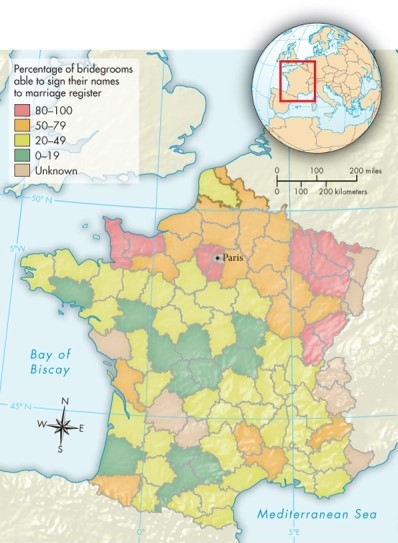
A)Proximity to the royal court would encourage the growth of literacy.
B)The concentration of wealth in the area of the capital would help to support a high rate of literacy.
C)Educational facilities, publishing houses, and a vibrant intellectual life in Paris would work to assist the growth of literacy in nearby areas.
D)The support of high church officials headquartered in Paris would help to enable a relatively high rate of literacy.
A)Proximity to the royal court would encourage the growth of literacy.
B)The concentration of wealth in the area of the capital would help to support a high rate of literacy.
C)Educational facilities, publishing houses, and a vibrant intellectual life in Paris would work to assist the growth of literacy in nearby areas.
D)The support of high church officials headquartered in Paris would help to enable a relatively high rate of literacy.
Question
Question
Question
Question
Question
Question
Question
What factor explains areas of relatively low literacy rates, as depicted in Map 18.1: Literacy in France, ca. 1789? 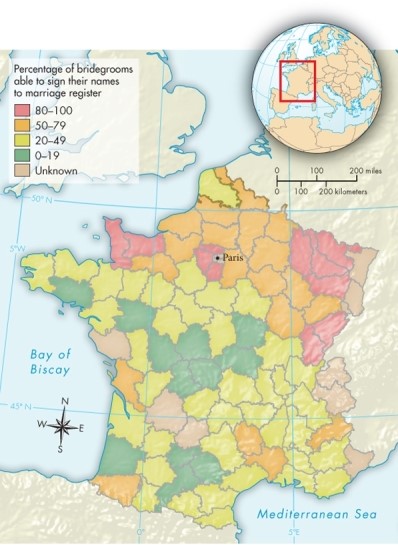
A)Regional traditions
B)Policies of the Catholic Church established for the region
C)The focus on agriculture in the region
D)Policies established for the region by the royal court
A)Regional traditions
B)Policies of the Catholic Church established for the region
C)The focus on agriculture in the region
D)Policies established for the region by the royal court
Question
Question
Question
Map 18.1: Literacy in France, ca. 1789 does not include any information on female literacy rates. What other information is excluded from this map? 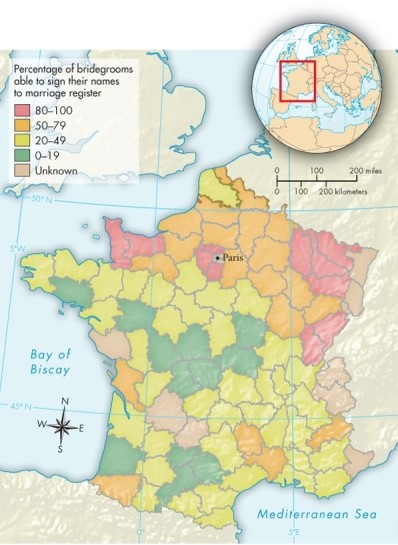
A)That there were trends in French literacy rates over time
B)That literacy rates varied considerably by region
C)That some areas had very low rates of literacy
D)That literacy rates in some areas were unknown
A)That there were trends in French literacy rates over time
B)That literacy rates varied considerably by region
C)That some areas had very low rates of literacy
D)That literacy rates in some areas were unknown
Question
Question
Question
Question
Question
Question
What factor explains the existence of several other areas, besides the area around Paris, with high literacy rates in France, as depicted in Map 18.1: Literacy in France, ca. 1789? 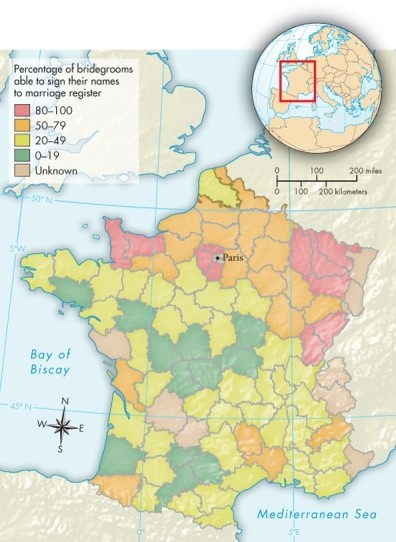
A)The existence of Catholic monastic groups such as the Jesuits
B)Royal favor that provided resources not available elsewhere in France
C)Urbanization that might also feature extensive commerce and manufacture
D)Large military facilities
A)The existence of Catholic monastic groups such as the Jesuits
B)Royal favor that provided resources not available elsewhere in France
C)Urbanization that might also feature extensive commerce and manufacture
D)Large military facilities
Question
Question
Question
Question
Question
Question
Question
Question
Question
Question
Question
Question
Question
Question
Question
Question
Question

Unlock Deck
Sign up to unlock the cards in this deck!
Unlock Deck
Unlock Deck
1/75

Play

Full screen (f)
Deck 18: Life in the Era of Expansion 1650-1800
1
Which of the following characterizes education for children outside the home in the early modern era?
A)As a consequence of the Reformation, the number of schools for common people declined.
B)Under the absolute monarchies, national school systems were created to educate nearly all of the children of commoners.
C)Schools remained largely unpopular because of their requirements that all children learn Latin.
D)Schools for the children of common people taught basic literacy, religion, and some arithmetic for boys and needlework for girls.
A)As a consequence of the Reformation, the number of schools for common people declined.
B)Under the absolute monarchies, national school systems were created to educate nearly all of the children of commoners.
C)Schools remained largely unpopular because of their requirements that all children learn Latin.
D)Schools for the children of common people taught basic literacy, religion, and some arithmetic for boys and needlework for girls.
Schools for the children of common people taught basic literacy, religion, and some arithmetic for boys and needlework for girls.
2
How did the Enlightenment affect attitudes toward popular culture?
A)Enlightened authors embraced popular culture as an authentic expression of the human condition unaffected by Christian theology.
B)Governments sought to use the critical perspectives of the Enlightenment to control and manage popular culture.
C)As the educated public adopted the Enlightenment's critical worldview, they increasingly saw popular culture as superstitious and vulgar.
D)Enlightened authors approached popular culture from an anthropological perspective that permitted them to analyze it without condemning it.
A)Enlightened authors embraced popular culture as an authentic expression of the human condition unaffected by Christian theology.
B)Governments sought to use the critical perspectives of the Enlightenment to control and manage popular culture.
C)As the educated public adopted the Enlightenment's critical worldview, they increasingly saw popular culture as superstitious and vulgar.
D)Enlightened authors approached popular culture from an anthropological perspective that permitted them to analyze it without condemning it.
As the educated public adopted the Enlightenment's critical worldview, they increasingly saw popular culture as superstitious and vulgar.
3
What place did prostitutes generally hold among the common people in towns?
A)They were social outcasts condemned for their immoral behavior.
B)They were accepted members of the community of the laboring poor.
C)They were seen as spiritually corrupted members of the community who had to be eliminated when identified.
D)They were respected individuals praised for their willingness to challenge conventional standards.
A)They were social outcasts condemned for their immoral behavior.
B)They were accepted members of the community of the laboring poor.
C)They were seen as spiritually corrupted members of the community who had to be eliminated when identified.
D)They were respected individuals praised for their willingness to challenge conventional standards.
They were accepted members of the community of the laboring poor.
4
As literacy expanded among the common people, what was a staple of popular literature other than the Bible?
A)The almanac
B)The chapbook containing Bible stories, prayers, and stories about the lives of the saints
C)Fairy tales, medieval romances, and fantastic adventures
D)Practical literature on rural crafts, household repairs, and useful plants
A)The almanac
B)The chapbook containing Bible stories, prayers, and stories about the lives of the saints
C)Fairy tales, medieval romances, and fantastic adventures
D)Practical literature on rural crafts, household repairs, and useful plants
Unlock Deck
Unlock for access to all 75 flashcards in this deck.
Unlock Deck
k this deck
5
What was the purpose of the raucous public rituals in which young men in a village would publicly humiliate a couple or individual who had committed adultery or abuse?
A)To make fun of traditional values that the young men rejected
B)To ridicule the church and its leaders for their failures
C)To regulate personal behavior and maintain community standards
D)To call for a renewed dedication of Christian holiness
A)To make fun of traditional values that the young men rejected
B)To ridicule the church and its leaders for their failures
C)To regulate personal behavior and maintain community standards
D)To call for a renewed dedication of Christian holiness
Unlock Deck
Unlock for access to all 75 flashcards in this deck.
Unlock Deck
k this deck
6
Until at least 1750, the practice of late marriage did not lead to a large number of illegitimate children because
A)sexual activity prior to marriage was extremely rare and harshly punished by the church.
B)poor nutrition dramatically diminished women's ability to become pregnant and to carry a child to term.
C)unmarried pregnant women commonly aborted their fetuses.
D)of community pressure on a couple to marry when the woman became pregnant.
A)sexual activity prior to marriage was extremely rare and harshly punished by the church.
B)poor nutrition dramatically diminished women's ability to become pregnant and to carry a child to term.
C)unmarried pregnant women commonly aborted their fetuses.
D)of community pressure on a couple to marry when the woman became pregnant.
Unlock Deck
Unlock for access to all 75 flashcards in this deck.
Unlock Deck
k this deck
7
In the seventeenth and eighteenth centuries, foundling homes
A)were closed by governments to force families to care for children.
B)were dissolved by the church to try to force women to refuse premarital sex.
C)only accepted children from single women in ill health.
D)had extremely high death rates.
A)were closed by governments to force families to care for children.
B)were dissolved by the church to try to force women to refuse premarital sex.
C)only accepted children from single women in ill health.
D)had extremely high death rates.
Unlock Deck
Unlock for access to all 75 flashcards in this deck.
Unlock Deck
k this deck
8
Why did Protestant countries take the lead in expanding education to all children?
A)They sought to challenge Catholic domination of scholarship and knowledge.
B)They were inspired by the Protestant idea that every believer should be able to read the Bible.
C)They believed Catholicism benefited from ignorance.
D)They sought to counter the appeal of witchcraft to the peasantry.
A)They sought to challenge Catholic domination of scholarship and knowledge.
B)They were inspired by the Protestant idea that every believer should be able to read the Bible.
C)They believed Catholicism benefited from ignorance.
D)They sought to counter the appeal of witchcraft to the peasantry.
Unlock Deck
Unlock for access to all 75 flashcards in this deck.
Unlock Deck
k this deck
9
Which of the following describes the treatment of children in the seventeenth and early eighteenth centuries?
A)Children were seen as beloved by God and not to be harshly rebuked.
B)The disciplining of children was often severe in order to conquer the child's will.
C)Children were largely undisciplined until they reached the age of education, around seven years of age.
D)Both Protestant and Catholic law forbade striking a child for any cause.
A)Children were seen as beloved by God and not to be harshly rebuked.
B)The disciplining of children was often severe in order to conquer the child's will.
C)Children were largely undisciplined until they reached the age of education, around seven years of age.
D)Both Protestant and Catholic law forbade striking a child for any cause.
Unlock Deck
Unlock for access to all 75 flashcards in this deck.
Unlock Deck
k this deck
10
A young woman entering domestic service could expect
A)to be protected against abuse by municipal and state laws.
B)to work hard on an endless array of jobs.
C)to attend weekly religious lessons at the local church.
D)to have a great deal of free time in which to enjoy town life.
A)to be protected against abuse by municipal and state laws.
B)to work hard on an endless array of jobs.
C)to attend weekly religious lessons at the local church.
D)to have a great deal of free time in which to enjoy town life.
Unlock Deck
Unlock for access to all 75 flashcards in this deck.
Unlock Deck
k this deck
11
Some scholars have argued that the neglectful attitudes toward children in preindustrial Europe were conditioned mostly by
A)high infant mortality rates.
B)church doctrine.
C)Enlightenment philosophy.
D)economic pressure on new migrants to the cities.
A)high infant mortality rates.
B)church doctrine.
C)Enlightenment philosophy.
D)economic pressure on new migrants to the cities.
Unlock Deck
Unlock for access to all 75 flashcards in this deck.
Unlock Deck
k this deck
12
What was the underlying reason for the illegitimacy explosion of 1750-1850?
A)Social and economic transformations that made it harder for families and communities to supervise behavior
B)The decline of traditional moral standards owing to the Enlightenment
C)Decreasing availability of birth control in the countryside
D)The sexual exploitation of poor girls by wealthy men
A)Social and economic transformations that made it harder for families and communities to supervise behavior
B)The decline of traditional moral standards owing to the Enlightenment
C)Decreasing availability of birth control in the countryside
D)The sexual exploitation of poor girls by wealthy men
Unlock Deck
Unlock for access to all 75 flashcards in this deck.
Unlock Deck
k this deck
13
Wet-nursing practices included
A)working women typically sending their babies to a wet nurse in the neighborhood.
B)rural wet-nursing conducted within the framework of a putting-out system.
C)upper-middle-class women nursing their own children to prove their motherly devotion.
D)weaning a baby from nursing within the first year.
A)working women typically sending their babies to a wet nurse in the neighborhood.
B)rural wet-nursing conducted within the framework of a putting-out system.
C)upper-middle-class women nursing their own children to prove their motherly devotion.
D)weaning a baby from nursing within the first year.
Unlock Deck
Unlock for access to all 75 flashcards in this deck.
Unlock Deck
k this deck
14
During a young man's period of apprenticeship, he would
A)face the same sexual exploitation that threatened girls.
B)be permitted to marry while training.
C)earn little money and work hard.
D)become a master after seven years of training.
A)face the same sexual exploitation that threatened girls.
B)be permitted to marry while training.
C)earn little money and work hard.
D)become a master after seven years of training.
Unlock Deck
Unlock for access to all 75 flashcards in this deck.
Unlock Deck
k this deck
15
In addition to supervising labor and birth, what was a typical task of the midwife?
A)Treating mental patients
B)Treating female medical difficulties
C)Assisting physicians
D)Selling contraceptives
A)Treating mental patients
B)Treating female medical difficulties
C)Assisting physicians
D)Selling contraceptives
Unlock Deck
Unlock for access to all 75 flashcards in this deck.
Unlock Deck
k this deck
16
What did the new discourse about children that emerged in the 1760s emphasize?
A)A call for greater tenderness toward children
B)Continuation of the practice of swaddling babies and using corsets to mold their bones
C)An expansion of foundling hospitals
D)Warnings against women nursing their own children
A)A call for greater tenderness toward children
B)Continuation of the practice of swaddling babies and using corsets to mold their bones
C)An expansion of foundling hospitals
D)Warnings against women nursing their own children
Unlock Deck
Unlock for access to all 75 flashcards in this deck.
Unlock Deck
k this deck
17
What caused the pattern of late marriage in early modern Europe?
A)The prevalence of the extended family structure
B)The fear of overpopulation
C)The availability of premarital sex
D)The tendency of couples to wait to marry until they were economically independent
A)The prevalence of the extended family structure
B)The fear of overpopulation
C)The availability of premarital sex
D)The tendency of couples to wait to marry until they were economically independent
Unlock Deck
Unlock for access to all 75 flashcards in this deck.
Unlock Deck
k this deck
18
What was a danger that threatened young girls who were living away from home in domestic service?
A)Increased risk of contracting infectious diseases
B)Reduced chances of marriage on returning home
C)Risk of sexual attack by males in the households they served
D)Malnutrition from subsisting on a city diet
A)Increased risk of contracting infectious diseases
B)Reduced chances of marriage on returning home
C)Risk of sexual attack by males in the households they served
D)Malnutrition from subsisting on a city diet
Unlock Deck
Unlock for access to all 75 flashcards in this deck.
Unlock Deck
k this deck
19
How were same-sex relations among women regarded in comparison to same-sex relations among men?
A)Same-sex relations among women were considered a youthful indiscretion that carried no particular stigma or condemnation, while those among men were harshly condemned as an attack on manly virtue.
B)Same-sex relations were encouraged among unmarried women and men as a way to squelch sexual passions.
C)Same-sex relations among men were accepted in imitation of Greek and Roman models, but those among women were harshly condemned as unnatural.
D)While considered unnatural, same-sex relations among women attracted less anxiety and condemnation than those among men.
A)Same-sex relations among women were considered a youthful indiscretion that carried no particular stigma or condemnation, while those among men were harshly condemned as an attack on manly virtue.
B)Same-sex relations were encouraged among unmarried women and men as a way to squelch sexual passions.
C)Same-sex relations among men were accepted in imitation of Greek and Roman models, but those among women were harshly condemned as unnatural.
D)While considered unnatural, same-sex relations among women attracted less anxiety and condemnation than those among men.
Unlock Deck
Unlock for access to all 75 flashcards in this deck.
Unlock Deck
k this deck
20
In the eighteenth century, the diet of the poorer classes consisted largely of bread and
A)dairy products.
B)vegetables.
C)wild game.
D)meat.
A)dairy products.
B)vegetables.
C)wild game.
D)meat.
Unlock Deck
Unlock for access to all 75 flashcards in this deck.
Unlock Deck
k this deck
21
What was the Catholic version of Pietism?
A)Methodism
B)Jansenism
C)Faith healing
D)Charivari
A)Methodism
B)Jansenism
C)Faith healing
D)Charivari
Unlock Deck
Unlock for access to all 75 flashcards in this deck.
Unlock Deck
k this deck
22
How did the diet of townspeople compare to that of the peasantry?
A)The townspeople ate more varied diets, since markets provided choices of meats, vegetables, and fruits.
B)The townspeople ate diets with many more spices and flavor additives.
C)The townspeople ate more monotonous diets, since only a few foods could survive the long transport to market in edible condition.
D)The townspeople ate diets loaded with meat and vegetables, while bread and beans, the diet of the peasants, played a minor role.
A)The townspeople ate more varied diets, since markets provided choices of meats, vegetables, and fruits.
B)The townspeople ate diets with many more spices and flavor additives.
C)The townspeople ate more monotonous diets, since only a few foods could survive the long transport to market in edible condition.
D)The townspeople ate diets loaded with meat and vegetables, while bread and beans, the diet of the peasants, played a minor role.
Unlock Deck
Unlock for access to all 75 flashcards in this deck.
Unlock Deck
k this deck
23
What was the result of the consumer revolution of the eighteenth century?
A)A vast increase in personal indebtedness, as individuals borrowed money in order to purchase consumer items
B)A new type of society in which people derived their self-identity as much from their consuming practices as from their work lives
C)The development of increasingly stark class distinctions based on consumption
D)Notions of community values and expected norms, since people could now purchase the same consumer items.
A)A vast increase in personal indebtedness, as individuals borrowed money in order to purchase consumer items
B)A new type of society in which people derived their self-identity as much from their consuming practices as from their work lives
C)The development of increasingly stark class distinctions based on consumption
D)Notions of community values and expected norms, since people could now purchase the same consumer items.
Unlock Deck
Unlock for access to all 75 flashcards in this deck.
Unlock Deck
k this deck
24
In the eighteenth century, what was the focal point of community cohesion?
A)The lord's manor
B)The marketplace
C)The tavern
D)The parish church
A)The lord's manor
B)The marketplace
C)The tavern
D)The parish church
Unlock Deck
Unlock for access to all 75 flashcards in this deck.
Unlock Deck
k this deck
25
What was the greatest achievement of eighteenth-century medical science?
A)Control of venereal disease
B)Elimination of the bubonic plague
C)Conquest of smallpox
D)Invention of anesthesia for surgery
A)Control of venereal disease
B)Elimination of the bubonic plague
C)Conquest of smallpox
D)Invention of anesthesia for surgery
Unlock Deck
Unlock for access to all 75 flashcards in this deck.
Unlock Deck
k this deck
26
In the eighteenth century, what did the strength of popular religion in Catholic countries reflect?
A)The desires of secular authorities
B)Its importance in community life
C)The decline of papal and clerical abuses
D)The role of the parish clergy in the state bureaucracy
A)The desires of secular authorities
B)Its importance in community life
C)The decline of papal and clerical abuses
D)The role of the parish clergy in the state bureaucracy
Unlock Deck
Unlock for access to all 75 flashcards in this deck.
Unlock Deck
k this deck
27
Why was John Wesley's Methodism particularly appealing?
A)He favored overthrowing abusive governments.
B)He advocated tender loving care for children.
C)He refuted the doctrine of predestination, insisting that anyone who earnestly sought salvation could gain it.
D)He allowed alcohol consumption, which other sects did not.
A)He favored overthrowing abusive governments.
B)He advocated tender loving care for children.
C)He refuted the doctrine of predestination, insisting that anyone who earnestly sought salvation could gain it.
D)He allowed alcohol consumption, which other sects did not.
Unlock Deck
Unlock for access to all 75 flashcards in this deck.
Unlock Deck
k this deck
28
Why did sugar and tea become commonly consumed products by all social classes in the eighteenth century?
A)Everyone wanted to support colonial expansion by consuming colonial products.
B)There was a steady drop in prices owing to the expanded use of colonial slave labor.
C)Drinking tea was seen as a sign of an increasingly egalitarian society.
D)The pace of work slowed, which allowed time for drinking tea.
A)Everyone wanted to support colonial expansion by consuming colonial products.
B)There was a steady drop in prices owing to the expanded use of colonial slave labor.
C)Drinking tea was seen as a sign of an increasingly egalitarian society.
D)The pace of work slowed, which allowed time for drinking tea.
Unlock Deck
Unlock for access to all 75 flashcards in this deck.
Unlock Deck
k this deck
29
How did the new fashion practices of the eighteenth century demonstrate changes in gender distinctions?
A)Men increasingly moved away from ostentatious fashions and toward plain dark suits, while women acquired larger and more expensive wardrobes.
B)Men adopted the wide variety of clothing options that consumer society made available, while women retained the conservative dress of the ideal virtuous women.
C)Men increasingly embraced a colorful clothing style to display their wealth, while women adopted a practical garb appropriate for managing the household.
D)Men increasingly emulated court dress in order to demonstrate their social assent while women adopted religious clothing to demonstrate their piety.
A)Men increasingly moved away from ostentatious fashions and toward plain dark suits, while women acquired larger and more expensive wardrobes.
B)Men adopted the wide variety of clothing options that consumer society made available, while women retained the conservative dress of the ideal virtuous women.
C)Men increasingly embraced a colorful clothing style to display their wealth, while women adopted a practical garb appropriate for managing the household.
D)Men increasingly emulated court dress in order to demonstrate their social assent while women adopted religious clothing to demonstrate their piety.
Unlock Deck
Unlock for access to all 75 flashcards in this deck.
Unlock Deck
k this deck
30
Eighteenth-century blood sports such as bullbaiting and cockfighting were
A)strictly forbidden by laws passed against abuse of animals.
B)popular with the European masses.
C)regarded by almost all Europeans as examples of primitive behavior that should be condemned in an Age of Enlightenment.
D)principally sponsored by betting syndicates that viewed them as highly lucrative sources of income.
A)strictly forbidden by laws passed against abuse of animals.
B)popular with the European masses.
C)regarded by almost all Europeans as examples of primitive behavior that should be condemned in an Age of Enlightenment.
D)principally sponsored by betting syndicates that viewed them as highly lucrative sources of income.
Unlock Deck
Unlock for access to all 75 flashcards in this deck.
Unlock Deck
k this deck
31
The growth in eighteenth-century consumerism in clothing was encouraged by what two factors?
A)The growth of fashion merchants who dictated changing styles and the declining production costs based on female labor
B)The royal courts establishing fashion standards and improved market distribution networks
C)The creation of the mechanical loom and the role of the servant class in spreading fashion
D)The use of new dyes and materials from colonial products and the enforcement of new class restrictions on clothing usage
A)The growth of fashion merchants who dictated changing styles and the declining production costs based on female labor
B)The royal courts establishing fashion standards and improved market distribution networks
C)The creation of the mechanical loom and the role of the servant class in spreading fashion
D)The use of new dyes and materials from colonial products and the enforcement of new class restrictions on clothing usage
Unlock Deck
Unlock for access to all 75 flashcards in this deck.
Unlock Deck
k this deck
32
Edward Jenner received financial prizes from the British government for
A)discovering the first effective method of inoculation against smallpox.
B)discovering that cowpox could be used to vaccinate against smallpox.
C)introducing inoculation against smallpox to western Asia.
D)introducing inoculation against smallpox to colonial North America.
A)discovering the first effective method of inoculation against smallpox.
B)discovering that cowpox could be used to vaccinate against smallpox.
C)introducing inoculation against smallpox to western Asia.
D)introducing inoculation against smallpox to colonial North America.
Unlock Deck
Unlock for access to all 75 flashcards in this deck.
Unlock Deck
k this deck
33
Europeans believed grain and bread should be available at
A)a just price-one that was fair to both consumers and producers.
B)a price average people could pay, even if it meant producers took a loss.
C)whatever price the government chose to impose.
D)whatever price the church recommended.
A)a just price-one that was fair to both consumers and producers.
B)a price average people could pay, even if it meant producers took a loss.
C)whatever price the government chose to impose.
D)whatever price the church recommended.
Unlock Deck
Unlock for access to all 75 flashcards in this deck.
Unlock Deck
k this deck
34
Why did surgeons in the eighteenth century face incredible difficulties?
A)They had only limited opportunities to practice surgical techniques.
B)Surgery was performed in utterly unsanitary conditions, which meant the simplest wound could become infected and lead to death.
C)They were reluctant to improve their knowledge of anatomy.
D)All operations were performed with anesthesia, but it was difficult to use and caused many deaths.
A)They had only limited opportunities to practice surgical techniques.
B)Surgery was performed in utterly unsanitary conditions, which meant the simplest wound could become infected and lead to death.
C)They were reluctant to improve their knowledge of anatomy.
D)All operations were performed with anesthesia, but it was difficult to use and caused many deaths.
Unlock Deck
Unlock for access to all 75 flashcards in this deck.
Unlock Deck
k this deck
35
Why did Pietism, which began in Germany in the late seventeenth century, appeal to people?
A)It emphasized a warm and emotional religion.
B)It offered a guarantee of salvation.
C)It was favored by secular authorities.
D)It preached a highly rational approach to religion.
A)It emphasized a warm and emotional religion.
B)It offered a guarantee of salvation.
C)It was favored by secular authorities.
D)It preached a highly rational approach to religion.
Unlock Deck
Unlock for access to all 75 flashcards in this deck.
Unlock Deck
k this deck
36
In the eighteenth century, what problem did the Church of England face?
A)Officials of both church and state who used it to provide high-paying jobs to favorites and ignored the spiritual needs of the people
B)Widespread rejection of Christian teaching as the Enlightenment became established
C)The loss of most of its land to enclosures, so that it became increasingly dependent on the state for support
D)The inability to recruit new priests as more opportunities opened for educated men in commerce and trade
A)Officials of both church and state who used it to provide high-paying jobs to favorites and ignored the spiritual needs of the people
B)Widespread rejection of Christian teaching as the Enlightenment became established
C)The loss of most of its land to enclosures, so that it became increasingly dependent on the state for support
D)The inability to recruit new priests as more opportunities opened for educated men in commerce and trade
Unlock Deck
Unlock for access to all 75 flashcards in this deck.
Unlock Deck
k this deck
37
The religious revival movement known as Pietism
A)promoted a strict legal code for Christian obedience.
B)praised a stern moralism that imposed guilt on the believer.
C)called for a warm, emotional religion that everyone could experience.
D)focused on an intensely intellectual approach to faith and belief.
A)promoted a strict legal code for Christian obedience.
B)praised a stern moralism that imposed guilt on the believer.
C)called for a warm, emotional religion that everyone could experience.
D)focused on an intensely intellectual approach to faith and belief.
Unlock Deck
Unlock for access to all 75 flashcards in this deck.
Unlock Deck
k this deck
38
How did the evangelicals within the Church of England respond to the rise of Methodism?
A)They sought to have Methodism outlawed and its practitioners arrested.
B)They copied Methodism's practices in order to appeal to more of the common people.
C)They hired a new collection of younger priests to attract more youth.
D)They required that all parishes must instruct the young in literacy and church doctrine.
A)They sought to have Methodism outlawed and its practitioners arrested.
B)They copied Methodism's practices in order to appeal to more of the common people.
C)They hired a new collection of younger priests to attract more youth.
D)They required that all parishes must instruct the young in literacy and church doctrine.
Unlock Deck
Unlock for access to all 75 flashcards in this deck.
Unlock Deck
k this deck
39
Why did the persecution of witches slowly come to an end by the late eighteenth century?
A)Common people in the countryside adopted Enlightenment ideas and practices.
B)Most people were preoccupied with the consumer revolution.
C)The spread of literacy undermined the old superstitions.
D)Elites increasingly dismissed fears of witchcraft and refused to prosecute suspected witches.
A)Common people in the countryside adopted Enlightenment ideas and practices.
B)Most people were preoccupied with the consumer revolution.
C)The spread of literacy undermined the old superstitions.
D)Elites increasingly dismissed fears of witchcraft and refused to prosecute suspected witches.
Unlock Deck
Unlock for access to all 75 flashcards in this deck.
Unlock Deck
k this deck
40
The dissolution of the Jesuit order in 1773 is a striking indication of the
A)decline of religious feeling in the eighteenth century.
B)resurgent power of the papacy.
C)power of the state over the church.
D)vitality of the Protestant revival.
A)decline of religious feeling in the eighteenth century.
B)resurgent power of the papacy.
C)power of the state over the church.
D)vitality of the Protestant revival.
Unlock Deck
Unlock for access to all 75 flashcards in this deck.
Unlock Deck
k this deck
41
The following is an excerpt from John Wesley's "Advice to Methodists" (Evaluating the Evidence 18.3): "Your Strictness of Life, taking the whole of it together, may likewise be accounted new. I mean, your making it a Rule, to abstain from fashionable Diversions, from reading Plays, Romances, or Books of Humour, from singing innocent Songs, or talking in a merry, gay, diverting Manner; your Plainness of Dress; your Manner of Dealing in Trade; your Exactness in observing the Lord's Day; your Scrupulosity as to Things that have not paid Custom; your total Abstinence from spirituous Liquors (unless in Cases of Extreme Necessity); your Rule, 'not to mention the Fault of an absent Person, in Particular, of Ministers, or of those in Authority,' may justly be termed new."
This passage provides evidence for which of the following?
A)Methodists were expected to behave in ways that reflected their spiritual beliefs.
B)Methodists believed that outward signs of piety were of little importance.
C)Methodists were, in many ways, similar to Catholics.
D)Methodists placed few rules and restrictions on believers.
This passage provides evidence for which of the following?
A)Methodists were expected to behave in ways that reflected their spiritual beliefs.
B)Methodists believed that outward signs of piety were of little importance.
C)Methodists were, in many ways, similar to Catholics.
D)Methodists placed few rules and restrictions on believers.
Unlock Deck
Unlock for access to all 75 flashcards in this deck.
Unlock Deck
k this deck
42
Why might Map 18.1: Literacy in France, ca. 1789 show the literacy rate to be relatively high in the area close to the capital city of Paris?
A)Proximity to the royal court would encourage the growth of literacy.
B)The concentration of wealth in the area of the capital would help to support a high rate of literacy.
C)Educational facilities, publishing houses, and a vibrant intellectual life in Paris would work to assist the growth of literacy in nearby areas.
D)The support of high church officials headquartered in Paris would help to enable a relatively high rate of literacy.
A)Proximity to the royal court would encourage the growth of literacy.
B)The concentration of wealth in the area of the capital would help to support a high rate of literacy.
C)Educational facilities, publishing houses, and a vibrant intellectual life in Paris would work to assist the growth of literacy in nearby areas.
D)The support of high church officials headquartered in Paris would help to enable a relatively high rate of literacy.
Unlock Deck
Unlock for access to all 75 flashcards in this deck.
Unlock Deck
k this deck
43
What was the connection between premarital sex and community controls?
Unlock Deck
Unlock for access to all 75 flashcards in this deck.
Unlock Deck
k this deck
44
One of the century's most influential works on child reading was Emile, or On Education by
A)John Wesley.
B)Edward Jenner.
C)Madame du Coudray.
D)Jean-Jacques Rousseau.
A)John Wesley.
B)Edward Jenner.
C)Madame du Coudray.
D)Jean-Jacques Rousseau.
Unlock Deck
Unlock for access to all 75 flashcards in this deck.
Unlock Deck
k this deck
45
The following is an excerpt from Jean-Jacques Rousseau's The Confessions (Thinking Like a Historian): "I have resolved on an enterprise which has no precedent, and which, once complete, will have no imitator. My purpose is to display to my kind a portrait in every way true to nature, and the man I shall portray will be myself. Simply myself. I know my own heart and understand my fellow man. But I am made unlike any one I have ever met; I will even venture to say that I am like no one in the whole world. I may be no better, but at least I am different. Whether Nature did well or ill in breaking the mould in which she formed me, is a question which can only be resolved after the reading of my book."
Why was Rousseau confident his work would "have no imitator"?
A)He saw himself as unique.
B)He believed he was the best writer who had ever lived or would ever live.
C)He was sure no one would want to copy him.
D)He knew he would be punished for his book.
Why was Rousseau confident his work would "have no imitator"?
A)He saw himself as unique.
B)He believed he was the best writer who had ever lived or would ever live.
C)He was sure no one would want to copy him.
D)He knew he would be punished for his book.
Unlock Deck
Unlock for access to all 75 flashcards in this deck.
Unlock Deck
k this deck
46
How did the surge in childhood education in the eighteenth century affect literacy rates?
Unlock Deck
Unlock for access to all 75 flashcards in this deck.
Unlock Deck
k this deck
47
How did Jansenism seek to reform Catholicism?
Unlock Deck
Unlock for access to all 75 flashcards in this deck.
Unlock Deck
k this deck
48
What was carnival, and why was it such an important part of popular culture?
Unlock Deck
Unlock for access to all 75 flashcards in this deck.
Unlock Deck
k this deck
49
What factor explains areas of relatively low literacy rates, as depicted in Map 18.1: Literacy in France, ca. 1789?
A)Regional traditions
B)Policies of the Catholic Church established for the region
C)The focus on agriculture in the region
D)Policies established for the region by the royal court
A)Regional traditions
B)Policies of the Catholic Church established for the region
C)The focus on agriculture in the region
D)Policies established for the region by the royal court
Unlock Deck
Unlock for access to all 75 flashcards in this deck.
Unlock Deck
k this deck
50
The following is an excerpt from Jacques-Louis Ménétra's account of his childhood in Paris (Evaluating the Evidence 18.1): "My father became a widower when I was two years old. I had been put out to nurse. My grandmother who always loved me a great deal and even idolized me, knowing that the nurse I was with had her milk gone bad, came to get me and after curing me put me back out to nurse [where] I ended up with a pretty good woman who taught me early on the profession of begging. My [grand]mother and my godfather when they came to see me . . . found me in a church begging charity. They took me home and from then until the age of eleven I lived with my good grandmother. My father wanted me back, afraid that he would have to pay my board. He put me to work in his trade even though several people tried to talk him out of it [but] he wouldn't listen to them. . . ."
How did Ménétra come to learn the profession of begging?
A)He was put out to nurse with a woman who taught him how to beg.
B)He was apprenticed to a beggar by his father.
C)He ran away from home and took up the profession.
D)He was born into a family of beggars.
How did Ménétra come to learn the profession of begging?
A)He was put out to nurse with a woman who taught him how to beg.
B)He was apprenticed to a beggar by his father.
C)He ran away from home and took up the profession.
D)He was born into a family of beggars.
Unlock Deck
Unlock for access to all 75 flashcards in this deck.
Unlock Deck
k this deck
51
The following is an excerpt from Louis-Sébastien Mercier's account of a typical day in eighteenth-century Paris (Evaluating the Evidence 18.2): "Night falls; and, while scene-shifters set to work at the playhouses, swarms of other workmen, carpenters, masons and the like, make their way towards the poorer quarters. They leave white footprints from the plaster on their shoes, a trail that any eye can follow. They are off home, and to bed, at the hour which finds elegant ladies sitting down to their dressing-tables to prepare for the business of the night."
Which of the following is suggested by Mercier's account?
A)Parisians of all classes participated in the city's nightlife.
B)For many ordinary Parisians, the work day did not end until dark.
C)The city of Paris shut down at nightfall.
D)It was illegal to be out on the streets of Paris after dark.
Which of the following is suggested by Mercier's account?
A)Parisians of all classes participated in the city's nightlife.
B)For many ordinary Parisians, the work day did not end until dark.
C)The city of Paris shut down at nightfall.
D)It was illegal to be out on the streets of Paris after dark.
Unlock Deck
Unlock for access to all 75 flashcards in this deck.
Unlock Deck
k this deck
52
Map 18.1: Literacy in France, ca. 1789 does not include any information on female literacy rates. What other information is excluded from this map?
A)That there were trends in French literacy rates over time
B)That literacy rates varied considerably by region
C)That some areas had very low rates of literacy
D)That literacy rates in some areas were unknown
A)That there were trends in French literacy rates over time
B)That literacy rates varied considerably by region
C)That some areas had very low rates of literacy
D)That literacy rates in some areas were unknown
Unlock Deck
Unlock for access to all 75 flashcards in this deck.
Unlock Deck
k this deck
53
What new vision of childhood emerged in the eighteenth century?
Unlock Deck
Unlock for access to all 75 flashcards in this deck.
Unlock Deck
k this deck
54
The following is an excerpt from John Wesley's "Advice to Methodists" (Evaluating the Evidence 18.3): "Your Strictness of Life, taking the whole of it together, may likewise be accounted new. I mean, your making it a Rule, to abstain from fashionable Diversions, from reading Plays, Romances, or Books of Humour, from singing innocent Songs, or talking in a merry, gay, diverting Manner; your Plainness of Dress; your Manner of Dealing in Trade; your Exactness in observing the Lord's Day; your Scrupulosity as to Things that have not paid Custom; your total Abstinence from spirituous Liquors (unless in Cases of Extreme Necessity)l your Rule, 'not to mention the Fault of an absent Person, in Particular, of Ministers, or of those in Authority,' may justly be termed new."
Which of the following was part of the "Strictness of Life"?
A)Avoiding members of the opposite sex
B)Spreading the news about Methodism to unbelievers
C)Abstaining from fashionable diversions
D)Praying at least five times per day
Which of the following was part of the "Strictness of Life"?
A)Avoiding members of the opposite sex
B)Spreading the news about Methodism to unbelievers
C)Abstaining from fashionable diversions
D)Praying at least five times per day
Unlock Deck
Unlock for access to all 75 flashcards in this deck.
Unlock Deck
k this deck
55
What was the experience of girls working as servants in the eighteenth century?
Unlock Deck
Unlock for access to all 75 flashcards in this deck.
Unlock Deck
k this deck
56
How did new patterns of food consumption develop in the eighteenth century?
Unlock Deck
Unlock for access to all 75 flashcards in this deck.
Unlock Deck
k this deck
57
How was the disease of smallpox conquered?
Unlock Deck
Unlock for access to all 75 flashcards in this deck.
Unlock Deck
k this deck
58
What factor explains the existence of several other areas, besides the area around Paris, with high literacy rates in France, as depicted in Map 18.1: Literacy in France, ca. 1789?
A)The existence of Catholic monastic groups such as the Jesuits
B)Royal favor that provided resources not available elsewhere in France
C)Urbanization that might also feature extensive commerce and manufacture
D)Large military facilities
A)The existence of Catholic monastic groups such as the Jesuits
B)Royal favor that provided resources not available elsewhere in France
C)Urbanization that might also feature extensive commerce and manufacture
D)Large military facilities
Unlock Deck
Unlock for access to all 75 flashcards in this deck.
Unlock Deck
k this deck
59
Why was wet-nursing a widespread, flourishing business in the eighteenth century?
Unlock Deck
Unlock for access to all 75 flashcards in this deck.
Unlock Deck
k this deck
60
When did most people marry in eighteenth-century western Europe?
Unlock Deck
Unlock for access to all 75 flashcards in this deck.
Unlock Deck
k this deck
61
What was the consumer revolution?
Unlock Deck
Unlock for access to all 75 flashcards in this deck.
Unlock Deck
k this deck
62
Trace the growing intervention of the state in ordinary people's lives in eighteenth-century Europe.
Unlock Deck
Unlock for access to all 75 flashcards in this deck.
Unlock Deck
k this deck
63
Answer the following questions:
community controls
A)A pattern of cooperation and common action in a traditional village that sought to uphold the economic, social, and moral stability of the closely knit community.
B)A widespread and flourishing business in the eighteenth century in which women were paid to breastfeed other women's babies.
C)The wide-ranging growth in consumption and new attitudes toward consumer goods that emerged in the cities of northwestern Europe in the second half of the eighteenth century.
D)The few days of revelry in Catholic countries that preceded Lent and that included drinking, masquerading, dancing, and rowdy spectacles that turned the established order upside down.
E)A sect of Catholicism that emphasized the heavy weight of original sin and accepted the doctrine of predestination; it was outlawed as heresy by the pope.
F)Members of a Protestant revival movement started by John Wesley, so called because they were so methodical in their devotion.
G)A Protestant revival movement in early-eighteenth-century Germany and Scandinavia that emphasized a warm and emotional religion, the priesthood of all believers, and the power of Christian rebirth in everyday affairs.
H)The sharp increase in out-of-wedlock births that occurred in Europe between 1750 and 1850, caused by low wages and the breakdown of community controls.
I)Events such as bullbaiting and cockfighting that involved inflicting violence and bloodshed on animals and were popular with the eighteenth-century European masses.
J)The idea that prices should be fair, protecting both consumers and producers, and that they should be imposed by government decree if necessary.
community controls
A)A pattern of cooperation and common action in a traditional village that sought to uphold the economic, social, and moral stability of the closely knit community.
B)A widespread and flourishing business in the eighteenth century in which women were paid to breastfeed other women's babies.
C)The wide-ranging growth in consumption and new attitudes toward consumer goods that emerged in the cities of northwestern Europe in the second half of the eighteenth century.
D)The few days of revelry in Catholic countries that preceded Lent and that included drinking, masquerading, dancing, and rowdy spectacles that turned the established order upside down.
E)A sect of Catholicism that emphasized the heavy weight of original sin and accepted the doctrine of predestination; it was outlawed as heresy by the pope.
F)Members of a Protestant revival movement started by John Wesley, so called because they were so methodical in their devotion.
G)A Protestant revival movement in early-eighteenth-century Germany and Scandinavia that emphasized a warm and emotional religion, the priesthood of all believers, and the power of Christian rebirth in everyday affairs.
H)The sharp increase in out-of-wedlock births that occurred in Europe between 1750 and 1850, caused by low wages and the breakdown of community controls.
I)Events such as bullbaiting and cockfighting that involved inflicting violence and bloodshed on animals and were popular with the eighteenth-century European masses.
J)The idea that prices should be fair, protecting both consumers and producers, and that they should be imposed by government decree if necessary.
Unlock Deck
Unlock for access to all 75 flashcards in this deck.
Unlock Deck
k this deck
64
The eighteenth century was an era of improving health and increased life expectancy. Why? What impact did improving health and longevity have on European society?
Unlock Deck
Unlock for access to all 75 flashcards in this deck.
Unlock Deck
k this deck
65
While the Enlightenment was spreading among the educated elites, religion remained a strong force in the lives of the common people. What were the patterns of popular religion for both Catholics and Protestants in the late eighteenth century? How did the church leaders, Protestant and Catholic, respond to popular religion?
Unlock Deck
Unlock for access to all 75 flashcards in this deck.
Unlock Deck
k this deck
66
Answer the following questions:
Methodists
A)A pattern of cooperation and common action in a traditional village that sought to uphold the economic, social, and moral stability of the closely knit community.
B)A widespread and flourishing business in the eighteenth century in which women were paid to breastfeed other women's babies.
C)The wide-ranging growth in consumption and new attitudes toward consumer goods that emerged in the cities of northwestern Europe in the second half of the eighteenth century.
D)The few days of revelry in Catholic countries that preceded Lent and that included drinking, masquerading, dancing, and rowdy spectacles that turned the established order upside down.
E)A sect of Catholicism that emphasized the heavy weight of original sin and accepted the doctrine of predestination; it was outlawed as heresy by the pope.
F)Members of a Protestant revival movement started by John Wesley, so called because they were so methodical in their devotion.
G)A Protestant revival movement in early-eighteenth-century Germany and Scandinavia that emphasized a warm and emotional religion, the priesthood of all believers, and the power of Christian rebirth in everyday affairs.
H)The sharp increase in out-of-wedlock births that occurred in Europe between 1750 and 1850, caused by low wages and the breakdown of community controls.
I)Events such as bullbaiting and cockfighting that involved inflicting violence and bloodshed on animals and were popular with the eighteenth-century European masses.
J)The idea that prices should be fair, protecting both consumers and producers, and that they should be imposed by government decree if necessary.
Methodists
A)A pattern of cooperation and common action in a traditional village that sought to uphold the economic, social, and moral stability of the closely knit community.
B)A widespread and flourishing business in the eighteenth century in which women were paid to breastfeed other women's babies.
C)The wide-ranging growth in consumption and new attitudes toward consumer goods that emerged in the cities of northwestern Europe in the second half of the eighteenth century.
D)The few days of revelry in Catholic countries that preceded Lent and that included drinking, masquerading, dancing, and rowdy spectacles that turned the established order upside down.
E)A sect of Catholicism that emphasized the heavy weight of original sin and accepted the doctrine of predestination; it was outlawed as heresy by the pope.
F)Members of a Protestant revival movement started by John Wesley, so called because they were so methodical in their devotion.
G)A Protestant revival movement in early-eighteenth-century Germany and Scandinavia that emphasized a warm and emotional religion, the priesthood of all believers, and the power of Christian rebirth in everyday affairs.
H)The sharp increase in out-of-wedlock births that occurred in Europe between 1750 and 1850, caused by low wages and the breakdown of community controls.
I)Events such as bullbaiting and cockfighting that involved inflicting violence and bloodshed on animals and were popular with the eighteenth-century European masses.
J)The idea that prices should be fair, protecting both consumers and producers, and that they should be imposed by government decree if necessary.
Unlock Deck
Unlock for access to all 75 flashcards in this deck.
Unlock Deck
k this deck
67
Answer the following questions:
blood sports
A)A pattern of cooperation and common action in a traditional village that sought to uphold the economic, social, and moral stability of the closely knit community.
B)A widespread and flourishing business in the eighteenth century in which women were paid to breastfeed other women's babies.
C)The wide-ranging growth in consumption and new attitudes toward consumer goods that emerged in the cities of northwestern Europe in the second half of the eighteenth century.
D)The few days of revelry in Catholic countries that preceded Lent and that included drinking, masquerading, dancing, and rowdy spectacles that turned the established order upside down.
E)A sect of Catholicism that emphasized the heavy weight of original sin and accepted the doctrine of predestination; it was outlawed as heresy by the pope.
F)Members of a Protestant revival movement started by John Wesley, so called because they were so methodical in their devotion.
G)A Protestant revival movement in early-eighteenth-century Germany and Scandinavia that emphasized a warm and emotional religion, the priesthood of all believers, and the power of Christian rebirth in everyday affairs.
H)The sharp increase in out-of-wedlock births that occurred in Europe between 1750 and 1850, caused by low wages and the breakdown of community controls.
I)Events such as bullbaiting and cockfighting that involved inflicting violence and bloodshed on animals and were popular with the eighteenth-century European masses.
J)The idea that prices should be fair, protecting both consumers and producers, and that they should be imposed by government decree if necessary.
blood sports
A)A pattern of cooperation and common action in a traditional village that sought to uphold the economic, social, and moral stability of the closely knit community.
B)A widespread and flourishing business in the eighteenth century in which women were paid to breastfeed other women's babies.
C)The wide-ranging growth in consumption and new attitudes toward consumer goods that emerged in the cities of northwestern Europe in the second half of the eighteenth century.
D)The few days of revelry in Catholic countries that preceded Lent and that included drinking, masquerading, dancing, and rowdy spectacles that turned the established order upside down.
E)A sect of Catholicism that emphasized the heavy weight of original sin and accepted the doctrine of predestination; it was outlawed as heresy by the pope.
F)Members of a Protestant revival movement started by John Wesley, so called because they were so methodical in their devotion.
G)A Protestant revival movement in early-eighteenth-century Germany and Scandinavia that emphasized a warm and emotional religion, the priesthood of all believers, and the power of Christian rebirth in everyday affairs.
H)The sharp increase in out-of-wedlock births that occurred in Europe between 1750 and 1850, caused by low wages and the breakdown of community controls.
I)Events such as bullbaiting and cockfighting that involved inflicting violence and bloodshed on animals and were popular with the eighteenth-century European masses.
J)The idea that prices should be fair, protecting both consumers and producers, and that they should be imposed by government decree if necessary.
Unlock Deck
Unlock for access to all 75 flashcards in this deck.
Unlock Deck
k this deck
68
Answer the following questions:
carnival
A)A pattern of cooperation and common action in a traditional village that sought to uphold the economic, social, and moral stability of the closely knit community.
B)A widespread and flourishing business in the eighteenth century in which women were paid to breastfeed other women's babies.
C)The wide-ranging growth in consumption and new attitudes toward consumer goods that emerged in the cities of northwestern Europe in the second half of the eighteenth century.
D)The few days of revelry in Catholic countries that preceded Lent and that included drinking, masquerading, dancing, and rowdy spectacles that turned the established order upside down.
E)A sect of Catholicism that emphasized the heavy weight of original sin and accepted the doctrine of predestination; it was outlawed as heresy by the pope.
F)Members of a Protestant revival movement started by John Wesley, so called because they were so methodical in their devotion.
G)A Protestant revival movement in early-eighteenth-century Germany and Scandinavia that emphasized a warm and emotional religion, the priesthood of all believers, and the power of Christian rebirth in everyday affairs.
H)The sharp increase in out-of-wedlock births that occurred in Europe between 1750 and 1850, caused by low wages and the breakdown of community controls.
I)Events such as bullbaiting and cockfighting that involved inflicting violence and bloodshed on animals and were popular with the eighteenth-century European masses.
J)The idea that prices should be fair, protecting both consumers and producers, and that they should be imposed by government decree if necessary.
carnival
A)A pattern of cooperation and common action in a traditional village that sought to uphold the economic, social, and moral stability of the closely knit community.
B)A widespread and flourishing business in the eighteenth century in which women were paid to breastfeed other women's babies.
C)The wide-ranging growth in consumption and new attitudes toward consumer goods that emerged in the cities of northwestern Europe in the second half of the eighteenth century.
D)The few days of revelry in Catholic countries that preceded Lent and that included drinking, masquerading, dancing, and rowdy spectacles that turned the established order upside down.
E)A sect of Catholicism that emphasized the heavy weight of original sin and accepted the doctrine of predestination; it was outlawed as heresy by the pope.
F)Members of a Protestant revival movement started by John Wesley, so called because they were so methodical in their devotion.
G)A Protestant revival movement in early-eighteenth-century Germany and Scandinavia that emphasized a warm and emotional religion, the priesthood of all believers, and the power of Christian rebirth in everyday affairs.
H)The sharp increase in out-of-wedlock births that occurred in Europe between 1750 and 1850, caused by low wages and the breakdown of community controls.
I)Events such as bullbaiting and cockfighting that involved inflicting violence and bloodshed on animals and were popular with the eighteenth-century European masses.
J)The idea that prices should be fair, protecting both consumers and producers, and that they should be imposed by government decree if necessary.
Unlock Deck
Unlock for access to all 75 flashcards in this deck.
Unlock Deck
k this deck
69
Answer the following questions:
illegitimacy explosion
A)A pattern of cooperation and common action in a traditional village that sought to uphold the economic, social, and moral stability of the closely knit community.
B)A widespread and flourishing business in the eighteenth century in which women were paid to breastfeed other women's babies.
C)The wide-ranging growth in consumption and new attitudes toward consumer goods that emerged in the cities of northwestern Europe in the second half of the eighteenth century.
D)The few days of revelry in Catholic countries that preceded Lent and that included drinking, masquerading, dancing, and rowdy spectacles that turned the established order upside down.
E)A sect of Catholicism that emphasized the heavy weight of original sin and accepted the doctrine of predestination; it was outlawed as heresy by the pope.
F)Members of a Protestant revival movement started by John Wesley, so called because they were so methodical in their devotion.
G)A Protestant revival movement in early-eighteenth-century Germany and Scandinavia that emphasized a warm and emotional religion, the priesthood of all believers, and the power of Christian rebirth in everyday affairs.
H)The sharp increase in out-of-wedlock births that occurred in Europe between 1750 and 1850, caused by low wages and the breakdown of community controls.
I)Events such as bullbaiting and cockfighting that involved inflicting violence and bloodshed on animals and were popular with the eighteenth-century European masses.
J)The idea that prices should be fair, protecting both consumers and producers, and that they should be imposed by government decree if necessary.
illegitimacy explosion
A)A pattern of cooperation and common action in a traditional village that sought to uphold the economic, social, and moral stability of the closely knit community.
B)A widespread and flourishing business in the eighteenth century in which women were paid to breastfeed other women's babies.
C)The wide-ranging growth in consumption and new attitudes toward consumer goods that emerged in the cities of northwestern Europe in the second half of the eighteenth century.
D)The few days of revelry in Catholic countries that preceded Lent and that included drinking, masquerading, dancing, and rowdy spectacles that turned the established order upside down.
E)A sect of Catholicism that emphasized the heavy weight of original sin and accepted the doctrine of predestination; it was outlawed as heresy by the pope.
F)Members of a Protestant revival movement started by John Wesley, so called because they were so methodical in their devotion.
G)A Protestant revival movement in early-eighteenth-century Germany and Scandinavia that emphasized a warm and emotional religion, the priesthood of all believers, and the power of Christian rebirth in everyday affairs.
H)The sharp increase in out-of-wedlock births that occurred in Europe between 1750 and 1850, caused by low wages and the breakdown of community controls.
I)Events such as bullbaiting and cockfighting that involved inflicting violence and bloodshed on animals and were popular with the eighteenth-century European masses.
J)The idea that prices should be fair, protecting both consumers and producers, and that they should be imposed by government decree if necessary.
Unlock Deck
Unlock for access to all 75 flashcards in this deck.
Unlock Deck
k this deck
70
What were marriage and family life like in eighteenth-century western Europe? What had changed from previous eras?
Unlock Deck
Unlock for access to all 75 flashcards in this deck.
Unlock Deck
k this deck
71
Answer the following questions:
Pietism
A)A pattern of cooperation and common action in a traditional village that sought to uphold the economic, social, and moral stability of the closely knit community.
B)A widespread and flourishing business in the eighteenth century in which women were paid to breastfeed other women's babies.
C)The wide-ranging growth in consumption and new attitudes toward consumer goods that emerged in the cities of northwestern Europe in the second half of the eighteenth century.
D)The few days of revelry in Catholic countries that preceded Lent and that included drinking, masquerading, dancing, and rowdy spectacles that turned the established order upside down.
E)A sect of Catholicism that emphasized the heavy weight of original sin and accepted the doctrine of predestination; it was outlawed as heresy by the pope.
F)Members of a Protestant revival movement started by John Wesley, so called because they were so methodical in their devotion.
G)A Protestant revival movement in early-eighteenth-century Germany and Scandinavia that emphasized a warm and emotional religion, the priesthood of all believers, and the power of Christian rebirth in everyday affairs.
H)The sharp increase in out-of-wedlock births that occurred in Europe between 1750 and 1850, caused by low wages and the breakdown of community controls.
I)Events such as bullbaiting and cockfighting that involved inflicting violence and bloodshed on animals and were popular with the eighteenth-century European masses.
J)The idea that prices should be fair, protecting both consumers and producers, and that they should be imposed by government decree if necessary.
Pietism
A)A pattern of cooperation and common action in a traditional village that sought to uphold the economic, social, and moral stability of the closely knit community.
B)A widespread and flourishing business in the eighteenth century in which women were paid to breastfeed other women's babies.
C)The wide-ranging growth in consumption and new attitudes toward consumer goods that emerged in the cities of northwestern Europe in the second half of the eighteenth century.
D)The few days of revelry in Catholic countries that preceded Lent and that included drinking, masquerading, dancing, and rowdy spectacles that turned the established order upside down.
E)A sect of Catholicism that emphasized the heavy weight of original sin and accepted the doctrine of predestination; it was outlawed as heresy by the pope.
F)Members of a Protestant revival movement started by John Wesley, so called because they were so methodical in their devotion.
G)A Protestant revival movement in early-eighteenth-century Germany and Scandinavia that emphasized a warm and emotional religion, the priesthood of all believers, and the power of Christian rebirth in everyday affairs.
H)The sharp increase in out-of-wedlock births that occurred in Europe between 1750 and 1850, caused by low wages and the breakdown of community controls.
I)Events such as bullbaiting and cockfighting that involved inflicting violence and bloodshed on animals and were popular with the eighteenth-century European masses.
J)The idea that prices should be fair, protecting both consumers and producers, and that they should be imposed by government decree if necessary.
Unlock Deck
Unlock for access to all 75 flashcards in this deck.
Unlock Deck
k this deck
72
Answer the following questions:
Jansenism
A)A pattern of cooperation and common action in a traditional village that sought to uphold the economic, social, and moral stability of the closely knit community.
B)A widespread and flourishing business in the eighteenth century in which women were paid to breastfeed other women's babies.
C)The wide-ranging growth in consumption and new attitudes toward consumer goods that emerged in the cities of northwestern Europe in the second half of the eighteenth century.
D)The few days of revelry in Catholic countries that preceded Lent and that included drinking, masquerading, dancing, and rowdy spectacles that turned the established order upside down.
E)A sect of Catholicism that emphasized the heavy weight of original sin and accepted the doctrine of predestination; it was outlawed as heresy by the pope.
F)Members of a Protestant revival movement started by John Wesley, so called because they were so methodical in their devotion.
G)A Protestant revival movement in early-eighteenth-century Germany and Scandinavia that emphasized a warm and emotional religion, the priesthood of all believers, and the power of Christian rebirth in everyday affairs.
H)The sharp increase in out-of-wedlock births that occurred in Europe between 1750 and 1850, caused by low wages and the breakdown of community controls.
I)Events such as bullbaiting and cockfighting that involved inflicting violence and bloodshed on animals and were popular with the eighteenth-century European masses.
J)The idea that prices should be fair, protecting both consumers and producers, and that they should be imposed by government decree if necessary.
Jansenism
A)A pattern of cooperation and common action in a traditional village that sought to uphold the economic, social, and moral stability of the closely knit community.
B)A widespread and flourishing business in the eighteenth century in which women were paid to breastfeed other women's babies.
C)The wide-ranging growth in consumption and new attitudes toward consumer goods that emerged in the cities of northwestern Europe in the second half of the eighteenth century.
D)The few days of revelry in Catholic countries that preceded Lent and that included drinking, masquerading, dancing, and rowdy spectacles that turned the established order upside down.
E)A sect of Catholicism that emphasized the heavy weight of original sin and accepted the doctrine of predestination; it was outlawed as heresy by the pope.
F)Members of a Protestant revival movement started by John Wesley, so called because they were so methodical in their devotion.
G)A Protestant revival movement in early-eighteenth-century Germany and Scandinavia that emphasized a warm and emotional religion, the priesthood of all believers, and the power of Christian rebirth in everyday affairs.
H)The sharp increase in out-of-wedlock births that occurred in Europe between 1750 and 1850, caused by low wages and the breakdown of community controls.
I)Events such as bullbaiting and cockfighting that involved inflicting violence and bloodshed on animals and were popular with the eighteenth-century European masses.
J)The idea that prices should be fair, protecting both consumers and producers, and that they should be imposed by government decree if necessary.
Unlock Deck
Unlock for access to all 75 flashcards in this deck.
Unlock Deck
k this deck
73
Answer the following questions:
just price
A)A pattern of cooperation and common action in a traditional village that sought to uphold the economic, social, and moral stability of the closely knit community.
B)A widespread and flourishing business in the eighteenth century in which women were paid to breastfeed other women's babies.
C)The wide-ranging growth in consumption and new attitudes toward consumer goods that emerged in the cities of northwestern Europe in the second half of the eighteenth century.
D)The few days of revelry in Catholic countries that preceded Lent and that included drinking, masquerading, dancing, and rowdy spectacles that turned the established order upside down.
E)A sect of Catholicism that emphasized the heavy weight of original sin and accepted the doctrine of predestination; it was outlawed as heresy by the pope.
F)Members of a Protestant revival movement started by John Wesley, so called because they were so methodical in their devotion.
G)A Protestant revival movement in early-eighteenth-century Germany and Scandinavia that emphasized a warm and emotional religion, the priesthood of all believers, and the power of Christian rebirth in everyday affairs.
H)The sharp increase in out-of-wedlock births that occurred in Europe between 1750 and 1850, caused by low wages and the breakdown of community controls.
I)Events such as bullbaiting and cockfighting that involved inflicting violence and bloodshed on animals and were popular with the eighteenth-century European masses.
J)The idea that prices should be fair, protecting both consumers and producers, and that they should be imposed by government decree if necessary.
just price
A)A pattern of cooperation and common action in a traditional village that sought to uphold the economic, social, and moral stability of the closely knit community.
B)A widespread and flourishing business in the eighteenth century in which women were paid to breastfeed other women's babies.
C)The wide-ranging growth in consumption and new attitudes toward consumer goods that emerged in the cities of northwestern Europe in the second half of the eighteenth century.
D)The few days of revelry in Catholic countries that preceded Lent and that included drinking, masquerading, dancing, and rowdy spectacles that turned the established order upside down.
E)A sect of Catholicism that emphasized the heavy weight of original sin and accepted the doctrine of predestination; it was outlawed as heresy by the pope.
F)Members of a Protestant revival movement started by John Wesley, so called because they were so methodical in their devotion.
G)A Protestant revival movement in early-eighteenth-century Germany and Scandinavia that emphasized a warm and emotional religion, the priesthood of all believers, and the power of Christian rebirth in everyday affairs.
H)The sharp increase in out-of-wedlock births that occurred in Europe between 1750 and 1850, caused by low wages and the breakdown of community controls.
I)Events such as bullbaiting and cockfighting that involved inflicting violence and bloodshed on animals and were popular with the eighteenth-century European masses.
J)The idea that prices should be fair, protecting both consumers and producers, and that they should be imposed by government decree if necessary.
Unlock Deck
Unlock for access to all 75 flashcards in this deck.
Unlock Deck
k this deck
74
Answer the following questions:
wet-nursing
A)A pattern of cooperation and common action in a traditional village that sought to uphold the economic, social, and moral stability of the closely knit community.
B)A widespread and flourishing business in the eighteenth century in which women were paid to breastfeed other women's babies.
C)The wide-ranging growth in consumption and new attitudes toward consumer goods that emerged in the cities of northwestern Europe in the second half of the eighteenth century.
D)The few days of revelry in Catholic countries that preceded Lent and that included drinking, masquerading, dancing, and rowdy spectacles that turned the established order upside down.
E)A sect of Catholicism that emphasized the heavy weight of original sin and accepted the doctrine of predestination; it was outlawed as heresy by the pope.
F)Members of a Protestant revival movement started by John Wesley, so called because they were so methodical in their devotion.
G)A Protestant revival movement in early-eighteenth-century Germany and Scandinavia that emphasized a warm and emotional religion, the priesthood of all believers, and the power of Christian rebirth in everyday affairs.
H)The sharp increase in out-of-wedlock births that occurred in Europe between 1750 and 1850, caused by low wages and the breakdown of community controls.
I)Events such as bullbaiting and cockfighting that involved inflicting violence and bloodshed on animals and were popular with the eighteenth-century European masses.
J)The idea that prices should be fair, protecting both consumers and producers, and that they should be imposed by government decree if necessary.
wet-nursing
A)A pattern of cooperation and common action in a traditional village that sought to uphold the economic, social, and moral stability of the closely knit community.
B)A widespread and flourishing business in the eighteenth century in which women were paid to breastfeed other women's babies.
C)The wide-ranging growth in consumption and new attitudes toward consumer goods that emerged in the cities of northwestern Europe in the second half of the eighteenth century.
D)The few days of revelry in Catholic countries that preceded Lent and that included drinking, masquerading, dancing, and rowdy spectacles that turned the established order upside down.
E)A sect of Catholicism that emphasized the heavy weight of original sin and accepted the doctrine of predestination; it was outlawed as heresy by the pope.
F)Members of a Protestant revival movement started by John Wesley, so called because they were so methodical in their devotion.
G)A Protestant revival movement in early-eighteenth-century Germany and Scandinavia that emphasized a warm and emotional religion, the priesthood of all believers, and the power of Christian rebirth in everyday affairs.
H)The sharp increase in out-of-wedlock births that occurred in Europe between 1750 and 1850, caused by low wages and the breakdown of community controls.
I)Events such as bullbaiting and cockfighting that involved inflicting violence and bloodshed on animals and were popular with the eighteenth-century European masses.
J)The idea that prices should be fair, protecting both consumers and producers, and that they should be imposed by government decree if necessary.
Unlock Deck
Unlock for access to all 75 flashcards in this deck.
Unlock Deck
k this deck
75
Answer the following questions:
consumer revolution
A)A pattern of cooperation and common action in a traditional village that sought to uphold the economic, social, and moral stability of the closely knit community.
B)A widespread and flourishing business in the eighteenth century in which women were paid to breastfeed other women's babies.
C)The wide-ranging growth in consumption and new attitudes toward consumer goods that emerged in the cities of northwestern Europe in the second half of the eighteenth century.
D)The few days of revelry in Catholic countries that preceded Lent and that included drinking, masquerading, dancing, and rowdy spectacles that turned the established order upside down.
E)A sect of Catholicism that emphasized the heavy weight of original sin and accepted the doctrine of predestination; it was outlawed as heresy by the pope.
F)Members of a Protestant revival movement started by John Wesley, so called because they were so methodical in their devotion.
G)A Protestant revival movement in early-eighteenth-century Germany and Scandinavia that emphasized a warm and emotional religion, the priesthood of all believers, and the power of Christian rebirth in everyday affairs.
H)The sharp increase in out-of-wedlock births that occurred in Europe between 1750 and 1850, caused by low wages and the breakdown of community controls.
I)Events such as bullbaiting and cockfighting that involved inflicting violence and bloodshed on animals and were popular with the eighteenth-century European masses.
J)The idea that prices should be fair, protecting both consumers and producers, and that they should be imposed by government decree if necessary.
consumer revolution
A)A pattern of cooperation and common action in a traditional village that sought to uphold the economic, social, and moral stability of the closely knit community.
B)A widespread and flourishing business in the eighteenth century in which women were paid to breastfeed other women's babies.
C)The wide-ranging growth in consumption and new attitudes toward consumer goods that emerged in the cities of northwestern Europe in the second half of the eighteenth century.
D)The few days of revelry in Catholic countries that preceded Lent and that included drinking, masquerading, dancing, and rowdy spectacles that turned the established order upside down.
E)A sect of Catholicism that emphasized the heavy weight of original sin and accepted the doctrine of predestination; it was outlawed as heresy by the pope.
F)Members of a Protestant revival movement started by John Wesley, so called because they were so methodical in their devotion.
G)A Protestant revival movement in early-eighteenth-century Germany and Scandinavia that emphasized a warm and emotional religion, the priesthood of all believers, and the power of Christian rebirth in everyday affairs.
H)The sharp increase in out-of-wedlock births that occurred in Europe between 1750 and 1850, caused by low wages and the breakdown of community controls.
I)Events such as bullbaiting and cockfighting that involved inflicting violence and bloodshed on animals and were popular with the eighteenth-century European masses.
J)The idea that prices should be fair, protecting both consumers and producers, and that they should be imposed by government decree if necessary.
Unlock Deck
Unlock for access to all 75 flashcards in this deck.
Unlock Deck
k this deck
Unlock Deck
Unlock for access to all 75 flashcards in this deck.






