







 Chat with AI

Deck 26: The Age of Anxiety 1880-1940
Full screen (f)

Question

Question
Question
Question
Question
Question
Question
Question
Question
Question
Question
Question
Question
Question
Question
Question
Question
Question
Question
Question
Question
Question
Question
Question
Question
Question
Question
Question
Question
Question
Question
Question
Question
Question
Question
Question
Question
Question
Question
Question
Question
Using Map 26.1: The Great Depression in the United States and Europe, 1929-1939, explain the relationship between unemployment and rioting. 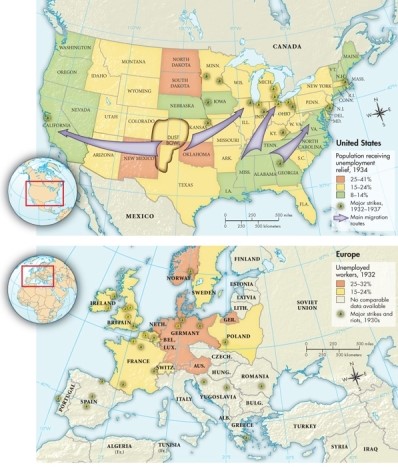
A)Countries with moderate unemployment experienced more strikes and riots.
B)Countries with high unemployment experienced more strikes and riots.
C)Strikes and riots occurred in every European country and American state with high unemployment.
D)Strikes and riots did not occur in states with low unemployment.
A)Countries with moderate unemployment experienced more strikes and riots.
B)Countries with high unemployment experienced more strikes and riots.
C)Strikes and riots occurred in every European country and American state with high unemployment.
D)Strikes and riots did not occur in states with low unemployment.
Question
According to Map 26.1: The Great Depression in the United States and Europe, 1929-1939, which European countries had the highest levels of unemployment? 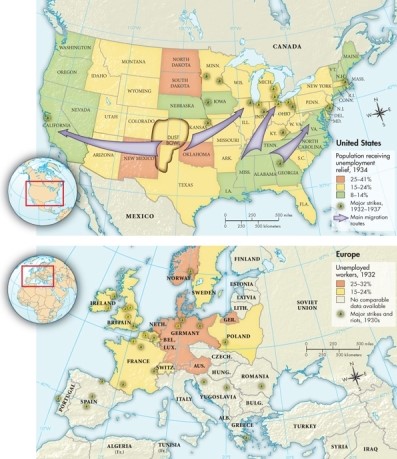
A)France, Britain, Ireland, and Sweden
B)Belgium, Luxembourg, Poland, and Switzerland
C)The Netherlands, Norway, Germany, and Austria
D)Germany, Norway, and Austria
A)France, Britain, Ireland, and Sweden
B)Belgium, Luxembourg, Poland, and Switzerland
C)The Netherlands, Norway, Germany, and Austria
D)Germany, Norway, and Austria
Question
Question
Question
Question
Question
Question
Question
According to Map 26.1: The Great Depression in the United States and Europe, 1929-1939, which American states contain the highest percentage of population receiving unemployment relief? 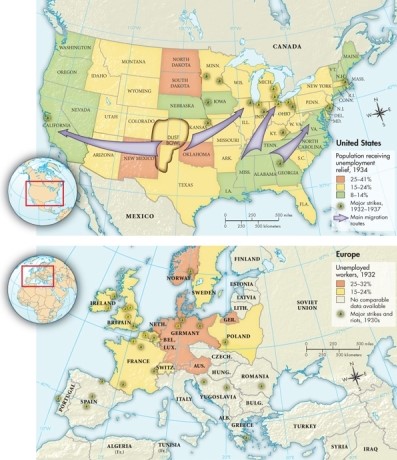
A)Washington, Oregon, Nevada, and California
B)Colorado, Kansas, and Texas
C)North Dakota, South Dakota, Oklahoma, and New Mexico
D)Michigan, Ohio, and Indiana
A)Washington, Oregon, Nevada, and California
B)Colorado, Kansas, and Texas
C)North Dakota, South Dakota, Oklahoma, and New Mexico
D)Michigan, Ohio, and Indiana
Question
Question
According to Map 26.1: The Great Depression in the United States and Europe, 1929-1939, which American states are in the Dust Bowl? 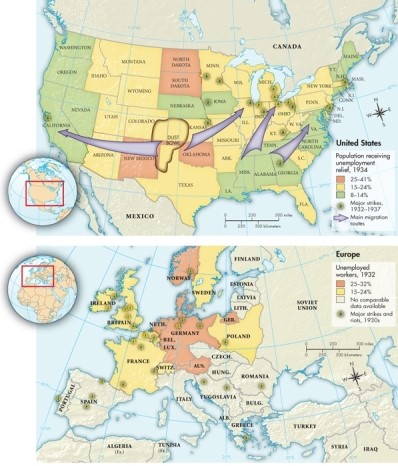
A)California, Arizona, New Mexico, Oklahoma, and Missouri
B)Tennessee, Kentucky, Indiana, and Ohio
C)Georgia, North Carolina, and Virginia
D)New Mexico, Colorado, Kansas, Oklahoma, and Texas
A)California, Arizona, New Mexico, Oklahoma, and Missouri
B)Tennessee, Kentucky, Indiana, and Ohio
C)Georgia, North Carolina, and Virginia
D)New Mexico, Colorado, Kansas, Oklahoma, and Texas
Question
Question
Question
Question
Question
Question
Question
Question
Question
Question
Question
Question
Question
Question
Question
Question
Question
Question
Question
Question
Question
Question
Question
Question
Question
Question
Question

Unlock Deck
Sign up to unlock the cards in this deck!
Unlock Deck
Unlock Deck
1/78

Play

Full screen (f)
Deck 26: The Age of Anxiety 1880-1940
1
Why was Britain more ready to conciliate Germany than France following the Versailles peace settlement?
A)The British and Germans shared a common cultural heritage.
B)The British feared the growth of French military power.
C)The British wanted a strong Germany as a bulwark against Bolshevism.
D)British had depended heavily on the German market for their exports before World War I.
A)The British and Germans shared a common cultural heritage.
B)The British feared the growth of French military power.
C)The British wanted a strong Germany as a bulwark against Bolshevism.
D)British had depended heavily on the German market for their exports before World War I.
British had depended heavily on the German market for their exports before World War I.
2
What is the composer Arnold Schönberg known for?
A)His creation of twelve-tone music that abandoned traditional harmony and tonality
B)His composition of nationalistic German operas
C)His use of pulsing dissonant rhythms in the ballet Rite of Spring
D)His composition of musical background for the first talkies
A)His creation of twelve-tone music that abandoned traditional harmony and tonality
B)His composition of nationalistic German operas
C)His use of pulsing dissonant rhythms in the ballet Rite of Spring
D)His composition of musical background for the first talkies
His creation of twelve-tone music that abandoned traditional harmony and tonality
3
With the failure of the United States to ratify the Versailles treaty, many French leaders placed their hopes for future security on
A)strict implementation of the treaty.
B)the alliance with Great Britain.
C)the League of Nations.
D)a closer relationship with Germany.
A)strict implementation of the treaty.
B)the alliance with Great Britain.
C)the League of Nations.
D)a closer relationship with Germany.
strict implementation of the treaty.
4
How did Jean-Paul Sartre think that people could live authentically in the twentieth century?
A)They must structure their lives around conventional social norms.
B)They must choose their actions fully aware of their responsibility for their behavior.
C)They must seek pleasure and avoid pain.
D)They must passively accept the loneliness and meaninglessness of human existence.
A)They must structure their lives around conventional social norms.
B)They must choose their actions fully aware of their responsibility for their behavior.
C)They must seek pleasure and avoid pain.
D)They must passively accept the loneliness and meaninglessness of human existence.
Unlock Deck
Unlock for access to all 78 flashcards in this deck.
Unlock Deck
k this deck
5
What did Jean-Paul Sartre mean by the expression "existence precedes essence"?
A)The soul only enters the body after one is born so that God can ensure each person a soul appropriate to his or her place in life.
B)Since there are no timeless or absolute truths, people must struggle to define their essence after they are born, completely on their own.
C)The immediacy of life and its struggles must take priority over quests for the eternal and salvation.
D)The essence of a life is defined by the environment, such as social position and access to education, into which one is born.
A)The soul only enters the body after one is born so that God can ensure each person a soul appropriate to his or her place in life.
B)Since there are no timeless or absolute truths, people must struggle to define their essence after they are born, completely on their own.
C)The immediacy of life and its struggles must take priority over quests for the eternal and salvation.
D)The essence of a life is defined by the environment, such as social position and access to education, into which one is born.
Unlock Deck
Unlock for access to all 78 flashcards in this deck.
Unlock Deck
k this deck
6
Gabriel Marcel found the answer to the postwar broken world in
A)socialism.
B)Marxism.
C)the Catholic Church.
D)Calvinist theology.
A)socialism.
B)Marxism.
C)the Catholic Church.
D)Calvinist theology.
Unlock Deck
Unlock for access to all 78 flashcards in this deck.
Unlock Deck
k this deck
7
In his writings on human psychology, Sigmund Freud asserted that
A)the superego is the self-promoting desire for control and power.
B)the ego is the irrational component of the self that is always seeking pleasure.
C)the id is constantly negotiating between the demands of the ego and the superego.
D)the id is the unconscious source of sexual and aggressive instincts.
A)the superego is the self-promoting desire for control and power.
B)the ego is the irrational component of the self that is always seeking pleasure.
C)the id is constantly negotiating between the demands of the ego and the superego.
D)the id is the unconscious source of sexual and aggressive instincts.
Unlock Deck
Unlock for access to all 78 flashcards in this deck.
Unlock Deck
k this deck
8
What did Marcel Proust attempt to do in his novel Remembrance of Things Past?
A)Understand the historical laws governing human behavior as they played out in individual lives
B)Explore how Nietzsche's declaration "God is dead" affected a typical French village structured around its local church
C)Demonstrate how the history of France was a story of the progress of mankind
D)Discover the inner meaning of bittersweet memories of childhood and youthful love
A)Understand the historical laws governing human behavior as they played out in individual lives
B)Explore how Nietzsche's declaration "God is dead" affected a typical French village structured around its local church
C)Demonstrate how the history of France was a story of the progress of mankind
D)Discover the inner meaning of bittersweet memories of childhood and youthful love
Unlock Deck
Unlock for access to all 78 flashcards in this deck.
Unlock Deck
k this deck
9
In Civilization and Its Discontents (1930), Freud argued that civilization required
A)individuals to renounce their irrational instincts in order to live peaceably in groups.
B)people to place themselves under the control of a single, all-powerful political figure.
C)members of capitalist societies to work toward the Marxist vision of a classless society.
D)all people to seek pleasure and avoid pain.
A)individuals to renounce their irrational instincts in order to live peaceably in groups.
B)people to place themselves under the control of a single, all-powerful political figure.
C)members of capitalist societies to work toward the Marxist vision of a classless society.
D)all people to seek pleasure and avoid pain.
Unlock Deck
Unlock for access to all 78 flashcards in this deck.
Unlock Deck
k this deck
10
In twentieth-century literature, the stream-of-consciousness technique uses
A)a series of visual images to express emotions.
B)a series of disjointed references and observations for the reader to decipher.
C)a linear line of language without punctuation or capitalization.
D)internal monologues to explore the psyche.
A)a series of visual images to express emotions.
B)a series of disjointed references and observations for the reader to decipher.
C)a linear line of language without punctuation or capitalization.
D)internal monologues to explore the psyche.
Unlock Deck
Unlock for access to all 78 flashcards in this deck.
Unlock Deck
k this deck
11
In the twentieth century, what was John Maynard Keynes known for?
A)He advocated minimal government intervention in the economy.
B)He was avowedly hostile to Germany.
C)He denounced the Treaty of Versailles for economic reasons.
D)He broke new ground in the study of genetics.
A)He advocated minimal government intervention in the economy.
B)He was avowedly hostile to Germany.
C)He denounced the Treaty of Versailles for economic reasons.
D)He broke new ground in the study of genetics.
Unlock Deck
Unlock for access to all 78 flashcards in this deck.
Unlock Deck
k this deck
12
In his philosophical writings, Friedrich Nietzsche argued that
A)the Western world had overemphasized rationality and stifled the authentic passions that drive human activity and true creativity.
B)democracy, progress, and respectability were important ideas that no civilization could do without.
C)the individual must not accept the idea that human existence is meaningless.
D)humans must overcome their animal instincts, which prevent them from refining their intellectual abilities and moral sensibilities.
A)the Western world had overemphasized rationality and stifled the authentic passions that drive human activity and true creativity.
B)democracy, progress, and respectability were important ideas that no civilization could do without.
C)the individual must not accept the idea that human existence is meaningless.
D)humans must overcome their animal instincts, which prevent them from refining their intellectual abilities and moral sensibilities.
Unlock Deck
Unlock for access to all 78 flashcards in this deck.
Unlock Deck
k this deck
13
What was the British political party that emerged during the 1920s as the main opposition to the Conservative party?
A)Liberal Party
B)Labour Party
C)Social Democratic Party
D)Christian Democratic Party
A)Liberal Party
B)Labour Party
C)Social Democratic Party
D)Christian Democratic Party
Unlock Deck
Unlock for access to all 78 flashcards in this deck.
Unlock Deck
k this deck
14
Which political group dominated the parliamentary governments of Germany in the mid to late 1920s?
A)Social Democrats
B)Right-wing nationalists
C)Moderate businessmen
D)Christian Democrats
A)Social Democrats
B)Right-wing nationalists
C)Moderate businessmen
D)Christian Democrats
Unlock Deck
Unlock for access to all 78 flashcards in this deck.
Unlock Deck
k this deck
15
What did the theories of Albert Einstein assert?
A)Matter and energy are interchangeable, linking the apparently infinite universe with the subatomic world.
B)The passage of time provides the one fixed reference in the universe, which scientists could establish as a standard point of reference.
C)Particles of nature are essentially dead, as they lack an internal animating energy.
D)The immutability of Newton's laws of nature has been secured by modern science.
A)Matter and energy are interchangeable, linking the apparently infinite universe with the subatomic world.
B)The passage of time provides the one fixed reference in the universe, which scientists could establish as a standard point of reference.
C)Particles of nature are essentially dead, as they lack an internal animating energy.
D)The immutability of Newton's laws of nature has been secured by modern science.
Unlock Deck
Unlock for access to all 78 flashcards in this deck.
Unlock Deck
k this deck
16
In the twentieth century, Werner Heisenburg established the "uncertainty principle," which postulates that
A)scientific knowledge is unreliable because new discoveries constantly undermine older theories about the universe.
B)scientific knowledge is the most reliable because scientists accept that their ideas are uncertain and constantly test and reexamine them.
C)nature itself is ultimately unknowable and unpredictable and lacks any absolute objective reality.
D)God produced doubt in humans to challenge their simple belief so that it would grow into a mature faith.
A)scientific knowledge is unreliable because new discoveries constantly undermine older theories about the universe.
B)scientific knowledge is the most reliable because scientists accept that their ideas are uncertain and constantly test and reexamine them.
C)nature itself is ultimately unknowable and unpredictable and lacks any absolute objective reality.
D)God produced doubt in humans to challenge their simple belief so that it would grow into a mature faith.
Unlock Deck
Unlock for access to all 78 flashcards in this deck.
Unlock Deck
k this deck
17
What agreement did the United States develop to resolve the economic problems of Germany and international tensions in Europe in 1924?
A)Agricultural Adjustment Act.
B)Dawes Plan
C)New Deal
D)Locarno Pact
A)Agricultural Adjustment Act.
B)Dawes Plan
C)New Deal
D)Locarno Pact
Unlock Deck
Unlock for access to all 78 flashcards in this deck.
Unlock Deck
k this deck
18
What was the main argument of logical positivism in the twentieth century?
A)Philosophy is only the logical clarification of thoughts.
B)Individuals must become engaged in modern life.
C)One must search for moral values and then act on those values.
D)The concept of God could be adapted to fit within Einstein's theory of the universe.
A)Philosophy is only the logical clarification of thoughts.
B)Individuals must become engaged in modern life.
C)One must search for moral values and then act on those values.
D)The concept of God could be adapted to fit within Einstein's theory of the universe.
Unlock Deck
Unlock for access to all 78 flashcards in this deck.
Unlock Deck
k this deck
19
What does the "middle way" refer to?
A)The Scandinavian response to the Great Depression
B)The design philosophy of the Bauhaus
C)The reform of German reparations payments
D)The new literary efforts of writers such as Joyce and Faulkner
A)The Scandinavian response to the Great Depression
B)The design philosophy of the Bauhaus
C)The reform of German reparations payments
D)The new literary efforts of writers such as Joyce and Faulkner
Unlock Deck
Unlock for access to all 78 flashcards in this deck.
Unlock Deck
k this deck
20
The nineteenth-century Danish theologian Søren Kierkegaard taught that
A)advances in science proved the existence of God by the universe's intricate design, which required an original designer.
B)God's existence could not be proven, but believers must take a leap of faith and accept the existence of a majestic God.
C)the study of the non-Western world shows us that there are many versions of God and all of them are legitimate.
D)religions provide an appropriate escape for the common people, but the educated should never be bound by such a belief.
A)advances in science proved the existence of God by the universe's intricate design, which required an original designer.
B)God's existence could not be proven, but believers must take a leap of faith and accept the existence of a majestic God.
C)the study of the non-Western world shows us that there are many versions of God and all of them are legitimate.
D)religions provide an appropriate escape for the common people, but the educated should never be bound by such a belief.
Unlock Deck
Unlock for access to all 78 flashcards in this deck.
Unlock Deck
k this deck
21
In the early twentieth century, the traditional arts and amusements of people in villages and small towns were overshadowed by
A)modern mass media such as cinema and radio.
B)public schools and mass education programs.
C)the expansion of professional sports.
D)a market culture expressed in merchandise catalogs.
A)modern mass media such as cinema and radio.
B)public schools and mass education programs.
C)the expansion of professional sports.
D)a market culture expressed in merchandise catalogs.
Unlock Deck
Unlock for access to all 78 flashcards in this deck.
Unlock Deck
k this deck
22
Who was the director of Triumph of the Will, a brilliant piece of cinematic propaganda based on the 1934 Nazi Party rally at Nuremberg?
A)Sergei Eisenstein
B)Fritz Lang
C)Adolf Hitler
D)Leni Riefenstahl
A)Sergei Eisenstein
B)Fritz Lang
C)Adolf Hitler
D)Leni Riefenstahl
Unlock Deck
Unlock for access to all 78 flashcards in this deck.
Unlock Deck
k this deck
23
The German government's printing of money to pay unemployment benefits to workers striking in the Ruhr against the Franco-Belgian occupation of 1923 led to
A)hyperinflation.
B)French withdrawal from the Ruhr.
C)a rise in the Ruhr workers' standard of living.
D)the crash of the U.S. stock market.
A)hyperinflation.
B)French withdrawal from the Ruhr.
C)a rise in the Ruhr workers' standard of living.
D)the crash of the U.S. stock market.
Unlock Deck
Unlock for access to all 78 flashcards in this deck.
Unlock Deck
k this deck
24
What did the Swedish response to the Depression involve?
A)Increasing social welfare benefits and state spending on public works projects
B)Increasing military spending
C)Balancing the government budget by cutting government programs
D)Erecting trade barriers and putting the currency on the gold standard
A)Increasing social welfare benefits and state spending on public works projects
B)Increasing military spending
C)Balancing the government budget by cutting government programs
D)Erecting trade barriers and putting the currency on the gold standard
Unlock Deck
Unlock for access to all 78 flashcards in this deck.
Unlock Deck
k this deck
25
What did President Franklin Roosevelt's National Recovery Administration (NRA) attempt to do?
A)Plan and control the U.S. economy
B)Purchase failing businesses
C)Establish a social welfare system
D)Nationalize banks, railroads, and heavy industry
A)Plan and control the U.S. economy
B)Purchase failing businesses
C)Establish a social welfare system
D)Nationalize banks, railroads, and heavy industry
Unlock Deck
Unlock for access to all 78 flashcards in this deck.
Unlock Deck
k this deck
26
What was an important factor in both the rapid growth of the American stock market in the 1920s and its collapse in October 1929?
A)Buying on margin
B)The great increase in investments by giant pension funds
C)Overly optimistic stockbrokers
D)Overregulation by the federal government
A)Buying on margin
B)The great increase in investments by giant pension funds
C)Overly optimistic stockbrokers
D)Overregulation by the federal government
Unlock Deck
Unlock for access to all 78 flashcards in this deck.
Unlock Deck
k this deck
27
The American stock market crash of October 1929 was primarily the result of
A)nationalist economic policies in Europe.
B)an imbalance between real investment and speculation.
C)the government's Keynesian economic policies.
D)the failure of Germany to keep up reparations payments.
A)nationalist economic policies in Europe.
B)an imbalance between real investment and speculation.
C)the government's Keynesian economic policies.
D)the failure of Germany to keep up reparations payments.
Unlock Deck
Unlock for access to all 78 flashcards in this deck.
Unlock Deck
k this deck
28
What did the Popular Front do after its 1936 victory in France?
A)It provided strong support for its sister Popular Front government in the Spanish Civil War.
B)It launched a modest program of social reform in an attempt not to frighten businessmen or conservatives.
C)It encouraged the union movement and launched a far-reaching program of social reforms that included a forty-hour workweek.
D)It adopted the program of the French Communist Party and appeared to be preparing for revolution in France.
A)It provided strong support for its sister Popular Front government in the Spanish Civil War.
B)It launched a modest program of social reform in an attempt not to frighten businessmen or conservatives.
C)It encouraged the union movement and launched a far-reaching program of social reforms that included a forty-hour workweek.
D)It adopted the program of the French Communist Party and appeared to be preparing for revolution in France.
Unlock Deck
Unlock for access to all 78 flashcards in this deck.
Unlock Deck
k this deck
29
The signatories of the 1928 Kellogg-Briand Pact, initiated by French prime minister Aristide Briand and U.S. secretary of state Frank B. Kellogg, agreed to
A)review on an annual basis any issues that might disturb the balance of power in Europe.
B)take part in a defensive alliance against the Soviet Union.
C)renounce war as an instrument of international policy.
D)sponsor a revision of German reparations payments.
A)review on an annual basis any issues that might disturb the balance of power in Europe.
B)take part in a defensive alliance against the Soviet Union.
C)renounce war as an instrument of international policy.
D)sponsor a revision of German reparations payments.
Unlock Deck
Unlock for access to all 78 flashcards in this deck.
Unlock Deck
k this deck
30
For artists such as the Dadaists and Surrealists, what was the purpose of art?
A)To counter the drab filth of industrial society and produce hope through beauty
B)To strive for beauty for beauty's sake regardless of social difficulties
C)To pursue the unconscious components of the mind in order to find pure truth
D)To expose the bankruptcy of modern society and produce radical social change
A)To counter the drab filth of industrial society and produce hope through beauty
B)To strive for beauty for beauty's sake regardless of social difficulties
C)To pursue the unconscious components of the mind in order to find pure truth
D)To expose the bankruptcy of modern society and produce radical social change
Unlock Deck
Unlock for access to all 78 flashcards in this deck.
Unlock Deck
k this deck
31
The Great Depression did not hit Britain as hard as the United States or Germany in part because
A)Britain had a tradition of deficit spending by the government.
B)the British government followed the recommendations of economist John Maynard Keynes.
C)the British economy had moved away from international markets and toward production of goods for the domestic market.
D)the United States provided Britain with substantial economic assistance.
A)Britain had a tradition of deficit spending by the government.
B)the British government followed the recommendations of economist John Maynard Keynes.
C)the British economy had moved away from international markets and toward production of goods for the domestic market.
D)the United States provided Britain with substantial economic assistance.
Unlock Deck
Unlock for access to all 78 flashcards in this deck.
Unlock Deck
k this deck
32
The German Communist Party, noisy and active in the 1920s, reserved their greatest hatred and sharpest barbs for
A)Hitler's Nazi Party.
B)union workers.
C)Social Democrats.
D)ultranationalists.
A)Hitler's Nazi Party.
B)union workers.
C)Social Democrats.
D)ultranationalists.
Unlock Deck
Unlock for access to all 78 flashcards in this deck.
Unlock Deck
k this deck
33
What idea does the functionalist architecture of Le Corbusier promote?
A)Buildings should be built without ornamentation and instead be practical structures with clean, straight lines.
B)Buildings should reflect their surrounding environment, imitating the forms and designs of nature.
C)Buildings should imitate classical forms that emphasized harmony and balance.
D)Buildings should express the mood of the architect in reaction to the society around him.
A)Buildings should be built without ornamentation and instead be practical structures with clean, straight lines.
B)Buildings should reflect their surrounding environment, imitating the forms and designs of nature.
C)Buildings should imitate classical forms that emphasized harmony and balance.
D)Buildings should express the mood of the architect in reaction to the society around him.
Unlock Deck
Unlock for access to all 78 flashcards in this deck.
Unlock Deck
k this deck
34
James Joyce's Ulysses weaves ironic parallels between the adventures of Homer's hero Ulysses and
A)the struggles of Napoleon Bonaparte to gain power during the French Revolution.
B)an ordinary man's aimless wanderings through the streets and pubs of Dublin.
C)the development of a tourist industry in colonial lands.
D)a group of radical students seeking to live on the margins of society in Berlin.
A)the struggles of Napoleon Bonaparte to gain power during the French Revolution.
B)an ordinary man's aimless wanderings through the streets and pubs of Dublin.
C)the development of a tourist industry in colonial lands.
D)a group of radical students seeking to live on the margins of society in Berlin.
Unlock Deck
Unlock for access to all 78 flashcards in this deck.
Unlock Deck
k this deck
35
Unemployment in the United States averaged only 5 percent in the 1920s but in 1933 soared to about
A)10 percent.
B)20 percent.
C)30 percent.
D)40 percent.
A)10 percent.
B)20 percent.
C)30 percent.
D)40 percent.
Unlock Deck
Unlock for access to all 78 flashcards in this deck.
Unlock Deck
k this deck
36
Why was the Great Depression slow to affect France?
A)France had substantial social security measures already in place that protected the population and prevented economic collapse.
B)France refused to abandon the gold standard, which protected its currency and aided its response to economic decline.
C)France was less industrialized than the other major continental powers in Europe and somewhat isolated from the world economy.
D)France's economy was based on basic materials that remained in demand even as demand for consumer goods collapsed.
A)France had substantial social security measures already in place that protected the population and prevented economic collapse.
B)France refused to abandon the gold standard, which protected its currency and aided its response to economic decline.
C)France was less industrialized than the other major continental powers in Europe and somewhat isolated from the world economy.
D)France's economy was based on basic materials that remained in demand even as demand for consumer goods collapsed.
Unlock Deck
Unlock for access to all 78 flashcards in this deck.
Unlock Deck
k this deck
37
What kind of world did Franz Kafka portray in fiction like The Trial (1925)?
A)A utopian world in which everyone has everything they need
B)A pessimistic world in which helpless individuals are crushed by inexplicably hostile forces
C)A Marxist world in which the proletariat have triumphed
D)A Freudian world in which all have repressed their instincts in order to live peaceably with one another
A)A utopian world in which everyone has everything they need
B)A pessimistic world in which helpless individuals are crushed by inexplicably hostile forces
C)A Marxist world in which the proletariat have triumphed
D)A Freudian world in which all have repressed their instincts in order to live peaceably with one another
Unlock Deck
Unlock for access to all 78 flashcards in this deck.
Unlock Deck
k this deck
38
In 1923, which German politician called off passive resistance in the Ruhr and agreed in principle to pay reparations?
A)Adolf Hitler
B)Stanley Baldwin
C)Gustav Stresemann
D)Ludwig Wittgenstein
A)Adolf Hitler
B)Stanley Baldwin
C)Gustav Stresemann
D)Ludwig Wittgenstein
Unlock Deck
Unlock for access to all 78 flashcards in this deck.
Unlock Deck
k this deck
39
How did France and Belgium react when Germany refused to make its second reparations payment?
A)They declared war.
B)They established a naval blockade of German ports.
C)They appealed to the League of Nations.
D)They occupied the Ruhr district.
A)They declared war.
B)They established a naval blockade of German ports.
C)They appealed to the League of Nations.
D)They occupied the Ruhr district.
Unlock Deck
Unlock for access to all 78 flashcards in this deck.
Unlock Deck
k this deck
40
Why did Britain's abandonment of the gold standard not aid its recovery?
A)Its gold reserves were so large from its colonial possessions that it undermined the efforts to create a free-floating currency.
B)After industrialization, gold played a small role in the world economy.
C)Many other wealthy countries abandoned the gold standard after Britain, blunting any advantage for Britain.
D)The lack of bank regulations and currency controls resulted in a currency that already was devalued.
A)Its gold reserves were so large from its colonial possessions that it undermined the efforts to create a free-floating currency.
B)After industrialization, gold played a small role in the world economy.
C)Many other wealthy countries abandoned the gold standard after Britain, blunting any advantage for Britain.
D)The lack of bank regulations and currency controls resulted in a currency that already was devalued.
Unlock Deck
Unlock for access to all 78 flashcards in this deck.
Unlock Deck
k this deck
41
Using Map 26.1: The Great Depression in the United States and Europe, 1929-1939, explain the relationship between unemployment and rioting.
A)Countries with moderate unemployment experienced more strikes and riots.
B)Countries with high unemployment experienced more strikes and riots.
C)Strikes and riots occurred in every European country and American state with high unemployment.
D)Strikes and riots did not occur in states with low unemployment.
A)Countries with moderate unemployment experienced more strikes and riots.
B)Countries with high unemployment experienced more strikes and riots.
C)Strikes and riots occurred in every European country and American state with high unemployment.
D)Strikes and riots did not occur in states with low unemployment.
Unlock Deck
Unlock for access to all 78 flashcards in this deck.
Unlock Deck
k this deck
42
According to Map 26.1: The Great Depression in the United States and Europe, 1929-1939, which European countries had the highest levels of unemployment?
A)France, Britain, Ireland, and Sweden
B)Belgium, Luxembourg, Poland, and Switzerland
C)The Netherlands, Norway, Germany, and Austria
D)Germany, Norway, and Austria
A)France, Britain, Ireland, and Sweden
B)Belgium, Luxembourg, Poland, and Switzerland
C)The Netherlands, Norway, Germany, and Austria
D)Germany, Norway, and Austria
Unlock Deck
Unlock for access to all 78 flashcards in this deck.
Unlock Deck
k this deck
43
The following is an excerpt from the Futurist manifest of Filippo Tommaso Marinetti (Evaluating the Evidence 26.2): "4. We say that the world's magnificence has been enriched by a new beauty: the beauty of speed. A racing car whose hood is adorned with great pipes, like serpents of explosive breath-a roaring car that seems to ride on grapeshot-is more beautiful than the Victory of Samothrace.5. We want to hymn the man at the wheel, who hurls the lance of his spirit across the Earth, along the circle of its orbit."
This passage reflects the Futurists' celebration of
A)modern technology.
B)nature.
C)war.
D)tradition.
This passage reflects the Futurists' celebration of
A)modern technology.
B)nature.
C)war.
D)tradition.
Unlock Deck
Unlock for access to all 78 flashcards in this deck.
Unlock Deck
k this deck
44
What was the goal of the Bauhaus school?
Unlock Deck
Unlock for access to all 78 flashcards in this deck.
Unlock Deck
k this deck
45
What did Gustav Stresemann do to meet the challenge of runaway inflation in Germany in 1923?
Unlock Deck
Unlock for access to all 78 flashcards in this deck.
Unlock Deck
k this deck
46
The following is an excerpt from George Orwell's The Road to Wigan Pier, a study of conditions in northern England (Evaluating the Evidence 26.3): "When you see the unemployment figures quoted at two millions, it is fatally easy to take this as meaning that two million people are out of work and the rest of the population is comparatively comfortable. . . .
This is an enormous under-estimate, because, in the first place, the only people shown on unemployment figures are those actually drawing the dole-that is, in general, heads of families. An unemployed man's dependants do not figure on the list unless they too are drawing a separate allowance. . . . In addition there are great numbers of people who are in work but who, from a financial point of view, might equally be unemployed, because they are not drawing anything that can be described as a living wage."
Why did Orwell think that unemployment figures underestimated the number of people who were in dire economic straits?
A)The statistics were intentionally inaccurate.
B)The statistics did not include the family members of the unemployed.
C)The statistics only counted industrial workers.
D)The statistics only counted workers in London.
This is an enormous under-estimate, because, in the first place, the only people shown on unemployment figures are those actually drawing the dole-that is, in general, heads of families. An unemployed man's dependants do not figure on the list unless they too are drawing a separate allowance. . . . In addition there are great numbers of people who are in work but who, from a financial point of view, might equally be unemployed, because they are not drawing anything that can be described as a living wage."
Why did Orwell think that unemployment figures underestimated the number of people who were in dire economic straits?
A)The statistics were intentionally inaccurate.
B)The statistics did not include the family members of the unemployed.
C)The statistics only counted industrial workers.
D)The statistics only counted workers in London.
Unlock Deck
Unlock for access to all 78 flashcards in this deck.
Unlock Deck
k this deck
47
What did orthodox economists believe in the 1930s?
A)Governments should increase spending and accept large deficits to stimulate the economy.
B)Balanced budgets were the key to economic growth.
C)Remaining on the gold standard would lead to a relatively quick economic recovery.
D)Governments should avoid limiting international trade by raising tariffs.
A)Governments should increase spending and accept large deficits to stimulate the economy.
B)Balanced budgets were the key to economic growth.
C)Remaining on the gold standard would lead to a relatively quick economic recovery.
D)Governments should avoid limiting international trade by raising tariffs.
Unlock Deck
Unlock for access to all 78 flashcards in this deck.
Unlock Deck
k this deck
48
The following is an excerpt from the Futurist manifest of Filippo Tommaso Marinetti (Evaluating the Evidence 26.2): "8. We stand on the last promontory of the centuries! . . . Why should we look back, when what we want is to break down the mysterious doors of the Impossible? Time and Space died yesterday. We already live in the absolute, because we have created eternal, omnipresent speed. 9. We will glorify war-the world's only hygiene-militarism, patriotism, the destructive gesture of freedom-bringers, beautiful ideas worth dying for, and scorn for woman.10. We will destroy the museums, libraries, academies of every kind, will fight moralism, feminism, every opportunistic or utilitarian cowardice."
How did Marinetti and the Futurists see war?
A)War will not be possible owing to interlocking international economies.
B)War and its ideals will be idolized by Futurists.
C)War will soon be entirely in the past, as utopia is within reach.
D)War is the tool of capitalists who want to enslave the proletariat, but Futurists are not fooled by this conspiracy of the middle class.
How did Marinetti and the Futurists see war?
A)War will not be possible owing to interlocking international economies.
B)War and its ideals will be idolized by Futurists.
C)War will soon be entirely in the past, as utopia is within reach.
D)War is the tool of capitalists who want to enslave the proletariat, but Futurists are not fooled by this conspiracy of the middle class.
Unlock Deck
Unlock for access to all 78 flashcards in this deck.
Unlock Deck
k this deck
49
According to Map 26.1: The Great Depression in the United States and Europe, 1929-1939, which American states contain the highest percentage of population receiving unemployment relief?
A)Washington, Oregon, Nevada, and California
B)Colorado, Kansas, and Texas
C)North Dakota, South Dakota, Oklahoma, and New Mexico
D)Michigan, Ohio, and Indiana
A)Washington, Oregon, Nevada, and California
B)Colorado, Kansas, and Texas
C)North Dakota, South Dakota, Oklahoma, and New Mexico
D)Michigan, Ohio, and Indiana
Unlock Deck
Unlock for access to all 78 flashcards in this deck.
Unlock Deck
k this deck
50
What did the Works Progress Administration (WPA) attempt to do during the Great Depression in the United States?
Unlock Deck
Unlock for access to all 78 flashcards in this deck.
Unlock Deck
k this deck
51
According to Map 26.1: The Great Depression in the United States and Europe, 1929-1939, which American states are in the Dust Bowl?
A)California, Arizona, New Mexico, Oklahoma, and Missouri
B)Tennessee, Kentucky, Indiana, and Ohio
C)Georgia, North Carolina, and Virginia
D)New Mexico, Colorado, Kansas, Oklahoma, and Texas
A)California, Arizona, New Mexico, Oklahoma, and Missouri
B)Tennessee, Kentucky, Indiana, and Ohio
C)Georgia, North Carolina, and Virginia
D)New Mexico, Colorado, Kansas, Oklahoma, and Texas
Unlock Deck
Unlock for access to all 78 flashcards in this deck.
Unlock Deck
k this deck
52
The following is an excerpt from Nietzsche's The Gay Science (Evaluating the Evidence 26.1): "The Madman. Haven't you heard of that madman, who on a bright morning day lit a lantern, ran into the marketplace, and screamed incessantly: 'I am looking for God! I am looking for God!' Since there were a lot of people standing around who did not believe in God, he only aroused great laughter. Is he lost? asked one person. Did he lose his way like a child? asked another. Or is he in hiding? Is he frightened of us? Has he gone on a journey? Or emigrated? And so they screamed and laughed. The madman leaped into the crowd and stared straight at them. 'Where has God gone?' he cried. 'I will tell you! We have killed him. You and I! All of us are his murderers!'"
Nietzsche believed that _____________ had killed God.
A)apathy
B)nationalism
C)the Church
D)modern society
Nietzsche believed that _____________ had killed God.
A)apathy
B)nationalism
C)the Church
D)modern society
Unlock Deck
Unlock for access to all 78 flashcards in this deck.
Unlock Deck
k this deck
53
What kinds of problems did mass unemployment cause during the Great Depression?
Unlock Deck
Unlock for access to all 78 flashcards in this deck.
Unlock Deck
k this deck
54
What point did the Dadaists try to make with their art?
Unlock Deck
Unlock for access to all 78 flashcards in this deck.
Unlock Deck
k this deck
55
Following the First World War, how did the revolt against established certainties in philosophy differ in the English-speaking world as opposed to continental Europe?
Unlock Deck
Unlock for access to all 78 flashcards in this deck.
Unlock Deck
k this deck
56
Who was the "modern girl"?
Unlock Deck
Unlock for access to all 78 flashcards in this deck.
Unlock Deck
k this deck
57
The following is an excerpt from George Orwell's The Road to Wigan Pier, a study of conditions in northern England (Evaluating the Evidence 26.3): "[The poor and the unemployed] don't necessarily lower their standards by cutting out luxuries and concentrating on necessities; more often it is the other way about-the more natural way, if you come to think of it. Hence the fact that in a decade of unparalleled depression, the consumption of all cheap luxuries has increased. The two things that have probably made the greatest difference of all are the movies and the mass-production of cheap smart clothes since the war. The youth who leaves school at fourteen and gets a blind-alley job is out of work at twenty, probably for life; but for two pounds ten on the hire-purchase system he can buy himself a suit which, for a little while and at a little distance, looks as though it had been tailored in Savile Row."
According to Orwell, the depression led to
A)a return to traditional values and pastimes.
B)the intensification of working-class militancy.
C)an increase in the consumption of cheap luxury items.
D)the adoption of an austere lifestyle by the poor.
According to Orwell, the depression led to
A)a return to traditional values and pastimes.
B)the intensification of working-class militancy.
C)an increase in the consumption of cheap luxury items.
D)the adoption of an austere lifestyle by the poor.
Unlock Deck
Unlock for access to all 78 flashcards in this deck.
Unlock Deck
k this deck
58
On what basis did John Maynard Keynes criticize the Versailles Treaty?
Unlock Deck
Unlock for access to all 78 flashcards in this deck.
Unlock Deck
k this deck
59
What was the Scandinavian response to the Great Depression?
Unlock Deck
Unlock for access to all 78 flashcards in this deck.
Unlock Deck
k this deck
60
What were the key components of the theology of Søren Kierkegaard?
Unlock Deck
Unlock for access to all 78 flashcards in this deck.
Unlock Deck
k this deck
61
Answer the following questions:
Dawes Plan
A)A philosophy that sees meaning only in those beliefs that can be empirically proven; it therefore rejects as nonsense most of the concerns of traditional philosophy, from the existence of God to the meaning of happiness.
B)A philosophy that stresses the meaninglessness of existence and the importance of the individual in searching for moral values in an uncertain world.
C)Sigmund Freud's terms to describe the three parts of the self and the basis of human behavior, which he saw as basically irrational.
D)The principle that buildings, like industrial products, should serve as well as possible the purpose for which they were made, without excessive ornamentation.
E)A literary technique, used by such writers as Virginia Woolf and James Joyce, in which a character's thoughts and feelings are described as they occur as a means to explore the human psyche.
F)A German interdisciplinary school of fine and applied arts that brought together many leading modern architects, designers, and theatrical innovators.
G)War reparations agreement that reduced Germany's yearly payments, made payment dependent on economic prosperity, and granted large U.S. loans to promote recovery.
H)A worldwide economic depression from 1929 through 1939, unique in its severity and duration and with slow and uneven recovery.
I)A label given to the artistic and cultural movements of the late-nineteenth and early-twentieth centuries; these movements were typified by radical experimentation that challenged traditional forms of artistic expression.
J)Albert Einstein's theory that time and space are relative to the observer, and that only the speed of light remains constant.
K)A short-lived New Deal-inspired alliance in France led by Léon Blum that encouraged the union movement and launched a far-reaching program of social reform.
L)An artistic movement of the 1920s and 1930s that attacked all accepted standards of art and behavior and delighted in outrageous conduct.
M)Somewhat stereotypical image of the modern and independent working woman popular in the 1920s.
Dawes Plan
A)A philosophy that sees meaning only in those beliefs that can be empirically proven; it therefore rejects as nonsense most of the concerns of traditional philosophy, from the existence of God to the meaning of happiness.
B)A philosophy that stresses the meaninglessness of existence and the importance of the individual in searching for moral values in an uncertain world.
C)Sigmund Freud's terms to describe the three parts of the self and the basis of human behavior, which he saw as basically irrational.
D)The principle that buildings, like industrial products, should serve as well as possible the purpose for which they were made, without excessive ornamentation.
E)A literary technique, used by such writers as Virginia Woolf and James Joyce, in which a character's thoughts and feelings are described as they occur as a means to explore the human psyche.
F)A German interdisciplinary school of fine and applied arts that brought together many leading modern architects, designers, and theatrical innovators.
G)War reparations agreement that reduced Germany's yearly payments, made payment dependent on economic prosperity, and granted large U.S. loans to promote recovery.
H)A worldwide economic depression from 1929 through 1939, unique in its severity and duration and with slow and uneven recovery.
I)A label given to the artistic and cultural movements of the late-nineteenth and early-twentieth centuries; these movements were typified by radical experimentation that challenged traditional forms of artistic expression.
J)Albert Einstein's theory that time and space are relative to the observer, and that only the speed of light remains constant.
K)A short-lived New Deal-inspired alliance in France led by Léon Blum that encouraged the union movement and launched a far-reaching program of social reform.
L)An artistic movement of the 1920s and 1930s that attacked all accepted standards of art and behavior and delighted in outrageous conduct.
M)Somewhat stereotypical image of the modern and independent working woman popular in the 1920s.
Unlock Deck
Unlock for access to all 78 flashcards in this deck.
Unlock Deck
k this deck
62
Answer the following questions:
Great Depression
A)A philosophy that sees meaning only in those beliefs that can be empirically proven; it therefore rejects as nonsense most of the concerns of traditional philosophy, from the existence of God to the meaning of happiness.
B)A philosophy that stresses the meaninglessness of existence and the importance of the individual in searching for moral values in an uncertain world.
C)Sigmund Freud's terms to describe the three parts of the self and the basis of human behavior, which he saw as basically irrational.
D)The principle that buildings, like industrial products, should serve as well as possible the purpose for which they were made, without excessive ornamentation.
E)A literary technique, used by such writers as Virginia Woolf and James Joyce, in which a character's thoughts and feelings are described as they occur as a means to explore the human psyche.
F)A German interdisciplinary school of fine and applied arts that brought together many leading modern architects, designers, and theatrical innovators.
G)War reparations agreement that reduced Germany's yearly payments, made payment dependent on economic prosperity, and granted large U.S. loans to promote recovery.
H)A worldwide economic depression from 1929 through 1939, unique in its severity and duration and with slow and uneven recovery.
I)A label given to the artistic and cultural movements of the late-nineteenth and early-twentieth centuries; these movements were typified by radical experimentation that challenged traditional forms of artistic expression.
J)Albert Einstein's theory that time and space are relative to the observer, and that only the speed of light remains constant.
K)A short-lived New Deal-inspired alliance in France led by Léon Blum that encouraged the union movement and launched a far-reaching program of social reform.
L)An artistic movement of the 1920s and 1930s that attacked all accepted standards of art and behavior and delighted in outrageous conduct.
M)Somewhat stereotypical image of the modern and independent working woman popular in the 1920s.
Great Depression
A)A philosophy that sees meaning only in those beliefs that can be empirically proven; it therefore rejects as nonsense most of the concerns of traditional philosophy, from the existence of God to the meaning of happiness.
B)A philosophy that stresses the meaninglessness of existence and the importance of the individual in searching for moral values in an uncertain world.
C)Sigmund Freud's terms to describe the three parts of the self and the basis of human behavior, which he saw as basically irrational.
D)The principle that buildings, like industrial products, should serve as well as possible the purpose for which they were made, without excessive ornamentation.
E)A literary technique, used by such writers as Virginia Woolf and James Joyce, in which a character's thoughts and feelings are described as they occur as a means to explore the human psyche.
F)A German interdisciplinary school of fine and applied arts that brought together many leading modern architects, designers, and theatrical innovators.
G)War reparations agreement that reduced Germany's yearly payments, made payment dependent on economic prosperity, and granted large U.S. loans to promote recovery.
H)A worldwide economic depression from 1929 through 1939, unique in its severity and duration and with slow and uneven recovery.
I)A label given to the artistic and cultural movements of the late-nineteenth and early-twentieth centuries; these movements were typified by radical experimentation that challenged traditional forms of artistic expression.
J)Albert Einstein's theory that time and space are relative to the observer, and that only the speed of light remains constant.
K)A short-lived New Deal-inspired alliance in France led by Léon Blum that encouraged the union movement and launched a far-reaching program of social reform.
L)An artistic movement of the 1920s and 1930s that attacked all accepted standards of art and behavior and delighted in outrageous conduct.
M)Somewhat stereotypical image of the modern and independent working woman popular in the 1920s.
Unlock Deck
Unlock for access to all 78 flashcards in this deck.
Unlock Deck
k this deck
63
Answer the following questions:
stream-of-consciousness writing
A)A philosophy that sees meaning only in those beliefs that can be empirically proven; it therefore rejects as nonsense most of the concerns of traditional philosophy, from the existence of God to the meaning of happiness.
B)A philosophy that stresses the meaninglessness of existence and the importance of the individual in searching for moral values in an uncertain world.
C)Sigmund Freud's terms to describe the three parts of the self and the basis of human behavior, which he saw as basically irrational.
D)The principle that buildings, like industrial products, should serve as well as possible the purpose for which they were made, without excessive ornamentation.
E)A literary technique, used by such writers as Virginia Woolf and James Joyce, in which a character's thoughts and feelings are described as they occur as a means to explore the human psyche.
F)A German interdisciplinary school of fine and applied arts that brought together many leading modern architects, designers, and theatrical innovators.
G)War reparations agreement that reduced Germany's yearly payments, made payment dependent on economic prosperity, and granted large U.S. loans to promote recovery.
H)A worldwide economic depression from 1929 through 1939, unique in its severity and duration and with slow and uneven recovery.
I)A label given to the artistic and cultural movements of the late-nineteenth and early-twentieth centuries; these movements were typified by radical experimentation that challenged traditional forms of artistic expression.
J)Albert Einstein's theory that time and space are relative to the observer, and that only the speed of light remains constant.
K)A short-lived New Deal-inspired alliance in France led by Léon Blum that encouraged the union movement and launched a far-reaching program of social reform.
L)An artistic movement of the 1920s and 1930s that attacked all accepted standards of art and behavior and delighted in outrageous conduct.
M)Somewhat stereotypical image of the modern and independent working woman popular in the 1920s.
stream-of-consciousness writing
A)A philosophy that sees meaning only in those beliefs that can be empirically proven; it therefore rejects as nonsense most of the concerns of traditional philosophy, from the existence of God to the meaning of happiness.
B)A philosophy that stresses the meaninglessness of existence and the importance of the individual in searching for moral values in an uncertain world.
C)Sigmund Freud's terms to describe the three parts of the self and the basis of human behavior, which he saw as basically irrational.
D)The principle that buildings, like industrial products, should serve as well as possible the purpose for which they were made, without excessive ornamentation.
E)A literary technique, used by such writers as Virginia Woolf and James Joyce, in which a character's thoughts and feelings are described as they occur as a means to explore the human psyche.
F)A German interdisciplinary school of fine and applied arts that brought together many leading modern architects, designers, and theatrical innovators.
G)War reparations agreement that reduced Germany's yearly payments, made payment dependent on economic prosperity, and granted large U.S. loans to promote recovery.
H)A worldwide economic depression from 1929 through 1939, unique in its severity and duration and with slow and uneven recovery.
I)A label given to the artistic and cultural movements of the late-nineteenth and early-twentieth centuries; these movements were typified by radical experimentation that challenged traditional forms of artistic expression.
J)Albert Einstein's theory that time and space are relative to the observer, and that only the speed of light remains constant.
K)A short-lived New Deal-inspired alliance in France led by Léon Blum that encouraged the union movement and launched a far-reaching program of social reform.
L)An artistic movement of the 1920s and 1930s that attacked all accepted standards of art and behavior and delighted in outrageous conduct.
M)Somewhat stereotypical image of the modern and independent working woman popular in the 1920s.
Unlock Deck
Unlock for access to all 78 flashcards in this deck.
Unlock Deck
k this deck
64
Answer the following questions:
id, ego, and superego
A)A philosophy that sees meaning only in those beliefs that can be empirically proven; it therefore rejects as nonsense most of the concerns of traditional philosophy, from the existence of God to the meaning of happiness.
B)A philosophy that stresses the meaninglessness of existence and the importance of the individual in searching for moral values in an uncertain world.
C)Sigmund Freud's terms to describe the three parts of the self and the basis of human behavior, which he saw as basically irrational.
D)The principle that buildings, like industrial products, should serve as well as possible the purpose for which they were made, without excessive ornamentation.
E)A literary technique, used by such writers as Virginia Woolf and James Joyce, in which a character's thoughts and feelings are described as they occur as a means to explore the human psyche.
F)A German interdisciplinary school of fine and applied arts that brought together many leading modern architects, designers, and theatrical innovators.
G)War reparations agreement that reduced Germany's yearly payments, made payment dependent on economic prosperity, and granted large U.S. loans to promote recovery.
H)A worldwide economic depression from 1929 through 1939, unique in its severity and duration and with slow and uneven recovery.
I)A label given to the artistic and cultural movements of the late-nineteenth and early-twentieth centuries; these movements were typified by radical experimentation that challenged traditional forms of artistic expression.
J)Albert Einstein's theory that time and space are relative to the observer, and that only the speed of light remains constant.
K)A short-lived New Deal-inspired alliance in France led by Léon Blum that encouraged the union movement and launched a far-reaching program of social reform.
L)An artistic movement of the 1920s and 1930s that attacked all accepted standards of art and behavior and delighted in outrageous conduct.
M)Somewhat stereotypical image of the modern and independent working woman popular in the 1920s.
id, ego, and superego
A)A philosophy that sees meaning only in those beliefs that can be empirically proven; it therefore rejects as nonsense most of the concerns of traditional philosophy, from the existence of God to the meaning of happiness.
B)A philosophy that stresses the meaninglessness of existence and the importance of the individual in searching for moral values in an uncertain world.
C)Sigmund Freud's terms to describe the three parts of the self and the basis of human behavior, which he saw as basically irrational.
D)The principle that buildings, like industrial products, should serve as well as possible the purpose for which they were made, without excessive ornamentation.
E)A literary technique, used by such writers as Virginia Woolf and James Joyce, in which a character's thoughts and feelings are described as they occur as a means to explore the human psyche.
F)A German interdisciplinary school of fine and applied arts that brought together many leading modern architects, designers, and theatrical innovators.
G)War reparations agreement that reduced Germany's yearly payments, made payment dependent on economic prosperity, and granted large U.S. loans to promote recovery.
H)A worldwide economic depression from 1929 through 1939, unique in its severity and duration and with slow and uneven recovery.
I)A label given to the artistic and cultural movements of the late-nineteenth and early-twentieth centuries; these movements were typified by radical experimentation that challenged traditional forms of artistic expression.
J)Albert Einstein's theory that time and space are relative to the observer, and that only the speed of light remains constant.
K)A short-lived New Deal-inspired alliance in France led by Léon Blum that encouraged the union movement and launched a far-reaching program of social reform.
L)An artistic movement of the 1920s and 1930s that attacked all accepted standards of art and behavior and delighted in outrageous conduct.
M)Somewhat stereotypical image of the modern and independent working woman popular in the 1920s.
Unlock Deck
Unlock for access to all 78 flashcards in this deck.
Unlock Deck
k this deck
65
Answer the following questions:
Popular Front
A)A philosophy that sees meaning only in those beliefs that can be empirically proven; it therefore rejects as nonsense most of the concerns of traditional philosophy, from the existence of God to the meaning of happiness.
B)A philosophy that stresses the meaninglessness of existence and the importance of the individual in searching for moral values in an uncertain world.
C)Sigmund Freud's terms to describe the three parts of the self and the basis of human behavior, which he saw as basically irrational.
D)The principle that buildings, like industrial products, should serve as well as possible the purpose for which they were made, without excessive ornamentation.
E)A literary technique, used by such writers as Virginia Woolf and James Joyce, in which a character's thoughts and feelings are described as they occur as a means to explore the human psyche.
F)A German interdisciplinary school of fine and applied arts that brought together many leading modern architects, designers, and theatrical innovators.
G)War reparations agreement that reduced Germany's yearly payments, made payment dependent on economic prosperity, and granted large U.S. loans to promote recovery.
H)A worldwide economic depression from 1929 through 1939, unique in its severity and duration and with slow and uneven recovery.
I)A label given to the artistic and cultural movements of the late-nineteenth and early-twentieth centuries; these movements were typified by radical experimentation that challenged traditional forms of artistic expression.
J)Albert Einstein's theory that time and space are relative to the observer, and that only the speed of light remains constant.
K)A short-lived New Deal-inspired alliance in France led by Léon Blum that encouraged the union movement and launched a far-reaching program of social reform.
L)An artistic movement of the 1920s and 1930s that attacked all accepted standards of art and behavior and delighted in outrageous conduct.
M)Somewhat stereotypical image of the modern and independent working woman popular in the 1920s.
Popular Front
A)A philosophy that sees meaning only in those beliefs that can be empirically proven; it therefore rejects as nonsense most of the concerns of traditional philosophy, from the existence of God to the meaning of happiness.
B)A philosophy that stresses the meaninglessness of existence and the importance of the individual in searching for moral values in an uncertain world.
C)Sigmund Freud's terms to describe the three parts of the self and the basis of human behavior, which he saw as basically irrational.
D)The principle that buildings, like industrial products, should serve as well as possible the purpose for which they were made, without excessive ornamentation.
E)A literary technique, used by such writers as Virginia Woolf and James Joyce, in which a character's thoughts and feelings are described as they occur as a means to explore the human psyche.
F)A German interdisciplinary school of fine and applied arts that brought together many leading modern architects, designers, and theatrical innovators.
G)War reparations agreement that reduced Germany's yearly payments, made payment dependent on economic prosperity, and granted large U.S. loans to promote recovery.
H)A worldwide economic depression from 1929 through 1939, unique in its severity and duration and with slow and uneven recovery.
I)A label given to the artistic and cultural movements of the late-nineteenth and early-twentieth centuries; these movements were typified by radical experimentation that challenged traditional forms of artistic expression.
J)Albert Einstein's theory that time and space are relative to the observer, and that only the speed of light remains constant.
K)A short-lived New Deal-inspired alliance in France led by Léon Blum that encouraged the union movement and launched a far-reaching program of social reform.
L)An artistic movement of the 1920s and 1930s that attacked all accepted standards of art and behavior and delighted in outrageous conduct.
M)Somewhat stereotypical image of the modern and independent working woman popular in the 1920s.
Unlock Deck
Unlock for access to all 78 flashcards in this deck.
Unlock Deck
k this deck
66
Although anxiety seems to have affected everyone in the 1920s, upper and lower classes retained a sharp division between high and popular culture. Which aspects of the developments in arts, literature, entertainment, and philosophy had an impact on the common person?
Unlock Deck
Unlock for access to all 78 flashcards in this deck.
Unlock Deck
k this deck
67
Answer the following questions:
"modern girl"
A)A philosophy that sees meaning only in those beliefs that can be empirically proven; it therefore rejects as nonsense most of the concerns of traditional philosophy, from the existence of God to the meaning of happiness.
B)A philosophy that stresses the meaninglessness of existence and the importance of the individual in searching for moral values in an uncertain world.
C)Sigmund Freud's terms to describe the three parts of the self and the basis of human behavior, which he saw as basically irrational.
D)The principle that buildings, like industrial products, should serve as well as possible the purpose for which they were made, without excessive ornamentation.
E)A literary technique, used by such writers as Virginia Woolf and James Joyce, in which a character's thoughts and feelings are described as they occur as a means to explore the human psyche.
F)A German interdisciplinary school of fine and applied arts that brought together many leading modern architects, designers, and theatrical innovators.
G)War reparations agreement that reduced Germany's yearly payments, made payment dependent on economic prosperity, and granted large U.S. loans to promote recovery.
H)A worldwide economic depression from 1929 through 1939, unique in its severity and duration and with slow and uneven recovery.
I)A label given to the artistic and cultural movements of the late-nineteenth and early-twentieth centuries; these movements were typified by radical experimentation that challenged traditional forms of artistic expression.
J)Albert Einstein's theory that time and space are relative to the observer, and that only the speed of light remains constant.
K)A short-lived New Deal-inspired alliance in France led by Léon Blum that encouraged the union movement and launched a far-reaching program of social reform.
L)An artistic movement of the 1920s and 1930s that attacked all accepted standards of art and behavior and delighted in outrageous conduct.
M)Somewhat stereotypical image of the modern and independent working woman popular in the 1920s.
"modern girl"
A)A philosophy that sees meaning only in those beliefs that can be empirically proven; it therefore rejects as nonsense most of the concerns of traditional philosophy, from the existence of God to the meaning of happiness.
B)A philosophy that stresses the meaninglessness of existence and the importance of the individual in searching for moral values in an uncertain world.
C)Sigmund Freud's terms to describe the three parts of the self and the basis of human behavior, which he saw as basically irrational.
D)The principle that buildings, like industrial products, should serve as well as possible the purpose for which they were made, without excessive ornamentation.
E)A literary technique, used by such writers as Virginia Woolf and James Joyce, in which a character's thoughts and feelings are described as they occur as a means to explore the human psyche.
F)A German interdisciplinary school of fine and applied arts that brought together many leading modern architects, designers, and theatrical innovators.
G)War reparations agreement that reduced Germany's yearly payments, made payment dependent on economic prosperity, and granted large U.S. loans to promote recovery.
H)A worldwide economic depression from 1929 through 1939, unique in its severity and duration and with slow and uneven recovery.
I)A label given to the artistic and cultural movements of the late-nineteenth and early-twentieth centuries; these movements were typified by radical experimentation that challenged traditional forms of artistic expression.
J)Albert Einstein's theory that time and space are relative to the observer, and that only the speed of light remains constant.
K)A short-lived New Deal-inspired alliance in France led by Léon Blum that encouraged the union movement and launched a far-reaching program of social reform.
L)An artistic movement of the 1920s and 1930s that attacked all accepted standards of art and behavior and delighted in outrageous conduct.
M)Somewhat stereotypical image of the modern and independent working woman popular in the 1920s.
Unlock Deck
Unlock for access to all 78 flashcards in this deck.
Unlock Deck
k this deck
68
In many respects, Chapter 26 is about the consequences of the First World War. Discuss this statement critically, being sure to address not only the war's impact on European society, politics, economies, and culture but also the prewar origins of postwar developments in science, art, and philosophy. Do you agree with this assertion? Why or why not?
Unlock Deck
Unlock for access to all 78 flashcards in this deck.
Unlock Deck
k this deck
69
How did radio and movies allow propagandists and political leaders to reconstruct orderly and reassuring images of the world for ordinary people, even as high-culture artists, composers, and writers continued to dismantle traditional cultural norms and express the anxiety and fear arising out of the First World War and its aftermath?
Unlock Deck
Unlock for access to all 78 flashcards in this deck.
Unlock Deck
k this deck
70
Answer the following questions:
logical positivism
A)A philosophy that sees meaning only in those beliefs that can be empirically proven; it therefore rejects as nonsense most of the concerns of traditional philosophy, from the existence of God to the meaning of happiness.
B)A philosophy that stresses the meaninglessness of existence and the importance of the individual in searching for moral values in an uncertain world.
C)Sigmund Freud's terms to describe the three parts of the self and the basis of human behavior, which he saw as basically irrational.
D)The principle that buildings, like industrial products, should serve as well as possible the purpose for which they were made, without excessive ornamentation.
E)A literary technique, used by such writers as Virginia Woolf and James Joyce, in which a character's thoughts and feelings are described as they occur as a means to explore the human psyche.
F)A German interdisciplinary school of fine and applied arts that brought together many leading modern architects, designers, and theatrical innovators.
G)War reparations agreement that reduced Germany's yearly payments, made payment dependent on economic prosperity, and granted large U.S. loans to promote recovery.
H)A worldwide economic depression from 1929 through 1939, unique in its severity and duration and with slow and uneven recovery.
I)A label given to the artistic and cultural movements of the late-nineteenth and early-twentieth centuries; these movements were typified by radical experimentation that challenged traditional forms of artistic expression.
J)Albert Einstein's theory that time and space are relative to the observer, and that only the speed of light remains constant.
K)A short-lived New Deal-inspired alliance in France led by Léon Blum that encouraged the union movement and launched a far-reaching program of social reform.
L)An artistic movement of the 1920s and 1930s that attacked all accepted standards of art and behavior and delighted in outrageous conduct.
M)Somewhat stereotypical image of the modern and independent working woman popular in the 1920s.
logical positivism
A)A philosophy that sees meaning only in those beliefs that can be empirically proven; it therefore rejects as nonsense most of the concerns of traditional philosophy, from the existence of God to the meaning of happiness.
B)A philosophy that stresses the meaninglessness of existence and the importance of the individual in searching for moral values in an uncertain world.
C)Sigmund Freud's terms to describe the three parts of the self and the basis of human behavior, which he saw as basically irrational.
D)The principle that buildings, like industrial products, should serve as well as possible the purpose for which they were made, without excessive ornamentation.
E)A literary technique, used by such writers as Virginia Woolf and James Joyce, in which a character's thoughts and feelings are described as they occur as a means to explore the human psyche.
F)A German interdisciplinary school of fine and applied arts that brought together many leading modern architects, designers, and theatrical innovators.
G)War reparations agreement that reduced Germany's yearly payments, made payment dependent on economic prosperity, and granted large U.S. loans to promote recovery.
H)A worldwide economic depression from 1929 through 1939, unique in its severity and duration and with slow and uneven recovery.
I)A label given to the artistic and cultural movements of the late-nineteenth and early-twentieth centuries; these movements were typified by radical experimentation that challenged traditional forms of artistic expression.
J)Albert Einstein's theory that time and space are relative to the observer, and that only the speed of light remains constant.
K)A short-lived New Deal-inspired alliance in France led by Léon Blum that encouraged the union movement and launched a far-reaching program of social reform.
L)An artistic movement of the 1920s and 1930s that attacked all accepted standards of art and behavior and delighted in outrageous conduct.
M)Somewhat stereotypical image of the modern and independent working woman popular in the 1920s.
Unlock Deck
Unlock for access to all 78 flashcards in this deck.
Unlock Deck
k this deck
71
Answer the following questions:
Dadaism
A)A philosophy that sees meaning only in those beliefs that can be empirically proven; it therefore rejects as nonsense most of the concerns of traditional philosophy, from the existence of God to the meaning of happiness.
B)A philosophy that stresses the meaninglessness of existence and the importance of the individual in searching for moral values in an uncertain world.
C)Sigmund Freud's terms to describe the three parts of the self and the basis of human behavior, which he saw as basically irrational.
D)The principle that buildings, like industrial products, should serve as well as possible the purpose for which they were made, without excessive ornamentation.
E)A literary technique, used by such writers as Virginia Woolf and James Joyce, in which a character's thoughts and feelings are described as they occur as a means to explore the human psyche.
F)A German interdisciplinary school of fine and applied arts that brought together many leading modern architects, designers, and theatrical innovators.
G)War reparations agreement that reduced Germany's yearly payments, made payment dependent on economic prosperity, and granted large U.S. loans to promote recovery.
H)A worldwide economic depression from 1929 through 1939, unique in its severity and duration and with slow and uneven recovery.
I)A label given to the artistic and cultural movements of the late-nineteenth and early-twentieth centuries; these movements were typified by radical experimentation that challenged traditional forms of artistic expression.
J)Albert Einstein's theory that time and space are relative to the observer, and that only the speed of light remains constant.
K)A short-lived New Deal-inspired alliance in France led by Léon Blum that encouraged the union movement and launched a far-reaching program of social reform.
L)An artistic movement of the 1920s and 1930s that attacked all accepted standards of art and behavior and delighted in outrageous conduct.
M)Somewhat stereotypical image of the modern and independent working woman popular in the 1920s.
Dadaism
A)A philosophy that sees meaning only in those beliefs that can be empirically proven; it therefore rejects as nonsense most of the concerns of traditional philosophy, from the existence of God to the meaning of happiness.
B)A philosophy that stresses the meaninglessness of existence and the importance of the individual in searching for moral values in an uncertain world.
C)Sigmund Freud's terms to describe the three parts of the self and the basis of human behavior, which he saw as basically irrational.
D)The principle that buildings, like industrial products, should serve as well as possible the purpose for which they were made, without excessive ornamentation.
E)A literary technique, used by such writers as Virginia Woolf and James Joyce, in which a character's thoughts and feelings are described as they occur as a means to explore the human psyche.
F)A German interdisciplinary school of fine and applied arts that brought together many leading modern architects, designers, and theatrical innovators.
G)War reparations agreement that reduced Germany's yearly payments, made payment dependent on economic prosperity, and granted large U.S. loans to promote recovery.
H)A worldwide economic depression from 1929 through 1939, unique in its severity and duration and with slow and uneven recovery.
I)A label given to the artistic and cultural movements of the late-nineteenth and early-twentieth centuries; these movements were typified by radical experimentation that challenged traditional forms of artistic expression.
J)Albert Einstein's theory that time and space are relative to the observer, and that only the speed of light remains constant.
K)A short-lived New Deal-inspired alliance in France led by Léon Blum that encouraged the union movement and launched a far-reaching program of social reform.
L)An artistic movement of the 1920s and 1930s that attacked all accepted standards of art and behavior and delighted in outrageous conduct.
M)Somewhat stereotypical image of the modern and independent working woman popular in the 1920s.
Unlock Deck
Unlock for access to all 78 flashcards in this deck.
Unlock Deck
k this deck
72
Answer the following questions:
functionalism
A)A philosophy that sees meaning only in those beliefs that can be empirically proven; it therefore rejects as nonsense most of the concerns of traditional philosophy, from the existence of God to the meaning of happiness.
B)A philosophy that stresses the meaninglessness of existence and the importance of the individual in searching for moral values in an uncertain world.
C)Sigmund Freud's terms to describe the three parts of the self and the basis of human behavior, which he saw as basically irrational.
D)The principle that buildings, like industrial products, should serve as well as possible the purpose for which they were made, without excessive ornamentation.
E)A literary technique, used by such writers as Virginia Woolf and James Joyce, in which a character's thoughts and feelings are described as they occur as a means to explore the human psyche.
F)A German interdisciplinary school of fine and applied arts that brought together many leading modern architects, designers, and theatrical innovators.
G)War reparations agreement that reduced Germany's yearly payments, made payment dependent on economic prosperity, and granted large U.S. loans to promote recovery.
H)A worldwide economic depression from 1929 through 1939, unique in its severity and duration and with slow and uneven recovery.
I)A label given to the artistic and cultural movements of the late-nineteenth and early-twentieth centuries; these movements were typified by radical experimentation that challenged traditional forms of artistic expression.
J)Albert Einstein's theory that time and space are relative to the observer, and that only the speed of light remains constant.
K)A short-lived New Deal-inspired alliance in France led by Léon Blum that encouraged the union movement and launched a far-reaching program of social reform.
L)An artistic movement of the 1920s and 1930s that attacked all accepted standards of art and behavior and delighted in outrageous conduct.
M)Somewhat stereotypical image of the modern and independent working woman popular in the 1920s.
functionalism
A)A philosophy that sees meaning only in those beliefs that can be empirically proven; it therefore rejects as nonsense most of the concerns of traditional philosophy, from the existence of God to the meaning of happiness.
B)A philosophy that stresses the meaninglessness of existence and the importance of the individual in searching for moral values in an uncertain world.
C)Sigmund Freud's terms to describe the three parts of the self and the basis of human behavior, which he saw as basically irrational.
D)The principle that buildings, like industrial products, should serve as well as possible the purpose for which they were made, without excessive ornamentation.
E)A literary technique, used by such writers as Virginia Woolf and James Joyce, in which a character's thoughts and feelings are described as they occur as a means to explore the human psyche.
F)A German interdisciplinary school of fine and applied arts that brought together many leading modern architects, designers, and theatrical innovators.
G)War reparations agreement that reduced Germany's yearly payments, made payment dependent on economic prosperity, and granted large U.S. loans to promote recovery.
H)A worldwide economic depression from 1929 through 1939, unique in its severity and duration and with slow and uneven recovery.
I)A label given to the artistic and cultural movements of the late-nineteenth and early-twentieth centuries; these movements were typified by radical experimentation that challenged traditional forms of artistic expression.
J)Albert Einstein's theory that time and space are relative to the observer, and that only the speed of light remains constant.
K)A short-lived New Deal-inspired alliance in France led by Léon Blum that encouraged the union movement and launched a far-reaching program of social reform.
L)An artistic movement of the 1920s and 1930s that attacked all accepted standards of art and behavior and delighted in outrageous conduct.
M)Somewhat stereotypical image of the modern and independent working woman popular in the 1920s.
Unlock Deck
Unlock for access to all 78 flashcards in this deck.
Unlock Deck
k this deck
73
Answer the following questions:
Bauhaus
A)A philosophy that sees meaning only in those beliefs that can be empirically proven; it therefore rejects as nonsense most of the concerns of traditional philosophy, from the existence of God to the meaning of happiness.
B)A philosophy that stresses the meaninglessness of existence and the importance of the individual in searching for moral values in an uncertain world.
C)Sigmund Freud's terms to describe the three parts of the self and the basis of human behavior, which he saw as basically irrational.
D)The principle that buildings, like industrial products, should serve as well as possible the purpose for which they were made, without excessive ornamentation.
E)A literary technique, used by such writers as Virginia Woolf and James Joyce, in which a character's thoughts and feelings are described as they occur as a means to explore the human psyche.
F)A German interdisciplinary school of fine and applied arts that brought together many leading modern architects, designers, and theatrical innovators.
G)War reparations agreement that reduced Germany's yearly payments, made payment dependent on economic prosperity, and granted large U.S. loans to promote recovery.
H)A worldwide economic depression from 1929 through 1939, unique in its severity and duration and with slow and uneven recovery.
I)A label given to the artistic and cultural movements of the late-nineteenth and early-twentieth centuries; these movements were typified by radical experimentation that challenged traditional forms of artistic expression.
J)Albert Einstein's theory that time and space are relative to the observer, and that only the speed of light remains constant.
K)A short-lived New Deal-inspired alliance in France led by Léon Blum that encouraged the union movement and launched a far-reaching program of social reform.
L)An artistic movement of the 1920s and 1930s that attacked all accepted standards of art and behavior and delighted in outrageous conduct.
M)Somewhat stereotypical image of the modern and independent working woman popular in the 1920s.
Bauhaus
A)A philosophy that sees meaning only in those beliefs that can be empirically proven; it therefore rejects as nonsense most of the concerns of traditional philosophy, from the existence of God to the meaning of happiness.
B)A philosophy that stresses the meaninglessness of existence and the importance of the individual in searching for moral values in an uncertain world.
C)Sigmund Freud's terms to describe the three parts of the self and the basis of human behavior, which he saw as basically irrational.
D)The principle that buildings, like industrial products, should serve as well as possible the purpose for which they were made, without excessive ornamentation.
E)A literary technique, used by such writers as Virginia Woolf and James Joyce, in which a character's thoughts and feelings are described as they occur as a means to explore the human psyche.
F)A German interdisciplinary school of fine and applied arts that brought together many leading modern architects, designers, and theatrical innovators.
G)War reparations agreement that reduced Germany's yearly payments, made payment dependent on economic prosperity, and granted large U.S. loans to promote recovery.
H)A worldwide economic depression from 1929 through 1939, unique in its severity and duration and with slow and uneven recovery.
I)A label given to the artistic and cultural movements of the late-nineteenth and early-twentieth centuries; these movements were typified by radical experimentation that challenged traditional forms of artistic expression.
J)Albert Einstein's theory that time and space are relative to the observer, and that only the speed of light remains constant.
K)A short-lived New Deal-inspired alliance in France led by Léon Blum that encouraged the union movement and launched a far-reaching program of social reform.
L)An artistic movement of the 1920s and 1930s that attacked all accepted standards of art and behavior and delighted in outrageous conduct.
M)Somewhat stereotypical image of the modern and independent working woman popular in the 1920s.
Unlock Deck
Unlock for access to all 78 flashcards in this deck.
Unlock Deck
k this deck
74
Answer the following questions:
theory of special relativity
A)A philosophy that sees meaning only in those beliefs that can be empirically proven; it therefore rejects as nonsense most of the concerns of traditional philosophy, from the existence of God to the meaning of happiness.
B)A philosophy that stresses the meaninglessness of existence and the importance of the individual in searching for moral values in an uncertain world.
C)Sigmund Freud's terms to describe the three parts of the self and the basis of human behavior, which he saw as basically irrational.
D)The principle that buildings, like industrial products, should serve as well as possible the purpose for which they were made, without excessive ornamentation.
E)A literary technique, used by such writers as Virginia Woolf and James Joyce, in which a character's thoughts and feelings are described as they occur as a means to explore the human psyche.
F)A German interdisciplinary school of fine and applied arts that brought together many leading modern architects, designers, and theatrical innovators.
G)War reparations agreement that reduced Germany's yearly payments, made payment dependent on economic prosperity, and granted large U.S. loans to promote recovery.
H)A worldwide economic depression from 1929 through 1939, unique in its severity and duration and with slow and uneven recovery.
I)A label given to the artistic and cultural movements of the late-nineteenth and early-twentieth centuries; these movements were typified by radical experimentation that challenged traditional forms of artistic expression.
J)Albert Einstein's theory that time and space are relative to the observer, and that only the speed of light remains constant.
K)A short-lived New Deal-inspired alliance in France led by Léon Blum that encouraged the union movement and launched a far-reaching program of social reform.
L)An artistic movement of the 1920s and 1930s that attacked all accepted standards of art and behavior and delighted in outrageous conduct.
M)Somewhat stereotypical image of the modern and independent working woman popular in the 1920s.
theory of special relativity
A)A philosophy that sees meaning only in those beliefs that can be empirically proven; it therefore rejects as nonsense most of the concerns of traditional philosophy, from the existence of God to the meaning of happiness.
B)A philosophy that stresses the meaninglessness of existence and the importance of the individual in searching for moral values in an uncertain world.
C)Sigmund Freud's terms to describe the three parts of the self and the basis of human behavior, which he saw as basically irrational.
D)The principle that buildings, like industrial products, should serve as well as possible the purpose for which they were made, without excessive ornamentation.
E)A literary technique, used by such writers as Virginia Woolf and James Joyce, in which a character's thoughts and feelings are described as they occur as a means to explore the human psyche.
F)A German interdisciplinary school of fine and applied arts that brought together many leading modern architects, designers, and theatrical innovators.
G)War reparations agreement that reduced Germany's yearly payments, made payment dependent on economic prosperity, and granted large U.S. loans to promote recovery.
H)A worldwide economic depression from 1929 through 1939, unique in its severity and duration and with slow and uneven recovery.
I)A label given to the artistic and cultural movements of the late-nineteenth and early-twentieth centuries; these movements were typified by radical experimentation that challenged traditional forms of artistic expression.
J)Albert Einstein's theory that time and space are relative to the observer, and that only the speed of light remains constant.
K)A short-lived New Deal-inspired alliance in France led by Léon Blum that encouraged the union movement and launched a far-reaching program of social reform.
L)An artistic movement of the 1920s and 1930s that attacked all accepted standards of art and behavior and delighted in outrageous conduct.
M)Somewhat stereotypical image of the modern and independent working woman popular in the 1920s.
Unlock Deck
Unlock for access to all 78 flashcards in this deck.
Unlock Deck
k this deck
75
How did the Age of Anxiety manifest itself in the artistic style known as modernism? Who were the leading representatives of the different media, and what were their artistic principles? What factors influenced the emergence and development of modernism?
Unlock Deck
Unlock for access to all 78 flashcards in this deck.
Unlock Deck
k this deck
76
Answer the following questions:
modernism
A)A philosophy that sees meaning only in those beliefs that can be empirically proven; it therefore rejects as nonsense most of the concerns of traditional philosophy, from the existence of God to the meaning of happiness.
B)A philosophy that stresses the meaninglessness of existence and the importance of the individual in searching for moral values in an uncertain world.
C)Sigmund Freud's terms to describe the three parts of the self and the basis of human behavior, which he saw as basically irrational.
D)The principle that buildings, like industrial products, should serve as well as possible the purpose for which they were made, without excessive ornamentation.
E)A literary technique, used by such writers as Virginia Woolf and James Joyce, in which a character's thoughts and feelings are described as they occur as a means to explore the human psyche.
F)A German interdisciplinary school of fine and applied arts that brought together many leading modern architects, designers, and theatrical innovators.
G)War reparations agreement that reduced Germany's yearly payments, made payment dependent on economic prosperity, and granted large U.S. loans to promote recovery.
H)A worldwide economic depression from 1929 through 1939, unique in its severity and duration and with slow and uneven recovery.
I)A label given to the artistic and cultural movements of the late-nineteenth and early-twentieth centuries; these movements were typified by radical experimentation that challenged traditional forms of artistic expression.
J)Albert Einstein's theory that time and space are relative to the observer, and that only the speed of light remains constant.
K)A short-lived New Deal-inspired alliance in France led by Léon Blum that encouraged the union movement and launched a far-reaching program of social reform.
L)An artistic movement of the 1920s and 1930s that attacked all accepted standards of art and behavior and delighted in outrageous conduct.
M)Somewhat stereotypical image of the modern and independent working woman popular in the 1920s.
modernism
A)A philosophy that sees meaning only in those beliefs that can be empirically proven; it therefore rejects as nonsense most of the concerns of traditional philosophy, from the existence of God to the meaning of happiness.
B)A philosophy that stresses the meaninglessness of existence and the importance of the individual in searching for moral values in an uncertain world.
C)Sigmund Freud's terms to describe the three parts of the self and the basis of human behavior, which he saw as basically irrational.
D)The principle that buildings, like industrial products, should serve as well as possible the purpose for which they were made, without excessive ornamentation.
E)A literary technique, used by such writers as Virginia Woolf and James Joyce, in which a character's thoughts and feelings are described as they occur as a means to explore the human psyche.
F)A German interdisciplinary school of fine and applied arts that brought together many leading modern architects, designers, and theatrical innovators.
G)War reparations agreement that reduced Germany's yearly payments, made payment dependent on economic prosperity, and granted large U.S. loans to promote recovery.
H)A worldwide economic depression from 1929 through 1939, unique in its severity and duration and with slow and uneven recovery.
I)A label given to the artistic and cultural movements of the late-nineteenth and early-twentieth centuries; these movements were typified by radical experimentation that challenged traditional forms of artistic expression.
J)Albert Einstein's theory that time and space are relative to the observer, and that only the speed of light remains constant.
K)A short-lived New Deal-inspired alliance in France led by Léon Blum that encouraged the union movement and launched a far-reaching program of social reform.
L)An artistic movement of the 1920s and 1930s that attacked all accepted standards of art and behavior and delighted in outrageous conduct.
M)Somewhat stereotypical image of the modern and independent working woman popular in the 1920s.
Unlock Deck
Unlock for access to all 78 flashcards in this deck.
Unlock Deck
k this deck
77
The Age of Anxiety was, in many ways, ushered in by developments in the fields of physics, philosophy, and psychology. How did these developments contribute to the Age of Anxiety?
Unlock Deck
Unlock for access to all 78 flashcards in this deck.
Unlock Deck
k this deck
78
Answer the following questions:
existentialism
A)A philosophy that sees meaning only in those beliefs that can be empirically proven; it therefore rejects as nonsense most of the concerns of traditional philosophy, from the existence of God to the meaning of happiness.
B)A philosophy that stresses the meaninglessness of existence and the importance of the individual in searching for moral values in an uncertain world.
C)Sigmund Freud's terms to describe the three parts of the self and the basis of human behavior, which he saw as basically irrational.
D)The principle that buildings, like industrial products, should serve as well as possible the purpose for which they were made, without excessive ornamentation.
E)A literary technique, used by such writers as Virginia Woolf and James Joyce, in which a character's thoughts and feelings are described as they occur as a means to explore the human psyche.
F)A German interdisciplinary school of fine and applied arts that brought together many leading modern architects, designers, and theatrical innovators.
G)War reparations agreement that reduced Germany's yearly payments, made payment dependent on economic prosperity, and granted large U.S. loans to promote recovery.
H)A worldwide economic depression from 1929 through 1939, unique in its severity and duration and with slow and uneven recovery.
I)A label given to the artistic and cultural movements of the late-nineteenth and early-twentieth centuries; these movements were typified by radical experimentation that challenged traditional forms of artistic expression.
J)Albert Einstein's theory that time and space are relative to the observer, and that only the speed of light remains constant.
K)A short-lived New Deal-inspired alliance in France led by Léon Blum that encouraged the union movement and launched a far-reaching program of social reform.
L)An artistic movement of the 1920s and 1930s that attacked all accepted standards of art and behavior and delighted in outrageous conduct.
M)Somewhat stereotypical image of the modern and independent working woman popular in the 1920s.
existentialism
A)A philosophy that sees meaning only in those beliefs that can be empirically proven; it therefore rejects as nonsense most of the concerns of traditional philosophy, from the existence of God to the meaning of happiness.
B)A philosophy that stresses the meaninglessness of existence and the importance of the individual in searching for moral values in an uncertain world.
C)Sigmund Freud's terms to describe the three parts of the self and the basis of human behavior, which he saw as basically irrational.
D)The principle that buildings, like industrial products, should serve as well as possible the purpose for which they were made, without excessive ornamentation.
E)A literary technique, used by such writers as Virginia Woolf and James Joyce, in which a character's thoughts and feelings are described as they occur as a means to explore the human psyche.
F)A German interdisciplinary school of fine and applied arts that brought together many leading modern architects, designers, and theatrical innovators.
G)War reparations agreement that reduced Germany's yearly payments, made payment dependent on economic prosperity, and granted large U.S. loans to promote recovery.
H)A worldwide economic depression from 1929 through 1939, unique in its severity and duration and with slow and uneven recovery.
I)A label given to the artistic and cultural movements of the late-nineteenth and early-twentieth centuries; these movements were typified by radical experimentation that challenged traditional forms of artistic expression.
J)Albert Einstein's theory that time and space are relative to the observer, and that only the speed of light remains constant.
K)A short-lived New Deal-inspired alliance in France led by Léon Blum that encouraged the union movement and launched a far-reaching program of social reform.
L)An artistic movement of the 1920s and 1930s that attacked all accepted standards of art and behavior and delighted in outrageous conduct.
M)Somewhat stereotypical image of the modern and independent working woman popular in the 1920s.
Unlock Deck
Unlock for access to all 78 flashcards in this deck.
Unlock Deck
k this deck
Unlock Deck
Unlock for access to all 78 flashcards in this deck.






