







 Chat with AI

Deck 22: Life in the Emerging Urban Society 1840-1914
Full screen (f)

Question

Question
Question
Question
Question
Question
Question
Question
Question
Question
Question
Question
Question
Question
Question
Question
Question
Question
Question
Question
Question
Question
Question
Question
Question
Question
Question
Question
Question
Question
Question
Question
Question
Question
Question
Question
Question
Question
Question
Question
Question
Question
Question
Question
Question
Question
On Map 22.1: European Cities of 100,000 or More, 1800-1900, which cities had the largest increase in population growth between 1800 and 1900? 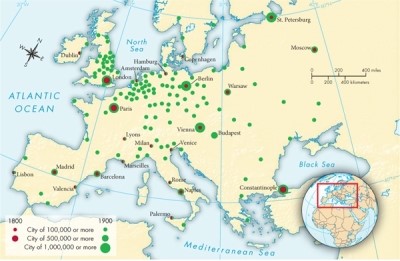
A)Berlin, St. Petersburg, and Vienna
B)London, Paris, and Constantinople
C)Moscow, Naples, Barcelona, and Madrid
D)London and Paris
A)Berlin, St. Petersburg, and Vienna
B)London, Paris, and Constantinople
C)Moscow, Naples, Barcelona, and Madrid
D)London and Paris
Question
The Boulevard Saint-Michel, shown on Map 22.2: The Modernization of Paris, ca. 1850-1870, was one of Baron Haussmann's most controversial projects because its construction 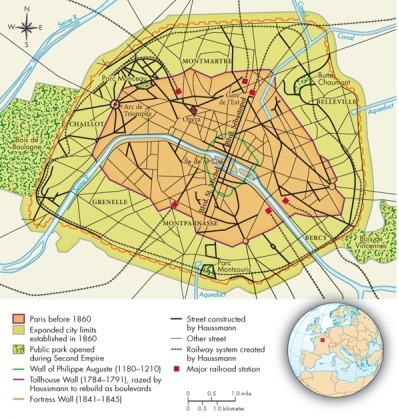
A)required the razing of much of Paris's medieval core.
B)took land that had been set aside for the Bois de Boulogne.
C)meant moving the Arc de Triomphe.
D)meant destroying the Fortress Wall (1841-1845).
A)required the razing of much of Paris's medieval core.
B)took land that had been set aside for the Bois de Boulogne.
C)meant moving the Arc de Triomphe.
D)meant destroying the Fortress Wall (1841-1845).
Question
Question
Question
Question
Which cities on Map 22.1: European Cities of 100,000 or More, 1800-1900 contained one million or more people in 1900? 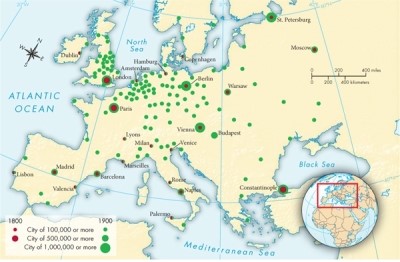
A)Madrid, London, Paris, Berlin, Vienna, and Moscow
B)Lisbon, Paris, Amsterdam, Copenhagen, Berlin, and Constantinople
C)Rome, Constantinople, Warsaw, Vienna, St. Petersburg, and Copenhagen
D)London, Paris, Berlin, Vienna, St. Petersburg, and Constantinople
A)Madrid, London, Paris, Berlin, Vienna, and Moscow
B)Lisbon, Paris, Amsterdam, Copenhagen, Berlin, and Constantinople
C)Rome, Constantinople, Warsaw, Vienna, St. Petersburg, and Copenhagen
D)London, Paris, Berlin, Vienna, St. Petersburg, and Constantinople
Question
Question
Question
Question
Question
Question
Question
Question
On Map 22.2: The Modernization of Paris, ca. 1850-1870, what formed the boundary of Paris before 1860? 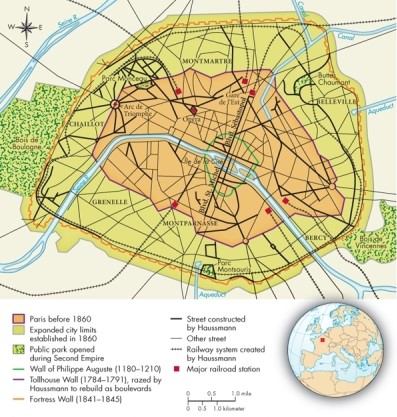
A)The Wall of Philippe August
B)The Tollhouse Wall
C)The Fortress Wall
D)The Boulevard Saint-Michel
A)The Wall of Philippe August
B)The Tollhouse Wall
C)The Fortress Wall
D)The Boulevard Saint-Michel
Question
Question
Question
Question
Question
Question
Question
Question
Question
Question
Question
Question
Question
Question
Question
Question
Question

Unlock Deck
Sign up to unlock the cards in this deck!
Unlock Deck
Unlock Deck
1/76

Play

Full screen (f)
Deck 22: Life in the Emerging Urban Society 1840-1914
1
As the nineteenth century progressed, the upper middle class
A)tended to merge with the old aristocracy.
B)formed tighter bonds with the rest of the middle class.
C)retained its frugal attitudes.
D)increasingly turned toward socialism.
A)tended to merge with the old aristocracy.
B)formed tighter bonds with the rest of the middle class.
C)retained its frugal attitudes.
D)increasingly turned toward socialism.
tended to merge with the old aristocracy.
2
As a result of the idea of separate spheres, middle-class married women who sought to work outside the home
A)found that they could not gain well-paying jobs, and their wages were less than men's for the same work.
B)gained a series of legal rights over their property and wages.
C)were eligible for professional employment if they had the proper education.
D)had easy access to childcare.
A)found that they could not gain well-paying jobs, and their wages were less than men's for the same work.
B)gained a series of legal rights over their property and wages.
C)were eligible for professional employment if they had the proper education.
D)had easy access to childcare.
found that they could not gain well-paying jobs, and their wages were less than men's for the same work.
3
What was a central component of the improvements in sanitation in the nineteenth century?
A)Horses carried many of the diseases that afflicted humans.
B)Communal baths would reduce the spread of dangerous bacteria.
C)Excrement from outhouses could be carried off by water through sewers at low cost.
D)Most diseases were carried into cities by rural laborers who came into the cities for work.
A)Horses carried many of the diseases that afflicted humans.
B)Communal baths would reduce the spread of dangerous bacteria.
C)Excrement from outhouses could be carried off by water through sewers at low cost.
D)Most diseases were carried into cities by rural laborers who came into the cities for work.
Excrement from outhouses could be carried off by water through sewers at low cost.
4
Which of the following describes late-nineteenth-century prostitution?
A)It was strictly divided along class lines; wealthy men visited expensive courtesans, and poor women provided sexual services for working-class men.
B)It was increasingly outlawed and suppressed across Europe as middle-class women pressed their ideas about morality on society.
C)It was a stage of life for many poor young women, which they moved beyond as they established their own homes and families.
D)While young men visited prostitutes, once men married, this action usually stopped abruptly in order to create family harmony.
A)It was strictly divided along class lines; wealthy men visited expensive courtesans, and poor women provided sexual services for working-class men.
B)It was increasingly outlawed and suppressed across Europe as middle-class women pressed their ideas about morality on society.
C)It was a stage of life for many poor young women, which they moved beyond as they established their own homes and families.
D)While young men visited prostitutes, once men married, this action usually stopped abruptly in order to create family harmony.
Unlock Deck
Unlock for access to all 76 flashcards in this deck.
Unlock Deck
k this deck
5
How did wages change in the late nineteenth century?
A)Real wages decreased for the mass of the population, and the gap between the rich and the poor increased.
B)Real wages rose for the mass of the population, but the gap between the rich and the poor did not decrease.
C)Real wages decreased for the mass of the population, but so did prices thanks to industrialization, leading to an increase in living standards.
D)Real wages increased for the mass of the population, but prices rose even more dramatically, leading to a decrease in living standards.
A)Real wages decreased for the mass of the population, and the gap between the rich and the poor increased.
B)Real wages rose for the mass of the population, but the gap between the rich and the poor did not decrease.
C)Real wages decreased for the mass of the population, but so did prices thanks to industrialization, leading to an increase in living standards.
D)Real wages increased for the mass of the population, but prices rose even more dramatically, leading to a decrease in living standards.
Unlock Deck
Unlock for access to all 76 flashcards in this deck.
Unlock Deck
k this deck
6
How did the urban working class change in the latter half of the nineteenth century?
A)It increasingly formed a unified, coherent culture that became the basis of class unity.
B)The sharp distinction between highly skilled artisans and unskilled manual workers broke down as semiskilled groups of workers became more prevalent.
C)Skilled artisans increasingly joined the middle class, leaving the working class largely unskilled.
D)The labor aristocracy disappeared as their positions were replaced by mechanized factory labor.
A)It increasingly formed a unified, coherent culture that became the basis of class unity.
B)The sharp distinction between highly skilled artisans and unskilled manual workers broke down as semiskilled groups of workers became more prevalent.
C)Skilled artisans increasingly joined the middle class, leaving the working class largely unskilled.
D)The labor aristocracy disappeared as their positions were replaced by mechanized factory labor.
Unlock Deck
Unlock for access to all 76 flashcards in this deck.
Unlock Deck
k this deck
7
How did the expansion of the Industrial Revolution affect the work life of the middle class?
A)The middle class increasingly used their ownership of businesses to distance themselves from active roles in the economy.
B)The middle class established a range of new professions, which required specialized knowledge and advanced education.
C)Increasingly undermined by wealthy industrialists, the middle class turned into wage laborers with a standard of living barely above that of the laboring poor.
D)The middle class left management positions in large private and public organizations, believing them to be beneath their dignity.
A)The middle class increasingly used their ownership of businesses to distance themselves from active roles in the economy.
B)The middle class established a range of new professions, which required specialized knowledge and advanced education.
C)Increasingly undermined by wealthy industrialists, the middle class turned into wage laborers with a standard of living barely above that of the laboring poor.
D)The middle class left management positions in large private and public organizations, believing them to be beneath their dignity.
Unlock Deck
Unlock for access to all 76 flashcards in this deck.
Unlock Deck
k this deck
8
Which of the following characterizes early-nineteenth-century British cities?
A)Overcrowding in cities inhibited population growth.
B)City officials demolished row houses in order to build more efficient apartment complexes.
C)New laws limiting capacity in buildings eased overcrowding.
D)Nearly all land was used for buildings, which meant parks or open areas were almost nonexistent.
A)Overcrowding in cities inhibited population growth.
B)City officials demolished row houses in order to build more efficient apartment complexes.
C)New laws limiting capacity in buildings eased overcrowding.
D)Nearly all land was used for buildings, which meant parks or open areas were almost nonexistent.
Unlock Deck
Unlock for access to all 76 flashcards in this deck.
Unlock Deck
k this deck
9
Why did illegitimacy rates decline after 1850?
A)The higher incidence of marriage for expectant mothers
B)Decreased premarital sexual activity
C)The increased availability of contraception and abortion
D)The increased influence of religion among the lower classes
A)The higher incidence of marriage for expectant mothers
B)Decreased premarital sexual activity
C)The increased availability of contraception and abortion
D)The increased influence of religion among the lower classes
Unlock Deck
Unlock for access to all 76 flashcards in this deck.
Unlock Deck
k this deck
10
What did the middle class generally agree was the correct attitude toward behavior and morality?
A)Always adhere to a strict moral code.
B)Whatever is fashionable is acceptable.
C)Those who fall into poverty or crime are not responsible for their circumstances.
D)Morality is based on natural law, not on Christianity.
A)Always adhere to a strict moral code.
B)Whatever is fashionable is acceptable.
C)Those who fall into poverty or crime are not responsible for their circumstances.
D)Morality is based on natural law, not on Christianity.
Unlock Deck
Unlock for access to all 76 flashcards in this deck.
Unlock Deck
k this deck
11
What was a result of improved economic conditions in the nineteenth century?
A)There were more job opportunities for women outside the home.
B)More women remained single.
C)Married women were not expected to work outside the home.
D)The vote was extended to women in much of Europe.
A)There were more job opportunities for women outside the home.
B)More women remained single.
C)Married women were not expected to work outside the home.
D)The vote was extended to women in much of Europe.
Unlock Deck
Unlock for access to all 76 flashcards in this deck.
Unlock Deck
k this deck
12
How did the culture of sports change in the late nineteenth century?
A)As the middle classes separated from the working classes, the working classes adopted more brutal sports such as bare-knuckle boxing.
B)Sports became private activities between local clubs that resisted commercialization.
C)Sports were taken over by elite society, which added costs that the poor could not afford.
D)Cruel sports such as cockfighting declined, while commercialized spectator sports became popular.
A)As the middle classes separated from the working classes, the working classes adopted more brutal sports such as bare-knuckle boxing.
B)Sports became private activities between local clubs that resisted commercialization.
C)Sports were taken over by elite society, which added costs that the poor could not afford.
D)Cruel sports such as cockfighting declined, while commercialized spectator sports became popular.
Unlock Deck
Unlock for access to all 76 flashcards in this deck.
Unlock Deck
k this deck
13
What was Georges Haussmann's contribution to nineteenth-century life?
A)Developing the antiseptic method
B)Rebuilding Paris
C)His realistic novels of lower-class life
D)Pioneering the use of electric streetcars in Europe
A)Developing the antiseptic method
B)Rebuilding Paris
C)His realistic novels of lower-class life
D)Pioneering the use of electric streetcars in Europe
Unlock Deck
Unlock for access to all 76 flashcards in this deck.
Unlock Deck
k this deck
14
In the nineteenth century, Edwin Chadwick gained fame as
A)a trade union leader.
B)an advocate of improved public sanitation.
C)a proponent of mass migration to the countryside.
D)an influential follower of Karl Marx.
A)a trade union leader.
B)an advocate of improved public sanitation.
C)a proponent of mass migration to the countryside.
D)an influential follower of Karl Marx.
Unlock Deck
Unlock for access to all 76 flashcards in this deck.
Unlock Deck
k this deck
15
How did the electric streetcar affect the urban environment?
A)Cities could expand as even people of modest means could travel quickly and cheaply to new, improved, and less congested housing.
B)The wealthy and middle classes could isolate themselves since the streetcar was too expensive for the poor.
C)Urban dwellers adopted the practice of returning home for lunch, diminishing the sense of attachment one felt to the workplace environment.
D)Cities abandoned efforts to control urban growth as the boundaries of cities expanded.
A)Cities could expand as even people of modest means could travel quickly and cheaply to new, improved, and less congested housing.
B)The wealthy and middle classes could isolate themselves since the streetcar was too expensive for the poor.
C)Urban dwellers adopted the practice of returning home for lunch, diminishing the sense of attachment one felt to the workplace environment.
D)Cities abandoned efforts to control urban growth as the boundaries of cities expanded.
Unlock Deck
Unlock for access to all 76 flashcards in this deck.
Unlock Deck
k this deck
16
How did the goals of middle-class feminists differ from those of socialist women?
A)Middle-class women believed that women's liberation required greater access to educational opportunities, while socialist women emphasized the need of women to support men on the barricades.
B)Middle-class women supported the efforts to obtain economic rights for women, while socialist women fought for an expansion of the welfare state.
C)Middle-class women fought for the right to vote, while socialist women argued that women's liberation could only occur as part of a working-class revolution.
D)Middle-class women endorsed the separate spheres theory in order to enhance women's power in the home, while socialists emphasized the need to empower women in the workplace immediately.
A)Middle-class women believed that women's liberation required greater access to educational opportunities, while socialist women emphasized the need of women to support men on the barricades.
B)Middle-class women supported the efforts to obtain economic rights for women, while socialist women fought for an expansion of the welfare state.
C)Middle-class women fought for the right to vote, while socialist women argued that women's liberation could only occur as part of a working-class revolution.
D)Middle-class women endorsed the separate spheres theory in order to enhance women's power in the home, while socialists emphasized the need to empower women in the workplace immediately.
Unlock Deck
Unlock for access to all 76 flashcards in this deck.
Unlock Deck
k this deck
17
Why did middle-class families spend considerable portions of their income on food?
A)The price of food skyrocketed as farm labor became more scarce.
B)They had to feed not only their families but their large staff of servants and assistants.
C)They developed a habit of purchasing expensive and exotic colonial products.
D)They gave frequent, large dinner parties as their favored social activity.
A)The price of food skyrocketed as farm labor became more scarce.
B)They had to feed not only their families but their large staff of servants and assistants.
C)They developed a habit of purchasing expensive and exotic colonial products.
D)They gave frequent, large dinner parties as their favored social activity.
Unlock Deck
Unlock for access to all 76 flashcards in this deck.
Unlock Deck
k this deck
18
What was the breakthrough implication of Louis Pasteur's work?
A)Human dietary habits affected immunity to diseases.
B)Diseases were passed to humans through airborne agents that could be eliminated by moving sources of filth and decay away from humans.
C)Diseases were caused by specific living organisms that could be controlled.
D)Most human diseases were the result of molds that occurred naturally in human environments.
A)Human dietary habits affected immunity to diseases.
B)Diseases were passed to humans through airborne agents that could be eliminated by moving sources of filth and decay away from humans.
C)Diseases were caused by specific living organisms that could be controlled.
D)Most human diseases were the result of molds that occurred naturally in human environments.
Unlock Deck
Unlock for access to all 76 flashcards in this deck.
Unlock Deck
k this deck
19
What was the flaw in Jean-Baptiste Lamarck's theory of evolution?
A)His assertion that characteristics parents acquired in the course of their lives could be passed on to their offspring by heredity
B)His denial that human beings had evolved from other primates
C)His claim that genetic mutations were random
D)His belief that God intervened to push evolution in the direction of greater complexity
A)His assertion that characteristics parents acquired in the course of their lives could be passed on to their offspring by heredity
B)His denial that human beings had evolved from other primates
C)His claim that genetic mutations were random
D)His belief that God intervened to push evolution in the direction of greater complexity
Unlock Deck
Unlock for access to all 76 flashcards in this deck.
Unlock Deck
k this deck
20
What was one of the social functions of the labor aristocracy's strict moral code?
A)To create a strong barrier against socialist influences
B)To maintain their unstable social and economic position
C)To prevent their children from joining the supposedly morally corrupt middle classes
D)To serve as an example to lower-paid, unskilled workers
A)To create a strong barrier against socialist influences
B)To maintain their unstable social and economic position
C)To prevent their children from joining the supposedly morally corrupt middle classes
D)To serve as an example to lower-paid, unskilled workers
Unlock Deck
Unlock for access to all 76 flashcards in this deck.
Unlock Deck
k this deck
21
Max Weber, the most prominent and influential late-nineteenth-century sociologist, argued that the rise of capitalism was directly linked to
A)Catholicism in southern Europe.
B)the French Revolution.
C)Protestantism in northern Europe.
D)the Napoleonic Wars.
A)Catholicism in southern Europe.
B)the French Revolution.
C)Protestantism in northern Europe.
D)the Napoleonic Wars.
Unlock Deck
Unlock for access to all 76 flashcards in this deck.
Unlock Deck
k this deck
22
Why did social scientists develop statistical methods to test their theories?
A)They believed that humans were reducible to numerical quantities.
B)They sought to discover how average individuals functioned and ignore the below average or exceptional.
C)They believed that numerical averages were superior to observation as a form of analysis.
D)They sought to analyze the massive sets of numerical data that governments had collected.
A)They believed that humans were reducible to numerical quantities.
B)They sought to discover how average individuals functioned and ignore the below average or exceptional.
C)They believed that numerical averages were superior to observation as a form of analysis.
D)They sought to analyze the massive sets of numerical data that governments had collected.
Unlock Deck
Unlock for access to all 76 flashcards in this deck.
Unlock Deck
k this deck
23
What was the core concept of Social Darwinism?
A)The human race was driven by an unending economic struggle that would determine the survival of the fittest.
B)Genetics provided the mechanism by which favorable characteristics are passed on to future generations.
C)Darwin's evolutionary theory could best be proved by a careful examination of the vast amount of numerical data collected by governments in recent decades.
D)Gustav Le Bon was correct in asserting that strong, charismatic leaders could easily manipulate mass crowds.
A)The human race was driven by an unending economic struggle that would determine the survival of the fittest.
B)Genetics provided the mechanism by which favorable characteristics are passed on to future generations.
C)Darwin's evolutionary theory could best be proved by a careful examination of the vast amount of numerical data collected by governments in recent decades.
D)Gustav Le Bon was correct in asserting that strong, charismatic leaders could easily manipulate mass crowds.
Unlock Deck
Unlock for access to all 76 flashcards in this deck.
Unlock Deck
k this deck
24
What was Count Leo Tolstoy's central message in War and Peace?
A)Human love, trust, and everyday family ties are life's enduring values.
B)Great men are able to bend history to their will.
C)The idealistic young always surrender to feverish ambition and society's pervasive greed.
D)Ordinary men and women are doomed to be crushed by fate and bad luck.
A)Human love, trust, and everyday family ties are life's enduring values.
B)Great men are able to bend history to their will.
C)The idealistic young always surrender to feverish ambition and society's pervasive greed.
D)Ordinary men and women are doomed to be crushed by fate and bad luck.
Unlock Deck
Unlock for access to all 76 flashcards in this deck.
Unlock Deck
k this deck
25
Gustave Flaubert tells the story of a frustrated middle-class housewife who has a sordid and adulterous love affair in his masterpiece,
A)Tess of the D'Urbervilles.
B)Father Goriot.
C)Germinal.
D)Madame Bovary.
A)Tess of the D'Urbervilles.
B)Father Goriot.
C)Germinal.
D)Madame Bovary.
Unlock Deck
Unlock for access to all 76 flashcards in this deck.
Unlock Deck
k this deck
26
Which of the following caused marked changes in childrearing practices?
A)Women had fewer children.
B)Mothers increasingly depended on advice from their mothers and grandmothers owing to the lack of literature on childrearing.
C)Women increasingly hired wet nurses to free them to care for other children.
D)The number of illegitimate children abandoned at foundling hospitals increased.
A)Women had fewer children.
B)Mothers increasingly depended on advice from their mothers and grandmothers owing to the lack of literature on childrearing.
C)Women increasingly hired wet nurses to free them to care for other children.
D)The number of illegitimate children abandoned at foundling hospitals increased.
Unlock Deck
Unlock for access to all 76 flashcards in this deck.
Unlock Deck
k this deck
27
In almost every advanced country around 1900, the wealthiest 20 percent of households received
A)25 percent to 30 percent of all national income.
B)30 percent to 40 percent of all national income.
C)50 percent to 60 percent of all national income.
D)80 percent of all national income.
A)25 percent to 30 percent of all national income.
B)30 percent to 40 percent of all national income.
C)50 percent to 60 percent of all national income.
D)80 percent of all national income.
Unlock Deck
Unlock for access to all 76 flashcards in this deck.
Unlock Deck
k this deck
28
What characterized the middle-class single-family home?
A)A special drawing room used to entertain guests
B)A music room, preferably one equipped with a grand piano
C)A carriage house
D)A separate wing for the servants' quarters
A)A special drawing room used to entertain guests
B)A music room, preferably one equipped with a grand piano
C)A carriage house
D)A separate wing for the servants' quarters
Unlock Deck
Unlock for access to all 76 flashcards in this deck.
Unlock Deck
k this deck
29
Realist writers fit within the late-nineteenth-century glorification of science because they
A)generally made the heroes of their novels scientists.
B)turned toward science fiction.
C)denied the importance of emotion in determining human action.
D)attempted to observe and record life in an objective manner.
A)generally made the heroes of their novels scientists.
B)turned toward science fiction.
C)denied the importance of emotion in determining human action.
D)attempted to observe and record life in an objective manner.
Unlock Deck
Unlock for access to all 76 flashcards in this deck.
Unlock Deck
k this deck
30
What set white-collar workers apart from other elements of the lower middle class?
A)They earned far more than skilled or semiskilled workers.
B)They were fiercely committed to the middle-class ideal of upward social mobility.
C)They were almost all deeply religious.
D)They were not only relatively well educated, but they also possessed complex technical skills.
A)They earned far more than skilled or semiskilled workers.
B)They were fiercely committed to the middle-class ideal of upward social mobility.
C)They were almost all deeply religious.
D)They were not only relatively well educated, but they also possessed complex technical skills.
Unlock Deck
Unlock for access to all 76 flashcards in this deck.
Unlock Deck
k this deck
31
What was the clearest sign that a family was middle class?
A)Having servants
B)Eating well
C)Going to the opera
D)Traveling
A)Having servants
B)Eating well
C)Going to the opera
D)Traveling
Unlock Deck
Unlock for access to all 76 flashcards in this deck.
Unlock Deck
k this deck
32
What benefits could a wife produce at home that could not be purchased in the market?
A)Improved health, better eating habits, and better behavior
B)Better clothing and household goods such as candles
C)Improved emotional satisfaction and sexual fulfillment
D)Better education for children and intellectual curiosity
A)Improved health, better eating habits, and better behavior
B)Better clothing and household goods such as candles
C)Improved emotional satisfaction and sexual fulfillment
D)Better education for children and intellectual curiosity
Unlock Deck
Unlock for access to all 76 flashcards in this deck.
Unlock Deck
k this deck
33
What caused the revolutionary reduction in the size of European families?
A)The family's desire to improve its economic and social position
B)The effectiveness and availability of birth control
C)The pursuit of careers outside the home by married women
D)The epidemic of infertility related to environmental contamination.
A)The family's desire to improve its economic and social position
B)The effectiveness and availability of birth control
C)The pursuit of careers outside the home by married women
D)The epidemic of infertility related to environmental contamination.
Unlock Deck
Unlock for access to all 76 flashcards in this deck.
Unlock Deck
k this deck
34
How did the nature of marriage change by the late nineteenth century?
A)Men increasingly saw marriage as a social relationship that left them free to pursue companionships and romance elsewhere.
B)Married couples managed their relationship as a business affair, which gave priority to money and financial calculation.
C)Married couples increasingly developed stronger emotional ties and based marriage decisions on sentiment and sexual attraction.
D)Women increasingly divorced husbands as new laws gave them greater rights over children and over the household finances.
A)Men increasingly saw marriage as a social relationship that left them free to pursue companionships and romance elsewhere.
B)Married couples managed their relationship as a business affair, which gave priority to money and financial calculation.
C)Married couples increasingly developed stronger emotional ties and based marriage decisions on sentiment and sexual attraction.
D)Women increasingly divorced husbands as new laws gave them greater rights over children and over the household finances.
Unlock Deck
Unlock for access to all 76 flashcards in this deck.
Unlock Deck
k this deck
35
What was the Second Industrial Revolution?
A)The extension of the textile and iron industries from Great Britain and Belgium to all parts of the Continent
B)The burst of industrial creativity and technological innovation that promoted strong economic growth toward the end of the nineteenth century
C)Ideas put forth by Karl Marx as to how industry would be organized after the successful proletarian revolution
D)The emergence of the United States at the end of the nineteenth century as the main challenger to the industry leadership of Great Britain
A)The extension of the textile and iron industries from Great Britain and Belgium to all parts of the Continent
B)The burst of industrial creativity and technological innovation that promoted strong economic growth toward the end of the nineteenth century
C)Ideas put forth by Karl Marx as to how industry would be organized after the successful proletarian revolution
D)The emergence of the United States at the end of the nineteenth century as the main challenger to the industry leadership of Great Britain
Unlock Deck
Unlock for access to all 76 flashcards in this deck.
Unlock Deck
k this deck
36
In the late nineteenth century, masturbation was
A)viewed with horror.
B)seen as a normal part of adolescence.
C)considered unhealthy for women but normal for men.
D)promoted as an alternative to premarital sex.
A)viewed with horror.
B)seen as a normal part of adolescence.
C)considered unhealthy for women but normal for men.
D)promoted as an alternative to premarital sex.
Unlock Deck
Unlock for access to all 76 flashcards in this deck.
Unlock Deck
k this deck
37
One of the most important scientific and technological developments in the nineteenth century saw a form of commercial energy useful in communications and manufacturing developed from
A)coke.
B)coal.
C)oil.
D)electricity.
A)coke.
B)coal.
C)oil.
D)electricity.
Unlock Deck
Unlock for access to all 76 flashcards in this deck.
Unlock Deck
k this deck
38
Utilitarianism was Jeremy Bentham's idea that social policies should promote
A)middle-class morality.
B)the concept of survival of the fittest.
C)the concept of separate spheres.
D)the greatest good for the greatest number.
A)middle-class morality.
B)the concept of survival of the fittest.
C)the concept of separate spheres.
D)the greatest good for the greatest number.
Unlock Deck
Unlock for access to all 76 flashcards in this deck.
Unlock Deck
k this deck
39
After years of scientific investigation and reflection, Charles Darwin concluded that
A)each species of animal was a divine creation.
B)all life had gradually evolved from a common ancestral origin.
C)acquired characteristics could be passed on to one's children.
D)his ideas about biological evolution should be applied to human affairs.
A)each species of animal was a divine creation.
B)all life had gradually evolved from a common ancestral origin.
C)acquired characteristics could be passed on to one's children.
D)his ideas about biological evolution should be applied to human affairs.
Unlock Deck
Unlock for access to all 76 flashcards in this deck.
Unlock Deck
k this deck
40
What was companionate marriage?
A)Marriage for the sake of convenience
B)Marriage for economic or social reasons
C)Marriage based on romantic love and middle-class family values
D)Marriage chosen by the parents of the couple
A)Marriage for the sake of convenience
B)Marriage for economic or social reasons
C)Marriage based on romantic love and middle-class family values
D)Marriage chosen by the parents of the couple
Unlock Deck
Unlock for access to all 76 flashcards in this deck.
Unlock Deck
k this deck
41
How did Louis Pasteur develop the germ theory of disease?
Unlock Deck
Unlock for access to all 76 flashcards in this deck.
Unlock Deck
k this deck
42
Who made up the new "middle classes"?
Unlock Deck
Unlock for access to all 76 flashcards in this deck.
Unlock Deck
k this deck
43
The following is an excerpt from Émile Zola's Germinal (Evaluating the Evidence 22.3): "The man had set out from Marchiennes about two o'clock. He walked with long strides, shivering beneath his worn cotton jacket and corduroy breeches. A small parcel tied in a check handkerchief troubled him much, and he pressed it against his side, sometimes with one elbow, sometimes with the other, so that he could slip to the bottom of his pockets both the benumbed hands that bled beneath the lashes of the wind. A single idea occupied his head-the empty head of a workman without work and without lodging-the hope that the cold would be less keen after sunrise."
What do we know about the man Zola describes?
A)He's unemployed.
B)He's a factory worker.
C)He used to be middle class.
D)He's an escaped prisoner.
What do we know about the man Zola describes?
A)He's unemployed.
B)He's a factory worker.
C)He used to be middle class.
D)He's an escaped prisoner.
Unlock Deck
Unlock for access to all 76 flashcards in this deck.
Unlock Deck
k this deck
44
Who or what bore responsibility for the awful conditions faced by urban populations in England in the first half of the nineteenth century?
Unlock Deck
Unlock for access to all 76 flashcards in this deck.
Unlock Deck
k this deck
45
The following is an excerpt from Émile Zola's Germinal (Evaluating the Evidence 22.3): "The man had set out from Marchiennes about two o'clock. He walked with long strides, shivering beneath his worn cotton jacket and corduroy breeches. A small parcel tied in a check handkerchief troubled him much, and he pressed it against his side, sometimes with one elbow, sometimes with the other, so that he could slip to the bottom of his pockets both the benumbed hands that bled beneath the lashes of the wind. A single idea occupied his head-the empty head of a workman without work and without lodging-the hope that the cold would be less keen after sunrise."
This passage is an example of
A)Nihilism.
B)Classicism.
C)Romanticism.
D)Realism.
This passage is an example of
A)Nihilism.
B)Classicism.
C)Romanticism.
D)Realism.
Unlock Deck
Unlock for access to all 76 flashcards in this deck.
Unlock Deck
k this deck
46
On Map 22.1: European Cities of 100,000 or More, 1800-1900, which cities had the largest increase in population growth between 1800 and 1900?
A)Berlin, St. Petersburg, and Vienna
B)London, Paris, and Constantinople
C)Moscow, Naples, Barcelona, and Madrid
D)London and Paris
A)Berlin, St. Petersburg, and Vienna
B)London, Paris, and Constantinople
C)Moscow, Naples, Barcelona, and Madrid
D)London and Paris
Unlock Deck
Unlock for access to all 76 flashcards in this deck.
Unlock Deck
k this deck
47
The Boulevard Saint-Michel, shown on Map 22.2: The Modernization of Paris, ca. 1850-1870, was one of Baron Haussmann's most controversial projects because its construction
A)required the razing of much of Paris's medieval core.
B)took land that had been set aside for the Bois de Boulogne.
C)meant moving the Arc de Triomphe.
D)meant destroying the Fortress Wall (1841-1845).
A)required the razing of much of Paris's medieval core.
B)took land that had been set aside for the Bois de Boulogne.
C)meant moving the Arc de Triomphe.
D)meant destroying the Fortress Wall (1841-1845).
Unlock Deck
Unlock for access to all 76 flashcards in this deck.
Unlock Deck
k this deck
48
In what ways did Baron Georges Haussmann transform Paris?
Unlock Deck
Unlock for access to all 76 flashcards in this deck.
Unlock Deck
k this deck
49
How did the role of the labor aristocracy change in the nineteenth century?
Unlock Deck
Unlock for access to all 76 flashcards in this deck.
Unlock Deck
k this deck
50
What were the major new ideas about children in the nineteenth century?
Unlock Deck
Unlock for access to all 76 flashcards in this deck.
Unlock Deck
k this deck
51
Which cities on Map 22.1: European Cities of 100,000 or More, 1800-1900 contained one million or more people in 1900?
A)Madrid, London, Paris, Berlin, Vienna, and Moscow
B)Lisbon, Paris, Amsterdam, Copenhagen, Berlin, and Constantinople
C)Rome, Constantinople, Warsaw, Vienna, St. Petersburg, and Copenhagen
D)London, Paris, Berlin, Vienna, St. Petersburg, and Constantinople
A)Madrid, London, Paris, Berlin, Vienna, and Moscow
B)Lisbon, Paris, Amsterdam, Copenhagen, Berlin, and Constantinople
C)Rome, Constantinople, Warsaw, Vienna, St. Petersburg, and Copenhagen
D)London, Paris, Berlin, Vienna, St. Petersburg, and Constantinople
Unlock Deck
Unlock for access to all 76 flashcards in this deck.
Unlock Deck
k this deck
52
How did electric streetcars affect cities?
Unlock Deck
Unlock for access to all 76 flashcards in this deck.
Unlock Deck
k this deck
53
The following is an excerpt from a sketch of London life in 1870 written from the perspective of a newcomer from the countryside (Evaluating the Evidence 22.1): "Self-dependence is another habit peculiarly of London growth. Men soon discover they have no longer the friend, the relative or the neighbour of their own small town to fall back upon. . . . No doubt there are warm friendships and intimacies in London as well as in the country, but few and far between. People associate more at arm's length, and give their hand more readily than their heart, and hug themselves within their own domestic circles. You know too little of people to be deeply interested either in them or their fortunes, so you expect nothing and are surprised at nothing. An acquaintance may depart London life, and even this life, or be sold up and disappear, without the same surprise or making the same gap as in a village circle."
The author implies that people in London, in contrast to people in the countryside,
A)fill important roles in the social life of the community as a whole.
B)are uneducated and lack curiosity.
C)care little for their neighbors.
D)are self-dependent.
The author implies that people in London, in contrast to people in the countryside,
A)fill important roles in the social life of the community as a whole.
B)are uneducated and lack curiosity.
C)care little for their neighbors.
D)are self-dependent.
Unlock Deck
Unlock for access to all 76 flashcards in this deck.
Unlock Deck
k this deck
54
The following is an excerpt from Stephan Zweig's The World of Yesterday (Evaluating the Evidence 22.2): "But even in those moral times, in Vienna in particular, the air was full of dangerous erotic infection, and a girl of good family had to live in a completely sterilized atmosphere, from the day of her birth until the day when she left the altar on her husband's arm. In order to protect young girls, they were not left alone for a single moment. . . . Every book which they read was inspected, and above all else, young girls were constantly kept busy to divert their attention from any possible dangerous thoughts."
What assumption underlay this effort to isolate young women from corrupting influences?
A)That women had no innate sexual desires
B)That women were much more sexually curious than men
C)That women were feeble minded
D)That women were much more sexually aggressive than men
What assumption underlay this effort to isolate young women from corrupting influences?
A)That women had no innate sexual desires
B)That women were much more sexually curious than men
C)That women were feeble minded
D)That women were much more sexually aggressive than men
Unlock Deck
Unlock for access to all 76 flashcards in this deck.
Unlock Deck
k this deck
55
How did Realist literature reflect the intellectual currents of the late nineteenth century?
Unlock Deck
Unlock for access to all 76 flashcards in this deck.
Unlock Deck
k this deck
56
The following is an excerpt from Stephan Zweig's The World of Yesterday (Evaluating the Evidence 22.2): "This 'social morality,' which on the one hand privately presupposed the existence of sexuality and its natural course, but on the other would not recognize it openly at any price, was doubly deceitful. While it winked one eye at a young man and even encouraged him with the other 'to sow his wild oats,' as the kindly language of the home put it, in the case of a woman it studiously shut both eyes and acted as if it were blind."
According to Zweig, in what way was the "social morality" of his day deceitful?
A)It decried the sexuality of the lower classes, while celebrating the sexuality of the elites.
B)It acknowledged the existence of sexuality, while at the same time denying young people of both sexes any outlet for their sexuality.
C)It encouraged men to be openly sexual, while at the same time encouraging women to keep their sexuality private.
D)It tacitly permitted sexual activity in young men, while at the same time pretending that young women were not sexual at all.
According to Zweig, in what way was the "social morality" of his day deceitful?
A)It decried the sexuality of the lower classes, while celebrating the sexuality of the elites.
B)It acknowledged the existence of sexuality, while at the same time denying young people of both sexes any outlet for their sexuality.
C)It encouraged men to be openly sexual, while at the same time encouraging women to keep their sexuality private.
D)It tacitly permitted sexual activity in young men, while at the same time pretending that young women were not sexual at all.
Unlock Deck
Unlock for access to all 76 flashcards in this deck.
Unlock Deck
k this deck
57
Why did working-class church attendance decline in the second half of the nineteenth century?
Unlock Deck
Unlock for access to all 76 flashcards in this deck.
Unlock Deck
k this deck
58
Who made up the labor aristocracy?
Unlock Deck
Unlock for access to all 76 flashcards in this deck.
Unlock Deck
k this deck
59
On Map 22.2: The Modernization of Paris, ca. 1850-1870, what formed the boundary of Paris before 1860?
A)The Wall of Philippe August
B)The Tollhouse Wall
C)The Fortress Wall
D)The Boulevard Saint-Michel
A)The Wall of Philippe August
B)The Tollhouse Wall
C)The Fortress Wall
D)The Boulevard Saint-Michel
Unlock Deck
Unlock for access to all 76 flashcards in this deck.
Unlock Deck
k this deck
60
In his pioneering work of quantitative sociology, Suicide (1897), Emile Durkheim concluded that ever-higher suicide rates were caused by widespread feelings of
A)envy of the upwardly mobile.
B)rootlessness.
C)boredom with life.
D)anxiety caused by the relentless pace of city life.
A)envy of the upwardly mobile.
B)rootlessness.
C)boredom with life.
D)anxiety caused by the relentless pace of city life.
Unlock Deck
Unlock for access to all 76 flashcards in this deck.
Unlock Deck
k this deck
61
Answer the following questions :
Second Industrial Revolution
A)The burst of industrial creativity and technological innovation that promoted strong economic growth in the last third of the nineteenth century.
B)The idea that disease was caused by the spread of living organisms that could be controlled.
C)The highly skilled workers, such as factory foremen and construction bosses, who made up about 15 percent of the working classes from about 1850 to 1914.
D)A branch of physics built on Sir Isaac Newton's laws of mechanics that investigated the relationship between heat and mechanical energy.
E)Poorly paid handicraft production, often carried out by married women paid by the piece and working at home.
F)A literary movement that, in contrast to romanticism, stressed the depiction of life as it actually was.
G)The idea of Jeremy Bentham that social policies should promote the "greatest good for the greatest number."
H)The idea, applied by thinkers in many fields, that stresses gradual change and continuous adjustment.
I)A body of thought that applied the theory of biological evolution to human affairs and saw the human race as driven by an unending economic struggle that would determine the survival of the fittest.
Second Industrial Revolution
A)The burst of industrial creativity and technological innovation that promoted strong economic growth in the last third of the nineteenth century.
B)The idea that disease was caused by the spread of living organisms that could be controlled.
C)The highly skilled workers, such as factory foremen and construction bosses, who made up about 15 percent of the working classes from about 1850 to 1914.
D)A branch of physics built on Sir Isaac Newton's laws of mechanics that investigated the relationship between heat and mechanical energy.
E)Poorly paid handicraft production, often carried out by married women paid by the piece and working at home.
F)A literary movement that, in contrast to romanticism, stressed the depiction of life as it actually was.
G)The idea of Jeremy Bentham that social policies should promote the "greatest good for the greatest number."
H)The idea, applied by thinkers in many fields, that stresses gradual change and continuous adjustment.
I)A body of thought that applied the theory of biological evolution to human affairs and saw the human race as driven by an unending economic struggle that would determine the survival of the fittest.
Unlock Deck
Unlock for access to all 76 flashcards in this deck.
Unlock Deck
k this deck
62
Answer the following questions :
Social Darwinism
A)The burst of industrial creativity and technological innovation that promoted strong economic growth in the last third of the nineteenth century.
B)The idea that disease was caused by the spread of living organisms that could be controlled.
C)The highly skilled workers, such as factory foremen and construction bosses, who made up about 15 percent of the working classes from about 1850 to 1914.
D)A branch of physics built on Sir Isaac Newton's laws of mechanics that investigated the relationship between heat and mechanical energy.
E)Poorly paid handicraft production, often carried out by married women paid by the piece and working at home.
F)A literary movement that, in contrast to romanticism, stressed the depiction of life as it actually was.
G)The idea of Jeremy Bentham that social policies should promote the "greatest good for the greatest number."
H)The idea, applied by thinkers in many fields, that stresses gradual change and continuous adjustment.
I)A body of thought that applied the theory of biological evolution to human affairs and saw the human race as driven by an unending economic struggle that would determine the survival of the fittest.
Social Darwinism
A)The burst of industrial creativity and technological innovation that promoted strong economic growth in the last third of the nineteenth century.
B)The idea that disease was caused by the spread of living organisms that could be controlled.
C)The highly skilled workers, such as factory foremen and construction bosses, who made up about 15 percent of the working classes from about 1850 to 1914.
D)A branch of physics built on Sir Isaac Newton's laws of mechanics that investigated the relationship between heat and mechanical energy.
E)Poorly paid handicraft production, often carried out by married women paid by the piece and working at home.
F)A literary movement that, in contrast to romanticism, stressed the depiction of life as it actually was.
G)The idea of Jeremy Bentham that social policies should promote the "greatest good for the greatest number."
H)The idea, applied by thinkers in many fields, that stresses gradual change and continuous adjustment.
I)A body of thought that applied the theory of biological evolution to human affairs and saw the human race as driven by an unending economic struggle that would determine the survival of the fittest.
Unlock Deck
Unlock for access to all 76 flashcards in this deck.
Unlock Deck
k this deck
63
Answer the following questions :
germ theory
A)The burst of industrial creativity and technological innovation that promoted strong economic growth in the last third of the nineteenth century.
B)The idea that disease was caused by the spread of living organisms that could be controlled.
C)The highly skilled workers, such as factory foremen and construction bosses, who made up about 15 percent of the working classes from about 1850 to 1914.
D)A branch of physics built on Sir Isaac Newton's laws of mechanics that investigated the relationship between heat and mechanical energy.
E)Poorly paid handicraft production, often carried out by married women paid by the piece and working at home.
F)A literary movement that, in contrast to romanticism, stressed the depiction of life as it actually was.
G)The idea of Jeremy Bentham that social policies should promote the "greatest good for the greatest number."
H)The idea, applied by thinkers in many fields, that stresses gradual change and continuous adjustment.
I)A body of thought that applied the theory of biological evolution to human affairs and saw the human race as driven by an unending economic struggle that would determine the survival of the fittest.
germ theory
A)The burst of industrial creativity and technological innovation that promoted strong economic growth in the last third of the nineteenth century.
B)The idea that disease was caused by the spread of living organisms that could be controlled.
C)The highly skilled workers, such as factory foremen and construction bosses, who made up about 15 percent of the working classes from about 1850 to 1914.
D)A branch of physics built on Sir Isaac Newton's laws of mechanics that investigated the relationship between heat and mechanical energy.
E)Poorly paid handicraft production, often carried out by married women paid by the piece and working at home.
F)A literary movement that, in contrast to romanticism, stressed the depiction of life as it actually was.
G)The idea of Jeremy Bentham that social policies should promote the "greatest good for the greatest number."
H)The idea, applied by thinkers in many fields, that stresses gradual change and continuous adjustment.
I)A body of thought that applied the theory of biological evolution to human affairs and saw the human race as driven by an unending economic struggle that would determine the survival of the fittest.
Unlock Deck
Unlock for access to all 76 flashcards in this deck.
Unlock Deck
k this deck
64
Much of the change in urban life in the 1800s was the result of scientific advances. What were the contributions of science to the improved urban environment and the economic and social structure of Europe?
Unlock Deck
Unlock for access to all 76 flashcards in this deck.
Unlock Deck
k this deck
65
Answer the following questions :
Realism
A)The burst of industrial creativity and technological innovation that promoted strong economic growth in the last third of the nineteenth century.
B)The idea that disease was caused by the spread of living organisms that could be controlled.
C)The highly skilled workers, such as factory foremen and construction bosses, who made up about 15 percent of the working classes from about 1850 to 1914.
D)A branch of physics built on Sir Isaac Newton's laws of mechanics that investigated the relationship between heat and mechanical energy.
E)Poorly paid handicraft production, often carried out by married women paid by the piece and working at home.
F)A literary movement that, in contrast to romanticism, stressed the depiction of life as it actually was.
G)The idea of Jeremy Bentham that social policies should promote the "greatest good for the greatest number."
H)The idea, applied by thinkers in many fields, that stresses gradual change and continuous adjustment.
I)A body of thought that applied the theory of biological evolution to human affairs and saw the human race as driven by an unending economic struggle that would determine the survival of the fittest.
Realism
A)The burst of industrial creativity and technological innovation that promoted strong economic growth in the last third of the nineteenth century.
B)The idea that disease was caused by the spread of living organisms that could be controlled.
C)The highly skilled workers, such as factory foremen and construction bosses, who made up about 15 percent of the working classes from about 1850 to 1914.
D)A branch of physics built on Sir Isaac Newton's laws of mechanics that investigated the relationship between heat and mechanical energy.
E)Poorly paid handicraft production, often carried out by married women paid by the piece and working at home.
F)A literary movement that, in contrast to romanticism, stressed the depiction of life as it actually was.
G)The idea of Jeremy Bentham that social policies should promote the "greatest good for the greatest number."
H)The idea, applied by thinkers in many fields, that stresses gradual change and continuous adjustment.
I)A body of thought that applied the theory of biological evolution to human affairs and saw the human race as driven by an unending economic struggle that would determine the survival of the fittest.
Unlock Deck
Unlock for access to all 76 flashcards in this deck.
Unlock Deck
k this deck
66
The place for women in the latter half of the nineteenth century seemed to be the home. Why? What other options did European women have?
Unlock Deck
Unlock for access to all 76 flashcards in this deck.
Unlock Deck
k this deck
67
Answer the following questions :
evolution
A)The burst of industrial creativity and technological innovation that promoted strong economic growth in the last third of the nineteenth century.
B)The idea that disease was caused by the spread of living organisms that could be controlled.
C)The highly skilled workers, such as factory foremen and construction bosses, who made up about 15 percent of the working classes from about 1850 to 1914.
D)A branch of physics built on Sir Isaac Newton's laws of mechanics that investigated the relationship between heat and mechanical energy.
E)Poorly paid handicraft production, often carried out by married women paid by the piece and working at home.
F)A literary movement that, in contrast to romanticism, stressed the depiction of life as it actually was.
G)The idea of Jeremy Bentham that social policies should promote the "greatest good for the greatest number."
H)The idea, applied by thinkers in many fields, that stresses gradual change and continuous adjustment.
I)A body of thought that applied the theory of biological evolution to human affairs and saw the human race as driven by an unending economic struggle that would determine the survival of the fittest.
evolution
A)The burst of industrial creativity and technological innovation that promoted strong economic growth in the last third of the nineteenth century.
B)The idea that disease was caused by the spread of living organisms that could be controlled.
C)The highly skilled workers, such as factory foremen and construction bosses, who made up about 15 percent of the working classes from about 1850 to 1914.
D)A branch of physics built on Sir Isaac Newton's laws of mechanics that investigated the relationship between heat and mechanical energy.
E)Poorly paid handicraft production, often carried out by married women paid by the piece and working at home.
F)A literary movement that, in contrast to romanticism, stressed the depiction of life as it actually was.
G)The idea of Jeremy Bentham that social policies should promote the "greatest good for the greatest number."
H)The idea, applied by thinkers in many fields, that stresses gradual change and continuous adjustment.
I)A body of thought that applied the theory of biological evolution to human affairs and saw the human race as driven by an unending economic struggle that would determine the survival of the fittest.
Unlock Deck
Unlock for access to all 76 flashcards in this deck.
Unlock Deck
k this deck
68
Karl Marx had predicted in 1848 that European society would be increasingly polarized into two classes: bourgeoisie and proletariat. What was the reality of the European social structure in the second half of the nineteenth century?
Unlock Deck
Unlock for access to all 76 flashcards in this deck.
Unlock Deck
k this deck
69
Answer the following questions :
sweated industries
A)The burst of industrial creativity and technological innovation that promoted strong economic growth in the last third of the nineteenth century.
B)The idea that disease was caused by the spread of living organisms that could be controlled.
C)The highly skilled workers, such as factory foremen and construction bosses, who made up about 15 percent of the working classes from about 1850 to 1914.
D)A branch of physics built on Sir Isaac Newton's laws of mechanics that investigated the relationship between heat and mechanical energy.
E)Poorly paid handicraft production, often carried out by married women paid by the piece and working at home.
F)A literary movement that, in contrast to romanticism, stressed the depiction of life as it actually was.
G)The idea of Jeremy Bentham that social policies should promote the "greatest good for the greatest number."
H)The idea, applied by thinkers in many fields, that stresses gradual change and continuous adjustment.
I)A body of thought that applied the theory of biological evolution to human affairs and saw the human race as driven by an unending economic struggle that would determine the survival of the fittest.
sweated industries
A)The burst of industrial creativity and technological innovation that promoted strong economic growth in the last third of the nineteenth century.
B)The idea that disease was caused by the spread of living organisms that could be controlled.
C)The highly skilled workers, such as factory foremen and construction bosses, who made up about 15 percent of the working classes from about 1850 to 1914.
D)A branch of physics built on Sir Isaac Newton's laws of mechanics that investigated the relationship between heat and mechanical energy.
E)Poorly paid handicraft production, often carried out by married women paid by the piece and working at home.
F)A literary movement that, in contrast to romanticism, stressed the depiction of life as it actually was.
G)The idea of Jeremy Bentham that social policies should promote the "greatest good for the greatest number."
H)The idea, applied by thinkers in many fields, that stresses gradual change and continuous adjustment.
I)A body of thought that applied the theory of biological evolution to human affairs and saw the human race as driven by an unending economic struggle that would determine the survival of the fittest.
Unlock Deck
Unlock for access to all 76 flashcards in this deck.
Unlock Deck
k this deck
70
One of the most fundamental changes in the second half of the nineteenth century in Europe was the decline in birthrates. Explain some of the reasons for this decline and discuss its consequences.
Unlock Deck
Unlock for access to all 76 flashcards in this deck.
Unlock Deck
k this deck
71
What were the major problems facing nineteenth-century European cities? How and with what degree of success were these problems addressed?
Unlock Deck
Unlock for access to all 76 flashcards in this deck.
Unlock Deck
k this deck
72
Answer the following questions :
utilitarianism
A)The burst of industrial creativity and technological innovation that promoted strong economic growth in the last third of the nineteenth century.
B)The idea that disease was caused by the spread of living organisms that could be controlled.
C)The highly skilled workers, such as factory foremen and construction bosses, who made up about 15 percent of the working classes from about 1850 to 1914.
D)A branch of physics built on Sir Isaac Newton's laws of mechanics that investigated the relationship between heat and mechanical energy.
E)Poorly paid handicraft production, often carried out by married women paid by the piece and working at home.
F)A literary movement that, in contrast to romanticism, stressed the depiction of life as it actually was.
G)The idea of Jeremy Bentham that social policies should promote the "greatest good for the greatest number."
H)The idea, applied by thinkers in many fields, that stresses gradual change and continuous adjustment.
I)A body of thought that applied the theory of biological evolution to human affairs and saw the human race as driven by an unending economic struggle that would determine the survival of the fittest.
utilitarianism
A)The burst of industrial creativity and technological innovation that promoted strong economic growth in the last third of the nineteenth century.
B)The idea that disease was caused by the spread of living organisms that could be controlled.
C)The highly skilled workers, such as factory foremen and construction bosses, who made up about 15 percent of the working classes from about 1850 to 1914.
D)A branch of physics built on Sir Isaac Newton's laws of mechanics that investigated the relationship between heat and mechanical energy.
E)Poorly paid handicraft production, often carried out by married women paid by the piece and working at home.
F)A literary movement that, in contrast to romanticism, stressed the depiction of life as it actually was.
G)The idea of Jeremy Bentham that social policies should promote the "greatest good for the greatest number."
H)The idea, applied by thinkers in many fields, that stresses gradual change and continuous adjustment.
I)A body of thought that applied the theory of biological evolution to human affairs and saw the human race as driven by an unending economic struggle that would determine the survival of the fittest.
Unlock Deck
Unlock for access to all 76 flashcards in this deck.
Unlock Deck
k this deck
73
In what ways did European states' intervention in the daily lives of ordinary people increase during the nineteenth century? Is this intervention connected with trends in European thought?
Unlock Deck
Unlock for access to all 76 flashcards in this deck.
Unlock Deck
k this deck
74
Answer the following questions :
thermodynamics
A)The burst of industrial creativity and technological innovation that promoted strong economic growth in the last third of the nineteenth century.
B)The idea that disease was caused by the spread of living organisms that could be controlled.
C)The highly skilled workers, such as factory foremen and construction bosses, who made up about 15 percent of the working classes from about 1850 to 1914.
D)A branch of physics built on Sir Isaac Newton's laws of mechanics that investigated the relationship between heat and mechanical energy.
E)Poorly paid handicraft production, often carried out by married women paid by the piece and working at home.
F)A literary movement that, in contrast to romanticism, stressed the depiction of life as it actually was.
G)The idea of Jeremy Bentham that social policies should promote the "greatest good for the greatest number."
H)The idea, applied by thinkers in many fields, that stresses gradual change and continuous adjustment.
I)A body of thought that applied the theory of biological evolution to human affairs and saw the human race as driven by an unending economic struggle that would determine the survival of the fittest.
thermodynamics
A)The burst of industrial creativity and technological innovation that promoted strong economic growth in the last third of the nineteenth century.
B)The idea that disease was caused by the spread of living organisms that could be controlled.
C)The highly skilled workers, such as factory foremen and construction bosses, who made up about 15 percent of the working classes from about 1850 to 1914.
D)A branch of physics built on Sir Isaac Newton's laws of mechanics that investigated the relationship between heat and mechanical energy.
E)Poorly paid handicraft production, often carried out by married women paid by the piece and working at home.
F)A literary movement that, in contrast to romanticism, stressed the depiction of life as it actually was.
G)The idea of Jeremy Bentham that social policies should promote the "greatest good for the greatest number."
H)The idea, applied by thinkers in many fields, that stresses gradual change and continuous adjustment.
I)A body of thought that applied the theory of biological evolution to human affairs and saw the human race as driven by an unending economic struggle that would determine the survival of the fittest.
Unlock Deck
Unlock for access to all 76 flashcards in this deck.
Unlock Deck
k this deck
75
The second half of the nineteenth century has been called the Golden Age of Science. How was this influence of science reflected in the literature and philosophy of the time?
Unlock Deck
Unlock for access to all 76 flashcards in this deck.
Unlock Deck
k this deck
76
Answer the following questions :
labor aristocracy
A)The burst of industrial creativity and technological innovation that promoted strong economic growth in the last third of the nineteenth century.
B)The idea that disease was caused by the spread of living organisms that could be controlled.
C)The highly skilled workers, such as factory foremen and construction bosses, who made up about 15 percent of the working classes from about 1850 to 1914.
D)A branch of physics built on Sir Isaac Newton's laws of mechanics that investigated the relationship between heat and mechanical energy.
E)Poorly paid handicraft production, often carried out by married women paid by the piece and working at home.
F)A literary movement that, in contrast to romanticism, stressed the depiction of life as it actually was.
G)The idea of Jeremy Bentham that social policies should promote the "greatest good for the greatest number."
H)The idea, applied by thinkers in many fields, that stresses gradual change and continuous adjustment.
I)A body of thought that applied the theory of biological evolution to human affairs and saw the human race as driven by an unending economic struggle that would determine the survival of the fittest.
labor aristocracy
A)The burst of industrial creativity and technological innovation that promoted strong economic growth in the last third of the nineteenth century.
B)The idea that disease was caused by the spread of living organisms that could be controlled.
C)The highly skilled workers, such as factory foremen and construction bosses, who made up about 15 percent of the working classes from about 1850 to 1914.
D)A branch of physics built on Sir Isaac Newton's laws of mechanics that investigated the relationship between heat and mechanical energy.
E)Poorly paid handicraft production, often carried out by married women paid by the piece and working at home.
F)A literary movement that, in contrast to romanticism, stressed the depiction of life as it actually was.
G)The idea of Jeremy Bentham that social policies should promote the "greatest good for the greatest number."
H)The idea, applied by thinkers in many fields, that stresses gradual change and continuous adjustment.
I)A body of thought that applied the theory of biological evolution to human affairs and saw the human race as driven by an unending economic struggle that would determine the survival of the fittest.
Unlock Deck
Unlock for access to all 76 flashcards in this deck.
Unlock Deck
k this deck
Unlock Deck
Unlock for access to all 76 flashcards in this deck.






