







 Chat with AI

Deck 17: Evolution of High-Mass Stars
Full screen (f)

Question

Question
Question
Question
Question
Question
Question
Question
Question
Question
Question
Question
Question
Question
Question
Question
Question
Question
Question
Question
Question
Question
Question
Question
Question
Question
Question
Question
Question
Question
Question
Question
Question
Question
Question
Question
Question
Question
Question
Question
Question
Question
Question
Question
Question
Question
Question
Question
Question
Question
Question
Question
Question
Question
Question
Question
Question
Question
Question
Question
Question
List the following H-R diagrams from oldest to youngest. 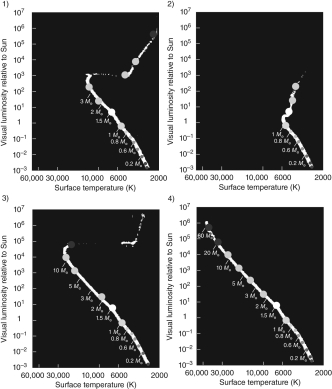
A) 2, 1, 3, 4
B) 1, 4, 3, 2
C) 4, 3, 1, 2
D) 1, 2, 4, 3
E) 3, 1, 4, 2
A) 2, 1, 3, 4
B) 1, 4, 3, 2
C) 4, 3, 1, 2
D) 1, 2, 4, 3
E) 3, 1, 4, 2
Question
Question
Question
Question
Question
Question
Question
Question
Question
Question
Question
Question
Which of the clusters in this figure are open clusters? 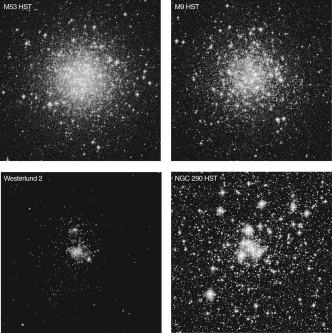
A) Westerlund 2 and M53
B) NGC 290 and M9
C) NGC 290 and Westerlund 2
D) M9 and Westerlund 2
E) M53 and NGC 290
A) Westerlund 2 and M53
B) NGC 290 and M9
C) NGC 290 and Westerlund 2
D) M9 and Westerlund 2
E) M53 and NGC 290
Question
Question
Question
Question
Suppose you measured H-R diagrams for the two star clusters pictured below. Which of the following statements is true? 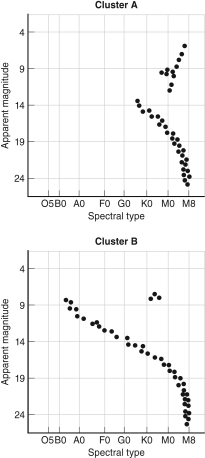
A) Cluster A is younger than cluster B, but both are the same distance away.
B) Cluster A is older and farther away than cluster B.
C) Cluster A and cluster B have the same age, but cluster B is closer.
D) Cluster A is older and closer than cluster B.
E) Cluster A is younger and farther away than cluster B.
A) Cluster A is younger than cluster B, but both are the same distance away.
B) Cluster A is older and farther away than cluster B.
C) Cluster A and cluster B have the same age, but cluster B is closer.
D) Cluster A is older and closer than cluster B.
E) Cluster A is younger and farther away than cluster B.
Question
Question
Question

Unlock Deck
Sign up to unlock the cards in this deck!
Unlock Deck
Unlock Deck
1/90

Play

Full screen (f)
Deck 17: Evolution of High-Mass Stars
1
The principal means by which high-mass stars generate energy on the main sequence is called:
A) the proton-proton chain
B) the carbon-carbon reaction
C) the triple-alpha process
D) the CNO cycle
E) neutrino cooling
A) the proton-proton chain
B) the carbon-carbon reaction
C) the triple-alpha process
D) the CNO cycle
E) neutrino cooling
the CNO cycle
2
The nuclear reaction that produces most of the energy for massive main-sequence stars is called the CNO cycle.
True
3
An 8M star will eventually die as a Type I supernova.
False
4
Pulsating variable stars are more commonly known as pulsars.
Unlock Deck
Unlock for access to all 90 flashcards in this deck.
Unlock Deck
k this deck
5
The production of large numbers of neutrons in nuclear reactions at the core of a massive star helps rob the core of energy and speeds its eventual collapse.
Unlock Deck
Unlock for access to all 90 flashcards in this deck.
Unlock Deck
k this deck
6
We can determine the age of a star cluster by measuring the color of the reddest red giant stars in the cluster.
Unlock Deck
Unlock for access to all 90 flashcards in this deck.
Unlock Deck
k this deck
7
We can determine the age of a star cluster because stars of different masses go through their lives at different rates.
Unlock Deck
Unlock for access to all 90 flashcards in this deck.
Unlock Deck
k this deck
8
Neutron stars are sometimes found in binary systems, where matter overflowing from a companion star and accreting onto the neutron star will produce X-rays and other energetic phenomena.
Unlock Deck
Unlock for access to all 90 flashcards in this deck.
Unlock Deck
k this deck
9
The CNO cycle is the dominant mechanism for hydrogen fusion only in high-mass main-sequence stars because of the greater __________ their cores.
A) concentration of heavy elements like carbon in
B) turbulence in
C) abundance of hydrogen in
D) temperature of
E) rotation speed of
A) concentration of heavy elements like carbon in
B) turbulence in
C) abundance of hydrogen in
D) temperature of
E) rotation speed of
Unlock Deck
Unlock for access to all 90 flashcards in this deck.
Unlock Deck
k this deck
10
Most of the uranium (atomic mass= 238) found on the Earth was formed in Type II supernova explosions.
Unlock Deck
Unlock for access to all 90 flashcards in this deck.
Unlock Deck
k this deck
11
A main-sequence star of 25 solar masses has about 12.5 times the luminosity of a 10 solar mass star. This is because:
A) the more massive star has a hotter core, and therefore nuclear burning proceeds more rapidly
B) massive stars have more convection in their cores, which heats up the material there
C) the massive star has more hydrogen to burn
D) the massive star has more carbon, which speeds up the CNO cycle
E) the massive star is probably younger than the 10 solar mass star
A) the more massive star has a hotter core, and therefore nuclear burning proceeds more rapidly
B) massive stars have more convection in their cores, which heats up the material there
C) the massive star has more hydrogen to burn
D) the massive star has more carbon, which speeds up the CNO cycle
E) the massive star is probably younger than the 10 solar mass star
Unlock Deck
Unlock for access to all 90 flashcards in this deck.
Unlock Deck
k this deck
12
Type I and Type II supernovae are approximately equal in luminosity.
Unlock Deck
Unlock for access to all 90 flashcards in this deck.
Unlock Deck
k this deck
13
In the CNO cycle, carbon is used a catalyst for the fusion of hydrogen to helium. This means that:
A) three helium nuclei fuse to form carbon
B) carbon facilitates the reaction but is not consumed in it
C) carbon boosts the energy from the reaction, which is why massive stars are luminous
D) carbon breaks apart into three helium nuclei
E) the reaction produces carbon nuclei in addition to helium
A) three helium nuclei fuse to form carbon
B) carbon facilitates the reaction but is not consumed in it
C) carbon boosts the energy from the reaction, which is why massive stars are luminous
D) carbon breaks apart into three helium nuclei
E) the reaction produces carbon nuclei in addition to helium
Unlock Deck
Unlock for access to all 90 flashcards in this deck.
Unlock Deck
k this deck
14
The evolutionary differences between high- and low-mass stars can be attributed to differences in the amount of mass each star possesses.
Unlock Deck
Unlock for access to all 90 flashcards in this deck.
Unlock Deck
k this deck
15
What is one way that massive stars differ from low-mass stars?
A) They are found at cooler temperatures on the main sequence.
B) They fuse carbon through silicon without leaving the main sequence.
C) Convection is important in their cores, which determines when the stars leave the main sequence.
D) They turn into red giants explosively.
E) Most of their fusion energy is emitted as neutrinos and not visible light.
A) They are found at cooler temperatures on the main sequence.
B) They fuse carbon through silicon without leaving the main sequence.
C) Convection is important in their cores, which determines when the stars leave the main sequence.
D) They turn into red giants explosively.
E) Most of their fusion energy is emitted as neutrinos and not visible light.
Unlock Deck
Unlock for access to all 90 flashcards in this deck.
Unlock Deck
k this deck
16
Every pulsar is a neutron star, but not every neutron star is a pulsar.
Unlock Deck
Unlock for access to all 90 flashcards in this deck.
Unlock Deck
k this deck
17
The densest state of matter found in nature occurs inside a white dwarf star.
Unlock Deck
Unlock for access to all 90 flashcards in this deck.
Unlock Deck
k this deck
18
Fusion reactions that create chemical elements heavier than oxygen require energy input; thus, these reactions cannot provide a star with power.
Unlock Deck
Unlock for access to all 90 flashcards in this deck.
Unlock Deck
k this deck
19
High-mass stars differ from low-mass stars in that they burn helium to carbon when on the main sequence.
Unlock Deck
Unlock for access to all 90 flashcards in this deck.
Unlock Deck
k this deck
20
Cepheid variable stars are important because we can use them to determine the distance to any stellar group that contains some of these stars.
Unlock Deck
Unlock for access to all 90 flashcards in this deck.
Unlock Deck
k this deck
21
Once silicon burning begins to fuse iron in the core of a high-mass main-sequence star, it only has a few __________ left to live.
A) seconds
B) days
C) months
D) years
E) million years
A) seconds
B) days
C) months
D) years
E) million years
Unlock Deck
Unlock for access to all 90 flashcards in this deck.
Unlock Deck
k this deck
22
If a 25M main-sequence star loses mass at a rate of 10 - 6 M /yr, then how much mass will it lose in its lifetime of 3 million years?
A) 3M
B) 5M
C) 8M
D) 10M
E) 12M
A) 3M
B) 5M
C) 8M
D) 10M
E) 12M
Unlock Deck
Unlock for access to all 90 flashcards in this deck.
Unlock Deck
k this deck
23
The luminosity of a Cepheid star varies in time because:
A) the entire star pulsates from its core to its surface
B) the outer envelope of the star pulsates in radius
C) the star rotates too quickly
D) the star is too massive to be stable
E) the star undergoes large surface temperature fluctuations
A) the entire star pulsates from its core to its surface
B) the outer envelope of the star pulsates in radius
C) the star rotates too quickly
D) the star is too massive to be stable
E) the star undergoes large surface temperature fluctuations
Unlock Deck
Unlock for access to all 90 flashcards in this deck.
Unlock Deck
k this deck
24
An iron core cannot support a massive main-sequence star because:
A) iron has low nuclear binding energy
B) iron is not present in stellar interiors
C) iron supplies too much pressure
D) iron fusion only occurs in a degenerate core
E) iron cannot fuse to make heavier nuclei and produce energy
A) iron has low nuclear binding energy
B) iron is not present in stellar interiors
C) iron supplies too much pressure
D) iron fusion only occurs in a degenerate core
E) iron cannot fuse to make heavier nuclei and produce energy
Unlock Deck
Unlock for access to all 90 flashcards in this deck.
Unlock Deck
k this deck
25
Massive stars explode when they:
A) accrete mass from their binary star companion
B) generate uranium in their cores
C) merge with another massive star
D) run out of nuclear fuel in their core, and the cores collapse
E) lose a lot of mass in a stellar wind
A) accrete mass from their binary star companion
B) generate uranium in their cores
C) merge with another massive star
D) run out of nuclear fuel in their core, and the cores collapse
E) lose a lot of mass in a stellar wind
Unlock Deck
Unlock for access to all 90 flashcards in this deck.
Unlock Deck
k this deck
26
How does nucleosynthesis depend on the mass of the star?
A) With increasing mass, heavier and heavier elements are formed throughout their interiors.
B) With increasing mass, heavier and heavier elements are formed in their cores.
C) With increasing mass, elements between helium and gold are formed in the cores.
D) With increasing mass, elements between helium and carbon are formed in the cores.
E) All stars more massive than 8 solar masses create elements from helium through uranium in their cores.
A) With increasing mass, heavier and heavier elements are formed throughout their interiors.
B) With increasing mass, heavier and heavier elements are formed in their cores.
C) With increasing mass, elements between helium and gold are formed in the cores.
D) With increasing mass, elements between helium and carbon are formed in the cores.
E) All stars more massive than 8 solar masses create elements from helium through uranium in their cores.
Unlock Deck
Unlock for access to all 90 flashcards in this deck.
Unlock Deck
k this deck
27
If you measure the average brightness and pulsation period of a Cepheid variable star, you can also determine its:
A) age
B) rotation period
C) distance
D) mass
E) composition
A) age
B) rotation period
C) distance
D) mass
E) composition
Unlock Deck
Unlock for access to all 90 flashcards in this deck.
Unlock Deck
k this deck
28
The main difference between Cepheid stars and RR Lyrae stars is:
A) their masses
B) that Cepheids form at much greater distances from Earth
C) that RR Lyrae were discovered much earlier than Cepheids
D) their pulsation mechanisms
E) that Cepheids obey a period-luminosity relation, but RR Lyraes do not
A) their masses
B) that Cepheids form at much greater distances from Earth
C) that RR Lyrae were discovered much earlier than Cepheids
D) their pulsation mechanisms
E) that Cepheids obey a period-luminosity relation, but RR Lyraes do not
Unlock Deck
Unlock for access to all 90 flashcards in this deck.
Unlock Deck
k this deck
29
Why does the luminosity of a high-mass star remain nearly constant as the star burns heavy elements in its core, even though it is producing millions of times more energy per second than it did on the main sequence?
A) Most of the energy is trapped in the core, increasing the core's temperature.
B) All of the extra energy goes into heating the shells of fusion surrounding the core.
C) Most of the energy is absorbed by the outer layers of the star, increasing the star's radius but leaving its luminosity unchanged.
D) Most of the energy is carried out of the star by escaping neutrinos.
E) All of the energy goes into breaking apart light elements like helium and carbon.
A) Most of the energy is trapped in the core, increasing the core's temperature.
B) All of the extra energy goes into heating the shells of fusion surrounding the core.
C) Most of the energy is absorbed by the outer layers of the star, increasing the star's radius but leaving its luminosity unchanged.
D) Most of the energy is carried out of the star by escaping neutrinos.
E) All of the energy goes into breaking apart light elements like helium and carbon.
Unlock Deck
Unlock for access to all 90 flashcards in this deck.
Unlock Deck
k this deck
30
The nuclear reaction that releases the most energy per kilogram is:
A) silicon fusing to iron
B) oxygen fusing to silicon
C) carbon fusing to magnesium
D) helium fusing to carbon
E) hydrogen fusing to helium
A) silicon fusing to iron
B) oxygen fusing to silicon
C) carbon fusing to magnesium
D) helium fusing to carbon
E) hydrogen fusing to helium
Unlock Deck
Unlock for access to all 90 flashcards in this deck.
Unlock Deck
k this deck
31
Which of these begins first in the core of a massive star?
A) silicon fusion to iron
B) neon fusion to magnesium
C) carbon fusion to neon
D) helium fusion to carbon
E) hydrogen fusion to helium
A) silicon fusion to iron
B) neon fusion to magnesium
C) carbon fusion to neon
D) helium fusion to carbon
E) hydrogen fusion to helium
Unlock Deck
Unlock for access to all 90 flashcards in this deck.
Unlock Deck
k this deck
32
Each kilogram of hydrogen that fuses into helium releases about 6*1014 Joules of energy. How many tons of hydrogen are fused each second to power a massive main-sequence star with a luminosity of 100 L ? Note that 1 L = 4 * 1026 Joule/second and 1 ton = 103 kg.
A) 2 * 106 tons
B) 7* 107 tons
C) 2 *109 tons
D) 7 *1010 tons
E) 2 * 1011 tons
A) 2 * 106 tons
B) 7* 107 tons
C) 2 *109 tons
D) 7 *1010 tons
E) 2 * 1011 tons
Unlock Deck
Unlock for access to all 90 flashcards in this deck.
Unlock Deck
k this deck
33
Each stage of nuclear burning in 25 M star is __________ in duration than in a star of 15 M .
A) much shorter
B) a little shorter
C) equally long
D) a little longer
E) much longer
A) much shorter
B) a little shorter
C) equally long
D) a little longer
E) much longer
Unlock Deck
Unlock for access to all 90 flashcards in this deck.
Unlock Deck
k this deck
34
During the main-sequence evolution of a massive star, increasingly heavier elements are fused in the core, giving the core support for:
A) longer and longer times
B) shorter and shorter times
C) an approximately equal amount of time
D) approximately 10,000 years
E) only a few days
A) longer and longer times
B) shorter and shorter times
C) an approximately equal amount of time
D) approximately 10,000 years
E) only a few days
Unlock Deck
Unlock for access to all 90 flashcards in this deck.
Unlock Deck
k this deck
35
Massive stars synthesize chemical elements going from helium up to iron:
A) throughout the interior
B) primarily at the surface
C) only in the core of the star
D) along the equator of the star
E) in a deep convection zone in the interior of the star
A) throughout the interior
B) primarily at the surface
C) only in the core of the star
D) along the equator of the star
E) in a deep convection zone in the interior of the star
Unlock Deck
Unlock for access to all 90 flashcards in this deck.
Unlock Deck
k this deck
36
What mechanism drives the pulsations in Cepheid variables?
A) changes in the rate of core nuclear reactions
B) the formation and destruction of sunspots
C) the ionization and recombination of hydrogen
D) the ionization and recombination of helium
E) large rates of mass loss
A) changes in the rate of core nuclear reactions
B) the formation and destruction of sunspots
C) the ionization and recombination of hydrogen
D) the ionization and recombination of helium
E) large rates of mass loss
Unlock Deck
Unlock for access to all 90 flashcards in this deck.
Unlock Deck
k this deck
37
As a high-mass main-sequence star evolves off the main sequence, it follows a: __________ on the H-R diagram.
A) nearly vertical path
B) path of constant radius
C) roughly horizontal path
D) path of declining luminosity
E) path of increasing temperature
A) nearly vertical path
B) path of constant radius
C) roughly horizontal path
D) path of declining luminosity
E) path of increasing temperature
Unlock Deck
Unlock for access to all 90 flashcards in this deck.
Unlock Deck
k this deck
38
The collapse of the core of a high-mass star at the end of its life lasts approximately:
A) one second
B) one minute
C) one hour
D) one week
E) one year
A) one second
B) one minute
C) one hour
D) one week
E) one year
Unlock Deck
Unlock for access to all 90 flashcards in this deck.
Unlock Deck
k this deck
39
What causes massive stars to expel their outer layers?
A) radiation pressure
B) high magnetic fields
C) rapid rotation
D) carbon fusion
E) emission of neutrinos
A) radiation pressure
B) high magnetic fields
C) rapid rotation
D) carbon fusion
E) emission of neutrinos
Unlock Deck
Unlock for access to all 90 flashcards in this deck.
Unlock Deck
k this deck
40
Massive stars explode soon after fusion to iron begins because:
A) iron has the smallest binding energy of all elements
B) neutrinos emitted during the fusion to iron are captured by the star's lighter elements
C) fusion of elements heavier than iron requires energy, so the star runs out of fuel and cannot hold itself up against gravity
D) stars do not contain elements heavier than iron; these are made in supernova explosions
E) iron nuclei are unstable and rapidly break apart into lighter elements
A) iron has the smallest binding energy of all elements
B) neutrinos emitted during the fusion to iron are captured by the star's lighter elements
C) fusion of elements heavier than iron requires energy, so the star runs out of fuel and cannot hold itself up against gravity
D) stars do not contain elements heavier than iron; these are made in supernova explosions
E) iron nuclei are unstable and rapidly break apart into lighter elements
Unlock Deck
Unlock for access to all 90 flashcards in this deck.
Unlock Deck
k this deck
41
When the core of a massive star collapses, a neutron star forms because:
A) all the charged particles are ejected in the resulting explosion
B) protons and electrons combine to make neutrons
C) iron nuclei disintegrate into neutrons
D) neutrinos escaping from the core carry away most of the electromagnetic charge
E) the collapse releases a large number of protons, which soon decay into neutrons
A) all the charged particles are ejected in the resulting explosion
B) protons and electrons combine to make neutrons
C) iron nuclei disintegrate into neutrons
D) neutrinos escaping from the core carry away most of the electromagnetic charge
E) the collapse releases a large number of protons, which soon decay into neutrons
Unlock Deck
Unlock for access to all 90 flashcards in this deck.
Unlock Deck
k this deck
42
Using the formula g = GMNS/R2NS, calculate the acceleration of gravity on a neutron star of mass 3 solar masses and radius 10 km, and express this in terms of the acceleration of gravity on the surface of the Earth (g = 9.8 m/s2).
A) 4 * 104
B) 4*105
C) 4 * 108
D) 4 * 1011
E) 4 * 1014
A) 4 * 104
B) 4*105
C) 4 * 108
D) 4 * 1011
E) 4 * 1014
Unlock Deck
Unlock for access to all 90 flashcards in this deck.
Unlock Deck
k this deck
43
A neutron star in a mass-transfer binary system is called:
A) a quasar
B) a double star
C) an X-ray binary
D) a Cepheid variable
E) a white dwarf star
A) a quasar
B) a double star
C) an X-ray binary
D) a Cepheid variable
E) a white dwarf star
Unlock Deck
Unlock for access to all 90 flashcards in this deck.
Unlock Deck
k this deck
44
How does the energy in light emitted by a supernova compare to the energy emitted by the Sun during its lifetime?
A) The supernova emits far less energy.
B) The supernova emits somewhat less energy.
C) Both emit about the same energy.
D) The supernova emits somewhat more energy.
E) The supernova emits far more energy.
A) The supernova emits far less energy.
B) The supernova emits somewhat less energy.
C) Both emit about the same energy.
D) The supernova emits somewhat more energy.
E) The supernova emits far more energy.
Unlock Deck
Unlock for access to all 90 flashcards in this deck.
Unlock Deck
k this deck
45
Type I and Type II supernovae are respectively caused by what types of stars?
A) white dwarfs, Cepheid variables
B) white dwarfs, pulsars
C) massive stars, white dwarfs
D) massive stars, neutron stars
E) white dwarfs, massive stars
A) white dwarfs, Cepheid variables
B) white dwarfs, pulsars
C) massive stars, white dwarfs
D) massive stars, neutron stars
E) white dwarfs, massive stars
Unlock Deck
Unlock for access to all 90 flashcards in this deck.
Unlock Deck
k this deck
46
When the first pulsar was discovered, scientists thought it might be a signal from a distant extraterrestrial civilization. However, this idea was quickly discarded because:
A) it was realized the signals were interference from cars and trucks passing by the radio observatory
B) the government made the scientists hide their original finding
C) they realized that Cepheid variables could produce the detected radio signals
D) more pulsars were discovered, which meant that these were natural phenomena
E) the technology required to create pulsed signals is beyond the power of any civilization
A) it was realized the signals were interference from cars and trucks passing by the radio observatory
B) the government made the scientists hide their original finding
C) they realized that Cepheid variables could produce the detected radio signals
D) more pulsars were discovered, which meant that these were natural phenomena
E) the technology required to create pulsed signals is beyond the power of any civilization
Unlock Deck
Unlock for access to all 90 flashcards in this deck.
Unlock Deck
k this deck
47
One reason why we think neutron stars were formed in supernova explosions is that:
A) all supernova remnants contain pulsars
B) pulsars are made of heavy elements, such as those produced in supernova explosions
C) pulsars are often found near Cepheids and Wolf-Rayet stars, which are also signs of massive star formation
D) pulsars spin very rapidly, as did the massive star just before it exploded
E) pulsars sometimes have material around them that looks like the ejecta from supernovae
A) all supernova remnants contain pulsars
B) pulsars are made of heavy elements, such as those produced in supernova explosions
C) pulsars are often found near Cepheids and Wolf-Rayet stars, which are also signs of massive star formation
D) pulsars spin very rapidly, as did the massive star just before it exploded
E) pulsars sometimes have material around them that looks like the ejecta from supernovae
Unlock Deck
Unlock for access to all 90 flashcards in this deck.
Unlock Deck
k this deck
48
The Type II supernova that created the Crab Nebula was seen by Chinese and Arab astronomers in the year 1054 CE. Because the star is 6,500 light-years away from us, we know the star exploded in the year:
A) 554 CE
B) 1054 CE
C) 1054 BCE
D) 5447 BCE
E) 7555 BCE
A) 554 CE
B) 1054 CE
C) 1054 BCE
D) 5447 BCE
E) 7555 BCE
Unlock Deck
Unlock for access to all 90 flashcards in this deck.
Unlock Deck
k this deck
49
Which of the following is NOT a common characteristic of a neutron star?
A) extremely high density
B) enormous magnetic field
C) very short rotation period
D) large radius
E) source of pulsars
A) extremely high density
B) enormous magnetic field
C) very short rotation period
D) large radius
E) source of pulsars
Unlock Deck
Unlock for access to all 90 flashcards in this deck.
Unlock Deck
k this deck
50
What mechanism provides the internal pressure inside a neutron star?
A) ordinary pressure from hydrogen and helium gas
B) degeneracy pressure from neutrons
C) degeneracy pressure from electrons
D) rapid rotation
E) strong magnetic fields
A) ordinary pressure from hydrogen and helium gas
B) degeneracy pressure from neutrons
C) degeneracy pressure from electrons
D) rapid rotation
E) strong magnetic fields
Unlock Deck
Unlock for access to all 90 flashcards in this deck.
Unlock Deck
k this deck
51
Neutron stars have masses that range from:
A) 3.5 M to 25 M
B) 1.2 M to 30 M
C) 2.5 M to 10 M
D) 1.4 M to 3 M
E) 0.1M to 1.4 M
A) 3.5 M to 25 M
B) 1.2 M to 30 M
C) 2.5 M to 10 M
D) 1.4 M to 3 M
E) 0.1M to 1.4 M
Unlock Deck
Unlock for access to all 90 flashcards in this deck.
Unlock Deck
k this deck
52
What is the minimum mass main-sequence star that becomes a Type II supernova?
A) 4M
B) 8M
C) 10M
D) 12M
E) 25M
A) 4M
B) 8M
C) 10M
D) 12M
E) 25M
Unlock Deck
Unlock for access to all 90 flashcards in this deck.
Unlock Deck
k this deck
53
We can identify only a fraction of all the radio pulsars that exist in our galaxy because:
A) gas and dust efficiently block radio photons
B) few swing their beam of synchrotron emission in our direction
C) most have evolved to become black holes, which emit no light
D) massive stars are very rare
E) neutron stars have tiny radii, and are hard to detect even with large telescopes
A) gas and dust efficiently block radio photons
B) few swing their beam of synchrotron emission in our direction
C) most have evolved to become black holes, which emit no light
D) massive stars are very rare
E) neutron stars have tiny radii, and are hard to detect even with large telescopes
Unlock Deck
Unlock for access to all 90 flashcards in this deck.
Unlock Deck
k this deck
54
The acceleration from gravity on the surface of a neutron star can be how large compared to the value on the surface of the Earth? For reference, the typical mass of a neutron star is 2 M and its radius is approximately 10 km.
A) equal in size
B) 10 times as large
C) 104 times as large
D) 107 times as large
E) 1011 times as large
A) equal in size
B) 10 times as large
C) 104 times as large
D) 107 times as large
E) 1011 times as large
Unlock Deck
Unlock for access to all 90 flashcards in this deck.
Unlock Deck
k this deck
55
A neutron star contains a mass of up to 3M in a sphere with a diameter approximately the size of:
A) an atomic nucleus
B) an apple
C) a school bus
D) a city
E) the Earth
A) an atomic nucleus
B) an apple
C) a school bus
D) a city
E) the Earth
Unlock Deck
Unlock for access to all 90 flashcards in this deck.
Unlock Deck
k this deck
56
Suppose the Milky Way makes 10 new stars per year and only 1 out of 5,000 will explode as a supernova. What would be the average time between supernova explosions in the Milky Way?
A) 50 years
B) 500 years
C) 5,000 years
D) 50,000 years
E) 500,000 years
A) 50 years
B) 500 years
C) 5,000 years
D) 50,000 years
E) 500,000 years
Unlock Deck
Unlock for access to all 90 flashcards in this deck.
Unlock Deck
k this deck
57
Type I and Type II supernovae can be distinguished by what combination of observations?
A) light curves and the detection of energetic cosmic rays
B) light curves and the detection of neutrons
C) light curves and the detection of radio pulses
D) spectra and light curves
E) spectra and X-ray emission
A) light curves and the detection of energetic cosmic rays
B) light curves and the detection of neutrons
C) light curves and the detection of radio pulses
D) spectra and light curves
E) spectra and X-ray emission
Unlock Deck
Unlock for access to all 90 flashcards in this deck.
Unlock Deck
k this deck
58
The Crab Nebula is an important test of our ideas about supernova explosions because:
A) people saw the supernova and later astronomers found a pulsar inside the nebula
B) the system contains an X-ray binary
C) the nebula is expanding slowly, as expected from mass loss rates in massive stars
D) the original star must have been like the Sun before it exploded
E) astronomers observed the merger of the two stars
A) people saw the supernova and later astronomers found a pulsar inside the nebula
B) the system contains an X-ray binary
C) the nebula is expanding slowly, as expected from mass loss rates in massive stars
D) the original star must have been like the Sun before it exploded
E) astronomers observed the merger of the two stars
Unlock Deck
Unlock for access to all 90 flashcards in this deck.
Unlock Deck
k this deck
59
What characteristic of a star cluster is used to determine its age?
A) the chemical composition of stars in the cluster
B) the luminosity of the faintest stars in the cluster
C) the color of the main sequence turnoff in the cluster
D) the total number of stars in the cluster
E) the apparent diameter of the cluster
A) the chemical composition of stars in the cluster
B) the luminosity of the faintest stars in the cluster
C) the color of the main sequence turnoff in the cluster
D) the total number of stars in the cluster
E) the apparent diameter of the cluster
Unlock Deck
Unlock for access to all 90 flashcards in this deck.
Unlock Deck
k this deck
60
Essentially all the elements heavier than iron in our Milky Way were formed:
A) by supernovae
B) during the formation of black holes
C) by fusion in the cores of the most massive main-sequence stars
D) during the formation of planetary nebulae
E) during the initial stages of the Big Bang
A) by supernovae
B) during the formation of black holes
C) by fusion in the cores of the most massive main-sequence stars
D) during the formation of planetary nebulae
E) during the initial stages of the Big Bang
Unlock Deck
Unlock for access to all 90 flashcards in this deck.
Unlock Deck
k this deck
61
List the following H-R diagrams from oldest to youngest.
A) 2, 1, 3, 4
B) 1, 4, 3, 2
C) 4, 3, 1, 2
D) 1, 2, 4, 3
E) 3, 1, 4, 2
A) 2, 1, 3, 4
B) 1, 4, 3, 2
C) 4, 3, 1, 2
D) 1, 2, 4, 3
E) 3, 1, 4, 2
Unlock Deck
Unlock for access to all 90 flashcards in this deck.
Unlock Deck
k this deck
62
Where did all heavy elements in the Sun come from?
A) Previous generations of stars seeded the interstellar medium out of which the Sun formed.
B) Nearby supernova explosions directly contaminated the Sun's surface.
C) Nucleosynthesis within the Sun generated all the elements we see in the solar spectrum.
D) The Sun gobbled up some planets during the early days of our Solar System.
E) The solar wind carries away hydrogen and helium, leaving behind the heavy elements.
A) Previous generations of stars seeded the interstellar medium out of which the Sun formed.
B) Nearby supernova explosions directly contaminated the Sun's surface.
C) Nucleosynthesis within the Sun generated all the elements we see in the solar spectrum.
D) The Sun gobbled up some planets during the early days of our Solar System.
E) The solar wind carries away hydrogen and helium, leaving behind the heavy elements.
Unlock Deck
Unlock for access to all 90 flashcards in this deck.
Unlock Deck
k this deck
63
If an 8M star loses mass at an average rate of 10 - 6 M /yr in a stellar wind, how many years would it take for its mass be reduced to 6M ? Would this amount of mass loss be possible in the star's lifetime?
Unlock Deck
Unlock for access to all 90 flashcards in this deck.
Unlock Deck
k this deck
64
Describe the physical mechanism that causes pulsations in Cepheid variables.
Unlock Deck
Unlock for access to all 90 flashcards in this deck.
Unlock Deck
k this deck
65
Why does the CNO cycle happen only in high-mass stars?
Unlock Deck
Unlock for access to all 90 flashcards in this deck.
Unlock Deck
k this deck
66
Where did the iron in your blood come from?
A) nucleosynthesis on the surfaces of neutron stars
B) nucleosynthesis that took place in supernova explosions
C) nucleosynthesis in the cores of low-mass stars
D) nucleosynthesis in the cores of massive stars
E) nucleosynthesis in red giant and horizontal-branch stars
A) nucleosynthesis on the surfaces of neutron stars
B) nucleosynthesis that took place in supernova explosions
C) nucleosynthesis in the cores of low-mass stars
D) nucleosynthesis in the cores of massive stars
E) nucleosynthesis in red giant and horizontal-branch stars
Unlock Deck
Unlock for access to all 90 flashcards in this deck.
Unlock Deck
k this deck
67
Of all the main-sequence stars ever formed with a mass equal to 25 percent of the Sun's mass, how many are still on the main sequence today?
A) none
B) 1 percent
C) 10 percent
D) 50 percent
E) 100 percent
A) none
B) 1 percent
C) 10 percent
D) 50 percent
E) 100 percent
Unlock Deck
Unlock for access to all 90 flashcards in this deck.
Unlock Deck
k this deck
68
You observed three different star clusters and found that the main-sequence turnoff stars in Cluster 1 had spectral type F, the main-sequence turnoff stars in Cluster 2 had spectral type A, and the main-sequence turnoff stars in Cluster 3 had spectral type G. Which star cluster is the youngest and which one is the oldest?
A) Cluster 1 is the youngest and cluster 2 is the oldest.
B) Cluster 2 is the youngest and cluster 1 is the oldest.
C) Cluster 2 is the youngest and cluster 3 is the oldest.
D) Cluster 3 is the youngest and cluster 1 is the oldest.
E) Cluster 3 is the youngest and cluster 2 is the oldest.
A) Cluster 1 is the youngest and cluster 2 is the oldest.
B) Cluster 2 is the youngest and cluster 1 is the oldest.
C) Cluster 2 is the youngest and cluster 3 is the oldest.
D) Cluster 3 is the youngest and cluster 1 is the oldest.
E) Cluster 3 is the youngest and cluster 2 is the oldest.
Unlock Deck
Unlock for access to all 90 flashcards in this deck.
Unlock Deck
k this deck
69
What might be true about the oldest stars in the Milky Way?
A) They would have lots of heavy elements, since they have been around for a long time and have undergone a lot of nucleosynthesis in their cores.
B) They would be seen as supergiants.
C) They would have few heavy elements, since there was not much chance for earlier generations of stars to explode as supernovae before these stars were formed.
D) They would be massive, since they were among the first stars formed.
E) They would likely be seen as pulsars.
A) They would have lots of heavy elements, since they have been around for a long time and have undergone a lot of nucleosynthesis in their cores.
B) They would be seen as supergiants.
C) They would have few heavy elements, since there was not much chance for earlier generations of stars to explode as supernovae before these stars were formed.
D) They would be massive, since they were among the first stars formed.
E) They would likely be seen as pulsars.
Unlock Deck
Unlock for access to all 90 flashcards in this deck.
Unlock Deck
k this deck
70
You observe a distant galaxy, and see that most of the blue light is coming from regions along spiral arms and in the outer regions of the galaxy. This blue light indicates that these regions contain:
A) likely sites for planets with life
B) neutron stars and white dwarf stars
C) K-type supergiants
D) only old, low-mass stars
E) young, massive stars
A) likely sites for planets with life
B) neutron stars and white dwarf stars
C) K-type supergiants
D) only old, low-mass stars
E) young, massive stars
Unlock Deck
Unlock for access to all 90 flashcards in this deck.
Unlock Deck
k this deck
71
Iron has 26 protons in its nucleus, and gold has 79 protons. Where did all the gold on the Earth come from?
A) nucleosynthesis on the surfaces of neutron stars
B) nucleosynthesis that took place in supernova explosions
C) nucleosynthesis in the cores of low-mass stars
D) nucleosynthesis in the cores of massive stars
E) nucleosynthesis in red giant and horizontal-branch stars
A) nucleosynthesis on the surfaces of neutron stars
B) nucleosynthesis that took place in supernova explosions
C) nucleosynthesis in the cores of low-mass stars
D) nucleosynthesis in the cores of massive stars
E) nucleosynthesis in red giant and horizontal-branch stars
Unlock Deck
Unlock for access to all 90 flashcards in this deck.
Unlock Deck
k this deck
72
What is the meaning of nuclear binding energy?
Unlock Deck
Unlock for access to all 90 flashcards in this deck.
Unlock Deck
k this deck
73
Which of the clusters in this figure are open clusters?
A) Westerlund 2 and M53
B) NGC 290 and M9
C) NGC 290 and Westerlund 2
D) M9 and Westerlund 2
E) M53 and NGC 290
A) Westerlund 2 and M53
B) NGC 290 and M9
C) NGC 290 and Westerlund 2
D) M9 and Westerlund 2
E) M53 and NGC 290
Unlock Deck
Unlock for access to all 90 flashcards in this deck.
Unlock Deck
k this deck
74
Why do massive stars explode once they generate an iron core?
Unlock Deck
Unlock for access to all 90 flashcards in this deck.
Unlock Deck
k this deck
75
Do large, high-mass main-sequence stars become red giants?
Unlock Deck
Unlock for access to all 90 flashcards in this deck.
Unlock Deck
k this deck
76
Why do main-sequence high-mass stars lose so much mass compared to low-mass stars?
Unlock Deck
Unlock for access to all 90 flashcards in this deck.
Unlock Deck
k this deck
77
Suppose you measured H-R diagrams for the two star clusters pictured below. Which of the following statements is true?
A) Cluster A is younger than cluster B, but both are the same distance away.
B) Cluster A is older and farther away than cluster B.
C) Cluster A and cluster B have the same age, but cluster B is closer.
D) Cluster A is older and closer than cluster B.
E) Cluster A is younger and farther away than cluster B.
A) Cluster A is younger than cluster B, but both are the same distance away.
B) Cluster A is older and farther away than cluster B.
C) Cluster A and cluster B have the same age, but cluster B is closer.
D) Cluster A is older and closer than cluster B.
E) Cluster A is younger and farther away than cluster B.
Unlock Deck
Unlock for access to all 90 flashcards in this deck.
Unlock Deck
k this deck
78
With the Hubble Space Telescope, you discover a Cepheid variable star in a nearby galaxy that has a period of 30 days. If nearby Cepheids follow a period-luminosity relationship that says the luminosity of the star is L =335 L * (P/1 day), then what is this Cepheid's luminosity and absolute magnitude? Recall that the Sun's absolute magnitude is M = 5. If the apparent magnitude of the Cepheid is 25, what is this galaxy's distance in Mpc?
Unlock Deck
Unlock for access to all 90 flashcards in this deck.
Unlock Deck
k this deck
79
How do Cepheid variable stars differ from RR Lyrae variable stars in their masses, luminosities, and periods?
Unlock Deck
Unlock for access to all 90 flashcards in this deck.
Unlock Deck
k this deck
80
Explain the effect of core convection on the main-sequence lifetime of massive main-sequence stars and contrast this to the situation in low-mass stars.
Unlock Deck
Unlock for access to all 90 flashcards in this deck.
Unlock Deck
k this deck
Unlock Deck
Unlock for access to all 90 flashcards in this deck.






