







 Chat with AI

Deck 31: Animal Origins and the Evolution of Body Plans
Full screen (f)

Question

Question
Question
Question
Question
Question
Question
Question
Question
Question
Question
Question
Question
Question
Question
Question
Question
Question
Question
Question
Question
Question
Question
Question
Question
Question
Question
Question
Question
Question
Question
Question
Question
Question
Question
Question
Question
Question
Question
Question
Question
Question
Question
Question
Question
Question
Question
Question
Question
Question
Question
Question
Question
Question
Question
Question
Question
Question
Question
Question
Question
Question
Use the following to answer questions :
Refer to the diagram below, showing an animal cross-section.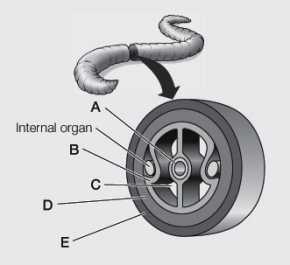
Is this animal acoelomate, pseudocoelomate, or coelomate?
Refer to the diagram below, showing an animal cross-section.
Is this animal acoelomate, pseudocoelomate, or coelomate?
Question
Use the following to answer questions :
Refer to the diagram below, depicting a sponge cross-section.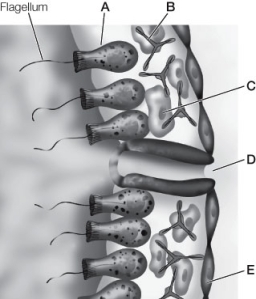
Which structure is a choanocyte?
Refer to the diagram below, depicting a sponge cross-section.
Which structure is a choanocyte?
Question
Question
Question
Question
Use the following to answer questions :
Refer to the diagram below, depicting a sponge cross-section.
-Which structure is a spicule?
Refer to the diagram below, depicting a sponge cross-section.
-Which structure is a spicule?
Question
Use the following to answer questions :
Refer to the diagram below, showing the life cycle of a cnidarian.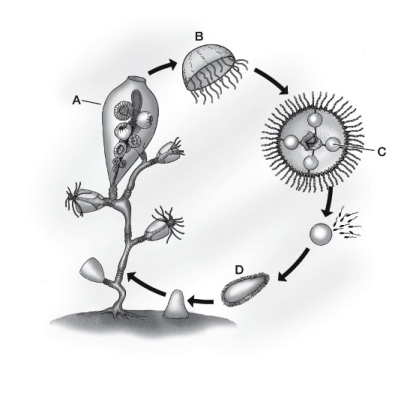
Which letter points to the polyp stage? Is it solitary or colonial?
Refer to the diagram below, showing the life cycle of a cnidarian.
Which letter points to the polyp stage? Is it solitary or colonial?
Question
Question
Use the following to answer questions :
Refer to the diagram below, showing an animal cross-section.
Identify the labeled structures.
Refer to the diagram below, showing an animal cross-section.
Identify the labeled structures.
Question
Question
Use the following to answer questions :
Refer to the diagram below, depicting a sponge cross-section.
Which structure is an opening for water to enter the sponge?
Refer to the diagram below, depicting a sponge cross-section.
Which structure is an opening for water to enter the sponge?
Question
Question
Question
Use the following to answer questions :
Refer to the diagram below, showing the life cycle of a cnidarian.
Of the three main clades of cnidarians, which class is shown?
Refer to the diagram below, showing the life cycle of a cnidarian.
Of the three main clades of cnidarians, which class is shown?
Question
Question
Question
Use the following to answer questions :
Refer to the diagram below, depicting a sponge cross-section.
Which structure is an epidermal cell?
Refer to the diagram below, depicting a sponge cross-section.
Which structure is an epidermal cell?
Question
Question

Unlock Deck
Sign up to unlock the cards in this deck!
Unlock Deck
Unlock Deck
1/122

Play

Full screen (f)
Deck 31: Animal Origins and the Evolution of Body Plans
1
The endosymbiotic dinoflagellates present in many corals
A) provide the corals with the products of photosynthesis.
B) allow corals to grow rapidly in clear, nutrient-poor tropical waters
C) can be lost when environmental conditions change.
D) All of the above
E) None of the above
A) provide the corals with the products of photosynthesis.
B) allow corals to grow rapidly in clear, nutrient-poor tropical waters
C) can be lost when environmental conditions change.
D) All of the above
E) None of the above
D
2
Clues to the evolutionary relationships of animals can be found in
A) the fossil record.
B) patterns of embryonic development.
C) comparative morphology and physiology.
D) nucleotide sequence patterns.
E) All of the above
A) the fossil record.
B) patterns of embryonic development.
C) comparative morphology and physiology.
D) nucleotide sequence patterns.
E) All of the above
E
3
Which of the following is not one of the characteristics that distinguishes deuterostomes from protostomes?
A) Cleavage type
B) Ability to form a blastopore
C) Embryological origin of the mouth
D) Derivation of mesoderm
E) Position of the nervous system (dorsal/ventral)
A) Cleavage type
B) Ability to form a blastopore
C) Embryological origin of the mouth
D) Derivation of mesoderm
E) Position of the nervous system (dorsal/ventral)
B
4
A bilaterally symmetrical animal can be divided into mirror images by
A) any plane through the midline of its body.
B) any plane from its anterior to its posterior end.
C) any plane from its dorsal to its ventral surface.
D) any plane through the midline of its body from its anterior to its posterior end.
E) a single plane through the midline of its body from its dorsal to its ventral surface.
A) any plane through the midline of its body.
B) any plane from its anterior to its posterior end.
C) any plane from its dorsal to its ventral surface.
D) any plane through the midline of its body from its anterior to its posterior end.
E) a single plane through the midline of its body from its dorsal to its ventral surface.
Unlock Deck
Unlock for access to all 122 flashcards in this deck.
Unlock Deck
k this deck
5
Because all animals must take in nutrients from their environment and digest their food internally, the nutritional mode of animals is called
A) heterotrophic.
B) photoheterotrophic.
C) photoautotrophic.
D) chemolithotrophic.
E) chemoautotrophic.
A) heterotrophic.
B) photoheterotrophic.
C) photoautotrophic.
D) chemolithotrophic.
E) chemoautotrophic.
Unlock Deck
Unlock for access to all 122 flashcards in this deck.
Unlock Deck
k this deck
6
Many parasites evolved complex life cycles because
A) they are too simple to disperse readily.
B) they are poor at recognizing new hosts.
C) they were driven to it by host defenses.
D) complex life cycles increase the probability of a parasite's transfer to a new host.
E) their ancestors had complex life cycles and they simply retained them.
A) they are too simple to disperse readily.
B) they are poor at recognizing new hosts.
C) they were driven to it by host defenses.
D) complex life cycles increase the probability of a parasite's transfer to a new host.
E) their ancestors had complex life cycles and they simply retained them.
Unlock Deck
Unlock for access to all 122 flashcards in this deck.
Unlock Deck
k this deck
7
In the common ancestor of protostomes and deuterostomes, the pattern of early cleavage was
A) spiral.
B) radial.
C) biradial.
D) deterministic.
E) haphazard.
A) spiral.
B) radial.
C) biradial.
D) deterministic.
E) haphazard.
Unlock Deck
Unlock for access to all 122 flashcards in this deck.
Unlock Deck
k this deck
8
A fluid-filled body cavity can function as a hydrostatic skeleton because
A) fluids are moderately compressible.
B) fluids are highly compressible.
C) fluids are incompressible at physiological pressures.
D) fluids have the same density as body tissues.
E) fluids can be moved by ciliary action.
A) fluids are moderately compressible.
B) fluids are highly compressible.
C) fluids are incompressible at physiological pressures.
D) fluids have the same density as body tissues.
E) fluids can be moved by ciliary action.
Unlock Deck
Unlock for access to all 122 flashcards in this deck.
Unlock Deck
k this deck
9
Bilateral symmetry
A) is found only among bilaterians.
B) is characteristic of all sponges.
C) is characteristic of all ctenophores.
D) is characteristic of all cnidarians.
E) None of the above
A) is found only among bilaterians.
B) is characteristic of all sponges.
C) is characteristic of all ctenophores.
D) is characteristic of all cnidarians.
E) None of the above
Unlock Deck
Unlock for access to all 122 flashcards in this deck.
Unlock Deck
k this deck
10
Cephalization is most commonly associated with
A) spherical symmetry.
B) radial symmetry.
C) sessile animals.
D) bilateral symmetry.
E) lophophorate animals.
A) spherical symmetry.
B) radial symmetry.
C) sessile animals.
D) bilateral symmetry.
E) lophophorate animals.
Unlock Deck
Unlock for access to all 122 flashcards in this deck.
Unlock Deck
k this deck
11
Which of the following is not considered part of the body plan of an organism?
A) The symmetry of the body
B) The structure of the body cavity
C) The segmentation of the body
D) External appendages
E) The larval morphology
A) The symmetry of the body
B) The structure of the body cavity
C) The segmentation of the body
D) External appendages
E) The larval morphology
Unlock Deck
Unlock for access to all 122 flashcards in this deck.
Unlock Deck
k this deck
12
The ancestor of the animal clade was probably a
A) colonial flagellated protist.
B) triploblastic acoelomate with spiral cleavage.
C) ciliated protist.
D) ctenophore.
E) None of the above
A) colonial flagellated protist.
B) triploblastic acoelomate with spiral cleavage.
C) ciliated protist.
D) ctenophore.
E) None of the above
Unlock Deck
Unlock for access to all 122 flashcards in this deck.
Unlock Deck
k this deck
13
Which of the following is a synapomorphy for the eumetazoans?
A) Distinct organ systems
B) Two embryonic cell layers
C) Radial symmetry
D) A blastopore that develops into the mouth
E) A blastopore that develops into the anus
A) Distinct organ systems
B) Two embryonic cell layers
C) Radial symmetry
D) A blastopore that develops into the mouth
E) A blastopore that develops into the anus
Unlock Deck
Unlock for access to all 122 flashcards in this deck.
Unlock Deck
k this deck
14
Among protostomes, cleavage of the fertilized egg is
A) delayed while the egg continues to mature.
B) always radial.
C) spiral, radial, or idiosyncratic.
D) triploblastic.
E) diploblastic.
A) delayed while the egg continues to mature.
B) always radial.
C) spiral, radial, or idiosyncratic.
D) triploblastic.
E) diploblastic.
Unlock Deck
Unlock for access to all 122 flashcards in this deck.
Unlock Deck
k this deck
15
Which of the following features is a synapomorphy of the animals?
A) Cells that contain chitin
B) Vascular systems
C) Similarities in their Hox genes
D) Bilateral symmetry
E) Spiral cleavage
A) Cells that contain chitin
B) Vascular systems
C) Similarities in their Hox genes
D) Bilateral symmetry
E) Spiral cleavage
Unlock Deck
Unlock for access to all 122 flashcards in this deck.
Unlock Deck
k this deck
16
The body plan of an animal is
A) its general structure.
B) the integrated functioning of its parts.
C) its general structure and the integrated functioning of its parts.
D) its general structure and its evolutionary history.
E) the integrated functioning of its parts and its evolutionary history.
A) its general structure.
B) the integrated functioning of its parts.
C) its general structure and the integrated functioning of its parts.
D) its general structure and its evolutionary history.
E) the integrated functioning of its parts and its evolutionary history.
Unlock Deck
Unlock for access to all 122 flashcards in this deck.
Unlock Deck
k this deck
17
Spiral cleavage is found in which of the following taxa?
A) Lophotrocozoans, such as earthworms
B) Spirilians
C) Ecdysozoans, such as insects
D) Both a and b
E) Both b and c
A) Lophotrocozoans, such as earthworms
B) Spirilians
C) Ecdysozoans, such as insects
D) Both a and b
E) Both b and c
Unlock Deck
Unlock for access to all 122 flashcards in this deck.
Unlock Deck
k this deck
18
Which of the following is not a feature that enables some animals to capture large prey?
A) Sharp teeth
B) Claws
C) Toxins
D) A filtering device
E) Tentacles with stinging cells
A) Sharp teeth
B) Claws
C) Toxins
D) A filtering device
E) Tentacles with stinging cells
Unlock Deck
Unlock for access to all 122 flashcards in this deck.
Unlock Deck
k this deck
19
Bilaterally symmetrical animals can be divided into two major groups that separated during the Cambrian. These two lineages differ fundamentally in their
A) modes of reproduction.
B) early embryological development.
C) mode of obtaining and storing energy.
D) environmental requirements.
E) metabolism.
A) modes of reproduction.
B) early embryological development.
C) mode of obtaining and storing energy.
D) environmental requirements.
E) metabolism.
Unlock Deck
Unlock for access to all 122 flashcards in this deck.
Unlock Deck
k this deck
20
The sponge body plan is characterized by
A) a mouth and digestive cavity but no muscles or nerves.
B) muscles and nerves but no mouth or digestive cavity.
C) a mouth, digestive cavity, and spicules.
D) muscles and spicules but no digestive cavity or nerves.
E) the lack of a mouth, digestive cavity, muscles, or nerves.
A) a mouth and digestive cavity but no muscles or nerves.
B) muscles and nerves but no mouth or digestive cavity.
C) a mouth, digestive cavity, and spicules.
D) muscles and spicules but no digestive cavity or nerves.
E) the lack of a mouth, digestive cavity, muscles, or nerves.
Unlock Deck
Unlock for access to all 122 flashcards in this deck.
Unlock Deck
k this deck
21
Which of the following statements concerning nematocysts is true?
A) They are organelles used in the capture of prey by cnidarians.
B) They are excretory organs in platyhelminthes.
C) They are reproductive cells in cnidarians.
D) They are ciliated cells in sponges.
E) They are excretory cells in sponges.
A) They are organelles used in the capture of prey by cnidarians.
B) They are excretory organs in platyhelminthes.
C) They are reproductive cells in cnidarians.
D) They are ciliated cells in sponges.
E) They are excretory cells in sponges.
Unlock Deck
Unlock for access to all 122 flashcards in this deck.
Unlock Deck
k this deck
22
Which of the following structures is not involved with some mechanism of movement in animals?
A) Fluid-filled coelom
B) Segmentation
C) Appendages
D) Cilia
E) All of these structures are involved in movement.
A) Fluid-filled coelom
B) Segmentation
C) Appendages
D) Cilia
E) All of these structures are involved in movement.
Unlock Deck
Unlock for access to all 122 flashcards in this deck.
Unlock Deck
k this deck
23
The divergence of the common ancestor of animals into the protostome and deuterostome lineages occurred during the
A) Cenozoic.
B) Silurian.
C) Jurassic.
D) Cambrian.
E) Mesozoic.
A) Cenozoic.
B) Silurian.
C) Jurassic.
D) Cambrian.
E) Mesozoic.
Unlock Deck
Unlock for access to all 122 flashcards in this deck.
Unlock Deck
k this deck
24
Which of the following are not adaptations for predatory feeding?
A) Toxins
B) Camouflage
C) Sensitive sense organs
D) Long and complex digestive systems
E) All of the above are adaptations for predatory feeding.
A) Toxins
B) Camouflage
C) Sensitive sense organs
D) Long and complex digestive systems
E) All of the above are adaptations for predatory feeding.
Unlock Deck
Unlock for access to all 122 flashcards in this deck.
Unlock Deck
k this deck
25
Most parasite species have a
A) simple life cycle and a single larval stage.
B) simple life cycle and a single host.
C) complex life cycle, multiple larval stages, and a single host.
D) complex life cycle, a single larval stage, and multiple hosts.
E) complex life cycle, multiple larval stages, and multiple hosts.
A) simple life cycle and a single larval stage.
B) simple life cycle and a single host.
C) complex life cycle, multiple larval stages, and a single host.
D) complex life cycle, a single larval stage, and multiple hosts.
E) complex life cycle, multiple larval stages, and multiple hosts.
Unlock Deck
Unlock for access to all 122 flashcards in this deck.
Unlock Deck
k this deck
26
The bilaterally symmetrical larval form found in many crustaceans is called a
A) trochophore.
B) nauplius.
C) planula.
D) caterpillar.
E) polyp.
A) trochophore.
B) nauplius.
C) planula.
D) caterpillar.
E) polyp.
Unlock Deck
Unlock for access to all 122 flashcards in this deck.
Unlock Deck
k this deck
27
A pseudocolomate animal lacks a
A) body cavity.
B) fluid-filled body cavity.
C) fluid-filled body cavity lined on the outside with mesoderm.
D) fluid-filled body cavity lined on the outside and inside with mesoderm.
E) pseudocoel.
A) body cavity.
B) fluid-filled body cavity.
C) fluid-filled body cavity lined on the outside with mesoderm.
D) fluid-filled body cavity lined on the outside and inside with mesoderm.
E) pseudocoel.
Unlock Deck
Unlock for access to all 122 flashcards in this deck.
Unlock Deck
k this deck
28
Which of the following are not eumetazoans?
A) Ctenophores
B) Sponges
C) Cnidarians
D) Bilateria
E) Protostomes
A) Ctenophores
B) Sponges
C) Cnidarians
D) Bilateria
E) Protostomes
Unlock Deck
Unlock for access to all 122 flashcards in this deck.
Unlock Deck
k this deck
29
Segmentation of animals is important evolutionarily because it
A) allows organisms to grow much larger than would be possible without segmentation.
B) has allowed organisms to alter their body forms in complex ways.
C) increases the mobility of an organism.
D) reduces the surface area-to-volume ratio.
E) All of the above
A) allows organisms to grow much larger than would be possible without segmentation.
B) has allowed organisms to alter their body forms in complex ways.
C) increases the mobility of an organism.
D) reduces the surface area-to-volume ratio.
E) All of the above
Unlock Deck
Unlock for access to all 122 flashcards in this deck.
Unlock Deck
k this deck
30
Which of the following is not associated with sponges?
A) Choanocytes
B) Pores
C) Spicules
D) Mesoderm
E) Eggs
A) Choanocytes
B) Pores
C) Spicules
D) Mesoderm
E) Eggs
Unlock Deck
Unlock for access to all 122 flashcards in this deck.
Unlock Deck
k this deck
31
Which of the following stages is not part of the typical life cycle of a butterfly?
A) Trochophore
B) Egg
C) Pupa
D) Larva
E) Adult
A) Trochophore
B) Egg
C) Pupa
D) Larva
E) Adult
Unlock Deck
Unlock for access to all 122 flashcards in this deck.
Unlock Deck
k this deck
32
The body cavity of coelomate animals develops within the
A) endoderm.
B) ectoderm.
C) mesoderm.
D) pseudocoel.
E) mesoglea.
A) endoderm.
B) ectoderm.
C) mesoderm.
D) pseudocoel.
E) mesoglea.
Unlock Deck
Unlock for access to all 122 flashcards in this deck.
Unlock Deck
k this deck
33
What is the main difference between a coelom and a pseudocoelom?
A) A coelom is enclosed by muscles on the outside only; a pseudocoelom is enclosed by muscles on the inside only.
B) A coelom does not have an enclosed body cavity; a pseudocoelom is completely surrounded by muscle.
C) A coelom is enclosed by muscles on the inside only; a pseudocoelom is a solid structure.
D) A coelom is enclosed by muscles on the inside and the outside; a pseudocoelom is surrounded by muscle on the outside of the body cavity.
E) None of the above
A) A coelom is enclosed by muscles on the outside only; a pseudocoelom is enclosed by muscles on the inside only.
B) A coelom does not have an enclosed body cavity; a pseudocoelom is completely surrounded by muscle.
C) A coelom is enclosed by muscles on the inside only; a pseudocoelom is a solid structure.
D) A coelom is enclosed by muscles on the inside and the outside; a pseudocoelom is surrounded by muscle on the outside of the body cavity.
E) None of the above
Unlock Deck
Unlock for access to all 122 flashcards in this deck.
Unlock Deck
k this deck
34
Motile filter feeders include
A) flamingos
B) blue whales
C) polychaetes
D) Both a and b
E) All of the above
A) flamingos
B) blue whales
C) polychaetes
D) Both a and b
E) All of the above
Unlock Deck
Unlock for access to all 122 flashcards in this deck.
Unlock Deck
k this deck
35
Which sponge cell type is specialized for creating the currents that draw food particles into the sponge?
A) Spicule
B) Pore cell
C) Osculum
D) Choanocyte
E) Nematocyst
A) Spicule
B) Pore cell
C) Osculum
D) Choanocyte
E) Nematocyst
Unlock Deck
Unlock for access to all 122 flashcards in this deck.
Unlock Deck
k this deck
36
The man-of-war is an example of a deadly
A) sponge.
B) cnidarian.
C) ctenophore.
D) nematocyst.
E) mollusk.
A) sponge.
B) cnidarian.
C) ctenophore.
D) nematocyst.
E) mollusk.
Unlock Deck
Unlock for access to all 122 flashcards in this deck.
Unlock Deck
k this deck
37
The terms "acoelomate," "pseudocoelomate," and "coelomate" refer to
A) levels of cephalization.
B) the origin of the blastopore.
C) ectoderm, mesoderm, and endoderm.
D) the body cavity of animals.
E) the vertebrate body plan.
A) levels of cephalization.
B) the origin of the blastopore.
C) ectoderm, mesoderm, and endoderm.
D) the body cavity of animals.
E) the vertebrate body plan.
Unlock Deck
Unlock for access to all 122 flashcards in this deck.
Unlock Deck
k this deck
38
Which of the following variables may be part of an evolutionary trade-off that confronts animal species?
A) Long egg incubation period
B) Ability to filter small food particles out of water
C) Production of many small eggs
D) Production of altricial young
E) All of the above
A) Long egg incubation period
B) Ability to filter small food particles out of water
C) Production of many small eggs
D) Production of altricial young
E) All of the above
Unlock Deck
Unlock for access to all 122 flashcards in this deck.
Unlock Deck
k this deck
39
Cnidarians have the type of symmetry known as _______ symmetry.
A) asymmetrical
B) radial
C) spherical
D) bilateral
E) axial
A) asymmetrical
B) radial
C) spherical
D) bilateral
E) axial
Unlock Deck
Unlock for access to all 122 flashcards in this deck.
Unlock Deck
k this deck
40
Which of the following feeding strategies is most likely to be associated with a sessile organism?
A) Filter feeding
B) Herbivory
C) Predation
D) Parasitism
E) Detritus feeding
A) Filter feeding
B) Herbivory
C) Predation
D) Parasitism
E) Detritus feeding
Unlock Deck
Unlock for access to all 122 flashcards in this deck.
Unlock Deck
k this deck
41
Which of the following is not a characteristic of the sponge body plan?
A) Gastrovascular cavity
B) No distinct tissue layers or organs
C) No separation between the different cell layers
D) Organization around a water canal system
E) Asymmetry
A) Gastrovascular cavity
B) No distinct tissue layers or organs
C) No separation between the different cell layers
D) Organization around a water canal system
E) Asymmetry
Unlock Deck
Unlock for access to all 122 flashcards in this deck.
Unlock Deck
k this deck
42
The simplest type of symmetry, in which body parts radiate outward from a central point, is called _______ symmetry. It is widespread among the protists.
Unlock Deck
Unlock for access to all 122 flashcards in this deck.
Unlock Deck
k this deck
43
Animals most likely arose from colonial flagellated protists as a result of division of labor among their aggregated cells. Among the extant animals, the _______ bear the strongest similarity to the most recent common ancestor of animals.
Unlock Deck
Unlock for access to all 122 flashcards in this deck.
Unlock Deck
k this deck
44
Which of the following groups consists of members that are entirely colonial and sessile?
A) Sea anemones
B) Hydrozoans
C) Jellyfishes
D) Corals
E) Nematocysts
A) Sea anemones
B) Hydrozoans
C) Jellyfishes
D) Corals
E) Nematocysts
Unlock Deck
Unlock for access to all 122 flashcards in this deck.
Unlock Deck
k this deck
45
_______ symmetry is strongly correlated with cephalization: the development of sense organs and central nervous tissues at the anterior end of an animal.
Unlock Deck
Unlock for access to all 122 flashcards in this deck.
Unlock Deck
k this deck
46
Placozoans, ctenophorans, and cnidarians are all considered _______, since they have inner and outer cell layers.
Unlock Deck
Unlock for access to all 122 flashcards in this deck.
Unlock Deck
k this deck
47
Which of the following is a significant threat to the coral reefs in many parts of the world?
A) Global warming
B) Boat traffic
C) Air pollution
D) Hurricane damage
E) Oil spills
A) Global warming
B) Boat traffic
C) Air pollution
D) Hurricane damage
E) Oil spills
Unlock Deck
Unlock for access to all 122 flashcards in this deck.
Unlock Deck
k this deck
48
Which of the following characteristics is not associated with the cnidarians?
A) Alternation between polyp and medusa
B) Three distinct body layers
C) Nematocysts
D) Gastrovascular cavity
E) Planula larva
A) Alternation between polyp and medusa
B) Three distinct body layers
C) Nematocysts
D) Gastrovascular cavity
E) Planula larva
Unlock Deck
Unlock for access to all 122 flashcards in this deck.
Unlock Deck
k this deck
49
Which cnidarian group is geologically important because growth of its members can result in the formation of islands and atolls?
A) Hydrozoans
B) Scyphozoans
C) Anthozoans
D) Turbellarians
E) Ctenophores
A) Hydrozoans
B) Scyphozoans
C) Anthozoans
D) Turbellarians
E) Ctenophores
Unlock Deck
Unlock for access to all 122 flashcards in this deck.
Unlock Deck
k this deck
50
The existence of three embryonic cell layers, including an outer _______, an inner _______, and a middle _______, is a synapomorphy for protostomes and deuterostomes.
Unlock Deck
Unlock for access to all 122 flashcards in this deck.
Unlock Deck
k this deck
51
The type of symmetry possessed by cnidaria, which have a cylindrical form with one main axis around which body parts are arranged, is called _______ symmetry.
Unlock Deck
Unlock for access to all 122 flashcards in this deck.
Unlock Deck
k this deck
52
Which of the following traits is not shared by all animals?
A) Specific types of cell-cell junctions
B) A common set of extracellular matrix molecules
C) A complete gut
D) Similarities in their small-subunit ribosomal RNAs
E) Similarities in their Hox genes
A) Specific types of cell-cell junctions
B) A common set of extracellular matrix molecules
C) A complete gut
D) Similarities in their small-subunit ribosomal RNAs
E) Similarities in their Hox genes
Unlock Deck
Unlock for access to all 122 flashcards in this deck.
Unlock Deck
k this deck
53
Of the more than 9,000 species of sponges, _______ live in fresh water.
A) 20
B) 50
C) 1,000
D) 4,500
E) 8,000
A) 20
B) 50
C) 1,000
D) 4,500
E) 8,000
Unlock Deck
Unlock for access to all 122 flashcards in this deck.
Unlock Deck
k this deck
54
The embryos of _______ animals have two cell layers: an outer _______ and an inner _______.
Unlock Deck
Unlock for access to all 122 flashcards in this deck.
Unlock Deck
k this deck
55
Among the _______, the mouth arises from the blastopore, an embryonic feature that is a synapomorphy of the group.
Unlock Deck
Unlock for access to all 122 flashcards in this deck.
Unlock Deck
k this deck
56
The placozoans are considered to be the sister group to which of the following taxa?
A) Ctenophorans
B) Cnidarians
C) Bilaterians
D) Sponges
E) Eumetazoa
A) Ctenophorans
B) Cnidarians
C) Bilaterians
D) Sponges
E) Eumetazoa
Unlock Deck
Unlock for access to all 122 flashcards in this deck.
Unlock Deck
k this deck
57
Which of the following statements about anthozoans is true?
A) They reproduce asexually only.
B) They are commonly known as jellyfish.
C) There are both solitary and colonial species.
D) Their gametes are produced directly by the medusa.
E) Nematocysts are not common in this group.
A) They reproduce asexually only.
B) They are commonly known as jellyfish.
C) There are both solitary and colonial species.
D) Their gametes are produced directly by the medusa.
E) Nematocysts are not common in this group.
Unlock Deck
Unlock for access to all 122 flashcards in this deck.
Unlock Deck
k this deck
58
Which of the following taxa has the largest number of described species?
A) Sponges
B) Placozoans
C) Ctenophorans
D) Cnidarians
E) Phoronids
A) Sponges
B) Placozoans
C) Ctenophorans
D) Cnidarians
E) Phoronids
Unlock Deck
Unlock for access to all 122 flashcards in this deck.
Unlock Deck
k this deck
59
Sponges differ from other animals in that they
A) do not form true organs.
B) are sessile.
C) are triploblastic.
D) have trochophore larvae.
E) Both a and b
A) do not form true organs.
B) are sessile.
C) are triploblastic.
D) have trochophore larvae.
E) Both a and b
Unlock Deck
Unlock for access to all 122 flashcards in this deck.
Unlock Deck
k this deck
60
Corals are able to survive in nutrient-poor tropical waters by forming symbiotic relationships with photosynthetic
A) plants.
B) red algae.
C) brown algae.
D) dinoflagellates.
E) None of the above
A) plants.
B) red algae.
C) brown algae.
D) dinoflagellates.
E) None of the above
Unlock Deck
Unlock for access to all 122 flashcards in this deck.
Unlock Deck
k this deck
61
The fluid-filled body cavities of animals function as _______ skeletons.
Unlock Deck
Unlock for access to all 122 flashcards in this deck.
Unlock Deck
k this deck
62
Use the following to answer questions :
Refer to the diagram below, showing an animal cross-section.
Is this animal acoelomate, pseudocoelomate, or coelomate?
Refer to the diagram below, showing an animal cross-section.
Is this animal acoelomate, pseudocoelomate, or coelomate?
Unlock Deck
Unlock for access to all 122 flashcards in this deck.
Unlock Deck
k this deck
63
Use the following to answer questions :
Refer to the diagram below, depicting a sponge cross-section.
Which structure is a choanocyte?
Refer to the diagram below, depicting a sponge cross-section.
Which structure is a choanocyte?
Unlock Deck
Unlock for access to all 122 flashcards in this deck.
Unlock Deck
k this deck
64
The _______ are marine cnidarians with a thick, firm mesoglea within the medusa.
Unlock Deck
Unlock for access to all 122 flashcards in this deck.
Unlock Deck
k this deck
65
Animals that lack an enclosed body cavity, such as flatworms, are called _______.
Unlock Deck
Unlock for access to all 122 flashcards in this deck.
Unlock Deck
k this deck
66
_______ are organisms that eat both plants and animals.
Unlock Deck
Unlock for access to all 122 flashcards in this deck.
Unlock Deck
k this deck
67
Use the following to answer questions :
Refer to the diagram below, depicting a sponge cross-section.
-Which structure is a spicule?
Refer to the diagram below, depicting a sponge cross-section.
-Which structure is a spicule?
Unlock Deck
Unlock for access to all 122 flashcards in this deck.
Unlock Deck
k this deck
68
Use the following to answer questions :
Refer to the diagram below, showing the life cycle of a cnidarian.
Which letter points to the polyp stage? Is it solitary or colonial?
Refer to the diagram below, showing the life cycle of a cnidarian.
Which letter points to the polyp stage? Is it solitary or colonial?
Unlock Deck
Unlock for access to all 122 flashcards in this deck.
Unlock Deck
k this deck
69
Derived cnidarian classes have life cycles involving two stages: the _______ and the _______.
Unlock Deck
Unlock for access to all 122 flashcards in this deck.
Unlock Deck
k this deck
70
Use the following to answer questions :
Refer to the diagram below, showing an animal cross-section.
Identify the labeled structures.
Refer to the diagram below, showing an animal cross-section.
Identify the labeled structures.
Unlock Deck
Unlock for access to all 122 flashcards in this deck.
Unlock Deck
k this deck
71
The organisms that make up the sister group of all bilaterally symmetrical animals (protostomes and deuterostomes) are the _______ and _______.
Unlock Deck
Unlock for access to all 122 flashcards in this deck.
Unlock Deck
k this deck
72
Use the following to answer questions :
Refer to the diagram below, depicting a sponge cross-section.
Which structure is an opening for water to enter the sponge?
Refer to the diagram below, depicting a sponge cross-section.
Which structure is an opening for water to enter the sponge?
Unlock Deck
Unlock for access to all 122 flashcards in this deck.
Unlock Deck
k this deck
73
Animals that live in or on another organism and obtain nutrients from it are known as _______.
Unlock Deck
Unlock for access to all 122 flashcards in this deck.
Unlock Deck
k this deck
74
Organisms that feed on decomposing organic matter are known as _______.
Unlock Deck
Unlock for access to all 122 flashcards in this deck.
Unlock Deck
k this deck
75
Use the following to answer questions :
Refer to the diagram below, showing the life cycle of a cnidarian.
Of the three main clades of cnidarians, which class is shown?
Refer to the diagram below, showing the life cycle of a cnidarian.
Of the three main clades of cnidarians, which class is shown?
Unlock Deck
Unlock for access to all 122 flashcards in this deck.
Unlock Deck
k this deck
76
There are three major groups of cnidarians: the _______ (which include sessile colonial corals), the _______ (commonly known as jellyfish), and the _______.
Unlock Deck
Unlock for access to all 122 flashcards in this deck.
Unlock Deck
k this deck
77
The immature life stage of some organisms before they assume their adult form is called the _______.
Unlock Deck
Unlock for access to all 122 flashcards in this deck.
Unlock Deck
k this deck
78
Use the following to answer questions :
Refer to the diagram below, depicting a sponge cross-section.
Which structure is an epidermal cell?
Refer to the diagram below, depicting a sponge cross-section.
Which structure is an epidermal cell?
Unlock Deck
Unlock for access to all 122 flashcards in this deck.
Unlock Deck
k this deck
79
Ctenophores can be distinguished from the cnidarians by their possession of a _______ and comblike plates known as ctenes.
Unlock Deck
Unlock for access to all 122 flashcards in this deck.
Unlock Deck
k this deck
80
The _______ is a free-swimming ciliated larva found in the radially symmetrical metazoans.
Unlock Deck
Unlock for access to all 122 flashcards in this deck.
Unlock Deck
k this deck
Unlock Deck
Unlock for access to all 122 flashcards in this deck.






