







 Chat with AI

Deck 13: Skin, Hair, Nails
Full screen (f)

Question

Question
Question
Question
Question
Question
Question
Question
Question
Question
Question
Question
Question
Question
Question
Question
Question
Question
Question
Question
The nurse preparing to perform a skin assessment while a student nurse observes. The student nurse asks, "Where exactly is the stratum basale located?" Which location will the nurse use to correctly identify this for the student nurse? 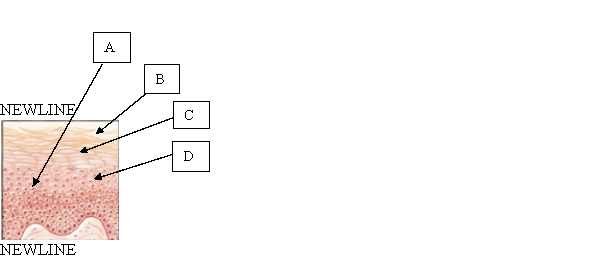
A) A.
B) B.
C) C.
D) D.
A) A.
B) B.
C) C.
D) D.
Question
Question
Question
Question
Question
Question
Question
Question
Question

Unlock Deck
Sign up to unlock the cards in this deck!
Unlock Deck
Unlock Deck
1/29

Play

Full screen (f)
Deck 13: Skin, Hair, Nails
1
The pediatric nurse conducts a follow-up phone call for a mother who was discharged with her newborn several days ago. The mother tells the nurse that she thinks her newborn is jaundice. Which question by the nurse will help to support this mother's statement?
A) "Does your baby have tiny, white facial bumps?"
B) "Does your baby's skin and mucous membranes have a yellowish color?"
C) "Does your baby have irregular red patches on the back of the neck?"
D) "Does your baby have dark spots on the area above the buttock?"
A) "Does your baby have tiny, white facial bumps?"
B) "Does your baby's skin and mucous membranes have a yellowish color?"
C) "Does your baby have irregular red patches on the back of the neck?"
D) "Does your baby have dark spots on the area above the buttock?"
"Does your baby's skin and mucous membranes have a yellowish color?"
2
The nurse is assessing a client with liver disease and notes that the skin, mucous membranes, and sclerae are yellowish in color. Which term is most appropriate for the nurse to use to describe this condition when documenting in the medical record?
A) Uremia.
B) Cyanosis.
C) Jaundice.
D) Carotenemia.
A) Uremia.
B) Cyanosis.
C) Jaundice.
D) Carotenemia.
Jaundice.
3
The nurse is conducting a focused interview on the client's integumentary system and prepares to obtain data related to risk factors for the development of integumentary disorders. Which question by the nurse would be unexpected based on the specific data the nurse is attempting to gain during the interview?
A) "How much time do you spend outdoors?"
B) "How do you care for your skin?"
C) "Do you have any tattoos or body piercings?"
D) "Have you noticed any drainage from your skin?"
E) "Do you take any medications on a regular basis?"
A) "How much time do you spend outdoors?"
B) "How do you care for your skin?"
C) "Do you have any tattoos or body piercings?"
D) "Have you noticed any drainage from your skin?"
E) "Do you take any medications on a regular basis?"
"How much time do you spend outdoors?"
"How do you care for your skin?"
"Do you have any tattoos or body piercings?"
"Do you take any medications on a regular basis?"
"How do you care for your skin?"
"Do you have any tattoos or body piercings?"
"Do you take any medications on a regular basis?"
4
The nurse is caring for a client who has smoked for many years and documents that "clubbing is present." Which technique is the best way for the nurse to determine the presence of clubbing?
A) Place two thumbs touching side-by-side.
B) Place two of the same fingers from each hand together.
C) Place two index fingers together tip-to-tip.
D) Place the hands out straight with the palm sides down.
A) Place two thumbs touching side-by-side.
B) Place two of the same fingers from each hand together.
C) Place two index fingers together tip-to-tip.
D) Place the hands out straight with the palm sides down.
Unlock Deck
Unlock for access to all 29 flashcards in this deck.
Unlock Deck
k this deck
5
The nurse is assessing a client in an outpatient clinical and notes the notes the presence of several abdominal lesions that appear in distinct clusters. When documenting this finding, which term will the nurse use?
A) Grouped.
B) Annular.
C) Discrete.
D) Confluent.
A) Grouped.
B) Annular.
C) Discrete.
D) Confluent.
Unlock Deck
Unlock for access to all 29 flashcards in this deck.
Unlock Deck
k this deck
6
The nurse is completing a focused interview to assess the skin, hair, and nails of a pregnant client. Which question would be most important for the nurse to include in the interview?
A) "Do you use any skin creams?"
B) "Do you try to avoid exposure to the sun?"
C) "Have you lost any hair during your pregnancy?"
D) "Have you had any nail changes?"
A) "Do you use any skin creams?"
B) "Do you try to avoid exposure to the sun?"
C) "Have you lost any hair during your pregnancy?"
D) "Have you had any nail changes?"
Unlock Deck
Unlock for access to all 29 flashcards in this deck.
Unlock Deck
k this deck
7
The nurse is caring for a client complaining of a painful, hot area located on the client's leg. Erythema and edema are present in the localized area. Which action should the nurse perform next?
A) Palpate the area.
B) Place a heating pad on the area.
C) Notify the healthcare provider.
D) Place client on bed rest.
A) Palpate the area.
B) Place a heating pad on the area.
C) Notify the healthcare provider.
D) Place client on bed rest.
Unlock Deck
Unlock for access to all 29 flashcards in this deck.
Unlock Deck
k this deck
8
The adult client is being assessed at an outpatient clinic and states, "I have sores in my mouth and on my lips." The nurse notes the presence of crusted lesions on the lips and inside the client's mouth along the cheek. The client states that the lesions do not itch. Based on this assessment data, which condition is this client likely experiencing?
A) Chickenpox.
B) Contact dermatitis.
C) Herpes simplex.
D) Psoriasis.
A) Chickenpox.
B) Contact dermatitis.
C) Herpes simplex.
D) Psoriasis.
Unlock Deck
Unlock for access to all 29 flashcards in this deck.
Unlock Deck
k this deck
9
The nurse is assessing a client's skin and notes a very light color on the skin, nails, and the client's mucous membranes. Which descriptions would the nurse use when documenting this finding?
A) Cyanosis.
B) Pallor.
C) Erythema.
D) Jaundice.
A) Cyanosis.
B) Pallor.
C) Erythema.
D) Jaundice.
Unlock Deck
Unlock for access to all 29 flashcards in this deck.
Unlock Deck
k this deck
10
The nurse completes a skin assessment for a client and is preparing to document the appearance of herpetic lesions found over a client's nose and mouth region. Which terms can the nurse use when documenting the skin assessment for this client in the medical record?
A) Vesicular.
B) Pustular.
C) Pruritic.
D) Ulcerated.
E) Crusty.
A) Vesicular.
B) Pustular.
C) Pruritic.
D) Ulcerated.
E) Crusty.
Unlock Deck
Unlock for access to all 29 flashcards in this deck.
Unlock Deck
k this deck
11
The nurse is assessing a female client and notes facial hirsutism. The client asks the nurse, "Why did this happen to me?" Which statement is the nurse's best response?
A) "Your diet is not nutritionally balanced."
B) "You may have some hormone imbalances."
C) "Usually, there is not a known cause for this condition."
D) "You need to take vitamins."
A) "Your diet is not nutritionally balanced."
B) "You may have some hormone imbalances."
C) "Usually, there is not a known cause for this condition."
D) "You need to take vitamins."
Unlock Deck
Unlock for access to all 29 flashcards in this deck.
Unlock Deck
k this deck
12
The nurse is reviewing documentation for a client from the previous shift. The documentation states, "+1 edema right lower leg." Based on this data, what does the nurse expect when assessing this client?
A) The presence of slight pitting, no obvious distortion.
B) Deep pitting, obvious distortion.
C) Pitting is obvious, extremities are swollen.
D) Moderate amount of edema.
A) The presence of slight pitting, no obvious distortion.
B) Deep pitting, obvious distortion.
C) Pitting is obvious, extremities are swollen.
D) Moderate amount of edema.
Unlock Deck
Unlock for access to all 29 flashcards in this deck.
Unlock Deck
k this deck
13
The nurse is performing a skin assessment on a client and notes a round, elevated, fluid-filled mass approximately 0.4 cm in size. Which term is the most appropriate for the nurse to use when documenting this finding in the medical record?
A) Vesicle.
B) Macule.
C) Papule.
D) Tumor.
A) Vesicle.
B) Macule.
C) Papule.
D) Tumor.
Unlock Deck
Unlock for access to all 29 flashcards in this deck.
Unlock Deck
k this deck
14
During the assessment of a client's integumentary status the nurse notes "vitiligo present bilateral hands." Which analysis of this information is the most appropriate by the nurse?
A) Nodules with ulcerations.
B) Dark, asymmetrical colored patches.
C) Grouped vesicles.
D) Abnormal loss of melanin in patches.
A) Nodules with ulcerations.
B) Dark, asymmetrical colored patches.
C) Grouped vesicles.
D) Abnormal loss of melanin in patches.
Unlock Deck
Unlock for access to all 29 flashcards in this deck.
Unlock Deck
k this deck
15
The nurse is assessing the skin of an adolescent client and notes the presence of a musky odor. The client states that this is embarrassing for him and that he showers daily. Which action should the nurse take in this situation?
A) Reassure the teen that this is normal.
B) Notify the client's healthcare provider.
C) Obtain a dietary referral.
D) Educate the client regarding the importance of increased water intake.
A) Reassure the teen that this is normal.
B) Notify the client's healthcare provider.
C) Obtain a dietary referral.
D) Educate the client regarding the importance of increased water intake.
Unlock Deck
Unlock for access to all 29 flashcards in this deck.
Unlock Deck
k this deck
16
The nurse is inspecting the fingernails of a client who is diagnosed with polycythemia. Which assessment data would be expected for this client?
A) Dark red nails.
B) Horizontal white bands.
C) Pale nail beds.
D) Spoon-shaped nails.
A) Dark red nails.
B) Horizontal white bands.
C) Pale nail beds.
D) Spoon-shaped nails.
Unlock Deck
Unlock for access to all 29 flashcards in this deck.
Unlock Deck
k this deck
17
The nurse is conducting an admission assessment for a client and notes skin vitiligo, which is highly visible even from a distance. The client asks the nurse to place a "No Visitors" sign on the door. The client states, "I hate the way my skin looks. Some people just stare at me." Which nursing diagnosis should be incorporated into the client's plan of care?
A) Defensive coping.
B) Risk for loneliness.
C) Deficient knowledge.
D) Disturbed body image.
A) Defensive coping.
B) Risk for loneliness.
C) Deficient knowledge.
D) Disturbed body image.
Unlock Deck
Unlock for access to all 29 flashcards in this deck.
Unlock Deck
k this deck
18
The nurse is performing a skin assessment on a client and notes an oval-shaped, elevated, fluid-filled mass that is approximately 1.5 centimeters in size. Which term will the nurse use when documenting this assessment data?
A) Vesicle.
B) Bulla.
C) Papule.
D) Tumor.
A) Vesicle.
B) Bulla.
C) Papule.
D) Tumor.
Unlock Deck
Unlock for access to all 29 flashcards in this deck.
Unlock Deck
k this deck
19
The nurse is preparing to assess the client's skin, hair, and nails. Which technique will the nurse use initially during this assessment?
A) Percussion.
B) Palpation.
C) Auscultation.
D) Inspection.
A) Percussion.
B) Palpation.
C) Auscultation.
D) Inspection.
Unlock Deck
Unlock for access to all 29 flashcards in this deck.
Unlock Deck
k this deck
20
The nurse preparing to perform a skin assessment while a student nurse observes. The student nurse asks, "Where exactly is the stratum basale located?" Which location will the nurse use to correctly identify this for the student nurse?
A) A.
B) B.
C) C.
D) D.
A) A.
B) B.
C) C.
D) D.
Unlock Deck
Unlock for access to all 29 flashcards in this deck.
Unlock Deck
k this deck
21
The nurse is planning to assess the integumentary status for an African American client. Which client statement supports the nurse's documentation that the client is experiencing pallor?
A) "The whites of my eyes don't look as white anymore; they have a little bit of a yellow cast to them."
B) "My nails look a little bit bluish."
C) "My nails are bright red."
D) "My palms and the inside of my mouth look really pale."
A) "The whites of my eyes don't look as white anymore; they have a little bit of a yellow cast to them."
B) "My nails look a little bit bluish."
C) "My nails are bright red."
D) "My palms and the inside of my mouth look really pale."
Unlock Deck
Unlock for access to all 29 flashcards in this deck.
Unlock Deck
k this deck
22
The nurse is assessing the skin of a newborn and notes a bright red, raised lesion on the lateral aspect of the thigh. The lesion is 4.5 centimeters in diameter. When light pressure is applied to the lesion, the site does not blanch. The mother expresses concern about the appearance of this site, and asks the nurse if it should be removed. Which response by the nurse is the most appropriate?
A) "Your pediatrician can make a surgical referral for you."
B) "It really is not that noticeable."
C) "You should be happy that your baby is healthy overall."
D) "These types of lesions usually disappear by the time a child turns 10 years old."
A) "Your pediatrician can make a surgical referral for you."
B) "It really is not that noticeable."
C) "You should be happy that your baby is healthy overall."
D) "These types of lesions usually disappear by the time a child turns 10 years old."
Unlock Deck
Unlock for access to all 29 flashcards in this deck.
Unlock Deck
k this deck
23
The nurse is preparing an educational program regarding the objectives listed in Healthy People 2020. Which statements in the presentation support these objectives?
A) African American females often require information regarding gentle hair and scalp care.
B) Infants have difficulty regulating their own body temperatures.
C) Older clients have increased sweat gland activity.
D) Clients with diabetes mellitus have an increased risk for skin breakdown.
E) Clients should monitor their moles for any changes, regardless of their age.
A) African American females often require information regarding gentle hair and scalp care.
B) Infants have difficulty regulating their own body temperatures.
C) Older clients have increased sweat gland activity.
D) Clients with diabetes mellitus have an increased risk for skin breakdown.
E) Clients should monitor their moles for any changes, regardless of their age.
Unlock Deck
Unlock for access to all 29 flashcards in this deck.
Unlock Deck
k this deck
24
The nurse is performing a skin assessment on an African American client and notes an elevated, irregular band of jagged tissue on the client's left arm. The client states, "I had a burn here a long time ago, but it seemed to keep on getting bigger." Which term will the nurse use when documenting this finding in the client's medical record?
A) Ulcer.
B) Keloid.
C) Fissure.
D) Scar.
A) Ulcer.
B) Keloid.
C) Fissure.
D) Scar.
Unlock Deck
Unlock for access to all 29 flashcards in this deck.
Unlock Deck
k this deck
25
The nurse is preparing a client for a detailed assessment of the integumentary system. Which statements by the nurse are useful to prepare the client for this examination?
A) "Please remove all jewelry so that I can conduct a full assessment."
B) "I will turn the temperature down in the exam room before we begin."
C) "Use this blanket to cover up until we are ready to begin."
D) "I will be touching your skin as part of the process."
E) "I will need you to take off your head dress for the entire examination."
A) "Please remove all jewelry so that I can conduct a full assessment."
B) "I will turn the temperature down in the exam room before we begin."
C) "Use this blanket to cover up until we are ready to begin."
D) "I will be touching your skin as part of the process."
E) "I will need you to take off your head dress for the entire examination."
Unlock Deck
Unlock for access to all 29 flashcards in this deck.
Unlock Deck
k this deck
26
The nurse is caring for a client who had abdominal surgery several months ago. The client has verbalized concern that the scar from the surgery is purplish in color. Which response by the nurse is the most appropriate?
A) "Having a scar is unavoidable."
B) "The color is normal and will fade with time."
C) "You can have plastic surgery to remove the scar later."
D) "You should be glad your surgery was a success."
A) "Having a scar is unavoidable."
B) "The color is normal and will fade with time."
C) "You can have plastic surgery to remove the scar later."
D) "You should be glad your surgery was a success."
Unlock Deck
Unlock for access to all 29 flashcards in this deck.
Unlock Deck
k this deck
27
The nurse is caring for a client with dark skin and needs to assess the skin for jaundice. Which action would be appropriate for the nurse in this situation?
A) Use a bright lamp and a magnifying glass.
B) Document "unable to assess" for skin changes.
C) Assess the skin the same way you would inspect a client with lighter skin.
D) Inspect the lips, oral mucosa, sclera, conjunctivae, and palms.
A) Use a bright lamp and a magnifying glass.
B) Document "unable to assess" for skin changes.
C) Assess the skin the same way you would inspect a client with lighter skin.
D) Inspect the lips, oral mucosa, sclera, conjunctivae, and palms.
Unlock Deck
Unlock for access to all 29 flashcards in this deck.
Unlock Deck
k this deck
28
While performing a skin assessment for a client, the nurse notes that the client becomes pales and diaphoretic. The client's vital signs have remained stable since the beginning of the examination: blood pressure 138/76 mmHg, heart rate is 88 beats per minute, and respiratory rate is 18 breaths per minute. Which is the priority response by the nurse?
A) The nurse immediately raises the client's head of bed.
B) The nurse asks the client, "Are you feeling anxious during this assessment?"
C) The nurse immediately notifies the client's healthcare provider.
D) The nurse provides the client with ½ cup of orange juice.
A) The nurse immediately raises the client's head of bed.
B) The nurse asks the client, "Are you feeling anxious during this assessment?"
C) The nurse immediately notifies the client's healthcare provider.
D) The nurse provides the client with ½ cup of orange juice.
Unlock Deck
Unlock for access to all 29 flashcards in this deck.
Unlock Deck
k this deck
29
During the assessment of an older adult client's skin, the nurse notes small areas of hyperpigmentation on the dorsal aspect of the client's hands. The client states, "I've been getting more of these big freckles as I get older." Which term will the nurse use when documenting this finding in the medical record?
A) Senile lentigines.
B) Cherry angiomas.
C) Cutaneous tags.
D) Cutaneous horns.
A) Senile lentigines.
B) Cherry angiomas.
C) Cutaneous tags.
D) Cutaneous horns.
Unlock Deck
Unlock for access to all 29 flashcards in this deck.
Unlock Deck
k this deck
Unlock Deck
Unlock for access to all 29 flashcards in this deck.






