







 Chat with AI

Deck 4: Arterial Blood Gas Assessments
Full screen (f)

Question
Study #2
A 180-pound, 79-year-old man with documented CO2 retention secondary to severe emphysema has been in the intensive care unit for 2 days with a diagnosis of acute bacterial pneumonia. The patient has been stable for the past 20 hours with the following arterial blood gas values and vital signs on a 28% Venturi mask:

A 180-pound, 79-year-old man with documented CO2 retention secondary to severe emphysema has been in the intensive care unit for 2 days with a diagnosis of acute bacterial pneumonia. The patient has been stable for the past 20 hours with the following arterial blood gas values and vital signs on a 28% Venturi mask:

Question
Match each blood gas value(s) that best fits the blood gas classification. Items may be used once, more than once, or not at all.
a.Acute alveolar hyperventilation
b.Acute ventilatory failure
c.Chronic ventilatory failure
d.Metabolic acidosis
e.Metabolic alkalosis
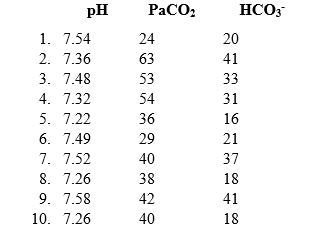
a.Acute alveolar hyperventilation
b.Acute ventilatory failure
c.Chronic ventilatory failure
d.Metabolic acidosis
e.Metabolic alkalosis
Question
Study #1
A 46-year old man without previous illness enters the coronary care unit with an electrocardiogram (ECG) diagnosis of "inferior wall infarct" and severe chest pain. He had received morphine in the emergency room. The cardiac monitor showed numerous premature ventricular contractions (PVCs).
Room Air Blood Gases:
 Blood Gas Interpretation: (1 pt)
A 46-year old man without previous illness enters the coronary care unit with an electrocardiogram (ECG) diagnosis of "inferior wall infarct" and severe chest pain. He had received morphine in the emergency room. The cardiac monitor showed numerous premature ventricular contractions (PVCs).
Room Air Blood Gases:
Blood Gas Interpretation: (1 pt)
Unlock Deck
Sign up to unlock the cards in this deck!
Unlock Deck
Unlock Deck
1/3

Play

Full screen (f)
Deck 4: Arterial Blood Gas Assessments
Study #2
A 180-pound, 79-year-old man with documented CO2 retention secondary to severe emphysema has been in the intensive care unit for 2 days with a diagnosis of acute bacterial pneumonia. The patient has been stable for the past 20 hours with the following arterial blood gas values and vital signs on a 28% Venturi mask:
A 180-pound, 79-year-old man with documented CO2 retention secondary to severe emphysema has been in the intensive care unit for 2 days with a diagnosis of acute bacterial pneumonia. The patient has been stable for the past 20 hours with the following arterial blood gas values and vital signs on a 28% Venturi mask:
Chronic ventilatory failure with moderate hypoxemia
Match each blood gas value(s) that best fits the blood gas classification. Items may be used once, more than once, or not at all.
a.Acute alveolar hyperventilation
b.Acute ventilatory failure
c.Chronic ventilatory failure
d.Metabolic acidosis
e.Metabolic alkalosis
a.Acute alveolar hyperventilation
b.Acute ventilatory failure
c.Chronic ventilatory failure
d.Metabolic acidosis
e.Metabolic alkalosis
1. A
2. C
3. E
4. B
5. D
6. A
7. E
8. D
9. E
10. D
2. C
3. E
4. B
5. D
6. A
7. E
8. D
9. E
10. D
Study #1
A 46-year old man without previous illness enters the coronary care unit with an electrocardiogram (ECG) diagnosis of "inferior wall infarct" and severe chest pain. He had received morphine in the emergency room. The cardiac monitor showed numerous premature ventricular contractions (PVCs).
Room Air Blood Gases:
Blood Gas Interpretation: (1 pt)
A 46-year old man without previous illness enters the coronary care unit with an electrocardiogram (ECG) diagnosis of "inferior wall infarct" and severe chest pain. He had received morphine in the emergency room. The cardiac monitor showed numerous premature ventricular contractions (PVCs).
Room Air Blood Gases:
Blood Gas Interpretation: (1 pt)Acute alveolar hyperventilation with mild hypoxemia
Unlock Deck
Unlock for access to all 3 flashcards in this deck.






