







 Chat with AI

Deck 8: Life Histories
Full screen (f)

Question

Question
Question
Question
Question
Question
Question
Question
Question
Question
Question
Question
Question
Question
Question
Question
Question
Question
Question
Question
Question
Question
Use this figure to answer questions 27 and 28.
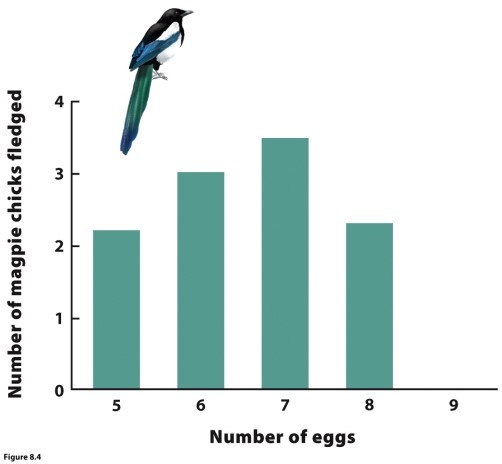
According to the figure, what are the implications of producing five versus eight eggs? Which option should be favoured by natural selection?
According to the figure, what are the implications of producing five versus eight eggs? Which option should be favoured by natural selection?
Question
Question
Question
Question
Question
Question
Question
Question
Question
Use this figure to answer questions 21 to 23.
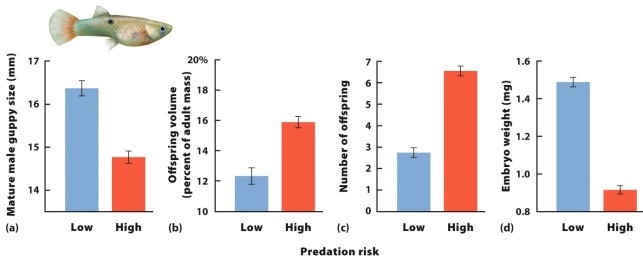
Which variable best summarizes the response to increased predation mortality for adults and suggests that putting more energy into reproduction provides an improved fitness benefit?
A) mature male guppy size
B) offspring volume (percent of adult mass)
C) number of offspring
D) embryo weight
Which variable best summarizes the response to increased predation mortality for adults and suggests that putting more energy into reproduction provides an improved fitness benefit?
A) mature male guppy size
B) offspring volume (percent of adult mass)
C) number of offspring
D) embryo weight
Question
Question
Use this figure to answer questions 21 to 23.
Which variable has the smallest proportional difference among the low and high levels of predation risk?
A) mature male guppy size
B) offspring volume (percent of adult mass)
C) number of offspring
D) embryo weight
Which variable has the smallest proportional difference among the low and high levels of predation risk?
A) mature male guppy size
B) offspring volume (percent of adult mass)
C) number of offspring
D) embryo weight
Question
Question
Use this figure to answer questions 27 and 28.
Use the information in the figure to explain whether the fitness of the parent increases with more eggs produced and why.
Use the information in the figure to explain whether the fitness of the parent increases with more eggs produced and why.
Question
Question
Question
Question
Use this figure to answer questions 21 to 23.
Which panel best illustrates the most direct effect of predation?
A) a
B) b
C) c
D) d
Which panel best illustrates the most direct effect of predation?
A) a
B) b
C) c
D) d
Question
Question
Question
Question
Question
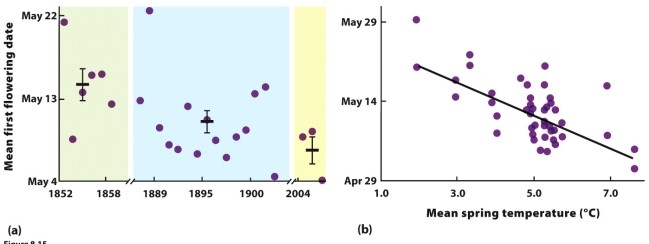
The data in the figure show a relationship between the mean flowering date for many plant species around Concord, New Hampshire, in the United States, and the mean spring temperature over a time span exceeding 150 years. However, there is a lot of scatter around the best-fit line in panel
b. What information in the chapter might suggest the source of this scatter, and what does it imply about the plant species' cues for flowering?
Question
Question
Question
Question
Question
Question
Question
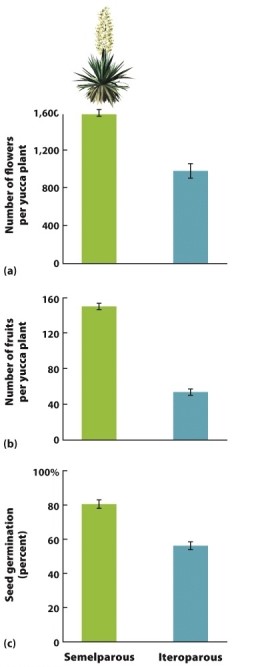
Yucca plants are mostly iteroparous, but some can be semelparous. Based on the information in Figure 8.9, semelparous yuccas have a higher percentage of seed germination, which suggests high fitness. Why, then, are most yucca varieties iteroparous?
Question
Question
Question
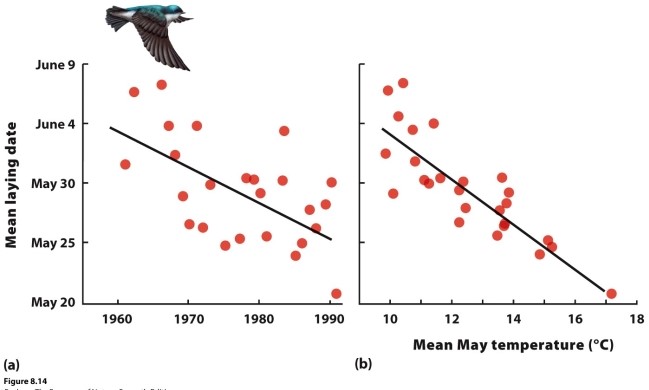
Explain the relationship between the two plotted variables in Figure 8.14b. How can egg development and laying occur prior to the end of May if there is a relation between the mean date of laying and average temperatures for May?
Question
Question
Question
Question
Question

Unlock Deck
Sign up to unlock the cards in this deck!
Unlock Deck
Unlock Deck
1/59

Play

Full screen (f)
Deck 8: Life Histories
1
Which plant life history type, fast or slow, would best describe a weed species that is a good invader of new habitats?
The fast life history would foster the development and spread of an opportunistic weed species that can rapidly populate a new or disturbed habitat.
2
Fecundity is
A) the number of reproductive episodes of an organism.
B) the amount of overall energy expended to reproduction over the life of an organism.
C) the number of offspring produced by an organism per reproductive episode.
D) the period in the life of an organism when it can produce offspring.
A) the number of reproductive episodes of an organism.
B) the amount of overall energy expended to reproduction over the life of an organism.
C) the number of offspring produced by an organism per reproductive episode.
D) the period in the life of an organism when it can produce offspring.
C
3
Explain why life history variables, such as number of offspring, size of offspring, and degree of parental care, are often correlated.
Species cannot maximize all of these traits. For example, if many offspring are produced, they will probably be smaller than if few are produced. Parental care is much more effective with few offspring.
4
Which of the following does NOT apply to determinate growth?
A) growth in body size throughout life
B) cessation of growth upon maturation (adulthood)
C) a fixed age of maturation
D) characteristic of bird and mammals
E) iteroparity
A) growth in body size throughout life
B) cessation of growth upon maturation (adulthood)
C) a fixed age of maturation
D) characteristic of bird and mammals
E) iteroparity
Unlock Deck
Unlock for access to all 59 flashcards in this deck.
Unlock Deck
k this deck
5
Which life history type do mammals exhibit?
A) slow
B) delayed
C) fast
D) accelerated
A) slow
B) delayed
C) fast
D) accelerated
Unlock Deck
Unlock for access to all 59 flashcards in this deck.
Unlock Deck
k this deck
6
Some marine snails (species L) produce large numbers of small eggs that are shed into the sea, hatch at an early stage of development, and feed on microscopic plants. Other marine snails (species S) produce few eggs that are retained for a long time within the body of the mother snail in a brood pouch, hatch at an advanced stage of development, and immediately begin to feed on the surfaces of large plants like the adults. If a biologist discovers approximately equal numbers of adults of species L and S in the same area over many generations, which of the following is most likely?
A) Young that are cared for by parents until they reach a more advanced stage have a greater chance of survival.
B) Approximately the same percentage of young produced by each species survive to maturity.
C) Organisms that produce a greater number of offspring will likely replace organisms with fewer offspring.
D) The young of species L grow more rapidly than the young of species S.
A) Young that are cared for by parents until they reach a more advanced stage have a greater chance of survival.
B) Approximately the same percentage of young produced by each species survive to maturity.
C) Organisms that produce a greater number of offspring will likely replace organisms with fewer offspring.
D) The young of species L grow more rapidly than the young of species S.
Unlock Deck
Unlock for access to all 59 flashcards in this deck.
Unlock Deck
k this deck
7
Topic: combinations of life history traits in plants
Difficulty: medium
Consider a species with a slow potential growth rate, reproduction at a relatively late age, allocation of a small proportion of net production to seeds, and reliance on vegetative spread. According to Grime's classification of life history traits, this species fits the profile of a:
A) stress-tolerant species.
B) facilitator.
C) ruderal.
D) competitor.
E) fixed-trait strategist.
Difficulty: medium
Consider a species with a slow potential growth rate, reproduction at a relatively late age, allocation of a small proportion of net production to seeds, and reliance on vegetative spread. According to Grime's classification of life history traits, this species fits the profile of a:
A) stress-tolerant species.
B) facilitator.
C) ruderal.
D) competitor.
E) fixed-trait strategist.
Unlock Deck
Unlock for access to all 59 flashcards in this deck.
Unlock Deck
k this deck
8
Which does NOT have fast life history attributes?
A) rabbit
B) fruit fly
C) grasses
D) albatross
E) shrimp
A) rabbit
B) fruit fly
C) grasses
D) albatross
E) shrimp
Unlock Deck
Unlock for access to all 59 flashcards in this deck.
Unlock Deck
k this deck
9
Explain the main life history trait that differentiates ruderals and stress-tolerant plants.
Unlock Deck
Unlock for access to all 59 flashcards in this deck.
Unlock Deck
k this deck
10
Which of the following does NOT apply to indeterminate growth?
A) growth in body size throughout life
B) cessation of growth upon maturation (adulthood)
C) flexible age of maturation
D) characteristic of plants and insects
E) semelparity
A) growth in body size throughout life
B) cessation of growth upon maturation (adulthood)
C) flexible age of maturation
D) characteristic of plants and insects
E) semelparity
Unlock Deck
Unlock for access to all 59 flashcards in this deck.
Unlock Deck
k this deck
11
Which does NOT have slow life history attributes?
A) oak tree
B) sea urchin
C) elephant
D) giant tortoise
E) bald eagle
A) oak tree
B) sea urchin
C) elephant
D) giant tortoise
E) bald eagle
Unlock Deck
Unlock for access to all 59 flashcards in this deck.
Unlock Deck
k this deck
12
Some marine snails (species L) produce large numbers of small eggs that are shed into the sea, hatch at an early stage of development, and feed on microscopic plants. Other marine snails (species S) produce few eggs that are retained for a long time within the body of the mother snail in a brood pouch, hatch at an advanced stage of development, and immediately begin to feed on the surfaces of large plants like the adults. A biologist discovers approximately equal numbers of adults of species L and S in the same area over many generations. While studying the two species of snails, the biologist hypothesizes that the two species expend approximately the same amount of energy producing young. What assumption is the biologist making?
A) Species S snails could produce as many eggs as species L snails under certain conditions.
B) An egg of species S contains more energy than an egg of species L.
C) Since species L snails produce more eggs, these eggs probably contain more energy.
D) Species S snails provide some energy to the young when they are in the brood pouch.
A) Species S snails could produce as many eggs as species L snails under certain conditions.
B) An egg of species S contains more energy than an egg of species L.
C) Since species L snails produce more eggs, these eggs probably contain more energy.
D) Species S snails provide some energy to the young when they are in the brood pouch.
Unlock Deck
Unlock for access to all 59 flashcards in this deck.
Unlock Deck
k this deck
13
How does having a large number of offspring affect a parent's fitness for subsequent breeding seasons?
A) It could limit the number of offspring the adult produces in its life.
B) The increased energy needed to feed many offspring may lower adult survival in the following breeding season.
C) The energy required to feed many offspring could trigger smaller broods in the future.
D) Competition with offspring for food could reduce energy for future reproduction.
A) It could limit the number of offspring the adult produces in its life.
B) The increased energy needed to feed many offspring may lower adult survival in the following breeding season.
C) The energy required to feed many offspring could trigger smaller broods in the future.
D) Competition with offspring for food could reduce energy for future reproduction.
Unlock Deck
Unlock for access to all 59 flashcards in this deck.
Unlock Deck
k this deck
14
Grime proposed that combinations of life history traits in plants are mainly determined by three factors. Which is NOT one of these factors?
A) disturbance
B) herbivory
C) competition
D) stress
A) disturbance
B) herbivory
C) competition
D) stress
Unlock Deck
Unlock for access to all 59 flashcards in this deck.
Unlock Deck
k this deck
15
Which life history trait is most likely to be fixed for a species?
A) timing of reproduction in the lifespan
B) number of offspring
C) survival rate of offspring
D) total energy given to reproduction
E) size of offspring
A) timing of reproduction in the lifespan
B) number of offspring
C) survival rate of offspring
D) total energy given to reproduction
E) size of offspring
Unlock Deck
Unlock for access to all 59 flashcards in this deck.
Unlock Deck
k this deck
16
Topic: growth versus age of sexual maturity and life span
Difficulty: medium
For birds, age at maturity
A) varies directly with annual survival rates of adults.
B) varies inversely with annual survival rates of adults.
C) varies with the productivity of the environment.
D) is not related to annual survival rates of adults.
Difficulty: medium
For birds, age at maturity
A) varies directly with annual survival rates of adults.
B) varies inversely with annual survival rates of adults.
C) varies with the productivity of the environment.
D) is not related to annual survival rates of adults.
Unlock Deck
Unlock for access to all 59 flashcards in this deck.
Unlock Deck
k this deck
17
The principle of allocation states that life history traits are adapted to maximize
A) fitness.
B) frequency of reproduction.
C) number of offspring in the population.
D) ability of offspring to start populations in new habitats.
E) fecundity.
A) fitness.
B) frequency of reproduction.
C) number of offspring in the population.
D) ability of offspring to start populations in new habitats.
E) fecundity.
Unlock Deck
Unlock for access to all 59 flashcards in this deck.
Unlock Deck
k this deck
18
When adults have a high probability of survival from one year to the next and offspring survival is relatively poor, the best strategy for an adult to maximize fitness is to
A) increase fecundity at the expense of survival.
B) delay reproduction for the next cycle.
C) increase survival at the expense of fecundity.
D) invest all excess energy in having fewer but larger offspring.
E) maintain a balance of fecundity and survival.
A) increase fecundity at the expense of survival.
B) delay reproduction for the next cycle.
C) increase survival at the expense of fecundity.
D) invest all excess energy in having fewer but larger offspring.
E) maintain a balance of fecundity and survival.
Unlock Deck
Unlock for access to all 59 flashcards in this deck.
Unlock Deck
k this deck
19
Which life history type, fast or slow, is more likely to describe an endangered animal species?
Unlock Deck
Unlock for access to all 59 flashcards in this deck.
Unlock Deck
k this deck
20
Topic: combinations of life history traits in plants
Difficulty: medium
Consider a species with a fast potential growth rate, reproduction at a relatively early age, allocation of a small proportion of net production to seeds, and reliance on vegetative spread. According to Grime's classification of life history traits, this species fits the profile of a
A) stress-tolerant species.
B) facilitator.
C) ruderal.
D) competitor.
E) fixed-trait strategist.
Difficulty: medium
Consider a species with a fast potential growth rate, reproduction at a relatively early age, allocation of a small proportion of net production to seeds, and reliance on vegetative spread. According to Grime's classification of life history traits, this species fits the profile of a
A) stress-tolerant species.
B) facilitator.
C) ruderal.
D) competitor.
E) fixed-trait strategist.
Unlock Deck
Unlock for access to all 59 flashcards in this deck.
Unlock Deck
k this deck
21
Red foxes mature after their first year of life and may live for 5 to 10 years. Foxes often reproduce many times over their life. The term to describe this aspect of their life history is
A) opportunistic.
B) precocious.
C) iteroparous.
D) semelparous.
A) opportunistic.
B) precocious.
C) iteroparous.
D) semelparous.
Unlock Deck
Unlock for access to all 59 flashcards in this deck.
Unlock Deck
k this deck
22
Use this figure to answer questions 27 and 28.
According to the figure, what are the implications of producing five versus eight eggs? Which option should be favoured by natural selection?
According to the figure, what are the implications of producing five versus eight eggs? Which option should be favoured by natural selection?
Unlock Deck
Unlock for access to all 59 flashcards in this deck.
Unlock Deck
k this deck
23
Topic: semelparity and iteroparity
Difficulty: medium
A mature female sockeye salmon swims up to 5000 km from her Pacific Ocean feeding ground to the mouth of a coastal river in British Columbia and then another 1000 km upstream to her spawning ground. Once there, she lays thousands of eggs in her single reproductive event and promptly dies. The salmon's reproductive life history is
A) semelparous.
B) iteroparous.
C) annual.
D) perennial.
Difficulty: medium
A mature female sockeye salmon swims up to 5000 km from her Pacific Ocean feeding ground to the mouth of a coastal river in British Columbia and then another 1000 km upstream to her spawning ground. Once there, she lays thousands of eggs in her single reproductive event and promptly dies. The salmon's reproductive life history is
A) semelparous.
B) iteroparous.
C) annual.
D) perennial.
Unlock Deck
Unlock for access to all 59 flashcards in this deck.
Unlock Deck
k this deck
24
Explain two significant ways in which environmental productivity and stability can influence the number of offspring produced and their probability of survival.
Unlock Deck
Unlock for access to all 59 flashcards in this deck.
Unlock Deck
k this deck
25
How would fecundity and age at maturity be influenced by adult and juvenile survival rates?
Unlock Deck
Unlock for access to all 59 flashcards in this deck.
Unlock Deck
k this deck
26
Topic: senescence
Difficulty: medium
In human females the increased prevalence of birth defects in offspring and of infertility after 30 years of age is known as
A) iteroparity.
B) semelparity.
C) senescence.
D) middle age.
E) reproductive failure.
Difficulty: medium
In human females the increased prevalence of birth defects in offspring and of infertility after 30 years of age is known as
A) iteroparity.
B) semelparity.
C) senescence.
D) middle age.
E) reproductive failure.
Unlock Deck
Unlock for access to all 59 flashcards in this deck.
Unlock Deck
k this deck
27
Topic: senescence
Difficulty: medium
If maintaining high survival and reproduction would increase an individual's fitness at any age, what is the most likely reason these traits decline with age in humans?
A) fewer reproductive opportunities
B) increased risk of death from childbirth
C) DNA damaged over time
D) increased exposure to toxins
E) less efficient metabolism
Difficulty: medium
If maintaining high survival and reproduction would increase an individual's fitness at any age, what is the most likely reason these traits decline with age in humans?
A) fewer reproductive opportunities
B) increased risk of death from childbirth
C) DNA damaged over time
D) increased exposure to toxins
E) less efficient metabolism
Unlock Deck
Unlock for access to all 59 flashcards in this deck.
Unlock Deck
k this deck
28
Compare the relative influence of determinate and indeterminate growth patterns on natural selection for adult size.
Unlock Deck
Unlock for access to all 59 flashcards in this deck.
Unlock Deck
k this deck
29
Topic: semelparity and iteroparity
Difficulty: medium
Lobelia telekii and its relative, L. keniensis, both grow on Mount Kenya in Africa. L. telekii grows on dry rocky slopes whose resources for reproduction (particularly moisture) are highly variable in time and space. L. keniensis is found in moist valley bottoms with more stable moisture supplies. Which species is semelparous?
A) L. telekii
B) L. keniensis
Difficulty: medium
Lobelia telekii and its relative, L. keniensis, both grow on Mount Kenya in Africa. L. telekii grows on dry rocky slopes whose resources for reproduction (particularly moisture) are highly variable in time and space. L. keniensis is found in moist valley bottoms with more stable moisture supplies. Which species is semelparous?
A) L. telekii
B) L. keniensis
Unlock Deck
Unlock for access to all 59 flashcards in this deck.
Unlock Deck
k this deck
30
What type of reproduction will be favoured if adult plant survival is low because of a disturbance such as fire?
A) semelparity
B) iteroparity
C) annual
D) perennial
A) semelparity
B) iteroparity
C) annual
D) perennial
Unlock Deck
Unlock for access to all 59 flashcards in this deck.
Unlock Deck
k this deck
31
Use this figure to answer questions 21 to 23.
Which variable best summarizes the response to increased predation mortality for adults and suggests that putting more energy into reproduction provides an improved fitness benefit?
A) mature male guppy size
B) offspring volume (percent of adult mass)
C) number of offspring
D) embryo weight
Which variable best summarizes the response to increased predation mortality for adults and suggests that putting more energy into reproduction provides an improved fitness benefit?
A) mature male guppy size
B) offspring volume (percent of adult mass)
C) number of offspring
D) embryo weight
Unlock Deck
Unlock for access to all 59 flashcards in this deck.
Unlock Deck
k this deck
32
Tropical songbirds tend to lay fewer eggs in each clutch than birds nesting at higher latitudes. David Lack of Oxford University first placed this observation in a life-history context. To what relation did Lack attribute this pattern?
Unlock Deck
Unlock for access to all 59 flashcards in this deck.
Unlock Deck
k this deck
33
Use this figure to answer questions 21 to 23.
Which variable has the smallest proportional difference among the low and high levels of predation risk?
A) mature male guppy size
B) offspring volume (percent of adult mass)
C) number of offspring
D) embryo weight
Which variable has the smallest proportional difference among the low and high levels of predation risk?
A) mature male guppy size
B) offspring volume (percent of adult mass)
C) number of offspring
D) embryo weight
Unlock Deck
Unlock for access to all 59 flashcards in this deck.
Unlock Deck
k this deck
34
The number of chicks fledged in a brood may not be independent of the number of eggs produced. How might researchers test these variables independently to determine whether there is a relationship between them?
Unlock Deck
Unlock for access to all 59 flashcards in this deck.
Unlock Deck
k this deck
35
Use this figure to answer questions 27 and 28.
Use the information in the figure to explain whether the fitness of the parent increases with more eggs produced and why.
Use the information in the figure to explain whether the fitness of the parent increases with more eggs produced and why.
Unlock Deck
Unlock for access to all 59 flashcards in this deck.
Unlock Deck
k this deck
36
What is the reproduction pattern of most insects?
A) semelparity
B) iteroparity
C) annual
D) perennial
A) semelparity
B) iteroparity
C) annual
D) perennial
Unlock Deck
Unlock for access to all 59 flashcards in this deck.
Unlock Deck
k this deck
37
A gradual increase in fecundity and increase in the probability of mortality is known as
A) logistic growth.
B) acclimation.
C) senescence.
D) semelparity.
A) logistic growth.
B) acclimation.
C) senescence.
D) semelparity.
Unlock Deck
Unlock for access to all 59 flashcards in this deck.
Unlock Deck
k this deck
38
We might expect natural selection to favour organisms that produce more offspring. Why is this not the case for species with a high degree of parental care?
Unlock Deck
Unlock for access to all 59 flashcards in this deck.
Unlock Deck
k this deck
39
Use this figure to answer questions 21 to 23.
Which panel best illustrates the most direct effect of predation?
A) a
B) b
C) c
D) d
Which panel best illustrates the most direct effect of predation?
A) a
B) b
C) c
D) d
Unlock Deck
Unlock for access to all 59 flashcards in this deck.
Unlock Deck
k this deck
40
For seed-producing trees, what conditions might favour production of few relatively large seeds? What conditions might favour production of many relatively small seeds?
Unlock Deck
Unlock for access to all 59 flashcards in this deck.
Unlock Deck
k this deck
41
Topic: senescence
Difficulty: medium
Across a wide range of bird and mammal species, the rate of aging
A) is positively related to the mortality rate due to extrinsic causes.
B) is negatively related to the mortality rate due to extrinsic causes.
C) is unrelated to the mortality rate due to extrinsic causes.
D) increases with the latitude of species range.
Difficulty: medium
Across a wide range of bird and mammal species, the rate of aging
A) is positively related to the mortality rate due to extrinsic causes.
B) is negatively related to the mortality rate due to extrinsic causes.
C) is unrelated to the mortality rate due to extrinsic causes.
D) increases with the latitude of species range.
Unlock Deck
Unlock for access to all 59 flashcards in this deck.
Unlock Deck
k this deck
42
Topic: the effects of resources
Difficulty: easy
Many animals undergo a dramatic metamorphosis from larval to adult form. Poorly nourished animals cannot grow as fast as well-nourished animals and therefore do not reach a given mass as quickly as their well-nourished counterparts. If metamorphosis occurs when a specific minimum body mass is reached, which of the following costs is most likely incurred by a poorly nourished animal?
A) longer period of risk prior to reproduction
B) reduced reproductive output as an adult
C) deformed offspring
D) offspring with poor competitive ability
E) reduced parental care
Difficulty: easy
Many animals undergo a dramatic metamorphosis from larval to adult form. Poorly nourished animals cannot grow as fast as well-nourished animals and therefore do not reach a given mass as quickly as their well-nourished counterparts. If metamorphosis occurs when a specific minimum body mass is reached, which of the following costs is most likely incurred by a poorly nourished animal?
A) longer period of risk prior to reproduction
B) reduced reproductive output as an adult
C) deformed offspring
D) offspring with poor competitive ability
E) reduced parental care
Unlock Deck
Unlock for access to all 59 flashcards in this deck.
Unlock Deck
k this deck
43
Explain how human fishing for larger individuals from a population of fish can reduce the average maturation time in the population.
Unlock Deck
Unlock for access to all 59 flashcards in this deck.
Unlock Deck
k this deck
44
The data in the figure show a relationship between the mean flowering date for many plant species around Concord, New Hampshire, in the United States, and the mean spring temperature over a time span exceeding 150 years. However, there is a lot of scatter around the best-fit line in panel
b. What information in the chapter might suggest the source of this scatter, and what does it imply about the plant species' cues for flowering?
Unlock Deck
Unlock for access to all 59 flashcards in this deck.
Unlock Deck
k this deck
45
What environmental factor would likely lead to later maturation with an iteroparous reproductive strategy?
A) fewer interspecific competitors
B) higher rainfall over several years
C) a lower severity and frequency of disturbance
D) global warming
A) fewer interspecific competitors
B) higher rainfall over several years
C) a lower severity and frequency of disturbance
D) global warming
Unlock Deck
Unlock for access to all 59 flashcards in this deck.
Unlock Deck
k this deck
46
The equation is for a
A) parabola.
B) hypotenuse.
C) straight line.
D) intercept.
A) parabola.
B) hypotenuse.
C) straight line.
D) intercept.
Unlock Deck
Unlock for access to all 59 flashcards in this deck.
Unlock Deck
k this deck
47
Many life history events are matched to seasonal changes in environmental conditions, such as the onset of winter. Explain why photoperiod is a more reliable seasonal indicator for plants than air temperature.
Unlock Deck
Unlock for access to all 59 flashcards in this deck.
Unlock Deck
k this deck
48
How might population density affect life history?
Unlock Deck
Unlock for access to all 59 flashcards in this deck.
Unlock Deck
k this deck
49
For some organisms, warmer spring temperatures have led to
A) larger adult size.
B) larger offspring at birth.
C) later offspring production.
D) earlier offspring production.
E) delayed maturation
A) larger adult size.
B) larger offspring at birth.
C) later offspring production.
D) earlier offspring production.
E) delayed maturation
Unlock Deck
Unlock for access to all 59 flashcards in this deck.
Unlock Deck
k this deck
50
Would human removal of large fish from a population influence both the age of maturation in the population and the proportion of energy dedicated to reproduction? Explain your answer.
Unlock Deck
Unlock for access to all 59 flashcards in this deck.
Unlock Deck
k this deck
51
Yucca plants are mostly iteroparous, but some can be semelparous. Based on the information in Figure 8.9, semelparous yuccas have a higher percentage of seed germination, which suggests high fitness. Why, then, are most yucca varieties iteroparous?
Unlock Deck
Unlock for access to all 59 flashcards in this deck.
Unlock Deck
k this deck
52
Topic: the effects of resources
Difficulty: medium
Research on frogs has shown that compared with well-nourished counterparts, poorly nourished frogs mature
A) at the same size but at a much later age.
B) at the same age but at a much smaller size.
C) at a somewhat later age and at a somewhat smaller size.
D) at a somewhat earlier age and at a somewhat smaller size.
Difficulty: medium
Research on frogs has shown that compared with well-nourished counterparts, poorly nourished frogs mature
A) at the same size but at a much later age.
B) at the same age but at a much smaller size.
C) at a somewhat later age and at a somewhat smaller size.
D) at a somewhat earlier age and at a somewhat smaller size.
Unlock Deck
Unlock for access to all 59 flashcards in this deck.
Unlock Deck
k this deck
53
Examine the equation for the coefficient of determination (), especially the total sums of squares. If we hold the error sums of squares constant, will the slope of the relation influence the value? Why or why not?
Unlock Deck
Unlock for access to all 59 flashcards in this deck.
Unlock Deck
k this deck
54
Explain the relationship between the two plotted variables in Figure 8.14b. How can egg development and laying occur prior to the end of May if there is a relation between the mean date of laying and average temperatures for May?
Unlock Deck
Unlock for access to all 59 flashcards in this deck.
Unlock Deck
k this deck
55
The error sum of squares in a regression is based on
A) the difference between the actual and expected values of .
B) the degree of change in per unit .
C) on how close the y-intercept is relative to 0.
D) how much the best fit line deviates from linearity.
A) the difference between the actual and expected values of .
B) the degree of change in per unit .
C) on how close the y-intercept is relative to 0.
D) how much the best fit line deviates from linearity.
Unlock Deck
Unlock for access to all 59 flashcards in this deck.
Unlock Deck
k this deck
56
Size limits for fish catches typically refer to the minimum size of individuals that can be harvested and retained. How might size limits affect the spawning strategy of a fish population compared with no size limits, assuming the fish captured are representative of the size distribution of the population?
Unlock Deck
Unlock for access to all 59 flashcards in this deck.
Unlock Deck
k this deck
57
One might suppose that an earlier, longer summer would be beneficial for most species, because it offers a longer growing season for offspring. How might earlier offspring births in a predator species be detrimental to it?
Unlock Deck
Unlock for access to all 59 flashcards in this deck.
Unlock Deck
k this deck
58
Is senescence inevitable? Please explain your answer, accounting for the great variation in patterns of aging among different species.
Unlock Deck
Unlock for access to all 59 flashcards in this deck.
Unlock Deck
k this deck
59
Which of the following is NOT a potential benefit of increased resource availability?
A) fast growth
B) early development
C) large size at maturation
D) reduced predation risk
A) fast growth
B) early development
C) large size at maturation
D) reduced predation risk
Unlock Deck
Unlock for access to all 59 flashcards in this deck.
Unlock Deck
k this deck
Unlock Deck
Unlock for access to all 59 flashcards in this deck.






