







 Chat with AI

Deck 13: The Labor Market in the Macroeconomy
Full screen (f)

Question

Question
Question
Question
Question
Question
Question
Question
Question
Question
Question
Question
Question
Question
Question
Question
Question
Question
Question
Question
Question
Question
Question
Question
Question
Refer to the information provided in Figure 13.1 below to answer the questions that follow. 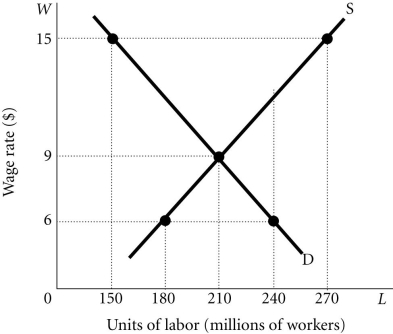 Figure 13.1
Refer to Figure 13.1. At wage rate $15, there is a ________ of labor equal to ________ million people.
A) surplus; 150
B) shortage; 150
C) shortage; 120
D) surplus; 120
Figure 13.1Refer to Figure 13.1. At wage rate $15, there is a ________ of labor equal to ________ million people.
A) surplus; 150
B) shortage; 150
C) shortage; 120
D) surplus; 120
Question
Question
Question
Question
Question
Question
Question
Question
Refer to the information provided in Figure 13.1 below to answer the questions that follow. Figure 13.1
Refer to Figure 13.1. At wage rate $6, there is a ________ of labor equal to ________ million people.
A) shortage; 180
B) shortage; 60
C) surplus; 180
D) surplus; 60
Figure 13.1Refer to Figure 13.1. At wage rate $6, there is a ________ of labor equal to ________ million people.
A) shortage; 180
B) shortage; 60
C) surplus; 180
D) surplus; 60
Question
Question
Question
Question
Question
Refer to the information provided in Figure 13.1 below to answer the questions that follow. Figure 13.1
Refer to Figure 13.1. The equilibrium wage rate is $________ and the equilibrium number of people employed is ________ million people.
A) 15; 270
B) 9; 210
C) 15; 150
D) 6; 180
Figure 13.1Refer to Figure 13.1. The equilibrium wage rate is $________ and the equilibrium number of people employed is ________ million people.
A) 15; 270
B) 9; 210
C) 15; 150
D) 6; 180
Question
Question
Question
Question
Refer to the information provided in Figure 13.1 below to answer the questions that follow. Figure 13.1
Refer to Figure 13.1. If the value people put on their leisure time increases, the equilibrium wage rate
A) could change from $9 to $6.
B) could change from $9 to $15.
C) would stay at $15.
D) would increase to $15.
Figure 13.1Refer to Figure 13.1. If the value people put on their leisure time increases, the equilibrium wage rate
A) could change from $9 to $6.
B) could change from $9 to $15.
C) would stay at $15.
D) would increase to $15.
Question
Question
Refer to the information provided in Figure 13.1 below to answer the questions that follow. Figure 13.1
Refer to Figure 13.1. At a wage rate of $________, there is a shortage of labor equal to ________ million people.
A) 6; 60
B) 6; 180
C) 15; 150
D) 15; 120
Figure 13.1Refer to Figure 13.1. At a wage rate of $________, there is a shortage of labor equal to ________ million people.
A) 6; 60
B) 6; 180
C) 15; 150
D) 15; 120
Question
Refer to the information provided in Figure 13.1 below to answer the questions that follow. Figure 13.1
Refer to Figure 13.1. At a wage rate of $9, there is a ________ of labor equal to ________ million people.
A) surplus; 210
B) shortage; 210
C) surplus; 120
D) None of the above are correct.
Figure 13.1Refer to Figure 13.1. At a wage rate of $9, there is a ________ of labor equal to ________ million people.
A) surplus; 210
B) shortage; 210
C) surplus; 120
D) None of the above are correct.
Question
Refer to the information provided in Figure 13.1 below to answer the questions that follow. Figure 13.1
Refer to Figure 13.1. At a wage rate of $________, there is a surplus of labor equal to ________ million people.
A) 6; 60
B) 6; 180
C) 15; 150
D) 15; 120
Figure 13.1Refer to Figure 13.1. At a wage rate of $________, there is a surplus of labor equal to ________ million people.
A) 6; 60
B) 6; 180
C) 15; 150
D) 15; 120
Question
Refer to the information provided in Figure 13.1 below to answer the questions that follow. Figure 13.1
Refer to Figure 13.1. According to classical economists if the wage rate is $6, the wage rate will ________ to eliminate the ________.
A) decline; surplus
B) increase; shortage
C) decline; shortage
D) increase; surplus
Figure 13.1Refer to Figure 13.1. According to classical economists if the wage rate is $6, the wage rate will ________ to eliminate the ________.
A) decline; surplus
B) increase; shortage
C) decline; shortage
D) increase; surplus
Question
Question
Refer to the information provided in Figure 13.1 below to answer the questions that follow. Figure 13.1
Refer to Figure 13.1. If the productivity of workers decreases, the equilibrium wage rate
A) could change from $9 to $6.
B) could change from $9 to $15.
C) would stay at $15.
D) would increase to $15.
Figure 13.1Refer to Figure 13.1. If the productivity of workers decreases, the equilibrium wage rate
A) could change from $9 to $6.
B) could change from $9 to $15.
C) would stay at $15.
D) would increase to $15.
Question
Refer to the information provided in Figure 13.1 below to answer the questions that follow. Figure 13.1
Refer to Figure 13.1. Which of the following can change the equilibrium wage rate from $9 to $6?
A) The value people put on their leisure time increases.
B) The value of what firms produce increases.
C) The productivity of workers decreases.
D) The productivity of workers increases.
Figure 13.1Refer to Figure 13.1. Which of the following can change the equilibrium wage rate from $9 to $6?
A) The value people put on their leisure time increases.
B) The value of what firms produce increases.
C) The productivity of workers decreases.
D) The productivity of workers increases.
Question
Refer to the information provided in Figure 13.1 below to answer the questions that follow. Figure 13.1
Refer to Figure 13.1. Which of the following can change the equilibrium wage rate from $9 to $15?
A) The value people put on their leisure time increases.
B) The value of what firms produce decreases.
C) The productivity of workers decreases.
D) the value of what firms produce increases.
Figure 13.1Refer to Figure 13.1. Which of the following can change the equilibrium wage rate from $9 to $15?
A) The value people put on their leisure time increases.
B) The value of what firms produce decreases.
C) The productivity of workers decreases.
D) the value of what firms produce increases.
Question
Question
Question
Question
Question
Question
Question
Question
Question
Refer to the information provided in Figure 13.1 below to answer the questions that follow. Figure 13.1
Refer to Figure 13.1. According to classical economists, if the wage rate is $15 the wage rate will ________ to eliminate the ________.
A) decline; surplus
B) decline; shortage
C) increase; surplus
D) increase; shortage
Figure 13.1Refer to Figure 13.1. According to classical economists, if the wage rate is $15 the wage rate will ________ to eliminate the ________.
A) decline; surplus
B) decline; shortage
C) increase; surplus
D) increase; shortage
Question
Question
Question
Question
Question
Question
Question
Question
Question
Question
Question
Question
Question
Question
Question
Question
Question
Question
Question
Question

Unlock Deck
Sign up to unlock the cards in this deck!
Unlock Deck
Unlock Deck
1/287

Play

Full screen (f)
Deck 13: The Labor Market in the Macroeconomy
1
If a country has a population of 300 million, 135 million people employed and 15 million people looking for work, then its unemployment rate is
A) 5%.
B) 10%.
C) 15%.
D) 35%.
A) 5%.
B) 10%.
C) 15%.
D) 35%.
B
2
Economists define the labor force to include
A) only people who are working full-time.
B) people who are working.
C) people who are not working but are actively looking for a job, and people who are working.
D) all individuals of work age, regardless of whether they are working or looking for a job.
A) only people who are working full-time.
B) people who are working.
C) people who are not working but are actively looking for a job, and people who are working.
D) all individuals of work age, regardless of whether they are working or looking for a job.
C
3
If you hear a person saying "I lost my job at a call center because my employer has outsourced all customer service to India," you should conclude that this person is ________ unemployed.
A) cyclically
B) structurally
C) frictionally
D) seasonally
A) cyclically
B) structurally
C) frictionally
D) seasonally
B
4
The labor force includes those people with a job and
A) those people who are looking for work.
B) those people training for a job.
C) those people who formerly worked and are now retired.
D) homemakers.
A) those people who are looking for work.
B) those people training for a job.
C) those people who formerly worked and are now retired.
D) homemakers.
Unlock Deck
Unlock for access to all 287 flashcards in this deck.
Unlock Deck
k this deck
5
The type of unemployment that is due to changes in the structure of the economy is
A) adjustable unemployment.
B) structural unemployment.
C) frictional unemployment.
D) cyclical unemployment.
A) adjustable unemployment.
B) structural unemployment.
C) frictional unemployment.
D) cyclical unemployment.
Unlock Deck
Unlock for access to all 287 flashcards in this deck.
Unlock Deck
k this deck
6
Which of the following would be likely to lead to a decrease in the natural rate of unemployment?
A) an increase in the number of teenage workers in the workforce
B) a decrease in the length of time during which people can receive unemployment benefits
C) a prolonged recession
D) all of the above
A) an increase in the number of teenage workers in the workforce
B) a decrease in the length of time during which people can receive unemployment benefits
C) a prolonged recession
D) all of the above
Unlock Deck
Unlock for access to all 287 flashcards in this deck.
Unlock Deck
k this deck
7
If you hear a person saying "I just relocated to this city after graduating from college and have yet to find an acceptable job in my field," you should conclude that this person is ________ unemployed.
A) cyclically
B) structurally
C) frictionally
D) seasonally
A) cyclically
B) structurally
C) frictionally
D) seasonally
Unlock Deck
Unlock for access to all 287 flashcards in this deck.
Unlock Deck
k this deck
8
The functioning of the labor market primarily affects the shape of the
A) aggregate demand curve.
B) money demand curve.
C) aggregate supply curve.
D) planned investment curve.
A) aggregate demand curve.
B) money demand curve.
C) aggregate supply curve.
D) planned investment curve.
Unlock Deck
Unlock for access to all 287 flashcards in this deck.
Unlock Deck
k this deck
9
The number unemployed divided by the labor force is the
A) unemployment rate.
B) civilian population.
C) per-capita employment rate.
D) discouraged worker total.
A) unemployment rate.
B) civilian population.
C) per-capita employment rate.
D) discouraged worker total.
Unlock Deck
Unlock for access to all 287 flashcards in this deck.
Unlock Deck
k this deck
10
Employment tends to rise when
A) aggregate output falls.
B) unemployment rises.
C) aggregate output rises.
D) labor productivity falls.
A) aggregate output falls.
B) unemployment rises.
C) aggregate output rises.
D) labor productivity falls.
Unlock Deck
Unlock for access to all 287 flashcards in this deck.
Unlock Deck
k this deck
11
If you hear a person saying "I lost my job because I was replaced by a machine," you should conclude that this person is ________ unemployed.
A) cyclically
B) structurally
C) frictionally
D) seasonally
A) cyclically
B) structurally
C) frictionally
D) seasonally
Unlock Deck
Unlock for access to all 287 flashcards in this deck.
Unlock Deck
k this deck
12
The type of unemployment that is most likely to arise as a result of technological changes is
A) cyclical unemployment.
B) seasonal unemployment.
C) frictional unemployment.
D) structural unemployment.
A) cyclical unemployment.
B) seasonal unemployment.
C) frictional unemployment.
D) structural unemployment.
Unlock Deck
Unlock for access to all 287 flashcards in this deck.
Unlock Deck
k this deck
13
The type of unemployment that arises during recessions is known as
A) the natural rate of unemployment.
B) cyclical unemployment.
C) structural unemployment.
D) frictional unemployment.
A) the natural rate of unemployment.
B) cyclical unemployment.
C) structural unemployment.
D) frictional unemployment.
Unlock Deck
Unlock for access to all 287 flashcards in this deck.
Unlock Deck
k this deck
14
Cyclical unemployment
A) arises from recessions.
B) is due to changes in the structure of the economy.
C) arises from the time it takes employers to find appropriate employees.
D) is due to seasonal changes.
A) arises from recessions.
B) is due to changes in the structure of the economy.
C) arises from the time it takes employers to find appropriate employees.
D) is due to seasonal changes.
Unlock Deck
Unlock for access to all 287 flashcards in this deck.
Unlock Deck
k this deck
15
The unemployment rate is
A) the number unemployed divided by the labor force.
B) the number unemployed divided by the number employed.
C) the number unemployed divided by the population.
D) the difference between the population and the number employed divided by the population.
A) the number unemployed divided by the labor force.
B) the number unemployed divided by the number employed.
C) the number unemployed divided by the population.
D) the difference between the population and the number employed divided by the population.
Unlock Deck
Unlock for access to all 287 flashcards in this deck.
Unlock Deck
k this deck
16
If a country has a population of 400 million, 160 million people employed and 40 million people looking for work, then its unemployment rate is
A) 10%.
B) 20%.
C) 25%.
D) 40%.
A) 10%.
B) 20%.
C) 25%.
D) 40%.
Unlock Deck
Unlock for access to all 287 flashcards in this deck.
Unlock Deck
k this deck
17
Structural unemployment
A) arises from recessions.
B) is due to changes in the structure of the economy.
C) arises from the time it takes employers to find appropriate employees.
D) is due to seasonal changes.
A) arises from recessions.
B) is due to changes in the structure of the economy.
C) arises from the time it takes employers to find appropriate employees.
D) is due to seasonal changes.
Unlock Deck
Unlock for access to all 287 flashcards in this deck.
Unlock Deck
k this deck
18
Structural unemployment
A) arises from the time it takes employers to find appropriate employees.
B) is most likely to arise from a recession.
C) is less severe during economic downturns.
D) is most likely to arise as a result of technological changes.
A) arises from the time it takes employers to find appropriate employees.
B) is most likely to arise from a recession.
C) is less severe during economic downturns.
D) is most likely to arise as a result of technological changes.
Unlock Deck
Unlock for access to all 287 flashcards in this deck.
Unlock Deck
k this deck
19
Employment tends to fall when
A) aggregate output falls.
B) unemployment rises.
C) aggregate output rises.
D) labor productivity falls.
A) aggregate output falls.
B) unemployment rises.
C) aggregate output rises.
D) labor productivity falls.
Unlock Deck
Unlock for access to all 287 flashcards in this deck.
Unlock Deck
k this deck
20
If you hear a person saying "I lost my job at the GM plant because car manufacturing is slow due to a slowdown in the economy," you should conclude that this person is ________ unemployed.
A) cyclically
B) structurally
C) frictionally
D) seasonally
A) cyclically
B) structurally
C) frictionally
D) seasonally
Unlock Deck
Unlock for access to all 287 flashcards in this deck.
Unlock Deck
k this deck
21
Employment tends to fall when aggregate output falls.
Unlock Deck
Unlock for access to all 287 flashcards in this deck.
Unlock Deck
k this deck
22
Sally stopped looking for work six months ago, so she would not be a part of the labor force.
Unlock Deck
Unlock for access to all 287 flashcards in this deck.
Unlock Deck
k this deck
23
The unemployment rate will never be zero because the economy is dynamic and always changing.
Unlock Deck
Unlock for access to all 287 flashcards in this deck.
Unlock Deck
k this deck
24
If a household member is not in the labor force, it is because he or she has decided his or her time is more valuable in nonmarket activities.
Unlock Deck
Unlock for access to all 287 flashcards in this deck.
Unlock Deck
k this deck
25
Refer to the information provided in Figure 13.1 below to answer the questions that follow. Figure 13.1
Refer to Figure 13.1. At wage rate $15, there is a ________ of labor equal to ________ million people.
A) surplus; 150
B) shortage; 150
C) shortage; 120
D) surplus; 120
Figure 13.1Refer to Figure 13.1. At wage rate $15, there is a ________ of labor equal to ________ million people.
A) surplus; 150
B) shortage; 150
C) shortage; 120
D) surplus; 120
Unlock Deck
Unlock for access to all 287 flashcards in this deck.
Unlock Deck
k this deck
26
Structural unemployment arises when the economy changes making some jobs obsolete.
Unlock Deck
Unlock for access to all 287 flashcards in this deck.
Unlock Deck
k this deck
27
Frictional unemployment is the type that arises due to recessions.
Unlock Deck
Unlock for access to all 287 flashcards in this deck.
Unlock Deck
k this deck
28
13.2 The Classical View of the Labor Market
Changes in the ________ market affect the shape of the short run aggregate supply curve.
A) money
B) labor
C) goods
D) financial
Changes in the ________ market affect the shape of the short run aggregate supply curve.
A) money
B) labor
C) goods
D) financial
Unlock Deck
Unlock for access to all 287 flashcards in this deck.
Unlock Deck
k this deck
29
Cyclical unemployment is that which rises in recessions and shrinks during expansions.
Unlock Deck
Unlock for access to all 287 flashcards in this deck.
Unlock Deck
k this deck
30
The unemployment rate is the fraction of the labor force without a job.
Unlock Deck
Unlock for access to all 287 flashcards in this deck.
Unlock Deck
k this deck
31
A decline in the demand for labor means the unemployment rate must rise.
Unlock Deck
Unlock for access to all 287 flashcards in this deck.
Unlock Deck
k this deck
32
If the quantity of labor demanded and the quantity of labor supplied are brought into equilibrium by rising and falling wage rates, there should be no persistent unemployment and the unemployment rate should be zero.
Unlock Deck
Unlock for access to all 287 flashcards in this deck.
Unlock Deck
k this deck
33
Refer to the information provided in Figure 13.1 below to answer the questions that follow. Figure 13.1
Refer to Figure 13.1. At wage rate $6, there is a ________ of labor equal to ________ million people.
A) shortage; 180
B) shortage; 60
C) surplus; 180
D) surplus; 60
Figure 13.1Refer to Figure 13.1. At wage rate $6, there is a ________ of labor equal to ________ million people.
A) shortage; 180
B) shortage; 60
C) surplus; 180
D) surplus; 60
Unlock Deck
Unlock for access to all 287 flashcards in this deck.
Unlock Deck
k this deck
34
Frictional and structural unemployment usually decrease during recessions.
Unlock Deck
Unlock for access to all 287 flashcards in this deck.
Unlock Deck
k this deck
35
To be unemployed, a person must be without a job and actively looking for work.
Unlock Deck
Unlock for access to all 287 flashcards in this deck.
Unlock Deck
k this deck
36
If a person is not employed but is looking for work, she is in the labor force.
Unlock Deck
Unlock for access to all 287 flashcards in this deck.
Unlock Deck
k this deck
37
In the recession of 2008-2009, the unemployment rate rose to over 10 percent.
Unlock Deck
Unlock for access to all 287 flashcards in this deck.
Unlock Deck
k this deck
38
Refer to the information provided in Figure 13.1 below to answer the questions that follow. Figure 13.1
Refer to Figure 13.1. The equilibrium wage rate is $________ and the equilibrium number of people employed is ________ million people.
A) 15; 270
B) 9; 210
C) 15; 150
D) 6; 180
Figure 13.1Refer to Figure 13.1. The equilibrium wage rate is $________ and the equilibrium number of people employed is ________ million people.
A) 15; 270
B) 9; 210
C) 15; 150
D) 6; 180
Unlock Deck
Unlock for access to all 287 flashcards in this deck.
Unlock Deck
k this deck
39
According to classical economists, the only types of unemployment that exist in an economy are
A) structural and frictional unemployment.
B) cyclical and frictional.
C) seasonal and cyclical.
D) frictional and seasonal.
A) structural and frictional unemployment.
B) cyclical and frictional.
C) seasonal and cyclical.
D) frictional and seasonal.
Unlock Deck
Unlock for access to all 287 flashcards in this deck.
Unlock Deck
k this deck
40
According to classical economists, excessive unemployment does not persist in the economy because
A) wages will always adjust to ensure equilibrium in the labor market.
B) the labor demand does not change in the economy.
C) the labor supply does not change in the economy.
D) interest rates always change to insure equilibrium in the money market.
A) wages will always adjust to ensure equilibrium in the labor market.
B) the labor demand does not change in the economy.
C) the labor supply does not change in the economy.
D) interest rates always change to insure equilibrium in the money market.
Unlock Deck
Unlock for access to all 287 flashcards in this deck.
Unlock Deck
k this deck
41
Martin is not employed. The value Martin places on his leisure time is $30 an hour. Martin looks for a job and all the offers he has are for less than $30 an hour. Martin should supply
A) exactly 40 hours per week in the labor market.
B) between 0 and 20 hours per week in the labor market.
C) between 20 and 40 hours per week in the labor market.
D) 0 hours in the labor market.
A) exactly 40 hours per week in the labor market.
B) between 0 and 20 hours per week in the labor market.
C) between 20 and 40 hours per week in the labor market.
D) 0 hours in the labor market.
Unlock Deck
Unlock for access to all 287 flashcards in this deck.
Unlock Deck
k this deck
42
Refer to the information provided in Figure 13.1 below to answer the questions that follow. Figure 13.1
Refer to Figure 13.1. If the value people put on their leisure time increases, the equilibrium wage rate
A) could change from $9 to $6.
B) could change from $9 to $15.
C) would stay at $15.
D) would increase to $15.
Figure 13.1Refer to Figure 13.1. If the value people put on their leisure time increases, the equilibrium wage rate
A) could change from $9 to $6.
B) could change from $9 to $15.
C) would stay at $15.
D) would increase to $15.
Unlock Deck
Unlock for access to all 287 flashcards in this deck.
Unlock Deck
k this deck
43
Which of the following may shift the labor supply curve?
A) an increase in worker productivity
B) a decrease in the value people place on their time
C) an increase in the price of the output of the firm
D) an increase in the corporate tax rate
A) an increase in worker productivity
B) a decrease in the value people place on their time
C) an increase in the price of the output of the firm
D) an increase in the corporate tax rate
Unlock Deck
Unlock for access to all 287 flashcards in this deck.
Unlock Deck
k this deck
44
Refer to the information provided in Figure 13.1 below to answer the questions that follow. Figure 13.1
Refer to Figure 13.1. At a wage rate of $________, there is a shortage of labor equal to ________ million people.
A) 6; 60
B) 6; 180
C) 15; 150
D) 15; 120
Figure 13.1Refer to Figure 13.1. At a wage rate of $________, there is a shortage of labor equal to ________ million people.
A) 6; 60
B) 6; 180
C) 15; 150
D) 15; 120
Unlock Deck
Unlock for access to all 287 flashcards in this deck.
Unlock Deck
k this deck
45
Refer to the information provided in Figure 13.1 below to answer the questions that follow. Figure 13.1
Refer to Figure 13.1. At a wage rate of $9, there is a ________ of labor equal to ________ million people.
A) surplus; 210
B) shortage; 210
C) surplus; 120
D) None of the above are correct.
Figure 13.1Refer to Figure 13.1. At a wage rate of $9, there is a ________ of labor equal to ________ million people.
A) surplus; 210
B) shortage; 210
C) surplus; 120
D) None of the above are correct.
Unlock Deck
Unlock for access to all 287 flashcards in this deck.
Unlock Deck
k this deck
46
Refer to the information provided in Figure 13.1 below to answer the questions that follow. Figure 13.1
Refer to Figure 13.1. At a wage rate of $________, there is a surplus of labor equal to ________ million people.
A) 6; 60
B) 6; 180
C) 15; 150
D) 15; 120
Figure 13.1Refer to Figure 13.1. At a wage rate of $________, there is a surplus of labor equal to ________ million people.
A) 6; 60
B) 6; 180
C) 15; 150
D) 15; 120
Unlock Deck
Unlock for access to all 287 flashcards in this deck.
Unlock Deck
k this deck
47
Refer to the information provided in Figure 13.1 below to answer the questions that follow. Figure 13.1
Refer to Figure 13.1. According to classical economists if the wage rate is $6, the wage rate will ________ to eliminate the ________.
A) decline; surplus
B) increase; shortage
C) decline; shortage
D) increase; surplus
Figure 13.1Refer to Figure 13.1. According to classical economists if the wage rate is $6, the wage rate will ________ to eliminate the ________.
A) decline; surplus
B) increase; shortage
C) decline; shortage
D) increase; surplus
Unlock Deck
Unlock for access to all 287 flashcards in this deck.
Unlock Deck
k this deck
48
Which of the following may shift the labor demand curve?
A) an increase in the value of leisure
B) a decrease in the value of leisure
C) more people entering the labor force
D) an increase in the value of output that firms produce
A) an increase in the value of leisure
B) a decrease in the value of leisure
C) more people entering the labor force
D) an increase in the value of output that firms produce
Unlock Deck
Unlock for access to all 287 flashcards in this deck.
Unlock Deck
k this deck
49
Refer to the information provided in Figure 13.1 below to answer the questions that follow. Figure 13.1
Refer to Figure 13.1. If the productivity of workers decreases, the equilibrium wage rate
A) could change from $9 to $6.
B) could change from $9 to $15.
C) would stay at $15.
D) would increase to $15.
Figure 13.1Refer to Figure 13.1. If the productivity of workers decreases, the equilibrium wage rate
A) could change from $9 to $6.
B) could change from $9 to $15.
C) would stay at $15.
D) would increase to $15.
Unlock Deck
Unlock for access to all 287 flashcards in this deck.
Unlock Deck
k this deck
50
Refer to the information provided in Figure 13.1 below to answer the questions that follow. Figure 13.1
Refer to Figure 13.1. Which of the following can change the equilibrium wage rate from $9 to $6?
A) The value people put on their leisure time increases.
B) The value of what firms produce increases.
C) The productivity of workers decreases.
D) The productivity of workers increases.
Figure 13.1Refer to Figure 13.1. Which of the following can change the equilibrium wage rate from $9 to $6?
A) The value people put on their leisure time increases.
B) The value of what firms produce increases.
C) The productivity of workers decreases.
D) The productivity of workers increases.
Unlock Deck
Unlock for access to all 287 flashcards in this deck.
Unlock Deck
k this deck
51
Refer to the information provided in Figure 13.1 below to answer the questions that follow. Figure 13.1
Refer to Figure 13.1. Which of the following can change the equilibrium wage rate from $9 to $15?
A) The value people put on their leisure time increases.
B) The value of what firms produce decreases.
C) The productivity of workers decreases.
D) the value of what firms produce increases.
Figure 13.1Refer to Figure 13.1. Which of the following can change the equilibrium wage rate from $9 to $15?
A) The value people put on their leisure time increases.
B) The value of what firms produce decreases.
C) The productivity of workers decreases.
D) the value of what firms produce increases.
Unlock Deck
Unlock for access to all 287 flashcards in this deck.
Unlock Deck
k this deck
52
A new policy is implemented that guarantees every adult an annual income of $10,000 whether they work or not. This will most likely shift the
A) labor demand curve to the right.
B) labor supply curve to the left.
C) labor supply curve to the right.
D) labor demand curve to the left.
A) labor demand curve to the right.
B) labor supply curve to the left.
C) labor supply curve to the right.
D) labor demand curve to the left.
Unlock Deck
Unlock for access to all 287 flashcards in this deck.
Unlock Deck
k this deck
53
The government lowers the marginal income tax rates so that after-tax wages are increased. This most likely will shift the labor
A) supply curve to the right.
B) supply curve to the left.
C) demand curve to the right.
D) demand curve to the left.
A) supply curve to the right.
B) supply curve to the left.
C) demand curve to the right.
D) demand curve to the left.
Unlock Deck
Unlock for access to all 287 flashcards in this deck.
Unlock Deck
k this deck
54
An increase in the productivity of workers shifts the labor ________ curve to the ________.
A) supply; left
B) supply; right
C) demand; right
D) demand; left
A) supply; left
B) supply; right
C) demand; right
D) demand; left
Unlock Deck
Unlock for access to all 287 flashcards in this deck.
Unlock Deck
k this deck
55
Lisa is currently not employed. She places a value of $12 an hour on her time in nonmarket activities. If Lisa is offered a job paying $17 an hour,
A) she should supply 0 hours in the labor market and allocate all of her time to nonmarket activities.
B) she should supply a positive number of hours in the labor market and allocate no time to nonmarket activities.
C) she should supply a positive number of hours in the labor market and to nonmarket activities.
D) she is indifferent between supplying hours to the labor market and using her time in nonmarket activities.
A) she should supply 0 hours in the labor market and allocate all of her time to nonmarket activities.
B) she should supply a positive number of hours in the labor market and allocate no time to nonmarket activities.
C) she should supply a positive number of hours in the labor market and to nonmarket activities.
D) she is indifferent between supplying hours to the labor market and using her time in nonmarket activities.
Unlock Deck
Unlock for access to all 287 flashcards in this deck.
Unlock Deck
k this deck
56
John is contemplating whether he should take a job offered to him. John should
A) not take the job if the value of his leisure is less than the wage rate the job pays.
B) not take the job if the value of his leisure is greater than the wage rate the job pays.
C) not take the job if taking the job implies he will enjoy less leisure.
D) take the job if taking the job implies he will enjoy more leisure.
A) not take the job if the value of his leisure is less than the wage rate the job pays.
B) not take the job if the value of his leisure is greater than the wage rate the job pays.
C) not take the job if taking the job implies he will enjoy less leisure.
D) take the job if taking the job implies he will enjoy more leisure.
Unlock Deck
Unlock for access to all 287 flashcards in this deck.
Unlock Deck
k this deck
57
Which of the following may shift the labor supply curve?
A) an increase in the wage rate
B) an increase in the value people place on their time
C) an increase in the price of the output of the firm
D) an increase in the corporate tax rate
A) an increase in the wage rate
B) an increase in the value people place on their time
C) an increase in the price of the output of the firm
D) an increase in the corporate tax rate
Unlock Deck
Unlock for access to all 287 flashcards in this deck.
Unlock Deck
k this deck
58
Doug is currently not employed. He places a value of $16 an hour on his time in nonmarket activities. If Doug is offered a job paying $12 an hour,
A) he should supply 0 hours in the labor market.
B) he should supply a positive number of hours in the labor market and allocate no time to nonmarket activities.
C) he is indifferent between supplying hours to the labor market and using his time in nonmarket activities.
D) he should supply a positive number of hours in the labor market and to nonmarket activities.
A) he should supply 0 hours in the labor market.
B) he should supply a positive number of hours in the labor market and allocate no time to nonmarket activities.
C) he is indifferent between supplying hours to the labor market and using his time in nonmarket activities.
D) he should supply a positive number of hours in the labor market and to nonmarket activities.
Unlock Deck
Unlock for access to all 287 flashcards in this deck.
Unlock Deck
k this deck
59
A decrease in worker productivity
A) reduces the demand for labor.
B) increases the demand for labor.
C) reduces the supply of labor.
D) increases the supply of labor.
A) reduces the demand for labor.
B) increases the demand for labor.
C) reduces the supply of labor.
D) increases the supply of labor.
Unlock Deck
Unlock for access to all 287 flashcards in this deck.
Unlock Deck
k this deck
60
Refer to the information provided in Figure 13.1 below to answer the questions that follow. Figure 13.1
Refer to Figure 13.1. According to classical economists, if the wage rate is $15 the wage rate will ________ to eliminate the ________.
A) decline; surplus
B) decline; shortage
C) increase; surplus
D) increase; shortage
Figure 13.1Refer to Figure 13.1. According to classical economists, if the wage rate is $15 the wage rate will ________ to eliminate the ________.
A) decline; surplus
B) decline; shortage
C) increase; surplus
D) increase; shortage
Unlock Deck
Unlock for access to all 287 flashcards in this deck.
Unlock Deck
k this deck
61
A decrease in the value people place on their actual time spent working will shift the labor ________ curve to the ________.
A) supply; right
B) supply; left
C) demand; right
D) demand; left
A) supply; right
B) supply; left
C) demand; right
D) demand; left
Unlock Deck
Unlock for access to all 287 flashcards in this deck.
Unlock Deck
k this deck
62
The classical view of the labor market is basically consistent with the assumption of ________ aggregate supply curve.
A) a horizontal (or almost horizontal)
B) a downward-sloping
C) an upward-sloping
D) a vertical (or almost vertical)
A) a horizontal (or almost horizontal)
B) a downward-sloping
C) an upward-sloping
D) a vertical (or almost vertical)
Unlock Deck
Unlock for access to all 287 flashcards in this deck.
Unlock Deck
k this deck
63
According to the classical theory, an expansionary monetary policy ________ the price level and ________ output in the long run.
A) decreases; increases
B) increases; doesn't change
C) increases; increases
D) doesn't change; doesn't change
A) decreases; increases
B) increases; doesn't change
C) increases; increases
D) doesn't change; doesn't change
Unlock Deck
Unlock for access to all 287 flashcards in this deck.
Unlock Deck
k this deck
64
If a new governmental policy increases unemployment benefits, we would expect the labor ________ curve to shift to the ________.
A) supply; right
B) demand; right
C) supply; left
D) demand; left
A) supply; right
B) demand; right
C) supply; left
D) demand; left
Unlock Deck
Unlock for access to all 287 flashcards in this deck.
Unlock Deck
k this deck
65
According to the classical economists, those who are not working
A) have chosen not to work at the market wage.
B) are too productive to be hired at the current wage.
C) are unable to find a job at the current wage rate.
D) have given up looking for a job, but would accept a job at the current wage if one were offered to them.
A) have chosen not to work at the market wage.
B) are too productive to be hired at the current wage.
C) are unable to find a job at the current wage rate.
D) have given up looking for a job, but would accept a job at the current wage if one were offered to them.
Unlock Deck
Unlock for access to all 287 flashcards in this deck.
Unlock Deck
k this deck
66
An increase in worker productivity
A) reduces the demand for labor.
B) increases the demand for labor.
C) reduces the supply of labor.
D) increases the supply of labor.
A) reduces the demand for labor.
B) increases the demand for labor.
C) reduces the supply of labor.
D) increases the supply of labor.
Unlock Deck
Unlock for access to all 287 flashcards in this deck.
Unlock Deck
k this deck
67
An increase in the value people place on their actual time spent working will shift the labor ________ curve to the ________.
A) supply; right
B) supply; left
C) demand; right
D) demand; left
A) supply; right
B) supply; left
C) demand; right
D) demand; left
Unlock Deck
Unlock for access to all 287 flashcards in this deck.
Unlock Deck
k this deck
68
Classical economists believe that the aggregate supply curve is vertical because
A) wages are flexible and they always change to clear the labor market.
B) the labor market is always in equilibrium.
C) people who are not working are those who have chosen not to work at the prevailing wage rate.
D) all of the above
A) wages are flexible and they always change to clear the labor market.
B) the labor market is always in equilibrium.
C) people who are not working are those who have chosen not to work at the prevailing wage rate.
D) all of the above
Unlock Deck
Unlock for access to all 287 flashcards in this deck.
Unlock Deck
k this deck
69
According to ________ economists, the only types of unemployment that exist in an economy are structural and frictional unemployment.
A) classical
B) Keynesian
C) monetarist
D) Marxist
A) classical
B) Keynesian
C) monetarist
D) Marxist
Unlock Deck
Unlock for access to all 287 flashcards in this deck.
Unlock Deck
k this deck
70
If firms start offering more employment benefits, such as more stock options and a better dental plan, we would expect the labor ________ curve to shift to the ________.
A) demand; right
B) demand; left
C) supply; right
D) supply; left
A) demand; right
B) demand; left
C) supply; right
D) supply; left
Unlock Deck
Unlock for access to all 287 flashcards in this deck.
Unlock Deck
k this deck
71
According to classical economists, ________ unemployment does not persist in the economy because wages will always adjust to ensure equilibrium in the labor market.
A) excessive
B) structural
C) frictional
D) the natural rate of
A) excessive
B) structural
C) frictional
D) the natural rate of
Unlock Deck
Unlock for access to all 287 flashcards in this deck.
Unlock Deck
k this deck
72
A decrease in the productivity of workers shifts the labor ________ curve to the ________.
A) supply; left
B) supply; right
C) demand; right
D) demand; left
A) supply; left
B) supply; right
C) demand; right
D) demand; left
Unlock Deck
Unlock for access to all 287 flashcards in this deck.
Unlock Deck
k this deck
73
One of the tenets of the classical view of the labor market is that the ________ adjustments are necessary to clear the labor market.
A) wage
B) price
C) interest rate
D) all of the above
A) wage
B) price
C) interest rate
D) all of the above
Unlock Deck
Unlock for access to all 287 flashcards in this deck.
Unlock Deck
k this deck
74
One of the tenets of the classical view of the labor market is that the wage adjustments that are necessary to clear the labor market
A) occur very infrequently.
B) occur quickly.
C) don't occur.
D) occur slowly.
A) occur very infrequently.
B) occur quickly.
C) don't occur.
D) occur slowly.
Unlock Deck
Unlock for access to all 287 flashcards in this deck.
Unlock Deck
k this deck
75
What definition of unemployment would you expect classical economists to use?
A) anyone who is actively seeking work
B) anyone who is willing to work if the market wage increases
C) anyone who is willing to work at the current market wage, but has not yet been able to find employment
D) anyone who is currently not working
A) anyone who is actively seeking work
B) anyone who is willing to work if the market wage increases
C) anyone who is willing to work at the current market wage, but has not yet been able to find employment
D) anyone who is currently not working
Unlock Deck
Unlock for access to all 287 flashcards in this deck.
Unlock Deck
k this deck
76
The shape of the short run aggregate supply curve is impacted by changes in the
A) money market.
B) labor market.
C) goods market.
D) financial market.
A) money market.
B) labor market.
C) goods market.
D) financial market.
Unlock Deck
Unlock for access to all 287 flashcards in this deck.
Unlock Deck
k this deck
77
If a new governmental policy decreases unemployment benefits, we would expect the labor ________ curve to shift to the ________.
A) supply; right
B) demand; right
C) supply; left
D) demand; left
A) supply; right
B) demand; right
C) supply; left
D) demand; left
Unlock Deck
Unlock for access to all 287 flashcards in this deck.
Unlock Deck
k this deck
78
If a policy is implemented that reduces unemployment benefits by 50 percent and reduces by 50 percent the time the unemployed can collect these benefits, then this would most likely shift the
A) labor demand curve to the left.
B) labor supply curve to the right.
C) labor supply curve to the left.
D) labor demand curve to the right.
A) labor demand curve to the left.
B) labor supply curve to the right.
C) labor supply curve to the left.
D) labor demand curve to the right.
Unlock Deck
Unlock for access to all 287 flashcards in this deck.
Unlock Deck
k this deck
79
The government raises the marginal income tax rates so that after-tax wages are decreased. This most likely will shift the labor
A) supply curve to the right.
B) supply curve to the left.
C) demand curve to the right.
D) demand curve to the left.
A) supply curve to the right.
B) supply curve to the left.
C) demand curve to the right.
D) demand curve to the left.
Unlock Deck
Unlock for access to all 287 flashcards in this deck.
Unlock Deck
k this deck
80
Those who believe that wages adjust quickly to clear the labor market also believe that
A) the AS curve is upward sloping.
B) the AD curve is steep.
C) the AD curve is flat.
D) the AS curve is vertical.
A) the AS curve is upward sloping.
B) the AD curve is steep.
C) the AD curve is flat.
D) the AS curve is vertical.
Unlock Deck
Unlock for access to all 287 flashcards in this deck.
Unlock Deck
k this deck
Unlock Deck
Unlock for access to all 287 flashcards in this deck.






