







 Chat with AI

Deck 15: Christianity and the Formation of Europe
Full screen (f)

Question

Question
Question
Question
Question
Question
Question
Question
Question
Question
Question
Question
Question
Question
Question
Question
Question
Question
Question
Question
Question
Question
Question
Question
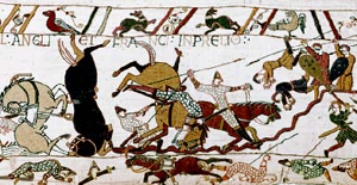
Consider the Bayeux Tapestry, pictured in the text. Identify the historical event it commemorates. How does this work depict this event and what point of view does it take?
Question
Question
Question
Question
Question
Question
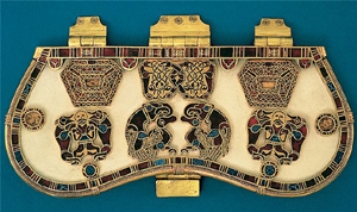
Consider the Sutton Hoo purse cover pictured in the text. Discuss this work with reference to the site in which it was found, the culture in which it was created, the artistic style it represents, and the materials used in its creation.
Question

Unlock Deck
Sign up to unlock the cards in this deck!
Unlock Deck
Unlock Deck
1/31

Play

Full screen (f)
Deck 15: Christianity and the Formation of Europe
1
________ is a pattern or patterns formed by intricately interwoven ribbons or bands.
A) Narthex
B) Interlace
C) Illumination
D) Embroidery
E) Ambulatory
A) Narthex
B) Interlace
C) Illumination
D) Embroidery
E) Ambulatory
B
2
Gothic cathedrals are known especially for:
A) the privacy and intimacy of their interior spaces.
B) their stained glass windows.
C) their heavy Romanesque walls.
D) their idyllic French countryside locations.
E) rounded arches and symmetrical towers.
A) the privacy and intimacy of their interior spaces.
B) their stained glass windows.
C) their heavy Romanesque walls.
D) their idyllic French countryside locations.
E) rounded arches and symmetrical towers.
B
3
The art and architecture of the high Middle Ages is generally divided into two periods, the ________ and the ________.
A) Romanesque; Carolingian
B) Renaissance; Gothic
C) Romanesque; Gothic
D) Romanesque; Renaissance
E) Gothic; Carolingian
A) Romanesque; Carolingian
B) Renaissance; Gothic
C) Romanesque; Gothic
D) Romanesque; Renaissance
E) Gothic; Carolingian
C
4
The transition from Romanesque to Gothic style can be seen in the ________ at Chartres Cathedral.
A) architecture
B) reliquaries
C) mosaics
D) sculpture
E) architecture and sculpture
A) architecture
B) reliquaries
C) mosaics
D) sculpture
E) architecture and sculpture
Unlock Deck
Unlock for access to all 31 flashcards in this deck.
Unlock Deck
k this deck
5
Soaring open spaces, pointed arches, ribbed vaulting, flying buttresses, and stained glass windows are characteristic of:
A) Renaissance architecture.
B) Romanesque churches.
C) the church of Sainte Foy.
D) Gothic cathedrals.
E) the Palace Chapel of Charlemagne.
A) Renaissance architecture.
B) Romanesque churches.
C) the church of Sainte Foy.
D) Gothic cathedrals.
E) the Palace Chapel of Charlemagne.
Unlock Deck
Unlock for access to all 31 flashcards in this deck.
Unlock Deck
k this deck
6
Because Christianity emphasized congregational worship, a fundamental change in the ________ was needed.
A) architectural design of places of worship
B) iconography of the church
C) placement of the altar
D) hierarchy of the gods
E) All of these answers are correct.
A) architectural design of places of worship
B) iconography of the church
C) placement of the altar
D) hierarchy of the gods
E) All of these answers are correct.
Unlock Deck
Unlock for access to all 31 flashcards in this deck.
Unlock Deck
k this deck
7
The ________ is the walkway directly in front of a church that serves as the entry porch.
A) nave
B) clerestory
C) narthex
D) apse
E) transept
A) nave
B) clerestory
C) narthex
D) apse
E) transept
Unlock Deck
Unlock for access to all 31 flashcards in this deck.
Unlock Deck
k this deck
8
In his painting ________, the artist Duccio pioneered the use of architecture to define space and direct movement.
A) Icon with the Crucifixion
B) Gospel Book of Durrow
C) Christ Entering Jerusalem
D) Pantokrator
E) The Lamentation
A) Icon with the Crucifixion
B) Gospel Book of Durrow
C) Christ Entering Jerusalem
D) Pantokrator
E) The Lamentation
Unlock Deck
Unlock for access to all 31 flashcards in this deck.
Unlock Deck
k this deck
9
The cross-shaped floor plan of a church is formed by the combined shapes of the nave and the:
A) aisles.
B) clerestory.
C) narthex.
D) apse.
E) transept.
A) aisles.
B) clerestory.
C) narthex.
D) apse.
E) transept.
Unlock Deck
Unlock for access to all 31 flashcards in this deck.
Unlock Deck
k this deck
10
The major axis of a central-plan church, such as the church of San Vitale in Ravenna, is:
A) octagonal.
B) rectilinear.
C) vertical.
D) diagonal.
E) horizontal.
A) octagonal.
B) rectilinear.
C) vertical.
D) diagonal.
E) horizontal.
Unlock Deck
Unlock for access to all 31 flashcards in this deck.
Unlock Deck
k this deck
11
What purpose is served by the carved figures that adorn the entryways at Chartres Cathedral?
A) They serve as reminders that one is entering a sacred space.
B) They are structural, holding up the archways above the doors.
C) They form a narrative, telling the story of Sainte Foy.
D) They are purely decorative, serving no real purpose.
E) They form a narrative but are purely decorative.
A) They serve as reminders that one is entering a sacred space.
B) They are structural, holding up the archways above the doors.
C) They form a narrative, telling the story of Sainte Foy.
D) They are purely decorative, serving no real purpose.
E) They form a narrative but are purely decorative.
Unlock Deck
Unlock for access to all 31 flashcards in this deck.
Unlock Deck
k this deck
12
Unlike their Greek and Roman predecessors, Byzantine artists preferred:
A) re-creation of daily life in their art.
B) a natural, more realistic art.
C) calligraphy in their art.
D) a flattened, abstracted style of art.
E) None of these answers is correct.
A) re-creation of daily life in their art.
B) a natural, more realistic art.
C) calligraphy in their art.
D) a flattened, abstracted style of art.
E) None of these answers is correct.
Unlock Deck
Unlock for access to all 31 flashcards in this deck.
Unlock Deck
k this deck
13
The mosaic Christ as the Sun exemplifies early Christian artists' appropriation of ________ iconography.
A) Egyptian
B) Greek
C) Islamic
D) Roman
E) both Greek and Roman
A) Egyptian
B) Greek
C) Islamic
D) Roman
E) both Greek and Roman
Unlock Deck
Unlock for access to all 31 flashcards in this deck.
Unlock Deck
k this deck
14
The Palace Chapel at Aachen was built for ________ as his personal place of worship.
A) Saint Denis
B) Abbot Suger
C) Charlemagne
D) William of Normandy
E) Constantine
A) Saint Denis
B) Abbot Suger
C) Charlemagne
D) William of Normandy
E) Constantine
Unlock Deck
Unlock for access to all 31 flashcards in this deck.
Unlock Deck
k this deck
15
The Abbey Church of Saint-Foy is one of the earliest ________ churches ever built.
A) Gothic
B) Romanesque
C) High Renaissance
D) Carolingian
E) post-and-beam
A) Gothic
B) Romanesque
C) High Renaissance
D) Carolingian
E) post-and-beam
Unlock Deck
Unlock for access to all 31 flashcards in this deck.
Unlock Deck
k this deck
16
The technique in which colored yarns are sewn to an existing woven background is called:
A) interlace.
B) embroidery.
C) tempera.
D) tapestry.
E) gouache.
A) interlace.
B) embroidery.
C) tempera.
D) tapestry.
E) gouache.
Unlock Deck
Unlock for access to all 31 flashcards in this deck.
Unlock Deck
k this deck
17
All the following are features of Romanesque architecture EXCEPT:
A) thick stone walls.
B) barrel-vaulted stone ceilings.
C) overall massiveness.
D) large windows of stained glass.
E) round arches.
A) thick stone walls.
B) barrel-vaulted stone ceilings.
C) overall massiveness.
D) large windows of stained glass.
E) round arches.
Unlock Deck
Unlock for access to all 31 flashcards in this deck.
Unlock Deck
k this deck
18
Duccio and Giotto were two artists whose innovations in ________ greatly influenced Renaissance painting styles.
A) basing their works on religious traditions
B) introducing a flat, decorative space
C) exploring classical subject matter
D) creating figures and settings with an increased naturalism
E) Gothic sculpture
A) basing their works on religious traditions
B) introducing a flat, decorative space
C) exploring classical subject matter
D) creating figures and settings with an increased naturalism
E) Gothic sculpture
Unlock Deck
Unlock for access to all 31 flashcards in this deck.
Unlock Deck
k this deck
19
Architects of Romanesque churches began installing ________ around the apse, which allowed the overflow of pilgrims to circulate freely around the interior of the church.
A) scaffolding
B) ambulatories
C) underground walkways
D) transepts
E) barrel vaulting
A) scaffolding
B) ambulatories
C) underground walkways
D) transepts
E) barrel vaulting
Unlock Deck
Unlock for access to all 31 flashcards in this deck.
Unlock Deck
k this deck
20
The walled, upward extension of the nave that is pierced with windows is called the:
A) nave.
B) clerestory.
C) narthex.
D) apse.
E) transept.
A) nave.
B) clerestory.
C) narthex.
D) apse.
E) transept.
Unlock Deck
Unlock for access to all 31 flashcards in this deck.
Unlock Deck
k this deck
21
Explain several reasons that stained glass is considered the most glorious aspect of the Gothic cathedrals.
Unlock Deck
Unlock for access to all 31 flashcards in this deck.
Unlock Deck
k this deck
22
Consider Christ Entering Jerusalem and The Lamentation. For each, identify the artist, media/techniques, and subject(s). Then discuss at least three ways in which these works can be considered as transitions or bridges between typical medieval styles of painting and early Renaissance styles.
Unlock Deck
Unlock for access to all 31 flashcards in this deck.
Unlock Deck
k this deck
23
Explain the function of jamb statues in cathedrals and compare the stylistic transition of these statues located in the west façade and south transept of Chartres Cathedral.
Unlock Deck
Unlock for access to all 31 flashcards in this deck.
Unlock Deck
k this deck
24
Consider the Bayeux Tapestry, pictured in the text. Identify the historical event it commemorates. How does this work depict this event and what point of view does it take?
Unlock Deck
Unlock for access to all 31 flashcards in this deck.
Unlock Deck
k this deck
25
The ________ technique was used to complete the Empress Theodora and Retinue in 547 C.E.
A) collage B. woven threads
C) fresco
D) encaustic
E) mosaic
A) collage B. woven threads
C) fresco
D) encaustic
E) mosaic
Unlock Deck
Unlock for access to all 31 flashcards in this deck.
Unlock Deck
k this deck
26
The term pantokrater, used in the title of the mosaic Christ as the Pantokater, is Greek for:
A) ruler of all.
B) gentle.
C) awe-inspiring.
D) holy.
E) savior.
A) ruler of all.
B) gentle.
C) awe-inspiring.
D) holy.
E) savior.
Unlock Deck
Unlock for access to all 31 flashcards in this deck.
Unlock Deck
k this deck
27
Considering the art of the Middle Ages, give examples of art forms that had more of a secular purpose as opposed to sacred and select one example to discuss in detail.
Unlock Deck
Unlock for access to all 31 flashcards in this deck.
Unlock Deck
k this deck
28
Compare and contrast Romanesque and Gothic styles, citing specific structures to illustrate your points.
Unlock Deck
Unlock for access to all 31 flashcards in this deck.
Unlock Deck
k this deck
29
Consider the Church of San Vitale, Ravenna, and the west façade of Chartres Cathedral. Identify the style of each of these structures and describe the characteristics that make each one typical of its style.
Unlock Deck
Unlock for access to all 31 flashcards in this deck.
Unlock Deck
k this deck
30
Consider the Sutton Hoo purse cover pictured in the text. Discuss this work with reference to the site in which it was found, the culture in which it was created, the artistic style it represents, and the materials used in its creation.
Unlock Deck
Unlock for access to all 31 flashcards in this deck.
Unlock Deck
k this deck
31
The gold-hammered vessel set with gems that contained the remains of Saint Foy is called a:
A) sarcophagus.
B) tomb.
C) reliquary.
D) icon.
E) mosaic.
A) sarcophagus.
B) tomb.
C) reliquary.
D) icon.
E) mosaic.
Unlock Deck
Unlock for access to all 31 flashcards in this deck.
Unlock Deck
k this deck
Unlock Deck
Unlock for access to all 31 flashcards in this deck.






