







 Chat with AI

Deck 6: Enzymes
Full screen (f)

Question

Question
Question
Question
Question
Question
Question
Question
Question
Question
Question
Question
For enzymes in which the slowest (rate-limiting) step is the reaction ![<strong>For enzymes in which the slowest (rate-limiting) step is the reaction K<sub>m</sub> becomes equivalent to:</strong> A) k<sub>cat</sub>. B) the [S], where V<sub>0</sub> = V<sub>max</sub>. C) the dissociation constant, K<sub>d</sub>, for the ES complex. D) the maximal velocity. E) the turnover number. <div style=padding-top: 35px>](https://d2lvgg3v3hfg70.cloudfront.net/TB5142/11eab0cc_0271_f198_8f52_0d6ac2439ed3_TB5142_00.jpg) Km becomes equivalent to:
Km becomes equivalent to:
A) kcat.
B) the [S], where V0 = Vmax.
C) the dissociation constant, Kd, for the ES complex.
D) the maximal velocity.
E) the turnover number.
Km becomes equivalent to:A) kcat.
B) the [S], where V0 = Vmax.
C) the dissociation constant, Kd, for the ES complex.
D) the maximal velocity.
E) the turnover number.
Question
Compare the two reaction coordinate diagrams below and select the answer that CORRECTLY describes their relationship. In each case, the single intermediate is the ES complex. 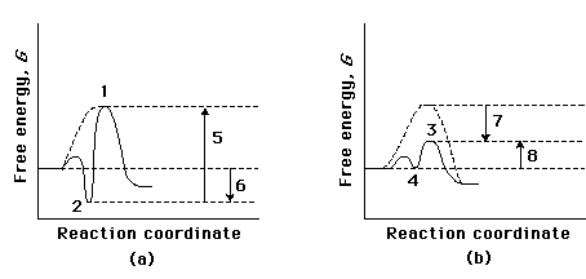
A) (a) describes a strict "lock and key" model, whereas (b) describes a transition-state complementarity model.
B) The activation energy for the catalyzed reaction is 5 in (a) and is 7 in (b).
C) The activation energy for the uncatalyzed reaction is given by 5 + 6 in (a) and by 7 + 4 in (b).
D) The contribution of binding energy is given by 5 in (a) and by 7 in (b).
E) The ES complex is given by 2 in (a) and 3 in (b).
A) (a) describes a strict "lock and key" model, whereas (b) describes a transition-state complementarity model.
B) The activation energy for the catalyzed reaction is 5 in (a) and is 7 in (b).
C) The activation energy for the uncatalyzed reaction is given by 5 + 6 in (a) and by 7 + 4 in (b).
D) The contribution of binding energy is given by 5 in (a) and by 7 in (b).
E) The ES complex is given by 2 in (a) and 3 in (b).
Question
Michaelis and Menten assumed that the overall reaction for an enzyme-catalyzed reaction could be written as: ![<strong>Michaelis and Menten assumed that the overall reaction for an enzyme-catalyzed reaction could be written as: Using this reaction, the rate of breakdown of the enzyme-substrate complex can be described by the expression:</strong> A) k<sub>1</sub> ([E<sub>t</sub>] - [ES]). B) k<sub>1</sub> ([E<sub>t</sub>] - [ES])[S]. C) k<sub>2</sub> [ES]. D) k<sub>-</sub><sub>1</sub> [ES] + k<sub>2</sub> [ES]. E) k<sub>-</sub><sub>1</sub> [ES]. <div style=padding-top: 35px>](https://d2lvgg3v3hfg70.cloudfront.net/TB5142/11eab0cc_0271_7c67_8f52_3bf2fdcf6ce5_TB5142_00.jpg) Using this reaction, the rate of breakdown of the enzyme-substrate complex can be described by the expression:
Using this reaction, the rate of breakdown of the enzyme-substrate complex can be described by the expression:
A) k1 ([Et] - [ES]).
B) k1 ([Et] - [ES])[S].
C) k2 [ES].
D) k-1 [ES] + k2 [ES].
E) k-1 [ES].
Using this reaction, the rate of breakdown of the enzyme-substrate complex can be described by the expression:A) k1 ([Et] - [ES]).
B) k1 ([Et] - [ES])[S].
C) k2 [ES].
D) k-1 [ES] + k2 [ES].
E) k-1 [ES].
Question
Question
In the following diagram of the first step in the reaction catalyzed by the protease chymotrypsin, the process of general base catalysis is illustrated by the number _____, and the process of covalent catalysis is illustrated by the number _____. 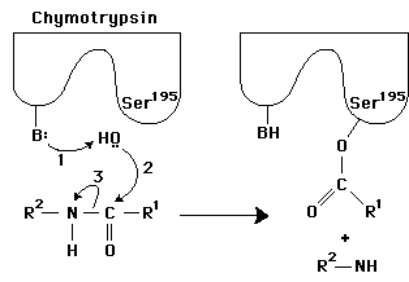
A) 1; 2
B) 1; 3
C) 2; 3
D) 2; 1
E) 3; 2
A) 1; 2
B) 1; 3
C) 2; 3
D) 2; 1
E) 3; 2
Question
Question
Question
Question
Question
Question
Question
Question
Question
Question
Question
Question
Question
Question
Question
Question
Question
Question
Question
Question
Question
Question
Question
For the simplified representation of an enzyme-catalyzed reaction shown below, the statement "ES is in steady-state" means that: ![<strong>For the simplified representation of an enzyme-catalyzed reaction shown below, the statement ES is in steady-state means that: </strong> A) k<sub>2</sub> is very slow. B) k<sub>1</sub> = k<sub>2</sub>. C) k<sub>1</sub> = k<sub>-</sub><sub>1</sub>. D) k<sub>1</sub>[E][S] = k<sub>-</sub><sub>1</sub>[ES] + k<sub>2</sub>[ES]. E) k<sub>1</sub>[E][S] = k<sub>-</sub><sub>1</sub>[ES]. <div style=padding-top: 35px>](https://d2lvgg3v3hfg70.cloudfront.net/TB5142/11eab0cc_0272_18a9_8f52_8bdd828be91a_TB5142_00.jpg)
A) k2 is very slow.
B) k1 = k2.
C) k1 = k-1.
D) k1[E][S] = k-1[ES] + k2[ES].
E) k1[E][S] = k-1[ES].
A) k2 is very slow.
B) k1 = k2.
C) k1 = k-1.
D) k1[E][S] = k-1[ES] + k2[ES].
E) k1[E][S] = k-1[ES].
Question
Question
Question
Question
Question
Question
Question
Question
Question
Question
Question
Question
Question
Question
Question
Question
Question
Question
Question
Question
Question
Question
Question
Question
Question
Question
Question
Question
Question
Question
Question
Question
Question
Question
Question
Question
Question
Question
Question
Question
Question

Unlock Deck
Sign up to unlock the cards in this deck!
Unlock Deck
Unlock Deck
1/106

Play

Full screen (f)
Deck 6: Enzymes
1
The steady state assumption, as applied to enzyme kinetics, implies:
A) Km = Ks.
B) the enzyme is regulated.
C) the ES complex is formed and broken down at equivalent rates.
D) the Km is equivalent to the cellular substrate concentration.
E) the maximum velocity occurs when the enzyme is saturated.
A) Km = Ks.
B) the enzyme is regulated.
C) the ES complex is formed and broken down at equivalent rates.
D) the Km is equivalent to the cellular substrate concentration.
E) the maximum velocity occurs when the enzyme is saturated.
C
2
One of the enzymes involved in glycolysis, aldolase, requires Zn2+ for catalysis. Under conditions of zinc deficiency, when the enzyme may lack zinc, it would be referred to as the:
A) apoenzyme.
B) coenzyme.
C) holoenzyme.
D) prosthetic group.
E) substrate.
A) apoenzyme.
B) coenzyme.
C) holoenzyme.
D) prosthetic group.
E) substrate.
A
3
Enzymes differ from other catalysts in that only enzymes:
A) are not consumed in the reaction.
B) display specificity toward a single reactant.
C) fail to influence the equilibrium point of the reaction.
D) form an activated complex with the reactants.
E) lower the activation energy of the reaction catalyzed.
A) are not consumed in the reaction.
B) display specificity toward a single reactant.
C) fail to influence the equilibrium point of the reaction.
D) form an activated complex with the reactants.
E) lower the activation energy of the reaction catalyzed.
B
4
Which statement is TRUE of enzyme catalysts?
A) Their catalytic activity is independent of pH.
B) They are generally equally active on D and L isomers of a given substrate.
C) They can increase the equilibrium constant for a given reaction by a thousand fold or more.
D) They can increase the reaction rate for a given reaction by a thousand-fold or more.
E) To be effective, they must be present at the same concentration as their substrate.
A) Their catalytic activity is independent of pH.
B) They are generally equally active on D and L isomers of a given substrate.
C) They can increase the equilibrium constant for a given reaction by a thousand fold or more.
D) They can increase the reaction rate for a given reaction by a thousand-fold or more.
E) To be effective, they must be present at the same concentration as their substrate.
Unlock Deck
Unlock for access to all 106 flashcards in this deck.
Unlock Deck
k this deck
5
The benefit of measuring the initial rate of a reaction V0 is that, at the beginning of a reaction:
A) [ES] can be measured accurately.
B) changes in [S] are negligible, so [S] can be treated as a constant.
C) changes in Km are negligible, so Km can be treated as a constant.
D) V0 = Vmax.
E) varying [S] has no effect on V0.
A) [ES] can be measured accurately.
B) changes in [S] are negligible, so [S] can be treated as a constant.
C) changes in Km are negligible, so Km can be treated as a constant.
D) V0 = Vmax.
E) varying [S] has no effect on V0.
Unlock Deck
Unlock for access to all 106 flashcards in this deck.
Unlock Deck
k this deck
6
Which statement is TRUE of enzyme catalysts?
A) They bind to substrates but are never covalently attached to substrate or product.
B) They increase the equilibrium constant for a reaction, thus favoring product formation.
C) They increase the stability of the product of a desired reaction by allowing ionizations, resonance, and isomerizations not normally available to substrates.
D) They lower the activation energy for the conversion of substrate to product.
E) To be effective, they must be present at the same concentration as their substrates.
A) They bind to substrates but are never covalently attached to substrate or product.
B) They increase the equilibrium constant for a reaction, thus favoring product formation.
C) They increase the stability of the product of a desired reaction by allowing ionizations, resonance, and isomerizations not normally available to substrates.
D) They lower the activation energy for the conversion of substrate to product.
E) To be effective, they must be present at the same concentration as their substrates.
Unlock Deck
Unlock for access to all 106 flashcards in this deck.
Unlock Deck
k this deck
7
The role of an enzyme in an enzyme-catalyzed reaction is to:
A) bind a transition state intermediate, such that it cannot be converted back to substrate.
B) ensure that all of the substrate is converted to product.
C) ensure that the product is more stable than the substrate.
D) increase the rate at which substrate is converted into product.
E) make the free-energy change for the reaction more favorable.
A) bind a transition state intermediate, such that it cannot be converted back to substrate.
B) ensure that all of the substrate is converted to product.
C) ensure that the product is more stable than the substrate.
D) increase the rate at which substrate is converted into product.
E) make the free-energy change for the reaction more favorable.
Unlock Deck
Unlock for access to all 106 flashcards in this deck.
Unlock Deck
k this deck
8
Which statement is TRUE of the binding energy derived from enzyme-substrate interactions?
A) It cannot provide enough energy to explain the large rate accelerations brought about by enzymes.
B) It is sometimes used to hold two substrates in the optimal orientation for reaction.
C) It is the result of covalent bonds formed between enzyme and substrate.
D) Most of it is derived from covalent bonds between enzyme and substrate.
E) Most of it is used up simply binding the substrate to the enzyme.
A) It cannot provide enough energy to explain the large rate accelerations brought about by enzymes.
B) It is sometimes used to hold two substrates in the optimal orientation for reaction.
C) It is the result of covalent bonds formed between enzyme and substrate.
D) Most of it is derived from covalent bonds between enzyme and substrate.
E) Most of it is used up simply binding the substrate to the enzyme.
Unlock Deck
Unlock for access to all 106 flashcards in this deck.
Unlock Deck
k this deck
9
Enzymes are potent catalysts because they:
A) are consumed in the reactions they catalyze.
B) are very specific and can prevent the conversion of products back to substrates.
C) drive reactions to completion while other catalysts drive reactions to equilibrium.
D) increase the equilibrium constants for the reactions they catalyze.
E) lower the activation energy for the reactions they catalyze.
A) are consumed in the reactions they catalyze.
B) are very specific and can prevent the conversion of products back to substrates.
C) drive reactions to completion while other catalysts drive reactions to equilibrium.
D) increase the equilibrium constants for the reactions they catalyze.
E) lower the activation energy for the reactions they catalyze.
Unlock Deck
Unlock for access to all 106 flashcards in this deck.
Unlock Deck
k this deck
10
Which enzymes are NOT among the six internationally accepted classes of enzymes?
A) hydrolases
B) ligases
C) oxidoreductases
D) polymerases
E) transferases
A) hydrolases
B) ligases
C) oxidoreductases
D) polymerases
E) transferases
Unlock Deck
Unlock for access to all 106 flashcards in this deck.
Unlock Deck
k this deck
11
An enzyme-catalyzed reaction was carried out with the substrate concentration initially a thousand times greater than the Km for that substrate. After 9 minutes, 1% of the substrate had been converted to product, and the amount of product formed in the reaction mixture was 12 mol. If, in a separate experiment, one-third as much enzyme and twice as much substrate had been combined, how long would it take for the same amount (12 mol) of product to be formed?
A) 1.5 min
B) 13.5 min
C) 27 min
D) 3 min
E) 6 min
A) 1.5 min
B) 13.5 min
C) 27 min
D) 3 min
E) 6 min
Unlock Deck
Unlock for access to all 106 flashcards in this deck.
Unlock Deck
k this deck
12
For enzymes in which the slowest (rate-limiting) step is the reaction Km becomes equivalent to:
A) kcat.
B) the [S], where V0 = Vmax.
C) the dissociation constant, Kd, for the ES complex.
D) the maximal velocity.
E) the turnover number.
Km becomes equivalent to:A) kcat.
B) the [S], where V0 = Vmax.
C) the dissociation constant, Kd, for the ES complex.
D) the maximal velocity.
E) the turnover number.
Unlock Deck
Unlock for access to all 106 flashcards in this deck.
Unlock Deck
k this deck
13
Compare the two reaction coordinate diagrams below and select the answer that CORRECTLY describes their relationship. In each case, the single intermediate is the ES complex.
A) (a) describes a strict "lock and key" model, whereas (b) describes a transition-state complementarity model.
B) The activation energy for the catalyzed reaction is 5 in (a) and is 7 in (b).
C) The activation energy for the uncatalyzed reaction is given by 5 + 6 in (a) and by 7 + 4 in (b).
D) The contribution of binding energy is given by 5 in (a) and by 7 in (b).
E) The ES complex is given by 2 in (a) and 3 in (b).
A) (a) describes a strict "lock and key" model, whereas (b) describes a transition-state complementarity model.
B) The activation energy for the catalyzed reaction is 5 in (a) and is 7 in (b).
C) The activation energy for the uncatalyzed reaction is given by 5 + 6 in (a) and by 7 + 4 in (b).
D) The contribution of binding energy is given by 5 in (a) and by 7 in (b).
E) The ES complex is given by 2 in (a) and 3 in (b).
Unlock Deck
Unlock for access to all 106 flashcards in this deck.
Unlock Deck
k this deck
14
Michaelis and Menten assumed that the overall reaction for an enzyme-catalyzed reaction could be written as: Using this reaction, the rate of breakdown of the enzyme-substrate complex can be described by the expression:
A) k1 ([Et] - [ES]).
B) k1 ([Et] - [ES])[S].
C) k2 [ES].
D) k-1 [ES] + k2 [ES].
E) k-1 [ES].
Using this reaction, the rate of breakdown of the enzyme-substrate complex can be described by the expression:A) k1 ([Et] - [ES]).
B) k1 ([Et] - [ES])[S].
C) k2 [ES].
D) k-1 [ES] + k2 [ES].
E) k-1 [ES].
Unlock Deck
Unlock for access to all 106 flashcards in this deck.
Unlock Deck
k this deck
15
Which statement about enzyme-catalyzed reactions is FALSE?
A) At saturating levels of substrate, the rate of an enzyme-catalyzed reaction is proportional to the enzyme concentration.
B) If enough substrate is added, the normal Vmax of a reaction can be attained even in the presence of a competitive inhibitor.
C) The rate of a reaction decreases steadily with time as substrate is depleted.
D) The activation energy for the catalyzed reaction is the same as for the uncatalyzed reaction, but the equilibrium constant is more favorable in the enzyme-catalyzed reaction.
E) The Michaelis-Menten constant Km equals the [S] at which V = 1/2 Vmax.
A) At saturating levels of substrate, the rate of an enzyme-catalyzed reaction is proportional to the enzyme concentration.
B) If enough substrate is added, the normal Vmax of a reaction can be attained even in the presence of a competitive inhibitor.
C) The rate of a reaction decreases steadily with time as substrate is depleted.
D) The activation energy for the catalyzed reaction is the same as for the uncatalyzed reaction, but the equilibrium constant is more favorable in the enzyme-catalyzed reaction.
E) The Michaelis-Menten constant Km equals the [S] at which V = 1/2 Vmax.
Unlock Deck
Unlock for access to all 106 flashcards in this deck.
Unlock Deck
k this deck
16
In the following diagram of the first step in the reaction catalyzed by the protease chymotrypsin, the process of general base catalysis is illustrated by the number _____, and the process of covalent catalysis is illustrated by the number _____.
A) 1; 2
B) 1; 3
C) 2; 3
D) 2; 1
E) 3; 2
A) 1; 2
B) 1; 3
C) 2; 3
D) 2; 1
E) 3; 2
Unlock Deck
Unlock for access to all 106 flashcards in this deck.
Unlock Deck
k this deck
17
Which statement is FALSE?
A) A reaction may not occur at a detectable rate even though it has a favorable equilibrium.
B) After a reaction, the enzyme involved becomes available to catalyze the reaction again.
C) For S P, a catalyst shifts the reaction equilibrium to the right.
D) Lowering the temperature of a reaction will lower the reaction rate.
E) Substrate binds to an enzyme's active site.
A) A reaction may not occur at a detectable rate even though it has a favorable equilibrium.
B) After a reaction, the enzyme involved becomes available to catalyze the reaction again.
C) For S P, a catalyst shifts the reaction equilibrium to the right.
D) Lowering the temperature of a reaction will lower the reaction rate.
E) Substrate binds to an enzyme's active site.
Unlock Deck
Unlock for access to all 106 flashcards in this deck.
Unlock Deck
k this deck
18
The following data were obtained in a study of an enzyme known to follow Michaelis-Menten kinetics: V0
Substrate added
( mol/min)
(mmol/L)
217
0)8
325
2
433
4
488
6
647
1,000
The Km for this enzyme is approximately:
A) 1 mM.
B) 1000 mM.
C) 2 mM.
D) 4 mM.
E) 6 mM.
Substrate added
( mol/min)
(mmol/L)
217
0)8
325
2
433
4
488
6
647
1,000
The Km for this enzyme is approximately:
A) 1 mM.
B) 1000 mM.
C) 2 mM.
D) 4 mM.
E) 6 mM.
Unlock Deck
Unlock for access to all 106 flashcards in this deck.
Unlock Deck
k this deck
19
Which statement about a plot of V0 versus [S] for an enzyme that follows Michaelis-Menten kinetics is FALSE?
A) As [S] increases, the initial velocity of reaction V0 also increases.
B) At very high [S], the velocity curve becomes a horizontal line that intersects the y-axis at Km.
C) Km is the [S] at which V0 = 1/2 Vmax.
D) The shape of the curve is a hyperbola.
E) The y-axis is a rate term with units of m/min.
A) As [S] increases, the initial velocity of reaction V0 also increases.
B) At very high [S], the velocity curve becomes a horizontal line that intersects the y-axis at Km.
C) Km is the [S] at which V0 = 1/2 Vmax.
D) The shape of the curve is a hyperbola.
E) The y-axis is a rate term with units of m/min.
Unlock Deck
Unlock for access to all 106 flashcards in this deck.
Unlock Deck
k this deck
20
The concept of "induced fit" refers to the fact that:
A) enzyme specificity is induced by enzyme-substrate binding.
B) enzyme-substrate binding induces an increase in the reaction entropy, thereby catalyzing the reaction.
C) enzyme-substrate binding induces movement along the reaction coordinate to the transition state.
D) substrate binding may induce a conformational change in the enzyme, which then brings catalytic groups into proper orientation.
E) when a substrate binds to an enzyme, the enzyme induces a loss of water (desolvation) from the substrate.
A) enzyme specificity is induced by enzyme-substrate binding.
B) enzyme-substrate binding induces an increase in the reaction entropy, thereby catalyzing the reaction.
C) enzyme-substrate binding induces movement along the reaction coordinate to the transition state.
D) substrate binding may induce a conformational change in the enzyme, which then brings catalytic groups into proper orientation.
E) when a substrate binds to an enzyme, the enzyme induces a loss of water (desolvation) from the substrate.
Unlock Deck
Unlock for access to all 106 flashcards in this deck.
Unlock Deck
k this deck
21
The double-reciprocal transformation of the Michaelis-Menten equation, also called the Lineweaver-Burk plot, is given by 1/V0 = Km /(Vmax[S]) + 1/Vmax
To determine Km from a double-reciprocal plot, you would:
A) multiply the reciprocal of the x-axis intercept by -1.
B) multiply the reciprocal of the y-axis intercept by -1.
C) take the reciprocal of the x-axis intercept.
D) take the reciprocal of the y-axis intercept.
E) take the x-axis intercept, where V0 = 1/2 Vmax.
To determine Km from a double-reciprocal plot, you would:
A) multiply the reciprocal of the x-axis intercept by -1.
B) multiply the reciprocal of the y-axis intercept by -1.
C) take the reciprocal of the x-axis intercept.
D) take the reciprocal of the y-axis intercept.
E) take the x-axis intercept, where V0 = 1/2 Vmax.
Unlock Deck
Unlock for access to all 106 flashcards in this deck.
Unlock Deck
k this deck
22
A small molecule that DECREASES the activity of an enzyme by binding to a site other than the catalytic site is termed a(n):
A) allosteric inhibitor.
B) alternative inhibitor.
C) competitive inhibitor.
D) stereospecific agent.
E) transition-state analog.
A) allosteric inhibitor.
B) alternative inhibitor.
C) competitive inhibitor.
D) stereospecific agent.
E) transition-state analog.
Unlock Deck
Unlock for access to all 106 flashcards in this deck.
Unlock Deck
k this deck
23
In a plot of l/V against 1/[S] for an enzyme-catalyzed reaction, the presence of a competitive inhibitor will alter the:
A) curvature of the plot.
B) intercept on the l/[S] axis.
C) intercept on the l/V axis.
D) pK of the plot.
E) Vmax.
A) curvature of the plot.
B) intercept on the l/[S] axis.
C) intercept on the l/V axis.
D) pK of the plot.
E) Vmax.
Unlock Deck
Unlock for access to all 106 flashcards in this deck.
Unlock Deck
k this deck
24
Which factor has NOT been shown to play a role in determining the specificity of protein kinases?
A) disulfide bonds near the phosphorylation site
B) primary sequence at phosphorylation site
C) protein quaternary structure
D) protein tertiary structure
E) residues near the phosphorylation site
A) disulfide bonds near the phosphorylation site
B) primary sequence at phosphorylation site
C) protein quaternary structure
D) protein tertiary structure
E) residues near the phosphorylation site
Unlock Deck
Unlock for access to all 106 flashcards in this deck.
Unlock Deck
k this deck
25
How is trypsinogen converted to trypsin?
A) A protein kinase-catalyzed phosphorylation converts trypsinogen to trypsin.
B) An increase in Ca2+ concentration promotes the conversion.
C) Proteolysis of trypsinogen forms trypsin.
D) Trypsinogen dimers bind an allosteric modulator, cAMP, causing dissociation into active trypsin monomers.
E) Two inactive trypsinogen dimers pair to form an active trypsin tetramer.
A) A protein kinase-catalyzed phosphorylation converts trypsinogen to trypsin.
B) An increase in Ca2+ concentration promotes the conversion.
C) Proteolysis of trypsinogen forms trypsin.
D) Trypsinogen dimers bind an allosteric modulator, cAMP, causing dissociation into active trypsin monomers.
E) Two inactive trypsinogen dimers pair to form an active trypsin tetramer.
Unlock Deck
Unlock for access to all 106 flashcards in this deck.
Unlock Deck
k this deck
26
In competitive inhibition, an inhibitor:
A) binds at several different sites on an enzyme.
B) binds covalently to the enzyme.
C) binds only to the ES complex.
D) binds reversibly at the active site.
E) lowers the characteristic Vmax of the enzyme.
A) binds at several different sites on an enzyme.
B) binds covalently to the enzyme.
C) binds only to the ES complex.
D) binds reversibly at the active site.
E) lowers the characteristic Vmax of the enzyme.
Unlock Deck
Unlock for access to all 106 flashcards in this deck.
Unlock Deck
k this deck
27
Both water and glucose share an -OH that can serve as a substrate for a reaction with the terminal phosphate of ATP catalyzed by hexokinase. Glucose, however, is about a million times more reactive as a substrate than water. The BEST explanation is that:
A) glucose has more -OH groups per molecule than does water.
B) the larger glucose binds better to the enzyme; it induces a conformational change in hexokinase that brings active-site amino acids into position for catalysis.
C) the -OH group of water is attached to an inhibitory H atom, while the glucose -OH group is attached to C.
D) water and the second substrate, ATP, compete for the active site resulting in a competitive inhibition of the enzyme.
E) water normally will not reach the active site because it is hydrophobic.
A) glucose has more -OH groups per molecule than does water.
B) the larger glucose binds better to the enzyme; it induces a conformational change in hexokinase that brings active-site amino acids into position for catalysis.
C) the -OH group of water is attached to an inhibitory H atom, while the glucose -OH group is attached to C.
D) water and the second substrate, ATP, compete for the active site resulting in a competitive inhibition of the enzyme.
E) water normally will not reach the active site because it is hydrophobic.
Unlock Deck
Unlock for access to all 106 flashcards in this deck.
Unlock Deck
k this deck
28
A transition-state analog:
A) is less stable when binding to an enzyme than the normal substrate.
B) resembles the active site of general acid-base enzymes.
C) resembles the transition-state structure of the normal enzyme-substrate complex.
D) stabilizes the transition state for the normal enzyme-substrate complex.
E) typically reacts more rapidly with an enzyme than the normal substrate.
A) is less stable when binding to an enzyme than the normal substrate.
B) resembles the active site of general acid-base enzymes.
C) resembles the transition-state structure of the normal enzyme-substrate complex.
D) stabilizes the transition state for the normal enzyme-substrate complex.
E) typically reacts more rapidly with an enzyme than the normal substrate.
Unlock Deck
Unlock for access to all 106 flashcards in this deck.
Unlock Deck
k this deck
29
The number of substrate molecules converted to product in a given unit of time by a single enzyme molecule at saturation is referred to as the:
A) dissociation constant.
B) half-saturation constant.
C) maximum velocity.
D) Michaelis-Menten number.
E) turnover number.
A) dissociation constant.
B) half-saturation constant.
C) maximum velocity.
D) Michaelis-Menten number.
E) turnover number.
Unlock Deck
Unlock for access to all 106 flashcards in this deck.
Unlock Deck
k this deck
30
A good transition-state analog:
A) binds covalently to the enzyme.
B) binds to the enzyme more tightly than the substrate.
C) binds very weakly to the enzyme.
D) is too unstable to isolate.
E) must be almost identical to the substrate.
A) binds covalently to the enzyme.
B) binds to the enzyme more tightly than the substrate.
C) binds very weakly to the enzyme.
D) is too unstable to isolate.
E) must be almost identical to the substrate.
Unlock Deck
Unlock for access to all 106 flashcards in this deck.
Unlock Deck
k this deck
31
The Lineweaver-Burk plot is used to:
A) determine the equilibrium constant for an enzymatic reaction.
B) extrapolate for the value of reaction rate at infinite enzyme concentration.
C) illustrate the effect of temperature on an enzymatic reaction.
D) solve, graphically, for the rate of an enzymatic reaction at infinite substrate concentration.
E) solve, graphically, for the ratio of products to reactants for any starting substrate concentration.
A) determine the equilibrium constant for an enzymatic reaction.
B) extrapolate for the value of reaction rate at infinite enzyme concentration.
C) illustrate the effect of temperature on an enzymatic reaction.
D) solve, graphically, for the rate of an enzymatic reaction at infinite substrate concentration.
E) solve, graphically, for the ratio of products to reactants for any starting substrate concentration.
Unlock Deck
Unlock for access to all 106 flashcards in this deck.
Unlock Deck
k this deck
32
Vmax for an enzyme-catalyzed reaction:
A) generally increases when pH increases.
B) increases in the presence of a competitive inhibitor.
C) is limited only by the amount of substrate supplied.
D) is twice the rate observed when the concentration of substrate is equal to the Km.
E) is unchanged in the presence of a uncompetitive inhibitor.
A) generally increases when pH increases.
B) increases in the presence of a competitive inhibitor.
C) is limited only by the amount of substrate supplied.
D) is twice the rate observed when the concentration of substrate is equal to the Km.
E) is unchanged in the presence of a uncompetitive inhibitor.
Unlock Deck
Unlock for access to all 106 flashcards in this deck.
Unlock Deck
k this deck
33
Penicillin and related drugs inhibit the enzyme _____; this enzyme is produced by _____.
A) -lacamase; bacteria
B) transpeptidase; human cells
C) transpeptidase; bacteria
D) lysozyme; human cells
E) aldolase; bacteria
A) -lacamase; bacteria
B) transpeptidase; human cells
C) transpeptidase; bacteria
D) lysozyme; human cells
E) aldolase; bacteria
Unlock Deck
Unlock for access to all 106 flashcards in this deck.
Unlock Deck
k this deck
34
Allosteric enzymes:
A) are regulated primarily by covalent modification.
B) usually catalyze several different reactions within a metabolic pathway.
C) usually have more than one polypeptide chain.
D) usually have only one active site.
E) usually show strict Michaelis-Menten kinetics.
A) are regulated primarily by covalent modification.
B) usually catalyze several different reactions within a metabolic pathway.
C) usually have more than one polypeptide chain.
D) usually have only one active site.
E) usually show strict Michaelis-Menten kinetics.
Unlock Deck
Unlock for access to all 106 flashcards in this deck.
Unlock Deck
k this deck
35
Enzyme X exhibits maximum activity at pH = 6.9. X shows a fairly sharp decrease in its activity when the pH goes much lower than 6.4. One likely interpretation of this pH activity is that:
A) a Glu residue on the enzyme is involved in the reaction.
B) a His residue on the enzyme is involved in the reaction.
C) the enzyme has a metallic cofactor.
D) the enzyme is found in gastric secretions.
E) the reaction relies on specific acid-base catalysis.
A) a Glu residue on the enzyme is involved in the reaction.
B) a His residue on the enzyme is involved in the reaction.
C) the enzyme has a metallic cofactor.
D) the enzyme is found in gastric secretions.
E) the reaction relies on specific acid-base catalysis.
Unlock Deck
Unlock for access to all 106 flashcards in this deck.
Unlock Deck
k this deck
36
The role of the metal ion (Mg2+) in catalysis by enolase is to:
A) act as a general acid catalyst.
B) act as a general base catalyst.
C) facilitate general acid catalysis.
D) facilitate general base catalysis.
E) stabilize protein conformation.
A) act as a general acid catalyst.
B) act as a general base catalyst.
C) facilitate general acid catalysis.
D) facilitate general base catalysis.
E) stabilize protein conformation.
Unlock Deck
Unlock for access to all 106 flashcards in this deck.
Unlock Deck
k this deck
37
Which statement about allosteric control of enzymatic activity is FALSE?
A) Allosteric effectors give rise to sigmoidal V0 versus [S] kinetic plots.
B) Allosteric proteins are generally composed of several subunits.
C) An effector may either inhibit or activate an enzyme.
D) Binding of the effector changes the conformation of the enzyme molecule.
E) Heterotropic allosteric effectors compete with substrate for binding sites.
A) Allosteric effectors give rise to sigmoidal V0 versus [S] kinetic plots.
B) Allosteric proteins are generally composed of several subunits.
C) An effector may either inhibit or activate an enzyme.
D) Binding of the effector changes the conformation of the enzyme molecule.
E) Heterotropic allosteric effectors compete with substrate for binding sites.
Unlock Deck
Unlock for access to all 106 flashcards in this deck.
Unlock Deck
k this deck
38
Phenyl-methane-sulfonyl-fluoride (PMSF) inactivates serine proteases by binding covalently to the catalytic serine residue at the active site; this enzyme-inhibitor bond is not cleaved by the enzyme. This is an example of what kind of inhibition?
A) irreversible
B) competitive
C) noncompetitive
D) mixed
E) pH inhibition
A) irreversible
B) competitive
C) noncompetitive
D) mixed
E) pH inhibition
Unlock Deck
Unlock for access to all 106 flashcards in this deck.
Unlock Deck
k this deck
39
For the simplified representation of an enzyme-catalyzed reaction shown below, the statement "ES is in steady-state" means that:
A) k2 is very slow.
B) k1 = k2.
C) k1 = k-1.
D) k1[E][S] = k-1[ES] + k2[ES].
E) k1[E][S] = k-1[ES].
A) k2 is very slow.
B) k1 = k2.
C) k1 = k-1.
D) k1[E][S] = k-1[ES] + k2[ES].
E) k1[E][S] = k-1[ES].
Unlock Deck
Unlock for access to all 106 flashcards in this deck.
Unlock Deck
k this deck
40
To calculate the turnover number of an enzyme, you need to know:
A) the enzyme concentration.
B) the initial velocity of the catalyzed reaction at [S] >> Km.
C) the initial velocity of the catalyzed reaction at low [S].
D) the Km for the substrate.
E) both the enzyme concentration and the initial velocity of the catalyzed reaction at [S] >> Km.
A) the enzyme concentration.
B) the initial velocity of the catalyzed reaction at [S] >> Km.
C) the initial velocity of the catalyzed reaction at low [S].
D) the Km for the substrate.
E) both the enzyme concentration and the initial velocity of the catalyzed reaction at [S] >> Km.
Unlock Deck
Unlock for access to all 106 flashcards in this deck.
Unlock Deck
k this deck
41
Enzymes that cleave carbon-carbon bonds without the use of water in the chemical reaction are members of which class of enzymes?
A) oxidoreductases
B) transferases
C) hydrolases
D) lyases
E) isomerases
A) oxidoreductases
B) transferases
C) hydrolases
D) lyases
E) isomerases
Unlock Deck
Unlock for access to all 106 flashcards in this deck.
Unlock Deck
k this deck
42
Binding energy between an enzyme and a substrate contributes to catalysis in which way?
A) Binding energy provides the enzyme specificity for the substrate.
B) Binding energy contributions allow for entropy reduction in the substrate-enzyme complex.
C) Binding energy compensates for energy changes as a result of desolvation of the substrate.
D) Binding energy contributes to the process of induced fit between the substrate and the enzyme.
E) All of the answers are correct.
A) Binding energy provides the enzyme specificity for the substrate.
B) Binding energy contributions allow for entropy reduction in the substrate-enzyme complex.
C) Binding energy compensates for energy changes as a result of desolvation of the substrate.
D) Binding energy contributes to the process of induced fit between the substrate and the enzyme.
E) All of the answers are correct.
Unlock Deck
Unlock for access to all 106 flashcards in this deck.
Unlock Deck
k this deck
43
If you were attempting to design a new drug for the treatment of a disease by interfering with enzyme activity in the disease-causing organism, which type of inhibitor would likely be the MOST effective?
A) a transition-state analog that is an irreversible inhibitor
B) a substrate analog that is a competitive inhibitor
C) a transition-state analog that is a competitive inhibitor
D) a product analog that is an uncompetitive inhibitor
E) a substrate analog that is a mixed inhibitor
A) a transition-state analog that is an irreversible inhibitor
B) a substrate analog that is a competitive inhibitor
C) a transition-state analog that is a competitive inhibitor
D) a product analog that is an uncompetitive inhibitor
E) a substrate analog that is a mixed inhibitor
Unlock Deck
Unlock for access to all 106 flashcards in this deck.
Unlock Deck
k this deck
44
What would be the systematic name for an enzyme that catalyzes the following reaction? alanine + 2-oxoglutarate pyruvate + glutamate
A) alanine:2-oxoglutarate hydrolyase
B) alanine:2-oxoglutarate ligase
C) alanine:2-oxoglutarate aminotransferase
D) glutamate oxidoreductase
E) pyruvate:glutamate phosphotransferase
A) alanine:2-oxoglutarate hydrolyase
B) alanine:2-oxoglutarate ligase
C) alanine:2-oxoglutarate aminotransferase
D) glutamate oxidoreductase
E) pyruvate:glutamate phosphotransferase
Unlock Deck
Unlock for access to all 106 flashcards in this deck.
Unlock Deck
k this deck
45
If chemical reactions will eventually reach an equilibrium state, what is the purpose of enzymes in a biological system?
A) Enzymes are consumed to speed up chemical reactions.
B) Enzymes speed up chemical reactions without being used up in the process.
C) Enzymes slow down chemical reactions.
D) Enzymes alter the equilibrium state between reactants and products.
E) Enzymes prevent the formation of unstable reaction intermediates.
A) Enzymes are consumed to speed up chemical reactions.
B) Enzymes speed up chemical reactions without being used up in the process.
C) Enzymes slow down chemical reactions.
D) Enzymes alter the equilibrium state between reactants and products.
E) Enzymes prevent the formation of unstable reaction intermediates.
Unlock Deck
Unlock for access to all 106 flashcards in this deck.
Unlock Deck
k this deck
46
A reaction that has a G'° of 25 kJ/mol is likely to have which property?
A) a large equilibrium constant
B) a small equilibrium constant
C) a slow reaction rate
D) both a large equilibrium constant and a slow reaction rate
E) both a small equilibrium constant and a slow reaction rate
A) a large equilibrium constant
B) a small equilibrium constant
C) a slow reaction rate
D) both a large equilibrium constant and a slow reaction rate
E) both a small equilibrium constant and a slow reaction rate
Unlock Deck
Unlock for access to all 106 flashcards in this deck.
Unlock Deck
k this deck
47
An enzyme that can convert glucose into fructose is a member of which class of enzymes?
A) oxidoreductases
B) transferases
C) hydrolases
D) lyases
E) isomerases
A) oxidoreductases
B) transferases
C) hydrolases
D) lyases
E) isomerases
Unlock Deck
Unlock for access to all 106 flashcards in this deck.
Unlock Deck
k this deck
48
Which amino acid is NOT capable using its side chain (R group) to participate in general acid-base catalysis?
A) Asp
B) His
C) Ser
D) Val
E) Lys
A) Asp
B) His
C) Ser
D) Val
E) Lys
Unlock Deck
Unlock for access to all 106 flashcards in this deck.
Unlock Deck
k this deck
49
Treatment of methanol poisoning by using ethanol is an example of what type of enzyme inhibition?
A) mixed inhibition
B) uncompetitive inhibition
C) competitive inhibition
D) noncompetitive inhibition
E) suicide inhibition
A) mixed inhibition
B) uncompetitive inhibition
C) competitive inhibition
D) noncompetitive inhibition
E) suicide inhibition
Unlock Deck
Unlock for access to all 106 flashcards in this deck.
Unlock Deck
k this deck
50
The HIV protease enzyme uses a general acid-base catalysis mechanism to cleave viral polypeptides but does not use a covalent catalysis. This enzyme functions optimally in the pH range of 4-6. Due to the specific amino acids involved in this catalysis, HIV protease is a member of which subclass of proteases?
A) metalloproteases
B) serine proteases
C) aspartyl proteases
D) cysteine proteases
E) lysine proteases
A) metalloproteases
B) serine proteases
C) aspartyl proteases
D) cysteine proteases
E) lysine proteases
Unlock Deck
Unlock for access to all 106 flashcards in this deck.
Unlock Deck
k this deck
51
In what way does an uncompetitive inhibitor bind to an enzyme?
A) It reversibly binds to the enzyme active site.
B) It irreversibly binds to the enzyme active site.
C) It reversibly binds to the enzyme-substrate complex but does not bind to the free enzyme.
D) It reversibly binds to both the free enzyme and the enzyme-substrate complex.
E) It irreversibly binds to an enzyme allosteric site.
A) It reversibly binds to the enzyme active site.
B) It irreversibly binds to the enzyme active site.
C) It reversibly binds to the enzyme-substrate complex but does not bind to the free enzyme.
D) It reversibly binds to both the free enzyme and the enzyme-substrate complex.
E) It irreversibly binds to an enzyme allosteric site.
Unlock Deck
Unlock for access to all 106 flashcards in this deck.
Unlock Deck
k this deck
52
Which statement BEST describes why niacin is required in the mammalian diet?
A) Niacin is a precursor of nicotinamide adenine dinucleotide (NAD), which is a coenzyme required by many oxidoreductase enzymes.
B) Niacin is a precursor of flavin adenine dinucleotide (FAD), which is a coenzyme required by many ligases.
C) Niacin is a precursor of thiamine pyrophosphate, which is a coenzyme required by many transferases.
D) Niacin is a component of coenzyme A, which is involved in many transferase reactions.
E) Niacin is not actually required in the mammalian diet.
A) Niacin is a precursor of nicotinamide adenine dinucleotide (NAD), which is a coenzyme required by many oxidoreductase enzymes.
B) Niacin is a precursor of flavin adenine dinucleotide (FAD), which is a coenzyme required by many ligases.
C) Niacin is a precursor of thiamine pyrophosphate, which is a coenzyme required by many transferases.
D) Niacin is a component of coenzyme A, which is involved in many transferase reactions.
E) Niacin is not actually required in the mammalian diet.
Unlock Deck
Unlock for access to all 106 flashcards in this deck.
Unlock Deck
k this deck
53
A double-reciprocal plot of 1/V0 versus 1/[S] for an enzyme in the presence of increasing concentrations of an uncompetitive inhibitor will have lines corresponding to the differentinhibitor concentrations that are BEST described by which statement?
A) The lines will intersect at the x-axis to the left of the y-axis.
B) The lines will cross the y-axis and will be parallel to each other.
C) The lines will intersect to the left of the y-axis but above the x-axis.
D) The lines will intersect below the x-axis, to the right of the y-axis.
E) The lines will be parallel to each other but will not cross the y-axis.
A) The lines will intersect at the x-axis to the left of the y-axis.
B) The lines will cross the y-axis and will be parallel to each other.
C) The lines will intersect to the left of the y-axis but above the x-axis.
D) The lines will intersect below the x-axis, to the right of the y-axis.
E) The lines will be parallel to each other but will not cross the y-axis.
Unlock Deck
Unlock for access to all 106 flashcards in this deck.
Unlock Deck
k this deck
54
Which statement regarding enzyme activity is CORRECT?
A) Enzymes bind their substrates better than the transition state.
B) Enzymes bind the transition state better than the reaction products.
C) Enzymes reduce the activation energy required for the reaction to take place.
D) Enzymes bind their substrates better than the transition state and the transition state better than the reaction products.
E) Enzymes bind the transition state better than the reaction products and reduce the activation energy required for the reaction to take place.
A) Enzymes bind their substrates better than the transition state.
B) Enzymes bind the transition state better than the reaction products.
C) Enzymes reduce the activation energy required for the reaction to take place.
D) Enzymes bind their substrates better than the transition state and the transition state better than the reaction products.
E) Enzymes bind the transition state better than the reaction products and reduce the activation energy required for the reaction to take place.
Unlock Deck
Unlock for access to all 106 flashcards in this deck.
Unlock Deck
k this deck
55
Chymotrypsin catalyzes the cleavage of proteins at peptide bonds adjacent to aromatic amino acid residues by using which catalytic mechanism?
A) general acid-base catalysis
B) metal ion catalysis
C) covalent catalysis
D) both general acid-base catalysis and metal ion catalysis
E) both general acid-base catalysis and covalent catalysis
A) general acid-base catalysis
B) metal ion catalysis
C) covalent catalysis
D) both general acid-base catalysis and metal ion catalysis
E) both general acid-base catalysis and covalent catalysis
Unlock Deck
Unlock for access to all 106 flashcards in this deck.
Unlock Deck
k this deck
56
A complex organic molecule that is necessary for enzyme function but is NOT permanently associated with the enzyme is a:
A) prosthetic group.
B) cofactor.
C) holofactor.
D) coenzyme.
E) metal ion.
A) prosthetic group.
B) cofactor.
C) holofactor.
D) coenzyme.
E) metal ion.
Unlock Deck
Unlock for access to all 106 flashcards in this deck.
Unlock Deck
k this deck
57
Blood coagulation involves:
A) a kinase cascade.
B) zymogen activation.
C) serine proteases.
D) both a kinase cascade and zymogen activation.
E) both zymogen activation and serine proteases.
A) a kinase cascade.
B) zymogen activation.
C) serine proteases.
D) both a kinase cascade and zymogen activation.
E) both zymogen activation and serine proteases.
Unlock Deck
Unlock for access to all 106 flashcards in this deck.
Unlock Deck
k this deck
58
The allosteric enzyme ATCase is regulated by CTP, which binds to the T-state of ATCase. CTP is a:
A) positive regulator.
B) negative regulator.
C) cofactor.
D) competitive inhibitor.
E) coenzyme.
A) positive regulator.
B) negative regulator.
C) cofactor.
D) competitive inhibitor.
E) coenzyme.
Unlock Deck
Unlock for access to all 106 flashcards in this deck.
Unlock Deck
k this deck
59
An enzyme's specificity constant (kcat/Km) has a maximum upper limit due to:
A) substrate concentration.
B) enzyme concentration.
C) the enzyme turnover number.
D) diffusion of the enzyme and substrate together.
E) the Michaelis constant.
A) substrate concentration.
B) enzyme concentration.
C) the enzyme turnover number.
D) diffusion of the enzyme and substrate together.
E) the Michaelis constant.
Unlock Deck
Unlock for access to all 106 flashcards in this deck.
Unlock Deck
k this deck
60
Which enzyme uses general acid-base catalysis and/or covalent catalysis mechanisms to hydrolyze peptidoglycan?
A) enolase
B) lysozyme
C) chymotrypsin
D) pepsin
E) lactamase
A) enolase
B) lysozyme
C) chymotrypsin
D) pepsin
E) lactamase
Unlock Deck
Unlock for access to all 106 flashcards in this deck.
Unlock Deck
k this deck
61
The enzyme pepsin is produced in the stomach lining initially as a _____, which requires _____ for activation in the stomach.
A) kinase; phosphorylation
B) zymogen; irreversible proteolytic cleavage
C) proprotein; reversible proteolytic cleavage
D) zymogen; ubiquitination
E) phosphorylase; irreversible proteolytic cleavage
A) kinase; phosphorylation
B) zymogen; irreversible proteolytic cleavage
C) proprotein; reversible proteolytic cleavage
D) zymogen; ubiquitination
E) phosphorylase; irreversible proteolytic cleavage
Unlock Deck
Unlock for access to all 106 flashcards in this deck.
Unlock Deck
k this deck
62
Two different enzymes are able to catalyze the same reaction, A B. They both have the same Vmax, but differ their Km the substrate A. For enzyme 1, the Km is 1.0 mM; for enzyme 2, the Km is 10 mM. When enzyme 1 was incubated with 0.1 mM A, it was observed that B was produced at a rate of 0.0020 mmoles/minute. a) What is the value of the Vmax of the enzymes? b) What will be the rate of production of B when enzyme 2 is incubated with 0.1 mM A? c) What will be the rate of production of B when enzyme 1 is incubated with 1 M (i.e., 1000 mM) A?
Unlock Deck
Unlock for access to all 106 flashcards in this deck.
Unlock Deck
k this deck
63
Which molecule would NOT be effective to administer as an anticoagulant?
A) aspirin
B) warfarin
C) heparin
D) vitamin K
E) antithrombin
A) aspirin
B) warfarin
C) heparin
D) vitamin K
E) antithrombin
Unlock Deck
Unlock for access to all 106 flashcards in this deck.
Unlock Deck
k this deck
64
Which type of enzyme is responsible for attaching phosphate groups to specific amino acids?
A) a protein phosphatase
B) a ribosylase
C) a protein kinase
D) a protein glycosylase
E) an ATPase
A) a protein phosphatase
B) a ribosylase
C) a protein kinase
D) a protein glycosylase
E) an ATPase
Unlock Deck
Unlock for access to all 106 flashcards in this deck.
Unlock Deck
k this deck
65
Which amino acid is NOT one that may be targeted for phosphorylation to modulate the activity of an enzyme?
A) Tyr
B) His
C) Ser
D) Ala
E) Thr
A) Tyr
B) His
C) Ser
D) Ala
E) Thr
Unlock Deck
Unlock for access to all 106 flashcards in this deck.
Unlock Deck
k this deck
66
An enzyme catalyzes a reaction at a velocity of 20 mol/min when the concentration of substrate (S) is 0.01 M. The Km for this substrate is 1 × 10⁻⁵ M. Assuming that Michaelis-Menten kinetics are followed, what will the reaction velocity be when the concentration of S is (a) 1 × 10⁻⁵ M and (b) 1 × 10⁻⁶ M?
Unlock Deck
Unlock for access to all 106 flashcards in this deck.
Unlock Deck
k this deck
67
Sometimes the difference in (standard) free-energy content, G'°, between a substrate S and a product P is very large, yet the rate of chemical conversion, S P, is quite slow. Why?
Unlock Deck
Unlock for access to all 106 flashcards in this deck.
Unlock Deck
k this deck
68
Draw and label a reaction coordinate diagram for an uncatalyzed reaction, S P, and the same reaction catalyzed by an enzyme, E.
Unlock Deck
Unlock for access to all 106 flashcards in this deck.
Unlock Deck
k this deck
69
The combination of amoxicillin and clavulanic acid into the drug known as Augmentin is widely used as an antibacterial agent. The purpose of amoxicillin in this drug is to target _____, which catalyzes crosslinking of peptidoglycan, and the purpose of clavulanic acid in this drug is to target _____, which normally would inactivate the amoxicillin. Both of these compounds act as _____ inhibitors of enzyme function.
A) transpeptidase; hexokinase; competitive
B) peptidoglycanase; lactamase; uncompetitive
C) transpeptidase; lactamase; suicide
D) glycanprotease; penicillinase; competitive
E) lactamase; lysozyme; suicide
A) transpeptidase; hexokinase; competitive
B) peptidoglycanase; lactamase; uncompetitive
C) transpeptidase; lactamase; suicide
D) glycanprotease; penicillinase; competitive
E) lactamase; lysozyme; suicide
Unlock Deck
Unlock for access to all 106 flashcards in this deck.
Unlock Deck
k this deck
70
For a reaction that can take place with or without catalysis by an enzyme, what would be the effect of the enzyme on the:
(a) standard free energy change of the reaction?
(b) activation energy of the reaction?
(c) initial velocity of the reaction?
(d) equilibrium constant of the reaction?
(a) standard free energy change of the reaction?
(b) activation energy of the reaction?
(c) initial velocity of the reaction?
(d) equilibrium constant of the reaction?
Unlock Deck
Unlock for access to all 106 flashcards in this deck.
Unlock Deck
k this deck
71
Which protein polymerizes into a gel-like matrix after it is activated to assist in blood clotting?
A) trypsinogen
B) fibrinogen
C) prothrombin
D) thrombin
E) warfarin
A) trypsinogen
B) fibrinogen
C) prothrombin
D) thrombin
E) warfarin
Unlock Deck
Unlock for access to all 106 flashcards in this deck.
Unlock Deck
k this deck
72
Define the terms "cofactor" and "coenzyme."
Unlock Deck
Unlock for access to all 106 flashcards in this deck.
Unlock Deck
k this deck
73
The difference in (standard) free energy content, G'°, between substrate S and product P may vary considerably among different reactions. What is the significance of these differences?
Unlock Deck
Unlock for access to all 106 flashcards in this deck.
Unlock Deck
k this deck
74
For the reaction E + S ES P the Michaelis-Menten constant, Km, is actually a summary of three terms. What are they? How is Km determined graphically?
Unlock Deck
Unlock for access to all 106 flashcards in this deck.
Unlock Deck
k this deck
75
Write out the equation that describes the mechanism for enzyme action used as a model by Michaelis and Menten. List the important assumptions used by Michaelis and Menten to derive a rate equation for this reaction.
Unlock Deck
Unlock for access to all 106 flashcards in this deck.
Unlock Deck
k this deck
76
What is the difference between general acid-base catalysis and specific acid-base catalysis? (Assume that the solvent is water.)
Unlock Deck
Unlock for access to all 106 flashcards in this deck.
Unlock Deck
k this deck
77
An enzyme can catalyze a reaction with either of two substrates, S1 or S2. The Km for S1 was found to be 2.0 mM, and the Km, for S2 was found to be 20 mM. A student determined that the Vmax was the same for the two substrates. Unfortunately, he lost the page of his notebook and needed to know the value of Vmax. He carried out two reactions: one with 0.1 mM S1, the other with 0.1 mM S2. Unfortunately, he forgot to label which reaction tube contained which substrate. Determine the value of Vmax from the results he obtained:
Tube number
Rate of formation of product
1
0.5
2
4.8
3
4
5
Tube number
Rate of formation of product
1
0.5
2
4.8
3
4
5
Unlock Deck
Unlock for access to all 106 flashcards in this deck.
Unlock Deck
k this deck
78
Michaelis-Menten kinetics is sometimes referred to as "saturation" kinetics. Why?
Unlock Deck
Unlock for access to all 106 flashcards in this deck.
Unlock Deck
k this deck
79
Write an equilibrium expression for the reaction S P and briefly explain the relationship between the value of the equilibrium constant and free energy.
Unlock Deck
Unlock for access to all 106 flashcards in this deck.
Unlock Deck
k this deck
80
The Mg2+ metal ions involved in the enolase reaction mechanism are required for which reason?
A) They form covalent bonds with a porphoryin ring to coordinate the substrate.
B) They enhance the electron-withdrawing potential of the carbonyl group of 2-phosphoglycerate.
C) They stabilize the phosphate group of 2-phosphoglycerate.
D) They allow a Lys in the active site to donate a proton to the 2-phosphoglycerate substrate.
E) They prevent the reverse catalysis of 3-phosphoglycerate to 2-phosphoglycerate from taking place.
A) They form covalent bonds with a porphoryin ring to coordinate the substrate.
B) They enhance the electron-withdrawing potential of the carbonyl group of 2-phosphoglycerate.
C) They stabilize the phosphate group of 2-phosphoglycerate.
D) They allow a Lys in the active site to donate a proton to the 2-phosphoglycerate substrate.
E) They prevent the reverse catalysis of 3-phosphoglycerate to 2-phosphoglycerate from taking place.
Unlock Deck
Unlock for access to all 106 flashcards in this deck.
Unlock Deck
k this deck
Unlock Deck
Unlock for access to all 106 flashcards in this deck.






