







 Chat with AI

Deck 6: Government Intervention
Full screen (f)

Question

Question
Question
Question
Question
Question
Question
Question
Question
Question
Question
Question
Question
Question
Question
Question
Question
Question
Question
Question
Question
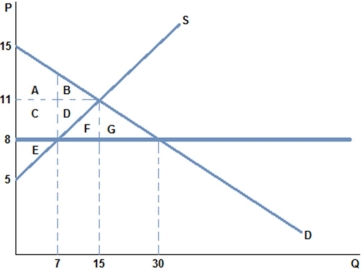 If a binding price ceiling were placed in the market in the graph shown:
A) quantity demanded would exceed quantity supplied.
B) quantity supplied would exceed quantity demanded.
C) the demand curve would have to shift.
D) the supply curve would have to shift.
Question
Question
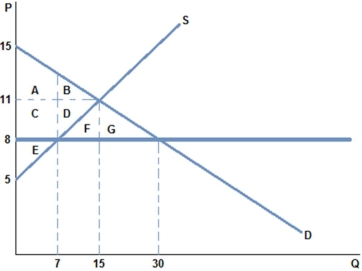 After a price ceiling of $8 is placed on the market in the graph shown, which area represents consumer surplus?
A) A + C
B) A + B
C) A + B + C
D) A + B + C + D + F + G
Question
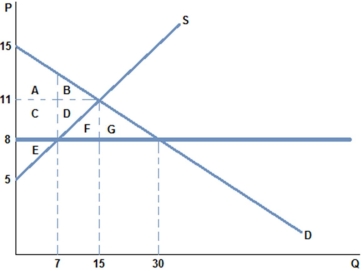 A price ceiling of $8 placed on the market in the graph shown:
A) is non-binding, and does not affect the market.
B) is binding, and causes a shortage.
C) is binding, and causes a surplus.
D) is non-binding, and does not prevent the market from reaching equilibrium.
Question
Question
Question
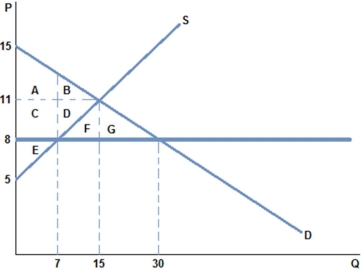 The graph shown best represents:
A) a binding price ceiling.
B) a binding price floor.
C) a missing market.
D) a market for an inferior good.
Question
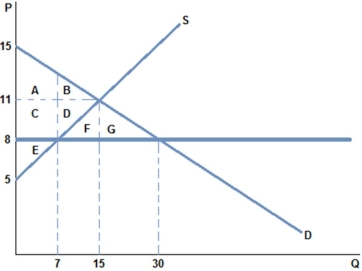 If a price ceiling of $8 were placed in the market in the graph shown:
A) a shortage of 7 would occur.
B) a shortage of 15 would occur.
C) a shortage of 23 would occur.
D) a shortage of 8 would occur.
Question
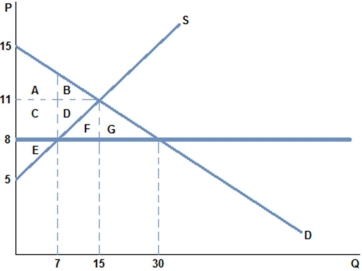 If a price ceiling of $8 were placed on the market in the graph shown, which area represents the surplus that is transferred from producers to consumers?
A) C + D + F + G
B) C + D
C) F + G
D) C
Question
Question
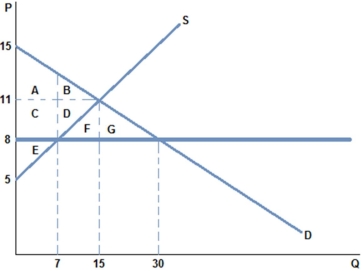 What could happen to render the price ceiling set in the graph shown non-binding?
A) Demand could increase, and shift to the right.
B) Demand could decrease, and shift to the left.
C) Supply could decrease, and shift to the left.
D) None of these would cause the price ceiling to be non-binding.
Question
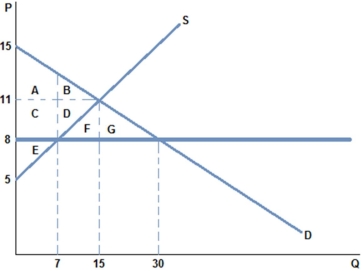 If a price ceiling of $8 were placed in the market in the graph shown:
A) some surplus is transferred from consumer to producer.
B) some surplus is transferred from producer to consumer.
C) all consumers are made better off.
D) all producers are made better off.
Question
Question
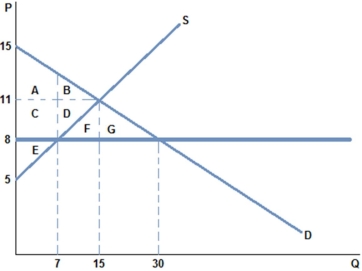 If a price ceiling of $8 were placed in the market in the graph shown, which area represents deadweight loss?
A) F + G
B) B + D
C) E
D) B + D + F + G
Question
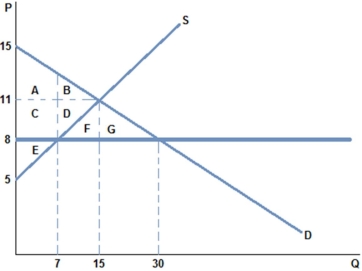 After a price ceiling of $8 is placed on the market in the graph shown, which area represents producer surplus?
A) C + D + E
B) C + D + F + G
C) E
D) A + C + E
Question
Question
Question
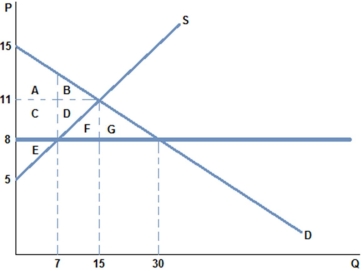 Which of the following changes to the market in the graph shown could cause the price ceiling to become non-binding?
A) Demand could increase, and shift to the right.
B) Supply could increase, and shift to the left.
C) Supply could increase, and shift to the right.
D) Supply could decrease, and shift to the left.
Question
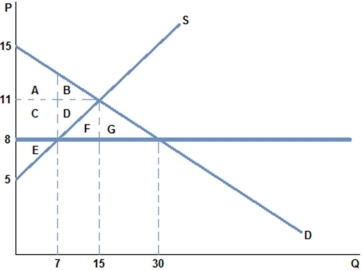 If a price ceiling of $8 were placed in the market in the graph shown:
A) an excess supply of 7 would occur.
B) an excess supply of 15 would occur.
C) an excess supply of 23 would occur.
D) None of these is true.
Question
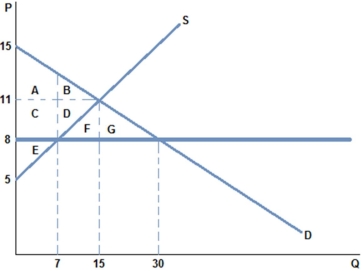 After a price ceiling of $8 is placed on the market in the graph shown, which area represents total surplus?
A) A + B + C + D + E + F + G
B) A + B + C + D + E
C) A + C + E
D) A + B + C + D + E + F
Question
 The graph shown best represents:
A) a non-binding price ceiling.
B) a non-binding price floor.
C) a missing market.
D) a market for an inferior good.
Question
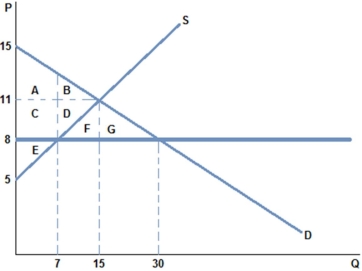 After a price ceiling of $8 is placed on the market in the graph shown, the total number of units traded:
A) falls by 8 relative to equilibrium.
B) falls by 15 relative to equilibrium.
C) falls by 23 relative to equilibrium.
D) increases by 15 relative to equilibrium.
Question
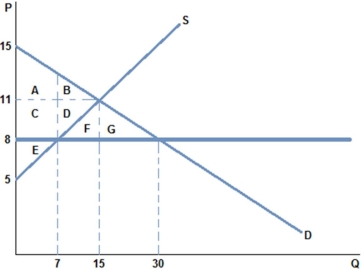 According to the graph above, a price ceiling in this market would be non-binding if it were set at:
A) $5.
B) $8.
C) $10.
D) $13.
Question
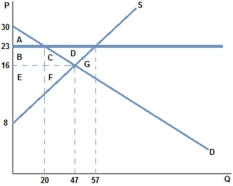 If a price floor of $23 were placed in the market in the graph shown:
A) a shortage of 37 would occur.
B) a shortage of 10 would occur.
C) a shortage of 27 would occur.
D) None of these would occur.
Question
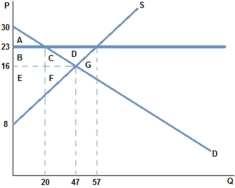 The graph shown best represents:
A) a non-binding price ceiling.
B) a non-binding price floor.
C) a missing market.
D) a market for an inferior good.
Question
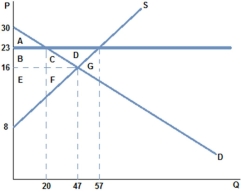 A binding price floor that could be set in the market in the graph shown would be:
A) $23.
B) $16.
C) $8.
D) $12.
Question
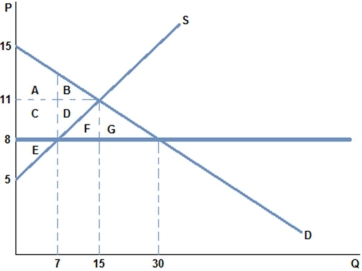 After a price ceiling of $8 is placed on the market in the graph shown:
A) some consumers benefit because they pay a lower price.
B) producers lose because they sell at a lower price.
C) the quantity traded in the market falls.
D) All of these are true.
Question
Question
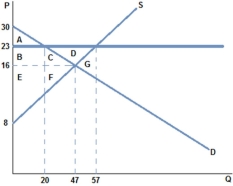 The graph shown best represents:
A) a binding price ceiling.
B) a binding price floor.
C) a missing market.
D) a market for an inferior good.
Question
Question
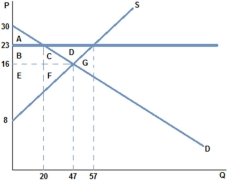 If a binding price floor were placed in the market in the graph shown:
A) quantity demanded would exceed quantity supplied.
B) quantity supplied would exceed quantity demanded.
C) the demand curve would have to shift.
D) the supply curve would have to shift.
Question
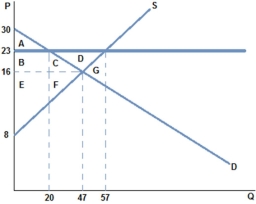 If a price floor of $23 were placed in the market in the graph shown:
A) a surplus of 27 would occur.
B) a surplus of 37 would occur.
C) a surplus of 10 would occur.
D) a surplus of 20 would occur.
Question
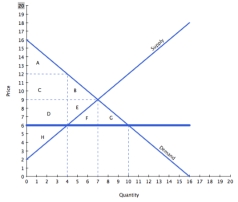 With reference to the graph above, if the intended aim of the price ceiling set at $6 was a net increase in the well-being of consumers, then positive analysis would consider:
A) whether the surplus transferred from consumers to producers is larger than the consumer surplus lost to deadweight loss.
B) whether the producer surplus lost to deadweight loss is larger than the producer surplus gained from a higher price.
C) whether the surplus transferred from producers to consumers is larger than the consumer surplus lost to deadweight loss.
D) whether the producer surplus lost due to lower prices is larger than the producer surplus lost due to fewer transactions taking place.
Question
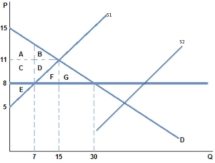 Suppose the market supply is initially at S1 and a price ceiling is set at 8. If supply shifts from S1 to S2, then
A) The price ceiling will no longer bind.
B) The price ceiling will prevent output from changing.
C) The size of the shortage will increase.
D) The market will not reach equilibrium.
Question
Question
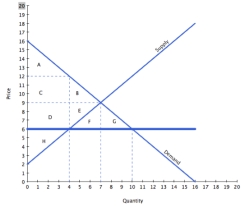 With reference to the graph above, if the intended aim of the price ceiling set at $6 was a net increase in the well-being of consumers:
A) then the policy was effective since consumers gained in surplus overall.
B) then the policy was ineffective since consumers gained in surplus overall.
C) then the policy was ineffective since consumers lost surplus overall.
D) then the policy was effective since consumers lost surplus overall.
Question
Question
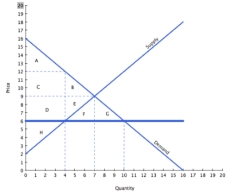 With reference to the graph above, if the intended aim of the price ceiling set at $6 was a net increase in the well-being of consumers, then positive analysis would conclude:
A) the policy was effective, since surplus gained by consumers through lower prices is greater than the surplus they lost through deadweight loss.
B) the policy was ineffective, since surplus gained by consumers through lower prices is less than the surplus they lost through deadweight loss.
C) the policy was effective, since surplus lost by producers through lower prices is less than the surplus gained by consumers through lower prices.
D) the policy was ineffective, since the amount of deadweight loss is greater than the surplus gained by consumers from lower prices.
Question
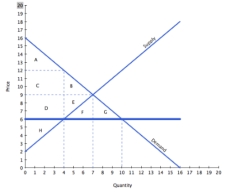 With reference to the graph above, if the intended aim of the price ceiling set at $6 was a net increase in the well-being of consumers, then normative analysis would conclude that:
A) the policy was effective, since surplus gained by consumers through lower prices is less than the surplus they lost through deadweight loss.
B) the policy was ineffective, since surplus gained by consumers through lower prices is less than the surplus they lost through deadweight loss.
C) the policy was effective, since surplus lost by producers through lower prices is less than the surplus gained by consumers through lower prices.
D) there is no "right" conclusion to be reached (in a normative sense), since people have different opinions concerning what constitutes a better outcome.
Question
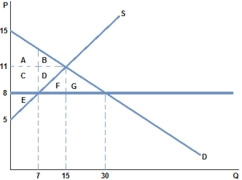 A binding price ceiling that could be set in the market in the graph shown would be:
A) $15.
B) $11.
C) $8.
D) $30.
Question
Question
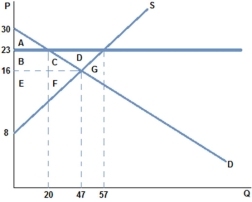 After a price floor of $23 is placed on the market in the graph shown, which area represents producer surplus?
A) B + C + D + F
B) B + E
C) B + C + D
D) B + C + E + F
Question
Question
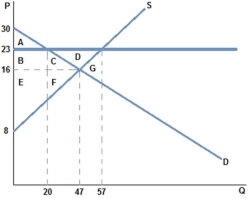 If a price floor of $23 were placed on the market in the graph shown, which area represents the surplus that is transferred?
A) B + C + D
B) B + C
C) C
D) B
Question
Question
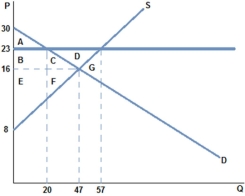 After a price floor of $23 is placed on the market in the graph shown, which area represents consumer surplus?
A) A
B) A + B
C) A + B + C
D) A + B + C + D
Question
Question
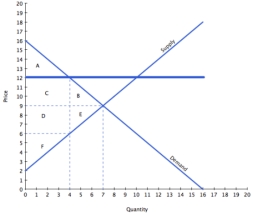 If the intended aim of the price floor set in the graph shown was a net increase in the well-being of producers, then normative analysis would conclude that:
A) the policy was effective, since surplus gained by producers through higher prices is greater than the surplus they lost through deadweight loss.
B) the policy was ineffective, since surplus gained by producers through higher prices is greater than the surplus they lost through deadweight loss.
C) the policy was effective, since surplus gained by producers through higher prices is greater than the surplus lost by consumers through higher prices.
D) there is no "right" conclusion to be reached in a normative sense, since people have different opinions concerning what constitutes a better outcome.
Question
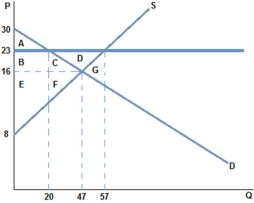 After a price floor of $23 is placed on the market in the graph shown:
A) some consumers lose because they pay a higher price.
B) some producers gain because they sell at a higher price.
C) the quantity traded in the market falls.
D) All of these are true.
Question
Question
Question
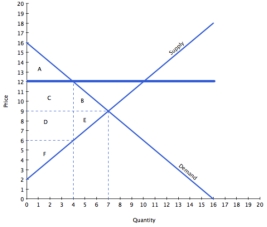 Which of the following changes to the market in the graph shown could cause the price floor to become non-binding?
A) Demand could decrease, and shift to the left.
B) Supply could increase, and shift to the left.
C) Supply could increase, and shift to the right.
D) Supply could decrease, and shift to the left.
Question
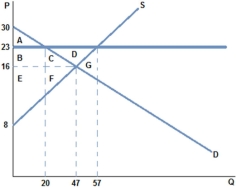 If a price floor of $23 were placed in the market in the graph shown:
A) some surplus is transferred from consumer to producer.
B) some surplus is transferred from producer to consumer.
C) all producers are better off.
D) all consumers are better off.
Question
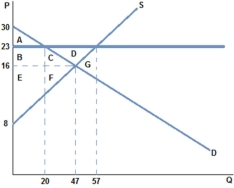 A price floor of $23 placed on the market in the graph shown:
A) is binding, and causes a shortage.
B) is non-binding, and does not affect the market.
C) is binding, and causes a surplus.
D) is non-binding, and does not prevent the market from reaching equilibrium.
Question
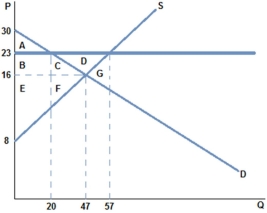 If a non-binding price floor were to be set in the market in the graph shown, it could be set at:
A) $30.
B) $23.
C) $16.
D) All of these would be binding price floors for this market.
Question
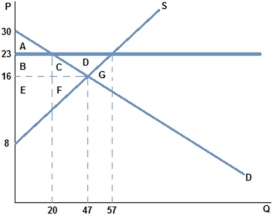 If the intended aim of the price floor set in the graph shown was a net increase in the well-being of producers, then positive analysis would have us consider:
A) whether the surplus transferred from producers to consumers is larger than the consumer surplus lost to deadweight loss.
B) whether the surplus transferred from consumers to producers is larger than the consumer surplus lost to deadweight loss.
C) whether the producer surplus lost to deadweight loss is greater than the producer surplus gained from a higher price.
D) whether the producer surplus lost due to lower prices is greater than the producer surplus lost due to fewer transactions taking place.
Question
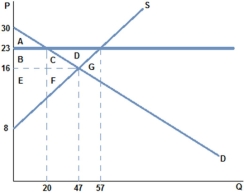 After a price floor of $23 is placed on the market in the graph shown, which area represents total surplus?
A) A
B) B + C + E + F
C) A + B + E
D) A + B + C + E + F
Question
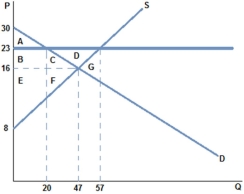 If a price floor of $23 were placed in the market in the graph shown, which area represents deadweight loss?
A) C + F
B) C + D + F
C) G
D) B + C + E + F
Question
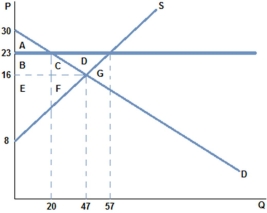 After a price floor of $23 is placed on the market in the graph shown, the total number of units traded:
A) falls by 20 relative to equilibrium.
B) falls by 27 relative to equilibrium.
C) falls by 37 relative to equilibrium.
D) increases by 10 relative to equilibrium.
Question

Unlock Deck
Sign up to unlock the cards in this deck!
Unlock Deck
Unlock Deck
1/154

Play

Full screen (f)
Deck 6: Government Intervention
1
Price controls:
A) are regulations that sets a maximum or minimum legal price for a particular good.
B) allow a market to reach equilibrium.
C) prevent a good from being bought or sold.
D) All of these are true.
A) are regulations that sets a maximum or minimum legal price for a particular good.
B) allow a market to reach equilibrium.
C) prevent a good from being bought or sold.
D) All of these are true.
are regulations that sets a maximum or minimum legal price for a particular good.
2
A type of public policy set in response to rising prices of a basic necessity, such as food, might be:
A) to make it illegal to charge higher prices for those goods.
B) to hire more producers of those goods.
C) to subsidize the price of those goods.
D) All of these are ways government can try to address rising prices of a basic necessity.
A) to make it illegal to charge higher prices for those goods.
B) to hire more producers of those goods.
C) to subsidize the price of those goods.
D) All of these are ways government can try to address rising prices of a basic necessity.
All of these are ways government can try to address rising prices of a basic necessity.
3
Governments may intervene in markets to:
A) increase the efficiency of the market.
B) reduce consumption certain products deemed "bad".
C) correct a market failure.
D) all of the above are reasons why governments intervene in market.
A) increase the efficiency of the market.
B) reduce consumption certain products deemed "bad".
C) correct a market failure.
D) all of the above are reasons why governments intervene in market.
all of the above are reasons why governments intervene in market.
4
Governments may attempt to protect dairy farmers from low milk prices by:
A) banning the hoarding of milk by households.
B) setting a minimum price on milk.
C) increasing taxes on dairy farmers.
D) reducing subsidies on the price of milk.
A) banning the hoarding of milk by households.
B) setting a minimum price on milk.
C) increasing taxes on dairy farmers.
D) reducing subsidies on the price of milk.
Unlock Deck
Unlock for access to all 154 flashcards in this deck.
Unlock Deck
k this deck
5
A price floor is:
A) a legal maximum price.
B) a legal minimum price.
C) a legal maximum quantity that can be sold at a particular price.
D) a legal minimum quantity that can be sold at a particular price.
A) a legal maximum price.
B) a legal minimum price.
C) a legal maximum quantity that can be sold at a particular price.
D) a legal minimum quantity that can be sold at a particular price.
Unlock Deck
Unlock for access to all 154 flashcards in this deck.
Unlock Deck
k this deck
6
If there is a sole producer of a good, and he faces no threat of competition, it is likely that:
A) government intervention will have no impact on the market.
B) government intervention will raise prices to consumers.
C) government intervention will increase total surplus.
D) government intervention will make things better for buyers and sellers.
A) government intervention will have no impact on the market.
B) government intervention will raise prices to consumers.
C) government intervention will increase total surplus.
D) government intervention will make things better for buyers and sellers.
Unlock Deck
Unlock for access to all 154 flashcards in this deck.
Unlock Deck
k this deck
7
If there is a sole producer of a good, and he faces no threat of competition, it is likely that:
A) the consumer surplus is greater than in a competitive equilibrium.
B) the price is set inefficiently high.
C) the price is set below the competitive equilibrium price.
D) the market is efficient.
A) the consumer surplus is greater than in a competitive equilibrium.
B) the price is set inefficiently high.
C) the price is set below the competitive equilibrium price.
D) the market is efficient.
Unlock Deck
Unlock for access to all 154 flashcards in this deck.
Unlock Deck
k this deck
8
A market failure is most likely to occur when:
A) a sole producer of a good faces no threat of competition.
B) several producers of a good compete for customers by having price wars.
C) several producers of a good search for the lowest-cost method of production.
D) many producers produce identical products, and only the consumers and producers are affected by the transactions.
A) a sole producer of a good faces no threat of competition.
B) several producers of a good compete for customers by having price wars.
C) several producers of a good search for the lowest-cost method of production.
D) many producers produce identical products, and only the consumers and producers are affected by the transactions.
Unlock Deck
Unlock for access to all 154 flashcards in this deck.
Unlock Deck
k this deck
9
Positive analysis:
A) is the best way to analyze a policy.
B) leads to the best solutions.
C) is the only way to analyze a policy.
D) examines if the policy actually accomplished its goals.
A) is the best way to analyze a policy.
B) leads to the best solutions.
C) is the only way to analyze a policy.
D) examines if the policy actually accomplished its goals.
Unlock Deck
Unlock for access to all 154 flashcards in this deck.
Unlock Deck
k this deck
10
Positive analysis:
A) involves the formulation and testing of hypotheses.
B) involves value judgments concerning the desirability of alternative outcomes.
C) weighs the fairness of a policy.
D) examines if the outcome is desirable.
A) involves the formulation and testing of hypotheses.
B) involves value judgments concerning the desirability of alternative outcomes.
C) weighs the fairness of a policy.
D) examines if the outcome is desirable.
Unlock Deck
Unlock for access to all 154 flashcards in this deck.
Unlock Deck
k this deck
11
Situations in which the assumption of efficient, competitive markets fails to hold are called:
A) market failures.
B) inelastic-response markets.
C) missing markets.
D) market interventions.
A) market failures.
B) inelastic-response markets.
C) missing markets.
D) market interventions.
Unlock Deck
Unlock for access to all 154 flashcards in this deck.
Unlock Deck
k this deck
12
Normative analysis:
A) involves the formulation and testing of hypotheses.
B) is a value-free evaluation of a policy.
C) is a matter of values and opinions.
D) examines if the policy actually accomplished its goal.
A) involves the formulation and testing of hypotheses.
B) is a value-free evaluation of a policy.
C) is a matter of values and opinions.
D) examines if the policy actually accomplished its goal.
Unlock Deck
Unlock for access to all 154 flashcards in this deck.
Unlock Deck
k this deck
13
Governments may choose to intervene in a market in an attempt to:
A) encourage the consumption of certain goods.
B) discourage the consumption of certain goods.
C) redistribute surplus.
D) All of these are true.
A) encourage the consumption of certain goods.
B) discourage the consumption of certain goods.
C) redistribute surplus.
D) All of these are true.
Unlock Deck
Unlock for access to all 154 flashcards in this deck.
Unlock Deck
k this deck
14
An example of a market failure is when:
A) one person's consumption of a good imposes costs on others
B) a firm selling a product faces competition from many other sellers.
C) a good is priced too high for poor families to afford.
D) the distribution of surplus is unfair.
A) one person's consumption of a good imposes costs on others
B) a firm selling a product faces competition from many other sellers.
C) a good is priced too high for poor families to afford.
D) the distribution of surplus is unfair.
Unlock Deck
Unlock for access to all 154 flashcards in this deck.
Unlock Deck
k this deck
15
In evaluating policy effectiveness, economists rely on:
A) positive analysis.
B) normative analysis.
C) both normative and positive analysis.
D) Economists can never fully analyze any real-world policy effectiveness.
A) positive analysis.
B) normative analysis.
C) both normative and positive analysis.
D) Economists can never fully analyze any real-world policy effectiveness.
Unlock Deck
Unlock for access to all 154 flashcards in this deck.
Unlock Deck
k this deck
16
Governments can discourage consumption of certain goods by:
A) a subsidy to consumers in those markets.
B) taxing substitute goods.
C) imposing a minimum price above the equilibrium price.
D) None of these policies decrease consumption of goods.
A) a subsidy to consumers in those markets.
B) taxing substitute goods.
C) imposing a minimum price above the equilibrium price.
D) None of these policies decrease consumption of goods.
Unlock Deck
Unlock for access to all 154 flashcards in this deck.
Unlock Deck
k this deck
17
A price ceiling is:
A) a legal maximum price.
B) a legal minimum price.
C) a legal maximum quantity that can be sold at a particular price.
D) a legal minimum quantity that can be sold at a particular price.
A) a legal maximum price.
B) a legal minimum price.
C) a legal maximum quantity that can be sold at a particular price.
D) a legal minimum quantity that can be sold at a particular price.
Unlock Deck
Unlock for access to all 154 flashcards in this deck.
Unlock Deck
k this deck
18
Government attempts to set prices below market equilibrium can:
A) lead to more producer surplus.
B) encourage more production.
C) reduce the total surplus in the market.
D) always create a better outcome.
A) lead to more producer surplus.
B) encourage more production.
C) reduce the total surplus in the market.
D) always create a better outcome.
Unlock Deck
Unlock for access to all 154 flashcards in this deck.
Unlock Deck
k this deck
19
The government imposing a minimum wage is an example of an attempt to:
A) correct a market failure.
B) redistribute surplus in a market.
C) encourage the consumption of inferior goods.
D) discourage the consumption of inferior goods.
A) correct a market failure.
B) redistribute surplus in a market.
C) encourage the consumption of inferior goods.
D) discourage the consumption of inferior goods.
Unlock Deck
Unlock for access to all 154 flashcards in this deck.
Unlock Deck
k this deck
20
Government attempts to lower, raise, or simply stabilize prices can:
A) shift the distribution of surplus.
B) create unintended side effects.
C) reduce efficiency of a market.
D) All of these are true.
A) shift the distribution of surplus.
B) create unintended side effects.
C) reduce efficiency of a market.
D) All of these are true.
Unlock Deck
Unlock for access to all 154 flashcards in this deck.
Unlock Deck
k this deck
21
If a binding price ceiling were placed in the market in the graph shown:A) quantity demanded would exceed quantity supplied.
B) quantity supplied would exceed quantity demanded.
C) the demand curve would have to shift.
D) the supply curve would have to shift.
Unlock Deck
Unlock for access to all 154 flashcards in this deck.
Unlock Deck
k this deck
22
A binding price floor:
A) will cause quantity demanded to exceed quantity supplied.
B) will cause quantity supplied to exceed quantity demanded.
C) will increase total well-being.
D) will set a legal maximum price in a market.
A) will cause quantity demanded to exceed quantity supplied.
B) will cause quantity supplied to exceed quantity demanded.
C) will increase total well-being.
D) will set a legal maximum price in a market.
Unlock Deck
Unlock for access to all 154 flashcards in this deck.
Unlock Deck
k this deck
23
After a price ceiling of $8 is placed on the market in the graph shown, which area represents consumer surplus?A) A + C
B) A + B
C) A + B + C
D) A + B + C + D + F + G
Unlock Deck
Unlock for access to all 154 flashcards in this deck.
Unlock Deck
k this deck
24
A price ceiling of $8 placed on the market in the graph shown:A) is non-binding, and does not affect the market.
B) is binding, and causes a shortage.
C) is binding, and causes a surplus.
D) is non-binding, and does not prevent the market from reaching equilibrium.
Unlock Deck
Unlock for access to all 154 flashcards in this deck.
Unlock Deck
k this deck
25
A price floor that is binding:
A) must be set above the equilibrium price, and will likely cause a shortage.
B) must be set below the equilibrium price, and will likely cause a shortage.
C) must be set above the equilibrium price, and will likely cause a surplus.
D) must be set below the equilibrium price, and will likely cause a surplus.
A) must be set above the equilibrium price, and will likely cause a shortage.
B) must be set below the equilibrium price, and will likely cause a shortage.
C) must be set above the equilibrium price, and will likely cause a surplus.
D) must be set below the equilibrium price, and will likely cause a surplus.
Unlock Deck
Unlock for access to all 154 flashcards in this deck.
Unlock Deck
k this deck
26
Governments tend to set price ceilings:
A) to ensure everyone can afford certain goods.
B) to ensure producers make enough for everyone.
C) to ensure producers make enough profit to stay in the industry.
D) to prevent consumers from choosing the wrong goods.
A) to ensure everyone can afford certain goods.
B) to ensure producers make enough for everyone.
C) to ensure producers make enough profit to stay in the industry.
D) to prevent consumers from choosing the wrong goods.
Unlock Deck
Unlock for access to all 154 flashcards in this deck.
Unlock Deck
k this deck
27
The graph shown best represents:A) a binding price ceiling.
B) a binding price floor.
C) a missing market.
D) a market for an inferior good.
Unlock Deck
Unlock for access to all 154 flashcards in this deck.
Unlock Deck
k this deck
28
If a price ceiling of $8 were placed in the market in the graph shown:A) a shortage of 7 would occur.
B) a shortage of 15 would occur.
C) a shortage of 23 would occur.
D) a shortage of 8 would occur.
Unlock Deck
Unlock for access to all 154 flashcards in this deck.
Unlock Deck
k this deck
29
If a price ceiling of $8 were placed on the market in the graph shown, which area represents the surplus that is transferred from producers to consumers?A) C + D + F + G
B) C + D
C) F + G
D) C
Unlock Deck
Unlock for access to all 154 flashcards in this deck.
Unlock Deck
k this deck
30
For a price ceiling to have an impact on a market it:
A) must be set above the equilibrium price.
B) must be set below the equilibrium price.
C) must be set at the equilibrium price.
D) can lead more goods to be produced in a market.
A) must be set above the equilibrium price.
B) must be set below the equilibrium price.
C) must be set at the equilibrium price.
D) can lead more goods to be produced in a market.
Unlock Deck
Unlock for access to all 154 flashcards in this deck.
Unlock Deck
k this deck
31
What could happen to render the price ceiling set in the graph shown non-binding?A) Demand could increase, and shift to the right.
B) Demand could decrease, and shift to the left.
C) Supply could decrease, and shift to the left.
D) None of these would cause the price ceiling to be non-binding.
Unlock Deck
Unlock for access to all 154 flashcards in this deck.
Unlock Deck
k this deck
32
If a price ceiling of $8 were placed in the market in the graph shown:A) some surplus is transferred from consumer to producer.
B) some surplus is transferred from producer to consumer.
C) all consumers are made better off.
D) all producers are made better off.
Unlock Deck
Unlock for access to all 154 flashcards in this deck.
Unlock Deck
k this deck
33
A binding price ceiling:
A) will cause quantity supplied to exceed quantity demanded.
B) will increase total well-being.
C) will set a legal minimum price in a market.
D) will cause quantity demanded to exceed quantity supplied.
A) will cause quantity supplied to exceed quantity demanded.
B) will increase total well-being.
C) will set a legal minimum price in a market.
D) will cause quantity demanded to exceed quantity supplied.
Unlock Deck
Unlock for access to all 154 flashcards in this deck.
Unlock Deck
k this deck
34
If a price ceiling of $8 were placed in the market in the graph shown, which area represents deadweight loss?A) F + G
B) B + D
C) E
D) B + D + F + G
Unlock Deck
Unlock for access to all 154 flashcards in this deck.
Unlock Deck
k this deck
35
After a price ceiling of $8 is placed on the market in the graph shown, which area represents producer surplus?A) C + D + E
B) C + D + F + G
C) E
D) A + C + E
Unlock Deck
Unlock for access to all 154 flashcards in this deck.
Unlock Deck
k this deck
36
In order for a price ceiling to "bind," it:
A) must be set above the equilibrium price, and will likely cause a shortage.
B) must be set below the equilibrium price, and will likely cause a shortage.
C) must be set above the equilibrium price, and will likely cause a surplus.
D) must be set below the equilibrium price, and will likely cause a surplus.
A) must be set above the equilibrium price, and will likely cause a shortage.
B) must be set below the equilibrium price, and will likely cause a shortage.
C) must be set above the equilibrium price, and will likely cause a surplus.
D) must be set below the equilibrium price, and will likely cause a surplus.
Unlock Deck
Unlock for access to all 154 flashcards in this deck.
Unlock Deck
k this deck
37
A price ceiling is non-binding when:
A) it is set above the equilibrium price.
B) it is set below the equilibrium price.
C) it reduces the output in a market.
D) it increases the output in a market.
A) it is set above the equilibrium price.
B) it is set below the equilibrium price.
C) it reduces the output in a market.
D) it increases the output in a market.
Unlock Deck
Unlock for access to all 154 flashcards in this deck.
Unlock Deck
k this deck
38
Which of the following changes to the market in the graph shown could cause the price ceiling to become non-binding?A) Demand could increase, and shift to the right.
B) Supply could increase, and shift to the left.
C) Supply could increase, and shift to the right.
D) Supply could decrease, and shift to the left.
Unlock Deck
Unlock for access to all 154 flashcards in this deck.
Unlock Deck
k this deck
39
If a price ceiling of $8 were placed in the market in the graph shown:A) an excess supply of 7 would occur.
B) an excess supply of 15 would occur.
C) an excess supply of 23 would occur.
D) None of these is true.
Unlock Deck
Unlock for access to all 154 flashcards in this deck.
Unlock Deck
k this deck
40
After a price ceiling of $8 is placed on the market in the graph shown, which area represents total surplus?A) A + B + C + D + E + F + G
B) A + B + C + D + E
C) A + C + E
D) A + B + C + D + E + F
Unlock Deck
Unlock for access to all 154 flashcards in this deck.
Unlock Deck
k this deck
41
The graph shown best represents:A) a non-binding price ceiling.
B) a non-binding price floor.
C) a missing market.
D) a market for an inferior good.
Unlock Deck
Unlock for access to all 154 flashcards in this deck.
Unlock Deck
k this deck
42
After a price ceiling of $8 is placed on the market in the graph shown, the total number of units traded:A) falls by 8 relative to equilibrium.
B) falls by 15 relative to equilibrium.
C) falls by 23 relative to equilibrium.
D) increases by 15 relative to equilibrium.
Unlock Deck
Unlock for access to all 154 flashcards in this deck.
Unlock Deck
k this deck
43
According to the graph above, a price ceiling in this market would be non-binding if it were set at:A) $5.
B) $8.
C) $10.
D) $13.
Unlock Deck
Unlock for access to all 154 flashcards in this deck.
Unlock Deck
k this deck
44
If a price floor of $23 were placed in the market in the graph shown:A) a shortage of 37 would occur.
B) a shortage of 10 would occur.
C) a shortage of 27 would occur.
D) None of these would occur.
Unlock Deck
Unlock for access to all 154 flashcards in this deck.
Unlock Deck
k this deck
45
The graph shown best represents:A) a non-binding price ceiling.
B) a non-binding price floor.
C) a missing market.
D) a market for an inferior good.
Unlock Deck
Unlock for access to all 154 flashcards in this deck.
Unlock Deck
k this deck
46
A binding price floor that could be set in the market in the graph shown would be:A) $23.
B) $16.
C) $8.
D) $12.
Unlock Deck
Unlock for access to all 154 flashcards in this deck.
Unlock Deck
k this deck
47
After a price ceiling of $8 is placed on the market in the graph shown:A) some consumers benefit because they pay a lower price.
B) producers lose because they sell at a lower price.
C) the quantity traded in the market falls.
D) All of these are true.
Unlock Deck
Unlock for access to all 154 flashcards in this deck.
Unlock Deck
k this deck
48
One way to allocate the scarce good created from an effective price ceiling is to:
A) offer it on a first-come, first-served basis.
B) ration a certain quantity per household.
C) give them to the friends and family of the producers.
D) All of these are examples of allocating using non-price methods.
A) offer it on a first-come, first-served basis.
B) ration a certain quantity per household.
C) give them to the friends and family of the producers.
D) All of these are examples of allocating using non-price methods.
Unlock Deck
Unlock for access to all 154 flashcards in this deck.
Unlock Deck
k this deck
49
The graph shown best represents:A) a binding price ceiling.
B) a binding price floor.
C) a missing market.
D) a market for an inferior good.
Unlock Deck
Unlock for access to all 154 flashcards in this deck.
Unlock Deck
k this deck
50
A prominent argument against the use of price ceilings is:
A) they are unfair.
B) they lead to a surplus and a waste of society's resources.
C) they lead to rent seeking.
D) they raise corporate profits.
A) they are unfair.
B) they lead to a surplus and a waste of society's resources.
C) they lead to rent seeking.
D) they raise corporate profits.
Unlock Deck
Unlock for access to all 154 flashcards in this deck.
Unlock Deck
k this deck
51
If a binding price floor were placed in the market in the graph shown:A) quantity demanded would exceed quantity supplied.
B) quantity supplied would exceed quantity demanded.
C) the demand curve would have to shift.
D) the supply curve would have to shift.
Unlock Deck
Unlock for access to all 154 flashcards in this deck.
Unlock Deck
k this deck
52
If a price floor of $23 were placed in the market in the graph shown:A) a surplus of 27 would occur.
B) a surplus of 37 would occur.
C) a surplus of 10 would occur.
D) a surplus of 20 would occur.
Unlock Deck
Unlock for access to all 154 flashcards in this deck.
Unlock Deck
k this deck
53
With reference to the graph above, if the intended aim of the price ceiling set at $6 was a net increase in the well-being of consumers, then positive analysis would consider:A) whether the surplus transferred from consumers to producers is larger than the consumer surplus lost to deadweight loss.
B) whether the producer surplus lost to deadweight loss is larger than the producer surplus gained from a higher price.
C) whether the surplus transferred from producers to consumers is larger than the consumer surplus lost to deadweight loss.
D) whether the producer surplus lost due to lower prices is larger than the producer surplus lost due to fewer transactions taking place.
Unlock Deck
Unlock for access to all 154 flashcards in this deck.
Unlock Deck
k this deck
54
Suppose the market supply is initially at S1 and a price ceiling is set at 8. If supply shifts from S1 to S2, thenA) The price ceiling will no longer bind.
B) The price ceiling will prevent output from changing.
C) The size of the shortage will increase.
D) The market will not reach equilibrium.
Unlock Deck
Unlock for access to all 154 flashcards in this deck.
Unlock Deck
k this deck
55
An unintended consequence of price ceilings is:
A) the loss of surplus always outweighs the benefits of the policy.
B) non-price rationing must occur, and can lead to bribes.
C) the transfer of surplus from producer to consumer rarely is recognized.
D) the producers increase the quality of the goods sold.
A) the loss of surplus always outweighs the benefits of the policy.
B) non-price rationing must occur, and can lead to bribes.
C) the transfer of surplus from producer to consumer rarely is recognized.
D) the producers increase the quality of the goods sold.
Unlock Deck
Unlock for access to all 154 flashcards in this deck.
Unlock Deck
k this deck
56
With reference to the graph above, if the intended aim of the price ceiling set at $6 was a net increase in the well-being of consumers:A) then the policy was effective since consumers gained in surplus overall.
B) then the policy was ineffective since consumers gained in surplus overall.
C) then the policy was ineffective since consumers lost surplus overall.
D) then the policy was effective since consumers lost surplus overall.
Unlock Deck
Unlock for access to all 154 flashcards in this deck.
Unlock Deck
k this deck
57
Because a price ceiling causes:
A) a shortage, some form of rationing must occur.
B) a surplus, some form of rationing must occur.
C) a shortage, the outcome will be efficient.
D) a surplus, the outcome will be inefficient.
A) a shortage, some form of rationing must occur.
B) a surplus, some form of rationing must occur.
C) a shortage, the outcome will be efficient.
D) a surplus, the outcome will be inefficient.
Unlock Deck
Unlock for access to all 154 flashcards in this deck.
Unlock Deck
k this deck
58
With reference to the graph above, if the intended aim of the price ceiling set at $6 was a net increase in the well-being of consumers, then positive analysis would conclude:A) the policy was effective, since surplus gained by consumers through lower prices is greater than the surplus they lost through deadweight loss.
B) the policy was ineffective, since surplus gained by consumers through lower prices is less than the surplus they lost through deadweight loss.
C) the policy was effective, since surplus lost by producers through lower prices is less than the surplus gained by consumers through lower prices.
D) the policy was ineffective, since the amount of deadweight loss is greater than the surplus gained by consumers from lower prices.
Unlock Deck
Unlock for access to all 154 flashcards in this deck.
Unlock Deck
k this deck
59
With reference to the graph above, if the intended aim of the price ceiling set at $6 was a net increase in the well-being of consumers, then normative analysis would conclude that:A) the policy was effective, since surplus gained by consumers through lower prices is less than the surplus they lost through deadweight loss.
B) the policy was ineffective, since surplus gained by consumers through lower prices is less than the surplus they lost through deadweight loss.
C) the policy was effective, since surplus lost by producers through lower prices is less than the surplus gained by consumers through lower prices.
D) there is no "right" conclusion to be reached (in a normative sense), since people have different opinions concerning what constitutes a better outcome.
Unlock Deck
Unlock for access to all 154 flashcards in this deck.
Unlock Deck
k this deck
60
A binding price ceiling that could be set in the market in the graph shown would be:A) $15.
B) $11.
C) $8.
D) $30.
Unlock Deck
Unlock for access to all 154 flashcards in this deck.
Unlock Deck
k this deck
61
Because a price floor causes:
A) a shortage, some form of rationing must occur.
B) a surplus, some producers may ultimately lose because they won't have enough customers.
C) a shortage, rent-seeking will occur.
D) a surplus, everyone will be better off.
A) a shortage, some form of rationing must occur.
B) a surplus, some producers may ultimately lose because they won't have enough customers.
C) a shortage, rent-seeking will occur.
D) a surplus, everyone will be better off.
Unlock Deck
Unlock for access to all 154 flashcards in this deck.
Unlock Deck
k this deck
62
After a price floor of $23 is placed on the market in the graph shown, which area represents producer surplus?A) B + C + D + F
B) B + E
C) B + C + D
D) B + C + E + F
Unlock Deck
Unlock for access to all 154 flashcards in this deck.
Unlock Deck
k this deck
63
A tax on sellers has what effect on a market?
A) Supply shifts vertically upward by the amount of the tax.
B) Demand shifts vertically downward by the amount of the tax.
C) Equilibrium price decreases and equilibrium quantity decreases.
D) Equilibrium price decreases and equilibrium quantity increases.
A) Supply shifts vertically upward by the amount of the tax.
B) Demand shifts vertically downward by the amount of the tax.
C) Equilibrium price decreases and equilibrium quantity decreases.
D) Equilibrium price decreases and equilibrium quantity increases.
Unlock Deck
Unlock for access to all 154 flashcards in this deck.
Unlock Deck
k this deck
64
If a price floor of $23 were placed on the market in the graph shown, which area represents the surplus that is transferred?A) B + C + D
B) B + C
C) C
D) B
Unlock Deck
Unlock for access to all 154 flashcards in this deck.
Unlock Deck
k this deck
65
Taxes:
A) may benefit many of the consumers in the market.
B) are sometimes used to correct market failures.
C) are sometimes used to transfer surplus from producers to consumers.
D) are sometimes used to transfer surplus from consumers to producers.
A) may benefit many of the consumers in the market.
B) are sometimes used to correct market failures.
C) are sometimes used to transfer surplus from producers to consumers.
D) are sometimes used to transfer surplus from consumers to producers.
Unlock Deck
Unlock for access to all 154 flashcards in this deck.
Unlock Deck
k this deck
66
After a price floor of $23 is placed on the market in the graph shown, which area represents consumer surplus?A) A
B) A + B
C) A + B + C
D) A + B + C + D
Unlock Deck
Unlock for access to all 154 flashcards in this deck.
Unlock Deck
k this deck
67
An argument against price floors is:
A) non-price rationing must occur, and can lead to consumers waiting in line.
B) the cost to taxpayers if the government buys all surplus.
C) producers will reduce the quality of the goods they sell.
D) they transfer surplus from producers to consumers.
A) non-price rationing must occur, and can lead to consumers waiting in line.
B) the cost to taxpayers if the government buys all surplus.
C) producers will reduce the quality of the goods they sell.
D) they transfer surplus from producers to consumers.
Unlock Deck
Unlock for access to all 154 flashcards in this deck.
Unlock Deck
k this deck
68
If the intended aim of the price floor set in the graph shown was a net increase in the well-being of producers, then normative analysis would conclude that:A) the policy was effective, since surplus gained by producers through higher prices is greater than the surplus they lost through deadweight loss.
B) the policy was ineffective, since surplus gained by producers through higher prices is greater than the surplus they lost through deadweight loss.
C) the policy was effective, since surplus gained by producers through higher prices is greater than the surplus lost by consumers through higher prices.
D) there is no "right" conclusion to be reached in a normative sense, since people have different opinions concerning what constitutes a better outcome.
Unlock Deck
Unlock for access to all 154 flashcards in this deck.
Unlock Deck
k this deck
69
After a price floor of $23 is placed on the market in the graph shown:A) some consumers lose because they pay a higher price.
B) some producers gain because they sell at a higher price.
C) the quantity traded in the market falls.
D) All of these are true.
Unlock Deck
Unlock for access to all 154 flashcards in this deck.
Unlock Deck
k this deck
70
One way to ensure all producers benefit from a price floor is to:
A) give a government guarantee to buy all surplus.
B) ration a certain quantity per consumer.
C) ration a certain quantity per producer .
D) All of these are examples of ensuring all producers benefit using non-price methods.
A) give a government guarantee to buy all surplus.
B) ration a certain quantity per consumer.
C) ration a certain quantity per producer .
D) All of these are examples of ensuring all producers benefit using non-price methods.
Unlock Deck
Unlock for access to all 154 flashcards in this deck.
Unlock Deck
k this deck
71
A tax imposed on a good can:
A) discourage consumption of the good.
B) encourage production of the good.
C) increase the supply of complementary goods.
D) prevent the market from reaching an efficient equilibrium.
A) discourage consumption of the good.
B) encourage production of the good.
C) increase the supply of complementary goods.
D) prevent the market from reaching an efficient equilibrium.
Unlock Deck
Unlock for access to all 154 flashcards in this deck.
Unlock Deck
k this deck
72
Which of the following changes to the market in the graph shown could cause the price floor to become non-binding?A) Demand could decrease, and shift to the left.
B) Supply could increase, and shift to the left.
C) Supply could increase, and shift to the right.
D) Supply could decrease, and shift to the left.
Unlock Deck
Unlock for access to all 154 flashcards in this deck.
Unlock Deck
k this deck
73
If a price floor of $23 were placed in the market in the graph shown:A) some surplus is transferred from consumer to producer.
B) some surplus is transferred from producer to consumer.
C) all producers are better off.
D) all consumers are better off.
Unlock Deck
Unlock for access to all 154 flashcards in this deck.
Unlock Deck
k this deck
74
A price floor of $23 placed on the market in the graph shown:A) is binding, and causes a shortage.
B) is non-binding, and does not affect the market.
C) is binding, and causes a surplus.
D) is non-binding, and does not prevent the market from reaching equilibrium.
Unlock Deck
Unlock for access to all 154 flashcards in this deck.
Unlock Deck
k this deck
75
If a non-binding price floor were to be set in the market in the graph shown, it could be set at:A) $30.
B) $23.
C) $16.
D) All of these would be binding price floors for this market.
Unlock Deck
Unlock for access to all 154 flashcards in this deck.
Unlock Deck
k this deck
76
If the intended aim of the price floor set in the graph shown was a net increase in the well-being of producers, then positive analysis would have us consider:A) whether the surplus transferred from producers to consumers is larger than the consumer surplus lost to deadweight loss.
B) whether the surplus transferred from consumers to producers is larger than the consumer surplus lost to deadweight loss.
C) whether the producer surplus lost to deadweight loss is greater than the producer surplus gained from a higher price.
D) whether the producer surplus lost due to lower prices is greater than the producer surplus lost due to fewer transactions taking place.
Unlock Deck
Unlock for access to all 154 flashcards in this deck.
Unlock Deck
k this deck
77
After a price floor of $23 is placed on the market in the graph shown, which area represents total surplus?A) A
B) B + C + E + F
C) A + B + E
D) A + B + C + E + F
Unlock Deck
Unlock for access to all 154 flashcards in this deck.
Unlock Deck
k this deck
78
If a price floor of $23 were placed in the market in the graph shown, which area represents deadweight loss?A) C + F
B) C + D + F
C) G
D) B + C + E + F
Unlock Deck
Unlock for access to all 154 flashcards in this deck.
Unlock Deck
k this deck
79
After a price floor of $23 is placed on the market in the graph shown, the total number of units traded:A) falls by 20 relative to equilibrium.
B) falls by 27 relative to equilibrium.
C) falls by 37 relative to equilibrium.
D) increases by 10 relative to equilibrium.
Unlock Deck
Unlock for access to all 154 flashcards in this deck.
Unlock Deck
k this deck
80
A tax on sellers:
A) shifts the supply curve left by the amount of the tax.
B) shifts the demand curve left by the amount of the tax.
C) shifts the supply curve up by the amount of the tax.
D) shifts the demand curve down by the amount of the tax.
A) shifts the supply curve left by the amount of the tax.
B) shifts the demand curve left by the amount of the tax.
C) shifts the supply curve up by the amount of the tax.
D) shifts the demand curve down by the amount of the tax.
Unlock Deck
Unlock for access to all 154 flashcards in this deck.
Unlock Deck
k this deck
Unlock Deck
Unlock for access to all 154 flashcards in this deck.






