







 Chat with AI

Deck 41: Hemorrhagic Coagulation Disorders
Full screen (f)

Question
In what is a patient with the following coagulation test results most likely deficient?

A) Fibrinogen
B) VII
C) VIII
D) X
A) Fibrinogen
B) VII
C) VIII
D) X

Question
Question
Question
Question
Question
Question
Question
Question
A 21-year-old woman has a primary complaint of menorrhagia. Her coagulation screen gives the following results. What disorder is most likely?
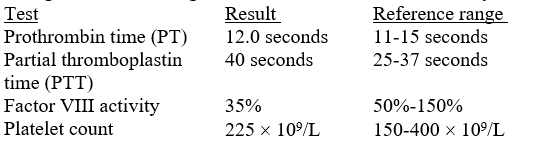
A) Hemophilia A
B) Hemophilia B
C) VWD, type 1
D) Factor X deficiency
A) Hemophilia A
B) Hemophilia B
C) VWD, type 1
D) Factor X deficiency
Question
Question
Question
Question
Question
Question
Question
Question
Question
Question
Question
Question
Question
Question
Question
Question
Question
A 67-year-old woman arrives at the emergency department with acute bleeding into the back of the throat. A coagulation screen is ordered with the following results:
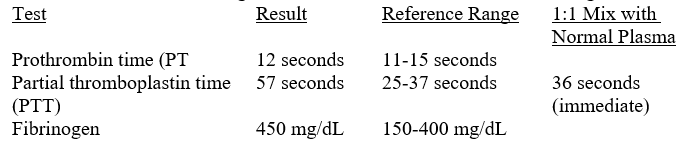
What would be a reasonable next step to perform?
A) Perform factor IX assay.
B) Perform factor VII assay.
C) Incubate the 1:1 mix at 37 C for 1 hour and then repeat the PTT.
D) Perform TT.
What would be a reasonable next step to perform?
A) Perform factor IX assay.
B) Perform factor VII assay.
C) Incubate the 1:1 mix at 37 C for 1 hour and then repeat the PTT.
D) Perform TT.
Question

Unlock Deck
Sign up to unlock the cards in this deck!
Unlock Deck
Unlock Deck
1/27

Play

Full screen (f)
Deck 41: Hemorrhagic Coagulation Disorders
1
In what is a patient with the following coagulation test results most likely deficient?
A) Fibrinogen
B) VII
C) VIII
D) X
A) Fibrinogen
B) VII
C) VIII
D) X
VII
2
Which of the following would be appropriate initial testing for the siblings in Question 1?
A) Fibrinogen, D-dimer, and platelet aggregation studies
B) Factor VIII assay, liver function tests, and vitamin K level
C) von Willebrand factor (VWF) antigen, Bethesda titer, and reptilase time
D) Prothrombin time (PT), partial thromboplastin time (PTT), and platelet count
A) Fibrinogen, D-dimer, and platelet aggregation studies
B) Factor VIII assay, liver function tests, and vitamin K level
C) von Willebrand factor (VWF) antigen, Bethesda titer, and reptilase time
D) Prothrombin time (PT), partial thromboplastin time (PTT), and platelet count
Prothrombin time (PT), partial thromboplastin time (PTT), and platelet count
3
Two children in the same family have recurrent, chronic bruising in multiple sites, repeated long-lasting epistaxis, and minor bleeding after dental work. Which type of disorder is most likely?
A) Localized, acquired, anatomic
B) Localized, congenital, anatomic
C) Generalized, congenital, systemic
D) Generalized, acquired, systemic
A) Localized, acquired, anatomic
B) Localized, congenital, anatomic
C) Generalized, congenital, systemic
D) Generalized, acquired, systemic
Generalized, congenital, systemic
4
The bleeding associated with renal disease is related most to defective:
A) Blood vessels
B) Plasma procoagulants
C) Platelets
D) Inhibitors
A) Blood vessels
B) Plasma procoagulants
C) Platelets
D) Inhibitors
Unlock Deck
Unlock for access to all 27 flashcards in this deck.
Unlock Deck
k this deck
5
Which of the following single-factor inherited deficiencies is most common as the cause for hemophilia?
A) Factor V
B) Factor VIII
C) Factor IX
D) Factor XI
A) Factor V
B) Factor VIII
C) Factor IX
D) Factor XI
Unlock Deck
Unlock for access to all 27 flashcards in this deck.
Unlock Deck
k this deck
6
Clot-based mixing studies and Bethesda titers are used to test for:
A) Vitamin K deficiency
B) Inhibitors (antibodies) against coagulation factors
C) DIC
D) Hemophilia
A) Vitamin K deficiency
B) Inhibitors (antibodies) against coagulation factors
C) DIC
D) Hemophilia
Unlock Deck
Unlock for access to all 27 flashcards in this deck.
Unlock Deck
k this deck
7
Which of the following tests is increased in a patient with severe hemophilia A?
A) PTT
B) Thrombin time (TT)
C) PT
D) Factor VIII assay
A) PTT
B) Thrombin time (TT)
C) PT
D) Factor VIII assay
Unlock Deck
Unlock for access to all 27 flashcards in this deck.
Unlock Deck
k this deck
8
What test is useful for detection of a female carrier of hemophilia A?
A) PTT
B) PT
C) Factor VIII to VWF ratio
D) VWF antigen test
A) PTT
B) PT
C) Factor VIII to VWF ratio
D) VWF antigen test
Unlock Deck
Unlock for access to all 27 flashcards in this deck.
Unlock Deck
k this deck
9
A 21-year-old woman has a primary complaint of menorrhagia. Her coagulation screen gives the following results. What disorder is most likely?
A) Hemophilia A
B) Hemophilia B
C) VWD, type 1
D) Factor X deficiency
A) Hemophilia A
B) Hemophilia B
C) VWD, type 1
D) Factor X deficiency
Unlock Deck
Unlock for access to all 27 flashcards in this deck.
Unlock Deck
k this deck
10
The urea solubility test is used to detect deficiencies in which factor?
A) Fibrinogen
B) Factor V
C) Factor XII
D) Factor XIII
A) Fibrinogen
B) Factor V
C) Factor XII
D) Factor XIII
Unlock Deck
Unlock for access to all 27 flashcards in this deck.
Unlock Deck
k this deck
11
What coagulation screening test is the most sensitive for detecting mild liver disease?
A) Fibrinogen
B) PTT
C) PT
D) TT
A) Fibrinogen
B) PTT
C) PT
D) TT
Unlock Deck
Unlock for access to all 27 flashcards in this deck.
Unlock Deck
k this deck
12
Which of the following is decreased in DIC?
A) Fibrinogen
B) PT
C) PTT
D) Fibrin degradation products
A) Fibrinogen
B) PT
C) PTT
D) Fibrin degradation products
Unlock Deck
Unlock for access to all 27 flashcards in this deck.
Unlock Deck
k this deck
13
What is the best test to distinguish hemophilia A from B or C?
A) Specific factor assays
B) PTT
C) TT
D) Bleeding time
A) Specific factor assays
B) PTT
C) TT
D) Bleeding time
Unlock Deck
Unlock for access to all 27 flashcards in this deck.
Unlock Deck
k this deck
14
Desmopressin acetate (DDAVP) is used to treat:
A) Dysfibrinogenemia
B) Warfarin overdose
C) Vitamin K deficiency
D) VWD, type 1
A) Dysfibrinogenemia
B) Warfarin overdose
C) Vitamin K deficiency
D) VWD, type 1
Unlock Deck
Unlock for access to all 27 flashcards in this deck.
Unlock Deck
k this deck
15
What is or are the possible mechanism (or mechanisms) for bleeding in patients with severe liver disease?
A) Thrombocytopenia
B) Inadequate production of procoagulants
C) Disseminated intravascular coagulation (DIC)
D) All of the above
A) Thrombocytopenia
B) Inadequate production of procoagulants
C) Disseminated intravascular coagulation (DIC)
D) All of the above
Unlock Deck
Unlock for access to all 27 flashcards in this deck.
Unlock Deck
k this deck
16
Which is the most common form of von Willebrand disease (VWD)?
A) Type 1
B) Type 2A
C) Type 3
D) Acquired
A) Type 1
B) Type 2A
C) Type 3
D) Acquired
Unlock Deck
Unlock for access to all 27 flashcards in this deck.
Unlock Deck
k this deck
17
What is the purest form of factor VIII that is available for treating a bleeding patient with hemophilia A?
A) Cryoprecipitate
B) Recombinant factor VIII concentrate
C) Fresh frozen plasma
D) Factor VIII concentrate prepared by chemical concentration
A) Cryoprecipitate
B) Recombinant factor VIII concentrate
C) Fresh frozen plasma
D) Factor VIII concentrate prepared by chemical concentration
Unlock Deck
Unlock for access to all 27 flashcards in this deck.
Unlock Deck
k this deck
18
Which patient group is most susceptible to bleeding because of a deficiency of vitamin K-dependent proteins?
A) Those with poor diets
B) Those on antibiotic agents
C) Pregnant women
D) Newborns
A) Those with poor diets
B) Those on antibiotic agents
C) Pregnant women
D) Newborns
Unlock Deck
Unlock for access to all 27 flashcards in this deck.
Unlock Deck
k this deck
19
What are the primary roles of VWF?
A) Mediates platelet adhesion and carrier molecule for factor VIII
B) Mediates platelet aggregation and carrier molecule for factor IX
C) Inhibits excess coagulation and activates protein C
D) Activates plasmin and enhances vitamin K factors
A) Mediates platelet adhesion and carrier molecule for factor VIII
B) Mediates platelet aggregation and carrier molecule for factor IX
C) Inhibits excess coagulation and activates protein C
D) Activates plasmin and enhances vitamin K factors
Unlock Deck
Unlock for access to all 27 flashcards in this deck.
Unlock Deck
k this deck
20
What is the typical clinical picture in patients with severe hemophilia A?
A) Generalized bleeding after trauma or dental work
B) Generalized hemorrhage
C) Major bruising on extremities and chronic nosebleeds
D) Serious anatomic bleeds into joints
A) Generalized bleeding after trauma or dental work
B) Generalized hemorrhage
C) Major bruising on extremities and chronic nosebleeds
D) Serious anatomic bleeds into joints
Unlock Deck
Unlock for access to all 27 flashcards in this deck.
Unlock Deck
k this deck
21
All of the following can mask a deficiency of VWF and thus of type 1 VWD except:
A) Type A blood group
B) Pregnancy
C) Acute stress
D) Type AB blood group
A) Type A blood group
B) Pregnancy
C) Acute stress
D) Type AB blood group
Unlock Deck
Unlock for access to all 27 flashcards in this deck.
Unlock Deck
k this deck
22
What procedure is used to quantitate a factor VIII inhibitor?
A) Bethesda assay
B) Reptilase time
C) Factor VIII concentration
D) VWF assay
A) Bethesda assay
B) Reptilase time
C) Factor VIII concentration
D) VWF assay
Unlock Deck
Unlock for access to all 27 flashcards in this deck.
Unlock Deck
k this deck
23
Which of the following screening tests would be normal when the plasma for the patient in Question 26 is analyzed?
A) PT
B) PTT
C) TT
D) All of the above
A) PT
B) PTT
C) TT
D) All of the above
Unlock Deck
Unlock for access to all 27 flashcards in this deck.
Unlock Deck
k this deck
24
Which of the following proteins is the best test to distinguish moderate to severe liver disease from vitamin K deficiency?
A) Factor V concentration
B) Factor VII concentration
C) Factor VIII concentration
D) Factor IX concentration
A) Factor V concentration
B) Factor VII concentration
C) Factor VIII concentration
D) Factor IX concentration
Unlock Deck
Unlock for access to all 27 flashcards in this deck.
Unlock Deck
k this deck
25
A 39-year-old male patient shows evidence of poor wound healing and a history of joint bleeding. What protein deficiency is most likely present?
A) Factor VIII
B) Factor IX
C) Factor V
D) Factor XIII
A) Factor VIII
B) Factor IX
C) Factor V
D) Factor XIII
Unlock Deck
Unlock for access to all 27 flashcards in this deck.
Unlock Deck
k this deck
26
A 67-year-old woman arrives at the emergency department with acute bleeding into the back of the throat. A coagulation screen is ordered with the following results:
What would be a reasonable next step to perform?
A) Perform factor IX assay.
B) Perform factor VII assay.
C) Incubate the 1:1 mix at 37 C for 1 hour and then repeat the PTT.
D) Perform TT.
What would be a reasonable next step to perform?
A) Perform factor IX assay.
B) Perform factor VII assay.
C) Incubate the 1:1 mix at 37 C for 1 hour and then repeat the PTT.
D) Perform TT.
Unlock Deck
Unlock for access to all 27 flashcards in this deck.
Unlock Deck
k this deck
27
Which type of VWD gives a positive response to low-dose ristocetin-induced platelet aggregation?
A) 1
B) 2A
C) 2B
D) 2N
A) 1
B) 2A
C) 2B
D) 2N
Unlock Deck
Unlock for access to all 27 flashcards in this deck.
Unlock Deck
k this deck
Unlock Deck
Unlock for access to all 27 flashcards in this deck.






