







 Chat with AI

Deck 38: Pediatric and Geriatric Hematology
Full screen (f)

Question

Question
Question
Question
Question
Question
Question
Question
Question
A Complete blood count (CBC) is requested on a full-term newborn girl, and the following results are obtained:
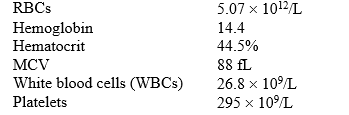
What conclusion can be made regarding these data for this infant?
A) All results are normal.
B) The white count is elevated.
C) Hemoglobin, hematocrit, and MCV are all decreased.
D) Red cell count, hemoglobin, and hematocrit are all normal, but MCV is decreased.
What conclusion can be made regarding these data for this infant?
A) All results are normal.
B) The white count is elevated.
C) Hemoglobin, hematocrit, and MCV are all decreased.
D) Red cell count, hemoglobin, and hematocrit are all normal, but MCV is decreased.
Question
Question
Question
Question
Question

Unlock Deck
Sign up to unlock the cards in this deck!
Unlock Deck
Unlock Deck
1/14

Play

Full screen (f)
Deck 38: Pediatric and Geriatric Hematology
1
At what age is it normal for bone marrow cellularity to be 80% to 90% (i.e., has very little fat)?
A) At birth
B) In an 8 year old
C) In a 20 to 40 year old
D) In those older than 70 years
A) At birth
B) In an 8 year old
C) In a 20 to 40 year old
D) In those older than 70 years
At birth
2
Why is the white count in a normal full-term newborn elevated shortly after birth?
A) A relative loss of plasma occurs.
B) An absolute increase in neutrophils occurs.
C) An absolute increase in lymphocytes occurs.
D) An absolute increase in both neutrophils and lymphocytes occurs.
A) A relative loss of plasma occurs.
B) An absolute increase in neutrophils occurs.
C) An absolute increase in lymphocytes occurs.
D) An absolute increase in both neutrophils and lymphocytes occurs.
An absolute increase in neutrophils occurs.
3
What is the most likely reason that the red blood cell (RBC) count remains elevated in a newborn for the first 2 weeks of life?
A) A relative loss of plasma occurs during the birth process.
B) A significantly longer RBC life span increases the number of red cells in circulation.
C) Partial anoxia exists in utero, and erythropoietin increases.
D) The switch from fetal to adult hemoglobin causes number of red cells to increase.
A) A relative loss of plasma occurs during the birth process.
B) A significantly longer RBC life span increases the number of red cells in circulation.
C) Partial anoxia exists in utero, and erythropoietin increases.
D) The switch from fetal to adult hemoglobin causes number of red cells to increase.
Partial anoxia exists in utero, and erythropoietin increases.
4
A normal 3-month-old boy has a hemoglobin of 11.2 g/dL. Which of the following is true about his hemoglobin? It is:
A) Higher than that of a normal full-term newborn
B) Lower than that of an adult of the same age
C) Higher than that of a 14 year old of the same sex
D) The same as that of an adult of the same sex
A) Higher than that of a normal full-term newborn
B) Lower than that of an adult of the same age
C) Higher than that of a 14 year old of the same sex
D) The same as that of an adult of the same sex
Unlock Deck
Unlock for access to all 14 flashcards in this deck.
Unlock Deck
k this deck
5
Iron deficiency anemia in older adults is most often a result of:
A) Poor nutritional intake of iron
B) Malabsorption of iron
C) Decreased ability to transport iron because of a decrease in transferrin
D) Bleeding in the gastrointestinal tract
A) Poor nutritional intake of iron
B) Malabsorption of iron
C) Decreased ability to transport iron because of a decrease in transferrin
D) Bleeding in the gastrointestinal tract
Unlock Deck
Unlock for access to all 14 flashcards in this deck.
Unlock Deck
k this deck
6
An 85-year-old woman has a hemoglobin of 10.5 g/dL. This is:
A) High for a woman of this age
B) Normal for this age regardless of sex (i.e., for both male and female patients)
C) A sign of an underlying disease and requires further evaluation
D) Most likely a myelophthisic anemia
A) High for a woman of this age
B) Normal for this age regardless of sex (i.e., for both male and female patients)
C) A sign of an underlying disease and requires further evaluation
D) Most likely a myelophthisic anemia
Unlock Deck
Unlock for access to all 14 flashcards in this deck.
Unlock Deck
k this deck
7
What is the normal bone marrow cellularity in the population older than 65 years?
A) 90%
B) 70%
C) 50%
D) 30%
A) 90%
B) 70%
C) 50%
D) 30%
Unlock Deck
Unlock for access to all 14 flashcards in this deck.
Unlock Deck
k this deck
8
Which of the following age groups normally has the lowest mean red cell values (red cell count, hemoglobin, hematocrit)?
A) Preterm premature
B) Full-term newborn
C) Normal 2-year-old child
D) Normal 30-year-old woman
A) Preterm premature
B) Full-term newborn
C) Normal 2-year-old child
D) Normal 30-year-old woman
Unlock Deck
Unlock for access to all 14 flashcards in this deck.
Unlock Deck
k this deck
9
A Complete blood count (CBC) is requested on a full-term newborn girl, and the following results are obtained:
What conclusion can be made regarding these data for this infant?
A) All results are normal.
B) The white count is elevated.
C) Hemoglobin, hematocrit, and MCV are all decreased.
D) Red cell count, hemoglobin, and hematocrit are all normal, but MCV is decreased.
What conclusion can be made regarding these data for this infant?
A) All results are normal.
B) The white count is elevated.
C) Hemoglobin, hematocrit, and MCV are all decreased.
D) Red cell count, hemoglobin, and hematocrit are all normal, but MCV is decreased.
Unlock Deck
Unlock for access to all 14 flashcards in this deck.
Unlock Deck
k this deck
10
Why is there a relative lymphocytosis in a 2 year old?
A) An absolute neutropenia occurs.
B) The absolute number of lymphocytes is increased as the immune system develops.
C) A greater proportion of neutrophils are marginated.
D) Fewer lymphocytes are marginated.
A) An absolute neutropenia occurs.
B) The absolute number of lymphocytes is increased as the immune system develops.
C) A greater proportion of neutrophils are marginated.
D) Fewer lymphocytes are marginated.
Unlock Deck
Unlock for access to all 14 flashcards in this deck.
Unlock Deck
k this deck
11
Which of the following is most commonly seen in the population older than70 years?
A) Chronic lymphocytic leukemia
B) Chronic myelogenous leukemia
C) Essential thrombocytosis
D) Acute lymphocytic leukemia
A) Chronic lymphocytic leukemia
B) Chronic myelogenous leukemia
C) Essential thrombocytosis
D) Acute lymphocytic leukemia
Unlock Deck
Unlock for access to all 14 flashcards in this deck.
Unlock Deck
k this deck
12
Which of the following is true concerning age-related changes of hemostasis in older adults?
A) Decreased factor VIII
B) Decreased platelet activity
C) Increased fibrinogen
D) Increased fibrinolysis
A) Decreased factor VIII
B) Decreased platelet activity
C) Increased fibrinogen
D) Increased fibrinolysis
Unlock Deck
Unlock for access to all 14 flashcards in this deck.
Unlock Deck
k this deck
13
All of the following are normal peripheral blood RBC findings at birth in a full-term infant except:
A) Nucleated RBCs
B) Mean cell volume (MCV) less than 90 fL
C) Reticulocytosis of 5%
D) Hemoglobin of 20.2 g/dL
A) Nucleated RBCs
B) Mean cell volume (MCV) less than 90 fL
C) Reticulocytosis of 5%
D) Hemoglobin of 20.2 g/dL
Unlock Deck
Unlock for access to all 14 flashcards in this deck.
Unlock Deck
k this deck
14
Which of the following is more likely to result from poor absorption rather than inadequate nutritional intake in older adults?
A) Folic acid deficiency
B) Iron deficiency
C) Vitamin B12 deficiency
D) Lead deficiency
A) Folic acid deficiency
B) Iron deficiency
C) Vitamin B12 deficiency
D) Lead deficiency
Unlock Deck
Unlock for access to all 14 flashcards in this deck.
Unlock Deck
k this deck
Unlock Deck
Unlock for access to all 14 flashcards in this deck.






