







 Chat with AI

Deck 55: Nursing Assessment of the Patient With Hematological Disorders
Full screen (f)

Question

Question
Question
Question
Question
Question
Question
Question
Question
Question
Question
Question
Question
Question
Question
A patient comes to the emergency department complaining of dyspnea. After analyzing these laboratory results, the nurse would conduct further assessment for which condition? 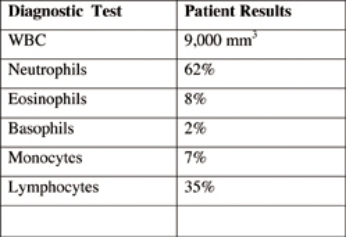
A) Pancytopenia
B) Chronic bacterial infection
C) A respiratory infection
D) A hypersensitivity response
A) Pancytopenia
B) Chronic bacterial infection
C) A respiratory infection
D) A hypersensitivity response
Question
Question
Question
Question
Question
Question
Question
Question
Question
Question
Question
Question
Question
Question
Question

Unlock Deck
Sign up to unlock the cards in this deck!
Unlock Deck
Unlock Deck
1/30

Play

Full screen (f)
Deck 55: Nursing Assessment of the Patient With Hematological Disorders
1
A patient's laboratory results reveal a low platelet count. The nurse would assess the patient for which skin finding?
A) Jaundice
B) Petechiae
C) A brown or dark tinge to the skin
D) A flushed appearance
A) Jaundice
B) Petechiae
C) A brown or dark tinge to the skin
D) A flushed appearance
Petechiae
2
A patient's white blood cell count is 11,000/mm3. The nurse evaluates this value as representing which component of the hematologic system?
A) The total number of circulating leukocytes
B) The total number of circulating neutrophils
C) The total number of circulating eosinophils
D) The total number of circulating basophils
A) The total number of circulating leukocytes
B) The total number of circulating neutrophils
C) The total number of circulating eosinophils
D) The total number of circulating basophils
The total number of circulating leukocytes
3
A patient's laboratory values indicate a "shift to the left." The nurse would anticipate further testing for which possible conditions? Note: Credit will be given only if all correct choices and no incorrect choices are selected.
Standard Text: Select all that apply.
A) Bone marrow disease
B) Undetected infection
C) Presence of foreign cells in the bone marrow
D) Immune system insufficiencies
E) Expected response to immunosuppressive therapies
Standard Text: Select all that apply.
A) Bone marrow disease
B) Undetected infection
C) Presence of foreign cells in the bone marrow
D) Immune system insufficiencies
E) Expected response to immunosuppressive therapies
Bone marrow disease
Undetected infection
Immune system insufficiencies
Expected response to immunosuppressive therapies
Undetected infection
Immune system insufficiencies
Expected response to immunosuppressive therapies
4
Which patient statements would the nurse document as part of the chief complaint? Note: Credit will be given only if all correct choices and no incorrect choices are selected.
Standard Text: Select all that apply.
A) "My father had sickle cell anemia."
B) "All I want to do is sleep. I am tired all the time."
C) "I get short of breath so easily."
D) "I lived in a city where there was a lot of pollution when I was a child."
E) "I can't seem to recover from the cold I had last month."
Standard Text: Select all that apply.
A) "My father had sickle cell anemia."
B) "All I want to do is sleep. I am tired all the time."
C) "I get short of breath so easily."
D) "I lived in a city where there was a lot of pollution when I was a child."
E) "I can't seem to recover from the cold I had last month."
Unlock Deck
Unlock for access to all 30 flashcards in this deck.
Unlock Deck
k this deck
5
The nurse is developing a series of presentations for a group of high school students interested in a career in health care. Which topics would the nurse consider for inclusion in a discussion of hematologic function? Note: Credit will be given only if all correct choices and no incorrect choices are selected.
Standard Text: Select all that apply.
A) The hematologic system is a transport system that functions to provide nutrients to the body.
B) The main component of the hematologic system is blood.
C) The hematologic system is a transport system that functions to remove toxins from the body.
D) The lymphatic and the reticuloendothelial/mononuclear phagocyte systems contribute to the functions of the hematologic system.
E) Blood is a type of epithelial tissue.
Standard Text: Select all that apply.
A) The hematologic system is a transport system that functions to provide nutrients to the body.
B) The main component of the hematologic system is blood.
C) The hematologic system is a transport system that functions to remove toxins from the body.
D) The lymphatic and the reticuloendothelial/mononuclear phagocyte systems contribute to the functions of the hematologic system.
E) Blood is a type of epithelial tissue.
Unlock Deck
Unlock for access to all 30 flashcards in this deck.
Unlock Deck
k this deck
6
What phrases would the nurse use to describe red blood cells? Note: Credit will be given only if all correct choices and no incorrect choices are selected.
Standard Text: Select all that apply.
A) Are formed from monoblasts
B) Maintain the chemical integrity of hemoglobin
C) Have a life span of approximately 90 days
D) Carry oxygen to tissues
E) Assume a rigid disk shape when filled with hemoglobin
Standard Text: Select all that apply.
A) Are formed from monoblasts
B) Maintain the chemical integrity of hemoglobin
C) Have a life span of approximately 90 days
D) Carry oxygen to tissues
E) Assume a rigid disk shape when filled with hemoglobin
Unlock Deck
Unlock for access to all 30 flashcards in this deck.
Unlock Deck
k this deck
7
The nurse asks specific questions about alcohol consumption when collecting data about a patient's hematologic system. What rationale would the nurse offer for these questions?
A) Excessive alcohol intake accelerates phagocytosis.
B) People who consume excessive amounts of alcohol often have vitamin deficiencies.
C) People who drink alcohol do not clot as well as those who do not.
D) Moderate alcohol consumption can help to accelerate erythrocyte formation.
A) Excessive alcohol intake accelerates phagocytosis.
B) People who consume excessive amounts of alcohol often have vitamin deficiencies.
C) People who drink alcohol do not clot as well as those who do not.
D) Moderate alcohol consumption can help to accelerate erythrocyte formation.
Unlock Deck
Unlock for access to all 30 flashcards in this deck.
Unlock Deck
k this deck
8
A patient is admitted to the unit with a high count of lymphocytes. The nurse knows that a greater number of which types of cells are present? Note: Credit will be given only if all correct choices and no incorrect choices are selected.
Standard Text: Select all that apply.
A) Thrombocytes
B) Natural killer cells NK cells)
C) Reticulocytes
D) T cells
E) B cells
Standard Text: Select all that apply.
A) Thrombocytes
B) Natural killer cells NK cells)
C) Reticulocytes
D) T cells
E) B cells
Unlock Deck
Unlock for access to all 30 flashcards in this deck.
Unlock Deck
k this deck
9
Physical examination related to the hematologic system of the adult patient should include inspection of which areas of the body? Note: Credit will be given only if all correct choices and no incorrect choices are selected.
Standard Text: Select all that apply.
A) Skin
B) Chest
C) Head and neck
D) Feet and leg musculature
E) Abdomen
Standard Text: Select all that apply.
A) Skin
B) Chest
C) Head and neck
D) Feet and leg musculature
E) Abdomen
Unlock Deck
Unlock for access to all 30 flashcards in this deck.
Unlock Deck
k this deck
10
Which statements would the nurse make when discussing age-related changes in the hematologic system? Note: Credit will be given only if all correct choices and no incorrect choices are selected.
Standard Text: Select all that apply.
A) "When you are past middle age, your hemoglobin levels will be slightly lower than when you were younger."
B) "You have less red marrow than when you were younger, but will still have this important component even into old age."
C) "As you continue to age, we will see big differences in your blood cell counts on lab tests."
D) "You may not respond to immunizations as well because of changes in your cells related to the immune response."
E) "It may take your body longer to return to the normal amount of blood cells if you are injured or get sick."
Standard Text: Select all that apply.
A) "When you are past middle age, your hemoglobin levels will be slightly lower than when you were younger."
B) "You have less red marrow than when you were younger, but will still have this important component even into old age."
C) "As you continue to age, we will see big differences in your blood cell counts on lab tests."
D) "You may not respond to immunizations as well because of changes in your cells related to the immune response."
E) "It may take your body longer to return to the normal amount of blood cells if you are injured or get sick."
Unlock Deck
Unlock for access to all 30 flashcards in this deck.
Unlock Deck
k this deck
11
The patient's laboratory testing reveals a decreased red blood cell count. The nurse anticipates further testing to determine if the patient has which disorder? Note: Credit will be given only if all correct choices and no incorrect choices are selected.
Standard Text: Select all that apply.
A) Polycythemia vera
B) Bleeding
C) Lack of hormone needed to produce leukocytes
D) Bone marrow suppression
E) Abnormal destruction of erythrocytes
Standard Text: Select all that apply.
A) Polycythemia vera
B) Bleeding
C) Lack of hormone needed to produce leukocytes
D) Bone marrow suppression
E) Abnormal destruction of erythrocytes
Unlock Deck
Unlock for access to all 30 flashcards in this deck.
Unlock Deck
k this deck
12
A patient's laboratory values indicate a "shift to the left." The nurse would expect changes in which cell count?
A) Platelets
B) White blood cell count
C) Erythrocytes
D) Absolute neutrophil count ANC)
A) Platelets
B) White blood cell count
C) Erythrocytes
D) Absolute neutrophil count ANC)
Unlock Deck
Unlock for access to all 30 flashcards in this deck.
Unlock Deck
k this deck
13
While reviewing the white blood cell count differential for a patient, the nurse notes that the basophil count is elevated. What does this laboratory value indicate to the nurse?
A) The patient is experiencing an acute hypersensitivity reaction.
B) The patient has a parasitic infection.
C) The patient is fighting chronic infection.
D) The patient is fighting cancer.
A) The patient is experiencing an acute hypersensitivity reaction.
B) The patient has a parasitic infection.
C) The patient is fighting chronic infection.
D) The patient is fighting cancer.
Unlock Deck
Unlock for access to all 30 flashcards in this deck.
Unlock Deck
k this deck
14
A patient with a family history of anemia is admitted to the unit. What type of blood cell would be characteristic of an anemia with a familial pattern?
A) Eosinophil
B) Sickle cell
C) Lymphocyte
D) Reticulocyte
A) Eosinophil
B) Sickle cell
C) Lymphocyte
D) Reticulocyte
Unlock Deck
Unlock for access to all 30 flashcards in this deck.
Unlock Deck
k this deck
15
A patient comes to the emergency department complaining of dyspnea. After analyzing these laboratory results, the nurse would conduct further assessment for which condition?
A) Pancytopenia
B) Chronic bacterial infection
C) A respiratory infection
D) A hypersensitivity response
A) Pancytopenia
B) Chronic bacterial infection
C) A respiratory infection
D) A hypersensitivity response
Unlock Deck
Unlock for access to all 30 flashcards in this deck.
Unlock Deck
k this deck
16
How would the nurse explain primary and secondary hemostasis to the parents of a child newly diagnosed with a platelet disorder? Note: Credit will be given only if all correct choices and no incorrect choices are selected.
Standard Text: Select all that apply.
A) "During primary hemostasis, the vessels around the injured area constrict to reduce blood loss."
B) "The clot that forms in the injured vessel becomes more stable during secondary hemostasis."
C) "Normally a soft plug or clot is formed early in primary hemostasis."
D) "Normally, the coagulation cascade is started in primary hemostasis."
E) "Platelets play a role in primary hemostasis."
Standard Text: Select all that apply.
A) "During primary hemostasis, the vessels around the injured area constrict to reduce blood loss."
B) "The clot that forms in the injured vessel becomes more stable during secondary hemostasis."
C) "Normally a soft plug or clot is formed early in primary hemostasis."
D) "Normally, the coagulation cascade is started in primary hemostasis."
E) "Platelets play a role in primary hemostasis."
Unlock Deck
Unlock for access to all 30 flashcards in this deck.
Unlock Deck
k this deck
17
A middle-aged couple has had their hemoglobin and hematocrit levels measured at a community health fair. How would the nurse explain the results of these tests?
A) Hemoglobin values vary between men and women, but hematocrit values do not.
B) Hemoglobin is the percentage of iron-carrying protein in a standard volume of blood, whereas hematocrit is an indicator of the amount of that protein in a red blood cell.
C) Normal hematocrit values are about 3 times the hemoglobin value.
D) Hemoglobin can change quickly due to dehydration.
A) Hemoglobin values vary between men and women, but hematocrit values do not.
B) Hemoglobin is the percentage of iron-carrying protein in a standard volume of blood, whereas hematocrit is an indicator of the amount of that protein in a red blood cell.
C) Normal hematocrit values are about 3 times the hemoglobin value.
D) Hemoglobin can change quickly due to dehydration.
Unlock Deck
Unlock for access to all 30 flashcards in this deck.
Unlock Deck
k this deck
18
When assessing an older adult for possible hematologic problems, the nurse should pay particular attention to which portions of the assessment? Note: Credit will be given only if all correct choices and no incorrect choices are selected.
Standard Text: Select all that apply.
A) General physical appearance
B) Laboratory parameters
C) Presence of risk factors
D) Presenting symptoms and chief complaint
E) History of bleeding problems
Standard Text: Select all that apply.
A) General physical appearance
B) Laboratory parameters
C) Presence of risk factors
D) Presenting symptoms and chief complaint
E) History of bleeding problems
Unlock Deck
Unlock for access to all 30 flashcards in this deck.
Unlock Deck
k this deck
19
The nurse would immediately collaborate with the health care provider if a patient experiences a "shift to the left" in laboratory values. What is the rationale for this collaboration?
A) This shift is an indicator of electrolyte imbalance.
B) This shift is an indicator of disruption of hemostasis.
C) This shift is an indicator of a potential bleeding problem.
D) This shift is an indicator of risk for a severe infection.
A) This shift is an indicator of electrolyte imbalance.
B) This shift is an indicator of disruption of hemostasis.
C) This shift is an indicator of a potential bleeding problem.
D) This shift is an indicator of risk for a severe infection.
Unlock Deck
Unlock for access to all 30 flashcards in this deck.
Unlock Deck
k this deck
20
A differential blood count has been ordered on a patient being admitted for surgery. How would the nurse explain the purpose of this test?
A) "This test will measure your clotting ability before you are taken to surgery."
B) "This test measures the total number of white blood cells."
C) "This test assesses whether you have responded to the blood transfusion you received last week."
D) "This test measures percentages of the different white blood cells to help us determine if you have an infection."
A) "This test will measure your clotting ability before you are taken to surgery."
B) "This test measures the total number of white blood cells."
C) "This test assesses whether you have responded to the blood transfusion you received last week."
D) "This test measures percentages of the different white blood cells to help us determine if you have an infection."
Unlock Deck
Unlock for access to all 30 flashcards in this deck.
Unlock Deck
k this deck
21
The patient is scheduled to have a mean corpuscular volume MCV), mean corpuscular hemoglobin MCH), and mean corpuscular hemoglobin concentration MCHC) drawn. How would the nurse explain the purpose of these tests?
A) "These tests will help us determine if you have cancer in your blood."
B) "We are testing to see if you have an infection."
C) "These tests will help us determine what kind of anemia you have."
D) "We are testing to see if you have anemia."
A) "These tests will help us determine if you have cancer in your blood."
B) "We are testing to see if you have an infection."
C) "These tests will help us determine what kind of anemia you have."
D) "We are testing to see if you have anemia."
Unlock Deck
Unlock for access to all 30 flashcards in this deck.
Unlock Deck
k this deck
22
A patient reports that she has decided to follow a vegetarian diet. The nurse would discuss methods of obtaining enough of which important element in the diet?
A) Calories
B) Iron
C) Fat
D) Protein
A) Calories
B) Iron
C) Fat
D) Protein
Unlock Deck
Unlock for access to all 30 flashcards in this deck.
Unlock Deck
k this deck
23
A patient is scheduled for a bone marrow aspiration. The nurse would reinforce which teaching about this procedure?
A) Bone marrow fluid will be drawn into a needle.
B) The sample will be taken from a vertebra in the neck.
C) Bone marrow fluid and a piece of bone will be collected.
D) The patient will receive general anesthesia for this procedure.
A) Bone marrow fluid will be drawn into a needle.
B) The sample will be taken from a vertebra in the neck.
C) Bone marrow fluid and a piece of bone will be collected.
D) The patient will receive general anesthesia for this procedure.
Unlock Deck
Unlock for access to all 30 flashcards in this deck.
Unlock Deck
k this deck
24
A patient diagnosed with sickle cell anemia is in severe pain. How would the nurse explain the etiology of this pain?
A) "You don't have enough red blood cells to carry oxygen to your tissues."
B) "You have infection in your blood because your white blood cells are not working correctly."
C) "Your red blood cells clog up the vessels and the tissues don't get oxygen."
D) "You have too many red cells, so your blood is too thick."
A) "You don't have enough red blood cells to carry oxygen to your tissues."
B) "You have infection in your blood because your white blood cells are not working correctly."
C) "Your red blood cells clog up the vessels and the tissues don't get oxygen."
D) "You have too many red cells, so your blood is too thick."
Unlock Deck
Unlock for access to all 30 flashcards in this deck.
Unlock Deck
k this deck
25
The nurse is reviewing laboratory results for a 45-year-old woman. Which result would the nurse immediately discuss with the health care provider?
A) Hemoglobin 10.8 g/dL
B) Mean corpuscular volume 89µm3
C) Mean corpuscular hemoglobin 30 pg
D) Total RBC 4,500,000 cells per cubic millimeter
A) Hemoglobin 10.8 g/dL
B) Mean corpuscular volume 89µm3
C) Mean corpuscular hemoglobin 30 pg
D) Total RBC 4,500,000 cells per cubic millimeter
Unlock Deck
Unlock for access to all 30 flashcards in this deck.
Unlock Deck
k this deck
26
A patient has just had a bone marrow biopsy taken from the iliac crest. What is the nurse's next action?
A) Apply a fluid collection device around the drain.
B) Cover the biopsy site with a bulky pressure dressing.
C) Plan to assess the patient regularly for pain and bleeding.
D) Have the patient ambulate to mobilize marrow replacement.
A) Apply a fluid collection device around the drain.
B) Cover the biopsy site with a bulky pressure dressing.
C) Plan to assess the patient regularly for pain and bleeding.
D) Have the patient ambulate to mobilize marrow replacement.
Unlock Deck
Unlock for access to all 30 flashcards in this deck.
Unlock Deck
k this deck
27
A patient's mean corpuscular volume MCV) is low. How would the nurse explain this finding to the patient?
A) "Your red blood cells do not have enough hemoglobin."
B) "Your red blood cells are not consistent in size."
C) "Your hematocrit is low."
D) "Your red blood cells are small."
A) "Your red blood cells do not have enough hemoglobin."
B) "Your red blood cells are not consistent in size."
C) "Your hematocrit is low."
D) "Your red blood cells are small."
Unlock Deck
Unlock for access to all 30 flashcards in this deck.
Unlock Deck
k this deck
28
Which chief complaint would the nurse evaluate as indicating the patient may have problems with erythrocyte levels?
A) "I have been running a low-grade fever for a week."
B) "I have bruises all over my body."
C) "I am sick all the time."
D) "I am so tired all the time."
A) "I have been running a low-grade fever for a week."
B) "I have bruises all over my body."
C) "I am sick all the time."
D) "I am so tired all the time."
Unlock Deck
Unlock for access to all 30 flashcards in this deck.
Unlock Deck
k this deck
29
A patient with a lung disease takes prophylactic antibiotics and tries to stay indoors during the winter. Today the patient reports bleeding more than normal after a minor injury. How would the nurse evaluate this report?
A) The antibiotic may be interfering with clotting times.
B) The patient is not getting enough vitamin D from sunlight.
C) The patient may be ingesting more vitamin K-containing food.
D) The patient's lung disease has affected the production of platelets.
A) The antibiotic may be interfering with clotting times.
B) The patient is not getting enough vitamin D from sunlight.
C) The patient may be ingesting more vitamin K-containing food.
D) The patient's lung disease has affected the production of platelets.
Unlock Deck
Unlock for access to all 30 flashcards in this deck.
Unlock Deck
k this deck
30
A patient is suspected of having pernicious anemia. Which area of the body would the nurse pay particular attention to during assessment?
A) Nose
B) Tongue
C) Hands
D) Feet
A) Nose
B) Tongue
C) Hands
D) Feet
Unlock Deck
Unlock for access to all 30 flashcards in this deck.
Unlock Deck
k this deck
Unlock Deck
Unlock for access to all 30 flashcards in this deck.






