







 Chat with AI

Deck 53: Caring for the Patient With Immune Response Disorders
Full screen (f)

Question

Question
Question
Question
Question
Question
Question
Question
Question
Question
Question
Question
Question
Question
Question
Question
Question
Question
Question
Question
Question
Question
Question
Question
Question
Question
Question
Question
Question
Which patient's findings would the nurse interpret as most consistent with a type II cytotoxic hypersensitivity reaction? 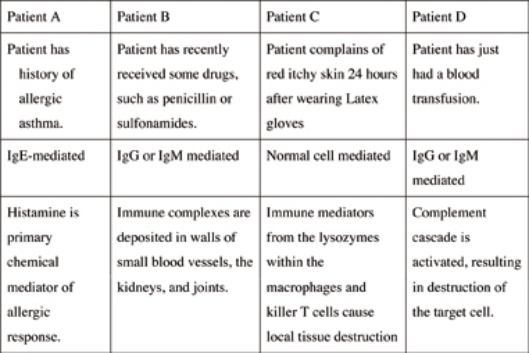
A) Patient A
B) Patient B
C) Patient C
D) Patient D
A) Patient A
B) Patient B
C) Patient C
D) Patient D
Question
Question
Question
Question
Question
Question

Unlock Deck
Sign up to unlock the cards in this deck!
Unlock Deck
Unlock Deck
1/35

Play

Full screen (f)
Deck 53: Caring for the Patient With Immune Response Disorders
1
A patient comes into the emergency department with itching, swelling, and slight shortness of breath after being stung by a bee 20 minutes ago. The nurse bases care of this patient on the pathophysiology of which hypersensitivity reaction?
A) Type I IgE-mediated hypersensitivity
B) Type II cytotoxic hypersensitivity
C) Type III immune complex-mediated hypersensitivity
D) Type IV delayed hypersensitivity
A) Type I IgE-mediated hypersensitivity
B) Type II cytotoxic hypersensitivity
C) Type III immune complex-mediated hypersensitivity
D) Type IV delayed hypersensitivity
Type I IgE-mediated hypersensitivity
2
The nurse is instructing a patient diagnosed with AIDS regarding food choices that will increase caloric intake. Which meal choice would indicate that the patient understands the dietary instruction?
A) Spaghetti and meat sauce, raisin salad, whole-grain roll with butter, vanilla milkshake with Ensure), and a piece of pecan pie
B) Baked chicken thigh), cabbage, small green salad, slice of white bread, dried prunes, and a soda
C) Red beans and rice, slaw, tomato, crackers, chocolate pudding, and iced tea
D) Vegetable soup, small piece of cornbread, banana pudding, and water
A) Spaghetti and meat sauce, raisin salad, whole-grain roll with butter, vanilla milkshake with Ensure), and a piece of pecan pie
B) Baked chicken thigh), cabbage, small green salad, slice of white bread, dried prunes, and a soda
C) Red beans and rice, slaw, tomato, crackers, chocolate pudding, and iced tea
D) Vegetable soup, small piece of cornbread, banana pudding, and water
Spaghetti and meat sauce, raisin salad, whole-grain roll with butter, vanilla milkshake with Ensure), and a piece of pecan pie
3
A patient with an autoimmune disorder tells the nurse, "My family keeps telling me I don't look sick." The nurse would choose which nursing diagnosis to help this patient?
A) Interrupted Family Processes
B) Ineffective Protection
C) Ineffective Coping
D) Social Isolation
A) Interrupted Family Processes
B) Ineffective Protection
C) Ineffective Coping
D) Social Isolation
Interrupted Family Processes
4
A patient is admitted to receive a kidney transplant from a live sibling. The nurse understands that which condition has been met for this surgery to be planned?
A) The human leukocyte antigens between the patient and sibling are very similar.
B) The human leukocyte antigens between the patient and sibling are very different.
C) The human leukocyte antigens of patient and sibling are an exact match.
D) The recipient's human leukocyte antigens have been eliminated.
A) The human leukocyte antigens between the patient and sibling are very similar.
B) The human leukocyte antigens between the patient and sibling are very different.
C) The human leukocyte antigens of patient and sibling are an exact match.
D) The recipient's human leukocyte antigens have been eliminated.
Unlock Deck
Unlock for access to all 35 flashcards in this deck.
Unlock Deck
k this deck
5
A patient is demonstrating signs of anaphylactic shock. Which action should the nurse take first to assist this patient?
A) Administer subcutaneous epinephrine.
B) Maintain an airway.
C) Provide calm reassurance.
D) Place the patient on a cardiac monitor.
A) Administer subcutaneous epinephrine.
B) Maintain an airway.
C) Provide calm reassurance.
D) Place the patient on a cardiac monitor.
Unlock Deck
Unlock for access to all 35 flashcards in this deck.
Unlock Deck
k this deck
6
Which statement by a patient who has HIV would the nurse evaluate as indicating additional health care teaching is necessary?
A) "I will use an oil-based lubricant when I use condoms."
B) "I know I should not donate blood anymore."
C) "I know I have to assume responsibility when I have sex."
D) "I will not share my toothbrush or razor with my partner."
A) "I will use an oil-based lubricant when I use condoms."
B) "I know I should not donate blood anymore."
C) "I know I have to assume responsibility when I have sex."
D) "I will not share my toothbrush or razor with my partner."
Unlock Deck
Unlock for access to all 35 flashcards in this deck.
Unlock Deck
k this deck
7
A patient with a history of latex allergy has developed itching and hives after being admitted for a fractured left femur. What initial nursing action is indicated?
A) Survey the patient's room for possible latex-containing items.
B) Ask if the patient is experiencing any difficulty breathing.
C) Alert the patient's health care provider concerning the symptoms.
D) Collect a detailed history from the patient regarding the allergy.
A) Survey the patient's room for possible latex-containing items.
B) Ask if the patient is experiencing any difficulty breathing.
C) Alert the patient's health care provider concerning the symptoms.
D) Collect a detailed history from the patient regarding the allergy.
Unlock Deck
Unlock for access to all 35 flashcards in this deck.
Unlock Deck
k this deck
8
A patient is experiencing symptoms of exposure to environmental ragweed. The nurse should instruct the patient on the use of which class of medications?
A) Antihistamines
B) Antibiotics
C) Antiviral medications
D) Antifungal medications
A) Antihistamines
B) Antibiotics
C) Antiviral medications
D) Antifungal medications
Unlock Deck
Unlock for access to all 35 flashcards in this deck.
Unlock Deck
k this deck
9
A patient is diagnosed with valvular heart disease after having strep throat. The nurse would explain that this condition is the result of which pathophysiology?
A) Molecular mimicry
B) Release of hidden antigens into the circulation
C) Biologic changes that caused self-antigens to produce autoantibodies
D) An autoimmune response by slow-growing mycobacteria
A) Molecular mimicry
B) Release of hidden antigens into the circulation
C) Biologic changes that caused self-antigens to produce autoantibodies
D) An autoimmune response by slow-growing mycobacteria
Unlock Deck
Unlock for access to all 35 flashcards in this deck.
Unlock Deck
k this deck
10
A patient develops a fever, rash, joint and muscle pain, and swollen lymph nodes after receiving a sulfonamide for a urinary tract infection UTI). The nurse anticipates providing care for which condition?
A) Serum sickness
B) Worsening of the infection
C) Respiratory involvement from systemic release of pathogens
D) Subacute rheumatoid arthritis from increased serum uric acid
A) Serum sickness
B) Worsening of the infection
C) Respiratory involvement from systemic release of pathogens
D) Subacute rheumatoid arthritis from increased serum uric acid
Unlock Deck
Unlock for access to all 35 flashcards in this deck.
Unlock Deck
k this deck
11
The nurse is performing an admission assessment on a patient with AIDS. Which question would best evaluate the patient's risk of contracting an opportunistic infection?
A) "What were the results of your last CD4 and T cells test?"
B) "Have you had any fever, diarrhea, or chills over the last 48 hours?"
C) "Can you identify the signs and symptoms of a possible infection?"
D) "Are you sexually active with persons who also have AIDS?"
A) "What were the results of your last CD4 and T cells test?"
B) "Have you had any fever, diarrhea, or chills over the last 48 hours?"
C) "Can you identify the signs and symptoms of a possible infection?"
D) "Are you sexually active with persons who also have AIDS?"
Unlock Deck
Unlock for access to all 35 flashcards in this deck.
Unlock Deck
k this deck
12
An HIV-positive patient comes into the clinic complaining of increasing pain in the feet and legs. The nurse realizes that this patient is demonstrating which complication?
A) A reaction to the medication
B) An opportunistic infection
C) A secondary cancer
D) A nervous system manifestation of the disease
A) A reaction to the medication
B) An opportunistic infection
C) A secondary cancer
D) A nervous system manifestation of the disease
Unlock Deck
Unlock for access to all 35 flashcards in this deck.
Unlock Deck
k this deck
13
A patient diagnosed with AIDS has developed oral candidiasis. The home health nurse would agree with which actions by the family to help manage this opportunistic infection? Note: Credit will be given only if all correct choices and no incorrect choices are selected.
Standard Text: Select all that apply.
A) Offer to quit smoking with the patient.
B) Plan meals that avoid salty, spicy, acidic, or abrasive foods.
C) Allow the patient's foods to cool prior to serving.
D) Assist the patient with oral care three times a day.
E) Provide the patient with a variety of favorite beverages.
Standard Text: Select all that apply.
A) Offer to quit smoking with the patient.
B) Plan meals that avoid salty, spicy, acidic, or abrasive foods.
C) Allow the patient's foods to cool prior to serving.
D) Assist the patient with oral care three times a day.
E) Provide the patient with a variety of favorite beverages.
Unlock Deck
Unlock for access to all 35 flashcards in this deck.
Unlock Deck
k this deck
14
A patient is diagnosed with a type IV delayed hypersensitivity reaction. Which patient reaction is an example of this type of reaction?
A) The patient's hands are dry, red, swollen, and itchy after wearing a latex costume to a party 2 days ago.
B) The patient is light-headed and complains of nausea after being stung by a wasp.
C) The patient develops rash and joint pain a week after taking penicillin.
D) The patient goes into shock after receiving a unit of blood.
A) The patient's hands are dry, red, swollen, and itchy after wearing a latex costume to a party 2 days ago.
B) The patient is light-headed and complains of nausea after being stung by a wasp.
C) The patient develops rash and joint pain a week after taking penicillin.
D) The patient goes into shock after receiving a unit of blood.
Unlock Deck
Unlock for access to all 35 flashcards in this deck.
Unlock Deck
k this deck
15
A patient who had a bone marrow transplant 10 days ago develops a maculopapular rash on the palms of both hands and the soles of the feet. The patient complains of severe abdominal pain with bloody diarrhea. The nurse would anticipate providing care for which condition?
A) Graft-versus-host disease
B) Chronic graft rejection
C) Acute tissue rejection
D) Hyperacute tissue rejection
A) Graft-versus-host disease
B) Chronic graft rejection
C) Acute tissue rejection
D) Hyperacute tissue rejection
Unlock Deck
Unlock for access to all 35 flashcards in this deck.
Unlock Deck
k this deck
16
A patient who is immunosuppressed asks the nurse why she is experiencing so many illnesses. How should the nurse respond?
A) "You are unable to develop immunity to common bacteria, so you will experience more illnesses."
B) "Your body takes longer to develop an immune response."
C) "Your body thinks everything is foreign matter and responds with an illness."
D) "You are under severe stress, which is causing the illnesses."
A) "You are unable to develop immunity to common bacteria, so you will experience more illnesses."
B) "Your body takes longer to develop an immune response."
C) "Your body thinks everything is foreign matter and responds with an illness."
D) "You are under severe stress, which is causing the illnesses."
Unlock Deck
Unlock for access to all 35 flashcards in this deck.
Unlock Deck
k this deck
17
A patient is suspected of having an allergic reaction to certain laundry detergents. The nurse recognizes that which diagnostic test result would best confirm a hypersensitivity reaction?
A) Rh antigen with negative results
B) Eosinophils of 2% of the total WBC
C) Prick test with 3 mm erythema
D) Indirect Coombs' showing no agglutination
A) Rh antigen with negative results
B) Eosinophils of 2% of the total WBC
C) Prick test with 3 mm erythema
D) Indirect Coombs' showing no agglutination
Unlock Deck
Unlock for access to all 35 flashcards in this deck.
Unlock Deck
k this deck
18
The nurse is providing discharge education for a patient who experienced an anaphylactic reaction to a bee sting. To ensure that the patient receives prompt, appropriate medical care in the event of another bee sting, the nurse encourages which actions? Note: Credit will be given only if all correct choices and no incorrect choices are selected.
Standard Text: Select all that apply.
A) Carry oral antihistamines at all times.
B) Be aware of how quickly the symptoms occur and exacerbate.
C) Always have quick access to an epinephrine pen.
D) Wear a medical alert bracelet that identifies allergy to bee venom.
E) Be able to identify early symptoms of allergic reaction.
Standard Text: Select all that apply.
A) Carry oral antihistamines at all times.
B) Be aware of how quickly the symptoms occur and exacerbate.
C) Always have quick access to an epinephrine pen.
D) Wear a medical alert bracelet that identifies allergy to bee venom.
E) Be able to identify early symptoms of allergic reaction.
Unlock Deck
Unlock for access to all 35 flashcards in this deck.
Unlock Deck
k this deck
19
A patient diagnosed with AIDS complains of nausea, fever, severe diarrhea, and anorexia. Which medication would be the most effective to relieve the anorexia and to stimulate the patient's appetite?
A) Megestrol Megace)
B) Ciprofloxacin Cipro)
C) Zidovudine Retrovir, AZT)
D) Abacavir Ziagen)
A) Megestrol Megace)
B) Ciprofloxacin Cipro)
C) Zidovudine Retrovir, AZT)
D) Abacavir Ziagen)
Unlock Deck
Unlock for access to all 35 flashcards in this deck.
Unlock Deck
k this deck
20
A patient who believes he has a peanut allergy presents at the emergency department concerned because he has ingested a small amount of commercially prepared food that may have contained peanut oil. Which nursing question best addresses the patient's risk for injury?
A) "Did you self-administer epinephrine?"
B) "What makes you think you are allergic to peanuts?"
C) "Have you every undergone testing for a peanut allergy?"
D) "Have you ever experienced an allergic reaction to peanuts before?"
A) "Did you self-administer epinephrine?"
B) "What makes you think you are allergic to peanuts?"
C) "Have you every undergone testing for a peanut allergy?"
D) "Have you ever experienced an allergic reaction to peanuts before?"
Unlock Deck
Unlock for access to all 35 flashcards in this deck.
Unlock Deck
k this deck
21
A patient diagnosed with HIV/AIDS has developed pneumonia and is bedbound. Which nursing interventions should be planned? Note: Credit will be given only if all correct choices and no incorrect choices are selected.
Standard Text: Select all that apply.
A) Maintain fluid intake of 3 liters daily unless contraindicated.
B) Suction the oral cavity, but avoid tracheal suctioning.
C) Elevate the head of the patient's bed at least 30 degrees.
D) Turn the patient every 2 hours.
E) Provide for periods of uninterrupted rest.
Standard Text: Select all that apply.
A) Maintain fluid intake of 3 liters daily unless contraindicated.
B) Suction the oral cavity, but avoid tracheal suctioning.
C) Elevate the head of the patient's bed at least 30 degrees.
D) Turn the patient every 2 hours.
E) Provide for periods of uninterrupted rest.
Unlock Deck
Unlock for access to all 35 flashcards in this deck.
Unlock Deck
k this deck
22
A patient who is HIV positive comes to the clinic with concerns about a new skin lesion. Which assessment findings would the nurse evaluate as indicating possible Kaposi's sarcoma? Note: Credit will be given only if all correct choices and no incorrect choices are selected.
Standard Text: Select all that apply.
A) The lesion turns a whitish color when pressure is applied.
B) The lesion is flat.
C) The lesion is a purple-brown color.
D) The lesion is the size of a quarter.
E) The lesion is raised.
Standard Text: Select all that apply.
A) The lesion turns a whitish color when pressure is applied.
B) The lesion is flat.
C) The lesion is a purple-brown color.
D) The lesion is the size of a quarter.
E) The lesion is raised.
Unlock Deck
Unlock for access to all 35 flashcards in this deck.
Unlock Deck
k this deck
23
When considering guidelines for teaching about safer sex, how would the nurse rank the risk for HIV transmission from highest to lowest? Standard Text: Click and drag the options below to move them up or down.
Choice
A) Heterosexual intercourse between partners using latex condoms Choice
B) Abstinence Choice
C) Monogamous sex between partners who are both EIA and Western Blot negative Choice
D) Anal intercourse between partners using latex condoms
Choice
A) Heterosexual intercourse between partners using latex condoms Choice
B) Abstinence Choice
C) Monogamous sex between partners who are both EIA and Western Blot negative Choice
D) Anal intercourse between partners using latex condoms
Unlock Deck
Unlock for access to all 35 flashcards in this deck.
Unlock Deck
k this deck
24
A patient with HIV/AIDS has had diarrhea for 7 days. The nurse would evaluate that dietary teaching regarding diarrhea has been effective when the patient selects which foods for breakfast? Note: Credit will be given only if all correct choices and no incorrect choices are selected.
Standard Text: Select all that apply.
A) Coffee with cream but no sugar
B) Sliced bananas and cream of rice cereal
C) Applesauce and dry toast
D) Eggs scrambled with cheese and ham
E) Banana nut bread and cream cheese
Standard Text: Select all that apply.
A) Coffee with cream but no sugar
B) Sliced bananas and cream of rice cereal
C) Applesauce and dry toast
D) Eggs scrambled with cheese and ham
E) Banana nut bread and cream cheese
Unlock Deck
Unlock for access to all 35 flashcards in this deck.
Unlock Deck
k this deck
25
A home health nurse is preparing to visit a patient who is bedbound after complications from HIV/AIDS. A review of the medical record reveals a new prescription for thalidomide. What conclusion can the nurse draw from this information?
A) The patient has developed severe wasting syndrome.
B) The patient has developed a candidiasis infection of the oral mucosa.
C) The patient's antiretroviral medications have been effective, resulting in the use of a less toxic medication.
D) The patient's pneumonia has worsened, so a stronger antibiotic has been prescribed.
A) The patient has developed severe wasting syndrome.
B) The patient has developed a candidiasis infection of the oral mucosa.
C) The patient's antiretroviral medications have been effective, resulting in the use of a less toxic medication.
D) The patient's pneumonia has worsened, so a stronger antibiotic has been prescribed.
Unlock Deck
Unlock for access to all 35 flashcards in this deck.
Unlock Deck
k this deck
26
An HIV-positive patient is not adhering to the prescribed medication therapy. Which action by the nurse would be most effective at improving patient compliance and the long-term treatment of the disease process?
A) Confront the patient about the noncompliant behavior.
B) Talk with the patient about not adhering to the medication schedule.
C) Remind the patient that not following the recommended regimen may result in earlier death.
D) Warn the patient that if the treatment plan is not followed, reimbursement for services is not assured.
A) Confront the patient about the noncompliant behavior.
B) Talk with the patient about not adhering to the medication schedule.
C) Remind the patient that not following the recommended regimen may result in earlier death.
D) Warn the patient that if the treatment plan is not followed, reimbursement for services is not assured.
Unlock Deck
Unlock for access to all 35 flashcards in this deck.
Unlock Deck
k this deck
27
A patient with HIV/AIDS is assigned the nursing diagnosis Impaired Oral Mucous Membranes. Which nursing interventions are indicated?
A) Have the patient rinse out the mouth with an antiseptic mouthwash after each meal.
B) Encourage the patient to suck on ice chips for pain relief.
C) Have the patient use a firm toothbrush to clean the teeth, tongue, and insides of the cheeks at least twice daily.
D) Encourage the patient to chew gum.
A) Have the patient rinse out the mouth with an antiseptic mouthwash after each meal.
B) Encourage the patient to suck on ice chips for pain relief.
C) Have the patient use a firm toothbrush to clean the teeth, tongue, and insides of the cheeks at least twice daily.
D) Encourage the patient to chew gum.
Unlock Deck
Unlock for access to all 35 flashcards in this deck.
Unlock Deck
k this deck
28
A patient diagnosed with HIV/AIDS weighed 180 pounds when diagnosed. The patient has had intermittent fever, diarrhea, and anorexia for the last 30 days. The nurse would be concerned that HIV wasting is occurring if the patient has lost more than _______ pounds.
Unlock Deck
Unlock for access to all 35 flashcards in this deck.
Unlock Deck
k this deck
29
Which patient's findings would the nurse interpret as most consistent with a type II cytotoxic hypersensitivity reaction?
A) Patient A
B) Patient B
C) Patient C
D) Patient D
A) Patient A
B) Patient B
C) Patient C
D) Patient D
Unlock Deck
Unlock for access to all 35 flashcards in this deck.
Unlock Deck
k this deck
30
A patient who is HIV positive comes to the clinic for a routine assessment. Which statement by the patient would the nurse evaluate as indicating a potential lack of adherence to the medication schedule? Note: Credit will be given only if all correct choices and no incorrect choices are selected.
Standard Text: Select all that apply.
A) "These medications are so expensive and my insurance doesn't pay very well."
B) "One of the newer medications I am taking is a combination of two that I took previously."
C) "One of the medications I am taking makes me nauseous."
D) "I take so many pills at so many different times of the day."
E) "Sometimes I feel I just cannot cope a single second longer."
Standard Text: Select all that apply.
A) "These medications are so expensive and my insurance doesn't pay very well."
B) "One of the newer medications I am taking is a combination of two that I took previously."
C) "One of the medications I am taking makes me nauseous."
D) "I take so many pills at so many different times of the day."
E) "Sometimes I feel I just cannot cope a single second longer."
Unlock Deck
Unlock for access to all 35 flashcards in this deck.
Unlock Deck
k this deck
31
A patient presents to the emergency department after sustaining a minor laceration. The patient tells the staff that he may be HIV positive, "but I don't know for certain." Which information should the nurse provide? Note: Credit will be given only if all correct choices and no incorrect choices are selected.
Standard Text: Select all that apply.
A) "You must go to the state health department to be tested."
B) "We can do a test here if you like."
C) "There is a test available that will quickly give us an idea of your HIV status."
D) "If the results of the test we do are positive, additional testing will be necessary."
E) "It will take at least 5 days for test results to return."
Standard Text: Select all that apply.
A) "You must go to the state health department to be tested."
B) "We can do a test here if you like."
C) "There is a test available that will quickly give us an idea of your HIV status."
D) "If the results of the test we do are positive, additional testing will be necessary."
E) "It will take at least 5 days for test results to return."
Unlock Deck
Unlock for access to all 35 flashcards in this deck.
Unlock Deck
k this deck
32
A patient has given permission for an enzyme immunoassay EIA) test for HIV. Which information should the nurse provide? Note: Credit will be given only if all correct choices and no incorrect choices are selected.
Standard Text: Select all that apply.
A) "You will need to return to the clinic in 3 days to discuss the results of this test."
B) "I will send you the results in the mail."
C) "If the test is positive, we will immediately set up an appointment for you to receive medications to treat the HIV."
D) "A Western blot test may also be necessary."
E) "If the test is negative, it will be repeated."
Standard Text: Select all that apply.
A) "You will need to return to the clinic in 3 days to discuss the results of this test."
B) "I will send you the results in the mail."
C) "If the test is positive, we will immediately set up an appointment for you to receive medications to treat the HIV."
D) "A Western blot test may also be necessary."
E) "If the test is negative, it will be repeated."
Unlock Deck
Unlock for access to all 35 flashcards in this deck.
Unlock Deck
k this deck
33
The nurse is preparing to instruct a class of young adults about ways to perform safe sex. What should be included in the nurse's presentation? Note: Credit will be given only if all correct choices and no incorrect choices are selected.
Standard Text: Select all that apply.
A) Use spermicidal agents to lubricate the condom.
B) Get HIV testing if entering a new monogamous relationship and have the test repeated in 6 months.
C) Avoid sexual activity until both partners are HIV negative for two tests.
D) Use a condom along with oral contraceptives.
E) Avoid using water-based lubricants.
Standard Text: Select all that apply.
A) Use spermicidal agents to lubricate the condom.
B) Get HIV testing if entering a new monogamous relationship and have the test repeated in 6 months.
C) Avoid sexual activity until both partners are HIV negative for two tests.
D) Use a condom along with oral contraceptives.
E) Avoid using water-based lubricants.
Unlock Deck
Unlock for access to all 35 flashcards in this deck.
Unlock Deck
k this deck
34
A patient who tested positive for HIV is started on antiretroviral medication. Which outcome would the nurse evaluate as indicating that the goals of this therapy are being met? Note: Credit will be given only if all correct choices and no incorrect choices are selected.
Standard Text: Select all that apply.
A) The patient's HIV RNA level has dropped from 100,000 copies/mL to 45,000 copies/mL.
B) The patient's CD4 + T-cell count is 150 cells/mL.
C) The patient has not developed an opportunistic infection.
D) The patient's viral load reveals that the disease is cured.
E) The patient has lost 10 pounds.
Standard Text: Select all that apply.
A) The patient's HIV RNA level has dropped from 100,000 copies/mL to 45,000 copies/mL.
B) The patient's CD4 + T-cell count is 150 cells/mL.
C) The patient has not developed an opportunistic infection.
D) The patient's viral load reveals that the disease is cured.
E) The patient has lost 10 pounds.
Unlock Deck
Unlock for access to all 35 flashcards in this deck.
Unlock Deck
k this deck
35
A patient had no skin reaction to a purified protein derivative PPD) screen. When discussing this result, the patient tells the nurse that she is HIV positive. What information should the nurse provide? Note: Credit will be given only if all correct choices and no incorrect choices are selected.
Standard Text: Select all that apply.
A) "As this is the first PPD you have ever had, you should have it repeated in 2 weeks."
B) "You have not contracted TB."
C) "Your skin test may not be valid."
D) "You should have a chest X-ray."
E) "Additional laboratory tests are indicated."
Standard Text: Select all that apply.
A) "As this is the first PPD you have ever had, you should have it repeated in 2 weeks."
B) "You have not contracted TB."
C) "Your skin test may not be valid."
D) "You should have a chest X-ray."
E) "Additional laboratory tests are indicated."
Unlock Deck
Unlock for access to all 35 flashcards in this deck.
Unlock Deck
k this deck
Unlock Deck
Unlock for access to all 35 flashcards in this deck.






