







 Chat with AI

Deck 27: Caring for the Patient With Lower Airway Disorders
Full screen (f)

Question

Question
Question
Question
The nurse is reviewing the results of a patient's diagnostic tests. Based on the chart, which physician order would the nurse 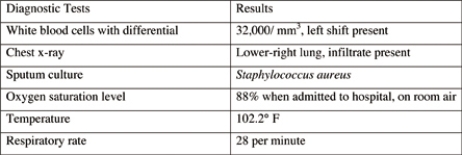
A) Fluid restriction of 1,500 mL per 24 hours
B) Up in chair as tolerated
C) Perform endotracheal suctioning as needed.
D) Administer azithromycin.
A) Fluid restriction of 1,500 mL per 24 hours
B) Up in chair as tolerated
C) Perform endotracheal suctioning as needed.
D) Administer azithromycin.
Question
Question
Question
Question
Question
Question
Question
Question
Question
Question
Question
Question
Question
Question
Question
Question
Question
Question
Question
Question
Question
Question
Question
Question
Question
Question
Question
Question
Question
Question
Question

Unlock Deck
Sign up to unlock the cards in this deck!
Unlock Deck
Unlock Deck
1/35

Play

Full screen (f)
Deck 27: Caring for the Patient With Lower Airway Disorders
1
A patient who is diagnosed with community-acquired pneumonia tells the nurse, "I don't feel too sick." How should the nurse respond?
A) "Give it a few days and you will."
B) "You're lucky."
C) "You may not need all the medications you have been prescribed."
D) "Even though you don't feel too ill, you should get additional rest."
A) "Give it a few days and you will."
B) "You're lucky."
C) "You may not need all the medications you have been prescribed."
D) "Even though you don't feel too ill, you should get additional rest."
"Even though you don't feel too ill, you should get additional rest."
2
A young child has been diagnosed with pneumonia and has been prescribed erythromycin, 45 mg per day for every 1 kilogram of body weight. The patient weighs 46 pounds. The physician asks that the patient receive the medication in three equal doses throughout the day. The patient should receive _____ mg per dose round the answer to a whole number).
314
3
A patient diagnosed with active tuberculosis is in a negative pressure room for respiratory airborne isolation. How long should the nurse maintain the patient in this type of isolation?
A) Until three consecutive sputum specimens for acid fast bacilli are negative
B) Until the Mantoux test PPD) converts from positive to negative
C) Until the patient has orders for discharge
D) Until the chest X-ray is normal
A) Until three consecutive sputum specimens for acid fast bacilli are negative
B) Until the Mantoux test PPD) converts from positive to negative
C) Until the patient has orders for discharge
D) Until the chest X-ray is normal
Until three consecutive sputum specimens for acid fast bacilli are negative
4
The nurse is reviewing the results of a patient's diagnostic tests. Based on the chart, which physician order would the nurse
A) Fluid restriction of 1,500 mL per 24 hours
B) Up in chair as tolerated
C) Perform endotracheal suctioning as needed.
D) Administer azithromycin.
A) Fluid restriction of 1,500 mL per 24 hours
B) Up in chair as tolerated
C) Perform endotracheal suctioning as needed.
D) Administer azithromycin.
Unlock Deck
Unlock for access to all 35 flashcards in this deck.
Unlock Deck
k this deck
5
A patient is diagnosed with histoplasmosis. Which elements of this patient's history would help explain the reason for the disease?
A) Lives in a city with chemical plants
B) Drives a vehicle that uses diesel fuel
C) Is an electrical engineer
D) Works part-time for a poultry farm
A) Lives in a city with chemical plants
B) Drives a vehicle that uses diesel fuel
C) Is an electrical engineer
D) Works part-time for a poultry farm
Unlock Deck
Unlock for access to all 35 flashcards in this deck.
Unlock Deck
k this deck
6
A patient tells the nurse she had the bacilli Calmette-Guérin BCG) vaccination as a child because her mother had tuberculosis. How will this patient be screened for tuberculosis?
A) Two-step Mantoux test
B) PPD test
C) Sputum tests
D) Chest X-ray
A) Two-step Mantoux test
B) PPD test
C) Sputum tests
D) Chest X-ray
Unlock Deck
Unlock for access to all 35 flashcards in this deck.
Unlock Deck
k this deck
7
A patient diagnosed with chronic bronchitis has the nursing diagnosis Ineffective Airway Clearance related to inadequate cough and excess mucus production. Which intervention would the nurse evaluate as being of the least value in addressing the nursing diagnosis?
A) Check the pulse oximetry reading.
B) Increase fluid intake up to 2 liters/day.
C) Suction the patient.
D) Provide chest physiotherapy.
A) Check the pulse oximetry reading.
B) Increase fluid intake up to 2 liters/day.
C) Suction the patient.
D) Provide chest physiotherapy.
Unlock Deck
Unlock for access to all 35 flashcards in this deck.
Unlock Deck
k this deck
8
A patient who had a Mantoux test for tuberculosis 2 days ago has a 2 mm area of erythema at the site of the test. How should the nurse evaluate this result?
A) As negative
B) As positive for tuberculosis
C) As indicating a sputum test for acid-fast bacilli is needed
D) As indicating need for a repeat PPD
A) As negative
B) As positive for tuberculosis
C) As indicating a sputum test for acid-fast bacilli is needed
D) As indicating need for a repeat PPD
Unlock Deck
Unlock for access to all 35 flashcards in this deck.
Unlock Deck
k this deck
9
The patient has a history of interstitial lung disease. Which assessment finding in today's examination would the nurse attribute to a different pathology?
A) New-onset chest pain
B) Increasing shortness of breath
C) Clubbing of the fingers
D) Hemoptysis
A) New-onset chest pain
B) Increasing shortness of breath
C) Clubbing of the fingers
D) Hemoptysis
Unlock Deck
Unlock for access to all 35 flashcards in this deck.
Unlock Deck
k this deck
10
The nurse, caring for a patient diagnosed with lung cancer, determines that the patient might be experiencing superior vena cava syndrome when which finding is assessed?
A) Face and neck swelling
B) Hourly urine outputs 250 to 500 mL
C) Calcium level of 14.0 mg/dL
D) Flat jugular veins
A) Face and neck swelling
B) Hourly urine outputs 250 to 500 mL
C) Calcium level of 14.0 mg/dL
D) Flat jugular veins
Unlock Deck
Unlock for access to all 35 flashcards in this deck.
Unlock Deck
k this deck
11
A patient diagnosed with tuberculosis is prescribed ethambutol Myambutol). Which nursing statement is indicated?
A) "Are you allergic to eggs?"
B) "Before starting this medication, you must have a baseline eye examination."
C) "You will need an influenza vaccine before starting this medication."
D) "Before you start this medication, we must schedule a baseline ECG electrocardiogram)."
A) "Are you allergic to eggs?"
B) "Before starting this medication, you must have a baseline eye examination."
C) "You will need an influenza vaccine before starting this medication."
D) "Before you start this medication, we must schedule a baseline ECG electrocardiogram)."
Unlock Deck
Unlock for access to all 35 flashcards in this deck.
Unlock Deck
k this deck
12
A patient with a lung abscess is being discharged from the hospital. Appropriate discharge instructions for this patient should include which information?
A) Complete the entire prescription of antibiotics.
B) Expect symptoms to become worse.
C) Return to routine activities of daily living.
D) Lung abscesses rarely cause other problems once treatment is started.
A) Complete the entire prescription of antibiotics.
B) Expect symptoms to become worse.
C) Return to routine activities of daily living.
D) Lung abscesses rarely cause other problems once treatment is started.
Unlock Deck
Unlock for access to all 35 flashcards in this deck.
Unlock Deck
k this deck
13
A patient states, "I've been sick for days and all the doctor does is take a chest X-ray, hand me prescriptions, and tell me I have bronchitis." How should the nurse respond?
A) "Your treatment is appropriate for the diagnosis."
B) "You should have had more diagnostic tests."
C) "The treatment you are receiving is inadequate for the diagnosis of bronchitis."
D) "You should probably be hospitalized."
A) "Your treatment is appropriate for the diagnosis."
B) "You should have had more diagnostic tests."
C) "The treatment you are receiving is inadequate for the diagnosis of bronchitis."
D) "You should probably be hospitalized."
Unlock Deck
Unlock for access to all 35 flashcards in this deck.
Unlock Deck
k this deck
14
A patient with chronic obstructive pulmonary disease COPD) tells the nurse that he does not always wear the prescribed oxygen at home because it is cumbersome and he is rarely short of breath. What is the nurse's best response to this patient?
A) "Wearing the oxygen will help keep your blood oxygen saturation levels up so your heart does not have to work as hard and will not become enlarged."
B) "You really should wear it at least while sleeping."
C) "You do seem to be doing fine without it."
D) "Keep the oxygen at home and if you become short of breath, you know to put it on until you are able to breathe normally again."
A) "Wearing the oxygen will help keep your blood oxygen saturation levels up so your heart does not have to work as hard and will not become enlarged."
B) "You really should wear it at least while sleeping."
C) "You do seem to be doing fine without it."
D) "Keep the oxygen at home and if you become short of breath, you know to put it on until you are able to breathe normally again."
Unlock Deck
Unlock for access to all 35 flashcards in this deck.
Unlock Deck
k this deck
15
Which patients would the nurse identify as being at risk for developing cor pulmonale? Note: Credit will be given only if all correct choices and no incorrect choices are selected.
Standard Text: Select all that apply.
A) Patient with left ventricular heart failure
B) Patient experiencing a massive pulmonary embolism
C) Patient with chronic obstructive pulmonary disease COPD)
D) Patient with sickle cell anemia
E) Patient with deep vein thrombosis
Standard Text: Select all that apply.
A) Patient with left ventricular heart failure
B) Patient experiencing a massive pulmonary embolism
C) Patient with chronic obstructive pulmonary disease COPD)
D) Patient with sickle cell anemia
E) Patient with deep vein thrombosis
Unlock Deck
Unlock for access to all 35 flashcards in this deck.
Unlock Deck
k this deck
16
A patient has been prescribed isoniazid INH) and rifampin for the treatment of tuberculosis. The nurse should instruct the patient to report which physical changes associated with this therapy? Note: Credit will be given only if all correct choices and no incorrect choices are selected.
Standard Text: Select all that apply.
A) Fever
B) Yellow tint to the skin
C) Discoloration of tears
D) Visual disturbances
E) Loss of appetite
Standard Text: Select all that apply.
A) Fever
B) Yellow tint to the skin
C) Discoloration of tears
D) Visual disturbances
E) Loss of appetite
Unlock Deck
Unlock for access to all 35 flashcards in this deck.
Unlock Deck
k this deck
17
Which statements would indicate that a patient diagnosed with asthma needs additional teaching at discharge? Note: Credit will be given only if all correct choices and no incorrect choices are selected.
Standard Text: Select all that apply.
A) "I know I shouldn't smoke, but one or two cigarettes a day shouldn't be harmful."
B) "I should monitor my peak flow daily and record it in a diary."
C) "I should rinse my mouth after each use of my corticosteroid inhaler."
D) "Using a spacer with my inhaler will allow for better and more accurate medication delivery."
E) "I should plan to have pulmonary function tests done every 5 years."
Standard Text: Select all that apply.
A) "I know I shouldn't smoke, but one or two cigarettes a day shouldn't be harmful."
B) "I should monitor my peak flow daily and record it in a diary."
C) "I should rinse my mouth after each use of my corticosteroid inhaler."
D) "Using a spacer with my inhaler will allow for better and more accurate medication delivery."
E) "I should plan to have pulmonary function tests done every 5 years."
Unlock Deck
Unlock for access to all 35 flashcards in this deck.
Unlock Deck
k this deck
18
A patient has been diagnosed with a restrictive lung disease. Which assessment finding would the nurse expect?
A) Cough that the patient describes as occasional for the last 2 weeks
B) Bradycardia
C) Patient report of increased shortness of breath when walking
D) Clear lung sounds
A) Cough that the patient describes as occasional for the last 2 weeks
B) Bradycardia
C) Patient report of increased shortness of breath when walking
D) Clear lung sounds
Unlock Deck
Unlock for access to all 35 flashcards in this deck.
Unlock Deck
k this deck
19
The newly licensed nurse is learning how to care for patients who have had thoracic surgery following a diagnosis of lung cancer. Which statement by the nurse would the preceptor evaluate as indicating the need for additional teaching? Standard Text: Select all that apply.
A) "I should assess the patient's respiratory system at least every 4 hours."
B) "I shouldn't offer pain medications to this patient because it will result in severe respiratory depression."
C) "If there are items that the patient needs frequently, I should keep them across the hospital room. This will ensure that the patient will get better faster."
D) "I will talk with the physical therapist about a plan for the patient's activity."
E) "I should teach my patient how to splint the incision."
A) "I should assess the patient's respiratory system at least every 4 hours."
B) "I shouldn't offer pain medications to this patient because it will result in severe respiratory depression."
C) "If there are items that the patient needs frequently, I should keep them across the hospital room. This will ensure that the patient will get better faster."
D) "I will talk with the physical therapist about a plan for the patient's activity."
E) "I should teach my patient how to splint the incision."
Unlock Deck
Unlock for access to all 35 flashcards in this deck.
Unlock Deck
k this deck
20
The nurse is providing care to a patient with atypical tuberculosis. What should the nurse do to ensure personal protection while caring for this patient?
A) Wear a gown and eye goggles.
B) Wear a gown and surgical mask.
C) Follow the same standard precautions used in the care of all patients.
D) Wear a HEPA respirator.
A) Wear a gown and eye goggles.
B) Wear a gown and surgical mask.
C) Follow the same standard precautions used in the care of all patients.
D) Wear a HEPA respirator.
Unlock Deck
Unlock for access to all 35 flashcards in this deck.
Unlock Deck
k this deck
21
The nurse would anticipate alpha-1 antitrypsin ATT) levels to be drawn on all patients ______ years of age or younger who demonstrate assessment findings of chronic obstructive pulmonary disease.
Unlock Deck
Unlock for access to all 35 flashcards in this deck.
Unlock Deck
k this deck
22
A patient diagnosed with a femur fracture is experiencing sudden dyspnea, pleuritic chest pain, syncope with movement, cyanosis, tachycardia, and tachypnea. What should be the nurse's first action?
A) Raise the head of the bed HOB).
B) Administer oxygen per nasal cannula for the cyanosis and dyspnea.
C) Provide reassurance and keep the patient calm by staying with the patient.
D) Evaluate urinary output to assess cardiac output.
A) Raise the head of the bed HOB).
B) Administer oxygen per nasal cannula for the cyanosis and dyspnea.
C) Provide reassurance and keep the patient calm by staying with the patient.
D) Evaluate urinary output to assess cardiac output.
Unlock Deck
Unlock for access to all 35 flashcards in this deck.
Unlock Deck
k this deck
23
During pulmonary function tests, a patient with asthma is found to have approximately 500 mL of air moving in and out of the lungs during normal, quiet breathing. How would the nurse document this result?
A) Tidal volume
B) Expiratory reserve volume
C) Residual volume
D) Vital capacity
A) Tidal volume
B) Expiratory reserve volume
C) Residual volume
D) Vital capacity
Unlock Deck
Unlock for access to all 35 flashcards in this deck.
Unlock Deck
k this deck
24
When preparing a patient for a pulmonary function test, which instruction should the nurse provide?
A) "Expect to be sedated for the test."
B) "Antinausea medication will be provided prior to the test."
C) "You will wear a nose clip during the test."
D) "You will be given oxygen for a while after the test."
A) "Expect to be sedated for the test."
B) "Antinausea medication will be provided prior to the test."
C) "You will wear a nose clip during the test."
D) "You will be given oxygen for a while after the test."
Unlock Deck
Unlock for access to all 35 flashcards in this deck.
Unlock Deck
k this deck
25
A patient presents with findings suggestive of pulmonary embolism. The D-dimer test is negative. How does the nurse interpret this finding?
A) The patient has a pulmonary embolism.
B) Additional testing is necessary, but a pulmonary embolism is unlikely.
C) There is 4% likelihood that the test is incorrect.
D) The test should be repeated in 48 hours.
A) The patient has a pulmonary embolism.
B) Additional testing is necessary, but a pulmonary embolism is unlikely.
C) There is 4% likelihood that the test is incorrect.
D) The test should be repeated in 48 hours.
Unlock Deck
Unlock for access to all 35 flashcards in this deck.
Unlock Deck
k this deck
26
Which assessment findings would indicate the need for immediate action by the nurse caring for a patient with asthma? Note: Credit will be given only if all correct choices and no incorrect choices are selected.
Standard Text: Select all that apply.
A) Tachycardia
B) Diffuse wheezing
C) Retractions
D) Inaudible breath sounds
E) Reduced wheezing
Standard Text: Select all that apply.
A) Tachycardia
B) Diffuse wheezing
C) Retractions
D) Inaudible breath sounds
E) Reduced wheezing
Unlock Deck
Unlock for access to all 35 flashcards in this deck.
Unlock Deck
k this deck
27
A patient diagnosed with a pulmonary embolism has been started on heparin therapy. The patient asks, "How long before the medicine dissolves my clot?" How should the nurse respond?
A) "It will be at least 3 days before your blood levels are high enough to start dissolving the clot."
B) "Your body will dissolve and resorb the clot. The heparin is to help prevent additional clots."
C) "As soon as you are given intravenous heparin, the clot will begin to dissolve."
D) "The clot will never dissolve. The heparin is to help prevent other clots from forming."
A) "It will be at least 3 days before your blood levels are high enough to start dissolving the clot."
B) "Your body will dissolve and resorb the clot. The heparin is to help prevent additional clots."
C) "As soon as you are given intravenous heparin, the clot will begin to dissolve."
D) "The clot will never dissolve. The heparin is to help prevent other clots from forming."
Unlock Deck
Unlock for access to all 35 flashcards in this deck.
Unlock Deck
k this deck
28
A child with recurrent respiratory infection is being evaluated for cystic fibrosis. The nurse explains to the parents that diagnosis is based on history and two sweat chloride tests equal to or over ______ mEq/L.
Unlock Deck
Unlock for access to all 35 flashcards in this deck.
Unlock Deck
k this deck
29
A nurse is discussing cystic fibrosis CF) with a group of young adults who have the disease. What information should the nurse provide about sexuality and reproduction? Note: Credit will be given only if all correct choices and no incorrect choices are selected.
Standard Text: Select all that apply.
A) Men with CF are generally not able to have biologic children.
B) Women with CF do not have problems becoming pregnant but have difficult labor and delivery experiences.
C) People with CF have reduced sexuality.
D) Children of a parent with CF will have the disease or be carriers.
E) Some women with CF are infertile.
Standard Text: Select all that apply.
A) Men with CF are generally not able to have biologic children.
B) Women with CF do not have problems becoming pregnant but have difficult labor and delivery experiences.
C) People with CF have reduced sexuality.
D) Children of a parent with CF will have the disease or be carriers.
E) Some women with CF are infertile.
Unlock Deck
Unlock for access to all 35 flashcards in this deck.
Unlock Deck
k this deck
30
The nurse is discussing the long-term care of a child with cystic fibrosis CF) with the parents. Which goals should the nurse include in this plan? Note: Credit will be given only if all correct choices and no incorrect choices are selected.
Standard Text: Select all that apply.
A) Prevention of infection
B) Improvement of nutrition
C) Making the child's life as normal as possible
D) Maintaining antibiotic therapy to cure the disease
E) Preventing common neurologic complications
Standard Text: Select all that apply.
A) Prevention of infection
B) Improvement of nutrition
C) Making the child's life as normal as possible
D) Maintaining antibiotic therapy to cure the disease
E) Preventing common neurologic complications
Unlock Deck
Unlock for access to all 35 flashcards in this deck.
Unlock Deck
k this deck
31
A patient diagnosed with chronic obstructive pulmonary disease COPD) has a pulse oximetry reading of 86%, polycythemia, increase in WBC bands count, temperature of 101° F, pulse 100, respirations 35, and a chest X-ray showing evidence of a flattened diaphragm with infiltrates. Which physician order would the nurse question for this patient?
A) Antibiotic therapy
B) Initiation of oxygen by nasal cannula at 1-2 L/minute
C) Bronchodilator therapy
D) Mucolytic therapy
A) Antibiotic therapy
B) Initiation of oxygen by nasal cannula at 1-2 L/minute
C) Bronchodilator therapy
D) Mucolytic therapy
Unlock Deck
Unlock for access to all 35 flashcards in this deck.
Unlock Deck
k this deck
32
The nurse is developing handouts for a community educational session about lung cancer. Which information should the nurse include in this material? Note: Credit will be given only if all correct choices and no incorrect choices are selected.
Standard Text: Select all that apply.
A) The majority of lung cancers are detected when the patient has an X-ray for an unrelated complaint.
B) Coughing is a common symptom of lung cancer.
C) Hoarseness is a symptom that should be evaluated.
D) Small-cell lung cancer is almost always found in smokers.
E) Lung cancer associated with smoking is almost always treated with radiation and chemotherapy.
Standard Text: Select all that apply.
A) The majority of lung cancers are detected when the patient has an X-ray for an unrelated complaint.
B) Coughing is a common symptom of lung cancer.
C) Hoarseness is a symptom that should be evaluated.
D) Small-cell lung cancer is almost always found in smokers.
E) Lung cancer associated with smoking is almost always treated with radiation and chemotherapy.
Unlock Deck
Unlock for access to all 35 flashcards in this deck.
Unlock Deck
k this deck
33
Which health promotion information should the nurse provide to the patient newly diagnosed with chronic obstructive pulmonary disease COPD)? Note: Credit will be given only if all correct choices and no incorrect choices are selected.
Standard Text: Select all that apply.
A) "Here is some information about a smoking cessation clinic you should investigate."
B) "I will give you a flu shot before you leave the clinic today."
C) "High pollen counts should not bother you, but stay inside on windy, dusty days."
D) "You should avoid being in enclosed areas with large groups of people."
E) "Avoid spending time outside if it is very hot or very cold."
Standard Text: Select all that apply.
A) "Here is some information about a smoking cessation clinic you should investigate."
B) "I will give you a flu shot before you leave the clinic today."
C) "High pollen counts should not bother you, but stay inside on windy, dusty days."
D) "You should avoid being in enclosed areas with large groups of people."
E) "Avoid spending time outside if it is very hot or very cold."
Unlock Deck
Unlock for access to all 35 flashcards in this deck.
Unlock Deck
k this deck
34
Which topics would be appropriate to instruct a patient diagnosed with occupational lung disease? Note: Credit will be given only if all correct choices and no incorrect choices are selected.
Standard Text: Select all that apply.
A) Methods to conserve energy and increase rest
B) Restricting fluids due to increased edema
C) Counseling for caregiver role strain from chronic disease management
D) Avoiding air pollutants and cigarette smoke
E) Importance of wearing personal protective equipment against occupational exposure
Standard Text: Select all that apply.
A) Methods to conserve energy and increase rest
B) Restricting fluids due to increased edema
C) Counseling for caregiver role strain from chronic disease management
D) Avoiding air pollutants and cigarette smoke
E) Importance of wearing personal protective equipment against occupational exposure
Unlock Deck
Unlock for access to all 35 flashcards in this deck.
Unlock Deck
k this deck
35
The nurse would identify which nursing diagnoses as appropriate for a 10-year-old patient just diagnosed with cystic fibrosis? Note: Credit will be given only if all correct choices and no incorrect choices are selected.
Standard Text: Select all that apply.
A) Ineffective Airway Clearance
B) Anticipatory Grieving
C) Imbalanced Nutrition: Less than Body Requirements
D) Mobility, Altered
E) Infection, Risk for
Standard Text: Select all that apply.
A) Ineffective Airway Clearance
B) Anticipatory Grieving
C) Imbalanced Nutrition: Less than Body Requirements
D) Mobility, Altered
E) Infection, Risk for
Unlock Deck
Unlock for access to all 35 flashcards in this deck.
Unlock Deck
k this deck
Unlock Deck
Unlock for access to all 35 flashcards in this deck.






