







 Chat with AI

Deck 23: Caring for the Patient With Chronic and Degenerative Neurological Disorders
Full screen (f)

Question

Question
Question
Question
Question
Question
Question
Question
Question
Question
Question
Question
Question
Question
Question
Question
Question
Question
Question
Question
Question
Question
Question
Question
The nurse recognizes the results in this laboratory report as consistent with which disorder? 
A) Myasthenia gravis
B) Parkinson's disease
C) Amyotrophic lateral sclerosis ALS)
D) Alzheimer's disease
A) Myasthenia gravis
B) Parkinson's disease
C) Amyotrophic lateral sclerosis ALS)
D) Alzheimer's disease
Question
Question
Question
Question
Question
Question
Question
Review the computerized charting record and identify the stage of Alzheimer's disease AD) of the patient described. 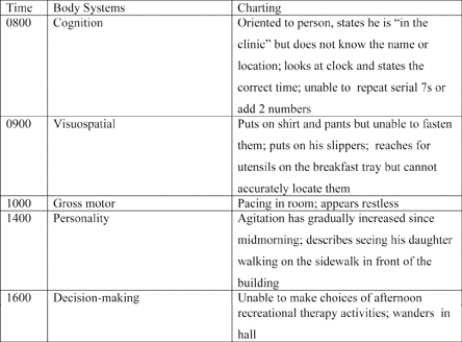
A) Mild
B) Preclinical
C) Moderate
D) Severe
A) Mild
B) Preclinical
C) Moderate
D) Severe
Question
Question
Question

Unlock Deck
Sign up to unlock the cards in this deck!
Unlock Deck
Unlock Deck
1/34

Play

Full screen (f)
Deck 23: Caring for the Patient With Chronic and Degenerative Neurological Disorders
1
Which test involving injection of a drug would the nurse anticipate being ordered to diagnose myasthenia gravis MG)?
A) A Tensilon test
B) A computed tomography CT) scan of the legs
C) A nerve stimulation study
D) Analysis of antiacetylcholine receptor antibodies
A) A Tensilon test
B) A computed tomography CT) scan of the legs
C) A nerve stimulation study
D) Analysis of antiacetylcholine receptor antibodies
A Tensilon test
2
A 30-year-old nurse who works on a busy medical-surgical unit has been diagnosed with multiple sclerosis MS). What is this patient's priority health promotion activity?
A) Negotiate a regular schedule of 8-hour day shifts and consider applying for nursing positions that are less stressful and demanding.
B) Work as hard as possible now because it may not be possible later.
C) Continue to work as scheduled without making changes.
D) Leave employment as a nurse because of the need for complete bed rest.
A) Negotiate a regular schedule of 8-hour day shifts and consider applying for nursing positions that are less stressful and demanding.
B) Work as hard as possible now because it may not be possible later.
C) Continue to work as scheduled without making changes.
D) Leave employment as a nurse because of the need for complete bed rest.
Negotiate a regular schedule of 8-hour day shifts and consider applying for nursing positions that are less stressful and demanding.
3
A patient with myasthenia gravis is taking pyridostigmine Mestinon). When teaching about this medication, the nurse should instruct the patient to immediately report which conditions? Note: Credit will be given only if all correct choices and no incorrect choices are selected.
Standard Text: Select all that apply.
A) Increased weakness
B) Excessive salivation
C) Fever
D) Tooth pain
E) Increased difficulty swallowing
Standard Text: Select all that apply.
A) Increased weakness
B) Excessive salivation
C) Fever
D) Tooth pain
E) Increased difficulty swallowing
Increased weakness
Excessive salivation
Increased difficulty swallowing
Excessive salivation
Increased difficulty swallowing
4
A patient who is newly diagnosed with Huntington's disease asks the nurse whether this disorder can be passed on to his future children. How should the nurse respond? Note: Credit will be given only if all correct choices and no incorrect choices are selected.
Standard Text: Select all that apply.
A) "There may be genetic concerns that should be discussed with the physician."
B) "Your children will not be affected by the disease."
C) "The disease is passed only through the mother's blood line."
D) "Each child will have a 50% chance of inheriting the gene."
E) "There is a strong chance that your children will be carriers, but they will only develop the disease if their mother is also a carrier."
Standard Text: Select all that apply.
A) "There may be genetic concerns that should be discussed with the physician."
B) "Your children will not be affected by the disease."
C) "The disease is passed only through the mother's blood line."
D) "Each child will have a 50% chance of inheriting the gene."
E) "There is a strong chance that your children will be carriers, but they will only develop the disease if their mother is also a carrier."
Unlock Deck
Unlock for access to all 34 flashcards in this deck.
Unlock Deck
k this deck
5
A nurse working in a fertility clinic reviews the health history of a patient whose father had Huntington's disease. What initial statement by the nurse would best address this patient's risk factors?
A) "What do you know about testing for this disease?"
B) "Have you ever been tested for this disease?"
C) "Are you sure you want to have children?"
D) "Your child has a 50% chance of getting this disease."
A) "What do you know about testing for this disease?"
B) "Have you ever been tested for this disease?"
C) "Are you sure you want to have children?"
D) "Your child has a 50% chance of getting this disease."
Unlock Deck
Unlock for access to all 34 flashcards in this deck.
Unlock Deck
k this deck
6
The nurse notes tremors and muscle rigidity in an older adult patient diagnosed with Parkinson's disease. Which medication would the nurse expect to administer to combat these symptoms?
A) Benztropine Cogentin)
B) Dantrolene Dantrium)
C) Riluzole Rilutek)
D) Nitroglycerin Nitro-bid)
A) Benztropine Cogentin)
B) Dantrolene Dantrium)
C) Riluzole Rilutek)
D) Nitroglycerin Nitro-bid)
Unlock Deck
Unlock for access to all 34 flashcards in this deck.
Unlock Deck
k this deck
7
The nurse is assessing a patient with myasthenia gravis. Which findings would the nurse attribute to this disease? Note: Credit will be given only if all correct choices and no incorrect choices are selected.
Standard Text: Select all that apply.
A) Visual problems may be an early symptom.
B) Routine exercise provides an improvement in muscle strength.
C) There may be difficulty swallowing.
D) Muscle strength improves greatly with physical therapy.
E) There may be poor articulation in speaking.
Standard Text: Select all that apply.
A) Visual problems may be an early symptom.
B) Routine exercise provides an improvement in muscle strength.
C) There may be difficulty swallowing.
D) Muscle strength improves greatly with physical therapy.
E) There may be poor articulation in speaking.
Unlock Deck
Unlock for access to all 34 flashcards in this deck.
Unlock Deck
k this deck
8
In order to care for adults with Alzheimer's disease AD), the nurse recognizes which common signs? Note: Credit will be given only if all correct choices and no incorrect choices are selected.
Standard Text: Select all that apply.
A) Poor or impaired judgment
B) Declining job skills
C) Inability to be comfortable in social situations
D) Obsession with organization
E) Focus on abstract thoughts
Standard Text: Select all that apply.
A) Poor or impaired judgment
B) Declining job skills
C) Inability to be comfortable in social situations
D) Obsession with organization
E) Focus on abstract thoughts
Unlock Deck
Unlock for access to all 34 flashcards in this deck.
Unlock Deck
k this deck
9
A patient complains of occasional periods of confusion and forgetfulness but reports a clear thought process most of the day. The symptoms have been gradually worsening. What is the best initial response by the nurse?
A) "Have you started any new medications?"
B) "You probably have nothing to worry about. It's most likely stress-related."
C) "Everybody has a few problems with memory as they get older."
D) "You should probably have an MRI of your brain."
A) "Have you started any new medications?"
B) "You probably have nothing to worry about. It's most likely stress-related."
C) "Everybody has a few problems with memory as they get older."
D) "You should probably have an MRI of your brain."
Unlock Deck
Unlock for access to all 34 flashcards in this deck.
Unlock Deck
k this deck
10
Which medication would the nurse anticipate administering as treatment for mild Alzheimer's disease AD)?
A) Donepezil Aricept)
B) Adrenocorticotropic hormone ACTH)
C) Olanzapine Zyprexa)
D) Memantine Namenda)
A) Donepezil Aricept)
B) Adrenocorticotropic hormone ACTH)
C) Olanzapine Zyprexa)
D) Memantine Namenda)
Unlock Deck
Unlock for access to all 34 flashcards in this deck.
Unlock Deck
k this deck
11
A patient states, "My doctor said sometimes I may have an on-and-off problem with this medication. What does that mean?" How should the nurse respond?
A) "The on times will be when your symptoms are under control; the off times are when you will have increased problems with symptom management."
B) "There will be times when you are depressed off) and when you are happy on)."
C) "You will have to take breaks from this medicine by stopping off) and starting it on) again so you don't build up a tolerance to it."
D) "The off-on phases are associated with your appetite."
A) "The on times will be when your symptoms are under control; the off times are when you will have increased problems with symptom management."
B) "There will be times when you are depressed off) and when you are happy on)."
C) "You will have to take breaks from this medicine by stopping off) and starting it on) again so you don't build up a tolerance to it."
D) "The off-on phases are associated with your appetite."
Unlock Deck
Unlock for access to all 34 flashcards in this deck.
Unlock Deck
k this deck
12
Once amyotrophic lateral sclerosis ALS) is diagnosed, what is the priority nursing activity?
A) Support the patient and family to meet physical and psychosocial needs.
B) Monitor for infection.
C) Assist the patient to avoid complications.
D) Assist the patient to adapt to the disease.
A) Support the patient and family to meet physical and psychosocial needs.
B) Monitor for infection.
C) Assist the patient to avoid complications.
D) Assist the patient to adapt to the disease.
Unlock Deck
Unlock for access to all 34 flashcards in this deck.
Unlock Deck
k this deck
13
A patient with Alzheimer's disease has lost 5 pounds over the past month. What is the best nursing intervention to address this weight loss?
A) Provide a high-fiber diet.
B) Recommend referral to a nutritionist for tube feeding.
C) Make sure the patient is put on a mechanical soft diet.
D) Give the patient food choices from which to select.
A) Provide a high-fiber diet.
B) Recommend referral to a nutritionist for tube feeding.
C) Make sure the patient is put on a mechanical soft diet.
D) Give the patient food choices from which to select.
Unlock Deck
Unlock for access to all 34 flashcards in this deck.
Unlock Deck
k this deck
14
The nurse is completing discharge teaching to a patient with a new diagnosis of myasthenia gravis MG). What information should the nurse provide about the patient's diet?
A) "You should try to maintain a healthy weight for your height."
B) "Your diet should include more fats."
C) "You should get most of your calories from liquids."
D) "There should be no difference in your diet from what you were eating prior to diagnosis."
A) "You should try to maintain a healthy weight for your height."
B) "Your diet should include more fats."
C) "You should get most of your calories from liquids."
D) "There should be no difference in your diet from what you were eating prior to diagnosis."
Unlock Deck
Unlock for access to all 34 flashcards in this deck.
Unlock Deck
k this deck
15
A patient is hospitalized with amyotrophic lateral sclerosis ALS), and the nursing diagnosis Spontaneous Ventilation, Impaired has been identified. In planning care for this patient, the nurse will prioritize the appropriate interventions. Rank the interventions, with the first being the most critical and the last the least critical. Standard Text: Click and drag the options below to move them up or down.
Choice
A) Assess respiratory rate and lung sounds every 4 hours. Choice
B) Monitor arterial blood gases to identify changes. Choice
C) Maintain hydration and caloric intake. Choice
D) Educate the patient about further treatment options.
Choice
A) Assess respiratory rate and lung sounds every 4 hours. Choice
B) Monitor arterial blood gases to identify changes. Choice
C) Maintain hydration and caloric intake. Choice
D) Educate the patient about further treatment options.
Unlock Deck
Unlock for access to all 34 flashcards in this deck.
Unlock Deck
k this deck
16
A home health nurse visits a patient with moderate Alzheimer's disease who lives at home with the spouse. To meet the needs of the spouse, the nurse suggests which action?
A) Finding respite care to come into the home several days a week
B) Making arrangements for the patient to visit the local senior citizens' center in the afternoon
C) Providing the patient with a list of daily activities to complete
D) Finding placement in a long-term care facility
A) Finding respite care to come into the home several days a week
B) Making arrangements for the patient to visit the local senior citizens' center in the afternoon
C) Providing the patient with a list of daily activities to complete
D) Finding placement in a long-term care facility
Unlock Deck
Unlock for access to all 34 flashcards in this deck.
Unlock Deck
k this deck
17
The nurse is having a conversation with an older adult with Parkinson's disease. What would this patient most likely exhibit during the conversation? Note: Credit will be given only if all correct choices and no incorrect choices are selected.
Standard Text: Select all that apply.
A) A low-pitched monotone voice
B) Bubbly, spirited discussion
C) Jumbled words that do not make sense
D) Angry, loud talk
E) Slurring and poor articulation of words
Standard Text: Select all that apply.
A) A low-pitched monotone voice
B) Bubbly, spirited discussion
C) Jumbled words that do not make sense
D) Angry, loud talk
E) Slurring and poor articulation of words
Unlock Deck
Unlock for access to all 34 flashcards in this deck.
Unlock Deck
k this deck
18
A patient's husband states, "I've noticed that my wife doesn't sleep well anymore and sometimes can't find the right words when we're talking." Which is the most appropriate response by the nurse?
A) "How long have you noticed these changes?"
B) "Does anyone in your family have Alzheimer's disease?"
C) "These are common changes associated with age."
D) "Do you think your spouse is depressed?"
A) "How long have you noticed these changes?"
B) "Does anyone in your family have Alzheimer's disease?"
C) "These are common changes associated with age."
D) "Do you think your spouse is depressed?"
Unlock Deck
Unlock for access to all 34 flashcards in this deck.
Unlock Deck
k this deck
19
The nurse is caring for a patient with amyotrophic lateral sclerosis ALS). The nurse plans care based on which understanding of the patient's prognosis?
A) The disease progresses slowly and is fatal.
B) The disease will progress over many years but the patient's quality of life will be good.
C) The disease progresses rapidly but can be halted by drug therapy.
D) The disease will progress slowly and can be controlled by medication.
A) The disease progresses slowly and is fatal.
B) The disease will progress over many years but the patient's quality of life will be good.
C) The disease progresses rapidly but can be halted by drug therapy.
D) The disease will progress slowly and can be controlled by medication.
Unlock Deck
Unlock for access to all 34 flashcards in this deck.
Unlock Deck
k this deck
20
A patient who was diagnosed with Parkinson's disease is exhibiting hypomimia. What will the nurse likely observe in this patient?
A) Slow movements of the arms and legs
B) Falling when attempting to step backward
C) Blank facial expression
D) Very slow talk
A) Slow movements of the arms and legs
B) Falling when attempting to step backward
C) Blank facial expression
D) Very slow talk
Unlock Deck
Unlock for access to all 34 flashcards in this deck.
Unlock Deck
k this deck
21
The nurse is assessing a patient who has been diagnosed with Parkinson's disease and documents that he is demonstrating bradykinesia. The nurse bases this on which observation?
A) The patient sloshes coffee out of his cup when eating breakfast.
B) The patient has difficulty initiating a walk to the bathroom.
C) The patient maintains his balance by holding on to the furniture.
D) The patient's skin is moist and his clothing is damp.
A) The patient sloshes coffee out of his cup when eating breakfast.
B) The patient has difficulty initiating a walk to the bathroom.
C) The patient maintains his balance by holding on to the furniture.
D) The patient's skin is moist and his clothing is damp.
Unlock Deck
Unlock for access to all 34 flashcards in this deck.
Unlock Deck
k this deck
22
The nurse is providing community education about Parkinson's disease PD) symptomology. Which information would the nurse include in this discussion? Note: Credit will be given only if all correct choices and no incorrect choices are selected.
Standard Text: Select all that apply.
A) "'Pill-rolling' motions are often seen in the hands."
B) "Muscle stiffness is a common manifestation."
C) "People with Parkinson's disease often complain that they move slowly."
D) "Many people with PD are injured because they tend to fall more than others."
E) "People with PD tend to have drooping of the eyelids."
Standard Text: Select all that apply.
A) "'Pill-rolling' motions are often seen in the hands."
B) "Muscle stiffness is a common manifestation."
C) "People with Parkinson's disease often complain that they move slowly."
D) "Many people with PD are injured because they tend to fall more than others."
E) "People with PD tend to have drooping of the eyelids."
Unlock Deck
Unlock for access to all 34 flashcards in this deck.
Unlock Deck
k this deck
23
The nurse is providing care to a patient with mysasthenia gravis MG). The nurse would plan this care based on which characteristics of the disease? Note: Credit will be given only if all correct choices and no incorrect choices are selected.
Standard Text: Select all that apply.
A) Immunosuppressant therapy may be prescribed.
B) Exercise increases muscle strength.
C) Visual problems may be an early symptom.
D) Initial drug treatment often involves cholinesterase inhibitors.
E) Ptosis may be either unilateral or bilateral.
Standard Text: Select all that apply.
A) Immunosuppressant therapy may be prescribed.
B) Exercise increases muscle strength.
C) Visual problems may be an early symptom.
D) Initial drug treatment often involves cholinesterase inhibitors.
E) Ptosis may be either unilateral or bilateral.
Unlock Deck
Unlock for access to all 34 flashcards in this deck.
Unlock Deck
k this deck
24
The nurse recognizes the results in this laboratory report as consistent with which disorder?
A) Myasthenia gravis
B) Parkinson's disease
C) Amyotrophic lateral sclerosis ALS)
D) Alzheimer's disease
A) Myasthenia gravis
B) Parkinson's disease
C) Amyotrophic lateral sclerosis ALS)
D) Alzheimer's disease
Unlock Deck
Unlock for access to all 34 flashcards in this deck.
Unlock Deck
k this deck
25
The nurse explains to a patient who has been diagnosed with myasthenia gravis MG) that this condition differs from amyotrophic lateral sclerosis ALS) in that MG has which characteristics? Note: Credit will be given only if all correct choices and no incorrect choices are selected.
Standard Text: Select all that apply.
A) It is usually fatal in 3 to 4 years after onset.
B) MG presents with shorter remissions as the disease progresses.
C) The onset of MG in women commonly occurs between 20 and 40 years of age.
D) Patients experience an increase of symptoms when exposed to sunlight, viral illness, and emotional stress.
E) MG produces involuntary twitching of the arms, legs, and tongue muscles.
Standard Text: Select all that apply.
A) It is usually fatal in 3 to 4 years after onset.
B) MG presents with shorter remissions as the disease progresses.
C) The onset of MG in women commonly occurs between 20 and 40 years of age.
D) Patients experience an increase of symptoms when exposed to sunlight, viral illness, and emotional stress.
E) MG produces involuntary twitching of the arms, legs, and tongue muscles.
Unlock Deck
Unlock for access to all 34 flashcards in this deck.
Unlock Deck
k this deck
26
When providing education for a patient newly diagnosed with mild Alzheimer's disease AD) and the family, the nurse identifies which actions as signs that the disease is progressing in severity? Note: Credit will be given only if all correct choices and no incorrect choices are selected.
Standard Text: Select all that apply.
A) The patient repeatedly allows pots of water to boil dry.
B) The patient claims that the newspaper is not readable anymore.
C) The patient becomes agitated when old friends come to visit.
D) The patient is obsessive about how personal belongings are organized.
E) The patient develops a ravenous appetite, especially for carbohydrates.
Standard Text: Select all that apply.
A) The patient repeatedly allows pots of water to boil dry.
B) The patient claims that the newspaper is not readable anymore.
C) The patient becomes agitated when old friends come to visit.
D) The patient is obsessive about how personal belongings are organized.
E) The patient develops a ravenous appetite, especially for carbohydrates.
Unlock Deck
Unlock for access to all 34 flashcards in this deck.
Unlock Deck
k this deck
27
The nurse is discussing the future with a patient recently diagnosed with amyotrophic lateral sclerosis ALS). The patient asks about the possibility of continuing to work at the family's construction business. How should the nurse respond?
A) "Can you do work that is less strenuous?"
B) "Is there a way you can switch over to the office side of the business?"
C) "This is a progressively debilitating disease. You need to think of ways to conserve your energy, not expend it."
D) "Work as long at your job as you feel capable of keeping up with the demands it makes on you."
A) "Can you do work that is less strenuous?"
B) "Is there a way you can switch over to the office side of the business?"
C) "This is a progressively debilitating disease. You need to think of ways to conserve your energy, not expend it."
D) "Work as long at your job as you feel capable of keeping up with the demands it makes on you."
Unlock Deck
Unlock for access to all 34 flashcards in this deck.
Unlock Deck
k this deck
28
When interviewing a patient suspected of exhibiting signs of Parkinson's disease, the nurse shows an understanding of the disease's etiology by asking which question?
A) "Is it painful to flex your chin to your chest?"
B) "Do you recall if any of your relatives had difficulty holding on to things with their hands?"
C) "Did your muscle weakness first occur in your arms or in your legs?"
D) "Did I understand correctly that your memory problems started about 5 years ago?"
A) "Is it painful to flex your chin to your chest?"
B) "Do you recall if any of your relatives had difficulty holding on to things with their hands?"
C) "Did your muscle weakness first occur in your arms or in your legs?"
D) "Did I understand correctly that your memory problems started about 5 years ago?"
Unlock Deck
Unlock for access to all 34 flashcards in this deck.
Unlock Deck
k this deck
29
The nurse is caring for a patient with amyotrophic lateral sclerosis ALS). What is the nurse's primary focus of care?
A) Respiratory support as the muscles of breathing fail, and managing secretions due to the inability to swallow and communicate
B) Providing gastrostomy feedings as soon as possible to build up muscle mass when motor functions return
C) Pain management and active range-of-motion ROM) exercises
D) Administering immunosuppressants
A) Respiratory support as the muscles of breathing fail, and managing secretions due to the inability to swallow and communicate
B) Providing gastrostomy feedings as soon as possible to build up muscle mass when motor functions return
C) Pain management and active range-of-motion ROM) exercises
D) Administering immunosuppressants
Unlock Deck
Unlock for access to all 34 flashcards in this deck.
Unlock Deck
k this deck
30
The nurse is preparing a patient diagnosed with amyotrophic lateral sclerosis ALS) for discharge. The nurse realizes that interventions for which nursing diagnosis should be priority for this patient?
A) Impaired Urinary Elimination related to spastic or flaccid bladder
B) Disturbed Thought Processes related to cognitive decline
C) Alteration in Vision Acuity related to ocular muscle involvement
D) Ineffective Breathing Pattern related to neuromuscular dysfunction
A) Impaired Urinary Elimination related to spastic or flaccid bladder
B) Disturbed Thought Processes related to cognitive decline
C) Alteration in Vision Acuity related to ocular muscle involvement
D) Ineffective Breathing Pattern related to neuromuscular dysfunction
Unlock Deck
Unlock for access to all 34 flashcards in this deck.
Unlock Deck
k this deck
31
Review the computerized charting record and identify the stage of Alzheimer's disease AD) of the patient described.
A) Mild
B) Preclinical
C) Moderate
D) Severe
A) Mild
B) Preclinical
C) Moderate
D) Severe
Unlock Deck
Unlock for access to all 34 flashcards in this deck.
Unlock Deck
k this deck
32
During discharge planning, a nurse encourages a patient diagnosed with multiple sclerosis to engage in a regular exercise program. This recommendation is based on the knowledge that exercise will help the patient manage which problems associated with the disease? Note: Credit will be given only if all correct choices and no incorrect choices are selected.
Standard Text: Select all that apply.
A) Obesity
B) Muscle spasticity
C) Infection
D) Constipation
E) Fatigue
Standard Text: Select all that apply.
A) Obesity
B) Muscle spasticity
C) Infection
D) Constipation
E) Fatigue
Unlock Deck
Unlock for access to all 34 flashcards in this deck.
Unlock Deck
k this deck
33
A patient diagnosed with Parkinson's disease PD) 11 years ago is being cared for at home by the spouse. The nurse asks whether the family has considered arranging for in-home assistive care, based primarily on which knowledge?
A) The patient may live for many more years.
B) This type of assistive care is warranted because PD is both progressive and degenerative.
C) It is becoming more difficult for the spouse to adequately meet the patient's physical needs.
D) This type of assistance can help preserve the physical and emotional well-being of the patient's spouse.
A) The patient may live for many more years.
B) This type of assistive care is warranted because PD is both progressive and degenerative.
C) It is becoming more difficult for the spouse to adequately meet the patient's physical needs.
D) This type of assistance can help preserve the physical and emotional well-being of the patient's spouse.
Unlock Deck
Unlock for access to all 34 flashcards in this deck.
Unlock Deck
k this deck
34
The nurse is conducting an informative session about Alzheimer's disease AD) for a local civic group. The nurse shows an understanding of the disorder by providing which information?
A) In AD, the central nervous system is unpredictably affected, resulting in a loss of communication and motor skills.
B) AD is a form of dementia that is caused by a lack of a brain chemical.
C) AD occurs when the person's own immune system attacks the cells of the body.
D) AD is a disease process that starts by affecting a person's memory and progresses toward the loss of reasoning abilities.
A) In AD, the central nervous system is unpredictably affected, resulting in a loss of communication and motor skills.
B) AD is a form of dementia that is caused by a lack of a brain chemical.
C) AD occurs when the person's own immune system attacks the cells of the body.
D) AD is a disease process that starts by affecting a person's memory and progresses toward the loss of reasoning abilities.
Unlock Deck
Unlock for access to all 34 flashcards in this deck.
Unlock Deck
k this deck
Unlock Deck
Unlock for access to all 34 flashcards in this deck.






