







 Chat with AI

Deck 20: Nursing Assessment of the Patient With Neurological Disorders
Full screen (f)

Question
A patient is brought to the emergency department following a motor vehicle accident. The patient jerks away from the nurse attempting to start an IV in the right arm and says, "Bring me my book. I need to eat." When asked what happened in the accident, the patient looks frantically from nurse to nurse and says, "I have a dog." Calculate the patient's Glasgow Coma Scale score. 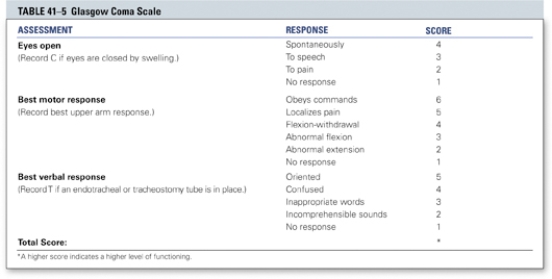

Question
Question
Question
Question
Question
Question
Question
Question
Question
Question
Question
Question
Question
Question
Question
Question
Question
Question
Question
Question
Question
Question
Question
Question
Question
Question
Question
Question
Question

Unlock Deck
Sign up to unlock the cards in this deck!
Unlock Deck
Unlock Deck
1/30

Play

Full screen (f)
Deck 20: Nursing Assessment of the Patient With Neurological Disorders
1
A patient is brought to the emergency department following a motor vehicle accident. The patient jerks away from the nurse attempting to start an IV in the right arm and says, "Bring me my book. I need to eat." When asked what happened in the accident, the patient looks frantically from nurse to nurse and says, "I have a dog." Calculate the patient's Glasgow Coma Scale score.
12
2
The nurse observes a patient who has a lack of coordination, clumsy movements, and an unbalanced gait. How would the nurse document this observation?
A) As flaccidity
B) As paralysis
C) As hemiparesis
D) As ataxia
A) As flaccidity
B) As paralysis
C) As hemiparesis
D) As ataxia
As ataxia
3
When bringing in the meal tray for a patient with damage to the glossopharyngeal nerve CN IX), which action by the nurse is most appropriate?
A) Place the tray on the patient's right side.
B) Assess the patient's ability to swallow.
C) Speak loudly and make eye contact with the patient.
D) Assist the patient in identifying where items are on the tray.
A) Place the tray on the patient's right side.
B) Assess the patient's ability to swallow.
C) Speak loudly and make eye contact with the patient.
D) Assist the patient in identifying where items are on the tray.
Assess the patient's ability to swallow.
4
During an assessment of a patient's cranial nerves, the nurse asks the patient to stick out the tongue. The nurse observes that the tongue deviates markedly to the right side. Which condition is the patient most likely exhibiting?
A) Abnormal hypoglossal nerve response
B) First cranial nerve CN I) damage
C) Sluggish oculomotor response
D) Absence of Homans' sign
A) Abnormal hypoglossal nerve response
B) First cranial nerve CN I) damage
C) Sluggish oculomotor response
D) Absence of Homans' sign
Unlock Deck
Unlock for access to all 30 flashcards in this deck.
Unlock Deck
k this deck
5
An intensive care unit ICU) nurse is preparing to assess the level of consciousness LOC) of a patient who experienced multiple trauma injuries and is on assisted ventilation. The nurse chooses the FOUR Score Consciousness Scale for which reason?
A) This scoring system does not require verbal responses.
B) This scoring system focuses primarily on assessment of cognitive ability.
C) This scoring system requires minimal interaction on the part of the patient.
D) This scoring system is designed especially for intensive care unit patients.
A) This scoring system does not require verbal responses.
B) This scoring system focuses primarily on assessment of cognitive ability.
C) This scoring system requires minimal interaction on the part of the patient.
D) This scoring system is designed especially for intensive care unit patients.
Unlock Deck
Unlock for access to all 30 flashcards in this deck.
Unlock Deck
k this deck
6
When assessing the patient's cognitive function, the nurse would evaluate which parameter?
A) Ability to smell items placed under the nose while eyes are closed
B) Orientation to time, place, and person, and ability to recall recent and past events
C) Ability to walk with a smooth, steady gait
D) Level of consciousness
A) Ability to smell items placed under the nose while eyes are closed
B) Orientation to time, place, and person, and ability to recall recent and past events
C) Ability to walk with a smooth, steady gait
D) Level of consciousness
Unlock Deck
Unlock for access to all 30 flashcards in this deck.
Unlock Deck
k this deck
7
The nurse reads that a patient's reflexes are 3+. How does the nurse interpret this score?
A) The reflexes are weaker than normal.
B) The reflexes are normal.
C) The reflexes are stronger than normal.
D) The reflexes are hyperactive.
A) The reflexes are weaker than normal.
B) The reflexes are normal.
C) The reflexes are stronger than normal.
D) The reflexes are hyperactive.
Unlock Deck
Unlock for access to all 30 flashcards in this deck.
Unlock Deck
k this deck
8
While assessing an unconscious patient's neurologic status, the nurse applies pain by pinching the sternocleidomastoid muscle. Which statement by the nurse indicates an understanding of the use of this technique?
A) "Pain will make abnormal motor responses observable."
B) "An unconscious patient's pain threshold is abnormally high."
C) "Response to pain is an indicator of cognitive function."
D) "The patient is most likely to respond to pain at that site."
A) "Pain will make abnormal motor responses observable."
B) "An unconscious patient's pain threshold is abnormally high."
C) "Response to pain is an indicator of cognitive function."
D) "The patient is most likely to respond to pain at that site."
Unlock Deck
Unlock for access to all 30 flashcards in this deck.
Unlock Deck
k this deck
9
The nurse observes signs that a patient may be experiencing dysfunction related to the acoustic nerve CN VIII). Which action by the nurse is most appropriate for minimizing the patient's risk for injury? Note: Credit will be given only if all correct choices and no incorrect choices are selected.
Standard Text: Select all that apply.
A) Identify the patient's fall risk category.
B) Assess the patient's gag reflex prior to offering food or liquids.
C) Assist the patient with bedside sitting or toileting.
D) Assess the patient's vision using a Snellen chart.
E) Place a red "falls risk" bracelet on the patient's arm.
Standard Text: Select all that apply.
A) Identify the patient's fall risk category.
B) Assess the patient's gag reflex prior to offering food or liquids.
C) Assist the patient with bedside sitting or toileting.
D) Assess the patient's vision using a Snellen chart.
E) Place a red "falls risk" bracelet on the patient's arm.
Unlock Deck
Unlock for access to all 30 flashcards in this deck.
Unlock Deck
k this deck
10
The nurse recognizes that which assessment observation of a comatose patient has the greatest implications?
A) Both arms are extended and adducted, with the palms facing down.
B) Fasciculational twitching occurs in the small muscle groups of both arms.
C) Muscles of the entire upper extremities are flaccid bilaterally.
D) Arms, wrist, and fingers are flexed and adducted.
A) Both arms are extended and adducted, with the palms facing down.
B) Fasciculational twitching occurs in the small muscle groups of both arms.
C) Muscles of the entire upper extremities are flaccid bilaterally.
D) Arms, wrist, and fingers are flexed and adducted.
Unlock Deck
Unlock for access to all 30 flashcards in this deck.
Unlock Deck
k this deck
11
Which techniques would the nurse use to test for graphesthesia? Note: Credit will be given only if all correct choices and no incorrect choices are selected.
Standard Text: Select all that apply.
A) Ask the patient to identify an object placed in the hand.
B) Have the patient close the eyes.
C) Ask the patient to occlude the ear not being tested.
D) Trace a letter in the palm of the patient's hand.
E) Lightly touch both sides of the patient simultaneously.
Standard Text: Select all that apply.
A) Ask the patient to identify an object placed in the hand.
B) Have the patient close the eyes.
C) Ask the patient to occlude the ear not being tested.
D) Trace a letter in the palm of the patient's hand.
E) Lightly touch both sides of the patient simultaneously.
Unlock Deck
Unlock for access to all 30 flashcards in this deck.
Unlock Deck
k this deck
12
An emergency department ED) nurse receives a report that an incoming patient has a Glasgow Coma Scale GCS) score of 8. Which is the most appropriate action by the nurse?
A) Treat the patient's pain.
B) Assess the patient's airway, breathing, and circulation.
C) Obtain a complete history from the patient.
D) Triage the patient with the other ED patients.
A) Treat the patient's pain.
B) Assess the patient's airway, breathing, and circulation.
C) Obtain a complete history from the patient.
D) Triage the patient with the other ED patients.
Unlock Deck
Unlock for access to all 30 flashcards in this deck.
Unlock Deck
k this deck
13
When testing cranial nerve XI spinal accessory), the nurse should ask the patient to perform which activity?
A) Shrug the shoulders and turn the head against resistance.
B) Stick out the tongue and move it from side to side.
C) Taste foods and distinguish sweet from sour.
D) Identify smells correctly with one side of the nares blocked.
A) Shrug the shoulders and turn the head against resistance.
B) Stick out the tongue and move it from side to side.
C) Taste foods and distinguish sweet from sour.
D) Identify smells correctly with one side of the nares blocked.
Unlock Deck
Unlock for access to all 30 flashcards in this deck.
Unlock Deck
k this deck
14
The nurse is interviewing a patient whose wife reports, "He's really forgetting things more these days." To provide the best assessment of this complaint, what should the nurse do first?
A) Ask the wife to give examples of the patient's forgetfulness.
B) Have the patient take the Mini-Mental Status Examination MMSE).
C) Use the mnemonic OLD CARTS to obtain assessment data.
D) Ask the patient if he too feels he's "forgetful."
A) Ask the wife to give examples of the patient's forgetfulness.
B) Have the patient take the Mini-Mental Status Examination MMSE).
C) Use the mnemonic OLD CARTS to obtain assessment data.
D) Ask the patient if he too feels he's "forgetful."
Unlock Deck
Unlock for access to all 30 flashcards in this deck.
Unlock Deck
k this deck
15
What should the nurse include in the assessment of muscle strength and movement?
A) Grade the posterior tibial pulses.
B) Grade flaccidity.
C) Observe to see whether strength and movement are bilaterally equal and strong.
D) Percuss the muscle for dullness.
A) Grade the posterior tibial pulses.
B) Grade flaccidity.
C) Observe to see whether strength and movement are bilaterally equal and strong.
D) Percuss the muscle for dullness.
Unlock Deck
Unlock for access to all 30 flashcards in this deck.
Unlock Deck
k this deck
16
The patient has upper motor neuron injuries. The nurse anticipates that what type of reflex is present?
A) Pathologic
B) Increased
C) Normal
D) Exaggerated
A) Pathologic
B) Increased
C) Normal
D) Exaggerated
Unlock Deck
Unlock for access to all 30 flashcards in this deck.
Unlock Deck
k this deck
17
Which terms would a nurse use to document abnormal posturing in an adult with a neurological deficit? Note: Credit will be given only if all correct choices and no incorrect choices are selected.
Standard Text: Select all that apply.
A) Decorticate posturing
B) Decerebrate posturing
C) Circumduction
D) Steppage
E) Nystagmus
Standard Text: Select all that apply.
A) Decorticate posturing
B) Decerebrate posturing
C) Circumduction
D) Steppage
E) Nystagmus
Unlock Deck
Unlock for access to all 30 flashcards in this deck.
Unlock Deck
k this deck
18
What precaution must the nurse take when performing the Romberg test?
A) Have the patient remain seated.
B) Stand close to the patient.
C) Have the patient keep the eyes open.
D) Warn the patient that a sharp object is being used for the test.
A) Have the patient remain seated.
B) Stand close to the patient.
C) Have the patient keep the eyes open.
D) Warn the patient that a sharp object is being used for the test.
Unlock Deck
Unlock for access to all 30 flashcards in this deck.
Unlock Deck
k this deck
19
The patient is exhibiting abnormal posturing to stimuli. Which findings would the nurse document as decerebrate posturing? Note: Credit will be given only if all correct choices and no incorrect choices are selected.
Standard Text: Select all that apply.
A) The arms are rigidly extended.
B) The toes are pointed downward.
C) The teeth are clenched.
D) The chin is held against the chest.
E) The arms are hypersupinated.
Standard Text: Select all that apply.
A) The arms are rigidly extended.
B) The toes are pointed downward.
C) The teeth are clenched.
D) The chin is held against the chest.
E) The arms are hypersupinated.
Unlock Deck
Unlock for access to all 30 flashcards in this deck.
Unlock Deck
k this deck
20
The nurse has just finished explaining to a patient's son the function of the Mini-Mental Status Examination MMSE). Which statement by the patient's son indicates his understanding?
A) "This test will evaluate my dad's ability to think, reason, and make decisions."
B) "This test will give us a good idea if Dad is mentally healthy enough to live alone."
C) "If Dad passes this test, we will know that his mind is still okay."
D) "I'm sure Dad will do well on the test; he's always been smart."
A) "This test will evaluate my dad's ability to think, reason, and make decisions."
B) "This test will give us a good idea if Dad is mentally healthy enough to live alone."
C) "If Dad passes this test, we will know that his mind is still okay."
D) "I'm sure Dad will do well on the test; he's always been smart."
Unlock Deck
Unlock for access to all 30 flashcards in this deck.
Unlock Deck
k this deck
21
A patient was admitted to the emergency department after falling at work. The nurse assesses that the patient's left pupil has a slightly oval shape. What nursing action is indicated?
A) Notify the physician immediately.
B) Document this finding as anisocoria.
C) Document a normal finding
D) Plan to reassess the pupils in a darker room.
A) Notify the physician immediately.
B) Document this finding as anisocoria.
C) Document a normal finding
D) Plan to reassess the pupils in a darker room.
Unlock Deck
Unlock for access to all 30 flashcards in this deck.
Unlock Deck
k this deck
22
The nurse recognizes which observation as a positive Babinski sign?
A) Inability to identify two simultaneous points of pain on the foot
B) Curling of all the toes in response to stroking stimulation
C) Feeling a buzzing sensation in the foot when touched with a tuning fork
D) Dorsiflexion of the great toe, with fanning of the other toes
A) Inability to identify two simultaneous points of pain on the foot
B) Curling of all the toes in response to stroking stimulation
C) Feeling a buzzing sensation in the foot when touched with a tuning fork
D) Dorsiflexion of the great toe, with fanning of the other toes
Unlock Deck
Unlock for access to all 30 flashcards in this deck.
Unlock Deck
k this deck
23
The nurse is assessing CN III oculomotor), CN IV trochlear), and CN VI abducens). Which eye movements would the nurse document as nystagmus? Note: Credit will be given only if all correct choices and no incorrect choices are selected.
Standard Text: Select all that apply.
A) The patient's eyes move together through the six cardinal positions of gaze.
B) The patient's eyes "jerk" horizontally instead of moving smoothly.
C) The patient's eyes move in a rotary fashion when attempting to follow the examiner's finger.
D) The patient's eyes cross when following the examiner's finger.
E) The patient's eyelids droop when the eye is moved to the left.
Standard Text: Select all that apply.
A) The patient's eyes move together through the six cardinal positions of gaze.
B) The patient's eyes "jerk" horizontally instead of moving smoothly.
C) The patient's eyes move in a rotary fashion when attempting to follow the examiner's finger.
D) The patient's eyes cross when following the examiner's finger.
E) The patient's eyelids droop when the eye is moved to the left.
Unlock Deck
Unlock for access to all 30 flashcards in this deck.
Unlock Deck
k this deck
24
The nurse assesses that a patient is able move her left arm but uses her right arm to assist. The nurse would assign the affected muscle group a strength grade of ______.
Unlock Deck
Unlock for access to all 30 flashcards in this deck.
Unlock Deck
k this deck
25
The nurse is about to educate a 75-year-old patient on the side effects of a newly prescribed medication. The patient is both hearing and vision impaired. What should be the nurse's primary intervention?
A) Be sure that the patient has glasses on and functioning hearing aids during the discussion.
B) Arrange for the patient's room to be well lighted and quiet during the teaching session.
C) Provide a written explanation to supplement the discussion.
D) Ask that a family member be present during the teaching session.
A) Be sure that the patient has glasses on and functioning hearing aids during the discussion.
B) Arrange for the patient's room to be well lighted and quiet during the teaching session.
C) Provide a written explanation to supplement the discussion.
D) Ask that a family member be present during the teaching session.
Unlock Deck
Unlock for access to all 30 flashcards in this deck.
Unlock Deck
k this deck
26
When the nurse assesses the patient's abdominal superficial reflexes, the umbilicus moves in the direction of the skin stimulated. How would the nurse document this observation?
A) An absence of response
B) A questionable response
C) A negative -) response
D) A present +) response
A) An absence of response
B) A questionable response
C) A negative -) response
D) A present +) response
Unlock Deck
Unlock for access to all 30 flashcards in this deck.
Unlock Deck
k this deck
27
The nurse is preparing to administer a Mini-Mental Status Examination MMSE) on a 75-year-old patient admitted for clinical depression. What is the nurse's primary intervention for this specific patient?
A) Make sure the patient is not hungry or in pain when taking the test.
B) Repeat the instructions just prior to beginning the assessment.
C) Arrange for the patient to be uninterrupted during the test.
D) Plan for the test when the patient will not be rushed to complete it.
A) Make sure the patient is not hungry or in pain when taking the test.
B) Repeat the instructions just prior to beginning the assessment.
C) Arrange for the patient to be uninterrupted during the test.
D) Plan for the test when the patient will not be rushed to complete it.
Unlock Deck
Unlock for access to all 30 flashcards in this deck.
Unlock Deck
k this deck
28
The nurse is using the OLD CARTS mnemonic to assess a patient's chief complaint of dizziness. Which information would the nurse interpret as temporal factors? Note: Credit will be given only if all correct choices and no incorrect choices are selected.
Standard Text: Select all that apply.
A) "I have had dizziness off and on for a week."
B) "I get dizzy 2 or 3 times a day."
C) "My dizziness usually begins when I get out of bed in the morning."
D) "The dizziness usually lasts for 20 to 30 seconds."
E) "The dizziness comes on suddenly and leaves suddenly."
Standard Text: Select all that apply.
A) "I have had dizziness off and on for a week."
B) "I get dizzy 2 or 3 times a day."
C) "My dizziness usually begins when I get out of bed in the morning."
D) "The dizziness usually lasts for 20 to 30 seconds."
E) "The dizziness comes on suddenly and leaves suddenly."
Unlock Deck
Unlock for access to all 30 flashcards in this deck.
Unlock Deck
k this deck
29
The patient's vision is recorded as 20/50. The nurse is measuring what this patient can see as compared to what a normal eye can see at _______ feet.
Unlock Deck
Unlock for access to all 30 flashcards in this deck.
Unlock Deck
k this deck
30
The nurse detects an abnormality in CN VIII facial) during a neurological assessment. Which interventions would the nurse consider? Note: Credit will be given only if all correct choices and no incorrect choices are selected.
Standard Text: Select all that apply.
A) Have the patient wear an eye patch during the day.
B) Check visual acuity with the Snellen chart.
C) Assess pupils for equality of size and response to light.
D) Provide the patient with an eye shield to wear at night.
E) Warn the patient about the possibility of choking when drinking fluids.
Standard Text: Select all that apply.
A) Have the patient wear an eye patch during the day.
B) Check visual acuity with the Snellen chart.
C) Assess pupils for equality of size and response to light.
D) Provide the patient with an eye shield to wear at night.
E) Warn the patient about the possibility of choking when drinking fluids.
Unlock Deck
Unlock for access to all 30 flashcards in this deck.
Unlock Deck
k this deck
Unlock Deck
Unlock for access to all 30 flashcards in this deck.






