







 Chat with AI

Deck 12: Pain Assessment and Management
Full screen (f)

Question

Question
Question
Question
Question
Question
Which patient or patients) is reporting symptoms that are most likely to be related to side effects of an opioid pain medication regimen? 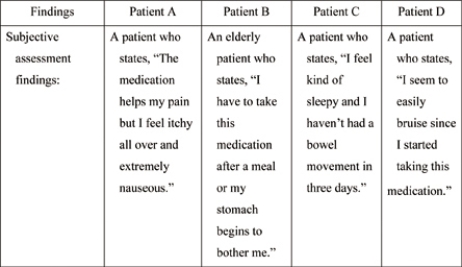
A) Patients A and C
B) Patient C only
C) Patients B and D
D) Patient D only
A) Patients A and C
B) Patient C only
C) Patients B and D
D) Patient D only
Question
Question
Question
Question
Question
Question
Question
Question
Question
Question
Which patient's or patients') physiologic assessment findings are consistent with the classic signs of acute pain? 
A) Patients A and C
B) Patient A only
C) Patients B and D
D) Patient C only
A) Patients A and C
B) Patient A only
C) Patients B and D
D) Patient C only
Question
Question
Question
Question
Question
Question
Question
Question
Question
Question
Question
Question
Question
Question

Unlock Deck
Sign up to unlock the cards in this deck!
Unlock Deck
Unlock Deck
1/30

Play

Full screen (f)
Deck 12: Pain Assessment and Management
1
The nurse is planning care for a patient with chronic pain. What would be the most appropriate pain control goal for this patient?
A) The patient will reduce the focus on pain.
B) The patient will require minimal analgesic medications.
C) The patient will be completely pain free.
D) The patient will report that the pain is bearable.
A) The patient will reduce the focus on pain.
B) The patient will require minimal analgesic medications.
C) The patient will be completely pain free.
D) The patient will report that the pain is bearable.
The patient will reduce the focus on pain.
2
While caring for a nonverbal patient, which action ensures appropriate and timely pain management?
A) Have the family medicate the patient, based on their knowledge of the patient's response to pain.
B) Use the McGill pain questionnaire to determine the optimal pain management plan.
C) Administer opioids around the clock, adding NSAIDS when necessary.
D) Medicate the patient based on the pathologic condition, nonverbal cues, and pain procedures.
A) Have the family medicate the patient, based on their knowledge of the patient's response to pain.
B) Use the McGill pain questionnaire to determine the optimal pain management plan.
C) Administer opioids around the clock, adding NSAIDS when necessary.
D) Medicate the patient based on the pathologic condition, nonverbal cues, and pain procedures.
Medicate the patient based on the pathologic condition, nonverbal cues, and pain procedures.
3
A patient who is receiving pain medication around the clock complains of an acute exacerbation of pain. What should the nurse do to help this patient?
A) Provide the medication ordered for breakthrough pain.
B) Talk the patient through the pain.
C) Encourage the patient to ignore the pain.
D) Give the patient a nonsteroidal anti-inflammatory drug NSAID).
A) Provide the medication ordered for breakthrough pain.
B) Talk the patient through the pain.
C) Encourage the patient to ignore the pain.
D) Give the patient a nonsteroidal anti-inflammatory drug NSAID).
Provide the medication ordered for breakthrough pain.
4
The nurse, caring for a patient recovering from surgery, knows that which intervention will provide the most pain relief for the patient?
A) Offer pain relief before the patient complains of pain.
B) Wait until the patient can describe the pain specifically.
C) Assess the pain level every 4 hours around the clock.
D) Allow the patient to "sleep off" the anesthesia, and then offer pain medication.
A) Offer pain relief before the patient complains of pain.
B) Wait until the patient can describe the pain specifically.
C) Assess the pain level every 4 hours around the clock.
D) Allow the patient to "sleep off" the anesthesia, and then offer pain medication.
Unlock Deck
Unlock for access to all 30 flashcards in this deck.
Unlock Deck
k this deck
5
A patient with a history of chronic pain tells the nurse, "I do a variety of things to make my body produce its own pain reliever." How should the nurse evaluate this statement?
A) This is a common denial technique.
B) The patient is trying to appear to be a pain expert.
C) This statement offers the nurse a reason to reduce the amount of pain medication prescribed.
D) The patient is taking advantage of the body's ability to make endorphins.
A) This is a common denial technique.
B) The patient is trying to appear to be a pain expert.
C) This statement offers the nurse a reason to reduce the amount of pain medication prescribed.
D) The patient is taking advantage of the body's ability to make endorphins.
Unlock Deck
Unlock for access to all 30 flashcards in this deck.
Unlock Deck
k this deck
6
Which patient or patients) is reporting symptoms that are most likely to be related to side effects of an opioid pain medication regimen?
A) Patients A and C
B) Patient C only
C) Patients B and D
D) Patient D only
A) Patients A and C
B) Patient C only
C) Patients B and D
D) Patient D only
Unlock Deck
Unlock for access to all 30 flashcards in this deck.
Unlock Deck
k this deck
7
A patient recovering from abdominal surgery is refusing hydromorphone Dilaudid) because she has heard that people may become addicted. She is crying and rates her pain 10 of 10. Which information should the nurse include as part of the patient's education? Note: Credit will be given only if all correct choices and no incorrect choices are selected.
Standard Text: Select all that apply.
A) Because the patient will take the medication on a prn basis, addiction cannot occur.
B) Untreated pain can result in poor wound healing.
C) Patients with uncontrolled pain have a higher risk of blood clots.
D) Dehydration can result from poorly managed pain.
E) Family members do not want to visit patients with visible signs of pain.
Standard Text: Select all that apply.
A) Because the patient will take the medication on a prn basis, addiction cannot occur.
B) Untreated pain can result in poor wound healing.
C) Patients with uncontrolled pain have a higher risk of blood clots.
D) Dehydration can result from poorly managed pain.
E) Family members do not want to visit patients with visible signs of pain.
Unlock Deck
Unlock for access to all 30 flashcards in this deck.
Unlock Deck
k this deck
8
A nurse in the emergency department is caring for a patient with a fractured tibia and fibula who admits to regular heroin use. Which factor should be used to determine the presence of pain and need for pain medication?
A) The patient has taken an opiate already today.
B) The shift report indicates the patient has been sleeping on and off.
C) The patient is angry about being in the hospital.
D) The patient reports pain in the leg of an intensity of 10 out of 10 on the numeric rating scale.
A) The patient has taken an opiate already today.
B) The shift report indicates the patient has been sleeping on and off.
C) The patient is angry about being in the hospital.
D) The patient reports pain in the leg of an intensity of 10 out of 10 on the numeric rating scale.
Unlock Deck
Unlock for access to all 30 flashcards in this deck.
Unlock Deck
k this deck
9
A patient says that she has pain every day but never asks her health care provider for medication because she doesn't want to "become addicted." What is the nurse's best response to this patient?
A) "Pain isn't always a bad thing to experience."
B) "It's better to experience the pain than to cover it up."
C) "There are many medications your doctor can prescribe that are not addicting."
D) "I wouldn't want to become addicted either."
A) "Pain isn't always a bad thing to experience."
B) "It's better to experience the pain than to cover it up."
C) "There are many medications your doctor can prescribe that are not addicting."
D) "I wouldn't want to become addicted either."
Unlock Deck
Unlock for access to all 30 flashcards in this deck.
Unlock Deck
k this deck
10
The nurse is planning to administer a pain medication to a patient who has just returned to the unit following bowel resection surgery. The patient has four standing orders for pain medication. Which order should the nurse select?
A) The one to be administered intravenously by patient demand and under patient control
B) The one to be given intramuscularly to work quickly
C) The one ordered on a prn basis
D) The one to be administered orally
A) The one to be administered intravenously by patient demand and under patient control
B) The one to be given intramuscularly to work quickly
C) The one ordered on a prn basis
D) The one to be administered orally
Unlock Deck
Unlock for access to all 30 flashcards in this deck.
Unlock Deck
k this deck
11
The nurse is administering analgesic medication to a group of patients. Which statement should guide the nurse in this work?
A) Pain should be managed to improve the patient's quality of life.
B) Opiates are not recommended for patients with addiction issues.
C) The nurse should be certain pain is present prior to administering opiates.
D) Patients with psychiatric diseases should avoid opiates for malignant pain.
A) Pain should be managed to improve the patient's quality of life.
B) Opiates are not recommended for patients with addiction issues.
C) The nurse should be certain pain is present prior to administering opiates.
D) Patients with psychiatric diseases should avoid opiates for malignant pain.
Unlock Deck
Unlock for access to all 30 flashcards in this deck.
Unlock Deck
k this deck
12
The nurse is assessing a patient with chronic pain and learns the patient is not able to sleep through the night. The nurse realizes this patient is demonstrating which problem?
A) The inability to cope with pain
B) A side effect of chronic pain medication use
C) Sleep deprivation because of poor pain control
D) Lying as a way to be prescribed more pain medication without an identified need
A) The inability to cope with pain
B) A side effect of chronic pain medication use
C) Sleep deprivation because of poor pain control
D) Lying as a way to be prescribed more pain medication without an identified need
Unlock Deck
Unlock for access to all 30 flashcards in this deck.
Unlock Deck
k this deck
13
Which statement explains why the nurse should assess each patient's pain response individually in every situation?
A) Everyone has a unique tolerance to pain.
B) Everyone has the same pain threshold.
C) Everyone perceives painful stimuli at the same intensity.
D) Most people have the same pain response to surgery.
A) Everyone has a unique tolerance to pain.
B) Everyone has the same pain threshold.
C) Everyone perceives painful stimuli at the same intensity.
D) Most people have the same pain response to surgery.
Unlock Deck
Unlock for access to all 30 flashcards in this deck.
Unlock Deck
k this deck
14
A patient has periodic severe nerve pain that is not well controlled with the current pain medication regimen. The nurse anticipates adding a medication from which category?
A) Nonsteroidal anti-inflammatory drugs NSAID)
B) Opioids
C) Antidepressants
D) Local anesthetics
A) Nonsteroidal anti-inflammatory drugs NSAID)
B) Opioids
C) Antidepressants
D) Local anesthetics
Unlock Deck
Unlock for access to all 30 flashcards in this deck.
Unlock Deck
k this deck
15
The nurse is managing care for a group of patients with pain. The nurse plans care for acute pain for which patient? Note: Credit will be given only if all correct choices and no incorrect choices are selected.
Standard Text: Select all that apply.
A) A patient who had a cholecystectomy this morning
B) A patient with phantom limb pain
C) A patient with a compound femur fracture that occurred 5 days ago
D) A patient with degenerative joint disease
E) A patient being treated for a burn that occurred 8 months ago
Standard Text: Select all that apply.
A) A patient who had a cholecystectomy this morning
B) A patient with phantom limb pain
C) A patient with a compound femur fracture that occurred 5 days ago
D) A patient with degenerative joint disease
E) A patient being treated for a burn that occurred 8 months ago
Unlock Deck
Unlock for access to all 30 flashcards in this deck.
Unlock Deck
k this deck
16
Which patient's or patients') physiologic assessment findings are consistent with the classic signs of acute pain?
A) Patients A and C
B) Patient A only
C) Patients B and D
D) Patient C only
A) Patients A and C
B) Patient A only
C) Patients B and D
D) Patient C only
Unlock Deck
Unlock for access to all 30 flashcards in this deck.
Unlock Deck
k this deck
17
A patient is receiving an opioid for severe acute pain. What information should the nurse provide regarding this medication? Note: Credit will be given only if all correct choices and no incorrect choices are selected.
Standard Text: Select all that apply.
A) Increase fluid intake.
B) Take a vitamin D supplement.
C) Eat more protein.
D) Increase intake of complex carbohydrates.
E) Take a stool softener daily.
Standard Text: Select all that apply.
A) Increase fluid intake.
B) Take a vitamin D supplement.
C) Eat more protein.
D) Increase intake of complex carbohydrates.
E) Take a stool softener daily.
Unlock Deck
Unlock for access to all 30 flashcards in this deck.
Unlock Deck
k this deck
18
A patient is being treated for chronic pain. The nurse realizes that which characteristic is typical of chronic pain?
A) The pain rating may be inconsistent with the underlying pathology.
B) Chronic pain usually has a clear, physiologic cause.
C) Chronic pain typically lasts 2 months or less.
D) The pain reported is usually less severe than acute pain.
A) The pain rating may be inconsistent with the underlying pathology.
B) Chronic pain usually has a clear, physiologic cause.
C) Chronic pain typically lasts 2 months or less.
D) The pain reported is usually less severe than acute pain.
Unlock Deck
Unlock for access to all 30 flashcards in this deck.
Unlock Deck
k this deck
19
A patient is seen talking and laughing in the clinic's waiting room, yet complains of excruciating pain. The nurse realizes this patient is most likely demonstrating which behavior?
A) Opioid drug-seeking
B) Denial
C) Fake pain
D) Inconsistent behavioral response to pain
A) Opioid drug-seeking
B) Denial
C) Fake pain
D) Inconsistent behavioral response to pain
Unlock Deck
Unlock for access to all 30 flashcards in this deck.
Unlock Deck
k this deck
20
A patient with chronic pain is being started on a "patch." What should the nurse include when instructing the patient about this pain-relieving delivery system? Note: Credit will be given only if all correct choices and no incorrect choices are selected.
Standard Text: Select all that apply.
A) It will not work as well as oral pain medications.
B) Do not apply heat over the area where the patch is placed.
C) The patient will never experience breakthrough pain.
D) The patient will never overdose with this delivery method.
E) Do not massage the area where the patch is placed.
Standard Text: Select all that apply.
A) It will not work as well as oral pain medications.
B) Do not apply heat over the area where the patch is placed.
C) The patient will never experience breakthrough pain.
D) The patient will never overdose with this delivery method.
E) Do not massage the area where the patch is placed.
Unlock Deck
Unlock for access to all 30 flashcards in this deck.
Unlock Deck
k this deck
21
A patient is prescribed ibuprofen for back pain. The nurse preparing to educate this patient about the drug would consider which information?
A) The drug should be used with caution in patients who consume more than three alcoholic beverages per day.
B) The drug can be taken safely up to the day of a surgical procedure.
C) The drug should be taken at a higher dose if administered with an opioid.
D) The drug is a step 1 analgesic in the World Health Organization's three-step approach to pain management.
A) The drug should be used with caution in patients who consume more than three alcoholic beverages per day.
B) The drug can be taken safely up to the day of a surgical procedure.
C) The drug should be taken at a higher dose if administered with an opioid.
D) The drug is a step 1 analgesic in the World Health Organization's three-step approach to pain management.
Unlock Deck
Unlock for access to all 30 flashcards in this deck.
Unlock Deck
k this deck
22
When carrying out the order for morphine 2 mg IV every 3 hours prn, the nurse recognizes that which intervention is most appropriate?
A) The nurse should wait until the previous dose of morphine has worn off before administering more.
B) For best results, the patient should receive the morphine every 3 hours.
C) The nurse should assess pain every hour and routinely offer the drug.
D) The nurse should wait until the patient requests the morphine to administer the drug.
A) The nurse should wait until the previous dose of morphine has worn off before administering more.
B) For best results, the patient should receive the morphine every 3 hours.
C) The nurse should assess pain every hour and routinely offer the drug.
D) The nurse should wait until the patient requests the morphine to administer the drug.
Unlock Deck
Unlock for access to all 30 flashcards in this deck.
Unlock Deck
k this deck
23
A patient is seen resting quietly; however, when the nurse enters the room, the patient grimaces and asks for more pain medication. What should the nurse do?
A) Tell the patient that medication cannot be provided at this time and leave the room.
B) Assess the level of pain and provide the requested pain medication.
C) Confront the patient and ask about the sudden demonstration of pain.
D) Refuse the medication and document that the patient appears to be faking the need for pain medication.
A) Tell the patient that medication cannot be provided at this time and leave the room.
B) Assess the level of pain and provide the requested pain medication.
C) Confront the patient and ask about the sudden demonstration of pain.
D) Refuse the medication and document that the patient appears to be faking the need for pain medication.
Unlock Deck
Unlock for access to all 30 flashcards in this deck.
Unlock Deck
k this deck
24
The nurse is caring for a patient with prostate cancer with metastasis to S-1 and the adjacent nerve root. The patient complains of unrelenting pain. When collaborating with the provider, the nurse would advocate for which example of balanced analgesia?
A) Use escalating doses of an opioid analgesic per the third step of the World Health Organization WHO) analgesic ladder.
B) Use an opioid around the clock rather than on an as-needed prn) basis.
C) Begin with the first step of the analgesic ladder as described by the World Health Organization WHO), and then evaluate the client's response.
D) Use an opioid for background pain and gabapentin Neurontin) for the neuropathic pain.
A) Use escalating doses of an opioid analgesic per the third step of the World Health Organization WHO) analgesic ladder.
B) Use an opioid around the clock rather than on an as-needed prn) basis.
C) Begin with the first step of the analgesic ladder as described by the World Health Organization WHO), and then evaluate the client's response.
D) Use an opioid for background pain and gabapentin Neurontin) for the neuropathic pain.
Unlock Deck
Unlock for access to all 30 flashcards in this deck.
Unlock Deck
k this deck
25
The nurse is assessing a patient who is unable to supply a self-report of pain. What should the nurse do to assess the patient's pain?
A) Use a surrogate pain rating from the family or caregiver.
B) Document that the client cannot scale the pain.
C) Document the client's pain using a numeric rating scale.
D) Use the McGill pain questionnaire to assess the pain.
A) Use a surrogate pain rating from the family or caregiver.
B) Document that the client cannot scale the pain.
C) Document the client's pain using a numeric rating scale.
D) Use the McGill pain questionnaire to assess the pain.
Unlock Deck
Unlock for access to all 30 flashcards in this deck.
Unlock Deck
k this deck
26
The nurse, completing a pain assessment, would attribute which data to the affective dimension of pain?
A) The patient is pale and moaning.
B) The patient rates the pain as 9 on a scale of 1 to 10.
C) The patient states, "The pain comes in waves in my abdomen."
D) The patient states that the pain is "punishment for my misdeeds."
A) The patient is pale and moaning.
B) The patient rates the pain as 9 on a scale of 1 to 10.
C) The patient states, "The pain comes in waves in my abdomen."
D) The patient states that the pain is "punishment for my misdeeds."
Unlock Deck
Unlock for access to all 30 flashcards in this deck.
Unlock Deck
k this deck
27
The nurse is evaluating a patient receiving hydromorphone Dilaudid). Which findings are adverse effects of this medication? Note: Credit will be given only if all correct choices and no incorrect choices are selected.
Standard Text: Select all that apply.
A) Pruritus
B) Polyuria
C) Nausea
D) Decreased respiratory rate
E) Tachypnea
Standard Text: Select all that apply.
A) Pruritus
B) Polyuria
C) Nausea
D) Decreased respiratory rate
E) Tachypnea
Unlock Deck
Unlock for access to all 30 flashcards in this deck.
Unlock Deck
k this deck
28
A patient who had abdominal surgery this morning is receiving opioid pain medication on a routine basis. The nurse would hold the medication if the patient's respirations fall below _____ per minute.
Unlock Deck
Unlock for access to all 30 flashcards in this deck.
Unlock Deck
k this deck
29
A patient tells the nurse that putting a small pillow under the knee and rubbing the thigh helps reduce hip pain. How would the nurse interpret this statement?
A) As a way to deny the presence of the hip pain
B) As demonstrating fear of taking pain medication
C) As a way to hide a previous pain medication addiction
D) As a nonpharmacologic method to reduce the hip pain
A) As a way to deny the presence of the hip pain
B) As demonstrating fear of taking pain medication
C) As a way to hide a previous pain medication addiction
D) As a nonpharmacologic method to reduce the hip pain
Unlock Deck
Unlock for access to all 30 flashcards in this deck.
Unlock Deck
k this deck
30
The nurse is performing a multidimensional pain assessment. Which questions should be included in this type of assessment? Note: Credit will be given only if all correct choices and no incorrect choices are selected.
Standard Text: Select all that apply.
A) "Can you rate the pain's severity?"
B) "Is there a history of similar pain in your family?"
C) "How are you managing your daily activities?"
D) "How does the pain make you feel?"
E) "Can you point to the area of pain?"
Standard Text: Select all that apply.
A) "Can you rate the pain's severity?"
B) "Is there a history of similar pain in your family?"
C) "How are you managing your daily activities?"
D) "How does the pain make you feel?"
E) "Can you point to the area of pain?"
Unlock Deck
Unlock for access to all 30 flashcards in this deck.
Unlock Deck
k this deck
Unlock Deck
Unlock for access to all 30 flashcards in this deck.






