







 Chat with AI

Deck 8: Reactions of Alkenes
Full screen (f)

Question

Question
Draw the major regioisomeric product generated in the reaction below. 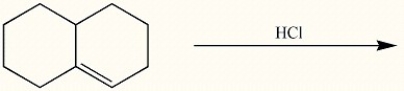
Question
Draw the major organic product generated in the reaction below. Pay particular attention to regio- and stereochemical detail. 
Question
Draw the major organic product generated in the reaction below. Pay particular attention to regio- and stereochemical detail. 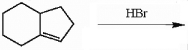
Question
Question
Draw the major organic product generated in the reaction below. Pay particular attention to regio- and stereochemical detail. 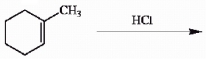
Question
When propylene reacts with hydrogen bromide in the presence of a peroxide initiator, which of the following structures are formed during the mechanism?
A)
B)
C)
D) H∙
A)
B)
C)
D) H∙
Question
Question
Draw the major organic product generated in the reaction below. Pay particular attention to regio- and stereochemical detail. 
Question
Predict the major product of the following reaction. 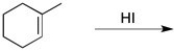
A)
B)
C)
D)
A)
B)
C)
D)
Question
Draw the major organic product generated in the reaction below. Pay particular attention to regio- and stereochemical detail. 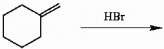
Question
Using any alkene as your starting material, how could you make the alkyl halide shown? 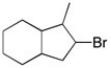
Question
Draw the major organic product generated in the reaction below. Pay particular attention to regio- and stereochemical detail. 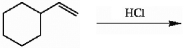
Question
Draw a full and complete mechanism to account for the formation of the product in the reaction shown below. 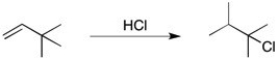
Question
Draw the major organic product generated in the reaction below. Pay particular attention to regio- and stereochemical detail. 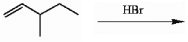
Question
Provide the structure of the major organic product of the reaction below. 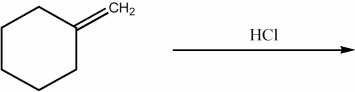
Question
Provide the structure of the major organic product of the reaction below. 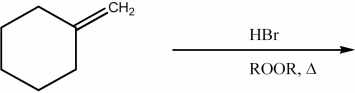
Question
Complete the following reaction and provide a detailed, step-by-step mechanism for the process. 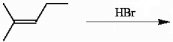
Question
Provide the major organic product of the reaction below. 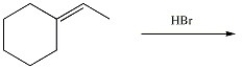
Question
Question
Question
Draw the major organic product generated in the reaction below. Pay particular attention to regio- and stereochemical detail. 
Question
Provide the reagents necessary to complete the following transformation. 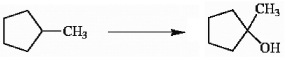
Question
Question
What is the major product of the following reaction? 
A)
B)
C)
D)
A)
B)
C)
D)
Question
Question
Question
Which radical is an intermediate in the following reaction? 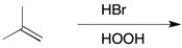
A)
B)
C)
D)
A)
B)
C)
D)
Question
Treatment of an alkene with an alcohol in the presence of an acid catalyst produces an ether as the major organic product. Provide a mechanism that shown how this product is formed. 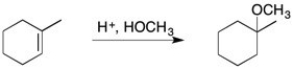
Question
Provide the reagents necessary to complete the following transformation. 
A) 1. BH3∙THF 2. H2O2, HO-
B) H2O, H2SO4
C) OsO4, H2O2
D) CH3CO3H
E) 1. CH3CO3H 2. H+, H2O
A) 1. BH3∙THF 2. H2O2, HO-
B) H2O, H2SO4
C) OsO4, H2O2
D) CH3CO3H
E) 1. CH3CO3H 2. H+, H2O
Question
Acid catalyzed hydration (H2SO4/water/△) of an unknown compound (A) with a chemical formula C6H12, yielded a racemic mixture of product C6H13OH. Which, if any, of the following compounds is/are possible structures for the initial compound (A)? 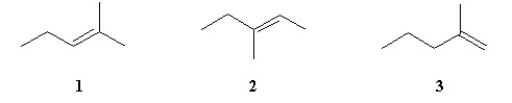
A) compound 1 only
B) compounds 2 and 3
C) compound 2 only
D) compounds 1 and 3
E) none of the above
A) compound 1 only
B) compounds 2 and 3
C) compound 2 only
D) compounds 1 and 3
E) none of the above
Question
Draw the major organic product generated in the reaction below. Pay particular attention to regio- and stereochemical detail. 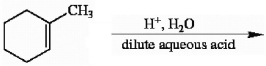
Question
Provide the structure of the major organic product of the reaction below. 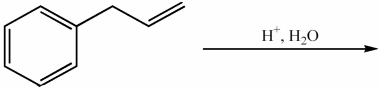
Question
Question
Question
Complete the following reaction and provide a detailed, step-by-step mechanism for the process. 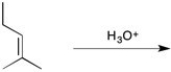
Question
Draw the major organic product(s) generated in the reaction below. Pay particular attention to regio- and stereochemical detail. 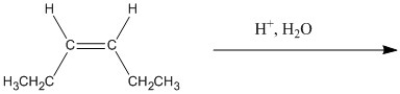
Question
Draw the major organic product generated in the reaction below. Pay particular attention to regio- and stereochemical detail. 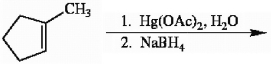
Question
Which one of these alkene would be likely to experience a carbocation rearrangement when treated with aqueous acid?
A)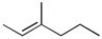
B)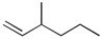
C)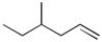
D) None of these would undergo a rearrangement.
A)
B)
C)
D) None of these would undergo a rearrangement.
Question
Draw the major organic product generated in the reaction below. Pay particular attention to regio- and stereochemical detail. 
Question
Which one of these alkene would be likely to experience a carbocation rearrangement when treated with Hg(OAc)2 in water, followed by reaction with sodium borohydride?
A)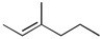
B)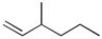
C)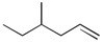
D) None of these would undergo a rearrangement.
A)
B)
C)
D) None of these would undergo a rearrangement.
Question
Provide the reagents necessary to complete the following transformation. 
A) 1. BH3∙THF 2. H2O2, HO-
B) H2O, H2SO4
C) OsO4, H2O2
D) CH3CO3H
E) 1. CH3CO3H 2. H+, H2O
A) 1. BH3∙THF 2. H2O2, HO-
B) H2O, H2SO4
C) OsO4, H2O2
D) CH3CO3H
E) 1. CH3CO3H 2. H+, H2O
Question
Complete the following reaction by filling in the appropriate reagents. 
Question
Provide the structure of the major organic product of the reaction below. 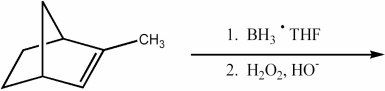
Question
Provide the structure of the major organic product of the reaction below. 
Question
Draw the major organic product generated in the reaction below. Pay particular attention to regio- and stereochemical detail. 
Question
Question
Draw the major organic product generated in the reaction below. Pay particular attention to regio- and stereochemical detail. 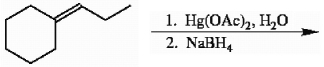
Question
Question
Use a transition state to explain the regiochemistry of the reaction below. Make sure to include correct partial charges. 
Question
Draw the major organic product generated in the reaction below. Pay particular attention to regio- and stereochemical detail. 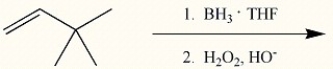
Question
Draw the major organic product generated in the reaction below. Pay particular attention to regio- and stereochemical detail. 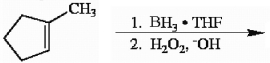
Question
Question
Draw the major organic product generated in the reaction below. Pay particular attention to regio- and stereochemical detail. 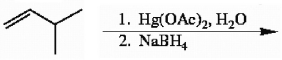
Question
Question
Draw the major organic product generated in the reaction below. Pay particular attention to regio- and stereochemical detail.
(Z)-3-hexene →
→
(Z)-3-hexene
→ Question
Draw the major organic product generated in the reaction below. Pay particular attention to regio- and stereochemical detail. 
Question
Provide the structure of the major organic product of the reaction below. 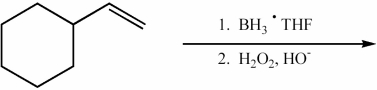
Question
Draw the major organic product generated in the reaction below. Pay particular attention to regio- and stereochemical detail. 
Question
Provide the structure of the major organic product of the reaction below. 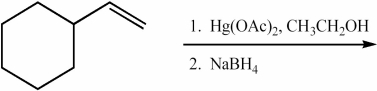
Question
Using any alkene as a starting material, how would you make the compound shown below? 
Question
Draw the major organic product generated in the reaction below. Pay particular attention to regio- and stereochemical detail. 
Question
Question
Draw a full and complete mechanism for the following reaction. 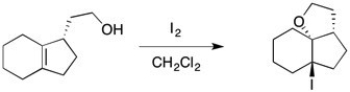
Question
Question
Which of the following alkenes will yield a meso dihalide when reacted with Br2/CCl4 at room temperature?
A)
B)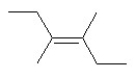
C)
D)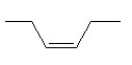
E) both Band D
A)
B)
C)
D)
E) both Band D
Question
Provide the structure of the major organic product of the reaction below. 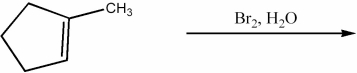
Question
Question
Predict the product of the following reaction. Include any relevant stereochemistry. 
Question
Provide the major organic product of the reaction below. 
Question
Question
Provide a detailed, step-by-step mechanism for the reaction shown below. 
Question
Draw the major organic product generated in the reaction below. Pay particular attention to regio- and stereochemical detail. 
Question
Complete the following reaction and provide a detailed, step-by-step mechanism for the process. 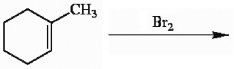
Question
Draw the major organic product generated in the reaction below. Pay particular attention to regio- and stereochemical detail. 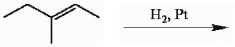
Question
Question
Draw the major organic product generated in the reaction below. Pay particular attention to regio- and stereochemical detail. 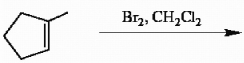
Question
Question
Draw the major organic product generated in the reaction below. Pay particular attention to regio- and stereochemical detail. 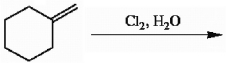
Question
Draw the major organic product(s) generated in the reaction below. Pay particular attention to regio- and stereochemical detail. 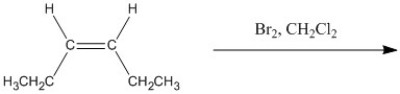

Unlock Deck
Sign up to unlock the cards in this deck!
Unlock Deck
Unlock Deck
1/134

Play

Full screen (f)
Deck 8: Reactions of Alkenes
1
Explain the regioselectivity observed in the radical addition of HBr to 2-methylpropene.
The reaction proceeds via the addition of Br∙ to the alkene. Two competing pathways are possible, but the transition state leading to the more substituted alkyl radical is lower in energy. This process ultimately makes the addition anti-Markovnikov in nature.
2
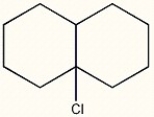
Draw the major regioisomeric product generated in the reaction below.
3
Draw the major organic product generated in the reaction below. Pay particular attention to regio- and stereochemical detail.

4
Draw the major organic product generated in the reaction below. Pay particular attention to regio- and stereochemical detail.
Unlock Deck
Unlock for access to all 134 flashcards in this deck.
Unlock Deck
k this deck
5
Based on the relative stabilities of the intermediates involved, explain the basis for Markovinkov's rule in the addition of hydrogen halides to alkenes.
Unlock Deck
Unlock for access to all 134 flashcards in this deck.
Unlock Deck
k this deck
6
Draw the major organic product generated in the reaction below. Pay particular attention to regio- and stereochemical detail.
Unlock Deck
Unlock for access to all 134 flashcards in this deck.
Unlock Deck
k this deck
7
When propylene reacts with hydrogen bromide in the presence of a peroxide initiator, which of the following structures are formed during the mechanism?
A)
B)
C)
D) H∙
A)
B)
C)
D) H∙
Unlock Deck
Unlock for access to all 134 flashcards in this deck.
Unlock Deck
k this deck
8
Name the major product which results when HBr is added to 3-ethyl-3-hexene.
Unlock Deck
Unlock for access to all 134 flashcards in this deck.
Unlock Deck
k this deck
9
Draw the major organic product generated in the reaction below. Pay particular attention to regio- and stereochemical detail.
Unlock Deck
Unlock for access to all 134 flashcards in this deck.
Unlock Deck
k this deck
10
Predict the major product of the following reaction.
A)
B)
C)
D)
A)
B)
C)
D)
Unlock Deck
Unlock for access to all 134 flashcards in this deck.
Unlock Deck
k this deck
11
Draw the major organic product generated in the reaction below. Pay particular attention to regio- and stereochemical detail.
Unlock Deck
Unlock for access to all 134 flashcards in this deck.
Unlock Deck
k this deck
12
Using any alkene as your starting material, how could you make the alkyl halide shown?
Unlock Deck
Unlock for access to all 134 flashcards in this deck.
Unlock Deck
k this deck
13
Draw the major organic product generated in the reaction below. Pay particular attention to regio- and stereochemical detail.
Unlock Deck
Unlock for access to all 134 flashcards in this deck.
Unlock Deck
k this deck
14
Draw a full and complete mechanism to account for the formation of the product in the reaction shown below.
Unlock Deck
Unlock for access to all 134 flashcards in this deck.
Unlock Deck
k this deck
15
Draw the major organic product generated in the reaction below. Pay particular attention to regio- and stereochemical detail.
Unlock Deck
Unlock for access to all 134 flashcards in this deck.
Unlock Deck
k this deck
16
Provide the structure of the major organic product of the reaction below.
Unlock Deck
Unlock for access to all 134 flashcards in this deck.
Unlock Deck
k this deck
17
Provide the structure of the major organic product of the reaction below.
Unlock Deck
Unlock for access to all 134 flashcards in this deck.
Unlock Deck
k this deck
18
Complete the following reaction and provide a detailed, step-by-step mechanism for the process.
Unlock Deck
Unlock for access to all 134 flashcards in this deck.
Unlock Deck
k this deck
19
Provide the major organic product of the reaction below.
Unlock Deck
Unlock for access to all 134 flashcards in this deck.
Unlock Deck
k this deck
20
HBr can be added to an alkene in the presence of peroxides (ROOR). What function does the peroxide serve in this reaction?
A) nucleophile
B) electrophile
C) radical chain initiator
D) acid catalyst
E) solvent
A) nucleophile
B) electrophile
C) radical chain initiator
D) acid catalyst
E) solvent
Unlock Deck
Unlock for access to all 134 flashcards in this deck.
Unlock Deck
k this deck
21
The mechanism for the acid-catalyzed hydration of alkenes is simply the reverse of the mechanism by which alcohols are dehydrated using concentrated acid. This is an illustration of the principle of ________.
Unlock Deck
Unlock for access to all 134 flashcards in this deck.
Unlock Deck
k this deck
22
Draw the major organic product generated in the reaction below. Pay particular attention to regio- and stereochemical detail.
Unlock Deck
Unlock for access to all 134 flashcards in this deck.
Unlock Deck
k this deck
23
Provide the reagents necessary to complete the following transformation.
Unlock Deck
Unlock for access to all 134 flashcards in this deck.
Unlock Deck
k this deck
24
When 3,6-dimethylcyclohexene is reacted with dry gaseous HBr, one of the products is 1-bromo-1,4-dimethylcyclohexane. Provide a detailed step-by-step mechanism to explain the formation of this product.
Unlock Deck
Unlock for access to all 134 flashcards in this deck.
Unlock Deck
k this deck
25
What is the major product of the following reaction?
A)
B)
C)
D)
A)
B)
C)
D)
Unlock Deck
Unlock for access to all 134 flashcards in this deck.
Unlock Deck
k this deck
26
What synthetic goal is achieved by subjecting an alkene to an oxymercuration-demercuration sequence?
A) Markovnikov addition of H2O wherein skeletal rearrangement is promoted
B) Markovnikov addition of H2O wherein skeletal rearrangement is prevented
C) anti-Markovnikov addition of H2O wherein skeletal rearrangement is promoted
D) anti-Markovnikov addition of H2O wherein skeletal rearrangement is prevented
E) syn-hydroxylation
A) Markovnikov addition of H2O wherein skeletal rearrangement is promoted
B) Markovnikov addition of H2O wherein skeletal rearrangement is prevented
C) anti-Markovnikov addition of H2O wherein skeletal rearrangement is promoted
D) anti-Markovnikov addition of H2O wherein skeletal rearrangement is prevented
E) syn-hydroxylation
Unlock Deck
Unlock for access to all 134 flashcards in this deck.
Unlock Deck
k this deck
27
Which of the following is the best reaction sequence to use if one wants to accomplish a Markovnikov addition of water to an alkene with minimal skeletal rearrangement?
A) water + dilute acid
B) water + concentrated acid
C) oxymercuration-demercuration
D) hydroboration-oxidation
E) none of the above
A) water + dilute acid
B) water + concentrated acid
C) oxymercuration-demercuration
D) hydroboration-oxidation
E) none of the above
Unlock Deck
Unlock for access to all 134 flashcards in this deck.
Unlock Deck
k this deck
28
Which radical is an intermediate in the following reaction?
A)
B)
C)
D)
A)
B)
C)
D)
Unlock Deck
Unlock for access to all 134 flashcards in this deck.
Unlock Deck
k this deck
29
Treatment of an alkene with an alcohol in the presence of an acid catalyst produces an ether as the major organic product. Provide a mechanism that shown how this product is formed.
Unlock Deck
Unlock for access to all 134 flashcards in this deck.
Unlock Deck
k this deck
30
Provide the reagents necessary to complete the following transformation.
A) 1. BH3∙THF 2. H2O2, HO-
B) H2O, H2SO4
C) OsO4, H2O2
D) CH3CO3H
E) 1. CH3CO3H 2. H+, H2O
A) 1. BH3∙THF 2. H2O2, HO-
B) H2O, H2SO4
C) OsO4, H2O2
D) CH3CO3H
E) 1. CH3CO3H 2. H+, H2O
Unlock Deck
Unlock for access to all 134 flashcards in this deck.
Unlock Deck
k this deck
31
Acid catalyzed hydration (H2SO4/water/△) of an unknown compound (A) with a chemical formula C6H12, yielded a racemic mixture of product C6H13OH. Which, if any, of the following compounds is/are possible structures for the initial compound (A)?
A) compound 1 only
B) compounds 2 and 3
C) compound 2 only
D) compounds 1 and 3
E) none of the above
A) compound 1 only
B) compounds 2 and 3
C) compound 2 only
D) compounds 1 and 3
E) none of the above
Unlock Deck
Unlock for access to all 134 flashcards in this deck.
Unlock Deck
k this deck
32
Draw the major organic product generated in the reaction below. Pay particular attention to regio- and stereochemical detail.
Unlock Deck
Unlock for access to all 134 flashcards in this deck.
Unlock Deck
k this deck
33
Provide the structure of the major organic product of the reaction below.
Unlock Deck
Unlock for access to all 134 flashcards in this deck.
Unlock Deck
k this deck
34
Which of the following intermediates is thought to occur in the mechanism by which alkenes are hydrated in the presence of acid?
A) carbanion
B) carbocation
C) free radical
D) carbene
E) alkyne
A) carbanion
B) carbocation
C) free radical
D) carbene
E) alkyne
Unlock Deck
Unlock for access to all 134 flashcards in this deck.
Unlock Deck
k this deck
35
Name the major alcohol product which results when 3,3-dimethylbut-1-ene is treated with dilute acid.
Unlock Deck
Unlock for access to all 134 flashcards in this deck.
Unlock Deck
k this deck
36
Complete the following reaction and provide a detailed, step-by-step mechanism for the process.
Unlock Deck
Unlock for access to all 134 flashcards in this deck.
Unlock Deck
k this deck
37
Draw the major organic product(s) generated in the reaction below. Pay particular attention to regio- and stereochemical detail.
Unlock Deck
Unlock for access to all 134 flashcards in this deck.
Unlock Deck
k this deck
38
Draw the major organic product generated in the reaction below. Pay particular attention to regio- and stereochemical detail.
Unlock Deck
Unlock for access to all 134 flashcards in this deck.
Unlock Deck
k this deck
39
Which one of these alkene would be likely to experience a carbocation rearrangement when treated with aqueous acid?
A)
B)
C)
D) None of these would undergo a rearrangement.
A)
B)
C)
D) None of these would undergo a rearrangement.
Unlock Deck
Unlock for access to all 134 flashcards in this deck.
Unlock Deck
k this deck
40
Draw the major organic product generated in the reaction below. Pay particular attention to regio- and stereochemical detail.
Unlock Deck
Unlock for access to all 134 flashcards in this deck.
Unlock Deck
k this deck
41
Which one of these alkene would be likely to experience a carbocation rearrangement when treated with Hg(OAc)2 in water, followed by reaction with sodium borohydride?
A)
B)
C)
D) None of these would undergo a rearrangement.
A)
B)
C)
D) None of these would undergo a rearrangement.
Unlock Deck
Unlock for access to all 134 flashcards in this deck.
Unlock Deck
k this deck
42
Provide the reagents necessary to complete the following transformation.
A) 1. BH3∙THF 2. H2O2, HO-
B) H2O, H2SO4
C) OsO4, H2O2
D) CH3CO3H
E) 1. CH3CO3H 2. H+, H2O
A) 1. BH3∙THF 2. H2O2, HO-
B) H2O, H2SO4
C) OsO4, H2O2
D) CH3CO3H
E) 1. CH3CO3H 2. H+, H2O
Unlock Deck
Unlock for access to all 134 flashcards in this deck.
Unlock Deck
k this deck
43
Complete the following reaction by filling in the appropriate reagents.
Unlock Deck
Unlock for access to all 134 flashcards in this deck.
Unlock Deck
k this deck
44
Provide the structure of the major organic product of the reaction below.
Unlock Deck
Unlock for access to all 134 flashcards in this deck.
Unlock Deck
k this deck
45
Provide the structure of the major organic product of the reaction below.
Unlock Deck
Unlock for access to all 134 flashcards in this deck.
Unlock Deck
k this deck
46
Draw the major organic product generated in the reaction below. Pay particular attention to regio- and stereochemical detail.
Unlock Deck
Unlock for access to all 134 flashcards in this deck.
Unlock Deck
k this deck
47
How many moles of BH3 need to be added to completely react with 1 mole of hex-1-ene?
A) 1 mole of BH3
B) 3 mole of BH3
C) 1/3 mole of BH3
D) 1/2 mole of BH3
A) 1 mole of BH3
B) 3 mole of BH3
C) 1/3 mole of BH3
D) 1/2 mole of BH3
Unlock Deck
Unlock for access to all 134 flashcards in this deck.
Unlock Deck
k this deck
48
Draw the major organic product generated in the reaction below. Pay particular attention to regio- and stereochemical detail.
Unlock Deck
Unlock for access to all 134 flashcards in this deck.
Unlock Deck
k this deck
49
When an alkene is subjected to treatment with Hg(OAc)2 in alcohol followed by reaction with NaBH4, what new class of compound is formed?
A) ether
B) epoxide
C) alkane
D) syn diol
E) alkyne
A) ether
B) epoxide
C) alkane
D) syn diol
E) alkyne
Unlock Deck
Unlock for access to all 134 flashcards in this deck.
Unlock Deck
k this deck
50
Use a transition state to explain the regiochemistry of the reaction below. Make sure to include correct partial charges.
Unlock Deck
Unlock for access to all 134 flashcards in this deck.
Unlock Deck
k this deck
51
Draw the major organic product generated in the reaction below. Pay particular attention to regio- and stereochemical detail.
Unlock Deck
Unlock for access to all 134 flashcards in this deck.
Unlock Deck
k this deck
52
Draw the major organic product generated in the reaction below. Pay particular attention to regio- and stereochemical detail.
Unlock Deck
Unlock for access to all 134 flashcards in this deck.
Unlock Deck
k this deck
53
Treatment of 2-methylpropene with which of the following reaction conditions results in an anti-Markovnikov addition product?
A) dry gaseous HBr with peroxides present
B) BH3-THF, followed by alkaline H2O2
C) aqueous Hg(OAc)2, followed by alkaline NaBH4
D) dilute H2SO4 and heat
E) both A and B
A) dry gaseous HBr with peroxides present
B) BH3-THF, followed by alkaline H2O2
C) aqueous Hg(OAc)2, followed by alkaline NaBH4
D) dilute H2SO4 and heat
E) both A and B
Unlock Deck
Unlock for access to all 134 flashcards in this deck.
Unlock Deck
k this deck
54
Draw the major organic product generated in the reaction below. Pay particular attention to regio- and stereochemical detail.
Unlock Deck
Unlock for access to all 134 flashcards in this deck.
Unlock Deck
k this deck
55
Provide the reagents necessary to convert 3-methyl-2-butanol to 2-methyl-2-butanol.
Unlock Deck
Unlock for access to all 134 flashcards in this deck.
Unlock Deck
k this deck
56
Draw the major organic product generated in the reaction below. Pay particular attention to regio- and stereochemical detail.
(Z)-3-hexene →
(Z)-3-hexene
→ Unlock Deck
Unlock for access to all 134 flashcards in this deck.
Unlock Deck
k this deck
57
Draw the major organic product generated in the reaction below. Pay particular attention to regio- and stereochemical detail.
Unlock Deck
Unlock for access to all 134 flashcards in this deck.
Unlock Deck
k this deck
58
Provide the structure of the major organic product of the reaction below.
Unlock Deck
Unlock for access to all 134 flashcards in this deck.
Unlock Deck
k this deck
59
Draw the major organic product generated in the reaction below. Pay particular attention to regio- and stereochemical detail.
Unlock Deck
Unlock for access to all 134 flashcards in this deck.
Unlock Deck
k this deck
60
Provide the structure of the major organic product of the reaction below.
Unlock Deck
Unlock for access to all 134 flashcards in this deck.
Unlock Deck
k this deck
61
Using any alkene as a starting material, how would you make the compound shown below?
Unlock Deck
Unlock for access to all 134 flashcards in this deck.
Unlock Deck
k this deck
62
Draw the major organic product generated in the reaction below. Pay particular attention to regio- and stereochemical detail.
Unlock Deck
Unlock for access to all 134 flashcards in this deck.
Unlock Deck
k this deck
63
Consider how the I-Cl bond is polarized and predict the product which results when this mixed halogen adds to 1-methylcyclohexene.
Unlock Deck
Unlock for access to all 134 flashcards in this deck.
Unlock Deck
k this deck
64
Draw a full and complete mechanism for the following reaction.
Unlock Deck
Unlock for access to all 134 flashcards in this deck.
Unlock Deck
k this deck
65
Humulene is a monocyclic terpene constituent of carnations. When 0.25 mol of humulene is hydrogenated in the presence of platinum catalyst, 0.75 mol of H2 reacts with the humulene to produce a monocyclic hydrocarbon of formula C15H30. What is the molecular formula of humulene?
Unlock Deck
Unlock for access to all 134 flashcards in this deck.
Unlock Deck
k this deck
66
Which of the following alkenes will yield a meso dihalide when reacted with Br2/CCl4 at room temperature?
A)
B)
C)
D)
E) both Band D
A)
B)
C)
D)
E) both Band D
Unlock Deck
Unlock for access to all 134 flashcards in this deck.
Unlock Deck
k this deck
67
Provide the structure of the major organic product of the reaction below.
Unlock Deck
Unlock for access to all 134 flashcards in this deck.
Unlock Deck
k this deck
68
Which of the following additions to alkenes occur(s) specifically in an anti fashion?
A) hydroboration-oxidation
B) addition of Br2
C) addition of H2
D) addition of H2O in dilute acid
E) both A and B
A) hydroboration-oxidation
B) addition of Br2
C) addition of H2
D) addition of H2O in dilute acid
E) both A and B
Unlock Deck
Unlock for access to all 134 flashcards in this deck.
Unlock Deck
k this deck
69
Predict the product of the following reaction. Include any relevant stereochemistry.
Unlock Deck
Unlock for access to all 134 flashcards in this deck.
Unlock Deck
k this deck
70
Provide the major organic product of the reaction below.
Unlock Deck
Unlock for access to all 134 flashcards in this deck.
Unlock Deck
k this deck
71
Both (E)- and (Z)-hex-3-ene can be treated with D2 in the presence of a platinum catalyst. How are the products from these two reactions related to each other?
A) The (E)- and (Z)-isomers generate the same products but in differing amounts.
B) The (E)- and (Z)-isomers generate the same products in exactly the same amounts.
C) The products of the two isomers are related as constitutional isomers.
D) The products of the two isomers are related as diastereomers.
E) The products of the two isomers are related as enantiomers.
A) The (E)- and (Z)-isomers generate the same products but in differing amounts.
B) The (E)- and (Z)-isomers generate the same products in exactly the same amounts.
C) The products of the two isomers are related as constitutional isomers.
D) The products of the two isomers are related as diastereomers.
E) The products of the two isomers are related as enantiomers.
Unlock Deck
Unlock for access to all 134 flashcards in this deck.
Unlock Deck
k this deck
72
Provide a detailed, step-by-step mechanism for the reaction shown below.
Unlock Deck
Unlock for access to all 134 flashcards in this deck.
Unlock Deck
k this deck
73
Draw the major organic product generated in the reaction below. Pay particular attention to regio- and stereochemical detail.
Unlock Deck
Unlock for access to all 134 flashcards in this deck.
Unlock Deck
k this deck
74
Complete the following reaction and provide a detailed, step-by-step mechanism for the process.
Unlock Deck
Unlock for access to all 134 flashcards in this deck.
Unlock Deck
k this deck
75
Draw the major organic product generated in the reaction below. Pay particular attention to regio- and stereochemical detail.
Unlock Deck
Unlock for access to all 134 flashcards in this deck.
Unlock Deck
k this deck
76
________ is the use of an optically active reagent or catalyst to convert an optically inactive starting material into an optically active product.
A) Asymmetric induction
B) Racemization
C) Optical reduction
D) Meso effection
E) Chiralization
A) Asymmetric induction
B) Racemization
C) Optical reduction
D) Meso effection
E) Chiralization
Unlock Deck
Unlock for access to all 134 flashcards in this deck.
Unlock Deck
k this deck
77
Draw the major organic product generated in the reaction below. Pay particular attention to regio- and stereochemical detail.
Unlock Deck
Unlock for access to all 134 flashcards in this deck.
Unlock Deck
k this deck
78
Addition of Br2 to (E)-hex-3-ene produces ________.
A) a meso dibromide
B) a mixture of enantiomeric dibromides which is optically active
C) a mixture of enantiomeric dibromides which is optically inactive
D) (Z)-3,4-dibromo-3-hexene
E) (E)-3,4-dibromo-3-hexene
A) a meso dibromide
B) a mixture of enantiomeric dibromides which is optically active
C) a mixture of enantiomeric dibromides which is optically inactive
D) (Z)-3,4-dibromo-3-hexene
E) (E)-3,4-dibromo-3-hexene
Unlock Deck
Unlock for access to all 134 flashcards in this deck.
Unlock Deck
k this deck
79
Draw the major organic product generated in the reaction below. Pay particular attention to regio- and stereochemical detail.
Unlock Deck
Unlock for access to all 134 flashcards in this deck.
Unlock Deck
k this deck
80
Draw the major organic product(s) generated in the reaction below. Pay particular attention to regio- and stereochemical detail.
Unlock Deck
Unlock for access to all 134 flashcards in this deck.
Unlock Deck
k this deck
Unlock Deck
Unlock for access to all 134 flashcards in this deck.






