







 Chat with AI

Deck 13: Multinational Capital Budgeting
Full screen (f)

Question

Question
Question
Question
Question
Question
Question
Question
Question
Question
Question
Question
Question
Question
Question
Question
Question
Question
Question
Question
Question
Question
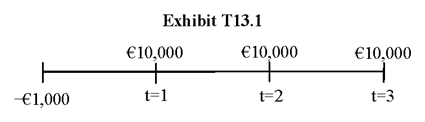
Refer to Exhibit T13.1. Assume 50% of the project's expected cash flows are retained in the host country until the project is 3 years old. The opportunity cost of these funds is i€ = 5%, but these blocked funds earn no interest. What is the NPV of the opportunity cost from these blocked funds?
A) €569.16
B) €598.24
C) €625.80
D) €658.68
E) €683.22
Question
Question
Refer to Exhibit T13.1. Assume the international parity conditions DO NOT hold . Expected future spot rates are: E(S1£/€) = £2.060/€, E(S2£/€) = £2.100/€, and E(S3£/€) =£2.220/€. Calculate NPV£ by converting euros to pounds at the expected future spot rates and discounting in pounds. Assume S0£/€ = £2/€ and i£ = 7%.
A) NPV£ = £52,464.96
B) NPV£ = £52,978.31
C) NPV£ = £53,015.25
D) NPV£ = £53,716.36
E) NPV£ = £54,142.84
Question
Question
Refer to Exhibit T13.1. Assume the international parity conditions hold. The current spot rate is S0£/€ = £2/€. If i£ = 7% and i€ = 5%, what is the expected future spot rate [E(S3£/€ )] at time t = 3?
A) £1.890/€
B) £1.963/€
C) £2.020/€
D) £2.116/€
E) £2.250/€
Question
Question
Question
Question
Question
Refer to Exhibit T13.1. Assume the international parity conditions hold. The current spot rate is S0£/€ = £2/€. If i£ = 7% and i€ = 5%, what is NPV£?
A) £48,591.54
B) £50,786.92
C) £52,464.96
D) £54,527.33
E) £55,328.10
Question
Refer to Exhibit T13.1. Suppose that beginning in year 1, there is a 10% chance each year the host government will seize the project's assets. If the assets are not seized, you expect to receive the cash flows as stated above. If the assets are seized in a particular year, you expect to receive no repatriated funds thereafter. Assuming international parity conditions hold, S0£/€ = £2/€, i€ = 5%, and i£ = 7%, what is the NPV in pounds?
A) £42,431.49
B) £47,018.46
C) £47,368.32
D) £49.652.21
E) £50,737.29
Question
Question
Refer to Exhibit T13.1. The appropriate discount rate is i€ = 5%. What is the NPV€ in euros?
A) €25,598.43
B) €26,232.48
C) €27,232.48
D) €29,000.00
E) €29,432.52
Question
Question
Refer to Exhibit T13.1. Suppose there is a 10% chance that the host government will seize the assets of the project in year 3. If the assets are not seized, you expect to receive the cash flows as shown. If the assets are seized, you expect to receive repatriated funds in year 1 and year 2 only. Assuming international parity conditions hold, S0£/€ = £2/€, i€ = 5%, and i£ = 7%, what is the NPV in pounds?
A) £42,431.49
B) £47,018.46
C) £47,368.32
D) £49.652.21
E) £50,737.29
Question

Unlock Deck
Sign up to unlock the cards in this deck!
Unlock Deck
Unlock Deck
1/37

Play

Full screen (f)
Deck 13: Multinational Capital Budgeting
1
If a project has a positive NPV from both the parent's and the project's perspective, then the parent firm should ______.
A) accept the project
B) reject the project
C) accept the project and try to capture the value in the foreign currency today
D) reject the project and continue to look for positive-NPV projects in the foreign currency
E) None of the above
A) accept the project
B) reject the project
C) accept the project and try to capture the value in the foreign currency today
D) reject the project and continue to look for positive-NPV projects in the foreign currency
E) None of the above
accept the project
2
The only relevant cash flows from the project's point of view are those that are to be remitted to the parent in the parent's functional currency.
False
3
Relevant cash flows from the parent's point of view are those that are remitted to the parent in its functional currency.
True
4
Blocked funds in a foreign country should be discounted at the risk-free rate of interest in the foreign currency.
Unlock Deck
Unlock for access to all 37 flashcards in this deck.
Unlock Deck
k this deck
5
In order to compensate for the effects of inflation, nominal cash flows should be discounted with a real discount rate.
Unlock Deck
Unlock for access to all 37 flashcards in this deck.
Unlock Deck
k this deck
6
Cash flows from subsidized financing are necessarily tied to a specific project.
Unlock Deck
Unlock for access to all 37 flashcards in this deck.
Unlock Deck
k this deck
7
In capital budgeting, repatriation occurs when expatriate employees return to the parent firm.
Unlock Deck
Unlock for access to all 37 flashcards in this deck.
Unlock Deck
k this deck
8
Blocked funds are cash flows generated by a foreign project that are not immediately repatriated to the parent because the project has better opportunities than the parent corporation.
Unlock Deck
Unlock for access to all 37 flashcards in this deck.
Unlock Deck
k this deck
9
In perfect financial markets in which the international parity conditions hold, discounting may be done either in the domestic or in the foreign currency.
Unlock Deck
Unlock for access to all 37 flashcards in this deck.
Unlock Deck
k this deck
10
Which of the following is FALSE?
A) Cash flows in a particular currency should be discounted in that currency.
B) Cash flows should be discounted at the opportunity cost of capital.
C) Cash flows to equity should be discounted at the weighted average cost of capital.
D) Nominal cash flows should be discounted at nominal discount rates.
E) Real cash flows should be discounted at real discount rates.
A) Cash flows in a particular currency should be discounted in that currency.
B) Cash flows should be discounted at the opportunity cost of capital.
C) Cash flows to equity should be discounted at the weighted average cost of capital.
D) Nominal cash flows should be discounted at nominal discount rates.
E) Real cash flows should be discounted at real discount rates.
Unlock Deck
Unlock for access to all 37 flashcards in this deck.
Unlock Deck
k this deck
11
If the international parity conditions hold, then nominal required returns in two different currencies are identical on comparable-risk assets.
Unlock Deck
Unlock for access to all 37 flashcards in this deck.
Unlock Deck
k this deck
12
Nominal cash flows in a foreign currency should be discounted ______.
A) at a nominal discount rate in the foreign currency
B) at a rate reflecting the parent's opportunity cost of capital in the domestic currency
C) at a weighted average cost of capital
D) at the cost of debt
E) at the cost of equity
A) at a nominal discount rate in the foreign currency
B) at a rate reflecting the parent's opportunity cost of capital in the domestic currency
C) at a weighted average cost of capital
D) at the cost of debt
E) at the cost of equity
Unlock Deck
Unlock for access to all 37 flashcards in this deck.
Unlock Deck
k this deck
13
According to finance theory, the value of subsidized financing that is separable from a particular project must still be added to the value of the project in calculating project value.
Unlock Deck
Unlock for access to all 37 flashcards in this deck.
Unlock Deck
k this deck
14
Project-specific expropriation risk has no effect on expected future cash flows from a project, but can increase the discount rate.
Unlock Deck
Unlock for access to all 37 flashcards in this deck.
Unlock Deck
k this deck
15
Managers care only about systematic risk and hence should not hedge political risk.
Unlock Deck
Unlock for access to all 37 flashcards in this deck.
Unlock Deck
k this deck
16
The discount rate should always be in the parent firm's functional currency.
Unlock Deck
Unlock for access to all 37 flashcards in this deck.
Unlock Deck
k this deck
17
Developing countries sometimes require that foreign companies investing capital locally take on additional development or infrastructure projects.
Unlock Deck
Unlock for access to all 37 flashcards in this deck.
Unlock Deck
k this deck
18
Expected future cash flows are estimated by ______ only incremental cash flows and ______ all opportunity costs.
A) including; including
B) including; excluding
C) excluding; including
D) excluding; excluding
E) None of the above
A) including; including
B) including; excluding
C) excluding; including
D) excluding; excluding
E) None of the above
Unlock Deck
Unlock for access to all 37 flashcards in this deck.
Unlock Deck
k this deck
19
Which of steps a) through d) is INAPPROPRIATE when discounting foreign currency cash flows using the parent's perspective?
A) Estimate expected future cash flows from the project in the foreign currency and put them on a time line.
B) Convert expected future cash flows into the domestic currency at the current spot exchange rate.
C) Identify the appropriate risk-adjusted discount rate in the domestic currency for the project.
D) Calculate the NPV in the domestic currency.
E) Each of the above is appropriate.
A) Estimate expected future cash flows from the project in the foreign currency and put them on a time line.
B) Convert expected future cash flows into the domestic currency at the current spot exchange rate.
C) Identify the appropriate risk-adjusted discount rate in the domestic currency for the project.
D) Calculate the NPV in the domestic currency.
E) Each of the above is appropriate.
Unlock Deck
Unlock for access to all 37 flashcards in this deck.
Unlock Deck
k this deck
20
Because of different currencies and interest rates in each country, capital budgeting analysis for cross-border investments is radically different from capital budgeting analysis for domestic investments.
Unlock Deck
Unlock for access to all 37 flashcards in this deck.
Unlock Deck
k this deck
21
Suppose the government of Germany offers you a 3-year, non-amortizing €50,000 loan to entice you to undertake a particular project within its borders. In addition, the government offers you an attractive rate of i€ = 10% when loans of similar risk yield a return of i€ = 15%. The German tax rate is 50%. What is the present value of the interest subsidy on this loan?
A) €2854.03
B) €3108.56
C) €3250.66
D) €4895.60
E) €5708.06
A) €2854.03
B) €3108.56
C) €3250.66
D) €4895.60
E) €5708.06
Unlock Deck
Unlock for access to all 37 flashcards in this deck.
Unlock Deck
k this deck
22
Refer to Exhibit T13.1. Assume 50% of the project's expected cash flows are retained in the host country until the project is 3 years old. The opportunity cost of these funds is i€ = 5%, but these blocked funds earn no interest. What is the NPV of the opportunity cost from these blocked funds?
A) €569.16
B) €598.24
C) €625.80
D) €658.68
E) €683.22
Unlock Deck
Unlock for access to all 37 flashcards in this deck.
Unlock Deck
k this deck
23
A project has a net present value of NPV€ = €10,000. In order to invest in the project, the German government requires that you undertake another project with the following cash flow stream: CF0€ = -€5000, E[CF1€] = €1000, E[CF2€] = €1000, and E[CF3€] = €1000. The appropriate discount rate for this project is i€ = 10%. What affect does this tie-in project have on your original NPV€ estimate?
A) It increases NPV€ from €10,000 to €12,513.15.
B) It increases NPV€ from €10,000 to €17,486.85.
C) It decreases NPV€ from €10,000 to €7,486.85.
D) It increases NPV€ from €10,000 to €2,513.15.
E) It is a separate project and has no effect on NPV.
A) It increases NPV€ from €10,000 to €12,513.15.
B) It increases NPV€ from €10,000 to €17,486.85.
C) It decreases NPV€ from €10,000 to €7,486.85.
D) It increases NPV€ from €10,000 to €2,513.15.
E) It is a separate project and has no effect on NPV.
Unlock Deck
Unlock for access to all 37 flashcards in this deck.
Unlock Deck
k this deck
24
Refer to Exhibit T13.1. Assume the international parity conditions DO NOT hold . Expected future spot rates are: E(S1£/€) = £2.060/€, E(S2£/€) = £2.100/€, and E(S3£/€) =£2.220/€. Calculate NPV£ by converting euros to pounds at the expected future spot rates and discounting in pounds. Assume S0£/€ = £2/€ and i£ = 7%.
A) NPV£ = £52,464.96
B) NPV£ = £52,978.31
C) NPV£ = £53,015.25
D) NPV£ = £53,716.36
E) NPV£ = £54,142.84
Unlock Deck
Unlock for access to all 37 flashcards in this deck.
Unlock Deck
k this deck
25
If a project has a positive NPV but the NPV is greater from the project's than from the parent's perspective, then the parent firm should ______.
A) accept the project
B) reject the project
C) accept the project and hedge the foreign currency cash flows
D) reject the project and continue to look for positive-NPV projects in the foreign country
E) None of the above
A) accept the project
B) reject the project
C) accept the project and hedge the foreign currency cash flows
D) reject the project and continue to look for positive-NPV projects in the foreign country
E) None of the above
Unlock Deck
Unlock for access to all 37 flashcards in this deck.
Unlock Deck
k this deck
26
Refer to Exhibit T13.1. Assume the international parity conditions hold. The current spot rate is S0£/€ = £2/€. If i£ = 7% and i€ = 5%, what is the expected future spot rate [E(S3£/€ )] at time t = 3?
A) £1.890/€
B) £1.963/€
C) £2.020/€
D) £2.116/€
E) £2.250/€
Unlock Deck
Unlock for access to all 37 flashcards in this deck.
Unlock Deck
k this deck
27
You invest BRL 1 million in land on the coast of Brazil. You expect the land to retain its BRL 1 million real value for the foreseeable future. The annual risk-free rate of interest in BRL is 10 percent. The market risk premium on the local Brazilian stock market is 5 percent per year. Expected annual inflation in BRL is 8 percent. The Brazilian corporate income tax rate is 40 percent. If you plan on selling the land in two years, what is your expected tax payment on the sale?
A) BRL 0
B) BRL 41,000
C) BRL 66,560
D) BRL 84,000
E) BRL 129,000
A) BRL 0
B) BRL 41,000
C) BRL 66,560
D) BRL 84,000
E) BRL 129,000
Unlock Deck
Unlock for access to all 37 flashcards in this deck.
Unlock Deck
k this deck
28
You invest BRL 10 million in inventory for your Brazilian factory. You expect to make no further investment or disinvestment in inventory over the 5-year life of your project. You expect the inventory will retain its real value. Inventory costing is done on a LIFO (last in/first out) basis. Expected annual inflation in BRL is 8 percent. The Brazilian corporate income tax rate is 40 percent. What is the expected nominal value of the inventory in five years before taxes (approximately)?
A) BRL 4.0 million
B) BRL 6.8 million
C) BRL10.0 million
D) BRL10.8 million
E) BRL14.7 million
A) BRL 4.0 million
B) BRL 6.8 million
C) BRL10.0 million
D) BRL10.8 million
E) BRL14.7 million
Unlock Deck
Unlock for access to all 37 flashcards in this deck.
Unlock Deck
k this deck
29
You invest BRL 1 million in land on the coast of Brazil. You expect the land to retain its BRL 1 million real value for the foreseeable future. The annual risk-free rate of interest in BRL is 10 percent. The market risk premium on the local Brazilian stock market is 5 percent per year. Expected annual inflation in BRL is 8 percent. The Brazilian corporate income tax rate is 40 percent. What is the expected nominal value of the land in two years before taxes?
A) BRL 1,000,000
B) BRL 1,102,500
C) BRL 1,166,400
D) BRL 1,210,000
E) BRL 1,322,500
A) BRL 1,000,000
B) BRL 1,102,500
C) BRL 1,166,400
D) BRL 1,210,000
E) BRL 1,322,500
Unlock Deck
Unlock for access to all 37 flashcards in this deck.
Unlock Deck
k this deck
30
You invest BRL 100 million in a factory in Brazil. The factory will be depreciated at the rate of BRL 5 million per year for 20 years to a zero salvage value. You expect the factory will be worth BRL 90 million in nominal terms after four years. You plan on selling the factory in four years. The Brazilian corporate income tax rate is 40 percent. What is your expected tax liability on the sale?
A) BRL 0 million
B) BRL 4 million
C) BRL 10 million
D) BRL 36 million
E) BRL 80 million
A) BRL 0 million
B) BRL 4 million
C) BRL 10 million
D) BRL 36 million
E) BRL 80 million
Unlock Deck
Unlock for access to all 37 flashcards in this deck.
Unlock Deck
k this deck
31
Refer to Exhibit T13.1. Assume the international parity conditions hold. The current spot rate is S0£/€ = £2/€. If i£ = 7% and i€ = 5%, what is NPV£?
A) £48,591.54
B) £50,786.92
C) £52,464.96
D) £54,527.33
E) £55,328.10
Unlock Deck
Unlock for access to all 37 flashcards in this deck.
Unlock Deck
k this deck
32
Refer to Exhibit T13.1. Suppose that beginning in year 1, there is a 10% chance each year the host government will seize the project's assets. If the assets are not seized, you expect to receive the cash flows as stated above. If the assets are seized in a particular year, you expect to receive no repatriated funds thereafter. Assuming international parity conditions hold, S0£/€ = £2/€, i€ = 5%, and i£ = 7%, what is the NPV in pounds?
A) £42,431.49
B) £47,018.46
C) £47,368.32
D) £49.652.21
E) £50,737.29
Unlock Deck
Unlock for access to all 37 flashcards in this deck.
Unlock Deck
k this deck
33
If a project has a positive NPV from the parent's perspective but a negative NPV from the project's perspective, then the parent firm should ______.
A) accept the project
B) reject the project
C) accept the project and try to capture the value in the foreign currency today
D) reject the project and continue to look for positive-NPV projects in the foreign currency
E) None of the above
A) accept the project
B) reject the project
C) accept the project and try to capture the value in the foreign currency today
D) reject the project and continue to look for positive-NPV projects in the foreign currency
E) None of the above
Unlock Deck
Unlock for access to all 37 flashcards in this deck.
Unlock Deck
k this deck
34
Refer to Exhibit T13.1. The appropriate discount rate is i€ = 5%. What is the NPV€ in euros?
A) €25,598.43
B) €26,232.48
C) €27,232.48
D) €29,000.00
E) €29,432.52
Unlock Deck
Unlock for access to all 37 flashcards in this deck.
Unlock Deck
k this deck
35
You invest BRL 10 million in inventory for your Brazilian factory. You expect to make no further investment or disinvestment in inventory over the 5-year life of your project. You expect the inventory will retain its real value. Inventory costing is done on a LIFO (last in/first out) basis. Expected annual inflation in BRL is 8 percent. The Brazilian corporate income tax rate is 40 percent. If you plan on selling the inventory in five years, your expected tax liability on the sale is about ______.
A) BRL 0.0 million
B) BRL 0.3 million
C) BRL 1.6 million
D) BRL1.9 million
E) BRL4.0 million
A) BRL 0.0 million
B) BRL 0.3 million
C) BRL 1.6 million
D) BRL1.9 million
E) BRL4.0 million
Unlock Deck
Unlock for access to all 37 flashcards in this deck.
Unlock Deck
k this deck
36
Refer to Exhibit T13.1. Suppose there is a 10% chance that the host government will seize the assets of the project in year 3. If the assets are not seized, you expect to receive the cash flows as shown. If the assets are seized, you expect to receive repatriated funds in year 1 and year 2 only. Assuming international parity conditions hold, S0£/€ = £2/€, i€ = 5%, and i£ = 7%, what is the NPV in pounds?
A) £42,431.49
B) £47,018.46
C) £47,368.32
D) £49.652.21
E) £50,737.29
Unlock Deck
Unlock for access to all 37 flashcards in this deck.
Unlock Deck
k this deck
37
If a project has a negative NPV from the parent's perspective but a positive NPV from the project's perspective, then the parent firm should ______.
A) accept the project
B) reject the project
C) accept the project and try to capture the value in the foreign currency today
D) reject the project and continue to look for positive-NPV projects in the foreign country
E) None of the above
A) accept the project
B) reject the project
C) accept the project and try to capture the value in the foreign currency today
D) reject the project and continue to look for positive-NPV projects in the foreign country
E) None of the above
Unlock Deck
Unlock for access to all 37 flashcards in this deck.
Unlock Deck
k this deck
Unlock Deck
Unlock for access to all 37 flashcards in this deck.






