







 Chat with AI

Deck 7: Production Economics
Full screen (f)

Question

Question
Question
Question
Question
Question
Question
Question
Question
Question
Question
Question
Question
Question
Question
Question
Fill in the missing data to solve this problem. 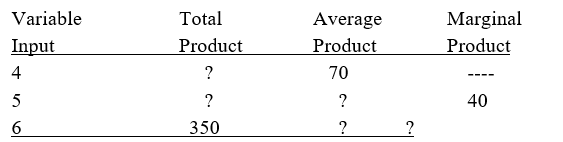
What is the total product for 5 units of input,and what is the marginal product for 6 units of input?
A)320 and 30
B)350 and 20
C)360 and 15
D)400 and 10
E)430 and 8
What is the total product for 5 units of input,and what is the marginal product for 6 units of input?
A)320 and 30
B)350 and 20
C)360 and 15
D)400 and 10
E)430 and 8
Question
Question
Question
Question
Question
Question
Question
Question
The original Cobb-Douglas function was given as  .It was subsequently rewritten as
  .What benefit was derived in the revision?
A)the function becomes a non-linear relationship so it would fit to production curves having an "S" shape
B)returns to scale can be shown in the revision
C)returns to scale become constant
D)a and b only
E)a,b,and c
.It was subsequently rewritten as .What benefit was derived in the revision?A)the function becomes a non-linear relationship so it would fit to production curves having an "S" shape
B)returns to scale can be shown in the revision
C)returns to scale become constant
D)a and b only
E)a,b,and c
Question
Question
Emco Company has an assembly line of fixed size A.Total output is a function of the number of workers (crew size)as shown in the following schedule:
 Determine the following schedules:
(a) marginal productivity of labor
(b) average productivity of labor
(c) elasticity of production with respect to labor
Determine the following schedules:(a) marginal productivity of labor
(b) average productivity of labor
(c) elasticity of production with respect to labor
Question
In the Cobb-Douglas production function (  ):
):
A)the marginal product of labor (L)is equal to 1
B)the average product of labor (L)is equal to 2
C)if the amount of labor input (L)is increased by 1 percent,the output will increase by 1 percent
D)a and b
E)a and c
):A)the marginal product of labor (L)is equal to 1
B)the average product of labor (L)is equal to 2
C)if the amount of labor input (L)is increased by 1 percent,the output will increase by 1 percent
D)a and b
E)a and c
Question
Question

Unlock Deck
Sign up to unlock the cards in this deck!
Unlock Deck
Unlock Deck
1/29

Play

Full screen (f)
Deck 7: Production Economics
1
In a production process,an excessive amount of the variable input relative to the fixed input is being used to produce the desired output.This statement is true for:
A)stage II
B)stages I and II
C)when Ep = 1
D)stage III
E)none of the above
A)stage II
B)stages I and II
C)when Ep = 1
D)stage III
E)none of the above
D
2
The following is a Cobb-Douglas production function: Q = 1.75K0.5∙L0.5.What is correct here?
A)A one-percent change in L will cause Q to change by one percent
B)A one-percent change in K will cause Q to change by two percent
C)This production function displays increasing returns to scale
D)This production function displays constant returns to scale
E)This production function displays decreasing returns to scale
A)A one-percent change in L will cause Q to change by one percent
B)A one-percent change in K will cause Q to change by two percent
C)This production function displays increasing returns to scale
D)This production function displays constant returns to scale
E)This production function displays decreasing returns to scale
D
3
The marginal product is defined as:
A)The ratio of total output to the amount of the variable input used in producing the output
B)The incremental change in total output that can be produced by the use of one more unit of the variable input in the production process
C)The percentage change in output resulting from a given percentage change in the amount
D)The amount of fixed cost involved.
E)None of the above
A)The ratio of total output to the amount of the variable input used in producing the output
B)The incremental change in total output that can be produced by the use of one more unit of the variable input in the production process
C)The percentage change in output resulting from a given percentage change in the amount
D)The amount of fixed cost involved.
E)None of the above
B
4
In production and cost analysis,the short run is the period of time in which one (or more)of the resources employed in the production process is fixed or incapable of being varied.
Unlock Deck
Unlock for access to all 29 flashcards in this deck.
Unlock Deck
k this deck
5
What's true about both the short-run and long-run in terms of production and cost analysis?
A)In the short-run,one or more of the resources are fixed
B)In the long-run,all the factors are variable
C)The time horizon determines whether or not an input variable is fixed or not
D)The law of diminishing returns is based in part on some factors of production being fixed,as they are in the short run.
E)All of the above
A)In the short-run,one or more of the resources are fixed
B)In the long-run,all the factors are variable
C)The time horizon determines whether or not an input variable is fixed or not
D)The law of diminishing returns is based in part on some factors of production being fixed,as they are in the short run.
E)All of the above
Unlock Deck
Unlock for access to all 29 flashcards in this deck.
Unlock Deck
k this deck
6
The marginal rate of technical substitution may be defined as all of the following except:
A)the rate at which one input may be substituted for another input in the production process,while total output remains constant
B)equal to the negative slope of the isoquant at any point on the isoquant
C)the rate at which all combinations of inputs have equal total costs
D)equal to the ratio of the marginal products of X and Y
E)b and c
A)the rate at which one input may be substituted for another input in the production process,while total output remains constant
B)equal to the negative slope of the isoquant at any point on the isoquant
C)the rate at which all combinations of inputs have equal total costs
D)equal to the ratio of the marginal products of X and Y
E)b and c
Unlock Deck
Unlock for access to all 29 flashcards in this deck.
Unlock Deck
k this deck
7
If the marginal product of labor is 100 and the price of labor is 10,while the marginal product of capital is 200 and the price of capital is $30,then what should the firm?
A)The firm should use relatively more capital
B)The firm should use relatively more labor
C)The firm should not make any changes - they are currently efficient
D)Using the Equimarginal Criterion,we can't determine the firm's efficiency level
E)Both c and d
A)The firm should use relatively more capital
B)The firm should use relatively more labor
C)The firm should not make any changes - they are currently efficient
D)Using the Equimarginal Criterion,we can't determine the firm's efficiency level
E)Both c and d
Unlock Deck
Unlock for access to all 29 flashcards in this deck.
Unlock Deck
k this deck
8
Which of the following is never negative?
A)marginal product
B)average product
C)production elasticity
D)marginal rate of technical substitution
E)slope of the isocost lines
A)marginal product
B)average product
C)production elasticity
D)marginal rate of technical substitution
E)slope of the isocost lines
Unlock Deck
Unlock for access to all 29 flashcards in this deck.
Unlock Deck
k this deck
9
The law of diminishing marginal returns:
A)states that each and every increase in the amount of the variable factor employed in the production process will yield diminishing marginal returns
B)is a mathematical theorem that can be logically proved or disproved
C)is the rate at which one input may be substituted for another input in the production process
D)none of the above
A)states that each and every increase in the amount of the variable factor employed in the production process will yield diminishing marginal returns
B)is a mathematical theorem that can be logically proved or disproved
C)is the rate at which one input may be substituted for another input in the production process
D)none of the above
Unlock Deck
Unlock for access to all 29 flashcards in this deck.
Unlock Deck
k this deck
10
Marginal revenue product is:
A)defined as the amount that an additional unit of the variable input adds to the total revenue
B)equal to the marginal factor cost of the variable factor times the marginal revenue resulting from the increase in output obtained
C)equal to the marginal product of the variable factor times the marginal product resulting from the increase in output obtained
D)a and b
E)a and c
A)defined as the amount that an additional unit of the variable input adds to the total revenue
B)equal to the marginal factor cost of the variable factor times the marginal revenue resulting from the increase in output obtained
C)equal to the marginal product of the variable factor times the marginal product resulting from the increase in output obtained
D)a and b
E)a and c
Unlock Deck
Unlock for access to all 29 flashcards in this deck.
Unlock Deck
k this deck
11
The Cobb-Douglas production function is: Q = 1.4*L0.6*K0.5.What would be the percentage change in output (%∆Q)if labor grows by 3.0% and capital is cut by 5.0%? [Hint: %∆Q = (EL * %∆L)+ (EK * %∆K)]
A)%∆Q = + 3.0%
B)%∆Q = + 5.0%
C)%∆Q = - 0.70%
D)%∆Q = - 2.50%
E)%∆Q = - 5.0%
A)%∆Q = + 3.0%
B)%∆Q = + 5.0%
C)%∆Q = - 0.70%
D)%∆Q = - 2.50%
E)%∆Q = - 5.0%
Unlock Deck
Unlock for access to all 29 flashcards in this deck.
Unlock Deck
k this deck
12
The isoquants for inputs that are perfect substitutes for one another consist of a series of:
A)right angles
B)parallel lines
C)concentric circles
D)right triangles
E)none of the above
A)right angles
B)parallel lines
C)concentric circles
D)right triangles
E)none of the above
Unlock Deck
Unlock for access to all 29 flashcards in this deck.
Unlock Deck
k this deck
13
Concerning the maximization of output subject to a cost constraint,which of the following statements (if any)are true?
A)At the optimal input combination,the slope of the isoquant must equal the slope of the isocost line.
B)The optimal solution occurs at the boundary of the feasible region of input combinations.
C)The optimal solution occurs at the point where the isoquant is tangent to the isocost lines.
D)all of the above
E)none of the above
A)At the optimal input combination,the slope of the isoquant must equal the slope of the isocost line.
B)The optimal solution occurs at the boundary of the feasible region of input combinations.
C)The optimal solution occurs at the point where the isoquant is tangent to the isocost lines.
D)all of the above
E)none of the above
Unlock Deck
Unlock for access to all 29 flashcards in this deck.
Unlock Deck
k this deck
14
Suppose you have a Cobb-Douglas function with a capital elasticity of output (α)of 0.28 and a labor elasticity of output (β)of 0.84.What statement is correct?
A)There are increasing returns to scale
B)If the amount of labor input (L)is increased by 1%,the output will increase by 0.84%
C)If the amount of capital input (K)is decreased by 1%,the output will decrease by 0.28%
D)The sum of the exponents in the Cobb-Douglas function is 1.12.
E)All of the above
A)There are increasing returns to scale
B)If the amount of labor input (L)is increased by 1%,the output will increase by 0.84%
C)If the amount of capital input (K)is decreased by 1%,the output will decrease by 0.28%
D)The sum of the exponents in the Cobb-Douglas function is 1.12.
E)All of the above
Unlock Deck
Unlock for access to all 29 flashcards in this deck.
Unlock Deck
k this deck
15
In a relationship among total,average and marginal products,where TP is maximized:
A)AP is maximized
B)AP is equal to zero
C)MP is maximized
D)MP is equal to zero
E)none of the above
A)AP is maximized
B)AP is equal to zero
C)MP is maximized
D)MP is equal to zero
E)none of the above
Unlock Deck
Unlock for access to all 29 flashcards in this deck.
Unlock Deck
k this deck
16
Fill in the missing data to solve this problem.
What is the total product for 5 units of input,and what is the marginal product for 6 units of input?
A)320 and 30
B)350 and 20
C)360 and 15
D)400 and 10
E)430 and 8
What is the total product for 5 units of input,and what is the marginal product for 6 units of input?
A)320 and 30
B)350 and 20
C)360 and 15
D)400 and 10
E)430 and 8
Unlock Deck
Unlock for access to all 29 flashcards in this deck.
Unlock Deck
k this deck
17
Holding the total output constant,the rate at which one input X may be substituted for another input Y in a production process is:
A)the slope of the isoquant curve
B)the marginal rate of technical substitution (MRTS)
C)equal to MPx/MPy
D)all of the above
E)none of the above
A)the slope of the isoquant curve
B)the marginal rate of technical substitution (MRTS)
C)equal to MPx/MPy
D)all of the above
E)none of the above
Unlock Deck
Unlock for access to all 29 flashcards in this deck.
Unlock Deck
k this deck
18
Marginal revenue product is defined as the amount that an additional unit of the variable input adds to ____.
A)marginal revenue
B)total output
C)total revenue
D)marginal product
E)none of the above
A)marginal revenue
B)total output
C)total revenue
D)marginal product
E)none of the above
Unlock Deck
Unlock for access to all 29 flashcards in this deck.
Unlock Deck
k this deck
19
Marginal factor cost is defined as the amount that an additional unit of the variable input adds to ____.
A)marginal cost
B)variable cost
C)marginal rate of technical substitution
D)total cost
E)none of the above
A)marginal cost
B)variable cost
C)marginal rate of technical substitution
D)total cost
E)none of the above
Unlock Deck
Unlock for access to all 29 flashcards in this deck.
Unlock Deck
k this deck
20
The combinations of inputs costing a constant C dollars is called:
A)an isocost line
B)an isoquant curve
C)the MRTS
D)an isorevenue line
E)none of the above
A)an isocost line
B)an isoquant curve
C)the MRTS
D)an isorevenue line
E)none of the above
Unlock Deck
Unlock for access to all 29 flashcards in this deck.
Unlock Deck
k this deck
21
Given a Cobb-Douglas production function estimate of Q = 1.19L.72K.18 for a given industry,this industry would have:
A)increasing returns to scale
B)constant returns to scale
C)decreasing returns to scale
D)negative returns to scale
E)none of the above
A)increasing returns to scale
B)constant returns to scale
C)decreasing returns to scale
D)negative returns to scale
E)none of the above
Unlock Deck
Unlock for access to all 29 flashcards in this deck.
Unlock Deck
k this deck
22
A certain production process employs two inputs--labor (L)and raw materials (R).Output (Q)is a function of these two inputs and is given by the following relationship:
Q = 6L2 R2 - .10L3 R3
Assume that raw materials (input R)are fixed at 10 units.
(a) Determine the total product function (TPL) for input L.
(b) Determine the marginal product function for input L.
(c) Determine the average product function for input L.
(d) Find the number of units of input L that maximizes the total product function.
(e) Find the number of units of input L that maximizes the marginal product function.
(f) Find the number of units of input L that maximizes the average product function.
(g) Determine the boundaries for the three stages of production.
Q = 6L2 R2 - .10L3 R3
Assume that raw materials (input R)are fixed at 10 units.
(a) Determine the total product function (TPL) for input L.
(b) Determine the marginal product function for input L.
(c) Determine the average product function for input L.
(d) Find the number of units of input L that maximizes the total product function.
(e) Find the number of units of input L that maximizes the marginal product function.
(f) Find the number of units of input L that maximizes the average product function.
(g) Determine the boundaries for the three stages of production.
Unlock Deck
Unlock for access to all 29 flashcards in this deck.
Unlock Deck
k this deck
23
The primary purpose of the Cobb-Douglas power function is to:
A)allow one to make estimates of cost-output relationships
B)allow one to make predictions about a resulting increase in output for a given increase in the inputs
C)aid one in gaining accurate empirical values for economic variables
D)calculate a short-run linear total cost function
E)a and b
A)allow one to make estimates of cost-output relationships
B)allow one to make predictions about a resulting increase in output for a given increase in the inputs
C)aid one in gaining accurate empirical values for economic variables
D)calculate a short-run linear total cost function
E)a and b
Unlock Deck
Unlock for access to all 29 flashcards in this deck.
Unlock Deck
k this deck
24
The original Cobb-Douglas function was given as .It was subsequently rewritten as .What benefit was derived in the revision?
A)the function becomes a non-linear relationship so it would fit to production curves having an "S" shape
B)returns to scale can be shown in the revision
C)returns to scale become constant
D)a and b only
E)a,b,and c
.It was subsequently rewritten as .What benefit was derived in the revision?A)the function becomes a non-linear relationship so it would fit to production curves having an "S" shape
B)returns to scale can be shown in the revision
C)returns to scale become constant
D)a and b only
E)a,b,and c
Unlock Deck
Unlock for access to all 29 flashcards in this deck.
Unlock Deck
k this deck
25
The isoquants for inputs that are perfect complements for one another consist of a series of:
A)right angles
B)parallel lines
C)concentric circles
D)right triangles
E)none of the above
A)right angles
B)parallel lines
C)concentric circles
D)right triangles
E)none of the above
Unlock Deck
Unlock for access to all 29 flashcards in this deck.
Unlock Deck
k this deck
26
Emco Company has an assembly line of fixed size A.Total output is a function of the number of workers (crew size)as shown in the following schedule:
Determine the following schedules:
(a) marginal productivity of labor
(b) average productivity of labor
(c) elasticity of production with respect to labor
Determine the following schedules:(a) marginal productivity of labor
(b) average productivity of labor
(c) elasticity of production with respect to labor
Unlock Deck
Unlock for access to all 29 flashcards in this deck.
Unlock Deck
k this deck
27
In the Cobb-Douglas production function ( ):
A)the marginal product of labor (L)is equal to 1
B)the average product of labor (L)is equal to 2
C)if the amount of labor input (L)is increased by 1 percent,the output will increase by 1 percent
D)a and b
E)a and c
):A)the marginal product of labor (L)is equal to 1
B)the average product of labor (L)is equal to 2
C)if the amount of labor input (L)is increased by 1 percent,the output will increase by 1 percent
D)a and b
E)a and c
Unlock Deck
Unlock for access to all 29 flashcards in this deck.
Unlock Deck
k this deck
28
The Cobb-Douglas production function has which of the following properties?
A)output is a linear increasing function of each of the inputs
B)it provides a good fit to the traditional S-shaped production function
C)the elasticity of production is constant and equal to 1 minus the exponent of the appropriate variable
D)all of the above
E)none of the above
A)output is a linear increasing function of each of the inputs
B)it provides a good fit to the traditional S-shaped production function
C)the elasticity of production is constant and equal to 1 minus the exponent of the appropriate variable
D)all of the above
E)none of the above
Unlock Deck
Unlock for access to all 29 flashcards in this deck.
Unlock Deck
k this deck
29
An industry can be characterized by the following production function:
Q = 2.5L.60 C.40
(a) What is the algebraic expression for the marginal productivity of labor?
(b) What is the algebraic expression for the average productivity of labor?
(c) How would you characterize the returns-to-scale in the industry?
Q = 2.5L.60 C.40
(a) What is the algebraic expression for the marginal productivity of labor?
(b) What is the algebraic expression for the average productivity of labor?
(c) How would you characterize the returns-to-scale in the industry?
Unlock Deck
Unlock for access to all 29 flashcards in this deck.
Unlock Deck
k this deck
Unlock Deck
Unlock for access to all 29 flashcards in this deck.






