







 Chat with AI

Deck 34: Solute and Water Transport Along the Nephron: Tubular Function
Full screen (f)

Question

Question
Question
The following graph depicts the changes in tubular fluid concentrations of various substances along the length of the proximal tubule,plotted as the tubular fluid-to-plasma concentration ratio (TF/P).Thus the TF/P = 1 for a substance that is at the same concentration in the tubular fluid and plasma (for all substances that are freely filtered,TF/P = 1 at the glomerulus). Match the following substances to the appropriate TF/P curve.  Na+
Na+
Na+ Question
Question
Question
The following graph depicts the changes in tubular fluid concentrations of various substances along the length of the proximal tubule,plotted as the tubular fluid-to-plasma concentration ratio (TF/P).Thus the TF/P = 1 for a substance that is at the same concentration in the tubular fluid and plasma (for all substances that are freely filtered,TF/P = 1 at the glomerulus). Match the following substances to the appropriate TF/P curve. 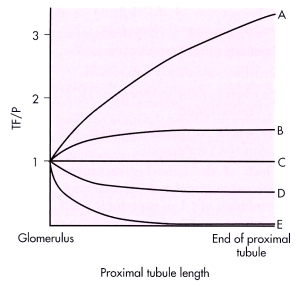 glucose
glucose Question
The following graph depicts the changes in tubular fluid concentrations of various substances along the length of the proximal tubule,plotted as the tubular fluid-to-plasma concentration ratio (TF/P).Thus the TF/P = 1 for a substance that is at the same concentration in the tubular fluid and plasma (for all substances that are freely filtered,TF/P = 1 at the glomerulus). Match the following substances to the appropriate TF/P curve. 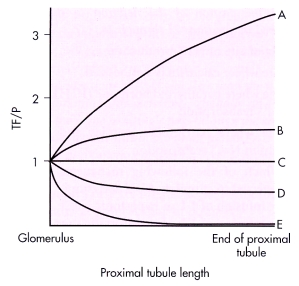 creatinine
creatinine Question

Unlock Deck
Sign up to unlock the cards in this deck!
Unlock Deck
Unlock Deck
1/8

Play

Full screen (f)
Deck 34: Solute and Water Transport Along the Nephron: Tubular Function
1
Starling forces regulate sodium and water reabsorption by the proximal tubule.Which of the following changes in Starling forces would increase reabsorption?
A)Increase in capillary hydrostatic pressure
B)Increase in capillary oncotic pressure
C)Decrease in capillary oncotic pressure
D)Decrease in the permeability of the peritubular capillary to sodium and water
A)Increase in capillary hydrostatic pressure
B)Increase in capillary oncotic pressure
C)Decrease in capillary oncotic pressure
D)Decrease in the permeability of the peritubular capillary to sodium and water
B
2
In the late portion of the proximal tubule,part of Na+ reabsorption is passive,through the paracellular pathway.What is the primary driving force for this passive reabsorption of Na+?
A)The fact that lower luminal hydrostatic pressure is lower than peritubular hydrostatic pressure
B)The fact that luminal [Na+] is higher than peritubular [Na+]
C)The fact that transepithelial voltage is lumen-positive
D)The fact that the oncotic pressure of interstitial fluid is lower than that of luminal fluid
A)The fact that lower luminal hydrostatic pressure is lower than peritubular hydrostatic pressure
B)The fact that luminal [Na+] is higher than peritubular [Na+]
C)The fact that transepithelial voltage is lumen-positive
D)The fact that the oncotic pressure of interstitial fluid is lower than that of luminal fluid
C
3
The following graph depicts the changes in tubular fluid concentrations of various substances along the length of the proximal tubule,plotted as the tubular fluid-to-plasma concentration ratio (TF/P).Thus the TF/P = 1 for a substance that is at the same concentration in the tubular fluid and plasma (for all substances that are freely filtered,TF/P = 1 at the glomerulus). Match the following substances to the appropriate TF/P curve. Na+
Na+C
4
Which of the following increases the reabsorption of sodium and chloride in the distal tubule and collecting duct?
A)Uroguanylin
B)Peritubular Starling forces
C)Natriuretic peptides
D)Aldosterone
E)Urodilatin
A)Uroguanylin
B)Peritubular Starling forces
C)Natriuretic peptides
D)Aldosterone
E)Urodilatin
Unlock Deck
Unlock for access to all 8 flashcards in this deck.
Unlock Deck
k this deck
5
Na+ reabsorption by the thick ascending limb of Henle's loop is:
A)Inhibited by a decrease in peritubular capillary hydrostatic pressure.
B)Inhibited by angiotensin II.
C)Increased with increased delivered load of Na+.
D)Inhibited by potassium-sparing diuretics.
E)Increased by natriuretic peptides.
A)Inhibited by a decrease in peritubular capillary hydrostatic pressure.
B)Inhibited by angiotensin II.
C)Increased with increased delivered load of Na+.
D)Inhibited by potassium-sparing diuretics.
E)Increased by natriuretic peptides.
Unlock Deck
Unlock for access to all 8 flashcards in this deck.
Unlock Deck
k this deck
6
The following graph depicts the changes in tubular fluid concentrations of various substances along the length of the proximal tubule,plotted as the tubular fluid-to-plasma concentration ratio (TF/P).Thus the TF/P = 1 for a substance that is at the same concentration in the tubular fluid and plasma (for all substances that are freely filtered,TF/P = 1 at the glomerulus). Match the following substances to the appropriate TF/P curve. glucose
glucose Unlock Deck
Unlock for access to all 8 flashcards in this deck.
Unlock Deck
k this deck
7
The following graph depicts the changes in tubular fluid concentrations of various substances along the length of the proximal tubule,plotted as the tubular fluid-to-plasma concentration ratio (TF/P).Thus the TF/P = 1 for a substance that is at the same concentration in the tubular fluid and plasma (for all substances that are freely filtered,TF/P = 1 at the glomerulus). Match the following substances to the appropriate TF/P curve. creatinine
creatinine Unlock Deck
Unlock for access to all 8 flashcards in this deck.
Unlock Deck
k this deck
8
Proximal tubule HCO3- reabsorption is inhibited by which of the following?
A)Increased partial pressure of carbon dioxide (Pco2)
B)Expansion of the extracellular fluid (ECF)volume
C)Systemic acidosis
D)Endothelin
E)Hypokalemia
A)Increased partial pressure of carbon dioxide (Pco2)
B)Expansion of the extracellular fluid (ECF)volume
C)Systemic acidosis
D)Endothelin
E)Hypokalemia
Unlock Deck
Unlock for access to all 8 flashcards in this deck.
Unlock Deck
k this deck
Unlock Deck
Unlock for access to all 8 flashcards in this deck.






