







 Chat with AI

Deck 18: International Trade and Public Policy
Full screen (f)

Question
Daily Output of Scotland and Poland
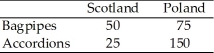 Table 18.1
Refer to Table 18.1.Scotland has a comparative advantage in:
A)accordions.
B)bagpipes.
C)both accordions and bagpipes.
D)neither accordions nor bagpipes.
Table 18.1Refer to Table 18.1.Scotland has a comparative advantage in:
A)accordions.
B)bagpipes.
C)both accordions and bagpipes.
D)neither accordions nor bagpipes.

Question
Daily Output of Scotland and Poland
Table 18.1
Refer to Table 18.1.If Scotland produces and consumes 5 accordions and 40 bagpipes while Poland produces and consumes 25 bagpipes and 100 accordions,then we say that Poland and Scotland are:
A)in autarky.
B)specializing and trading.
C)in limited trade.
D)fully utilizing the benefits of their comparative advantage.
Table 18.1Refer to Table 18.1.If Scotland produces and consumes 5 accordions and 40 bagpipes while Poland produces and consumes 25 bagpipes and 100 accordions,then we say that Poland and Scotland are:
A)in autarky.
B)specializing and trading.
C)in limited trade.
D)fully utilizing the benefits of their comparative advantage.
Question
Question
Daily Output of Scotland and Poland
Table 18.1
Refer to Table 18.1.The opportunity cost of a bagpipe in Scotland is:
A)2 accordions.
B)1/2 accordion.
C)6 accordions.
D)1/3 accordion.
Table 18.1Refer to Table 18.1.The opportunity cost of a bagpipe in Scotland is:
A)2 accordions.
B)1/2 accordion.
C)6 accordions.
D)1/3 accordion.
Question
Question
Question
Question
Question
Question
Question
Daily Output of Scotland and Poland
Table 18.1
Refer to Table 18.1.The opportunity cost of an accordion in Poland is:
A)2 bagpipes.
B)1/2 bagpipe.
C)6 bagpipes.
D)1/3 bagpipe.
Table 18.1Refer to Table 18.1.The opportunity cost of an accordion in Poland is:
A)2 bagpipes.
B)1/2 bagpipe.
C)6 bagpipes.
D)1/3 bagpipe.
Question
Daily Output of Scotland and Poland
Table 18.1
Refer to Table 18.1.If Scotland produces 50 bagpipes,how many accordions can they produce for the rest of the day?
A)zero
B)25
C)50
D)1/2
Table 18.1Refer to Table 18.1.If Scotland produces 50 bagpipes,how many accordions can they produce for the rest of the day?
A)zero
B)25
C)50
D)1/2
Question
Daily Output of Scotland and Poland
Table 18.1
Refer to Table 18.1.If Scotland produces 10 bagpipes,how many accordions can they produce for the rest of the day?
A)20
B)15
C)40
D)25
Table 18.1Refer to Table 18.1.If Scotland produces 10 bagpipes,how many accordions can they produce for the rest of the day?
A)20
B)15
C)40
D)25
Question
Daily Output of Scotland and Poland
Table 18.1
Refer to Table 18.1.If Poland produces 50 bagpipes,how many accordions can they produce for the rest of the day?
A)50
B)125
C)25
D)75
Table 18.1Refer to Table 18.1.If Poland produces 50 bagpipes,how many accordions can they produce for the rest of the day?
A)50
B)125
C)25
D)75
Question
Question
Question
Question
Daily Output of Scotland and Poland
Table 18.1
Refer to Table 18.1.The opportunity cost of an accordion in Scotland is:
A)2 bagpipes.
B)1/2 bagpipe.
C)6 bagpipes.
D)1/3 bagpipe.
Table 18.1Refer to Table 18.1.The opportunity cost of an accordion in Scotland is:
A)2 bagpipes.
B)1/2 bagpipe.
C)6 bagpipes.
D)1/3 bagpipe.
Question
Daily Output of Scotland and Poland
Table 18.1
Refer to Table 18.1.The opportunity cost of a bagpipe in Poland is:
A)2 accordions.
B)1/2 accordion.
C)6 accordions.
D)1/3 accordion.
Table 18.1Refer to Table 18.1.The opportunity cost of a bagpipe in Poland is:
A)2 accordions.
B)1/2 accordion.
C)6 accordions.
D)1/3 accordion.
Question
Question
Daily Output of Scotland and Poland
Table 18.1
Refer to Table 18.1.After trade begins,________ will specialize in the production of accordions and ________ will specialize in the production of bagpipes.
A)Scotland;Poland
B)Poland;Scotland
C)Poland;Poland
D)Scotland;Scotland
Table 18.1Refer to Table 18.1.After trade begins,________ will specialize in the production of accordions and ________ will specialize in the production of bagpipes.
A)Scotland;Poland
B)Poland;Scotland
C)Poland;Poland
D)Scotland;Scotland
Question
Daily Output of Scotland and Poland
Table 18.1
Refer to Table 18.1.The nation with a comparative advantage in accordions is:
A)both Scotland and Poland.
B)neither Scotland nor Poland.
C)Poland.
D)Scotland.
Table 18.1Refer to Table 18.1.The nation with a comparative advantage in accordions is:
A)both Scotland and Poland.
B)neither Scotland nor Poland.
C)Poland.
D)Scotland.
Question
Question
Daily Output of Japan and U.S.
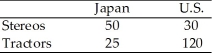 Table 18.2
Refer to Table 18.2.The opportunity cost of stereos in the U.S.is:
A)2 tractors.
B)1/4 tractor.
C)1/2 tractor.
D)4 tractors.
Table 18.2Refer to Table 18.2.The opportunity cost of stereos in the U.S.is:
A)2 tractors.
B)1/4 tractor.
C)1/2 tractor.
D)4 tractors.
Question
Daily Output of Japan and U.S.
Table 18.2
Refer to Table 18.2.Possible terms of trade between the U.S.and Japan are:
A)1 stereo for 8 tractors.
B)1 tractor for 3 stereos.
C)1 stereo for 1/3 tractor.
D)1 tractor for 1/3 stereo.
Table 18.2Refer to Table 18.2.Possible terms of trade between the U.S.and Japan are:
A)1 stereo for 8 tractors.
B)1 tractor for 3 stereos.
C)1 stereo for 1/3 tractor.
D)1 tractor for 1/3 stereo.
Question
Daily Output of Japan and U.S.
Table 18.2
Refer to Table 18.2.The opportunity cost of stereos in Japan is:
A)2 tractors.
B)1/4 tractor.
C)1/2 tractor.
D)4 tractors.
Table 18.2Refer to Table 18.2.The opportunity cost of stereos in Japan is:
A)2 tractors.
B)1/4 tractor.
C)1/2 tractor.
D)4 tractors.
Question
Question
Daily Output of Japan and U.S.
Table 18.2
Refer to Table 18.2.Japan has a comparative advantage in the production of:
A)stereos.
B)tractors.
C)both stereos and tractors.
D)neither stereos nor tractors.
Table 18.2Refer to Table 18.2.Japan has a comparative advantage in the production of:
A)stereos.
B)tractors.
C)both stereos and tractors.
D)neither stereos nor tractors.
Question
Daily Output of Japan and U.S.
Table 18.2
Refer to Table 18.2.The opportunity cost of tractors in the U.S.is:
A)2 stereos.
B)1/4 stereo.
C)1/2 stereo.
D)4 stereos.
Table 18.2Refer to Table 18.2.The opportunity cost of tractors in the U.S.is:
A)2 stereos.
B)1/4 stereo.
C)1/2 stereo.
D)4 stereos.
Question
Daily Output of Japan and U.S.
Table 18.2
Refer to Table 18.2.After trade begins,________ will specialize in the production of stereos and ________ will specialize in the production of tractors.
A)U.S. ;U.S.
B)U.S. ;Japan
C)Japan;U.S.
D)Japan;Japan
Table 18.2Refer to Table 18.2.After trade begins,________ will specialize in the production of stereos and ________ will specialize in the production of tractors.
A)U.S. ;U.S.
B)U.S. ;Japan
C)Japan;U.S.
D)Japan;Japan
Question
Question
Daily Output of Scotland and Poland
Table 18.1
Refer to Table 18.1.Poland has a comparative advantage in:
A)accordions.
B)bagpipes.
C)both accordions and bagpipes.
D)neither accordions nor bagpipes.
Table 18.1Refer to Table 18.1.Poland has a comparative advantage in:
A)accordions.
B)bagpipes.
C)both accordions and bagpipes.
D)neither accordions nor bagpipes.
Question
Question
Question
Daily Output of Japan and U.S.
Table 18.2
Refer to Table 18.2.The opportunity cost of tractors in Japan is:
A)2 stereos.
B)1/4 stereo.
C)1/2 stereo.
D)4 stereos.
Table 18.2Refer to Table 18.2.The opportunity cost of tractors in Japan is:
A)2 stereos.
B)1/4 stereo.
C)1/2 stereo.
D)4 stereos.
Question
Daily Output of Japan and U.S.
Table 18.2
Refer to Table 18.2.The U.S.has a comparative advantage in the production of:
A)stereos.
B)tractors.
C)both stereos and tractors.
D)neither stereos nor tractors.
Table 18.2Refer to Table 18.2.The U.S.has a comparative advantage in the production of:
A)stereos.
B)tractors.
C)both stereos and tractors.
D)neither stereos nor tractors.
Question
Daily Output of Japan and U.S.
Table 18.2
Refer to Table 18.2.The nation with a comparative advantage in tractors is:
A)both the U.S.and Japan.
B)neither the U.S.nor Japan.
C)the U.S.
D)Japan.
Table 18.2Refer to Table 18.2.The nation with a comparative advantage in tractors is:
A)both the U.S.and Japan.
B)neither the U.S.nor Japan.
C)the U.S.
D)Japan.
Question
Question
Daily Output of Scotland and Poland
Table 18.1
Refer to Table 18.1.Possible terms of trade between Scotland and Poland are:
A)1 accordion for 1/4 bagpipe.
B)1 bagpipe for 2 accordions.
C)1 bagpipe for 1/3 accordion.
D)1 accordion for 1 bagpipe.
Table 18.1Refer to Table 18.1.Possible terms of trade between Scotland and Poland are:
A)1 accordion for 1/4 bagpipe.
B)1 bagpipe for 2 accordions.
C)1 bagpipe for 1/3 accordion.
D)1 accordion for 1 bagpipe.
Question
Daily Output of Scotland and Poland
Table 18.1
Refer to Table 18.1.The nation with a comparative advantage in bagpipes is:
A)both Scotland and Poland.
B)neither Scotland nor Poland.
C)Poland.
D)Scotland.
Table 18.1Refer to Table 18.1.The nation with a comparative advantage in bagpipes is:
A)both Scotland and Poland.
B)neither Scotland nor Poland.
C)Poland.
D)Scotland.
Question
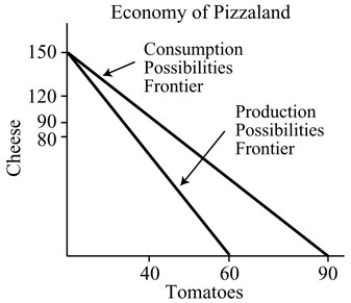 Figure 18.2
Refer to Figure 18.2.In autarky,the maximum amount of tomatoes that Pizzaland can produce is:
A)120.
B)90.
C)150.
D)60.
Question
Figure 18.2Refer to Figure 18.2.The opportunity cost of producing tomatoes in Pizzaland is:
A)0.4 cheese.
B)0.6 cheese.
C)1.67 cheese.
D)2.5 cheese.
Question
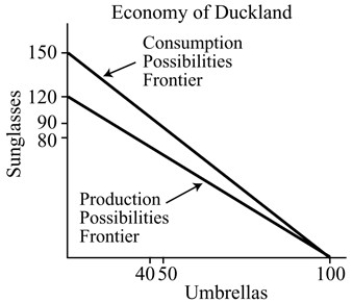 Figure 18.1
Refer to Figure 18.1.In autarky,the maximum amount of umbrellas that Duckland can produce is:
A)50.
B)100.
C)150.
D)40.
Question
Figure 18.2Refer to Figure 18.2.Pizzaland has a comparative advantage in the production of:
A)tomatoes.
B)cheese.
C)both cheese and tomatoes.
D)neither cheese nor tomatoes.
Question
Question
Figure 18.1Refer to Figure 18.1.The opportunity cost of producing sunglasses in Duckland is:
A)6/5 umbrellas.
B)2/3 umbrellas.
C)5/6 umbrellas.
D)3/2 umbrellas.
Question
Figure 18.1Refer to Figure 18.1.In autarky,the maximum amount of sunglasses that Duckland can produce is:
A)90.
B)100.
C)150.
D)120.
Question
Question
Question
Figure 18.1Refer to Figure 18.1.After trade and specialization begin,the maximum amount of sunglasses that Duckland can consume is:
A)90.
B)100.
C)150.
D)40.
Question
Question
Figure 18.2Refer to Figure 18.2.In autarky,the maximum amount of cheese that Pizzaland can produce is:
A)150.
B)90.
C)80.
D)120.
Question
Figure 18.1Refer to Figure 18.1.The terms of trade for Duckland is:
A)1 pair of sunglasses for 6/5 umbrellas.
B)1 pair of sunglasses for 2/3 umbrellas.
C)1 pair of sunglasses for 5/6 umbrellas.
D)1 pair of sunglasses for 3/2 umbrellas.
Question
Figure 18.2Refer to Figure 18.2.The opportunity cost of producing cheese in Pizzaland is:
A)0.4 tomato.
B)0.6 tomatoes.
C)1.67 tomatoes.
D)2.5 tomatoes.
Question
Figure 18.1Refer to Figure 18.1.The opportunity cost of producing umbrellas in Duckland is:
A)6/5 sunglasses.
B)2/3 sunglasses.
C)5/6 sunglasses.
D)3/2 sunglasses.
Question
Question
Question
Figure 18.1Refer to Figure 18.1.Duckland has a comparative advantage in the production of:
A)sunglasses.
B)umbrellas.
C)both umbrellas and sunglasses.
D)neither umbrellas nor sunglasses.
Question
Figure 18.1Refer to Figure 18.1.After trade and specialization begin,the maximum amount of umbrellas that Duckland can consume is:
A)90.
B)100.
C)150.
D)120.
Question
Question
Question
Question
Figure 18.2Refer to Figure 18.2.The terms of trade for Pizzaland is:
A)1 tomato for .167 cheeses.
B)1 tomato for .6 cheese.
C)1 tomato for .4 cheese.
D)1 tomato for 2.5 cheeses.
Question
Question
Question
Figure 18.2Refer to Figure 18.2.After trade and specialization begin,the maximum amount of cheese that Pizzaland can consume is:
A)150.
B)90.
C)120.
D)60.
Question
Question
Question
Question
Figure 18.2Refer to Figure 18.2.After trade and specialization begin,the maximum amount of tomatoes that Pizzaland can consume is:
A)120.
B)90.
C)80.
D)60.
Question
Question
Question
Consider the following weekly production possibilities of bagpipes and accordions in Poland and Scotland: 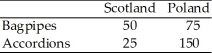 What is each country's opportunity cost of producing bagpipes and accordions? If the countries could,should they trade?
What is each country's opportunity cost of producing bagpipes and accordions? If the countries could,should they trade? Question
Question
Consider the following weekly production possibilities of bagpipes and accordions in Poland and Scotland: 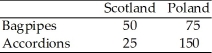 What is the possible range of terms of trade between Poland and Scotland?
What is the possible range of terms of trade between Poland and Scotland? Question
Question
Question
Question
Question

Unlock Deck
Sign up to unlock the cards in this deck!
Unlock Deck
Unlock Deck
1/229

Play

Full screen (f)
Deck 18: International Trade and Public Policy
1
Daily Output of Scotland and Poland
Table 18.1
Refer to Table 18.1.Scotland has a comparative advantage in:
A)accordions.
B)bagpipes.
C)both accordions and bagpipes.
D)neither accordions nor bagpipes.
Table 18.1Refer to Table 18.1.Scotland has a comparative advantage in:
A)accordions.
B)bagpipes.
C)both accordions and bagpipes.
D)neither accordions nor bagpipes.
B
2
Daily Output of Scotland and Poland
Table 18.1
Refer to Table 18.1.If Scotland produces and consumes 5 accordions and 40 bagpipes while Poland produces and consumes 25 bagpipes and 100 accordions,then we say that Poland and Scotland are:
A)in autarky.
B)specializing and trading.
C)in limited trade.
D)fully utilizing the benefits of their comparative advantage.
Table 18.1Refer to Table 18.1.If Scotland produces and consumes 5 accordions and 40 bagpipes while Poland produces and consumes 25 bagpipes and 100 accordions,then we say that Poland and Scotland are:
A)in autarky.
B)specializing and trading.
C)in limited trade.
D)fully utilizing the benefits of their comparative advantage.
A
3
Suppose nation A produces only two goods,apples and oranges.If nation A produces only apples,it can make 20 apples per day.If nation A produces only oranges,it can make 15 oranges per day.If the country has a constant production trade-off between apples and oranges,then the opportunity cost of one apple in nation A is:
A)1.33 oranges.
B)15 oranges.
C)20 oranges.
D).75 oranges.
A)1.33 oranges.
B)15 oranges.
C)20 oranges.
D).75 oranges.
D
4
Daily Output of Scotland and Poland
Table 18.1
Refer to Table 18.1.The opportunity cost of a bagpipe in Scotland is:
A)2 accordions.
B)1/2 accordion.
C)6 accordions.
D)1/3 accordion.
Table 18.1Refer to Table 18.1.The opportunity cost of a bagpipe in Scotland is:
A)2 accordions.
B)1/2 accordion.
C)6 accordions.
D)1/3 accordion.
Unlock Deck
Unlock for access to all 229 flashcards in this deck.
Unlock Deck
k this deck
5
The production possibilities curve represents the set of all:
A)feasible combinations of goods given that a nation's resources are fully employed.
B)factors of production that can be used to manufacture goods and services.
C)combinations of goods and services that can be used in the production of other goods and services.
D)nonlinear forms of production in the economy.
A)feasible combinations of goods given that a nation's resources are fully employed.
B)factors of production that can be used to manufacture goods and services.
C)combinations of goods and services that can be used in the production of other goods and services.
D)nonlinear forms of production in the economy.
Unlock Deck
Unlock for access to all 229 flashcards in this deck.
Unlock Deck
k this deck
6
Suppose nation A produces only two goods,apples and oranges.If nation A produces only apples,it can make 12 apples per day.If nation A produces only oranges,it can make 36 oranges per day.If the country has a constant production trade-off between apples and oranges,then the opportunity cost of one apple in nation A is:
A)36 oranges.
B)3 oranges.
C)12 oranges.
D).33 oranges.
A)36 oranges.
B)3 oranges.
C)12 oranges.
D).33 oranges.
Unlock Deck
Unlock for access to all 229 flashcards in this deck.
Unlock Deck
k this deck
7
If the production possibilities curve is drawn as a straight line it means that:
A)the tradeoff between the two goods is increasing.
B)the tradeoff between the two goods is decreasing.
C)the tradeoff between the two goods is constant.
D)no tradeoff is possible between the two goods.
A)the tradeoff between the two goods is increasing.
B)the tradeoff between the two goods is decreasing.
C)the tradeoff between the two goods is constant.
D)no tradeoff is possible between the two goods.
Unlock Deck
Unlock for access to all 229 flashcards in this deck.
Unlock Deck
k this deck
8
For a nation to have a comparative advantage in a good it must have:
A)more resources.
B)better resources.
C)a lower opportunity cost of producing that good.
D)a straight-line production possibilities curve.
A)more resources.
B)better resources.
C)a lower opportunity cost of producing that good.
D)a straight-line production possibilities curve.
Unlock Deck
Unlock for access to all 229 flashcards in this deck.
Unlock Deck
k this deck
9
Suppose nation A produces only two goods,apples and oranges.If nation A produces only apples,it can make 12 apples per day.If nation A produces only oranges,it can make 36 oranges per day.If the country has a constant production trade-off between apples and oranges,then the opportunity cost of one orange in nation A is:
A)0.33 apples.
B)3 apples.
C)36 apples.
D)12 apples.
A)0.33 apples.
B)3 apples.
C)36 apples.
D)12 apples.
Unlock Deck
Unlock for access to all 229 flashcards in this deck.
Unlock Deck
k this deck
10
The terms of trade refers to the:
A)slope of the production possibilities curve.
B)relative amounts of the goods that will be exchanged for each other in trade.
C)opportunity cost of producing each good in each country.
D)all of the above
A)slope of the production possibilities curve.
B)relative amounts of the goods that will be exchanged for each other in trade.
C)opportunity cost of producing each good in each country.
D)all of the above
Unlock Deck
Unlock for access to all 229 flashcards in this deck.
Unlock Deck
k this deck
11
Daily Output of Scotland and Poland
Table 18.1
Refer to Table 18.1.The opportunity cost of an accordion in Poland is:
A)2 bagpipes.
B)1/2 bagpipe.
C)6 bagpipes.
D)1/3 bagpipe.
Table 18.1Refer to Table 18.1.The opportunity cost of an accordion in Poland is:
A)2 bagpipes.
B)1/2 bagpipe.
C)6 bagpipes.
D)1/3 bagpipe.
Unlock Deck
Unlock for access to all 229 flashcards in this deck.
Unlock Deck
k this deck
12
Daily Output of Scotland and Poland
Table 18.1
Refer to Table 18.1.If Scotland produces 50 bagpipes,how many accordions can they produce for the rest of the day?
A)zero
B)25
C)50
D)1/2
Table 18.1Refer to Table 18.1.If Scotland produces 50 bagpipes,how many accordions can they produce for the rest of the day?
A)zero
B)25
C)50
D)1/2
Unlock Deck
Unlock for access to all 229 flashcards in this deck.
Unlock Deck
k this deck
13
Daily Output of Scotland and Poland
Table 18.1
Refer to Table 18.1.If Scotland produces 10 bagpipes,how many accordions can they produce for the rest of the day?
A)20
B)15
C)40
D)25
Table 18.1Refer to Table 18.1.If Scotland produces 10 bagpipes,how many accordions can they produce for the rest of the day?
A)20
B)15
C)40
D)25
Unlock Deck
Unlock for access to all 229 flashcards in this deck.
Unlock Deck
k this deck
14
Daily Output of Scotland and Poland
Table 18.1
Refer to Table 18.1.If Poland produces 50 bagpipes,how many accordions can they produce for the rest of the day?
A)50
B)125
C)25
D)75
Table 18.1Refer to Table 18.1.If Poland produces 50 bagpipes,how many accordions can they produce for the rest of the day?
A)50
B)125
C)25
D)75
Unlock Deck
Unlock for access to all 229 flashcards in this deck.
Unlock Deck
k this deck
15
If Germany can produce cars at a lower opportunity cost than any other nation,Germany is said to have a(n)________ in the production of cars.
A)comparative advantage
B)autarky
C)absolute advantage
D)comparative disadvantage
A)comparative advantage
B)autarky
C)absolute advantage
D)comparative disadvantage
Unlock Deck
Unlock for access to all 229 flashcards in this deck.
Unlock Deck
k this deck
16
Suppose nation A produces only two goods,apples and oranges.If nation A produces only apples,it can make 16 apples per day.If nation A produces only oranges,it can make 4 oranges per day.If the country has a constant production trade-off between apples and oranges,then the opportunity cost of one apple in nation A is:
A).25 oranges.
B)4 oranges.
C)16 oranges.
D)2 oranges.
A).25 oranges.
B)4 oranges.
C)16 oranges.
D)2 oranges.
Unlock Deck
Unlock for access to all 229 flashcards in this deck.
Unlock Deck
k this deck
17
If France can produce grapes at a higher opportunity cost than any other nation,France is said to have a(n)________ in the production of grapes.
A)autarky
B)absolute advantage
C)comparative disadvantage
D)comparative advantage
A)autarky
B)absolute advantage
C)comparative disadvantage
D)comparative advantage
Unlock Deck
Unlock for access to all 229 flashcards in this deck.
Unlock Deck
k this deck
18
Daily Output of Scotland and Poland
Table 18.1
Refer to Table 18.1.The opportunity cost of an accordion in Scotland is:
A)2 bagpipes.
B)1/2 bagpipe.
C)6 bagpipes.
D)1/3 bagpipe.
Table 18.1Refer to Table 18.1.The opportunity cost of an accordion in Scotland is:
A)2 bagpipes.
B)1/2 bagpipe.
C)6 bagpipes.
D)1/3 bagpipe.
Unlock Deck
Unlock for access to all 229 flashcards in this deck.
Unlock Deck
k this deck
19
Daily Output of Scotland and Poland
Table 18.1
Refer to Table 18.1.The opportunity cost of a bagpipe in Poland is:
A)2 accordions.
B)1/2 accordion.
C)6 accordions.
D)1/3 accordion.
Table 18.1Refer to Table 18.1.The opportunity cost of a bagpipe in Poland is:
A)2 accordions.
B)1/2 accordion.
C)6 accordions.
D)1/3 accordion.
Unlock Deck
Unlock for access to all 229 flashcards in this deck.
Unlock Deck
k this deck
20
If France can produce grapes at a lower opportunity cost than any other nation,France is said to have a(n)________ in the production of grapes.
A)autarky
B)absolute advantage
C)comparative disadvantage
D)comparative advantage
A)autarky
B)absolute advantage
C)comparative disadvantage
D)comparative advantage
Unlock Deck
Unlock for access to all 229 flashcards in this deck.
Unlock Deck
k this deck
21
Daily Output of Scotland and Poland
Table 18.1
Refer to Table 18.1.After trade begins,________ will specialize in the production of accordions and ________ will specialize in the production of bagpipes.
A)Scotland;Poland
B)Poland;Scotland
C)Poland;Poland
D)Scotland;Scotland
Table 18.1Refer to Table 18.1.After trade begins,________ will specialize in the production of accordions and ________ will specialize in the production of bagpipes.
A)Scotland;Poland
B)Poland;Scotland
C)Poland;Poland
D)Scotland;Scotland
Unlock Deck
Unlock for access to all 229 flashcards in this deck.
Unlock Deck
k this deck
22
Daily Output of Scotland and Poland
Table 18.1
Refer to Table 18.1.The nation with a comparative advantage in accordions is:
A)both Scotland and Poland.
B)neither Scotland nor Poland.
C)Poland.
D)Scotland.
Table 18.1Refer to Table 18.1.The nation with a comparative advantage in accordions is:
A)both Scotland and Poland.
B)neither Scotland nor Poland.
C)Poland.
D)Scotland.
Unlock Deck
Unlock for access to all 229 flashcards in this deck.
Unlock Deck
k this deck
23
A situation in which a country does NOT trade with another country is called:
A)autarky.
B)free trade.
C)comparative advantage.
D)specialization.
A)autarky.
B)free trade.
C)comparative advantage.
D)specialization.
Unlock Deck
Unlock for access to all 229 flashcards in this deck.
Unlock Deck
k this deck
24
Daily Output of Japan and U.S.
Table 18.2
Refer to Table 18.2.The opportunity cost of stereos in the U.S.is:
A)2 tractors.
B)1/4 tractor.
C)1/2 tractor.
D)4 tractors.
Table 18.2Refer to Table 18.2.The opportunity cost of stereos in the U.S.is:
A)2 tractors.
B)1/4 tractor.
C)1/2 tractor.
D)4 tractors.
Unlock Deck
Unlock for access to all 229 flashcards in this deck.
Unlock Deck
k this deck
25
Daily Output of Japan and U.S.
Table 18.2
Refer to Table 18.2.Possible terms of trade between the U.S.and Japan are:
A)1 stereo for 8 tractors.
B)1 tractor for 3 stereos.
C)1 stereo for 1/3 tractor.
D)1 tractor for 1/3 stereo.
Table 18.2Refer to Table 18.2.Possible terms of trade between the U.S.and Japan are:
A)1 stereo for 8 tractors.
B)1 tractor for 3 stereos.
C)1 stereo for 1/3 tractor.
D)1 tractor for 1/3 stereo.
Unlock Deck
Unlock for access to all 229 flashcards in this deck.
Unlock Deck
k this deck
26
Daily Output of Japan and U.S.
Table 18.2
Refer to Table 18.2.The opportunity cost of stereos in Japan is:
A)2 tractors.
B)1/4 tractor.
C)1/2 tractor.
D)4 tractors.
Table 18.2Refer to Table 18.2.The opportunity cost of stereos in Japan is:
A)2 tractors.
B)1/4 tractor.
C)1/2 tractor.
D)4 tractors.
Unlock Deck
Unlock for access to all 229 flashcards in this deck.
Unlock Deck
k this deck
27
If Cowland can produce milk at a lower opportunity cost than any other nation,Cowland is said to have a(n)________ in the production of milk.
A)autarky
B)absolute advantage
C)comparative advantage
D)comparative disadvantage
A)autarky
B)absolute advantage
C)comparative advantage
D)comparative disadvantage
Unlock Deck
Unlock for access to all 229 flashcards in this deck.
Unlock Deck
k this deck
28
Daily Output of Japan and U.S.
Table 18.2
Refer to Table 18.2.Japan has a comparative advantage in the production of:
A)stereos.
B)tractors.
C)both stereos and tractors.
D)neither stereos nor tractors.
Table 18.2Refer to Table 18.2.Japan has a comparative advantage in the production of:
A)stereos.
B)tractors.
C)both stereos and tractors.
D)neither stereos nor tractors.
Unlock Deck
Unlock for access to all 229 flashcards in this deck.
Unlock Deck
k this deck
29
Daily Output of Japan and U.S.
Table 18.2
Refer to Table 18.2.The opportunity cost of tractors in the U.S.is:
A)2 stereos.
B)1/4 stereo.
C)1/2 stereo.
D)4 stereos.
Table 18.2Refer to Table 18.2.The opportunity cost of tractors in the U.S.is:
A)2 stereos.
B)1/4 stereo.
C)1/2 stereo.
D)4 stereos.
Unlock Deck
Unlock for access to all 229 flashcards in this deck.
Unlock Deck
k this deck
30
Daily Output of Japan and U.S.
Table 18.2
Refer to Table 18.2.After trade begins,________ will specialize in the production of stereos and ________ will specialize in the production of tractors.
A)U.S. ;U.S.
B)U.S. ;Japan
C)Japan;U.S.
D)Japan;Japan
Table 18.2Refer to Table 18.2.After trade begins,________ will specialize in the production of stereos and ________ will specialize in the production of tractors.
A)U.S. ;U.S.
B)U.S. ;Japan
C)Japan;U.S.
D)Japan;Japan
Unlock Deck
Unlock for access to all 229 flashcards in this deck.
Unlock Deck
k this deck
31
A nation can produce anywhere ________ its production possibilities curve.
A)on
B)outside
C)inside
D)both A and C
A)on
B)outside
C)inside
D)both A and C
Unlock Deck
Unlock for access to all 229 flashcards in this deck.
Unlock Deck
k this deck
32
Daily Output of Scotland and Poland
Table 18.1
Refer to Table 18.1.Poland has a comparative advantage in:
A)accordions.
B)bagpipes.
C)both accordions and bagpipes.
D)neither accordions nor bagpipes.
Table 18.1Refer to Table 18.1.Poland has a comparative advantage in:
A)accordions.
B)bagpipes.
C)both accordions and bagpipes.
D)neither accordions nor bagpipes.
Unlock Deck
Unlock for access to all 229 flashcards in this deck.
Unlock Deck
k this deck
33
Autarky refers to:
A)a situation in which nations trade goods and services.
B)a nation in the Middle East.
C)a situation in which there is no trade.
D)the equilibrium a nation reaches after trade begins.
A)a situation in which nations trade goods and services.
B)a nation in the Middle East.
C)a situation in which there is no trade.
D)the equilibrium a nation reaches after trade begins.
Unlock Deck
Unlock for access to all 229 flashcards in this deck.
Unlock Deck
k this deck
34
If Nation A can produce shirts at a lower opportunity cost than any other nation,Nation A is said to have a(n)________ in the production of shirts.
A)autarky
B)comparative advantage
C)absolute advantage
D)comparative disadvantage
A)autarky
B)comparative advantage
C)absolute advantage
D)comparative disadvantage
Unlock Deck
Unlock for access to all 229 flashcards in this deck.
Unlock Deck
k this deck
35
Daily Output of Japan and U.S.
Table 18.2
Refer to Table 18.2.The opportunity cost of tractors in Japan is:
A)2 stereos.
B)1/4 stereo.
C)1/2 stereo.
D)4 stereos.
Table 18.2Refer to Table 18.2.The opportunity cost of tractors in Japan is:
A)2 stereos.
B)1/4 stereo.
C)1/2 stereo.
D)4 stereos.
Unlock Deck
Unlock for access to all 229 flashcards in this deck.
Unlock Deck
k this deck
36
Daily Output of Japan and U.S.
Table 18.2
Refer to Table 18.2.The U.S.has a comparative advantage in the production of:
A)stereos.
B)tractors.
C)both stereos and tractors.
D)neither stereos nor tractors.
Table 18.2Refer to Table 18.2.The U.S.has a comparative advantage in the production of:
A)stereos.
B)tractors.
C)both stereos and tractors.
D)neither stereos nor tractors.
Unlock Deck
Unlock for access to all 229 flashcards in this deck.
Unlock Deck
k this deck
37
Daily Output of Japan and U.S.
Table 18.2
Refer to Table 18.2.The nation with a comparative advantage in tractors is:
A)both the U.S.and Japan.
B)neither the U.S.nor Japan.
C)the U.S.
D)Japan.
Table 18.2Refer to Table 18.2.The nation with a comparative advantage in tractors is:
A)both the U.S.and Japan.
B)neither the U.S.nor Japan.
C)the U.S.
D)Japan.
Unlock Deck
Unlock for access to all 229 flashcards in this deck.
Unlock Deck
k this deck
38
When President Jefferson declared a self-imposed embargo on international shipping between 1807-1809,it may be said that the U.S.came very close to:
A)autarky.
B)free trade.
C)comparative advantage.
D)specialization.
A)autarky.
B)free trade.
C)comparative advantage.
D)specialization.
Unlock Deck
Unlock for access to all 229 flashcards in this deck.
Unlock Deck
k this deck
39
Daily Output of Scotland and Poland
Table 18.1
Refer to Table 18.1.Possible terms of trade between Scotland and Poland are:
A)1 accordion for 1/4 bagpipe.
B)1 bagpipe for 2 accordions.
C)1 bagpipe for 1/3 accordion.
D)1 accordion for 1 bagpipe.
Table 18.1Refer to Table 18.1.Possible terms of trade between Scotland and Poland are:
A)1 accordion for 1/4 bagpipe.
B)1 bagpipe for 2 accordions.
C)1 bagpipe for 1/3 accordion.
D)1 accordion for 1 bagpipe.
Unlock Deck
Unlock for access to all 229 flashcards in this deck.
Unlock Deck
k this deck
40
Daily Output of Scotland and Poland
Table 18.1
Refer to Table 18.1.The nation with a comparative advantage in bagpipes is:
A)both Scotland and Poland.
B)neither Scotland nor Poland.
C)Poland.
D)Scotland.
Table 18.1Refer to Table 18.1.The nation with a comparative advantage in bagpipes is:
A)both Scotland and Poland.
B)neither Scotland nor Poland.
C)Poland.
D)Scotland.
Unlock Deck
Unlock for access to all 229 flashcards in this deck.
Unlock Deck
k this deck
41
Figure 18.2Refer to Figure 18.2.In autarky,the maximum amount of tomatoes that Pizzaland can produce is:
A)120.
B)90.
C)150.
D)60.
Unlock Deck
Unlock for access to all 229 flashcards in this deck.
Unlock Deck
k this deck
42
Figure 18.2Refer to Figure 18.2.The opportunity cost of producing tomatoes in Pizzaland is:
A)0.4 cheese.
B)0.6 cheese.
C)1.67 cheese.
D)2.5 cheese.
Unlock Deck
Unlock for access to all 229 flashcards in this deck.
Unlock Deck
k this deck
43
Figure 18.1Refer to Figure 18.1.In autarky,the maximum amount of umbrellas that Duckland can produce is:
A)50.
B)100.
C)150.
D)40.
Unlock Deck
Unlock for access to all 229 flashcards in this deck.
Unlock Deck
k this deck
44
Figure 18.2Refer to Figure 18.2.Pizzaland has a comparative advantage in the production of:
A)tomatoes.
B)cheese.
C)both cheese and tomatoes.
D)neither cheese nor tomatoes.
Unlock Deck
Unlock for access to all 229 flashcards in this deck.
Unlock Deck
k this deck
45
The rate at which nations will exchange goods and service is known as the:
A)exchange rate.
B)transfer rate.
C)terms of trade.
D)terms of exchange.
A)exchange rate.
B)transfer rate.
C)terms of trade.
D)terms of exchange.
Unlock Deck
Unlock for access to all 229 flashcards in this deck.
Unlock Deck
k this deck
46
Figure 18.1Refer to Figure 18.1.The opportunity cost of producing sunglasses in Duckland is:
A)6/5 umbrellas.
B)2/3 umbrellas.
C)5/6 umbrellas.
D)3/2 umbrellas.
Unlock Deck
Unlock for access to all 229 flashcards in this deck.
Unlock Deck
k this deck
47
Figure 18.1Refer to Figure 18.1.In autarky,the maximum amount of sunglasses that Duckland can produce is:
A)90.
B)100.
C)150.
D)120.
Unlock Deck
Unlock for access to all 229 flashcards in this deck.
Unlock Deck
k this deck
48
The consumption possibilities curve shows the combinations of goods that can be:
A)consumed by a nation before trade begins.
B)consumed by a nation after trading begins.
C)produced by a nation before trading begins.
D)produced by a nation after trade begins.
A)consumed by a nation before trade begins.
B)consumed by a nation after trading begins.
C)produced by a nation before trading begins.
D)produced by a nation after trade begins.
Unlock Deck
Unlock for access to all 229 flashcards in this deck.
Unlock Deck
k this deck
49
Which of the following statements is false?
A)The production possibilities curve shows the combinations of goods that can be consumed by a nation before trade begins.
B)The production possibilities curve shows the combinations of goods that can be consumed by a nation after trade and specialization begins.
C)The production possibilities curve shows the combinations of goods that can be produced by a nation before trading begins.
D)The production possibilities curve shows the combinations of goods that can be produced by a nation after trade and specialization begins.
A)The production possibilities curve shows the combinations of goods that can be consumed by a nation before trade begins.
B)The production possibilities curve shows the combinations of goods that can be consumed by a nation after trade and specialization begins.
C)The production possibilities curve shows the combinations of goods that can be produced by a nation before trading begins.
D)The production possibilities curve shows the combinations of goods that can be produced by a nation after trade and specialization begins.
Unlock Deck
Unlock for access to all 229 flashcards in this deck.
Unlock Deck
k this deck
50
Figure 18.1Refer to Figure 18.1.After trade and specialization begin,the maximum amount of sunglasses that Duckland can consume is:
A)90.
B)100.
C)150.
D)40.
Unlock Deck
Unlock for access to all 229 flashcards in this deck.
Unlock Deck
k this deck
51
The production possibilities curve shows the combinations of goods that can be:
A)consumed by a nation before trade begins.
B)produced by a nation before trading begins.
C)produced by a nation after trade begins.
D)all of the above.
A)consumed by a nation before trade begins.
B)produced by a nation before trading begins.
C)produced by a nation after trade begins.
D)all of the above.
Unlock Deck
Unlock for access to all 229 flashcards in this deck.
Unlock Deck
k this deck
52
Figure 18.2Refer to Figure 18.2.In autarky,the maximum amount of cheese that Pizzaland can produce is:
A)150.
B)90.
C)80.
D)120.
Unlock Deck
Unlock for access to all 229 flashcards in this deck.
Unlock Deck
k this deck
53
Figure 18.1Refer to Figure 18.1.The terms of trade for Duckland is:
A)1 pair of sunglasses for 6/5 umbrellas.
B)1 pair of sunglasses for 2/3 umbrellas.
C)1 pair of sunglasses for 5/6 umbrellas.
D)1 pair of sunglasses for 3/2 umbrellas.
Unlock Deck
Unlock for access to all 229 flashcards in this deck.
Unlock Deck
k this deck
54
Figure 18.2Refer to Figure 18.2.The opportunity cost of producing cheese in Pizzaland is:
A)0.4 tomato.
B)0.6 tomatoes.
C)1.67 tomatoes.
D)2.5 tomatoes.
Unlock Deck
Unlock for access to all 229 flashcards in this deck.
Unlock Deck
k this deck
55
Figure 18.1Refer to Figure 18.1.The opportunity cost of producing umbrellas in Duckland is:
A)6/5 sunglasses.
B)2/3 sunglasses.
C)5/6 sunglasses.
D)3/2 sunglasses.
Unlock Deck
Unlock for access to all 229 flashcards in this deck.
Unlock Deck
k this deck
56
The terms of trade is the:
A)exchange rate for two nations.
B)the end point of a consumption possibilities curve.
C)opportunity costs of production.
D)rate at which two goods will be exchanged.
A)exchange rate for two nations.
B)the end point of a consumption possibilities curve.
C)opportunity costs of production.
D)rate at which two goods will be exchanged.
Unlock Deck
Unlock for access to all 229 flashcards in this deck.
Unlock Deck
k this deck
57
The combinations of goods a nation can consume after trade and specialization begin are illustrated by the ________ curve.
A)supply
B)production possibilities
C)consumption possibilities
D)demand
A)supply
B)production possibilities
C)consumption possibilities
D)demand
Unlock Deck
Unlock for access to all 229 flashcards in this deck.
Unlock Deck
k this deck
58
Figure 18.1Refer to Figure 18.1.Duckland has a comparative advantage in the production of:
A)sunglasses.
B)umbrellas.
C)both umbrellas and sunglasses.
D)neither umbrellas nor sunglasses.
Unlock Deck
Unlock for access to all 229 flashcards in this deck.
Unlock Deck
k this deck
59
Figure 18.1Refer to Figure 18.1.After trade and specialization begin,the maximum amount of umbrellas that Duckland can consume is:
A)90.
B)100.
C)150.
D)120.
Unlock Deck
Unlock for access to all 229 flashcards in this deck.
Unlock Deck
k this deck
60
As a whole,nations are better off after trade and specialization because:
A)nations can consume along their consumption possibilities curve,which is above of their production possibilities curve.
B)nations can consume along their consumption possibilities curve,which is below of their production possibilities curve.
C)nations can consume along their production possibilities curve,which is above of their consumption possibilities curve.
D)nations experience an outward shift of their production possibilities curve.
A)nations can consume along their consumption possibilities curve,which is above of their production possibilities curve.
B)nations can consume along their consumption possibilities curve,which is below of their production possibilities curve.
C)nations can consume along their production possibilities curve,which is above of their consumption possibilities curve.
D)nations experience an outward shift of their production possibilities curve.
Unlock Deck
Unlock for access to all 229 flashcards in this deck.
Unlock Deck
k this deck
61
Free trade will affect a country's employment in different industries.
Unlock Deck
Unlock for access to all 229 flashcards in this deck.
Unlock Deck
k this deck
62
Which of the following statements is true?
A)Free trade will benefit all workers in a nation equally.
B)As a result of specialization some workers will be displaced and hence,harmed by free trade.
C)Free trade leads to lower wages for all workers in both nations.
D)Specialization will result in a decline in an industry and none of those workers will be able to find other jobs.
A)Free trade will benefit all workers in a nation equally.
B)As a result of specialization some workers will be displaced and hence,harmed by free trade.
C)Free trade leads to lower wages for all workers in both nations.
D)Specialization will result in a decline in an industry and none of those workers will be able to find other jobs.
Unlock Deck
Unlock for access to all 229 flashcards in this deck.
Unlock Deck
k this deck
63
Figure 18.2Refer to Figure 18.2.The terms of trade for Pizzaland is:
A)1 tomato for .167 cheeses.
B)1 tomato for .6 cheese.
C)1 tomato for .4 cheese.
D)1 tomato for 2.5 cheeses.
Unlock Deck
Unlock for access to all 229 flashcards in this deck.
Unlock Deck
k this deck
64
Suppose there are only 2 nations A and B,and only two goods,x and y.If nation A produces only x,it can make 20x per day.If nation A produces only y,it can make 15y per day.If nation B produces only x,it can make 15x per day.If nation B produces only y,it can make 15y per day.After trade begins nation ________ will specialize in the production of x and nation ________ will specialize in the production of y.
A)A;A
B)A;B
C)B;B
D)B;A
A)A;A
B)A;B
C)B;B
D)B;A
Unlock Deck
Unlock for access to all 229 flashcards in this deck.
Unlock Deck
k this deck
65
Suppose Canada produces only two goods,corn and automobiles.If Canada has a comparative advantage in automobiles,a move toward free trade will:
A)harm automobile workers,benefit corn workers,but benefit the nation as a whole.
B)harm automobile workers,harm corn workers,but benefit the nation as a whole.
C)benefit automobile workers,harm corn workers,but harm the nation as a whole.
D)benefit automobile workers,harm corn workers,but benefit the nation as a whole.
A)harm automobile workers,benefit corn workers,but benefit the nation as a whole.
B)harm automobile workers,harm corn workers,but benefit the nation as a whole.
C)benefit automobile workers,harm corn workers,but harm the nation as a whole.
D)benefit automobile workers,harm corn workers,but benefit the nation as a whole.
Unlock Deck
Unlock for access to all 229 flashcards in this deck.
Unlock Deck
k this deck
66
Figure 18.2Refer to Figure 18.2.After trade and specialization begin,the maximum amount of cheese that Pizzaland can consume is:
A)150.
B)90.
C)120.
D)60.
Unlock Deck
Unlock for access to all 229 flashcards in this deck.
Unlock Deck
k this deck
67
The opportunity cost of a table is 5 chairs in nation A and 4 chairs in nation B.If the nations specialize and trade,an acceptable terms of trade for both nations would be 3 chairs per table.
Unlock Deck
Unlock for access to all 229 flashcards in this deck.
Unlock Deck
k this deck
68
Suppose France produces only two goods,airplanes and grapes.If France has a comparative advantage in grapes,a move toward free trade will:
A)harm grape workers,benefit airplane workers,but benefit the nation as a whole.
B)harm grape workers,harm airplane workers,but benefit the nation as a whole.
C)benefit grape workers,harm airplane workers,but harm the nation as a whole.
D)benefit grape workers,harm airplane workers,but benefit the nation as a whole.
A)harm grape workers,benefit airplane workers,but benefit the nation as a whole.
B)harm grape workers,harm airplane workers,but benefit the nation as a whole.
C)benefit grape workers,harm airplane workers,but harm the nation as a whole.
D)benefit grape workers,harm airplane workers,but benefit the nation as a whole.
Unlock Deck
Unlock for access to all 229 flashcards in this deck.
Unlock Deck
k this deck
69
If the opportunity cost of a table is 5 chairs in nation A and 1 chair in nation B,it makes sense for nation A to produce chairs.
Unlock Deck
Unlock for access to all 229 flashcards in this deck.
Unlock Deck
k this deck
70
Figure 18.2Refer to Figure 18.2.After trade and specialization begin,the maximum amount of tomatoes that Pizzaland can consume is:
A)120.
B)90.
C)80.
D)60.
Unlock Deck
Unlock for access to all 229 flashcards in this deck.
Unlock Deck
k this deck
71
Suppose there are only 2 nations A and B,and only two goods,x and y.If nation A produces only x,it can make 16x per day.If nation A produces only y,it can make 4y per day.If nation B produces only x,it can make 20x per day.If nation B produces only y,it can make 4y per day.After trade begins,nation ________ will specialize in the production of x and nation ________ will specialize in the production of y.
A)A;A
B)A;B
C)B;B
D)B;A
A)A;A
B)A;B
C)B;B
D)B;A
Unlock Deck
Unlock for access to all 229 flashcards in this deck.
Unlock Deck
k this deck
72
The opportunity cost of a table is 5 chairs in nation A and 1 chair in nation B.If the nations specialize and trade,an acceptable terms of trade for both nations would be 3 chairs per table.
Unlock Deck
Unlock for access to all 229 flashcards in this deck.
Unlock Deck
k this deck
73
Consider the following weekly production possibilities of bagpipes and accordions in Poland and Scotland: What is each country's opportunity cost of producing bagpipes and accordions? If the countries could,should they trade?
What is each country's opportunity cost of producing bagpipes and accordions? If the countries could,should they trade? Unlock Deck
Unlock for access to all 229 flashcards in this deck.
Unlock Deck
k this deck
74
If the opportunity cost of a table is 5 chairs in nation A and 1 chair in nation B,it makes sense for nation B to produce chairs.
Unlock Deck
Unlock for access to all 229 flashcards in this deck.
Unlock Deck
k this deck
75
Consider the following weekly production possibilities of bagpipes and accordions in Poland and Scotland: What is the possible range of terms of trade between Poland and Scotland?
What is the possible range of terms of trade between Poland and Scotland? Unlock Deck
Unlock for access to all 229 flashcards in this deck.
Unlock Deck
k this deck
76
Suppose Japan produces only two goods,rice and electronics.If Japan has a comparative advantage in electronics,a move toward free trade will:
A)harm electronics workers,benefit rice workers,but benefit the nation as a whole.
B)benefit electronics workers,harm rice workers,but benefit the nation as a whole.
C)harm electronics workers,harm rice workers,but benefit the nation as a whole.
D)benefit electronics workers,harm rice workers,but harm the nation as a whole.
A)harm electronics workers,benefit rice workers,but benefit the nation as a whole.
B)benefit electronics workers,harm rice workers,but benefit the nation as a whole.
C)harm electronics workers,harm rice workers,but benefit the nation as a whole.
D)benefit electronics workers,harm rice workers,but harm the nation as a whole.
Unlock Deck
Unlock for access to all 229 flashcards in this deck.
Unlock Deck
k this deck
77
Suppose the United States produces only two goods,grapes and tractors.If the United States has a comparative advantage in tractors,a move toward free trade will:
A)harm tractor workers,benefit grape workers,but benefit the nation as a whole.
B)harm tractor workers,harm grape workers,but benefit the nation as a whole.
C)benefit tractor workers,harm grape workers,but benefit the nation as a whole.
D)benefit tractor workers,harm grape workers,but harm the nation as a whole.
A)harm tractor workers,benefit grape workers,but benefit the nation as a whole.
B)harm tractor workers,harm grape workers,but benefit the nation as a whole.
C)benefit tractor workers,harm grape workers,but benefit the nation as a whole.
D)benefit tractor workers,harm grape workers,but harm the nation as a whole.
Unlock Deck
Unlock for access to all 229 flashcards in this deck.
Unlock Deck
k this deck
78
Free trade makes the people of a country worse off.
Unlock Deck
Unlock for access to all 229 flashcards in this deck.
Unlock Deck
k this deck
79
Suppose the United States produces only two goods,textiles and computer chips.If the United States has a comparative advantage in computer chips,a move toward free trade will:
A)benefit computer chip workers,harm textile workers,but benefit the nation as a whole.
B)harm computer chip workers,benefit textile workers,but benefit the nation as a whole.
C)harm computer chip workers,harm textile workers,but benefit the nation as a whole.
D)benefit computer chip workers,harm textile workers,but harm the nation as a whole.
A)benefit computer chip workers,harm textile workers,but benefit the nation as a whole.
B)harm computer chip workers,benefit textile workers,but benefit the nation as a whole.
C)harm computer chip workers,harm textile workers,but benefit the nation as a whole.
D)benefit computer chip workers,harm textile workers,but harm the nation as a whole.
Unlock Deck
Unlock for access to all 229 flashcards in this deck.
Unlock Deck
k this deck
80
Suppose there are only 2 nations A and B,and only two goods,x and y.If nation A produces only x,it can make 12x per day.If nation A produces only y,it can make 36y per day.If nation B produces only x,it can make 4x per day.If nation B produces only y,it can make 12y per day.After trade begins,nation ________ will specialize in the production of x and nation ________ will specialize in the production of y.
A)A;B
B)B;B
C)B;A
D)No trade will occur.
A)A;B
B)B;B
C)B;A
D)No trade will occur.
Unlock Deck
Unlock for access to all 229 flashcards in this deck.
Unlock Deck
k this deck
Unlock Deck
Unlock for access to all 229 flashcards in this deck.






