







 Chat with AI


Zoology 10th Edition by Stephen Miller,John Harley
Edition 10ISBN: 978-0077837273Zoology 10th Edition by Stephen Miller,John Harley
Edition 10ISBN: 978-0077837273 Exercise 6
Traditional classification systems reflect a taxonomic hierarchy in which organisms are grouped into ever-broadening categories based on shared characteristics and evolutionary relationships. Evolutionary biologists have described three domains of living organisms. Taxonomists sort out the diversity within these domains by assembling organisms into groups that include a single ancestor and all descendants of that ancestor. These monophyletic groups provide a complete history of an animal lineage.
Why are derived characteristics more useful in establishing evolutionary relationships than are shared characteristics? Use two subgroups of mammals to illustrate your answer (see table 22.1). For example, compare horses (order Perissodactyla) and camels (order Artiodactyla).
TABLE 22.1 CLASSIFICATION OF LIVING MAMMALS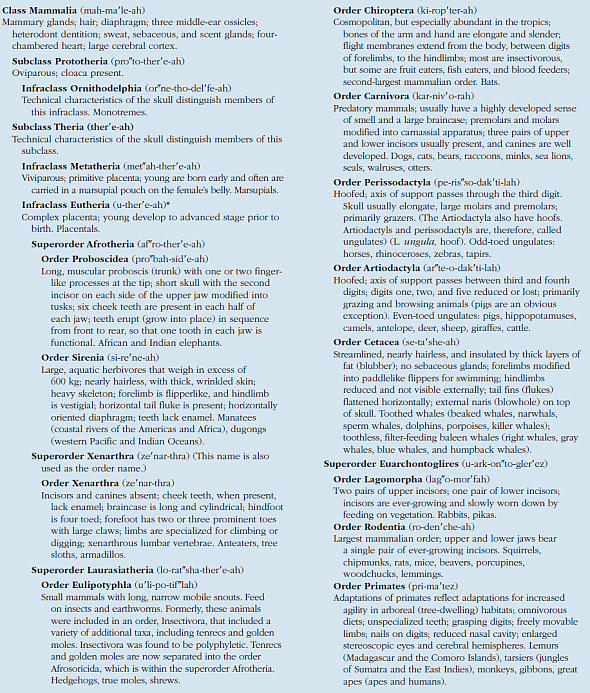
*Selected eutherian orders are described.
Why are derived characteristics more useful in establishing evolutionary relationships than are shared characteristics? Use two subgroups of mammals to illustrate your answer (see table 22.1). For example, compare horses (order Perissodactyla) and camels (order Artiodactyla).
TABLE 22.1 CLASSIFICATION OF LIVING MAMMALS
*Selected eutherian orders are described.
Explanation Verified
Verified
Hierarchical ordering of biological orga...

Zoology 10th Edition by Stephen Miller,John Harley

Why don’t you like this exercise?
Other Minimum 8 character and maximum 255 character
Character 255






