







 Chat with AI


Zoology 10th Edition by Stephen Miller,John Harley
Edition 10ISBN: 978-0077837273Zoology 10th Edition by Stephen Miller,John Harley
Edition 10ISBN: 978-0077837273 Exercise 3
Multicellularity arose approximately 600 million years ago. The evolutionary events leading to multicellularity are largely unknown. The coenocytial hypothesis is the idea that multi-cellularity may have arisen by the formation of cell boundaries in a large coenocytic protist. The colonial hypothesis is the idea that multicellularity may have arisen as dividing cells remained together. Similarities of choanoflagellate protists and sponge choanocytes, and between choanoflagellate and animal genes, suggest close evolutionary ties between these protists and animals.
FIGURE 9.3 Phylum Porifera. Many sponges are brightly colored with hues of red, orange, green, or yellow. ( a ) Verongia sp. ( b ) The elephant ear sponge ( Agelas clathrodes ).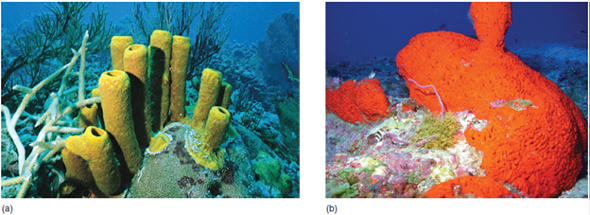
Assuming that the choanoflagellates are the ancestors of the Animalia, would the colonial hypothesis or the coenocytial hypothesis be a more likely explanation of animal origins? Explain.
FIGURE 9.3 Phylum Porifera. Many sponges are brightly colored with hues of red, orange, green, or yellow. ( a ) Verongia sp. ( b ) The elephant ear sponge ( Agelas clathrodes ).
Assuming that the choanoflagellates are the ancestors of the Animalia, would the colonial hypothesis or the coenocytial hypothesis be a more likely explanation of animal origins? Explain.
Explanation Verified
Verified
Choanoflagellates are free living or col...

Zoology 10th Edition by Stephen Miller,John Harley

Why don’t you like this exercise?
Other Minimum 8 character and maximum 255 character
Character 255






