







 Chat with AI


Microbiology: A Systems Approach 4th Edition by Marjorie Kelly Cowan
Edition 4ISBN: 978-0073402437Microbiology: A Systems Approach 4th Edition by Marjorie Kelly Cowan
Edition 4ISBN: 978-0073402437 Exercise 6
Ridding the Planet of Polio
Polio has been nearly eradicated in most of the industrialized world, so why do concerns over this disease still exist worldwide Because polio has not been eradicated globally; millions of children are still at risk of death or paralysis due to poliovirus infection. The Global Polio Eradication Initiative (GPEI) was launched in 1988 by the World Health Organization (WHO) with the intent of vaccinating every child. The GPEI was largely successful in interrupting endemic polio in India, which has been considered polio-free since February 2012. However, as of mid-2013 there are three countries in which polio is still endemic: Afghanistan, Nigeria, and Pakistan. Three countries that were previously deemed polio-free have recently seen a resurgence in cases of the disease: Angola, Chad, and the Democratic Republic of the Congo (DRC). The most recent outbreak of polio began in November 2010 in the DRC; a total of 554 cases of acute flaccid paralysis occurred and the outbreak was not brought under control until March 2011 through the immunization of all citizens. Travelers to and from the country were also advised to receive booster vaccinations to ensure that the disease would not spread beyond the country's borders. This is just one example of a number of polio outbreaks that have occurred worldwide in recent years. The WHO declared eradication of polio a "programmatic emergency for global public health" in January 2012, and it is hoped that its vaccination efforts will reduce the suffering of many individuals around the world today.
Why does polio continue to be an "emergency for global public health"
What are the difficulties in vaccinating children around the world and eradicating polio
Source: www.polioeradication.org/infectedcountries.aspx
Massive efforts have been undertaken by the GPEI, UNICEF, the WHO, the CDC, and Rotary International to vaccinate children in countries where polio is still endemic or where there have been outbreaks. A trivalent (three-part) vaccine is available, but studies have shown that this vaccine is less effective than newer versions of monovalent oral vaccines consisting of only type I or type III poliovirus or a bivalent vaccine consisting of type I and type III. In 2003, with new cases of disease dropping rapidly, it appeared that the effort had paid off-it was estimated that disease eradication would occur by 2005. However, within the year, new outbreaks began to develop in Nigeria leading to nearly 800 new cases in this country alone and many as far away as Saudi Arabia, where travelers to Mecca furthered its spread. This was disheartening news to health care workers around the world.
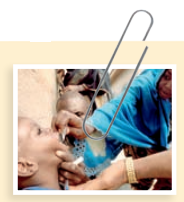
What prompted this reemergence of polio in countries that were on the brink of eradication Geography is one factor, as there is great difficulty in reaching children in remote areas. The countryside of many affected countries, such as Pakistan and Afghanistan, is mountainous, rocky, and treacherous, making it difficult to transport the vaccine to children in need. Also, the vaccine itself was found to contribute to the new cases. Oral polio vaccine (OPV) is used for mass vaccination of individuals in developing countries, because it is effective and much cheaper than the alternate inactivated polio vaccine (IPV) used in other areas of the world. The trade-off comes in the potential for the OPV to cause actual polio disease. It is made up of live attenuated virus, which in rare cases reverts to a virulent form causing disease rather than protecting against it. This contributed to a small portion of new disease cases. This would not have happened if the population had been at the 100% level of vaccination, and it illustrates the importance of achieving vaccination in all countries around the world.
What difficulties are encountered today in the continued global effort to eradicate polio
Besides vaccination, what other measures can be taken to interrupt the polio transmission cycle
Source : 2012. CDC MMWR , vol. 61, no. 19, p. 353.
Polio has been nearly eradicated in most of the industrialized world, so why do concerns over this disease still exist worldwide Because polio has not been eradicated globally; millions of children are still at risk of death or paralysis due to poliovirus infection. The Global Polio Eradication Initiative (GPEI) was launched in 1988 by the World Health Organization (WHO) with the intent of vaccinating every child. The GPEI was largely successful in interrupting endemic polio in India, which has been considered polio-free since February 2012. However, as of mid-2013 there are three countries in which polio is still endemic: Afghanistan, Nigeria, and Pakistan. Three countries that were previously deemed polio-free have recently seen a resurgence in cases of the disease: Angola, Chad, and the Democratic Republic of the Congo (DRC). The most recent outbreak of polio began in November 2010 in the DRC; a total of 554 cases of acute flaccid paralysis occurred and the outbreak was not brought under control until March 2011 through the immunization of all citizens. Travelers to and from the country were also advised to receive booster vaccinations to ensure that the disease would not spread beyond the country's borders. This is just one example of a number of polio outbreaks that have occurred worldwide in recent years. The WHO declared eradication of polio a "programmatic emergency for global public health" in January 2012, and it is hoped that its vaccination efforts will reduce the suffering of many individuals around the world today.
Why does polio continue to be an "emergency for global public health"
What are the difficulties in vaccinating children around the world and eradicating polio
Source: www.polioeradication.org/infectedcountries.aspx
Massive efforts have been undertaken by the GPEI, UNICEF, the WHO, the CDC, and Rotary International to vaccinate children in countries where polio is still endemic or where there have been outbreaks. A trivalent (three-part) vaccine is available, but studies have shown that this vaccine is less effective than newer versions of monovalent oral vaccines consisting of only type I or type III poliovirus or a bivalent vaccine consisting of type I and type III. In 2003, with new cases of disease dropping rapidly, it appeared that the effort had paid off-it was estimated that disease eradication would occur by 2005. However, within the year, new outbreaks began to develop in Nigeria leading to nearly 800 new cases in this country alone and many as far away as Saudi Arabia, where travelers to Mecca furthered its spread. This was disheartening news to health care workers around the world.
What prompted this reemergence of polio in countries that were on the brink of eradication Geography is one factor, as there is great difficulty in reaching children in remote areas. The countryside of many affected countries, such as Pakistan and Afghanistan, is mountainous, rocky, and treacherous, making it difficult to transport the vaccine to children in need. Also, the vaccine itself was found to contribute to the new cases. Oral polio vaccine (OPV) is used for mass vaccination of individuals in developing countries, because it is effective and much cheaper than the alternate inactivated polio vaccine (IPV) used in other areas of the world. The trade-off comes in the potential for the OPV to cause actual polio disease. It is made up of live attenuated virus, which in rare cases reverts to a virulent form causing disease rather than protecting against it. This contributed to a small portion of new disease cases. This would not have happened if the population had been at the 100% level of vaccination, and it illustrates the importance of achieving vaccination in all countries around the world.
What difficulties are encountered today in the continued global effort to eradicate polio
Besides vaccination, what other measures can be taken to interrupt the polio transmission cycle
Source : 2012. CDC MMWR , vol. 61, no. 19, p. 353.
Explanation Verified
Verified
Although polio has been nearly eradicate...

Microbiology: A Systems Approach 4th Edition by Marjorie Kelly Cowan

Why don’t you like this exercise?
Other Minimum 8 character and maximum 255 character
Character 255






