







 Chat with AI


Genetics 5th Edition by Leland Hartwell ,Michael Goldberg,Janice Fischer ,Leroy Hood,Charles Aquadro
Edition 5ISBN: 978-0073525310Genetics 5th Edition by Leland Hartwell ,Michael Goldberg,Janice Fischer ,Leroy Hood,Charles Aquadro
Edition 5ISBN: 978-0073525310 Exercise 1
Compare the chemical structures of DNA and proteins.
Explanation Verified
Verified
DNA (deoxyribonucleic acid) and proteins are two macromolecules of great importance to an organism. DNA belongs to class of molecules named as nucleic acids formed by joining several nucleotides together. A nucleotide is made up of a five-carbon sugar; deoxyribose in case of DNA, one phosphate group and nitrogenous base. Four nitrogenous bases found in DNA are adenine, guanine, cytosine and thymine.In a nucleotide phosphate group is attached to 5'carbon of sugar and nitrogenous is joined to 1'carbon of sugar. Nucleotides are joined together by phosphodiester bond. DNA forms a double helical structure where adenine pairs with thymine and cytosine pairs with guanine. Two nitrogenous bases are joined by hydrogen bonds.Proteins are large molecules composed of smaller units called amino acids. Amino acid is compound having an amino group and a carboxyl group at one end of R side chain. Arrangement of amino acids determines the structure of protein, primary, secondary, or tertiary.
When amino acids arrange in linear fashion they constitute primary structure of proteins. Secondary structure of protein is formed by interaction between neighbouring amino acids. Tertiary structure of proteins represents the three-dimensional shape of protein due to interaction between primary and secondary protein structure. Repeated folding of tertiary structure give rise to quaternary protein structure.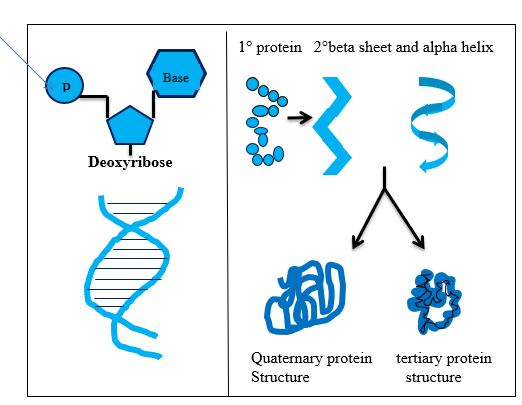
When amino acids arrange in linear fashion they constitute primary structure of proteins. Secondary structure of protein is formed by interaction between neighbouring amino acids. Tertiary structure of proteins represents the three-dimensional shape of protein due to interaction between primary and secondary protein structure. Repeated folding of tertiary structure give rise to quaternary protein structure.

Genetics 5th Edition by Leland Hartwell ,Michael Goldberg,Janice Fischer ,Leroy Hood,Charles Aquadro

Why don’t you like this exercise?
Other Minimum 8 character and maximum 255 character
Character 255






