







 Chat with AI

Introduction to Psychology 10th Edition by Rod Plotnik,Haig Kouyoumdjian
Edition 10ISBN: 978-1133939535Introduction to Psychology 10th Edition by Rod Plotnik,Haig Kouyoumdjian
Edition 10ISBN: 978-1133939535 Exercise 17
Taste Shapes? Hear Colors? Smell Sounds?
When Carol Crane hears the sound of guitars, she feels as if someone is blowing on her ankles. Hearing the piano gives her a tapping sensation on her chest. Hearing jazz music makes her feel as if heavy, sharp raindrops are falling all over her body! When Carol looks at the number 4, she sees red, and when she looks at the letter b, she sees blue. Carol is different from most other people because of the complex way she experiences many sensations.
Carol has an uncommon condition called synesthesia, which means when one of her senses gets stimulated, another sense automatically, involuntarily gets stimulated too. Perceiving colors with letters and numbers is the most common form of synesthesia. Less common types include experiencing sounds with smells and shapes with flavors. Sometimes, the associations are reasonable or logical, such as the smell of lemons leading people to see yellow. But, other times, the associations are surprising, such as the smell of lavender leading people to see green and to feel stickiness.
Many people with synesthesia enjoy their special abilities; however, there is a real downside for others. Some people experience unpleasant associations, such as the awful taste of earwax when hearing certain words. As you can imagine, this can make reading very unpleasant! As a result of having multiple senses stimulated, people can experience distractions at work, while reading or studying, or while driving and looking at road signs. These unique experiences can be frustrating because they are frequent and automatic, making them very difficult to prevent or stop.
Researchers have been studying people with synesthesia and have learned some fascinating things. In people with synesthesia, the signals that come from sensory organs, such as the eyes and ears, travel to places in the brain they shouldn't necessarily be going to, which leads to the signals being interpreted as multiple sensations. For example, when people experience color sensations when hearing words, hearing words activates areas of the brain responsible for both hearing and vision.
Other biological research suggests that synesthesia runs in families. Researchers have identified specific chromosomal regions associated with auditory-visual synesthesia, which is when people see colors in response to sounds. Still, the genetic basis for synesthesia is complex and understanding how it develops requires much further study. Researchers are hopeful that understanding the genetic involvement in synesthesia will also help them better understand how the brain is organized and how different areas are connected, ultimately leading to a better understanding of human perception.
The seemingly endless variations of synesthesia highlight the differences in how individuals perceive the world. The research on synesthesia confirms that the brain filters what it perceives and that perception is a highly individualized process.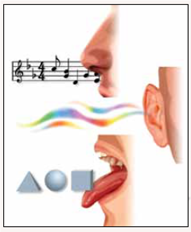
Question
Which part of the neuron is responsible for taking signals that come from sensory organs to multiple areas of the brain?
When Carol Crane hears the sound of guitars, she feels as if someone is blowing on her ankles. Hearing the piano gives her a tapping sensation on her chest. Hearing jazz music makes her feel as if heavy, sharp raindrops are falling all over her body! When Carol looks at the number 4, she sees red, and when she looks at the letter b, she sees blue. Carol is different from most other people because of the complex way she experiences many sensations.
Carol has an uncommon condition called synesthesia, which means when one of her senses gets stimulated, another sense automatically, involuntarily gets stimulated too. Perceiving colors with letters and numbers is the most common form of synesthesia. Less common types include experiencing sounds with smells and shapes with flavors. Sometimes, the associations are reasonable or logical, such as the smell of lemons leading people to see yellow. But, other times, the associations are surprising, such as the smell of lavender leading people to see green and to feel stickiness.
Many people with synesthesia enjoy their special abilities; however, there is a real downside for others. Some people experience unpleasant associations, such as the awful taste of earwax when hearing certain words. As you can imagine, this can make reading very unpleasant! As a result of having multiple senses stimulated, people can experience distractions at work, while reading or studying, or while driving and looking at road signs. These unique experiences can be frustrating because they are frequent and automatic, making them very difficult to prevent or stop.
Researchers have been studying people with synesthesia and have learned some fascinating things. In people with synesthesia, the signals that come from sensory organs, such as the eyes and ears, travel to places in the brain they shouldn't necessarily be going to, which leads to the signals being interpreted as multiple sensations. For example, when people experience color sensations when hearing words, hearing words activates areas of the brain responsible for both hearing and vision.
Other biological research suggests that synesthesia runs in families. Researchers have identified specific chromosomal regions associated with auditory-visual synesthesia, which is when people see colors in response to sounds. Still, the genetic basis for synesthesia is complex and understanding how it develops requires much further study. Researchers are hopeful that understanding the genetic involvement in synesthesia will also help them better understand how the brain is organized and how different areas are connected, ultimately leading to a better understanding of human perception.
The seemingly endless variations of synesthesia highlight the differences in how individuals perceive the world. The research on synesthesia confirms that the brain filters what it perceives and that perception is a highly individualized process.
Question
Which part of the neuron is responsible for taking signals that come from sensory organs to multiple areas of the brain?
Explanation Verified
Verified
When any stimulus is presented before a ...

Introduction to Psychology 10th Edition by Rod Plotnik,Haig Kouyoumdjian

Why don’t you like this exercise?
Other Minimum 8 character and maximum 255 character
Character 255






