







 Chat with AI

Essentials of the Living World 5th Edition by George Johnson
Edition 5ISBN: 978-0078096945Essentials of the Living World 5th Edition by George Johnson
Edition 5ISBN: 978-0078096945 Exercise 1
Does the Presence of One Species Limit the Population Size of Others?
Implicit in Darwin's theory of evolution is the idea that species in nature compete for limited resources. Does this really happen? Some of the best evidence of competition between species comes from experimental field studies, studies conducted not in the laboratory but out in natural populations. By setting up experiments in which two species occur either alone or together, scientists can determine whether the presence of one species has a negative impact on the size of the population of the other species. The experiment discussed here concerns a variety of seed-eating rodents that occur in North American deserts. In 1988, researchers set up a series of 50-meter × 50-meter enclosures to investigate the effect of kangaroo rats on smaller seed-eating rodents. Kangaroo rats were removed from half of the enclosures, but not from the other enclosures. The walls of all the enclosures had holes that allowed rodents to come and go, but in plots without kangaroo rats the holes were too small to allow the kangaroo rats to enter.
The graph to the right displays data collected over the course of the next three years as researchers monitored the number of the smaller rodents present in the enclosures. To estimate the population sizes, researchers determined how many small rodents could be captured in a fixed interval. Data were collected for each enclosure immediately after the kangaroo rats were removed in 1988, and at three-month intervals thereafter. The graph presents the relative population size-that is, the total number of captures averaged over the number of enclosures (an average is the numerical mean value, calculated by adding a list of values and then dividing this sum by the number of items in the list. For example, if a total of 30 rats were captured from 3 enclosures, the average would be 10 rats). As you can see, the two kinds of enclosures do not contain the same number of small rodents.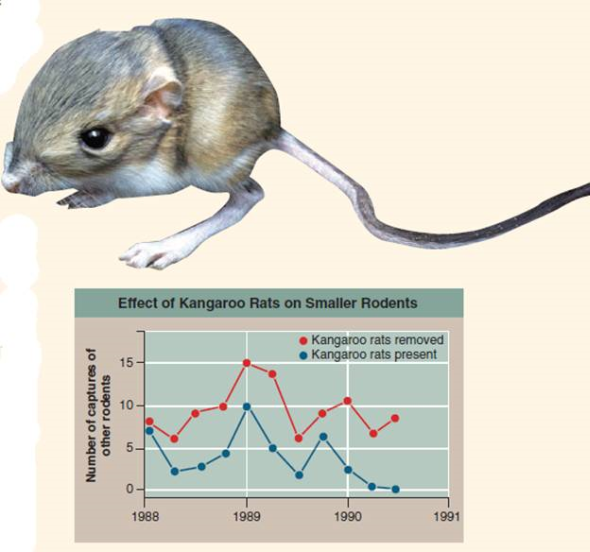
Applying Concepts
a. Variable. In the graph, what is the dependent variable?
b. Relative Magnitude. Which of the two kinds of enclosures maintains the highest population of small rodents? Does it have kangaroo rats, or have they been removed?
Implicit in Darwin's theory of evolution is the idea that species in nature compete for limited resources. Does this really happen? Some of the best evidence of competition between species comes from experimental field studies, studies conducted not in the laboratory but out in natural populations. By setting up experiments in which two species occur either alone or together, scientists can determine whether the presence of one species has a negative impact on the size of the population of the other species. The experiment discussed here concerns a variety of seed-eating rodents that occur in North American deserts. In 1988, researchers set up a series of 50-meter × 50-meter enclosures to investigate the effect of kangaroo rats on smaller seed-eating rodents. Kangaroo rats were removed from half of the enclosures, but not from the other enclosures. The walls of all the enclosures had holes that allowed rodents to come and go, but in plots without kangaroo rats the holes were too small to allow the kangaroo rats to enter.
The graph to the right displays data collected over the course of the next three years as researchers monitored the number of the smaller rodents present in the enclosures. To estimate the population sizes, researchers determined how many small rodents could be captured in a fixed interval. Data were collected for each enclosure immediately after the kangaroo rats were removed in 1988, and at three-month intervals thereafter. The graph presents the relative population size-that is, the total number of captures averaged over the number of enclosures (an average is the numerical mean value, calculated by adding a list of values and then dividing this sum by the number of items in the list. For example, if a total of 30 rats were captured from 3 enclosures, the average would be 10 rats). As you can see, the two kinds of enclosures do not contain the same number of small rodents.
Applying Concepts
a. Variable. In the graph, what is the dependent variable?
b. Relative Magnitude. Which of the two kinds of enclosures maintains the highest population of small rodents? Does it have kangaroo rats, or have they been removed?
Explanation Verified
Verified
The Charles Darwin theory of evolution called Natural selection. Natural selection is a process in which definite characteristics are selected over others during the process of evolution. It is a natural and unguided process and it states that traits, which are advantageous to an individual, will help that individual reproduce more successfully, and thus the population will keep traits that are advantageous. Traits that do not help an individual will likely lead to that individual not reproducing and that trait not showing up in subsequent generations (or) population.
In controlled experiments, there are two kinds of variables, namely independent variables, and dependent variables. Independent variables are the parameters of an experiment that do not vary with any change in other parameters. Dependent variable
  is the variable in an experiment that is observed for any influences by changes in another factor.
(a)
A dependent variable is what you measure in the experiment and is dependent on another factor. The dependent variable responds to the independent variable. Therefore, in this experiment the number of smaller rodents (or) the is the dependent variable.
(b)
Living in the ecosystem, in a region at the same time with the limited amount of resources ranging from a territory, food and potential mates, may often lead to competition among members of the same species or other species as well. Such behavior is known as competitive behavior. The competitive dominance hierarchy in the simulated intertidal zone focuses on competition for Space.
So, the enclosures that have their kangaroo rats removed show the highest population of small rodents. This is so because, the competition for the available limited resource is no more present after the removal of these kangaroo rats, and thus the population size increases.
In controlled experiments, there are two kinds of variables, namely independent variables, and dependent variables. Independent variables
are the parameters of an experiment that do not vary with any change in other parameters. Dependent variable is the variable in an experiment that is observed for any influences by changes in another factor.(a)
A dependent variable is what you measure in the experiment and is dependent on another factor. The dependent variable responds to the independent variable. Therefore, in this experiment the number of smaller rodents (or) the
is the dependent variable.(b)
Living in the ecosystem, in a region at the same time with the limited amount of resources ranging from a territory, food and potential mates, may often lead to competition among members of the same species or other species as well. Such behavior is known as competitive behavior. The competitive dominance hierarchy in the simulated intertidal zone focuses on competition for Space.
So, the enclosures that have their kangaroo rats removed show the highest population of small rodents. This is so because, the competition for the available limited resource is no more present after the removal of these kangaroo rats, and thus the population size increases.

Essentials of the Living World 5th Edition by George Johnson

Why don’t you like this exercise?
Other Minimum 8 character and maximum 255 character
Character 255






