







 Chat with AI


Essentials of the Living World 5th Edition by George Johnson
Edition 5ISBN: 978-0078096945Essentials of the Living World 5th Edition by George Johnson
Edition 5ISBN: 978-0078096945 Exercise 1
What Causes New Forms to Arise?
Biologists once presumed that new forms-genera, families, and orders-arose most often during times of massive geological disturbance, stimulated by the resulting environmental changes. But no such relationship exists. An alternative hypothesis was proposed by evolutionist George Simpson in 1953. He proposed that diversification followed new evolutionary innovations, "inventions" that permitted an organism to occupy a new "adaptive zone." After a burst of new orders that define the major groups, subsequent specialization would lead to new genera.
The early bony fishes, typified by the sturgeon below, had feeble jaws and long sharklike tails. They dominated the Devonian (the Age of Fishes) but were succeeded in the Triassic (the period when dinosaurs appeared) by fishes such as the gar pike with a more powerful jaw that improved feeding and a shortened more maneuverable tail that improved locomotion. Gar pikes were in turn succeeded by teleost fishes such as the perch, with an even better tail for fast, maneuverable swimming and a complex mouth with a mobile upper jaw that slides forward as the mouth opens.
This history allows a clear test of Simpson's hypothesis. Was the appearance of these three orders followed by a burst of evolution, as Simpson predicts, the new innovations in feeding and locomotion opening wide the door of opportunity? If so, many new genera should be seen in the fossil record soon after the appearance of each new order. If not, the pattern of when new genera appear should not track the appearance of new orders.
The graph shows the evolutionary history of the class Osteichthyes, the bony fishes, since they first appeared in the Silurian some 420 million years ago.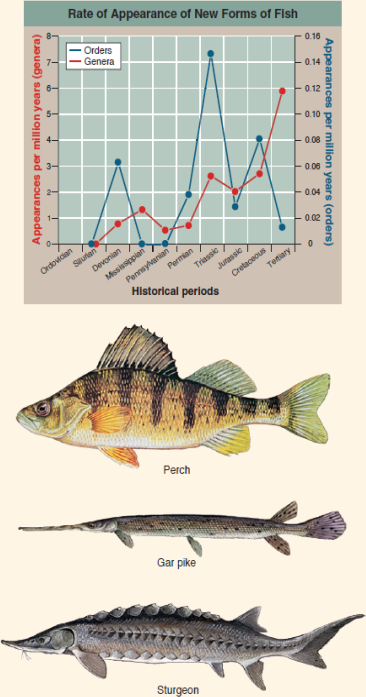
Interpreting Data Three great innovations in jaw and tail occur during the history of the bony fishes, producing the superorders represented by sturgeons, then gars, and then teleost fishes. In what period did each innovation occur?
Biologists once presumed that new forms-genera, families, and orders-arose most often during times of massive geological disturbance, stimulated by the resulting environmental changes. But no such relationship exists. An alternative hypothesis was proposed by evolutionist George Simpson in 1953. He proposed that diversification followed new evolutionary innovations, "inventions" that permitted an organism to occupy a new "adaptive zone." After a burst of new orders that define the major groups, subsequent specialization would lead to new genera.
The early bony fishes, typified by the sturgeon below, had feeble jaws and long sharklike tails. They dominated the Devonian (the Age of Fishes) but were succeeded in the Triassic (the period when dinosaurs appeared) by fishes such as the gar pike with a more powerful jaw that improved feeding and a shortened more maneuverable tail that improved locomotion. Gar pikes were in turn succeeded by teleost fishes such as the perch, with an even better tail for fast, maneuverable swimming and a complex mouth with a mobile upper jaw that slides forward as the mouth opens.
This history allows a clear test of Simpson's hypothesis. Was the appearance of these three orders followed by a burst of evolution, as Simpson predicts, the new innovations in feeding and locomotion opening wide the door of opportunity? If so, many new genera should be seen in the fossil record soon after the appearance of each new order. If not, the pattern of when new genera appear should not track the appearance of new orders.
The graph shows the evolutionary history of the class Osteichthyes, the bony fishes, since they first appeared in the Silurian some 420 million years ago.
Interpreting Data Three great innovations in jaw and tail occur during the history of the bony fishes, producing the superorders represented by sturgeons, then gars, and then teleost fishes. In what period did each innovation occur?
Explanation Verified
Verified
The great innovations in jaws and tails ...

Essentials of the Living World 5th Edition by George Johnson

Why don’t you like this exercise?
Other Minimum 8 character and maximum 255 character
Character 255






