







 Chat with AI

Essentials of the Living World 5th Edition by George Johnson
Edition 5ISBN: 978-0078096945Essentials of the Living World 5th Edition by George Johnson
Edition 5ISBN: 978-0078096945 Exercise 1
Defining a Treatment Window for Malaria
While malaria kills more people each year than any other infectious disease, the combination of mosquito control and effective treatment has virtually eliminated this disease from the United States. In 1941, more than 4,000 Americans died of malaria; in 2006, by contrast, fewer than five people died of malaria.
The key to controlling malaria has come from understanding its life cycle. The first critical advance came in 1897 in a remote field hospital in Secunderabad, India, when English physician Ronald Ross observed that hospital patients who did not have malaria were more likely to develop the disease in the open wards (those without screens or netting) than in wards with closed windows or screens. Observing closely, he saw that patients in the open wards were being bitten by mosquitoes of the genus Anopheles. Dissecting mosquitoes that had bitten malaria patients, he found the plasmodium parasite. Newly hatched mosquitoes that had not yet fed, when allowed to feed on malaria-free blood, did not acquire the parasite. Ross reached the conclusion that mosquitoes were spreading the disease from one person to another, passing along the parasite while feeding. In every country where it has been possible to eliminate the Anopheles mosquitoes, the incidence of the disease malaria has plummeted.
The second critical advance came with the development of drugs to treat malaria victims. The British had discovered in India in the mid-1800s that a bitter substance called quinine taken from the bark of cinchona trees was useful in suppressing attacks of malaria. The boys in the photograph are being treated with an intravenous solution of quinine. Quinine also reduces the fever during attacks, but does not cure the disease. Today physicians use instead the synthetic drugs chloroquine and primaquine, which are much more effective than quinine, with fewer side effects.
Unlike quinine, these two drugs can cure patients completely, because they attack and destroy one of the phases of the plasmodium life cycle, the merozoites released into the bloodstream several days after infection-but only if the drugs are administered soon enough after the bite that starts the infection.
To determine the time frame for successful treatment, doctors have carefully studied the time course of a malarial infection. The graph above presents what they have found. Numbers of merozoites are presented on the y axis on a log scale-each step reflects a 10-fold increase in numbers. The infection becomes life-threatening if 1% of red blood cells become infected, and death is almost inevitable if 20% of red blood cells are infected.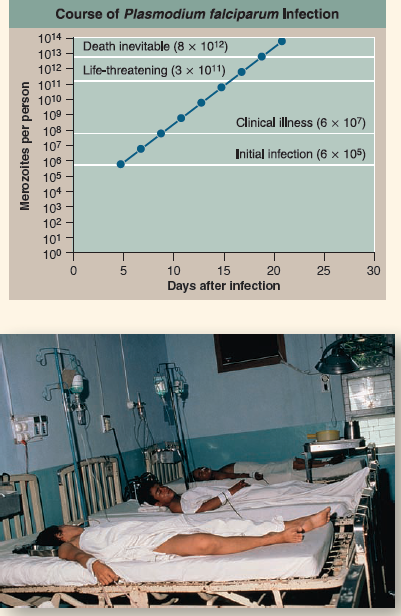
Making Inferences
a. How long after infection is it before the liver releases merozoites into the blood stream (that is, initial infection by merozoites)? Before the disease becomes life-threatening? Before death is inevitable?
b. How long does it take merozoites to multiply 10-fold?
While malaria kills more people each year than any other infectious disease, the combination of mosquito control and effective treatment has virtually eliminated this disease from the United States. In 1941, more than 4,000 Americans died of malaria; in 2006, by contrast, fewer than five people died of malaria.
The key to controlling malaria has come from understanding its life cycle. The first critical advance came in 1897 in a remote field hospital in Secunderabad, India, when English physician Ronald Ross observed that hospital patients who did not have malaria were more likely to develop the disease in the open wards (those without screens or netting) than in wards with closed windows or screens. Observing closely, he saw that patients in the open wards were being bitten by mosquitoes of the genus Anopheles. Dissecting mosquitoes that had bitten malaria patients, he found the plasmodium parasite. Newly hatched mosquitoes that had not yet fed, when allowed to feed on malaria-free blood, did not acquire the parasite. Ross reached the conclusion that mosquitoes were spreading the disease from one person to another, passing along the parasite while feeding. In every country where it has been possible to eliminate the Anopheles mosquitoes, the incidence of the disease malaria has plummeted.
The second critical advance came with the development of drugs to treat malaria victims. The British had discovered in India in the mid-1800s that a bitter substance called quinine taken from the bark of cinchona trees was useful in suppressing attacks of malaria. The boys in the photograph are being treated with an intravenous solution of quinine. Quinine also reduces the fever during attacks, but does not cure the disease. Today physicians use instead the synthetic drugs chloroquine and primaquine, which are much more effective than quinine, with fewer side effects.
Unlike quinine, these two drugs can cure patients completely, because they attack and destroy one of the phases of the plasmodium life cycle, the merozoites released into the bloodstream several days after infection-but only if the drugs are administered soon enough after the bite that starts the infection.
To determine the time frame for successful treatment, doctors have carefully studied the time course of a malarial infection. The graph above presents what they have found. Numbers of merozoites are presented on the y axis on a log scale-each step reflects a 10-fold increase in numbers. The infection becomes life-threatening if 1% of red blood cells become infected, and death is almost inevitable if 20% of red blood cells are infected.
Making Inferences
a. How long after infection is it before the liver releases merozoites into the blood stream (that is, initial infection by merozoites)? Before the disease becomes life-threatening? Before death is inevitable?
b. How long does it take merozoites to multiply 10-fold?
Explanation Verified
Verified
Malaria is a disease which is life threa...

Essentials of the Living World 5th Edition by George Johnson

Why don’t you like this exercise?
Other Minimum 8 character and maximum 255 character
Character 255






