







 Chat with AI

Essentials of the Living World 5th Edition by George Johnson
Edition 5ISBN: 978-0078096945Essentials of the Living World 5th Edition by George Johnson
Edition 5ISBN: 978-0078096945 Exercise 2
Are Island Populations of Song Sparrows Density Dependent?
When island populations are isolated, receiving no visitors from other populations, they provide an attractive opportunity to test the degree to which a population's growth rate is affected by its size. A population's size can influence the rate at which it grows because increased numbers of individuals within a population tend to deplete available resources, leading to an increased risk of death by deprivation. Also, predators tend to focus their attention on common prey, resulting in increasing rates of mortality as populations grow. However, simply knowing that a population is decreasing in numbers does not tell you that the decrease has been caused by the size of the population. Many factors such as severe weather, volcanic eruption, and human disturbance can influence island population sizes too.
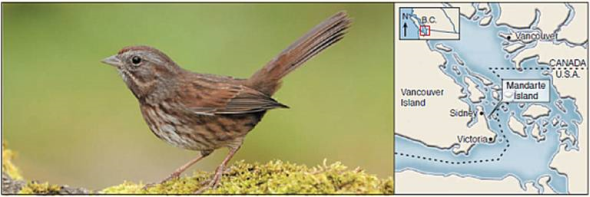
The graph to the right displays data collected from 13 song sparrow populations on Mandarte Island (see map below). In an attempt to gauge the impact of population size on the evolutionary success of these populations, each population was counted, and its juvenile mortality rate estimated. On the graph, these juvenile mortality rates have been plotted against the number of breeding adults in each population. Although the data appear scattered, the "best-fit" regression line is statistically significant ( statistically significant means that there is a less than 5% chance that there is in fact no correlation between dependent and independent variables).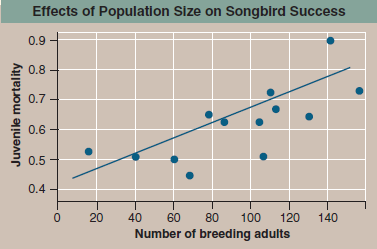
Making Inferences Are the populations with lower juvenile mortality bigger or smaller than the populations with higher juvenile mortality?
When island populations are isolated, receiving no visitors from other populations, they provide an attractive opportunity to test the degree to which a population's growth rate is affected by its size. A population's size can influence the rate at which it grows because increased numbers of individuals within a population tend to deplete available resources, leading to an increased risk of death by deprivation. Also, predators tend to focus their attention on common prey, resulting in increasing rates of mortality as populations grow. However, simply knowing that a population is decreasing in numbers does not tell you that the decrease has been caused by the size of the population. Many factors such as severe weather, volcanic eruption, and human disturbance can influence island population sizes too.
The graph to the right displays data collected from 13 song sparrow populations on Mandarte Island (see map below). In an attempt to gauge the impact of population size on the evolutionary success of these populations, each population was counted, and its juvenile mortality rate estimated. On the graph, these juvenile mortality rates have been plotted against the number of breeding adults in each population. Although the data appear scattered, the "best-fit" regression line is statistically significant ( statistically significant means that there is a less than 5% chance that there is in fact no correlation between dependent and independent variables).
Making Inferences Are the populations with lower juvenile mortality bigger or smaller than the populations with higher juvenile mortality?
Explanation Verified
Verified
The scatter diagram shows the relationsh...

Essentials of the Living World 5th Edition by George Johnson

Why don’t you like this exercise?
Other Minimum 8 character and maximum 255 character
Character 255






