







 Chat with AI


Essentials of the Living World 5th Edition by George Johnson
Edition 5ISBN: 978-0078096945Essentials of the Living World 5th Edition by George Johnson
Edition 5ISBN: 978-0078096945 Exercise 2
Does Clear-Cutting Forests Cause Permanent Damage?
The lumber industry practice called "clear-cutting" has been common in many states. Loggers find it more efficient to simply remove all trees from a watershed and sort the logs out later than to selectively cut only the most desirable mature trees. While the open cuts seem a desolation to the casual observer, the loggers claim that new forests can become established more readily in the open cut as sunlight now more easily reaches seedlings at ground level. Ecologists counter that clear-cutting fundamentally changes the forest in ways which cannot be easily reversed.
Who is right? The most direct way to find out is to try it: Clearcut an area and watch it very carefully. Just this sort of massive field test was carried out in a now-classic experiment at the Hubbard Brook Experimental Forest in New Hampshire. Hubbard Brook is the central stream of a large watershed that drains a region of temperate deciduous forest in northern New Hampshire. The research team, led by then-Dartmouth College professors Herbert Bormann and Gene Likens, first gathered a great deal of information about the forest watershed. Starting in 1963, they censused the trees, measured the flow of water through the watershed, and carefully documented the levels of minerals and other nutrients in the water leaving the ecosystem via Hubbard Brook. To keep track, they constructed concrete dams across each of the six streams that drain the forest and monitored the runoff, chemically analyzing samples. The undisturbed forest proved very efficient at retaining nitrogen and other nutrients. The small amounts of nutrients that entered the ecosystem in rain and snow were approximately equal to the amounts of nutrients that ran out of the valleys into Hubbard Brook.
Now came the test. In the winter of 1965, the investigators felled all the trees and shrubs in 48 acres drained by one stream (as shown in the photo) and examined the water running off. The immediate effect was dramatic: The amount of water running out of the valley increased by 40%. Water that otherwise would have been taken up by vegetation and released into the atmosphere through evaporation was now simply running off. It was clear that the forest was not retaining water as well, but what about the soil nutrients, the key to future forest fertility?
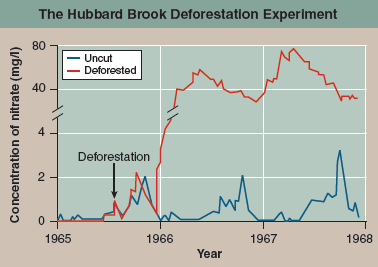
The red line in the graph above shows nitrogen minerals leaving the ecosystem in the runoff water of the stream draining the clear-cut area; the blue line shows the nitrogen runoff in a neighboring stream draining an adjacent uncut portion of the forest.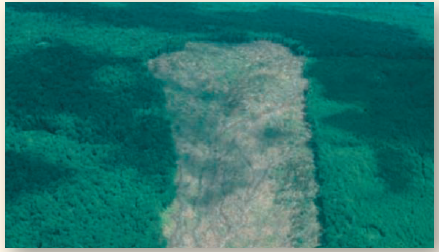
Interpreting Data
a. What is the approximate concentration of nitrogen in the runoff of the uncut valley before cutting? Of the cut valley before cutting?
b. What is the approximate concentration of nitrogen in the runoff of the uncut valley one year after cutting? Of the clear-cut valley one year after cutting?
The lumber industry practice called "clear-cutting" has been common in many states. Loggers find it more efficient to simply remove all trees from a watershed and sort the logs out later than to selectively cut only the most desirable mature trees. While the open cuts seem a desolation to the casual observer, the loggers claim that new forests can become established more readily in the open cut as sunlight now more easily reaches seedlings at ground level. Ecologists counter that clear-cutting fundamentally changes the forest in ways which cannot be easily reversed.
Who is right? The most direct way to find out is to try it: Clearcut an area and watch it very carefully. Just this sort of massive field test was carried out in a now-classic experiment at the Hubbard Brook Experimental Forest in New Hampshire. Hubbard Brook is the central stream of a large watershed that drains a region of temperate deciduous forest in northern New Hampshire. The research team, led by then-Dartmouth College professors Herbert Bormann and Gene Likens, first gathered a great deal of information about the forest watershed. Starting in 1963, they censused the trees, measured the flow of water through the watershed, and carefully documented the levels of minerals and other nutrients in the water leaving the ecosystem via Hubbard Brook. To keep track, they constructed concrete dams across each of the six streams that drain the forest and monitored the runoff, chemically analyzing samples. The undisturbed forest proved very efficient at retaining nitrogen and other nutrients. The small amounts of nutrients that entered the ecosystem in rain and snow were approximately equal to the amounts of nutrients that ran out of the valleys into Hubbard Brook.
Now came the test. In the winter of 1965, the investigators felled all the trees and shrubs in 48 acres drained by one stream (as shown in the photo) and examined the water running off. The immediate effect was dramatic: The amount of water running out of the valley increased by 40%. Water that otherwise would have been taken up by vegetation and released into the atmosphere through evaporation was now simply running off. It was clear that the forest was not retaining water as well, but what about the soil nutrients, the key to future forest fertility?
The red line in the graph above shows nitrogen minerals leaving the ecosystem in the runoff water of the stream draining the clear-cut area; the blue line shows the nitrogen runoff in a neighboring stream draining an adjacent uncut portion of the forest.
Interpreting Data
a. What is the approximate concentration of nitrogen in the runoff of the uncut valley before cutting? Of the cut valley before cutting?
b. What is the approximate concentration of nitrogen in the runoff of the uncut valley one year after cutting? Of the clear-cut valley one year after cutting?
Explanation Verified
Verified
The approximate concentration of nitroge...

Essentials of the Living World 5th Edition by George Johnson

Why don’t you like this exercise?
Other Minimum 8 character and maximum 255 character
Character 255






