







 Chat with AI

Essentials of the Living World 5th Edition by George Johnson
Edition 5ISBN: 978-0078096945Essentials of the Living World 5th Edition by George Johnson
Edition 5ISBN: 978-0078096945 Exercise 1
Do Crabs Eat Sensibly?
Many behavioral ecologists claim that animals exhibit so-called optimal foraging behavior. The idea is that because an animal's choice in seeking food involves a trade-off between the food's energy content and the cost of obtaining it, evolution should favor foraging behaviors that optimize the trade-off.
While this all makes sense, it is not at all clear that this is what animals would actually do. This optimal foraging approach makes a key assumption, that maximizing the amount of energy acquired will lead to increased reproductive success. In some cases, this is clearly true. In ground squirrels, zebra finches, and orb-weaving spiders, researchers have found a direct relationship between net energy intake and the number of offspring raised successfully.
However, animals have other needs besides energy, and sometimes these needs conflict. One obvious "other need," important to many animals, is to avoid predators. It makes little sense for you to eat a little more food if doing so greatly increases the probability that you will yourself be eaten. Often the behavior that maximizes energy intake increases predation risk. A shore crab foraging for mussels on a beach exposes itself to predatory gulls and other shore birds with each foray. Thus, the behavior that maximizes fitness may reflect a trade-off, obtaining the most energy with the least risk of being eaten. Not surprisingly, a wide variety of animals use a more cautious foraging behavior when predators are present-becoming less active and staying nearer to cover.
So what does a shore crab do? To find out, an investigator looked to see if shore crabs in fact feed on those mussels that provide the most energy, as the theory predicts. He found that the mussels on the beach he studied come in a range of sizes, from small ones less than 10 millimeters in length that are easy for a crab to open but yield the least amount of energy, to large mussels over 30 millimeters in length that yield the most energy but also take considerably more energy to pry open. To obtain the most net energy, the optimal approach, described by the blue curve in the graph above, would be for shore crabs to feed primarily on intermediate-sized mussels about 22 millimeters in length. Is this in fact what shore crabs do? To find out, the researcher carefully monitored the size of the mussels eaten each day by the beach's population of shore crabs. The results he obtained-the numbers of mussels of each size actually eaten-are presented in the red histogram.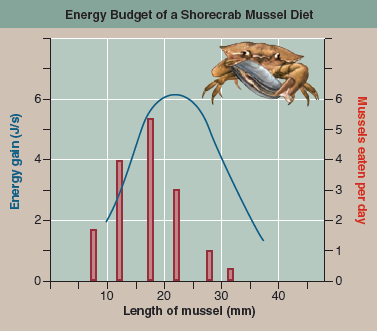
Applying Concepts What variable do the curve and the histogram have in common?
Many behavioral ecologists claim that animals exhibit so-called optimal foraging behavior. The idea is that because an animal's choice in seeking food involves a trade-off between the food's energy content and the cost of obtaining it, evolution should favor foraging behaviors that optimize the trade-off.
While this all makes sense, it is not at all clear that this is what animals would actually do. This optimal foraging approach makes a key assumption, that maximizing the amount of energy acquired will lead to increased reproductive success. In some cases, this is clearly true. In ground squirrels, zebra finches, and orb-weaving spiders, researchers have found a direct relationship between net energy intake and the number of offspring raised successfully.
However, animals have other needs besides energy, and sometimes these needs conflict. One obvious "other need," important to many animals, is to avoid predators. It makes little sense for you to eat a little more food if doing so greatly increases the probability that you will yourself be eaten. Often the behavior that maximizes energy intake increases predation risk. A shore crab foraging for mussels on a beach exposes itself to predatory gulls and other shore birds with each foray. Thus, the behavior that maximizes fitness may reflect a trade-off, obtaining the most energy with the least risk of being eaten. Not surprisingly, a wide variety of animals use a more cautious foraging behavior when predators are present-becoming less active and staying nearer to cover.
So what does a shore crab do? To find out, an investigator looked to see if shore crabs in fact feed on those mussels that provide the most energy, as the theory predicts. He found that the mussels on the beach he studied come in a range of sizes, from small ones less than 10 millimeters in length that are easy for a crab to open but yield the least amount of energy, to large mussels over 30 millimeters in length that yield the most energy but also take considerably more energy to pry open. To obtain the most net energy, the optimal approach, described by the blue curve in the graph above, would be for shore crabs to feed primarily on intermediate-sized mussels about 22 millimeters in length. Is this in fact what shore crabs do? To find out, the researcher carefully monitored the size of the mussels eaten each day by the beach's population of shore crabs. The results he obtained-the numbers of mussels of each size actually eaten-are presented in the red histogram.
Applying Concepts What variable do the curve and the histogram have in common?
Explanation Verified
Verified
The curve is a plot of the length of mus...

Essentials of the Living World 5th Edition by George Johnson

Why don’t you like this exercise?
Other Minimum 8 character and maximum 255 character
Character 255






