







 Chat with AI

Essentials of the Living World 5th Edition by George Johnson
Edition 5ISBN: 978-0078096945Essentials of the Living World 5th Edition by George Johnson
Edition 5ISBN: 978-0078096945 Exercise 4
Do Big Hearts Beat Faster?
Small animals live at a much faster pace than large animals. They reproduce more quickly, and live shorter lives. As a rule, they tend to move about more quickly and so consume more oxygen per unit body weight. Interestingly, small and large mammals have about the same size heart, relative to body size (about 0.6% of body mass). It is interesting to ask whether all mammalian hearts beat at the same rate. The heart of a 7,000-kilogram (a kilogram is 1,000 grams) African bull elephant must push a far greater volume of blood through its body than the heart of a 20-gram mouse, but the elephant is able to do it through much-larger-diameter arteries, which impose far less resistance to the blood's flow. Does the elephant's heart beat faster? Or does the mouse's, in order to deliver more oxygen to its muscles? Or perhaps the mouse's heart beats more slowly, because of increased resistance to flow through narrower blood vessels?
The graph to the right displays the pulse rate of a number of mammals of different body sizes (the pulse rate is the number of heartbeats counted per minute, a measure of how rapidly the heart is beating). Note that both the x and y axes use log scales (see page 13). For comparison, the pulse rate of an adult human at rest is about 70 beats per minute. The largest mammal is the blue whale, as big as a supersized moving van with a body mass as great as 136,000 kilograms; the smallest is the pygmy shrew, smaller than a cockroach with a body mass of a few hundredths of a gram.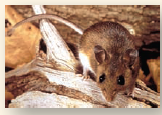
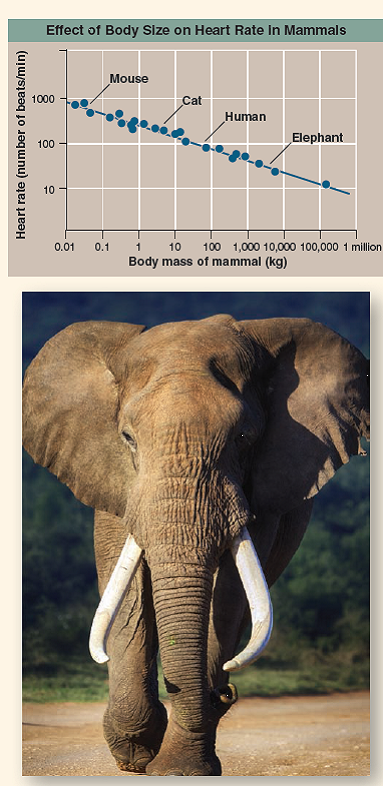
Drawing Conclusions If you plotted data for an experiment measuring body mass versus resting oxygen consumption, you would get exactly the same slope of the line as shown in this graph. What does this tell us about why body size affects heart rate in mammals as it does?
Small animals live at a much faster pace than large animals. They reproduce more quickly, and live shorter lives. As a rule, they tend to move about more quickly and so consume more oxygen per unit body weight. Interestingly, small and large mammals have about the same size heart, relative to body size (about 0.6% of body mass). It is interesting to ask whether all mammalian hearts beat at the same rate. The heart of a 7,000-kilogram (a kilogram is 1,000 grams) African bull elephant must push a far greater volume of blood through its body than the heart of a 20-gram mouse, but the elephant is able to do it through much-larger-diameter arteries, which impose far less resistance to the blood's flow. Does the elephant's heart beat faster? Or does the mouse's, in order to deliver more oxygen to its muscles? Or perhaps the mouse's heart beats more slowly, because of increased resistance to flow through narrower blood vessels?
The graph to the right displays the pulse rate of a number of mammals of different body sizes (the pulse rate is the number of heartbeats counted per minute, a measure of how rapidly the heart is beating). Note that both the x and y axes use log scales (see page 13). For comparison, the pulse rate of an adult human at rest is about 70 beats per minute. The largest mammal is the blue whale, as big as a supersized moving van with a body mass as great as 136,000 kilograms; the smallest is the pygmy shrew, smaller than a cockroach with a body mass of a few hundredths of a gram.
Drawing Conclusions If you plotted data for an experiment measuring body mass versus resting oxygen consumption, you would get exactly the same slope of the line as shown in this graph. What does this tell us about why body size affects heart rate in mammals as it does?
Explanation Verified
Verified
The mouse for example is small, the smal...

Essentials of the Living World 5th Edition by George Johnson

Why don’t you like this exercise?
Other Minimum 8 character and maximum 255 character
Character 255






