







 Chat with AI


Human Heredity 11th Edition by Michael Cummings
Edition 11ISBN: 978-1305251052Human Heredity 11th Edition by Michael Cummings
Edition 11ISBN: 978-1305251052 Exercise 9
Czar Nicholas Romanov II of Russia was overthrown in the Bolshevik Revolution that began in 1917. He and Empress Alexandra (granddaughter of Queen Victoria); their daughters Olga, Tatiana, Marie, and Anastasia; and their son Alexei (who had hemophilia) were taken prisoner. In July 1918, revolutionists executed the czar, but for many years the fate of his family was unknown. In the 1920s, a Russian investigator, Nikolai Solokof, reported that the czar, his wife and children, and four others were executed at Ekaterinburg, Russia, on July 16, 1918, and that their bodies were buried in a grave in the woods near the city. Other accounts indicated that at least one family member, Anastasia, escaped to live in western Europe or the United States. Over the years, the mystery surrounding the family generated several books and movies.
In the late 1970s, two Russian amateur historians began investigating Solokof's accounts, and, after a painstaking search, nine skeletons were dug from a shallow grave at a site 20 miles from Ekaterinburg in July 1991. All the skeletons bore marks and bullet wounds indicating violent death. Forensic experts examined the remains and, using computer-assisted facial reconstructions and other evidence, concluded that the remains included those of the czar, the czarina, and three of their five children. The remains of two children were missing: the son, Alexei, and one daughter.
DNA was extracted from bone fragments and used for sex testing, for DNA typing to establish family relationships, and for mitochondrial DNA testing to trace maternal relationships. The results indicated that the skeletons were of four males and five females, confirming the results of physical analysis. Five STRs were used to test family relationships. The results showed that five skeletons were a family group and that two were parents and three were children.
To determine whether the remains belonged to the Romanovs, investigators conducted mitochondrial DNA (mtDNA) testing. Because mtDNA is maternally inherited, living relatives of the czarina-including Prince Philip, the husband of Queen Elizabeth of Great Britain-were included in the tests. This analysis showed an exact match between the remains of the czarina, the three children, and living relatives, and the mtDNA from the czar matched that of two living maternal relatives, confirming that the remains are those of the czar, his wife, and three of his children. The remains of the czar and his family were reburied in the cathedral of St. Peter and Paul in St. Petersburg in 1998.
In August 2007, excavations at a nearby site recovered bones thought to be those of the young prince Alexei and his elder sister Maria. In 2009, the publication of forensic DNA test results confirmed that the remains belonged to the two children of the czar, ending the mystery about the fate of the royal family.
This study, stretching over several years and two continents, overcame several technical challenges but clearly established the identity of the skeletons as those of the Romanovs. The results show the power that genetic technology can bring to solving a historical mystery. Robert Massie describes the intrigues, the mysteries, and the science surrounding the search for the Romanovs in his book The Romanovs: The Final Chapter.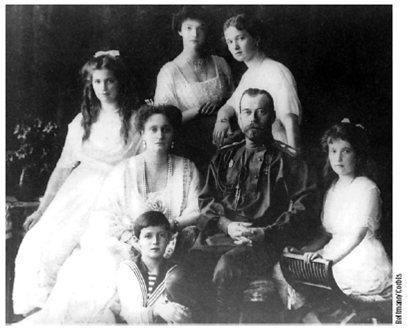
Suppose you are arrested for a serious crime and a DNA profile is created and entered into databases. Later, you are proven innocent. Should you have the right to have your DNA profile removed from all databases?
In the late 1970s, two Russian amateur historians began investigating Solokof's accounts, and, after a painstaking search, nine skeletons were dug from a shallow grave at a site 20 miles from Ekaterinburg in July 1991. All the skeletons bore marks and bullet wounds indicating violent death. Forensic experts examined the remains and, using computer-assisted facial reconstructions and other evidence, concluded that the remains included those of the czar, the czarina, and three of their five children. The remains of two children were missing: the son, Alexei, and one daughter.
DNA was extracted from bone fragments and used for sex testing, for DNA typing to establish family relationships, and for mitochondrial DNA testing to trace maternal relationships. The results indicated that the skeletons were of four males and five females, confirming the results of physical analysis. Five STRs were used to test family relationships. The results showed that five skeletons were a family group and that two were parents and three were children.
To determine whether the remains belonged to the Romanovs, investigators conducted mitochondrial DNA (mtDNA) testing. Because mtDNA is maternally inherited, living relatives of the czarina-including Prince Philip, the husband of Queen Elizabeth of Great Britain-were included in the tests. This analysis showed an exact match between the remains of the czarina, the three children, and living relatives, and the mtDNA from the czar matched that of two living maternal relatives, confirming that the remains are those of the czar, his wife, and three of his children. The remains of the czar and his family were reburied in the cathedral of St. Peter and Paul in St. Petersburg in 1998.
In August 2007, excavations at a nearby site recovered bones thought to be those of the young prince Alexei and his elder sister Maria. In 2009, the publication of forensic DNA test results confirmed that the remains belonged to the two children of the czar, ending the mystery about the fate of the royal family.
This study, stretching over several years and two continents, overcame several technical challenges but clearly established the identity of the skeletons as those of the Romanovs. The results show the power that genetic technology can bring to solving a historical mystery. Robert Massie describes the intrigues, the mysteries, and the science surrounding the search for the Romanovs in his book The Romanovs: The Final Chapter.
Suppose you are arrested for a serious crime and a DNA profile is created and entered into databases. Later, you are proven innocent. Should you have the right to have your DNA profile removed from all databases?
Explanation Verified
Verified
DNA (Deoxyribo nucleic acid) sequencing ...

Human Heredity 11th Edition by Michael Cummings

Why don’t you like this exercise?
Other Minimum 8 character and maximum 255 character
Character 255






