







 Chat with AI


Human Heredity 11th Edition by Michael Cummings
Edition 11ISBN: 978-1305251052Human Heredity 11th Edition by Michael Cummings
Edition 11ISBN: 978-1305251052 Exercise 21
Jan, a 32-year-old woman, and her husband, Darryl, have been married for 7 years. They have attempted to have a baby on several occasions. Five years ago, they had a first-trimester miscarriage, followed by an ectopic pregnancy later the same year. Jan continued to see her OB/GYN physician for infertility problems but was very dissatisfied with the response. After four miscarriages, she went to see a fertility specialist, who diagnosed her with severe endometriosis and polycystic ovarian disease (detected by hormone studies). The infertility physician explained that these two conditions were hampering her ability to become pregnant and thus making her infertile. She referred Jan to a genetic counselor.
At the appointment, the counselor explained to Jan that one form of endometriosis (MIM 131200) can be a genetic disorder, and that polycystic ovarian disease can also be a genetic disorder (MIM 184700) and is one of the most common reproductive disorders among women. The counselor recommended that a detailed family history of both Jan and Darryl would help establish whether Jan's problems have a genetic component and whether any of her potential daughters would be at risk for one or both of these disorders. In the meantime, Jan is taking hormones, and she and Darryl are considering alternative modes of reproduction.
Using the information in Figure 1, explain the reproductive options that are open to Jan and Darryl.
Would ISCI be an option? Why or why not?
FIGURE 1 The many ways gametes can be combined in assisted reproduction.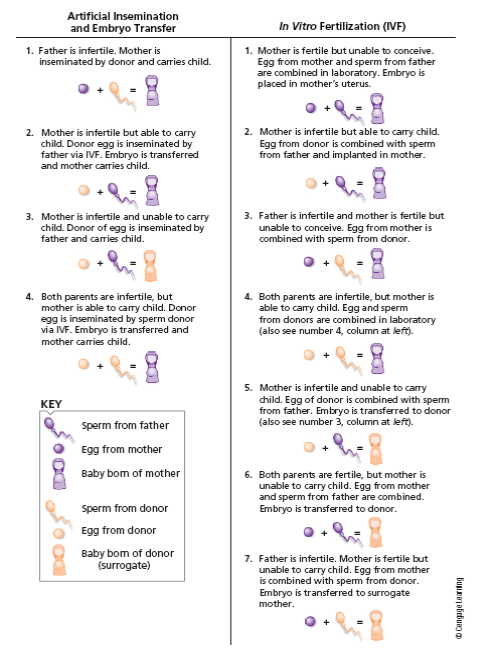
At the appointment, the counselor explained to Jan that one form of endometriosis (MIM 131200) can be a genetic disorder, and that polycystic ovarian disease can also be a genetic disorder (MIM 184700) and is one of the most common reproductive disorders among women. The counselor recommended that a detailed family history of both Jan and Darryl would help establish whether Jan's problems have a genetic component and whether any of her potential daughters would be at risk for one or both of these disorders. In the meantime, Jan is taking hormones, and she and Darryl are considering alternative modes of reproduction.
Using the information in Figure 1, explain the reproductive options that are open to Jan and Darryl.
Would ISCI be an option? Why or why not?
FIGURE 1 The many ways gametes can be combined in assisted reproduction.
Explanation Verified
Verified
ISCI stands for Intracytoplasmic Sperm I...

Human Heredity 11th Edition by Michael Cummings

Why don’t you like this exercise?
Other Minimum 8 character and maximum 255 character
Character 255






