







 Chat with AI


Clinical Laboratory Hematology 3rd Edition by Shirlyn McKenzie, Lynne Williams
Edition 3ISBN: 978-0133076011Clinical Laboratory Hematology 3rd Edition by Shirlyn McKenzie, Lynne Williams
Edition 3ISBN: 978-0133076011 Exercise 8
Roger, a 52-year-old man with hyperuricemia, went to the clinic for a follow-up evaluation for splenomegaly. His palpable spleen, noted 18 months earlier, had been gradually enlarging. He originally denied fatigue, fever, and discomfort. He was examined, and a CBC was ordered. The results revealed leukocytosis, thrombocytosis, and anemia.
Consider how reflex laboratory testing can assist in diagnosing this patient.
Physical examination revealed a slightly enlarged liver and palpable spleen. Roger had hyperuricemia. Blood counts showed: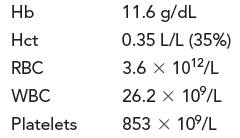
The blood cell differential showed marked anisocytosis, poikilocytosis with many teardrops, and numerous nucleated red blood cells (NRBCs). Immature myeloid cells were found along with basophilia and large platelets.
During the office visit, Roger stated his symptoms of fatigue, weakness, dyspnea, bone pain, and abdominal discomfort. A bone marrow biopsy was ordered. The aspiration was unsuccessful, but the marrow biopsy showed moderate to marked hyperplasia, clusters of platelets, abnormal megakaryocyte morphology, and fibrotic marrow spaces.
Over the next several months, Roger experienced increasing splenomegaly and abdominal discomfort. Cytogenetic studies revealed a trisomy 8.
What is the most likely explanation for the increased splenomegaly?
Consider how reflex laboratory testing can assist in diagnosing this patient.
Physical examination revealed a slightly enlarged liver and palpable spleen. Roger had hyperuricemia. Blood counts showed:
The blood cell differential showed marked anisocytosis, poikilocytosis with many teardrops, and numerous nucleated red blood cells (NRBCs). Immature myeloid cells were found along with basophilia and large platelets.
During the office visit, Roger stated his symptoms of fatigue, weakness, dyspnea, bone pain, and abdominal discomfort. A bone marrow biopsy was ordered. The aspiration was unsuccessful, but the marrow biopsy showed moderate to marked hyperplasia, clusters of platelets, abnormal megakaryocyte morphology, and fibrotic marrow spaces.
Over the next several months, Roger experienced increasing splenomegaly and abdominal discomfort. Cytogenetic studies revealed a trisomy 8.
What is the most likely explanation for the increased splenomegaly?
Explanation Verified
Verified
In the given case study, a patient, Roge...

Clinical Laboratory Hematology 3rd Edition by Shirlyn McKenzie, Lynne Williams

Why don’t you like this exercise?
Other Minimum 8 character and maximum 255 character
Character 255






