







 Chat with AI


Intermediate Microeconomics and Its Application 12th Edition by Walter Nicholson,Christopher Snyder
Edition 12ISBN: 978-1133189022Intermediate Microeconomics and Its Application 12th Edition by Walter Nicholson,Christopher Snyder
Edition 12ISBN: 978-1133189022 Exercise 4
Findings on Firms' Average Costs
Most studies of firms' long-run costs have found that average-cost curves have a modified L-shape, such as the one shown in Figure 1. Average costs tend to decline as larger output levels are examined until some minimum efficient scale, q, is reached. Above that output, average costs tend to flatten out as larger scales of output are about equally efficient. Knowing about such cost patterns can often go a long way in explaining how industries evolve over time.
Some Empirical Evidence
Table 1 reports the results of representative studies of long-run average-cost curves for a variety of industries. Entries in the table represent the long-run average cost for a firm of a particular size (small, medium, or large) as a percentage of the minimal average-cost firm in the industry. For example, the data for hospitals indicate that small hospitals have average costs that are about 29:6 percent greater than average costs for large ones. This cost disadvantage of small hospitals can go a long way toward explaining the decline in rural hospitals in the United States in recent years. The large hospitals in the study appear to be large enough to exhaust available efficiencies.
Diseconomies of Scale
The only industry in Table 1 that appears to suffer cost disadvantages of large-scale operations is trucking. Higher costs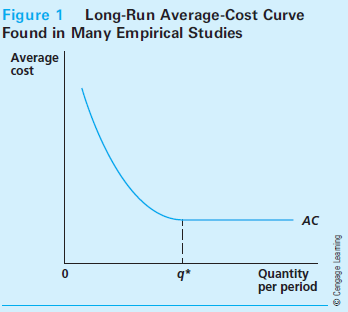
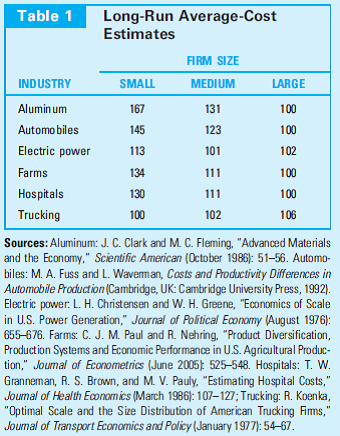
for large trucking firms may arise because they are more likely to be unionized or because it is harder to monitor many drivers' activities. In order to control their costs, many large trucking firms (especially package delivery firms like UPS or Federal Express) have adopted a number of efficiency-enhancing incentives for their drivers.
If small farms are inefficient, why haven't these disappeared? Could the localvore movement or the lure of the traditional farming lifestyle provide explanations?
Most studies of firms' long-run costs have found that average-cost curves have a modified L-shape, such as the one shown in Figure 1. Average costs tend to decline as larger output levels are examined until some minimum efficient scale, q, is reached. Above that output, average costs tend to flatten out as larger scales of output are about equally efficient. Knowing about such cost patterns can often go a long way in explaining how industries evolve over time.
Some Empirical Evidence
Table 1 reports the results of representative studies of long-run average-cost curves for a variety of industries. Entries in the table represent the long-run average cost for a firm of a particular size (small, medium, or large) as a percentage of the minimal average-cost firm in the industry. For example, the data for hospitals indicate that small hospitals have average costs that are about 29:6 percent greater than average costs for large ones. This cost disadvantage of small hospitals can go a long way toward explaining the decline in rural hospitals in the United States in recent years. The large hospitals in the study appear to be large enough to exhaust available efficiencies.
Diseconomies of Scale
The only industry in Table 1 that appears to suffer cost disadvantages of large-scale operations is trucking. Higher costs
for large trucking firms may arise because they are more likely to be unionized or because it is harder to monitor many drivers' activities. In order to control their costs, many large trucking firms (especially package delivery firms like UPS or Federal Express) have adopted a number of efficiency-enhancing incentives for their drivers.
If small farms are inefficient, why haven't these disappeared? Could the localvore movement or the lure of the traditional farming lifestyle provide explanations?
Explanation Verified
Verified
Locavore movement was started by people ...

Intermediate Microeconomics and Its Application 12th Edition by Walter Nicholson,Christopher Snyder

Why don’t you like this exercise?
Other Minimum 8 character and maximum 255 character
Character 255






