







 Chat with AI


Engineering Economy 7th Edition by Leland Blank ,Anthony Tarquin
Edition 7ISBN: 978-0073376301Engineering Economy 7th Edition by Leland Blank ,Anthony Tarquin
Edition 7ISBN: 978-0073376301 Exercise 32
RENEWABLE ENERGY SOURCES FOR ELECTRICITY GENERATION
Background
Pedernales Electric Cooperative (PEC) is the largest member-owned electric co-op in the United States with over 232,000 meters in 12 Central Texas counties. PEC has a capacity of approximately 1300 MW (megawatts) of power, of which 277 MW, or about 21%, is from renewable sources. The latest addition is 60 MW of power from a wind farm in south Texas close to the city of Corpus Christi. A constant question is how much of PEC's generation capacity should be from renewable sources, especially given the environmental issues with coal-generated electricity and the rising costs of hydrocarbon fuels.
Wind and nuclear sources are the current consideration for the PEC leadership as Texas is increasing its generation by nuclear power and the state is the national leader in wind farm-produced electricity.
Consider yourself a member of the board of directors of PEC. You are an engineer who has been newly elected by the PEC membership to serve a 3-year term as a director-at-large. As such, you do not represent a specific district within the entire service area; all other directors do represent a specific district. You have many questions about the operations of PEC, plus you are interested in the economic and societal benefits of pursuing more renewable source generation capacity.
Information
Here are some data that you have obtained. The information is sketchy, as this point, and the numbers are very approximate. Electricity generation cost estimates are national in scope, not PEC-specific, and are provided in cents per kilowatt-hour (¢/kWh).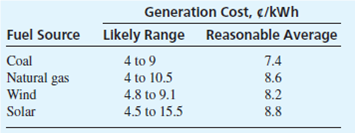
National average cost of electricity to residential customers: 11¢/kWh
PEC average cost to residential customers: 10.27 ¢/kWh (from primary sources) and 10.92 ¢/kWh (renewable sources) Expected life of a generation facility: 20 to 40 years (it is likely closer to 20 than 40)
Time to construct a facility: 2 to 5 years
Capital cost to build a generation facility: $900 to $1500 per kW
You have also learned that the PEC staff uses the wellrecognized levelized energy cost (LEC) method to determine the price of electricity that must be charged to customers to break even. The formula takes into account the capital cost of the generation facilities, the cost of capital of borrowed money, annual maintenance and operation (M O) costs, and the expected life of the facility. The LEC formula, expressed in dollars per kWh for ( t = 1, 2,... , n ), is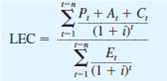
where P t = capital investments made in year t
A t = annual maintenance and operating (M O) costs for year t
C t = fuel costs for year t
E t = amount of electricity generated in year t
n = expected life of facility
i = discount rate (cost of capital)
Much of the current generation capacity of PEC facilities utilizes coal and natural gas as the primary fuel source. What about the ethical aspects of the government's allowance for these plants to continue polluting the atmosphere with the emissions that may cause health problems for citizens and further the effects of global warming What types of regulations, if any, should be developed for PEC (and other generators) to follow in the future
Background
Pedernales Electric Cooperative (PEC) is the largest member-owned electric co-op in the United States with over 232,000 meters in 12 Central Texas counties. PEC has a capacity of approximately 1300 MW (megawatts) of power, of which 277 MW, or about 21%, is from renewable sources. The latest addition is 60 MW of power from a wind farm in south Texas close to the city of Corpus Christi. A constant question is how much of PEC's generation capacity should be from renewable sources, especially given the environmental issues with coal-generated electricity and the rising costs of hydrocarbon fuels.
Wind and nuclear sources are the current consideration for the PEC leadership as Texas is increasing its generation by nuclear power and the state is the national leader in wind farm-produced electricity.
Consider yourself a member of the board of directors of PEC. You are an engineer who has been newly elected by the PEC membership to serve a 3-year term as a director-at-large. As such, you do not represent a specific district within the entire service area; all other directors do represent a specific district. You have many questions about the operations of PEC, plus you are interested in the economic and societal benefits of pursuing more renewable source generation capacity.
Information
Here are some data that you have obtained. The information is sketchy, as this point, and the numbers are very approximate. Electricity generation cost estimates are national in scope, not PEC-specific, and are provided in cents per kilowatt-hour (¢/kWh).
National average cost of electricity to residential customers: 11¢/kWh
PEC average cost to residential customers: 10.27 ¢/kWh (from primary sources) and 10.92 ¢/kWh (renewable sources) Expected life of a generation facility: 20 to 40 years (it is likely closer to 20 than 40)
Time to construct a facility: 2 to 5 years
Capital cost to build a generation facility: $900 to $1500 per kW
You have also learned that the PEC staff uses the wellrecognized levelized energy cost (LEC) method to determine the price of electricity that must be charged to customers to break even. The formula takes into account the capital cost of the generation facilities, the cost of capital of borrowed money, annual maintenance and operation (M O) costs, and the expected life of the facility. The LEC formula, expressed in dollars per kWh for ( t = 1, 2,... , n ), is
where P t = capital investments made in year t
A t = annual maintenance and operating (M O) costs for year t
C t = fuel costs for year t
E t = amount of electricity generated in year t
n = expected life of facility
i = discount rate (cost of capital)
Much of the current generation capacity of PEC facilities utilizes coal and natural gas as the primary fuel source. What about the ethical aspects of the government's allowance for these plants to continue polluting the atmosphere with the emissions that may cause health problems for citizens and further the effects of global warming What types of regulations, if any, should be developed for PEC (and other generators) to follow in the future
Explanation Verified
Verified
Ethics is set of code of conduct which i...

Engineering Economy 7th Edition by Leland Blank ,Anthony Tarquin

Why don’t you like this exercise?
Other Minimum 8 character and maximum 255 character
Character 255






