







 Chat with AI


International Economics 13th Edition by Robert Carbaugh
Edition 13ISBN: 978-1439038949International Economics 13th Edition by Robert Carbaugh
Edition 13ISBN: 978-1439038949 Exercise 5
Assume the nation of Australia is "small" and thus unable to influence world price. Its demand and supply schedules for TV sets are shown in Table 4.12. Using graph paper, plot the demand and supply schedules on the same graph. 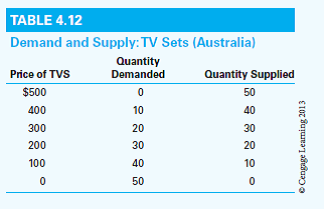
a. Determine Australia's market equilibrium for TV sets.
(1) What are the equilibrium price and quantity?
(2) Calculate the value of Australian consumer surplus and producer surplus.
b. Under free-trade conditions, suppose Australia imports TV sets at a price of $100 each. Determine the free-trade equilibrium, and illustrate graphically.
(1) How many TV sets will be produced, consumed, and imported?
(2) Calculate the dollar value of Australian consumer surplus and producer surplus.
c. To protect its producers from foreign competition, suppose the Australian government levies a specific tariff of $100 on imported TV sets.
(1) Determine and show graphically the effects of the tariff on the price of TV sets in Australia, the quantity of TV sets supplied by Australian producers, the quantity of TV sets demanded by Australian consumers, and the volume of trade.
(2) Calculate the reduction in Australian consumer surplus due to the tariff-induced increase in the price of TV sets.
(3) Calculate the value of the tariff 's consumption, protective, redistributive, and revenue effects. (4) What is the amount of deadweight welfare loss imposed on the Australian economy by the tariff?
a. Determine Australia's market equilibrium for TV sets.
(1) What are the equilibrium price and quantity?
(2) Calculate the value of Australian consumer surplus and producer surplus.
b. Under free-trade conditions, suppose Australia imports TV sets at a price of $100 each. Determine the free-trade equilibrium, and illustrate graphically.
(1) How many TV sets will be produced, consumed, and imported?
(2) Calculate the dollar value of Australian consumer surplus and producer surplus.
c. To protect its producers from foreign competition, suppose the Australian government levies a specific tariff of $100 on imported TV sets.
(1) Determine and show graphically the effects of the tariff on the price of TV sets in Australia, the quantity of TV sets supplied by Australian producers, the quantity of TV sets demanded by Australian consumers, and the volume of trade.
(2) Calculate the reduction in Australian consumer surplus due to the tariff-induced increase in the price of TV sets.
(3) Calculate the value of the tariff 's consumption, protective, redistributive, and revenue effects. (4) What is the amount of deadweight welfare loss imposed on the Australian economy by the tariff?
Explanation Verified
Verified
The following table provides information...

International Economics 13th Edition by Robert Carbaugh

Why don’t you like this exercise?
Other Minimum 8 character and maximum 255 character
Character 255






