



expand icon
book Management 14th Edition by Leslie Rue,Lloyd Byars ,Nabil Ibrahim cover

Management 14th Edition by Leslie Rue,Lloyd Byars ,Nabil Ibrahim

Edition 14ISBN: 978-0078029110
book Management 14th Edition by Leslie Rue,Lloyd Byars ,Nabil Ibrahim cover

Management 14th Edition by Leslie Rue,Lloyd Byars ,Nabil Ibrahim

Edition 14ISBN: 978-0078029110
Exercise 16
Who Dropped the Ball?
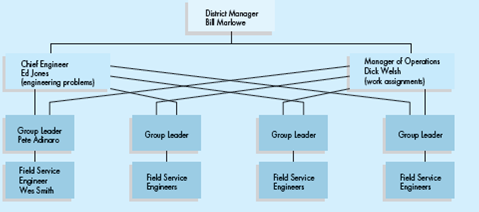
In October 2011, Industrial Water Treatment Company (IWT) introduced KELATE, a new product that was 10 times more effective than other treatments in controlling scale buildup in boilers. The instantaneous demand for KELATE required that IWT double its number of service engineers within the following year. The sudden expansion caused IWT to reorganize its operations. Previously, each district office was headed by a district manager who was assisted by a chief engineer and two engineering supervisors. In 2012, this structure changed. The district manager now had a chief engineer and a manager of operations. Four engineering supervisors (now designated as group leaders) were established. They were to channel all work assignments through the manager of operations, while all engineering-related problems were to be handled by the chief engineer. Each group leader supervised 8 to 10 field service engineers (see Exhibit 1).
EXHIBIT 1 Partial Organizational Chart for IWT
Who Dropped the Ball?  In October 2011, Industrial Water Treatment Company (IWT) introduced KELATE, a new product that was 10 times more effective than other treatments in controlling scale buildup in boilers. The instantaneous demand for KELATE required that IWT double its number of service engineers within the following year. The sudden expansion caused IWT to reorganize its operations. Previously, each district office was headed by a district manager who was assisted by a chief engineer and two engineering supervisors. In 2012, this structure changed. The district manager now had a chief engineer and a manager of operations. Four engineering supervisors (now designated as group leaders) were established. They were to channel all work assignments through the manager of operations, while all engineering-related problems were to be handled by the chief engineer. Each group leader supervised 8 to 10 field service engineers (see Exhibit 1). EXHIBIT 1 Partial Organizational Chart for IWT      Bill Marlowe, district manager for the southeast district, has just received a letter from an old and very large customer, Sel Tex, Inc. The letter revealed that when Sel Tex inspected one of its boilers last week, it found the water treatment was not working properly. When Sel Tex officials contacted Wes Smith, IWT's service engineer for the area, they were told he was scheduled to be working in the Jacksonville area the rest of the week but would get someone else down there the next day. When no one showed up, Sel Tex officials were naturally upset; after all, they were only requesting the engineering service they had been promised. Bill Marlowe, perturbed over the growing number of customer complaints that seemed to be coming his way in recent months, called Ed Jones, chief engineer, into his office and showed him the letter he had received from Sel Tex.     Dick Welsh, manager of operations, came into Bill's office about 20 minutes later.         Are the problems related to the way IWT is organized, or are they related to the employees?
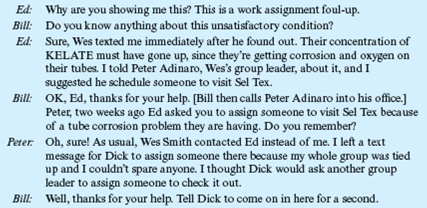
Bill Marlowe, district manager for the southeast district, has just received a letter from an old and very large customer, Sel Tex, Inc. The letter revealed that when Sel Tex inspected one of its boilers last week, it found the water treatment was not working properly. When Sel Tex officials contacted Wes Smith, IWT's service engineer for the area, they were told he was scheduled to be working in the Jacksonville area the rest of the week but would get someone else down there the next day. When no one showed up, Sel Tex officials were naturally upset; after all, they were only requesting the engineering service they had been promised.
Bill Marlowe, perturbed over the growing number of customer complaints that seemed to be coming his way in recent months, called Ed Jones, chief engineer, into his office and showed him the letter he had received from Sel Tex.
Who Dropped the Ball?  In October 2011, Industrial Water Treatment Company (IWT) introduced KELATE, a new product that was 10 times more effective than other treatments in controlling scale buildup in boilers. The instantaneous demand for KELATE required that IWT double its number of service engineers within the following year. The sudden expansion caused IWT to reorganize its operations. Previously, each district office was headed by a district manager who was assisted by a chief engineer and two engineering supervisors. In 2012, this structure changed. The district manager now had a chief engineer and a manager of operations. Four engineering supervisors (now designated as group leaders) were established. They were to channel all work assignments through the manager of operations, while all engineering-related problems were to be handled by the chief engineer. Each group leader supervised 8 to 10 field service engineers (see Exhibit 1). EXHIBIT 1 Partial Organizational Chart for IWT      Bill Marlowe, district manager for the southeast district, has just received a letter from an old and very large customer, Sel Tex, Inc. The letter revealed that when Sel Tex inspected one of its boilers last week, it found the water treatment was not working properly. When Sel Tex officials contacted Wes Smith, IWT's service engineer for the area, they were told he was scheduled to be working in the Jacksonville area the rest of the week but would get someone else down there the next day. When no one showed up, Sel Tex officials were naturally upset; after all, they were only requesting the engineering service they had been promised. Bill Marlowe, perturbed over the growing number of customer complaints that seemed to be coming his way in recent months, called Ed Jones, chief engineer, into his office and showed him the letter he had received from Sel Tex.     Dick Welsh, manager of operations, came into Bill's office about 20 minutes later.         Are the problems related to the way IWT is organized, or are they related to the employees?

Dick Welsh, manager of operations, came into Bill's office about 20 minutes later.
Who Dropped the Ball?  In October 2011, Industrial Water Treatment Company (IWT) introduced KELATE, a new product that was 10 times more effective than other treatments in controlling scale buildup in boilers. The instantaneous demand for KELATE required that IWT double its number of service engineers within the following year. The sudden expansion caused IWT to reorganize its operations. Previously, each district office was headed by a district manager who was assisted by a chief engineer and two engineering supervisors. In 2012, this structure changed. The district manager now had a chief engineer and a manager of operations. Four engineering supervisors (now designated as group leaders) were established. They were to channel all work assignments through the manager of operations, while all engineering-related problems were to be handled by the chief engineer. Each group leader supervised 8 to 10 field service engineers (see Exhibit 1). EXHIBIT 1 Partial Organizational Chart for IWT      Bill Marlowe, district manager for the southeast district, has just received a letter from an old and very large customer, Sel Tex, Inc. The letter revealed that when Sel Tex inspected one of its boilers last week, it found the water treatment was not working properly. When Sel Tex officials contacted Wes Smith, IWT's service engineer for the area, they were told he was scheduled to be working in the Jacksonville area the rest of the week but would get someone else down there the next day. When no one showed up, Sel Tex officials were naturally upset; after all, they were only requesting the engineering service they had been promised. Bill Marlowe, perturbed over the growing number of customer complaints that seemed to be coming his way in recent months, called Ed Jones, chief engineer, into his office and showed him the letter he had received from Sel Tex.     Dick Welsh, manager of operations, came into Bill's office about 20 minutes later.         Are the problems related to the way IWT is organized, or are they related to the employees?

Are the problems related to the way IWT is organized, or are they related to the employees?
Explanation
Verified
like image
like image

The business of the company IW has incre...

close menu
Management 14th Edition by Leslie Rue,Lloyd Byars ,Nabil Ibrahim
cross icon

