







 Chat with AI

Essentials of Economics 2nd Edition by Campbell McConnell, Randy Grant, Stanley Brue
Edition 2ISBN: 978-0073511313Essentials of Economics 2nd Edition by Campbell McConnell, Randy Grant, Stanley Brue
Edition 2ISBN: 978-0073511313 Exercise 3
Assume the following cost data are for a purely competitive producer: LO3
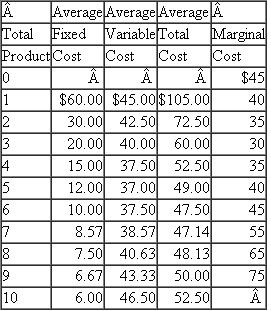
a. At a product price of $56, will this firm produce in the short run Why or why not If it is preferable to produce, what will be the profit-maximizing or loss-minimizing output Explain. What economic profit or loss will the firm realize per unit of output
b. Answer the relevant questions of 3a assuming product price is $41.
c. Answer the relevant questions of 3a assuming product price is $32.
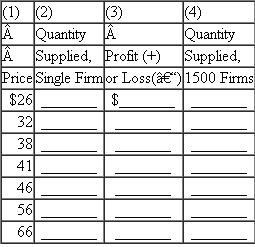
d. In the table below, complete the short-run supply schedule for the firm (columns 1 and 2) and indicate the profit or loss incurred at each output (column 3).
e. Explain: "That segment of a competitive firm's marginal-cost curve that lies above its average-variable-cost curve constitutes the short-run supply curve for the firm." Illustrate graphically. How does this curve relate to the law of diminishing returns (Chapter 6)
f. Using the data in 3d, assume that there are 1500 identical firms in this competitive industry; that is, there are 1500 firms, each of which has the cost data shown in the table. Complete the industry supply schedule (column 4).
g. Suppose the market demand data for the product are as follows:
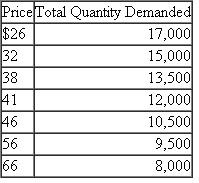
What will be the equilibrium price for the product in 3d What will be the equilibrium output for the industry For each firm What will be the profit or loss per unit Per firm Will this industry expand or contract in the long run
a. At a product price of $56, will this firm produce in the short run Why or why not If it is preferable to produce, what will be the profit-maximizing or loss-minimizing output Explain. What economic profit or loss will the firm realize per unit of output
b. Answer the relevant questions of 3a assuming product price is $41.
c. Answer the relevant questions of 3a assuming product price is $32.
d. In the table below, complete the short-run supply schedule for the firm (columns 1 and 2) and indicate the profit or loss incurred at each output (column 3).
e. Explain: "That segment of a competitive firm's marginal-cost curve that lies above its average-variable-cost curve constitutes the short-run supply curve for the firm." Illustrate graphically. How does this curve relate to the law of diminishing returns (Chapter 6)
f. Using the data in 3d, assume that there are 1500 identical firms in this competitive industry; that is, there are 1500 firms, each of which has the cost data shown in the table. Complete the industry supply schedule (column 4).
g. Suppose the market demand data for the product are as follows:
What will be the equilibrium price for the product in 3d What will be the equilibrium output for the industry For each firm What will be the profit or loss per unit Per firm Will this industry expand or contract in the long run
Explanation Verified
Verified
Assume the following cost data are for a...

Essentials of Economics 2nd Edition by Campbell McConnell, Randy Grant, Stanley Brue

Why don’t you like this exercise?
Other Minimum 8 character and maximum 255 character
Character 255






